
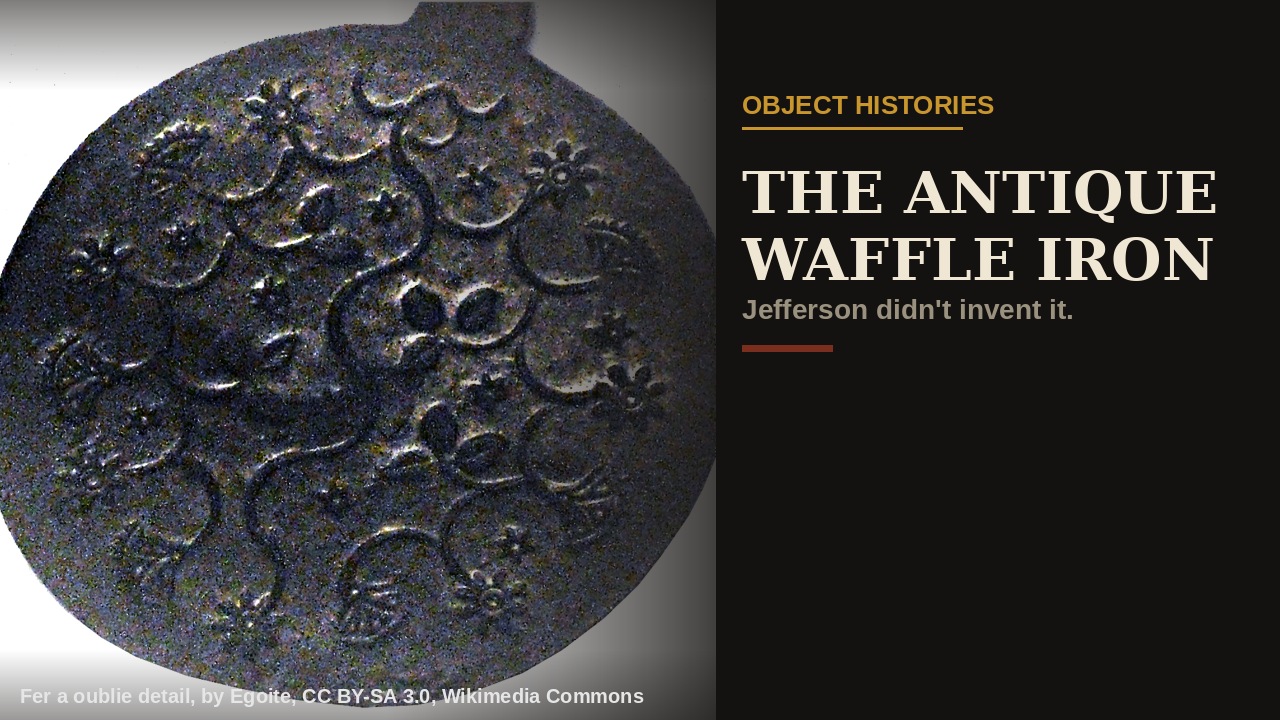
The oldest surviving waffle iron in a major museum collection does not say the word “waffle” anywhere on it. It says, in reversed cast-iron letters meant to print correctly onto a hot wafer, that service is never lost and that a perfect love only grows greener. It names a couple, Renzo and Luca Pacca. It is dated 1481, made in Umbria, and it is held today by the Victoria and Albert Museum in London, catalogued simply as a “wafering iron.”
Nobody made that iron to hold syrup. Syrup on a waffle is a relatively recent, largely American habit. For most of this object’s five-and-a-half-century documented history, the grid pressed into a wafer iron’s plates did a completely different job: it told you whose kitchen, whose church, or whose family crest you were eating off. The question this article actually answers isn’t who gets credit for the American waffle — that’s a Dutch-versus-Jefferson story already well covered. It’s a narrower, stranger one: why does a waffle have a grid at all, and when did that grid stop being a picture and start being a pattern?
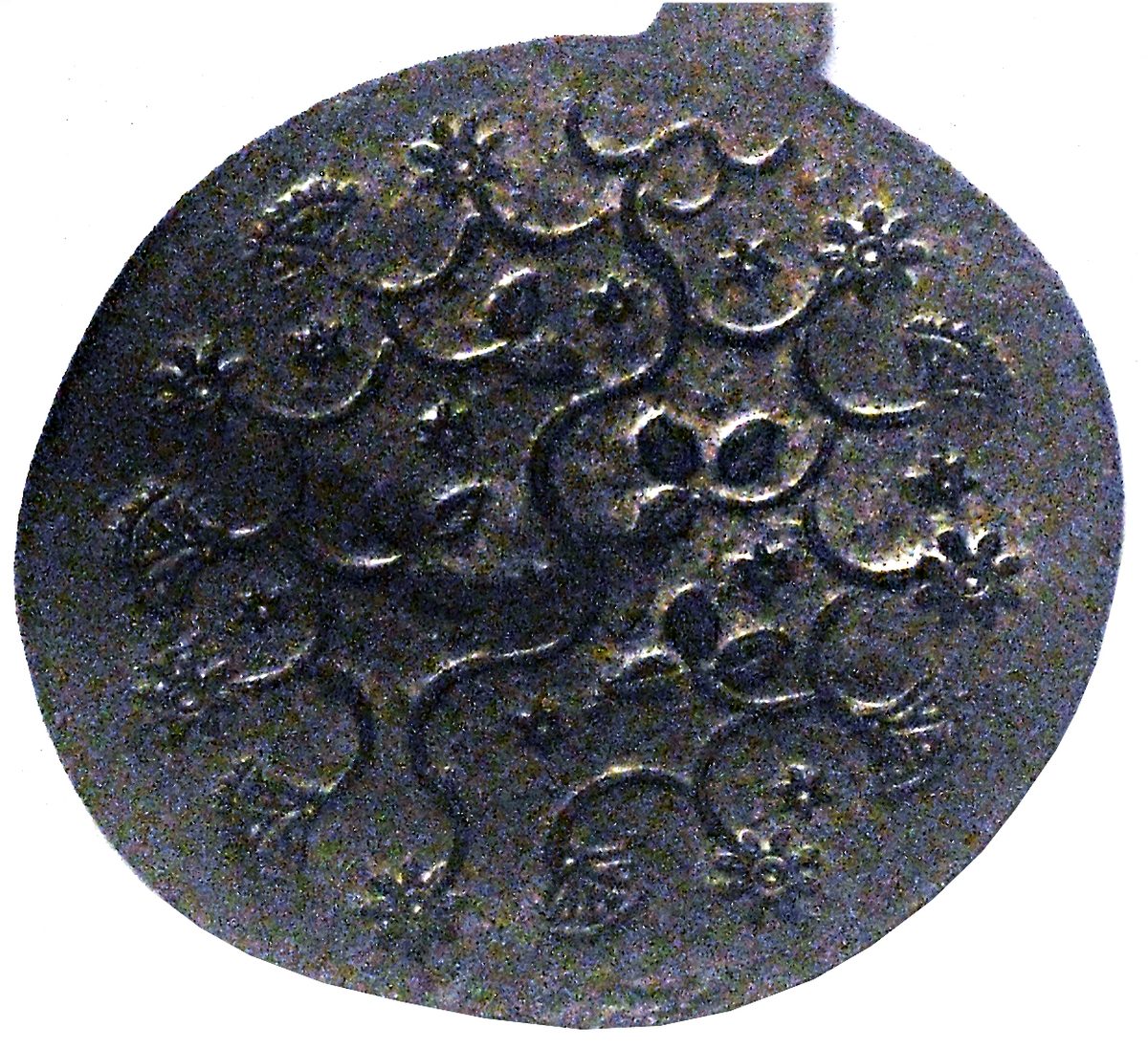
A pressed wafer announced whose house you were eating in
The practice of pressing thin batter between hot iron plates is genuinely old. The Historic New Orleans Collection, in cataloguing its own 18th-century communion wafer iron, traces the technique back to ancient Greece, where cooks pressed flat cakes between iron plates, and says the Romans carried the practice onward from there. By the 13th century, laypeople across medieval Europe were making their own version — thin wafers called oublies, baked as festive treats for feast days or handed out as parting gifts to wedding guests.
Because the iron itself was expensive — forged or cast by hand, commissioned individually — the plates became a natural place to put a mark of ownership. The V&A’s 1481 Italian iron is exactly that kind of commission: one plate carries a shield bearing a towered castle, the other a mortar with two pestles, and the lettering around the rim names the couple the iron was almost certainly made for. A nobleman’s wafer iron, in other words, worked the same way a signet ring did. Every cake that came off it was stamped, visibly, with whose table you were sitting at.
The church used the identical tool for the body of Christ
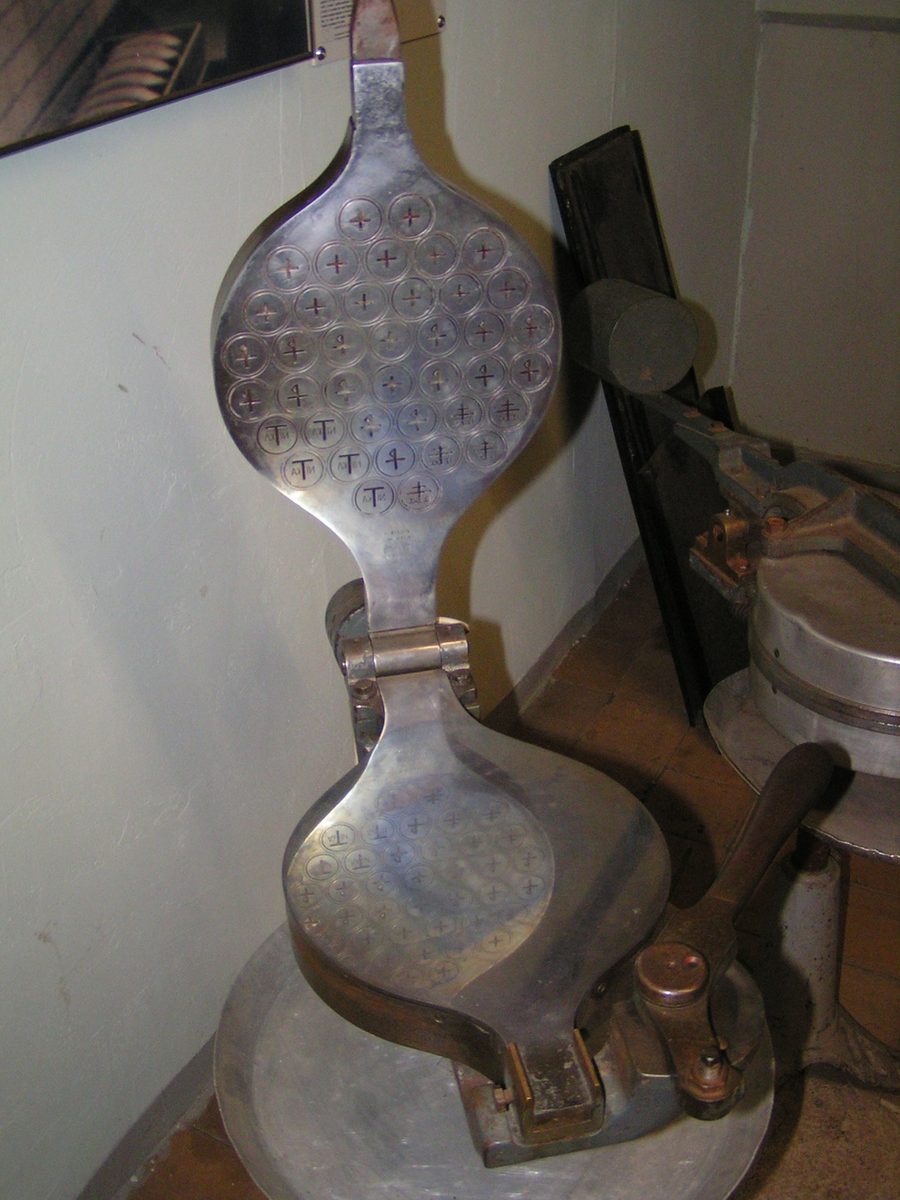
Secular households were not the only owners of hinged iron plates. European churches used a close cousin of the same device — German speakers call it a hostieneisen, a “host iron” — to stamp unleavened communion wafers before baking. The Historic New Orleans Collection’s own example belonged to the Ursuline convent in New Orleans, whose nuns arrived in the city in 1727 and completed their convent in 1734. Its plates carry crosses, a crucifix, the three nails of the Crucifixion, and the IHS monogram, a combination the museum connects to the Jesuit priest, Nicolas Ignace de Beaubois, who accompanied the Ursulines to Louisiana. Smaller wafers pressed from the iron went to lay worshippers; larger, more elaborate ones were reserved for the priest, especially during the Elevation of the Host.
What’s genuinely hard to pin down — and worth saying plainly, rather than papering over — is exactly how a church’s host iron differed in construction from a noble household’s wafer iron of the same century. The surviving museum records describe the engravings in detail and establish that both kinds of iron existed side by side, carrying either sacred or secular imagery on request. They don’t document a separate manufacturing tradition for the two, which suggests the split was almost entirely in what the blacksmith engraved, not in how the iron itself was built.
Why waffles actually have a grid, and when it happened
None of the engraved irons described above carry a true grid. They carry pictures — shields, monograms, crosses, a mortar and pestle — arranged within a round or oval frame. The uniform waffle grid most people picture today, the simple cross-hatch of raised squares, is a comparatively late simplification. The Smithsonian’s own curatorial note on its Domestic Life Collection, which holds at least fifty historic waffle irons including wafer irons from the early 1700s, puts it directly: early irons “had etched-style designs,” and “the familiar grid shape came later.”
No single source nails down an exact year or inventor for that shift, and this article won’t pretend one exists. What the record does support is a plausible mechanical explanation. A bespoke heraldic engraving made sense when a blacksmith was forging one iron for one wealthy family. It made far less sense once waffle irons became a kitchen staple manufactured in volume, first by provincial ironmongers and later by industrial foundries — a repeating grid is dramatically cheaper to cut into a casting mold or stamp into sheet metal than a custom coat of arms, and it still does useful work once butter and syrup, rather than a crest, are what the cook wants held in place. The grid’s shape even echoes its ancestor: a quartered heraldic shield, stripped of its charges, is already most of the way to a cross-hatch. Whether that’s the literal lineage or just a tidy coincidence, nobody has published the paper trail to prove it either way.
A hand that didn’t burn took three centuries to patent
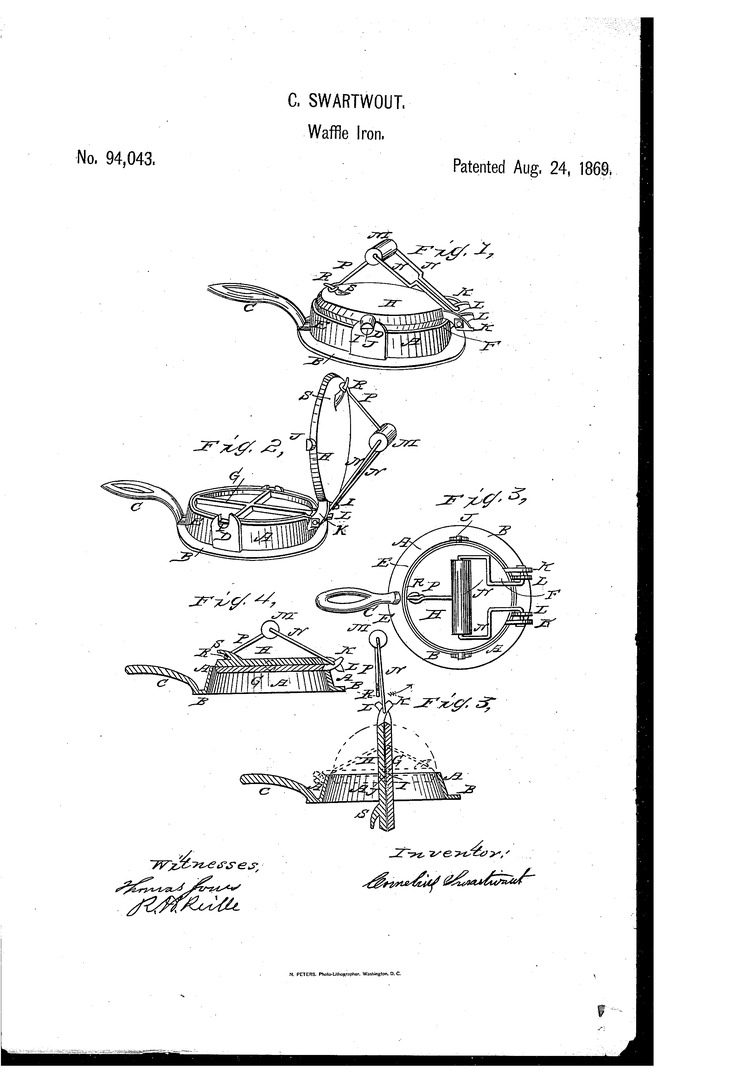
The grid’s design was one unsolved problem. A far more painful one was simply opening the thing. For centuries, a wafer iron was two plates on long handles, held together at a hinge and worked over an open hearth; prying the hot jaws apart after baking meant using your fingers or a table knife, and the hinge’s protruding “ears” broke off constantly under that kind of use.
Cornelius Swartwout, of Troy, New York, patented the fix. US Patent No. 94,043, signed on May 10, 1869, and granted on August 24, 1869, doesn’t claim to have invented the waffle iron — it claims a wooden handle run through on a metal connecting rod, which takes the place of the rivets that used to hold the hinge together, plus a separate hooked piece that catches a lug on the iron’s jaw to pry it open. The patent’s own language is specific about what problem that solved: the iron could now be turned “without danger of slipping, and without the possibility of burning the hand.” Swartwout assigned the patent jointly with three other Troy residents — Joseph Foxell, Thomas Jones, and Edward W. Millard — which suggests this was a financed local venture rather than one inventor working alone in a shed. August 24 is now celebrated annually as National Waffle Day.
Electricity didn’t reach the waffle iron for another half-century
Swartwout’s patent made a stovetop waffle iron safer to use. It did nothing to remove the stove. That took much longer. According to Smithsonian Magazine, General Electric built a prototype electric waffle iron in 1911 — but didn’t put one into production for another seven years, placing the first commercially sold electric waffle iron around 1918, nearly half a century after Swartwout’s patent and roughly two and a half millennia after the Historic New Orleans Collection’s starting point in ancient Greece. An electric element replaced the hearth or stovetop entirely, which is what eventually allowed the waffle iron to become a countertop appliance rather than a hearth tool — but the gap between “someone built one” and “you could buy one” is a reminder that even an obviously useful bit of kitchen technology doesn’t move from workshop to market on any predictable schedule.
Two very different restaurant legends, the same basic grid
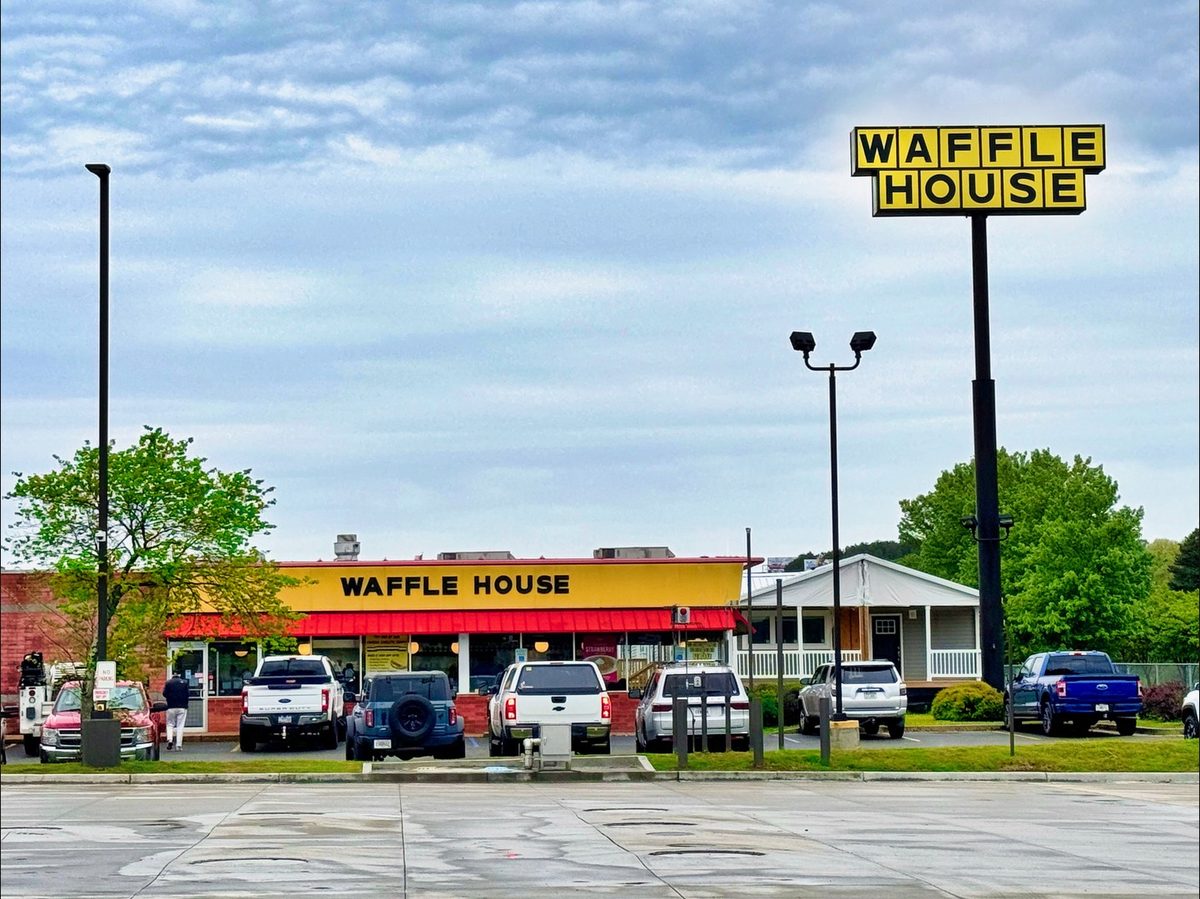
By the mid-20th century, that grid was reliable enough to build an entire restaurant chain around. Joe Rogers Sr. and Tom Forkner opened the first Waffle House on Labor Day 1955, in Avondale Estates, Georgia, pooling about $4,000 in savings; that original location is now the company’s own Waffle House Museum. The chain has grown to well over 1,900 locations today. The Atlanta Journal-Constitution’s own count puts nationwide output at roughly 145 waffles and 341 strips of bacon served every single minute, and about 877 million waffles served cumulatively since 1955 — figures that, tellingly, shift slightly depending on which year’s count you catch; Smithsonian Magazine’s version of the same company puts current locations at around 2,100 rather than 1,900, a small discrepancy that’s really just evidence of how fast the chain still opens new stores.
Chicken and waffles has its own, separate restaurant legend, and it has nothing to do with Jefferson, the Dutch, or syrup at all. Journalist Ray Marcano traces the dish most people actually mean — fried chicken served alongside a syrup-soaked waffle on one plate — to Wells, a Harlem restaurant on Seventh Avenue that Joe Wells opened in 1938. Wells stayed open late for jazz musicians coming off their sets with nowhere else to eat at four in the morning, too late for dinner and too early for breakfast, and the restaurant’s answer was reportedly to serve both meals on the same plate. It ran until 1982 and is still credited as the birthplace of the modern combination, distinct from an older, less related Pennsylvania Dutch habit of ladling chicken and gravy over waffles going back to the 1600s.
The grid outlived almost everything it was built to represent

The waffle’s association with Belgium is, itself, an American marketing invention. The dish debuted internationally as the “Brussels waffle” at the 1958 Brussels World’s Fair, where vendor Walter Cleyman reportedly sold around 400,000 of them, and he and his family sold roughly another 500,000 under the same name at the 1962 Seattle World’s Fair. It was Maurice and Rose Vermersch, selling their own version for 99 cents apiece at the 1964 New York World’s Fair, who renamed it on the spot — not “the Brussels waffle” but the “Bel-Gem Waffle,” because, according to their daughter MariePaule, they were tired of explaining to Americans where Belgium actually was. The Vermersches reportedly sold about 2,500 waffles a day at that fair. The product renamed itself for an audience that didn’t know its own geography, and “Belgian waffle” is the name that stuck.
The grid’s strangest afterlife has nothing to do with food at all. In the early 1970s, University of Oregon track coach Bill Bowerman was experimenting with rubber soles for better outdoor traction and, according to the account the Smithsonian’s own National Museum of American History displays alongside the shoe itself, used — and reportedly ruined — his wife’s waffle iron to mold a test pattern. Bowerman’s patent, No. 3,793,750, was granted on February 26, 1974, for an athletic shoe sole with that same grid of raised studs; Nike put its “waffle trainer” into production that same year, and a pair from a few years later sits in the Smithsonian’s own collection today, catalogued not as kitchenware but as footwear.
Watch the full history
The companion video traces the better-known, more American side of this same object — Thomas Jefferson’s waffle irons, the Dutch colonists who beat him to it by a century, and the same Waffle House-to-Nike afterlife, in under six minutes.

Related reading
- How the Washboard Became a Musical Instrument — another everyday object whose grid-like, repeating design turned out to double as something else entirely.
- Why Sugar Skulls Get a Name Written on the Forehead — a different case of a food object’s pattern carrying a specific, documented symbolic meaning.
- Who Invented the Ice Cream Freezer? The 1843 Patent, and the Man Who Profited Without One — a near-contemporary 19th-century kitchen patent story, with its own dispute over who actually profited.
- Why Keyboards Use QWERTY — And What the Jamming Story Gets Wrong — a second case of a familiar object’s pattern — the keyboard layout — getting credited to the wrong inventor.
Shop the styles/items featured in this video:
- Antique Electric Waffle Irons 1900-1960 — the appliance’s own history in book form
- Lehmans Cast Iron Waffle Maker — a real non-electric stovetop iron, same idea as the antique
- Cuisinart Non-Stick Flip Belgian Waffle Maker — the modern version
Works cited
- Swartwout, Cornelius. Waffle-Iron. US Patent 94,043, filed May 10, 1869, and issued August 24, 1869. Link.
- “Waffle Iron Patented.” Unbound (Smithsonian Institution Libraries and Archives blog), August 24, 2010. Link.
- “What’s Cooking Wednesday: National Waffle Day.” Prologue: Pieces of History (National Archives blog), August 24, 2011. Link.
- “A Brief History of the Waffle Iron.” Smithsonian Magazine. Link.
- “Ursuline Communion Wafer Iron.” The Historic New Orleans Collection, Collection Highlights. Link.
- “Wafering Iron.” Victoria and Albert Museum Collections, object M.443-1924. Link.
- “Nike LDV Running Shoes.” Smithsonian National Museum of American History, catalog 2014.3088.01. Link.
- Marcano, Ray. “History on a Plate: The Harlem Heritage of Chicken and Waffles.” theGrio, February 26, 2023. Link.
- Sands, Chris. “How the 1964 World’s Fair Helped Popularize the Belgian Waffle.” Tasting Table, April 5, 2023. Link.
- “Waffle.” Merriam-Webster.com Dictionary. Link.
- Pirani, Fiza. “Waffle House: The Numbers.” The Atlanta Journal-Constitution, August 13, 2019. Link.
Would you still eat a waffle stamped with someone else’s family crest, or would you rather have the 1964 World’s Fair Bel-Gem version instead?