
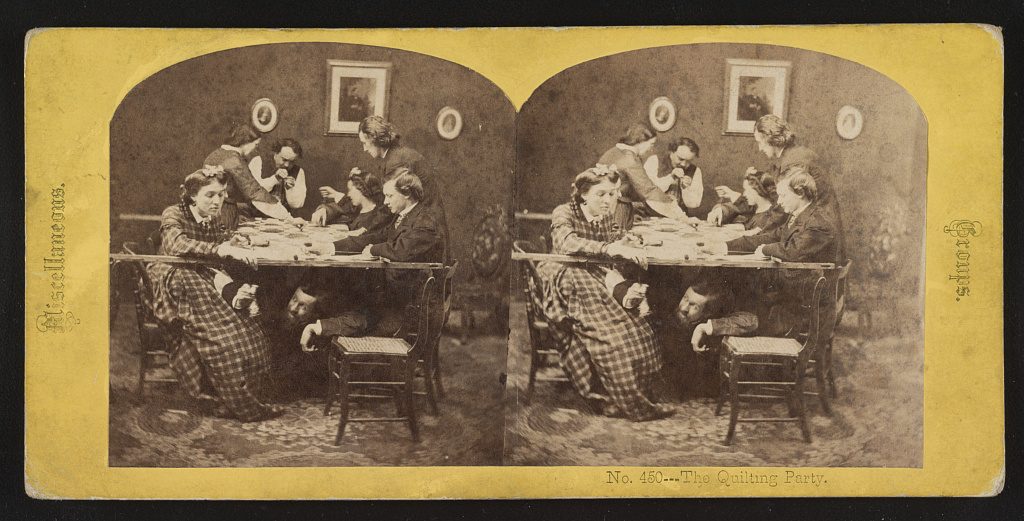
In 1861, a New York stereograph publisher named George Stacy put a joke on the market: a staged photograph of men and women crowded around a table, sewing, while one man’s arm disappeared under the cloth for a prank. He titled it, flatly, “The Quilting Party.” People bought it as a novelty, which means that before the Civil War had even ended, the quilting bee was already a familiar enough scene to be worth sending up.
That is the first problem with the quilting bee as most people picture it: a lot of what feels like eyewitness memory is actually inherited nostalgia, manufactured and re-sold for well over a century. The second problem is that underneath the nostalgia is a genuinely clever piece of social engineering — a fast, reliable way to turn one woman’s months of solitary needlework into a single afternoon’s finished, usable object. This article sorts out which parts of the quilting-bee story are documented, which are folklore dressed up as history, and how the custom actually worked before it quietly moved into churches, folk festivals, and a veterans’ charity that is still running it, at scale, today.
Quilting Took an Afternoon Because Piecing Already Took Months
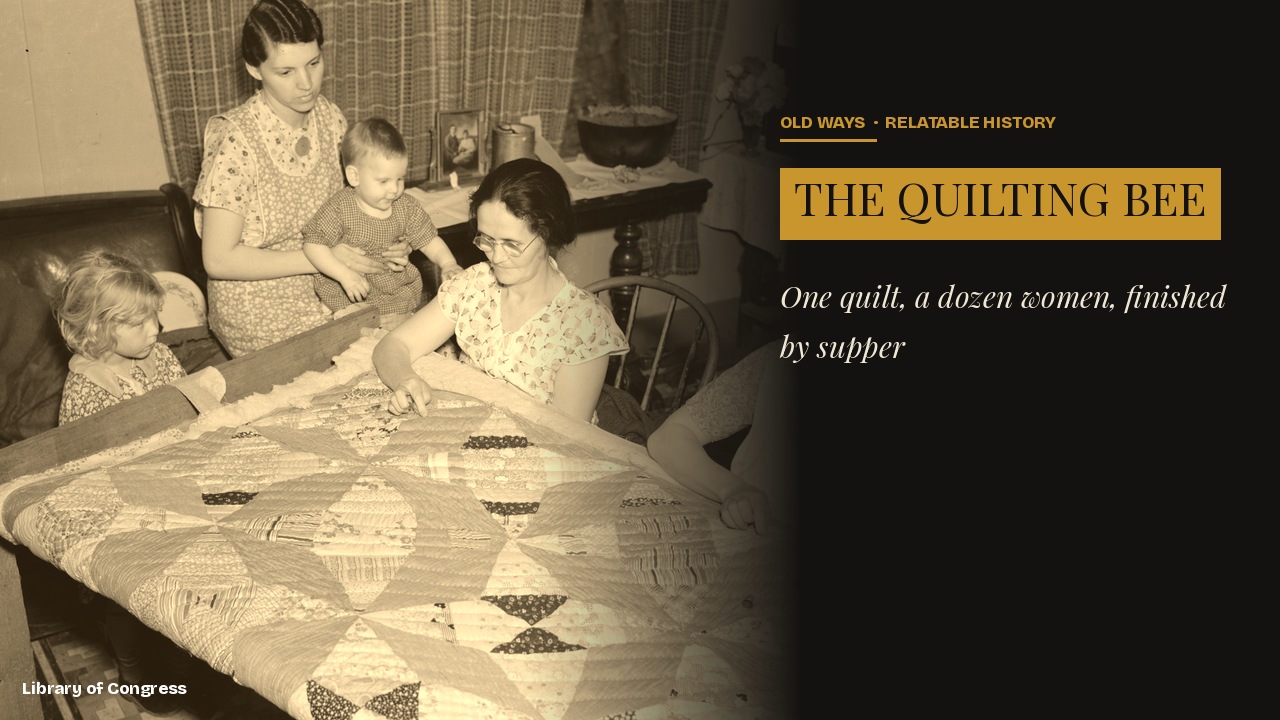
A quilt is three layers: a pieced or appliquéd top, a layer of wadding (wool, cotton, or later synthetic batting) for warmth, and a plain backing cloth. “Piecing” is sewing the decorative top out of scraps, and it is slow, solitary work — a woman doing it alone by firelight in the evenings could reasonably spend months on a single top, the kind of seasonal indoor labor that filled the hours a farmhouse’s woodstove was already working overtime to make bearable. “Quilting” is the separate, later step of stitching all three layers together, usually in a running stitch through a pattern marked on the top.
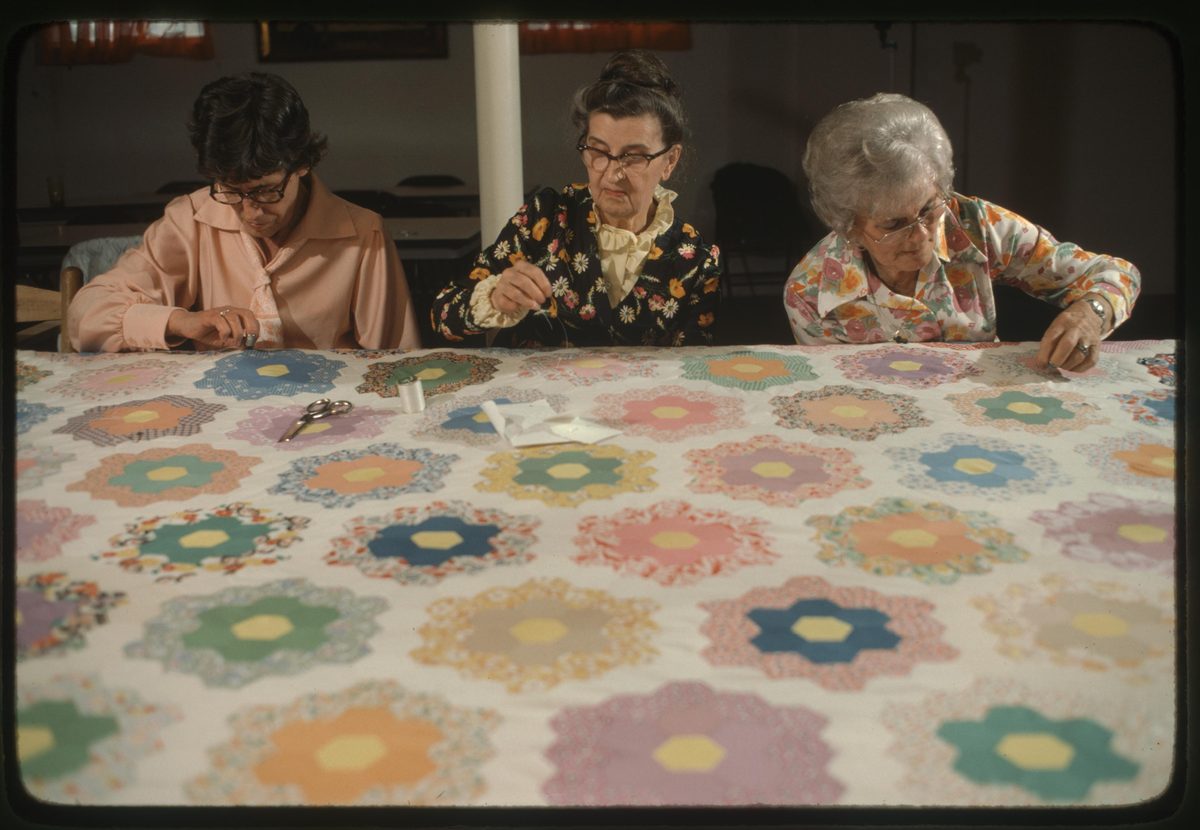
That second step is the one a frame and a crowd can actually speed up, because it is infinitely divisible in a way piecing is not. The finished top is basted and stretched drum-tight across a wooden frame — often just four narrow boards clamped or tied at the corners and propped on the backs of chairs — and as many people as can reach the edge quilt inward from their own side at once. When the stitched band nearest the frame’s rails is finished, the frame is rolled or the rails repositioned, and the next band goes up. Ten or twelve people working simultaneously on a job that only one person can effectively do alone is exactly the kind of task a “bee” is good for, and exactly the kind of task piecing is not: you cannot usefully put six people on one person’s patchwork top without them simply trading off the needle.
The Word “Bee” Is Older Than the Country’s Quilting Habit
The communal-labor sense of “bee” — comparing a crowd of cooperating neighbors to the industry of the insect — is first recorded in American English in 1769, decades before “quilting bee” itself shows up in print. Lexicographer Douglas Harper’s etymological research dates the specific phrase “quilting bee” to by 1824, describing it as originally a New England custom: a gathering of women convened to help one of their number finish quilting a counterpane. “Raising-bee,” for barn and house construction, is attested by 1814; “husking-bee,” for shucking corn, by 1830. The quilting bee did not invent the pattern of borrowing an insect’s name for shared work — it simply became the most durable example of it.
The “Twelve Quilts Before You Could Marry” Story Doesn’t Hold Up
Here is where the record gets genuinely interesting, because it disagrees with the legend. The commonly repeated version holds that a young woman was expected to piece a dozen quilt tops alone, unaided, before she was even engaged, with a thirteenth — the bridal quilt — finished communally once a wedding was set. The International Quilt Museum at the University of Nebraska–Lincoln, which holds one of the largest academic quilt collections in the world, treats the twelve-or-thirteen figure as folklore rather than documented practice. Its own research notes that families who could afford to send a daughter off with quilts at all typically provided two or three, “rather than a dozen,” often with her mother’s help or store-bought linens alongside them.
The museum’s research goes further, drawing on the diary of Martha Ballard, a Maine midwife whose day-by-day journal from 1785 to 1812 is one of the most complete records of ordinary women’s work to survive from the early republic. Quilting parties, the museum notes, “made up only a small proportion of time spent sharing quiltmaking activities” in Ballard’s account — neighbors far more often helped each other warp looms, spin, and sew on an ordinary, un-ceremonial basis than they gathered for a single dedicated bee. The museum’s assessment is that the romantic, courtship-centered version of the quilting bee owes less to the 18th century than to the 1876 Centennial Exposition and to turn-of-the-century writers like Eliza Calvert Hall and Ruth Finley, who wrote at a moment when industrialization and migration had people genuinely nostalgic for a vanishing rural cooperation, and who shifted the emphasis from the stitching to the socializing.
That reading sits a little awkwardly next to George Stacy’s 1860s joke photograph, which predates the Centennial by fifteen years and already treats the quilting party as a stock comic setting rather than a cherished memory. The honest version is probably that both things are true at once: a real, if more modest and more routine, custom of cooperative quilting existed well before the Civil War, and a separate wave of sentimental rewriting after 1876 exaggerated it into the folklore most people now take as given.
The Best Photographic Record Comes From the Great Depression, Not the Colonial Era
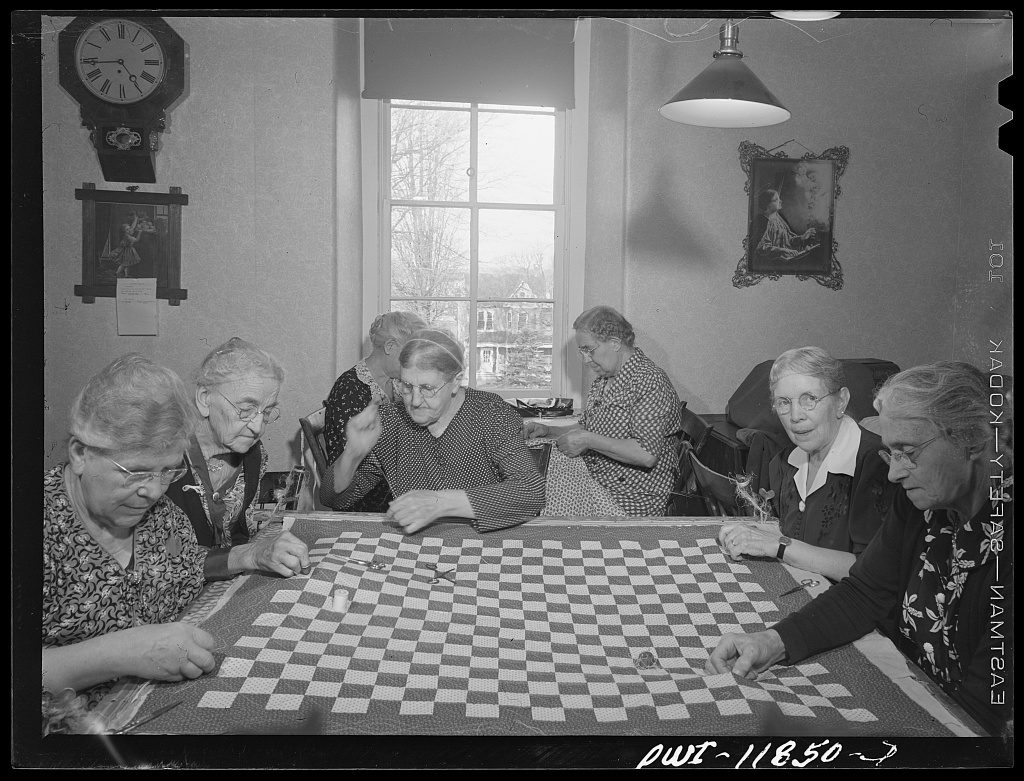
If the colonial record is thin, the 20th-century record is not. Franklin Roosevelt’s Farm Security Administration sent photographers across rural America in the 1930s and early 1940s to document the hardship and self-sufficiency of farm life, and quilting parties were squarely in frame. In November 1942, photographer Marjory Collins recorded the Moravian sewing circle of Lititz, Pennsylvania — a standing, scheduled group, not a one-off bridal bee, that quilted for anyone willing to pay a cent a yard for the thread and donated the proceeds to the church, a small but telling detail that the custom had as much to do with organized charity as with any individual woman’s wedding.
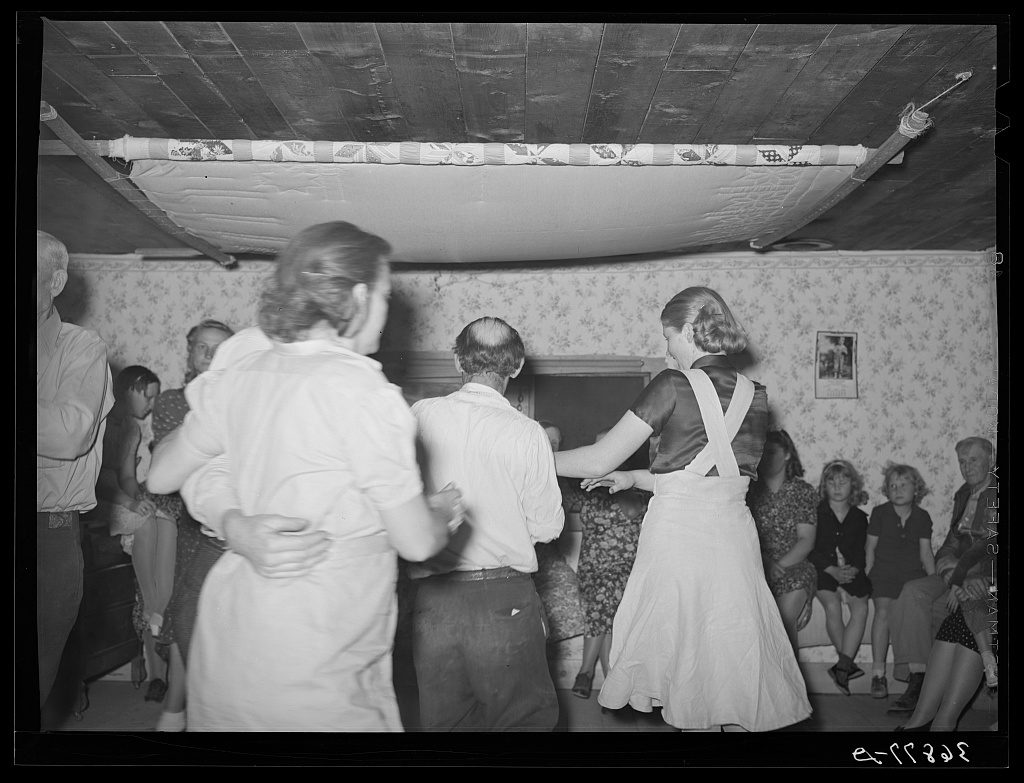
Russell Lee’s 1940 study of Pie Town, New Mexico — a community of roughly 200 migrant Texas and Oklahoma farm families — produced the single most quoted image of the custom’s social afterlife: a photograph of a square dance held in a homesteader’s front room, with the day’s finished quilt strung along the rafters overhead as a makeshift canopy. It is a small detail that confirms the whole structure the legend describes even while the legend’s numbers don’t check out: the frame came down, supper was served, and the quilt itself became part of the party’s decoration before anyone had even used it on a bed.
Mail-Order Catalogs Sustained Quilting Long Before They Threatened It
The standard explanation for the custom’s decline blames electricity: once store-bought blankets filled the Sears catalog and rural electrification brought department-store bedding within reach, the story goes, nobody needed to quilt together anymore. The actual record is messier and, for a while, runs the opposite direction. Rural free delivery in the 1890s and the rise of mail-order catalogs did not initially kill home quiltmaking; they standardized and spread it. The Ladies Art Company’s 1898 catalog offered 400 pieced-quilt patterns by mail. Sears, Roebuck and Company sold a full line of quilting fabric, batting, and kits alongside everything else in its catalog. Mountain Mist’s Blue Book of Quilts, published through the 1930s, let readers order patterns directly from designer Phoebe Edwards. For decades, a farm wife outside Pie Town and a department-store shopper buying a factory-made fur muff in a city a thousand miles away had access to the exact same quilt patterns and fashions, often from the exact same catalog page.
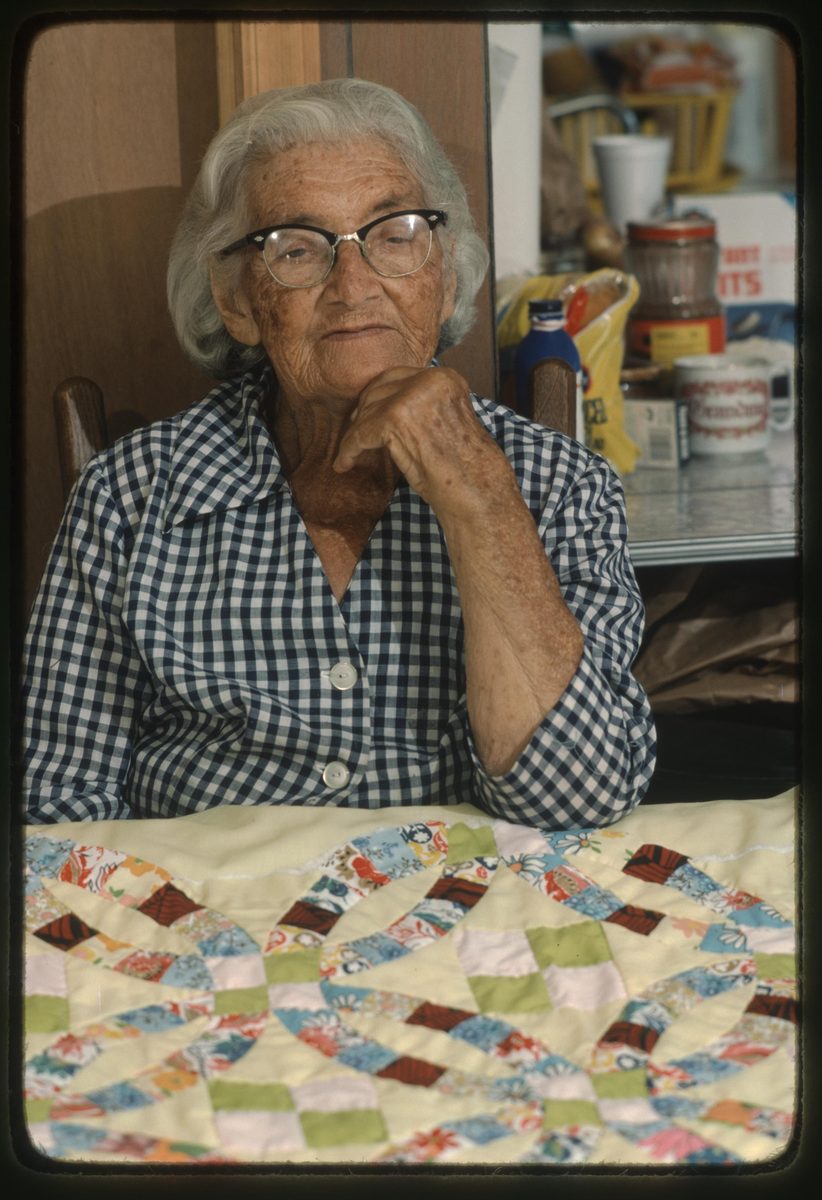
Where the custom genuinely did fade, historians researching North Carolina’s quilting record point less to electric blankets than to the plainer fact of people leaving: families moved off farms and into tobacco and textile mill towns, and then into wartime industrial jobs, and store-bought bedding in town shops made hand quilting feel, to a generation in motion, simply old-fashioned. The craft did not vanish so much as lose the rural density of neighbors that made a frame full of hands easy to assemble on short notice.
The Custom Didn’t Die. It Went to Church, Then to War
Two living descendants of the colonial-era bee are worth naming, because both still function exactly the way Martha Ballard’s neighbors did two centuries ago: many hands, one frame, a single sitting. Pennsylvania’s Amish and Mennonite communities still hold quilting gatherings as a standing part of church and family life, and their work anchors the annual quilt auction at the Kutztown Folk Festival, founded in 1950, which recently drew more than 2,500 submitted quilts in a single year for a sale where hand-quilted pieces have fetched well over $10,000. Judges there still prize hand quilting specifically, even as machine quilting has become the faster, cheaper, more common choice almost everywhere else.
The second is less folksy and more direct. In 2003, a Delaware quilter and midwife named Catherine Roberts, whose son had just deployed to Iraq, made a single quilt and delivered it to a wounded soldier recovering at Walter Reed Army Medical Center. The organization she founded afterward, the Quilts of Valor Foundation, runs on the same mechanics as any 19th-century bee, scaled up and formalized: volunteer groups piece and quilt in batches so that a finished “Quilt of Valor” can be presented to a combat veteran in person, often at a ceremony, rather than mailed out whenever one person finishes one quilt. The Foundation had distributed more than 90,000 quilts within its first decade and has awarded tens of thousands more since, to veterans of every conflict from Vietnam onward. Nobody involved calls it a quilting bee. It is one anyway.
Watch the Full History
The video covers the same ground in under nine minutes: the frame, the folklore, and the Depression-era photographs that actually back the story up.

Related Reading
- The History of the Sausage Stuffer: How Farms Wasted Nothing From a Hog
- How Much Firewood Heated a Farmhouse Through a 19th-Century Winter
- What Was a War Garden? Inside America’s WWI Food Front
- Who Stole the Irish Crown Jewels? The Unsolved 1907 Dublin Castle Heist
Whatever number you first guessed when the video asked how many hands it took to finish a quilt in an afternoon, the honest answer from every account above is the same: however many showed up. That was never a weakness in the system. A bee, a sewing circle, and a Quilts of Valor sewing day all solve the identical problem — a job too large for one set of hands, finished in one sitting by however many neighbors can be gathered — and two hundred years of American needlework has never actually replaced that solution with anything faster. It just changed who was sitting around the frame, and who the finished quilt was for.
Works Cited
- International Quilt Museum, University of Nebraska–Lincoln. “The Quilting Bee?” World Quilts: The American Story. Link.
- International Quilt Museum, University of Nebraska–Lincoln. “Weddings.” World Quilts: The American Story. Link.
- International Quilt Museum, University of Nebraska–Lincoln. “Mail Order.” World Quilts: The American Story. Link.
- International Quilt Museum, University of Nebraska–Lincoln. “Mrs. Bill Stagg.” World Quilts: The American Story: The Great Depression. Link.
- International Quilt Museum, University of Nebraska–Lincoln. “Field of Stars.” World Quilts: The American Story, on a Quilt of Valor. Link.
- Harper, Douglas. “Bee.” Online Etymology Dictionary.
- Bell-Kite, Diana. “Quilting Part V: Twentieth Century and the 1970s Revival.” NCpedia, North Carolina Government & Heritage Library, March 5, 2015.
- Branner, Gwen. “Heirloom Fabrics: The Quilt Auction at the Kutztown Folk Festival.” Smithsonian Center for Folklife and Cultural Heritage.
- Library of Congress, Prints & Photographs Division. “The Quilting Party.” Stereograph, George Stacy, publisher, [between 1861 and 1866].
- Library of Congress, Prints & Photographs Division, Farm Security Administration/Office of War Information Collection. Marjory Collins, photographer. “Lititz, Pennsylvania. The Moravian Sewing Circle…,” November 1942.
- Library of Congress, American Folklife Center. Terry Eiler, photographer. Blue Ridge Parkway Folklife Project Collection (AFC 1982/009), 1978.
- Dover Air Force Base Public Affairs. “Quilts of Valor: A Comfort for Complex Wartime Emotions.” U.S. Air Force.