
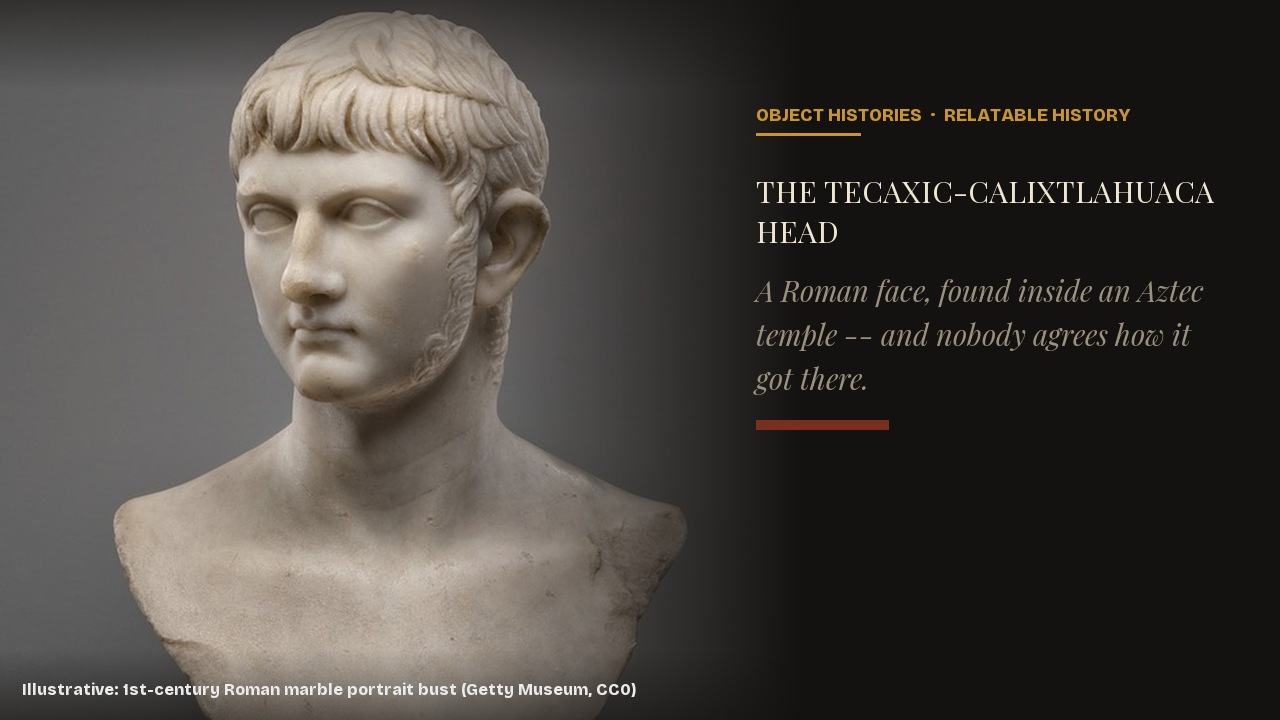
It took Romeo Hristov roughly two and a half years to find the object he was looking for, and when he did, it was sitting in a storage tray at Mexico City’s National Museum of Anthropology, catalogued under No. 20-1416 in a section reserved for Colonial-era pieces. That cataloguing was itself a quiet verdict — someone, at some point, had already decided the little terracotta face wasn’t ancient at all. Hristov didn’t agree, and neither did the two classical archaeologists who had looked at it decades earlier. Nobody involved has ever fully backed down.
What makes this case unusual isn’t that people disagree about an old object — that happens constantly. It’s that the disagreement runs through three completely different kinds of evidence, and each one points a different way. A stylistic reading says Roman. A laboratory test says maybe, within an eleven-century window. And the excavation paperwork, when you actually go looking for it, turns out to be the weakest part of the whole case — weak enough that at least one specialist thinks the real mystery isn’t where the head came from, but how anyone can still vouch for where it was found.
None of what follows retells the video’s case point for point. It’s the paper trail underneath it: the actual publications, the actual lab results, and the named researchers who have been arguing about this one object, on and off, since 1960.
Thirty years passed between the dig and the first word of it
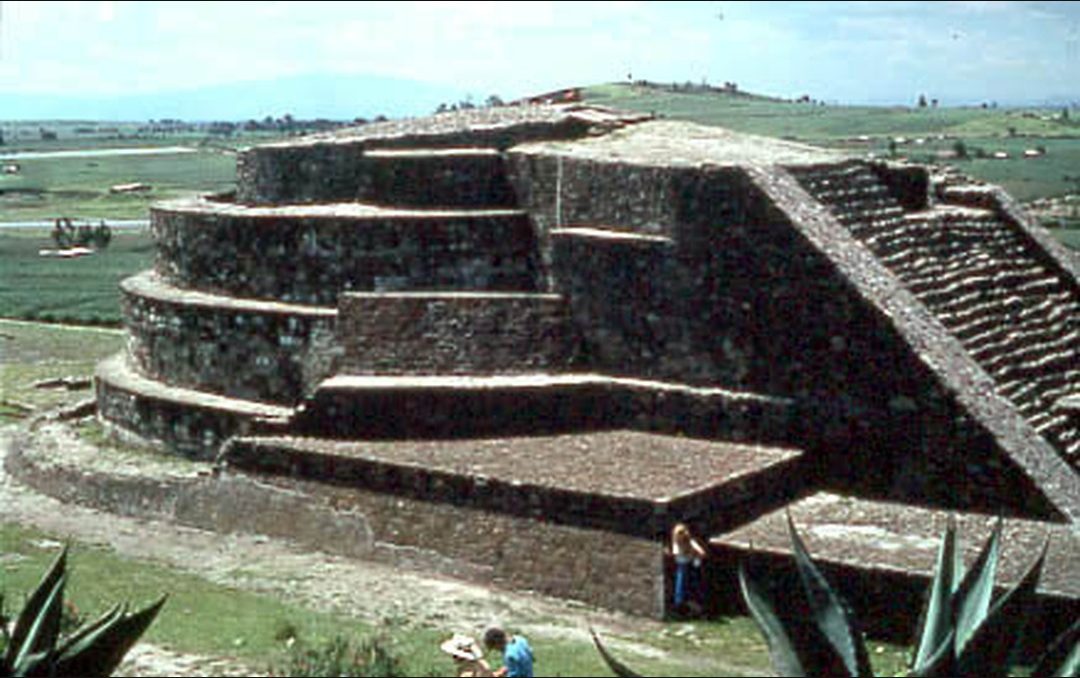
The head came out of the ground in 1933, during José García Payón’s excavations at Tecaxic-Calixtlahuaca, a hilltop settlement roughly forty miles northwest of Mexico City that was destroyed and abandoned around 1510. García Payón’s team found it inside a burial offering sealed beneath the cemented floors of a pyramidal structure — by his own later count, under three successive floors laid down as the building was enlarged — alongside gold, copper, turquoise, rock crystal, jet, worked bone, shell and pottery. The objects around it dated the offering to between 1476 and 1510.
García Payón did not publish a word about any of it for almost thirty years. His first mention came in a short 1961 note in the Instituto Nacional de Antropología e Historia’s bulletin, titled, tellingly, ‘A little clay head of strange physiognomy.’ His fuller site reports didn’t appear until 1979 and 1981, and even those run to only a few paragraphs on the head itself. By then he had been dead for several years, which matters later in this story.
The object then more or less disappeared from view. When Hristov went looking for it around 1990, nobody at the museum could tell him exactly where it was. It took him roughly two and a half years to track it down, filed where the catalogue said it belonged: among Colonial objects, not pre-Hispanic ones.
Two of Europe’s senior Roman specialists said yes without flinching
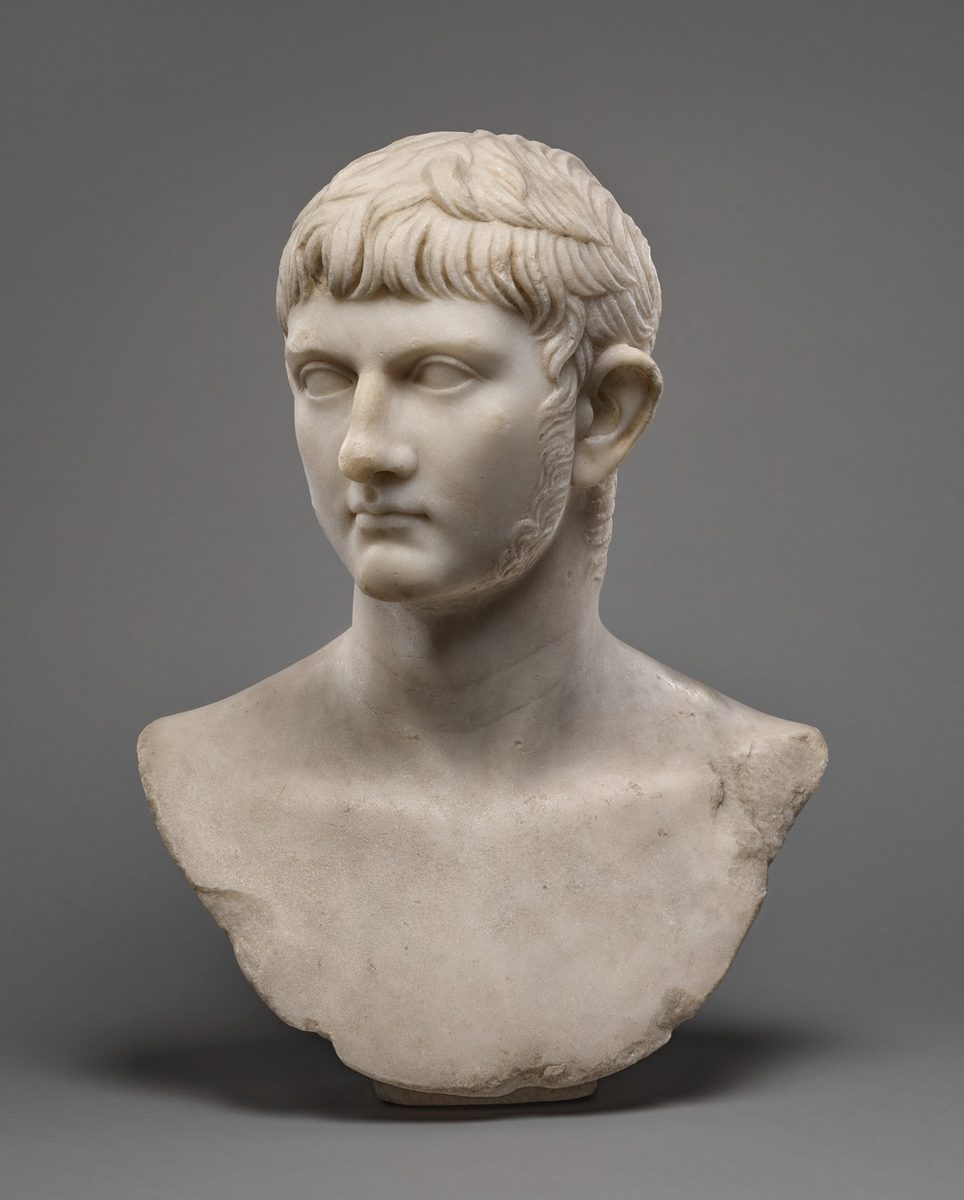
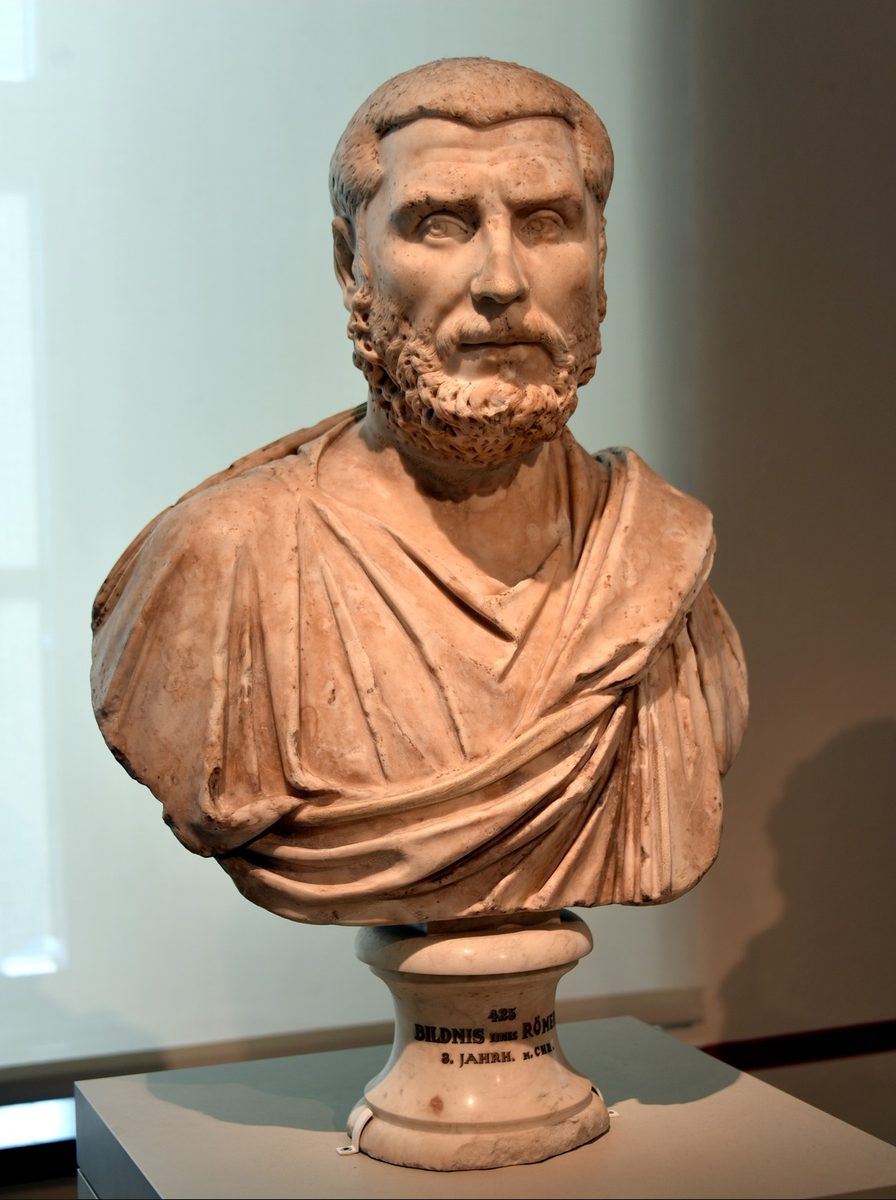
The first classicist on record is Robert Heine-Geldern, who wrote in a 1961 Austrian academy bulletin that the head derived “unquestionably” from the Hellenistic-Roman tradition and dated it to around 200 CE. He said his reading had been confirmed by Ernst Boehringer, then president of the German Archaeological Institute — a serious credential to have behind you, even second-hand.
Four decades later, Bernard Andreae, director emeritus of that same institute’s Rome branch, examined the piece and told the Italian newspaper Corriere della Sera in February 2000 that it was “Roman, without any doubt” — a second-century work, in his reading, identifiable by the hair and beard’s treatment in the Severan style. It’s worth flagging a small wrinkle here: the Severan dynasty’s emperors mostly belong to the third century, not the second, which is the kind of detail that makes a confident attribution a little less airtight than it sounds when it’s quoted in a headline.
The head got a public hearing in front of peers at the 34th International Congress of Americanists in Vienna in 1960, and it was not generally accepted there — not because anyone had a better explanation, but because of the sheer gap between a second- or third-century Roman object and a burial that everything else in it dates to the 1470s at the earliest. A confident style match from one specialty doesn’t automatically overrule a chronological problem flagged by another.
A German physics lab tried to settle it, and only partly could
Thermoluminescence dating measures something different from what an art historian looks at. It estimates how long it has been since a piece of fired clay last cooled from a kiln, by reading the energy trapped in its mineral grains since that moment. It can’t identify a sculptor or a workshop. In 1995, with permission from the National Museum of Anthropology to sample and photograph the object, a team at the Forschungsstelle Archäometrie in Heidelberg — led on the physics side by Günther Wagner, working with geophysicist Peter Schaaf of Mexico’s national university — ran the test.
The result, as Wagner later described it in a letter to New Scientist, put the clay’s last firing somewhere between about 730 and 2,880 years before the test was run — roughly the 9th century BCE to the mid-13th century CE. That is an enormous window, and it was wider than Hristov and Genovés had originally reported in their own 1999 paper, where they’d cited a tighter preliminary figure. Schaaf and Wagner later said that earlier number should be disregarded.
What the range does rule out is a modern forgery and, probably, a Colonial-period origin — both would fall well outside it. What it does not do is confirm a Roman date specifically, since the 2nd or 3rd century CE sits comfortably inside a window that also covers more than a thousand years of pre-Hispanic Mesoamerican history. Schaaf and Wagner’s own published comment on the test is blunt about this: the result, they wrote, is “of only limited use,” hampered by “relatively low accuracy,” and it narrows the field without picking a winner.
The strongest case against Rome isn’t about Rome at all
Michael E. Smith, an anthropologist at Arizona State University who has spent years studying the Calixtlahuaca site, makes an argument that has nothing to do with sculpture style or clay physics. It’s about paperwork. A well-documented 1930s excavation, he points out, should have left behind excavation photographs, in-situ photos of the offering as it was found, plan maps, profile drawings, a detailed written description of the context, and contemporary catalogue or lab records. For García Payón’s dig at Calixtlahuaca, essentially none of that survives beyond a brief summary.
Smith is careful to say this isn’t a case of excusably low 1930s standards — his point is that contemporaries doing comparable work documented it properly. George Vaillant’s excavations at Zacatenco and Ticoman in 1930 and 1931, and Sigvald Linné’s work at Teotihuacan in 1934, both produced the kind of detailed field record that Calixtlahuaca lacks. Whatever happened to the head between 1933 and García Payón’s death, there is no surviving contemporary paper trail that can rule anything out.
That absence cuts in an uncomfortable direction for every theory, including the skeptical ones. Smith raises the possibility that an unrelated object simply entered the collection after the dig was over — he and two colleagues have documented other donated pieces, from entirely different sites, mixed into the same Toluca collection over the years. If that happened here, the burial was never disturbed and the head still doesn’t belong to it. Either way, Smith’s conclusion is plain: it is simply not possible today to reconstruct the find context with any confidence, which means “sealed and undisturbed” is an inference people keep repeating, not a documented fact anyone can point to. The Roanoke Colony’s disappearance runs into a similar wall: the written record that would settle it was simply never kept.
The hoax story has a named source, and a named denial
The most colorful alternative explanation is that someone planted the head as a joke. Paul Schmidt, of the National Autonomous University of Mexico’s anthropological research institute, put this in writing in a March 2000 letter, naming Hugo Moedano — a student present at the dig — as the prankster, and citing the late archaeologist John Paddock as his own source for the story. In 1996, Schmidt had reportedly told Hristov that “everybody knows” the head is Colonial, and that García Payón himself hadn’t even been present for the excavation.
That last claim ran straight into a direct denial. In 1997, Fernando García Payón, the excavator’s son, said his father had always insisted he was on site. Hristov also asked several senior Mexican archaeologists — Román Piña Chán, Ángel García Cook, Luis Torres Montes, Carlos Navarrete and Jorge Angulo — whether they had heard the prank story. None had. By April 2000, Fernando García Payón went further, telling Hristov that Moedano had never been at the excavation at all, and calling the entire account “nonsense.”
And yet Smith’s independent account says a version of the hoax story circulated for years in Paddock’s own classroom lectures, and that many Mexican archaeologists believe some form of it regardless of what either García Payón ever said. Paddock and Moedano are both dead, which means the one piece of testimony that could settle this conclusively — Moedano’s own account — will never be collected. A different object, the Kensington Runestone, settled its own hoax question only once a confession and a matching tool turned up; here, nothing comparable has ever surfaced.
If the head crossed an ocean, the Canary Islands are where the case gets made
Hristov and Genovés don’t rest their transoceanic argument on the head alone. They point to a documented Roman-era archaeological site on Lanzarote, in the Canary Islands, dated from roughly the 1st century BCE to the 4th century CE and reported following a 1987 discovery, plus separate evidence of Phoenician and Berber contact with Tenerife and Lanzarote reaching back to the 6th or 5th century BCE. Their point is that the Canaries were a genuine, documented waypoint for Mediterranean sailors centuries before 1510, which at least gives a drifting or storm-blown vessel somewhere to have started from.
Critics, Smith among them, don’t dispute that the Canary Islands evidence is real. Their objection is about what one object can carry as proof. Even a genuinely ancient, genuinely Roman artifact sitting in a Mexican burial would demonstrate, at most, that a single piece of matter moved from one side of the Atlantic to the other by some route nobody can reconstruct — not that anyone who carried it arrived deliberately, survived the trip, or told anyone about it afterward. Weighing one physical clue against the total absence of a written record is exactly the problem that makes the search for Genghis Khan’s tomb such a different kind of puzzle from this one, and it’s the same asymmetry at work here.
The same logic cuts against the Colonial-import theory, for what it’s worth. If a Spaniard had simply carried the head to Calixtlahuaca sometime before 1510, that would require unrecorded European contact with the Aztec world nearly a decade before the documented first contact in 1518 — and the Aztecs, who left detailed accounts of 1519 onward, left none of that. Every theory on the table, not just the Roman one, is missing the same kind of corroborating record.
Watch the full history
The video walks through the same excavation, the same lab test and the same rival explanations in under five minutes, with the Mesoamerican and Roman comparison images this article skips over.

Related reading
- The Kensington Runestone Hoax: What the Evidence Actually Shows
- What Happened to the Lost Colony of Roanoke?
- The Tomb of Genghis Khan: A Decision Not a Mystery
- What Actually Killed the Franklin Expedition’s Crew
Sixty years on, the museum card still says Colonial, the thermoluminescence result still covers eleven centuries, and the one eyewitness account that could confirm or kill the prank theory went to the grave with Hugo Moedano. That isn’t a failure of any single piece of evidence so much as a demonstration of how much a single missing decade of record-keeping can cost. If García Payón’s team had photographed the offering in place, numbered it on the day, and logged it into a lab ledger before the dust settled, this would likely be a closed question either way.
Instead it’s a live one, argued in the same handful of journals and personal research pages by the same handful of named people for over sixty years, with no forgery ever proven and no confirmed ancient Roman landfall in the Americas ever found to back the alternative up. So the question the video leaves open is the honest one to leave open here too: genuine anomaly, an honest excavation mix-up, or a joke that outlived everyone who could have owned up to it.
Works cited
- Hristov, Romeo and Santiago Genovés T. “Mesoamerican Evidence of Pre-Columbian Transoceanic Contacts.” Ancient Mesoamerica 10, no. 2 (1999): 207–213. Link.
- Schaaf, Peter and Günther A. Wagner. “Comments on ‘Mesoamerican Evidence of Pre-Columbian Transoceanic Contacts’ by Hristov and Genovés.” Ancient Mesoamerica 12, no. 1 (2001): 79–82. Link.
- Hristov, Romeo and Santiago Genovés T. “Reply to Peter Schaaf and Günther A. Wagner’s Comments on ‘Mesoamerican Evidence of Pre-Columbian Transoceanic Contacts.’” Ancient Mesoamerica 12, no. 1 (2001): 83–86. Link.
- García Payón, José. “Una cabecita de barro, de extraña fisonomía.” Boletín del Instituto Nacional de Antropología e Historia 6 (1961): 1–2.
- García Payón, José. La zona arqueológica de Tecaxic-Calixtlahuaca y los matlatzincas, vol. 30. Toluca: Biblioteca Enciclopédica del Estado de México, 1979.
- Heine-Geldern, Robert. “Ein römischer Fund aus dem vorkolumbischen Mexiko.” Anzeiger der Österreichischen Akademie der Wissenschaften, Phil.-Hist. Klasse, no. 16 (1961): 117–119.
- Smith, Michael E. “The ‘Roman Figurine’ Supposedly Excavated at Calixtlahuaca.” Arizona State University, Matlatzinco research page, updated 2010. Link.
- Hristov, Romeo. “The Roman Head from Tecaxic-Calixtlahuaca, Mexico: A Review of the Evidence.” University of New Mexico research page. Link.
- McCulloch, J. Huston. “The Calixtlahuaca Head.” Ohio State University research page, last revised 2010.
- Wagner, Günther. Letter on the thermoluminescence dating of the Calixtlahuaca head. New Scientist, no. 2233 (8 April 2000): 64–65.