
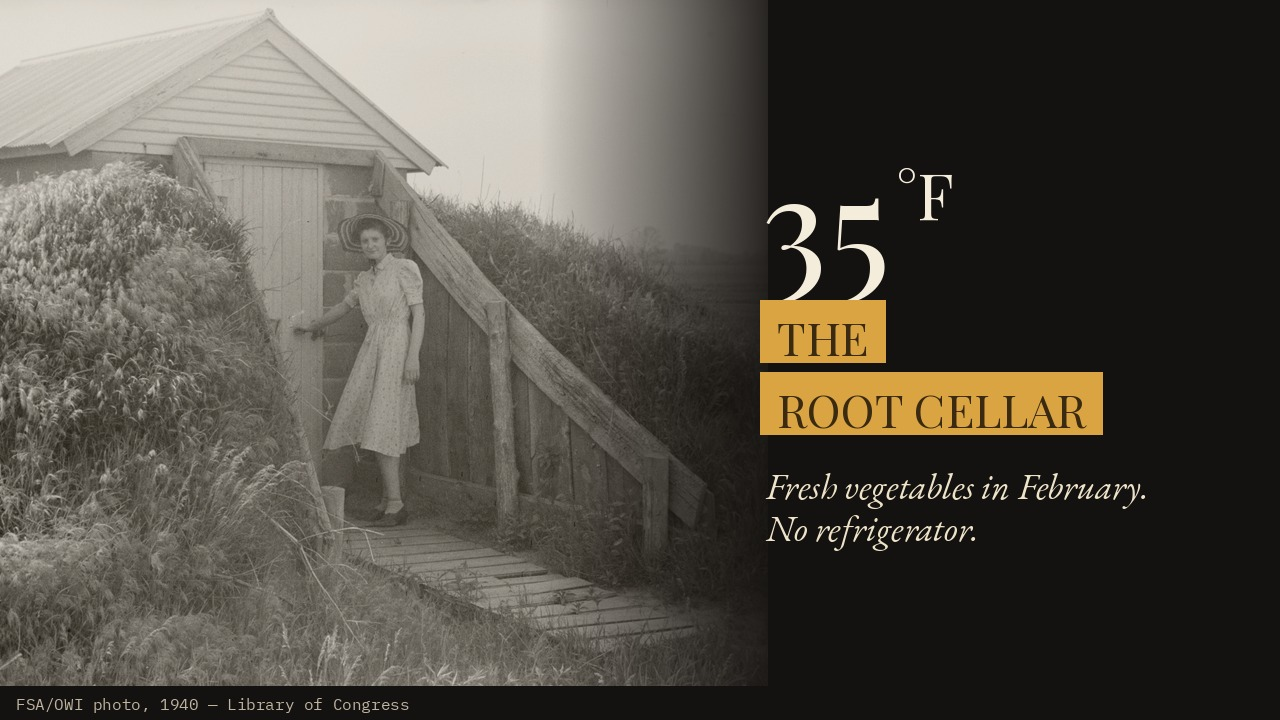
In February 1917, with canning jars scarce and lean months ahead for half of American farm households, the U.S. Department of Agriculture published a twenty-two-page bulletin with a startling premise: the best refrigerator most families would ever own required no fuel, no ice, and no maintenance beyond a shovel and a door. It was a hole in the ground. Farmers’ Bulletin 879, Home Storage of Vegetables, laid out exactly how to build one, and the design it described — a room a few feet below the frost line, vented low and high, left with a bare dirt floor on purpose — was already a century and a half old by the time the government bothered to write it down.
That is the real story of the root cellar: not a folk curiosity but an engineered system, refined by trial and error across thousands of farms, that did a specific and measurable job. It held potatoes, carrots, cabbages and apples at close to 35°F and 90 percent humidity, all winter, with no power at all. What follows is the physics behind that number, how the system was actually built and run, the one household rule almost nobody violated on purpose, and the wiring that finally put the whole apparatus out of business.
A root cellar is an engineered room, not just a hole
The term itself is older than the United States. Heritage researchers at the Heritage Foundation of Newfoundland and Labrador have traced “root cellar” in print to a 1767 real-estate advertisement in The New York Journal, offering a house with a “root cellar 22 feet by 11 feet, stoned up all around,” and to an advertisement four years later for a Hudson River farm with three hundred apple trees and a “good root cellar.” By 1868 the phrase had become official enough that a model-farm plan drawn up by the newly formed U.S. Department of Agriculture specified one by name, sized to hold “bushels of roots, safe from frost and not warmer than the surrounding earth.”
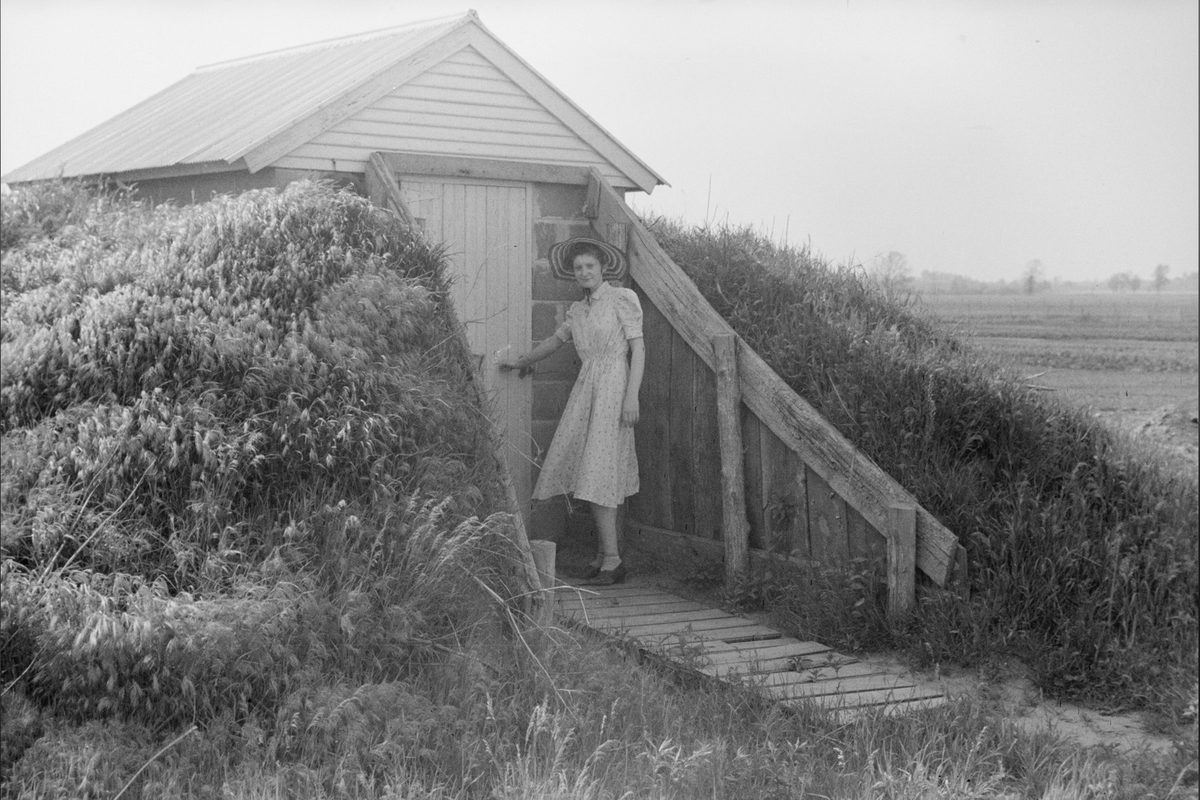
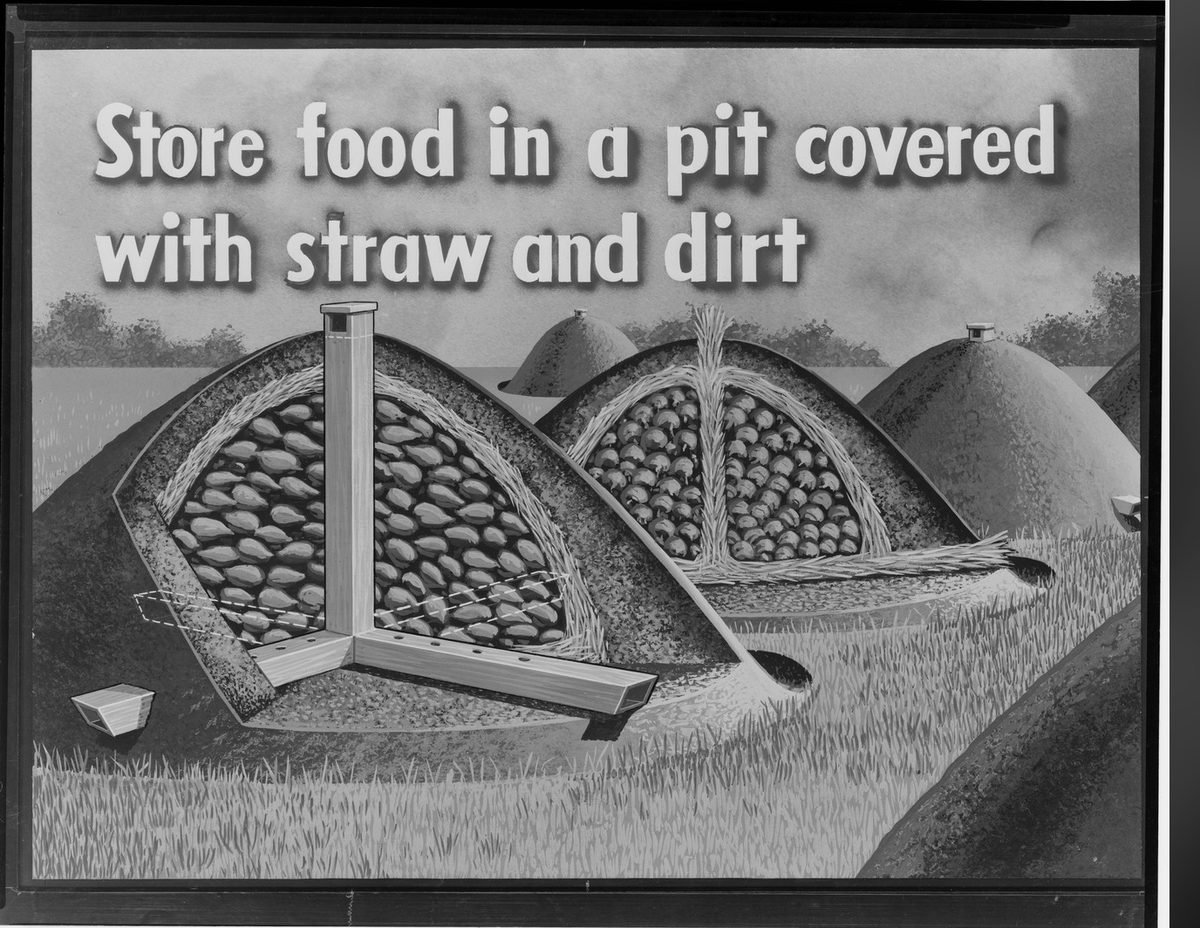
Beattie’s 1917 bulletin treats the root cellar as a piece of engineering with several interchangeable forms: a partitioned room in the house basement with its own ventilated window; a freestanding outdoor cellar of wood, brick or concrete, ideally dug into a hillside so no steps were needed; or, cheapest of all, a conical pit lined with straw and topped with a ventilating flue, holding nothing more than potatoes and a few inches of dirt. The bulletin is explicit that bins decay quickly in a damp cellar and recommends barrels, boxes and crates set on slat floors instead, kept off the bare earth so air could circulate underneath and mice couldn’t nest in them.
Construction depended entirely on what a farm had on hand. In Newfoundland, where the tradition ran especially deep, builders quarried and split flat stones by hand for dry-stacked walls, then roofed the structure with whatever timber survived: old railway ties, guardrails, even telephone poles, laid across a ridgepole and banked over with sod. By the 1930s concrete had begun replacing stone as the standard material in some outport communities, a shift the Heritage Foundation’s researchers date directly to when poured concrete became locally affordable.
The mechanism: ground that barely notices the seasons
A few feet down, soil stops tracking the day-to-day swing of the air above it and instead settles near the site’s long-run average temperature. A 1982 U.S. Geological Survey study of well temperatures in central Delaware, run by hydrologist Arthur Hodges, measured this directly: water eight feet down swung from 45°F in February to 70°F in September, a 25-degree spread driven by the surface above it. At thirty-five feet, in the same well, the range for the entire year was just 56.0°F to 57.8°F — under two degrees. A root cellar does not dig anywhere near thirty-five feet, but it exploits the same principle at a shallower, cruder scale: a floor eight to ten feet down, with a foot or more of packed earth over the roof, damps the swing enough that the room can be walked, in Beattie’s words, down toward freezing on cold nights and sealed shut before the day warmed it back up.
That nightly management was not optional. Beattie’s bulletin instructs the farmer to open the door and ventilators after dark, when outside air ran colder than the cellar, and shut everything tight again before morning warmth crept back in. Done consistently through autumn, this pulled the room down to just above freezing and held it there; done carelessly, the cellar drifted warm and the crop inside started to sprout or rot weeks early. The 1960 revision of the bulletin, by USDA plant pathologist Lacy McCulloch, adds a rule of thumb that would have been folk knowledge on most farms already: elaborate storage facilities only made sense where winter temperatures averaged 30°F or colder, since colder outside air is what does the cooling work for free.
The second half of the mechanism is moisture, and it is the part a modern refrigerator cannot match. The University of Missouri Extension’s current storage chart puts root vegetables at 90 to 95 percent relative humidity and 32°F to 40°F, figures nearly identical to what Beattie recorded over a century ago. A bare dirt floor, deliberately never paved, held that humidity by simple evaporation; concrete or brick floors needed water sprinkled on them or pans set under the vents to do the same job. A refrigerator’s compressor, by contrast, actively pulls moisture out of the air as it cools, which is exactly why a carrot goes limp in a crisper drawer in days but could keep firm in a cellar for months.
Running a cellar meant knowing which crops could not touch
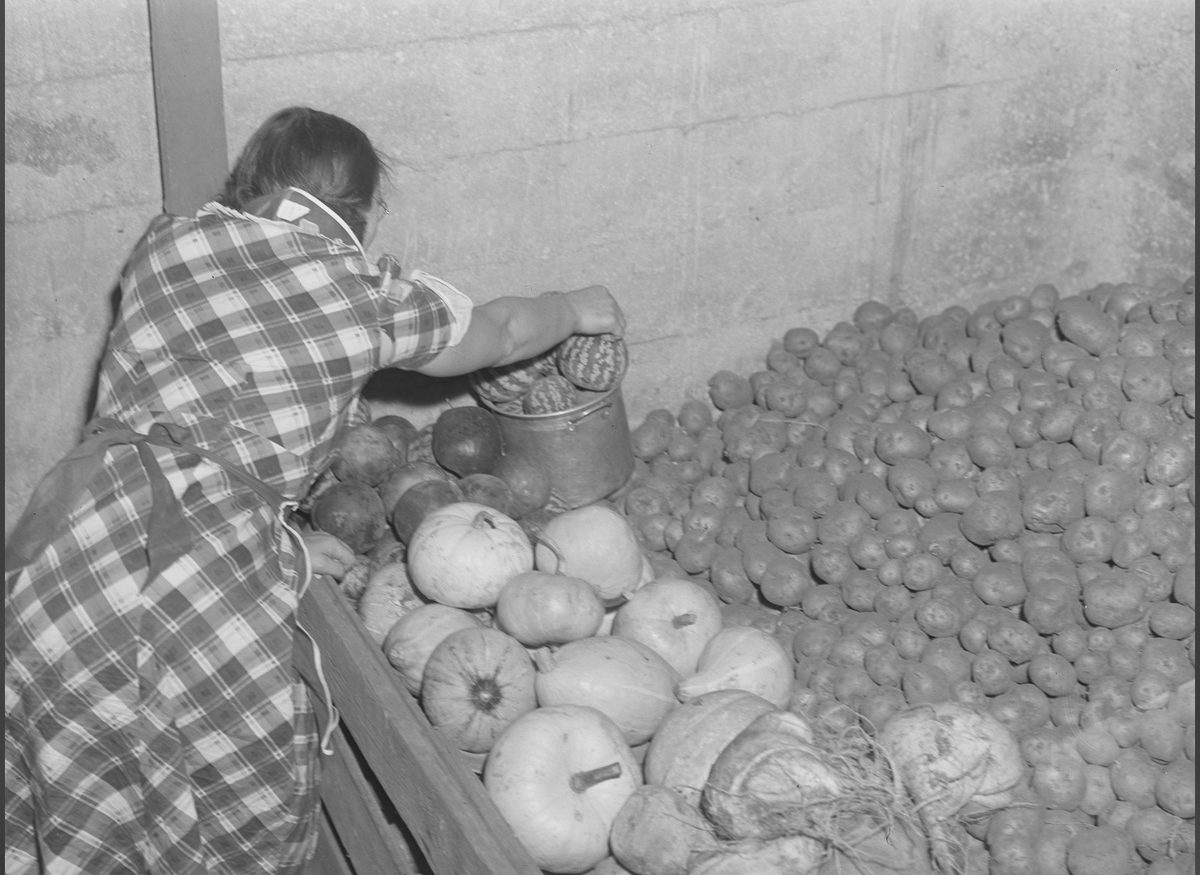
Both USDA bulletins treat the cellar as a set of separate microclimates rather than one uniform box. Potatoes, carrots, beets, turnips, cabbages and other root crops wanted it cold and very moist. Onions and dry beans wanted the opposite: cool and dry, which is why they typically went to an attic or a well-ventilated room instead of the damp cellar floor. Sweet potatoes and winter squash needed a curing period at 75°F to 80°F before storage, then a steady 50°F to 55°F afterward — too warm for the main root cellar, which is why farms with the space kept a second, milder room or a shelf near the kitchen chimney for them.
The rule everyone learned, whether from a bulletin or from a parent, was to keep apples away from potatoes. McCulloch’s 1960 revision states it in a single sentence: apples and pears absorb odors readily and should be stored apart from vegetables, and both bulletins separately note that ripening fruit hastens the sprouting of stored potatoes. The mechanism is ethylene gas, a natural ripening hormone that apples give off in quantity; extension guides today still repeat the same warning nearly word for word. On a farm without walls to spare, the fix was simply distance: potatoes at one end of the room, apples at the other, as far apart as the space allowed.
Cabbage got its own treatment because of its smell. Both Beattie and McCulloch specifically warn against storing cabbage or turnips in a basement room connected to the house, since the odor travels through the floorboards; an outdoor cellar or a pulled-and-inverted trench, roots up, was the preferred method instead. Celery, similarly, was kept apart from both, since it absorbs other vegetables’ smells and loses its own flavor for it.
In Newfoundland, where the growing season was short and the stakes were higher, the cellar did more than store a garden. Families layered in bottled and dried meat, salted fish, kegs of homemade berry wine, and whatever the household could not eat before the ground froze. Boyd Whalen of Western Bay told Heritage Foundation researchers plainly what that meant: “Everyone had a root cellar. Everybody. Couldn’t live without one. If you did, you were very, very poor.” On the American Plains the cellar pulled double duty as a tornado shelter, its below-grade construction being exactly what a family needed when the sky turned green in June.
The root cellar’s last great deployment was a war effort
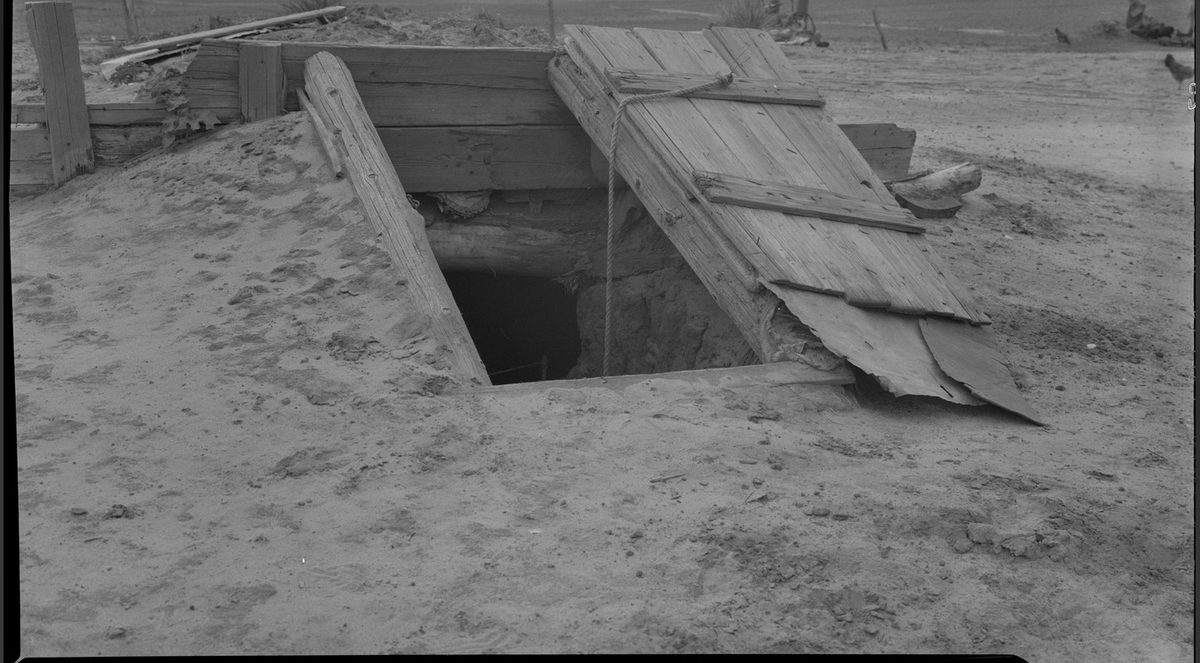
The root cellar’s use never fully stopped after the nineteenth century, but it had a documented second peak during World War II. The USDA’s 1942 filmstrip Today’s Storage Is Tomorrow’s Dinner, built from Farm Security Administration photographs and preserved today by the Library of Congress, told rural families plainly: “The less cash, the more important it is to produce at home as much food as possible,” framing home storage explicitly as a wartime duty rather than a rural habit. The same USDA campaign that pushed Victory Gardens pushed storage just as hard, since a garden’s worth of late-season carrots and cabbage was worthless to the war effort if it rotted by December.
The scale of the parallel gardening campaign shows how seriously the government took food self-sufficiency: Americans planted more than twenty million Victory Gardens between 1942 and 1945, and USDA figures credited them with growing 42 percent of all produce grown in the country in 1943 alone, historian Stephanie Hinnershitz writes for the National WWII Museum. Storage bulletins and posters were the second half of that campaign, aimed at making sure the harvest survived past the growing season rather than the growing itself.
Electricity, not refrigeration, is what actually ended it
It is tempting to credit the electric refrigerator with retiring the root cellar, but the more direct cause was simpler: farms had to get power lines before they could get refrigerators, and for most of rural America that took until the 1940s and 1950s. In 1935, according to the National Rural Electric Cooperative Association’s own history, fewer than one farm in ten in the United States had central-station electric service; investor-owned utilities saw little profit in stringing wire across sparsely settled counties. President Franklin Roosevelt’s Rural Electrification Administration, created by executive order in May 1935, changed the economics by lending money to newly formed, farmer-owned electric cooperatives rather than waiting on private utilities.
The pace of what followed was fast by any standard. Within four years of the end of World War II, NRECA’s history notes, the number of rural electric systems in operation doubled, connected customers more than tripled, and energized line mileage grew more than fivefold. By 1953, over 90 percent of American farms had electricity, a near-total reversal of the 1935 figure in under two decades. Refrigeration followed the wire, not the other way around: a farm kitchen could not run an electric refrigerator until the cooperative reached the property line, no matter how badly the family wanted one.
Once the wire and the appliance both arrived, the calculation that had justified a root cellar for two centuries simply stopped making sense. A refrigerator needed no nightly ventilator management, held a steadier temperature than any buried room, and sat conveniently inside the kitchen instead of down a ladder in the dark. The interstate trucking network and the postwar supermarket did the rest, putting fresh vegetables on a shelf in January regardless of what any individual family had managed to grow and store the previous fall.
What survives, and what it’s worth
Some root cellars never stopped working. Elliston, on the tip of Newfoundland’s Bonavista Peninsula, still has several hundred of them and has formally called itself the “Root Cellar Capital of the World” since 2000. One belonging to the Chaulk family, still in occasional use, dates to 1839. Rex Chaulk, interviewed by Heritage Foundation researchers, described using his to store as many as eighty seventy-five-pound sacks of potatoes at a time, enough to help feed his wife and their fifteen children through a Newfoundland winter. Two of Elliston’s cellars, built by the Goodland brothers in 1915 and known locally as the “Upstairs-Downstairs” cellars, are protected municipal heritage sites today, and both are still used to store food.
What makes the root cellar worth understanding now is not nostalgia. It is a rare case of a low-technology system that was genuinely optimized: two USDA bulletins, four decades apart, describe essentially the same target numbers, because the physics of buried earth and evaporating moisture had not changed and the design had already found the answer. The compressor in a modern refrigerator does the same two jobs, cold and controlled humidity, but does them with a motor running around the clock. The cellar did them with a door, a vent, and whichever direction the farmer happened to open them that night.
So the question the video closes on is worth sitting with: if the power went out for a winter, would you know which vegetables to keep apart, and which room in your house is closest to 35°F right now?
Watch the full history
The four-minute video walks the root cellar from a dug-out hillside pit to the wagonloads of October produce that filled it, and on to the supermarket shelf that replaced it.

Related reading
- How a Springhouse Worked — the dairy half of the farm’s cold-storage system, cooled by a running spring instead of the earth.
- The Icehouse — the only farm building that could get colder than 32°F without power.
- The Crock and Sauerkraut — what happened to a cellar’s cabbages that weren’t heading into a storage bin whole.
- The Icebox — the appliance that took over the root cellar’s job in the kitchen, decades before the plug-in refrigerator.
- The Sod House — the other structure that borrowed the earth’s insulation, this time to live in rather than store food in.
Shop the items in this history
- Root Cellaring by Mike and Nancy Bubel
- Wooden vegetable storage crates
- Cellar thermometer and hygrometer
Works cited
- Beattie, James H. Home Storage of Vegetables. U.S. Department of Agriculture, Farmers’ Bulletin 879, August 1917. Link.
- McCulloch, Lacy P. Home Storage of Vegetables and Fruits. U.S. Department of Agriculture, Farmers’ Bulletin 1939, revised June 1960. Link.
- University of Missouri Extension. “Home Storage of Fruits and Vegetables in Root Cellars.” Publication MP562. Link.
- Heritage Foundation of Newfoundland and Labrador. “The Roots of the North American Root Cellar.” Heritage Underground: A History of Root Cellars in Newfoundland and Labrador. Digital Museums Canada. Link.
- Heritage Foundation of Newfoundland and Labrador. “Constructing Root Cellars.” Heritage Underground. Digital Museums Canada. Link.
- Heritage Foundation of Newfoundland and Labrador. “Root Cellar Usage and Food Preservation.” Heritage Underground. Digital Museums Canada. Link.
- Heritage Foundation of Newfoundland and Labrador. “Elliston: The Root Cellar Capital of the World.” Heritage Underground. Digital Museums Canada. Link.
- Hodges, Arthur L. Ground-Water Temperature of the Wyoming Quadrangle, Delaware, with Application to Ground-Water-Source Heat Pumps. U.S. Geological Survey Water-Resources Investigations Report 82-53, 1982. Link.
- Hinnershitz, Stephanie. “Victory Gardens: Food for the Fight.” The National WWII Museum, New Orleans, 26 November 2024. Link.
- “History.” America’s Electric Cooperatives (National Rural Electric Cooperative Association), Arlington, Virginia. Link.
- Library of Congress, Prints and Photographs Division. “Feast Your Eyes: Today’s Storage Is Tomorrow’s Dinner.” Picture This (blog), January 2014. Farm Security Administration/Office of War Information photographs.