

No hand pump has ever pulled water out of the ground. Not one, in roughly two thousand years of them. What actually moves the water is the fourteen and seven-tenths pounds of pressure the atmosphere puts on every square inch of the earth’s surface, all the time, everywhere — the pump’s only job is to get out of that pressure’s way. Understood that way, the cast-iron pitcher pump that sat beside a hundred million American farmhouse doors was not a machine for lifting water so much as a machine for creating an absence, which the sky then filled.
That single fact — that suction is a vacancy, not a force — also set a hard physical ceiling on how the device could be used. No amount of better iron, sharper machining, or harder pumping could make a plain hand pump draw water from much past twenty-five feet down, on any farm, in any country, at any point in its history. This article covers the mechanism inside the pitcher, the physics behind that limit, who actually built the thing that ended up in millions of American dooryards, and what finally took its job away.
It also covers what does not apply that limit — because a very similar-looking pump, still in daily use across parts of the world today, reaches water more than ten times deeper than a dooryard pitcher pump ever could, and the reason why is the same physics working a different way.

A leather cup, a check valve, and a column of nothing
Open a pitcher pump and there are only two moving parts that matter. Inside the vertical pipe sits a plunger, and wrapped around its edge is a disc of leather cut slightly oversize, so that it presses against the inner wall of the cylinder and seals it — functionally the same job a piston ring does in an engine. At the bottom of the pipe, down in the water itself, sits a second, simpler seal: a flap or ball check valve that will let water pass upward through it but snaps shut the instant anything tries to push back down.
Pull the handle and the plunger rises. As it does, the sealed volume between the plunger and the check valve gets larger, and since nothing has been added to fill that space, the pressure inside it drops. The check valve below opens, and the fourteen-point-seven pounds per square inch already pressing down on the water table outside the pipe shoves water up through the valve to fill the gap. Push the handle back down and the check valve slams shut, trapping that water above it while the plunger’s leather cup carries the load already lifted on its next upstroke, a few inches closer to the spout each time.
None of it works dry. A pump left standing loses water past the leather cup as it shrinks and stiffens, and a plunger moving through air rather than water cannot build the seal it needs — which is why every pitcher pump came with instructions to prime it: pour a cup or two of water down the spout first, so the leather swells tight against the cylinder wall before you ever touch the handle. Skip that step and a pitcher pump will click uselessly for as long as you work it.
Why twenty-five feet, and nowhere close to more
For most of the seventeenth century, the accepted explanation for suction was Galileo’s: a pump created a “force of vacuum” that itself pulled the water up, and that force simply had limits. Galileo had reason to think about it — well-diggers and pump-makers working for the Grand Duke of Tuscany had run into the same wall he had, unable to raise water in a suction pipe past roughly ten meters no matter how the pump was built.
The correct explanation came from Evangelista Torricelli, who had studied under Galileo. In 1644 Torricelli filled a glass tube about a meter long with mercury, sealed one end, and inverted it into a dish of more mercury. Some of the mercury drained out of the tube and into the dish, but not all of it — a column about seventy-six centimeters tall stayed suspended, with nothing but empty space above it. Torricelli’s explanation was that the weight of the atmosphere, pressing down on the mercury in the open dish, was holding that column up. There was no vacuum force pulling from above. There was only air, with weight, pushing from below.
Run the same arithmetic with water instead of mercury, which is about fourteen times lighter for the same volume, and the column gets fourteen times taller: roughly thirty-four feet at sea level. That is the absolute theoretical ceiling for any suction device on Earth, full stop, not just a pitcher pump — it is the same number that limits a drinking straw and a vacuum-lift irrigation system alike. A real pump never reaches it. Friction in the pipe, an imperfect seal at the leather cup, warmer water with a higher vapor pressure, and simple elevation above sea level all eat into the margin, which is why the working figure that shows up again and again in pump literature, then and now, is close to twenty-five feet. Below that depth, a well needed something other than a plain hand pump at the top of it.
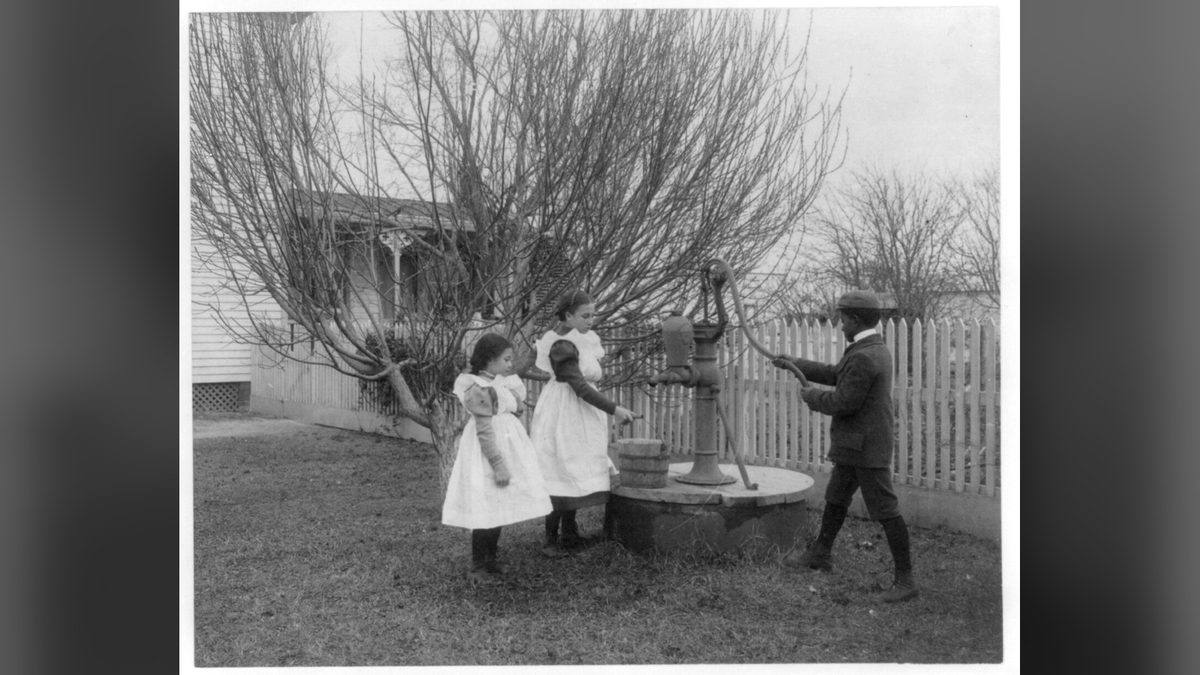
The pump predates the well it was bolted to by two thousand years
The mechanism is far older than cast iron or even Europe. Around 270 BC the Alexandrian inventor Ctesibius built a bronze force pump — twin cylinders, valved so that water drawn into one chamber on the upstroke could be forced out through the other — and the Roman engineer Vitruvius recorded how it worked in Book X of De Architectura, written after 27 BC. Ctesibius’s own writings did not survive; Vitruvius’s description, and two surviving Roman bronze pumps built to something like his plan, are most of what is left of it.
The version that reached American farms took a much plainer route. Colonial and early-republic wells were commonly fitted with a wooden pump: a hollowed hardwood log for the barrel, a wooden or leather-tipped plunger, the whole assembly prone to rot exactly where it could least be inspected, below the waterline. In Seneca Falls, New York, Seabury S. Gould had spent the 1840s in the wooden-pump trade before deciding iron would outlast it. In 1849 — a year after buying into the firm that would become his own — Gould oversaw the casting and assembly of what pump-industry histories credit as the world’s first all-metal pump. The company took his name in 1869 as the Goulds Manufacturing Company, and by the 1870s it had competitors: an 1876 catalog from W&B Douglas Pumps of Middletown, Connecticut, held in the Library of Congress’s collections, shows the cast-iron pitcher pump had already become a standard mail-order item, not a novelty.
What made the cast-iron version worth the added cost was not speed or lift — iron obeys the same twenty-five-foot ceiling wood did — but durability. A sand-cast iron cylinder did not swell, split, or rot the way a bored log did, and a farm that had sunk real money into a dug well wanted the pump on top of it to outlast the well diggers.
What a pump ran a household on
A working pump did not end the labor of water; it relocated it to the dooryard and made it rhythmic instead of occasional. Every bucket for cooking, dish-washing, the Saturday wash, and the weekly bath came up the same twenty-five feet of pipe, one stroke at a time, then had to be carried the rest of the way by hand. Helen Bolton, recorded by Nebraska’s Wessels Living History Farm project describing her family’s pre-electric routine, recalled that baths happened once a week, on Saturday night, with the same heated water reused by several family members in turn rather than drawn and heated fresh for each one — heating water on a wood stove being its own separate chore layered on top of pumping it.
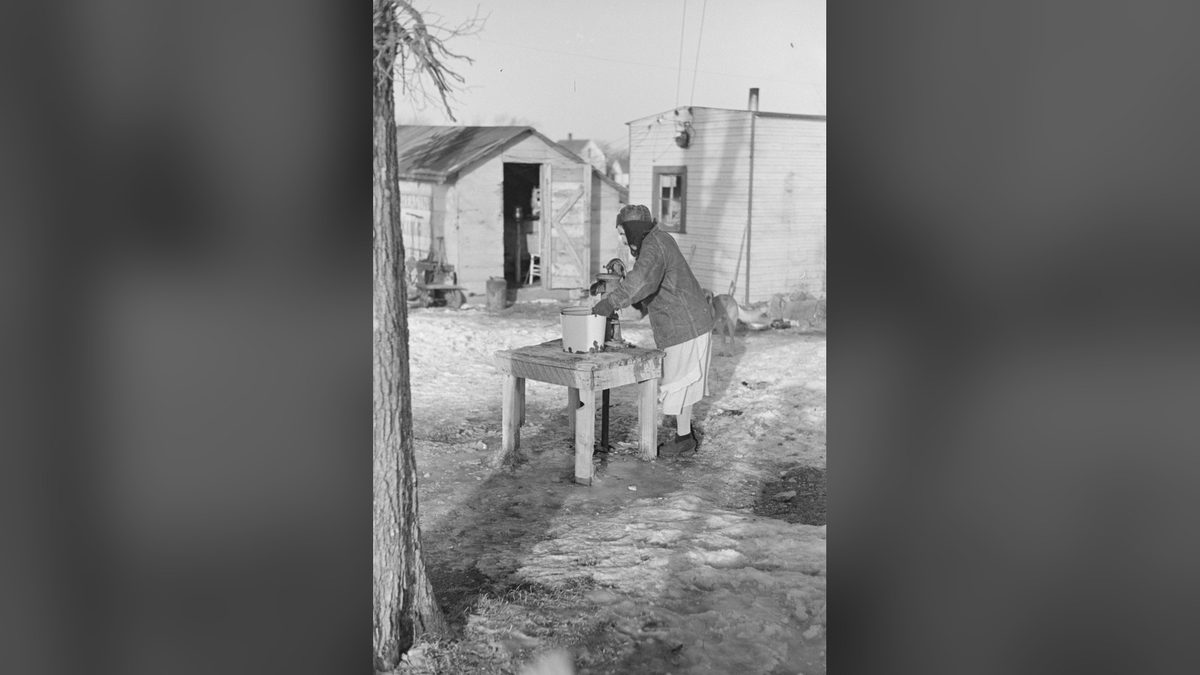
The 1945 Census of Agriculture, the last taken before the postwar rural building boom, is blunt about how far that labor still stretched: of 5,859,169 farms counted that year, only 1,679,023 — 28.7 percent, fewer than three in ten — reported running water in the farm dwelling at all. Nearly three-quarters of American farm households were still filling every vessel in the house from a pump, a cistern, or a well by hand, in the same year the Second World War ended.
Outdoors, the same pump usually had a second job. Stock still had to drink, and a trough set beside the pump — sometimes fed directly by an overflow pipe, sometimes filled by the same bucket carried a few extra steps — let horses, cattle, and hogs water themselves without a person hauling each animal’s share separately. On a farm with any livestock at all, the pump was rarely idle for long between the kitchen and the barnyard.
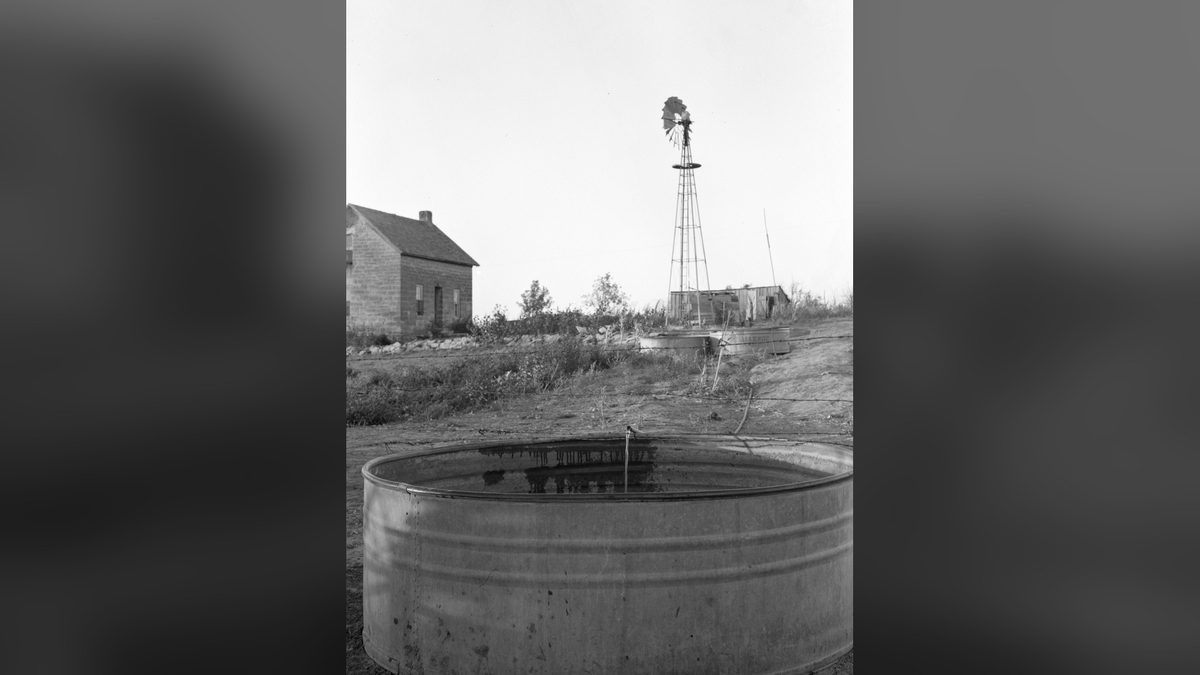
The wire that beat the pump, in about twenty years
What finally ended the daily reign of the dooryard pump was not a better pump. It was a power line, and for most of rural America that line was late. The National Rural Electric Cooperative Association’s own history states that as late as the mid-1930s, nine out of ten rural American homes had no electric service at all — private utilities had little financial interest in stringing wire to farms spaced a quarter-mile or more apart. President Franklin Roosevelt created the Rural Electrification Administration by executive order on 11 May 1935; the following year Congress passed the Rural Electrification Act and the lending program that funded farmer-owned cooperatives to build their own lines got underway.
Once power reached a farmhouse, the pump was usually one of the first jobs handed to it: an electric motor could run a jet pump or submersible pump continuously, pressurizing a tank and delivering water to taps throughout the house on demand, with no twenty-five-foot ceiling at all, since the motor — not atmospheric pressure — was now doing the lifting. Herman Goertzen, also recorded by the Wessels project, remembered the moment his family’s new house got a pump built into the kitchen sink as, in his words, “a fantastic thing” — you could work the handle and water came out right there, no trip to the yard required. Progress arrived pump-shaped even at the exact moment it was making the dooryard pump obsolete.
The pace afterward was fast by any standard. By 1953, the cooperative association’s history records, more than ninety percent of American farms had electricity, up from roughly eleven percent when the REA was created eighteen years earlier. Within a few more years nearly all of them did, and with the wire came the well pump, the pressure tank, and the end of hauling.
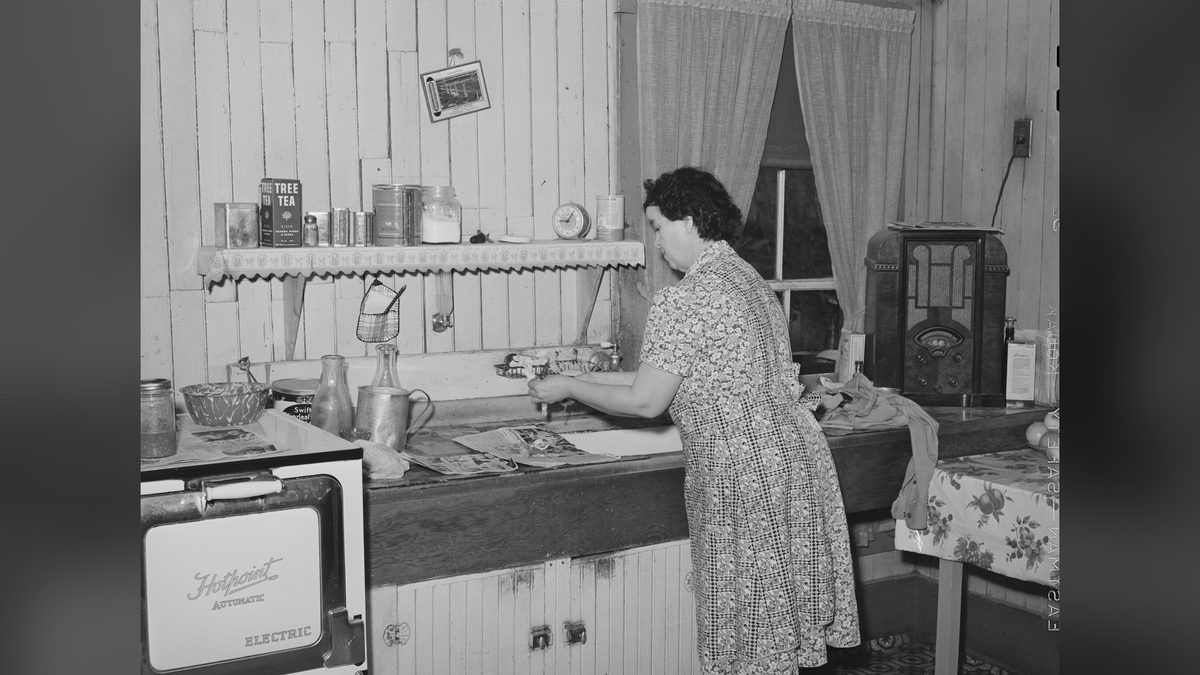
The pump that ignores the twenty-five-foot rule
The twenty-five-foot ceiling is not universal, and the exception matters. In the 1960s and ’70s, UNICEF worked with the Indian government’s Mechanical Engineering Research and Development Organisation and the state-owned firm Richardson and Cruddas to design a handpump sturdy enough for shared village use rather than a single household, building on an existing design called the Sholapur Pump. The result, the India Mark II, is by UNICEF’s own account the world’s most widely used handpump, reaching water from as deep as fifty meters — more than ten times the reach of the pitcher pump in this article’s video.
The trick is that it is not, mechanically, a suction pump at all. An engineered deep-well hand pump lowers the actual plunger and cylinder down the borehole on a rod, below the water line, so the handle at the surface is not creating suction over a long column of air — it is directly driving a piston that is already submerged, pushing water up ahead of it the way a force pump does rather than pulling it up the way a lift pump does. The twenty-five-foot limit still governs anything trying to suck water up from above; it has nothing to say about a pump that has simply moved itself to where the water already is.
What is left, and what it tells you
The dooryard pitcher pump did not get replaced because it was poorly designed. It got replaced because it was doing, by hand, exactly what physics allows a column of air to do for free, and once a cheap motor was available to do the same job past that column’s limit, there was no reason left to stand in the yard working a handle. Millions of the iron pumps still stand where they were bolted down, disconnected but not removed, because fieldstone and cast iron are both more trouble to haul away than to leave.
What the pump leaves behind is a genuinely useful fact about how the world works: the atmosphere above you is not empty, it has weight, and that weight will do real mechanical work if you simply get out of its way. A drinking straw, a syringe, and a nineteenth-century farm pump are all, underneath, the same trick.
So the question stands the way the video leaves it. If the power went off tonight and stayed off, how would you get water out of the ground?
Watch the full history
The five-minute video walks the pitcher pump stroke by stroke, from the leather cup to the well beside a Kansas water tower.

Related reading
- How a Springhouse Worked — the other farm water building that ran on physics instead of a wire.
- The Root Cellar — how the same farm solved food storage without electricity or a pump.
- The Icehouse — a third pre-electric utility, this one built around a frozen pond.
- The Cistern — what a farm with no well and no spring caught instead.
Shop the items in this history
- Cast-iron pitcher pump, the same style shown here
- Leather pump cup and washer repair kit
- Galvanized water bucket
Works cited
- Vitruvius. De Architectura, Book X, Chapter VII: “The Pump of Ctesibius.” Translated by Morris Hicky Morgan. Harvard University Press, 1914. Link.
- “Ctesibius of Alexandria.” Encyclopaedia Britannica.
- “Evangelista Torricelli.” History of Chemistry. Purdue University Department of Chemistry. Link.
- “5.1: Water from Wells — Atmospheric Pressure at Work.” Chemistry LibreTexts, General Chemistry: A Molecular Approach. Link.
- “The History of Pumps: Through the Years.” Pumps & Systems. Link.
- History of Goulds Pumps: A Scrapbook Collection. New York Heritage Digital Collections. Link.
- U.S. Bureau of the Census. “Farm Facilities—Farms Reporting Specified Facilities in the Farm Dwelling.” Census of Agriculture: 1945, Table 2. U.S. Department of Agriculture, National Agricultural Statistics Service archive. Link.
- “History.” America’s Electric Cooperatives. National Rural Electric Cooperative Association. Link.
- “A History of UNICEF Work on Water, Sanitation and Hygiene in India.” UNICEF India, 15 October 2020. Link.
- Friedman, Daniel. “Hand Pumps for Water Wells: History & Types of Hand Pumps.” InspectApedia. Link.
- Reinhardt, Claudia, and Bill Ganzel. “Indoor Plumbing.” Farming in the 1930s, Wessels Living History Farm, Ganzel Group, 2003.