
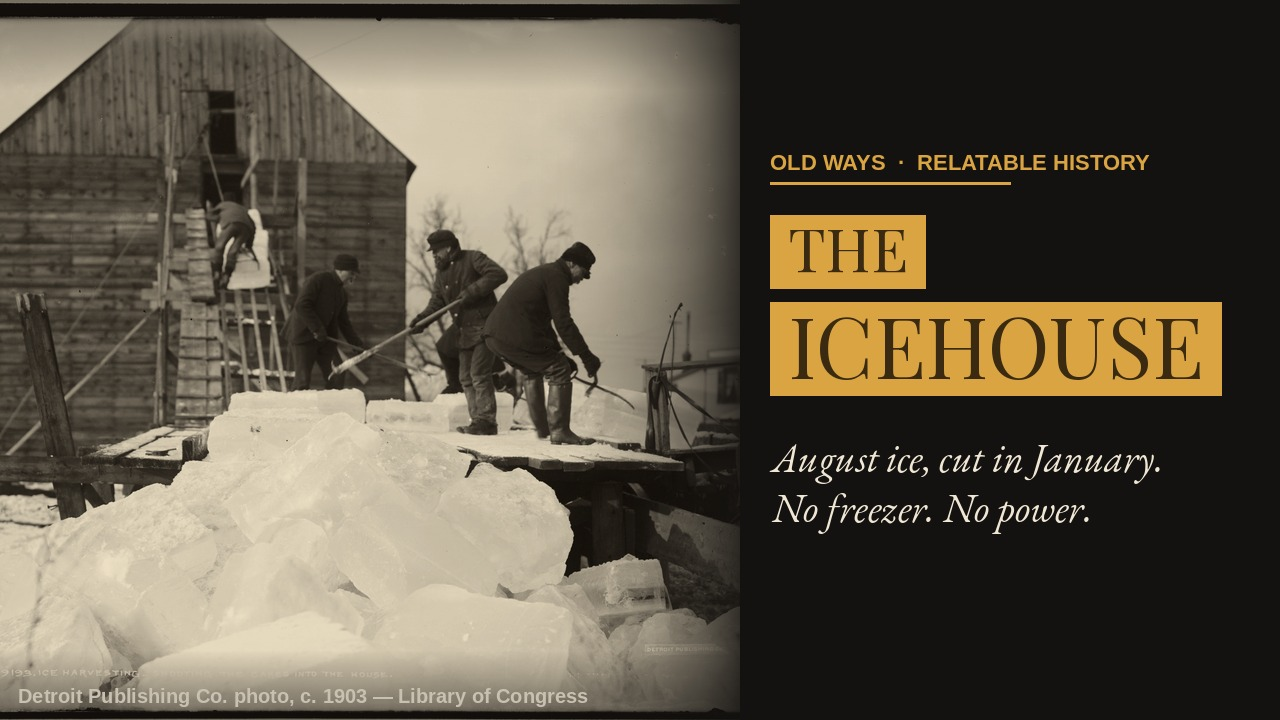
In a single year, 1847, three hundred and fifty-three ships loaded with ice cleared Boston Harbor, bound for the American South and for ports as far off as Rio de Janeiro and Hong Kong. Between what those ships carried abroad and what Boston itself burned through at home, the city moved something on the order of a hundred thousand tons of frozen New England pond water that year alone. None of it was mechanically refrigerated in transit. It was packed edge to edge in sawdust and left to survive on physics for weeks at sea — the same physics, at a much smaller scale, that kept a block of January ice solid in a farm’s icehouse until the following August.
It is easy to picture the farm icehouse as a quaint, self-contained corner of rural life: a squat shed behind the barn, a door that stayed shut. It was that. But it was also the retail end of a system that had been engineered, patented, and scaled into one of nineteenth-century America’s strangest export industries — a business built on selling New England winter to people who had never once seen snow. What follows is how that system actually worked, who built the trade around it, who did the cutting, and what finally put both the farm shed and the export firm out of business.
An icehouse is an engineered vessel, not just a shed
The U.S. Department of Agriculture’s 1911 guide to the subject, Ice Houses, by horticulturist L. C. Corbett, lays out the design in four physical principles: the mass of ice must expose as little surface as possible, which is why a good storehouse packs it into a shape close to a cube rather than a long low pile; it must be completely insulated from outside heat; it must drain fast, since standing meltwater melts ice far quicker than still air does; and the ice itself must be packed tight enough to stop air from circulating through the mass. Cakes were cut to standard dimensions, typically 22 by 22 inches or 22 by 32 inches, so they would stack without gaps. A frame icehouse eleven feet on a side and eleven feet tall — a modest farm building — held a cube of ice equivalent to about 38 tons, since a cubic foot of ice weighs roughly 58 pounds and a ton occupies nearly 80 cubic feet. Bulletin 475 specified a packing layer of sawdust or shavings at least 15 inches deep under the ice and another 15 to 18 inches between the stack and the walls, rammed in tight.
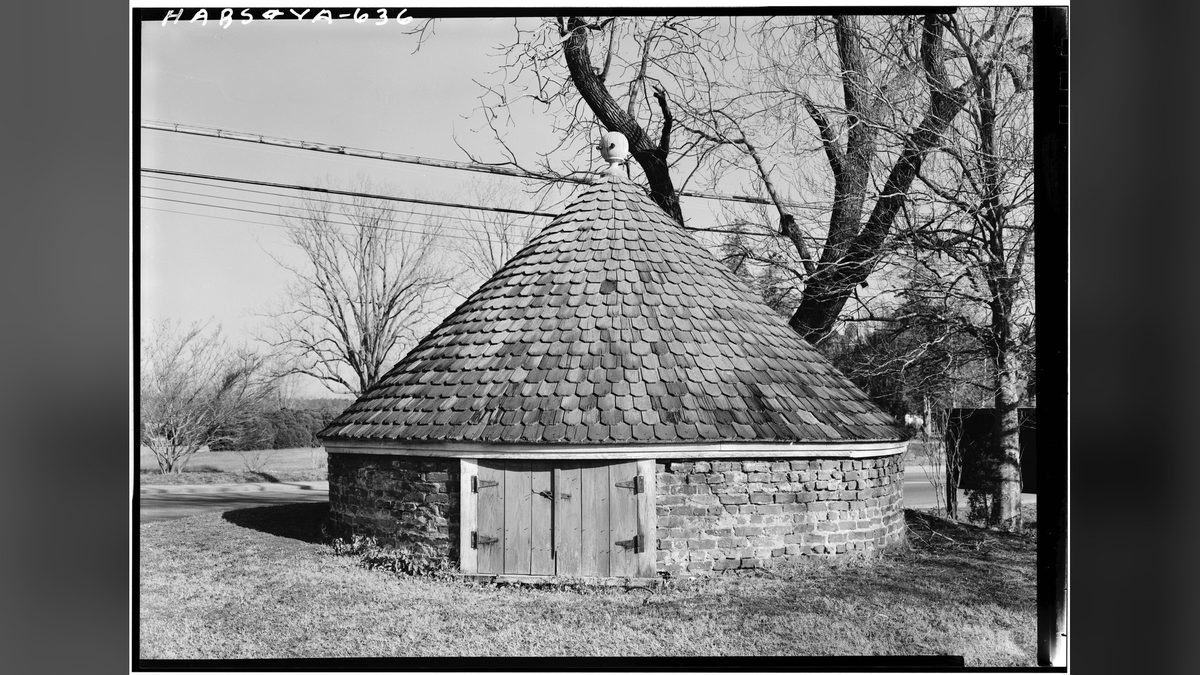
The design was not new when the government wrote it down. On Virginia’s Eastern Shore, the Fisher-Seymour icehouse, built around 1813 alongside a farmhouse begun two decades earlier, still stands: seventeen feet across, sunk mostly below grade with its brick walls projecting only three feet above the surrounding yard, capped by a wood-shingled conical roof. The Historic American Buildings Survey, which documented it for the Library of Congress, notes that the structure was almost certainly built to the same principles the USDA would formalize a century later: minimal exposed surface, a below-grade setting that used the earth’s own insulation, and a design that had clearly already been worked out by trial and error long before any bulletin existed to explain it.
The physics: why ice melts from the outside in
Melting one pound of ice at 32°F takes 144 British thermal units of heat — a fixed physical quantity engineers call the latent heat of fusion, and it is the whole reason the system works at all. Because that much energy has to arrive before a single pound converts from solid to liquid, a large, tightly packed mass of ice can only be attacked at its surface; the interior stays frozen until the outside layers have absorbed their share of heat and melted away first. This is why shape mattered so much to Corbett’s bulletin: a cube exposes the least surface area for a given volume, so it sacrifices the smallest possible fraction of itself to protect the rest. A loose, irregular pile of broken ice, by contrast, has far more exposed surface per ton and disappears correspondingly faster, which is exactly why the bulletin warns that irregular cakes need thicker walls and more insulation than uniform ones to keep pace.
Drainage was the second half of the mechanism, and it is easy to underestimate. Water conducts heat away from a solid much faster than still air does, so meltwater left sitting against the ice accelerates its own destruction; a farm icehouse floor was graded or fitted with drains specifically so the first ounces of melt ran off immediately rather than pooling. Masonry-walled houses needed even more attention to this than timber ones, since brick and concrete conduct heat far better than wood and could not be relied on to do any of the insulating work themselves — the entire burden fell on the packing material and the drainage beneath it.
Harvesting the crop: a grid cut into a frozen pond
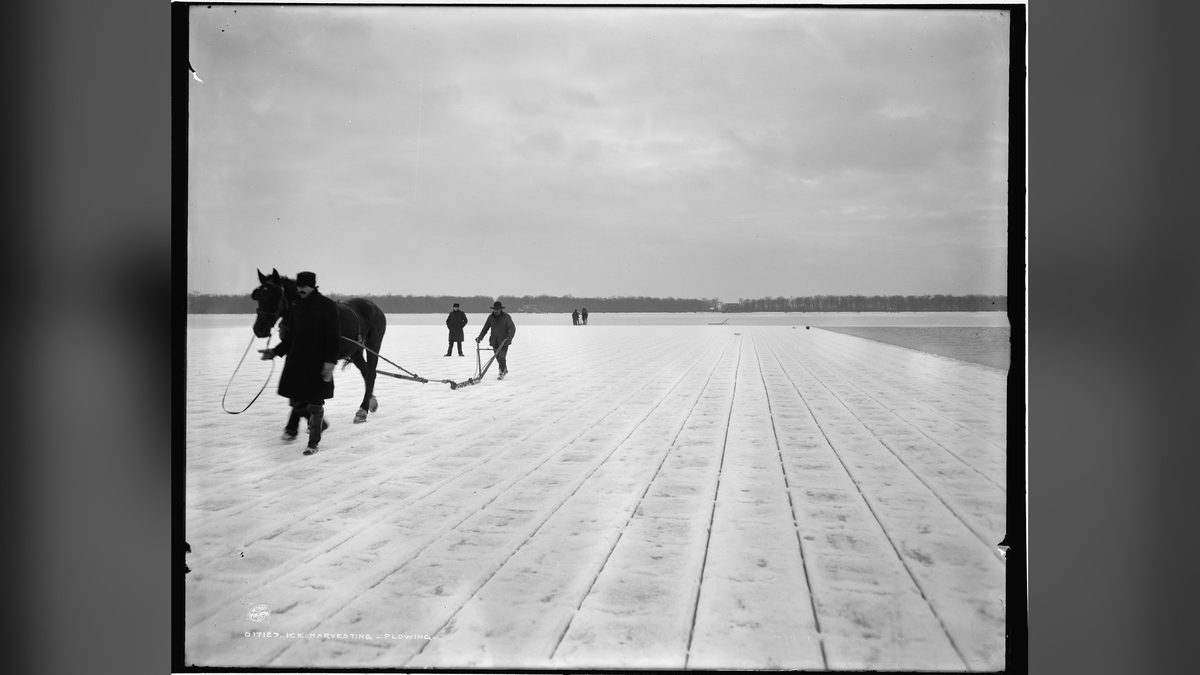
Before the 1820s, ice was cut by hand with saws, a slow and physically brutal job. The change came from Nathaniel Wyeth, a foreman on Frederic Tudor’s ice operation who grew up on the shores of Fresh Pond in Cambridge, Massachusetts. In 1829 Wyeth patented what the Hagley Museum and Library, which holds the original patent model, describes as a horse-drawn cutting sled with two rows of blades set at different depths: a shallower pass scored the surface first, and once the sled was flipped, a deeper set of cutters finished the job, producing even-sided blocks far faster than any saw crew could manage. Wyeth went on to hold more than a dozen ice-harvesting patents in total; his entry in the Dictionary of American Biography states that “it was said at his death that practically every implement and device used in the ice business had been invented by Nat Wyeth.” His improvements to icehouse design, not just the cutting tools, are what Boston University historian Andrew Robichaud credits with making Tudor’s business profitable in the first place.
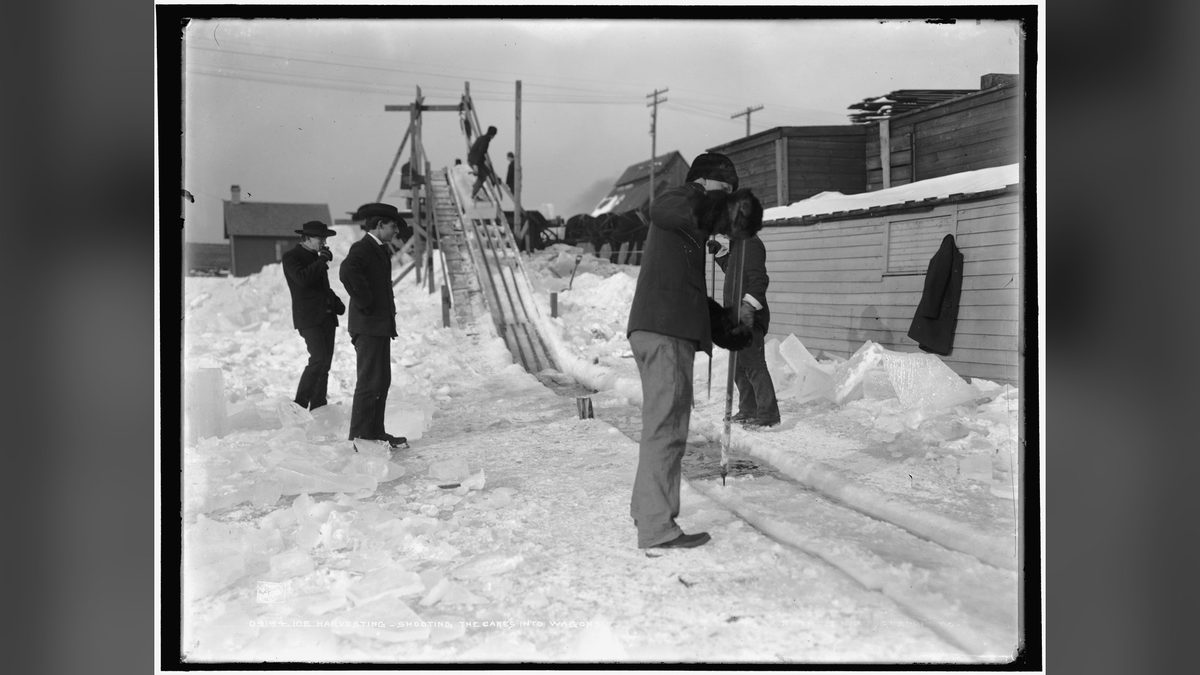
Henry David Thoreau watched a harvest crew work Walden Pond firsthand in the winter of 1846 to 1847, while he was living in his cabin there, and wrote about it in Walden. A hundred men came out from Cambridge each day, he recorded, bringing “many carloads of ungainly-looking farming tools — sleds, plows, drill-barrows, turf-knives, spades, saws, rakes,” and cut for sixteen days. He called the ice-cutters “a merry race, full of jest and sport,” and noted, with the dry irony he was known for, that the ice bound for Charleston, New Orleans, Madras, Bombay, and Calcutta meant that “the sweltering inhabitants of” those cities “drink at my well.”
Cold as a global commodity
The industry Thoreau was describing began with one very bad trip. In 1806, a twenty-two-year-old Boston merchant named Frederic Tudor loaded a ship with 130 tons of Massachusetts ice and sent it to the French colony of Martinique. A good deal of it melted en route, and because Martinique had no icehouses at all, there was nowhere to store what survived; Tudor’s own suggestion to buyers, that they simply wrap it in blankets and take it home, was not exactly a business plan. He lost money on that voyage and on several that followed, and was jailed twice for debt before the venture found its footing. Once icehouses existed at the receiving ports and Wyeth’s improvements cut the shipping losses, the trade became genuinely lucrative: by 1833 Tudor’s ice was reaching Calcutta after a four-month voyage, and by the 1840s it was going as far as Rangoon, Singapore, Hong Kong, and Rio de Janeiro. He became known worldwide as the “Ice King,” and by his death in 1864 his fortune was worth roughly $200 million in today’s dollars.
The scale this reached domestically is almost as striking as the export figures. The federal government’s first official report on the ice industry, commissioned in 1879, estimated an annual U.S. harvest of eight to ten million tons. New York City alone consumed nearly a million tons of it a year, breweries chief among the buyers; Chicago’s meatpacking industry used 580,000 tons annually; Boston and Philadelphia each used just under 400,000 tons. By the middle of the century, 135 separate commercial icehouses lined the Hudson River between New York City and Albany. Ice, at its industrial peak, rivaled cotton and grain in economic importance — all of it, ultimately, resting on the same cube-shaped, sawdust-packed principle at work in a single farm’s backyard shed.
Who actually did the cutting
Histories of the ice trade have long enjoyed crediting Tudor with something close to genius — the salesman who convinced an entire country it needed cold drinks. Robichaud, who is writing a history of the industry and has studied Tudor’s papers at Harvard’s Baker Library, is skeptical of that framing. Tudor, he argues, “was not just some successful entrepreneur, but was made by networks of family and class privilege, and on the backs of low-wage workers and enslaved people.” The men Thoreau watched cutting Walden Pond were largely Irish immigrant laborers hired by the day. And the practice reached further back and further up the social ladder than the export trade: Thomas Jefferson had an icehouse built at Monticello in 1802, sixteen feet below ground and six above it, constructed by enslaved craftsmen under his Irish joiner James Dinsmore and stocked each winter with ice cut from the Rivanna River by enslaved laborers working alongside hired free wagoners. The romance of a “merry race” of ice-cutters, in other words, sat directly on top of an economy of cheap and frequently unfree labor — a detail the industry’s own triumphalist histories tended to leave out.
How a farm actually spent its ice
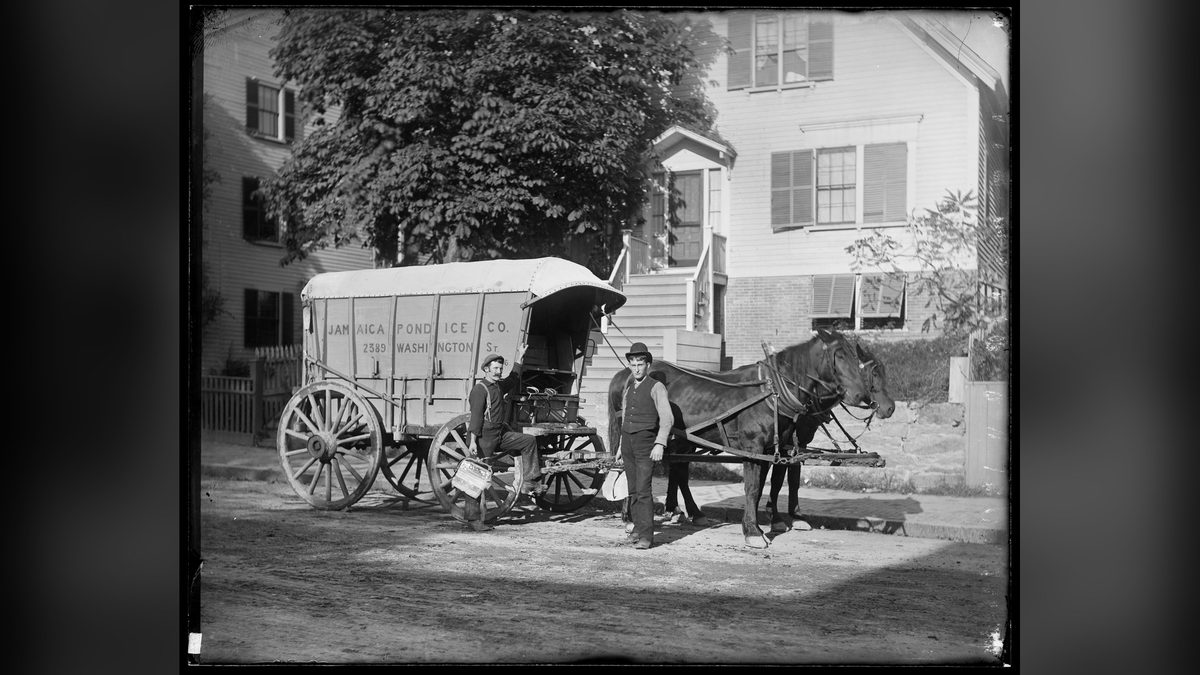
The appliance on the receiving end was called an icebox, and it predates the farm icehouse bulletins by more than a century: the first version reached the American public in 1803, a cedar chest lined with tin and insulated with rabbit fur, built for farmers hauling butter to market. Later household models were built from mahogany or teak, lined with zinc, and packed with cork, flannel, or green baize; one admiring nineteenth-century journalist called the result “almost as indispensable as the sofa or the sideboard.” A typical ice-chest household burned through roughly three hundred hundred-pound blocks of ice a year. Where a family had no pond of its own, commercial delivery filled the gap: firms like the Jamaica Pond Ice Company in Boston ran horse-drawn wagons on daily routes, exactly the kind of service that made ice a routine household expense rather than a rural curiosity. Corbett’s USDA bulletin went further still for farms with the resources, sketching plans for a combined icehouse-and-dairy building and even a brine-circulating cold-storage system, essentially a mechanical refrigerator’s layout built around a block of natural ice instead of a compressor.
What actually ended it
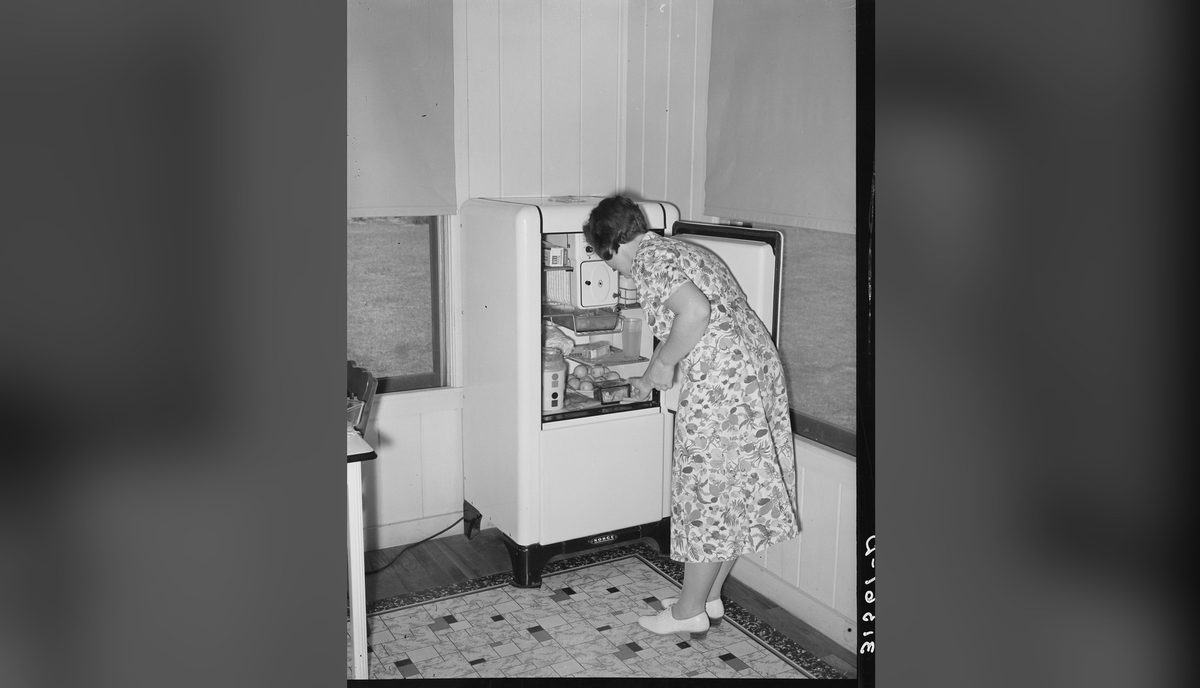
Unlike some other farm systems this series has covered, the icehouse was not undone by a single invention arriving at the farm gate. It was undone by a sequence. Mechanically manufactured “factory ice” spread through the 1890s, partly pushed along by a run of unreliably warm winters that made natural harvests unpredictable in exactly the years the growing cities needed them most. The home electric refrigerator arrived next, and it is that machine, not the mechanical ice plant, that finally closed out the natural-ice trade for good; by the 1950s the commercial harvest had essentially ended. Individual farms held on considerably longer than the export firms did — plenty of families were still cutting their own pond ice into the 1940s, for the simple reason that an icehouse cost nothing to run and a refrigerator needed a power line the farm did not yet have.
What survives
The Fisher-Seymour icehouse is still standing on Virginia’s Eastern Shore, conical roof intact, documented for the historical record down to the inch. Monticello’s icehouse has been restored as well, its roof rebuilt in 2009; Jefferson’s own household correspondence records that when a fire threatened the main house in 1819, the stockpile in what the family had taken to calling the “snow house” was packed against the adjoining terrace specifically to keep the flames from spreading. Both buildings outlasted the industry that made them briefly unremarkable.
What makes the icehouse worth taking seriously now is not nostalgia for a simpler machine. It is a reminder that an entire global commodity trade — ships, patents, fortunes, and an 1879 federal report tallying it in the millions of tons — was built on nothing more exotic than a cube shape, a foot of sawdust, and a drain. The next time a freezer door swings open without a second thought, it is worth asking what it would take to have that same ice in July if the freezer, the delivery truck, and the power grid all vanished at once — and, just as importantly, whose labor would be doing the cutting.
Watch the full history
The five-minute video walks the icehouse from the January pond to the kitchen icebox, and on to the ammonia plants and wired-up farms that finally retired it.

Related reading
- How a Root Cellar Kept Vegetables All Winter — the farm’s other great storage system, this one built into the earth instead of packed in sawdust.
- How a Springhouse Worked — the dairy’s answer to the same cold-storage problem, solved with running water instead of a January pond.
- The Icebox — the wooden cabinet in the kitchen that a farm’s stored ice actually went into every morning.
- The Crock and Sauerkraut — a different, ice-free way farms kept food edible through the same winter months.
Shop the items in this history
Works cited
- Rupp, Rebecca. “Frederic Tudor: The King of Ice.” National Geographic (The Plate), 19 July 2014. Link.
- Cascio, Chris. “Chilling with the Ice King of New England.” Hagley Museum and Library. Link.
- Hahn, Devin, and Amy Laskowski. “Tracing the History of New England’s Ice Trade.” The Brink, Boston University, 4 February 2022. Link.
- Corbett, L. C. Ice Houses. U.S. Department of Agriculture, Farmers’ Bulletin 475, revised August 1911. Link.
- Historic American Buildings Survey. “Fisher-Seymour Icehouse, State Route 13, Accomac, Accomack County, VA.” Survey HABS VA-636. Library of Congress, Prints and Photographs Division. (loc.gov/item/va0004 — blocks automated access; cited as print.)
- “Latent Heat of Melting for Common Materials.” The Engineering ToolBox. Link.
- Thoreau, Henry David. Walden; or, Life in the Woods. Ticknor and Fields, 1854. Chapter 16, “The Pond in Winter.” Link.
- Library of Congress, Prints and Photographs Division. “[Ice harvesting, plowing].” Detroit Publishing Company Collection. (loc.gov/item/2016806712 — blocks automated access; cited as print.)
- “Ice House.” Thomas Jefferson Encyclopedia, Thomas Jefferson Foundation, Monticello. (monticello.org/encyclopedia/ice-house — blocks automated access; cited as print.)