
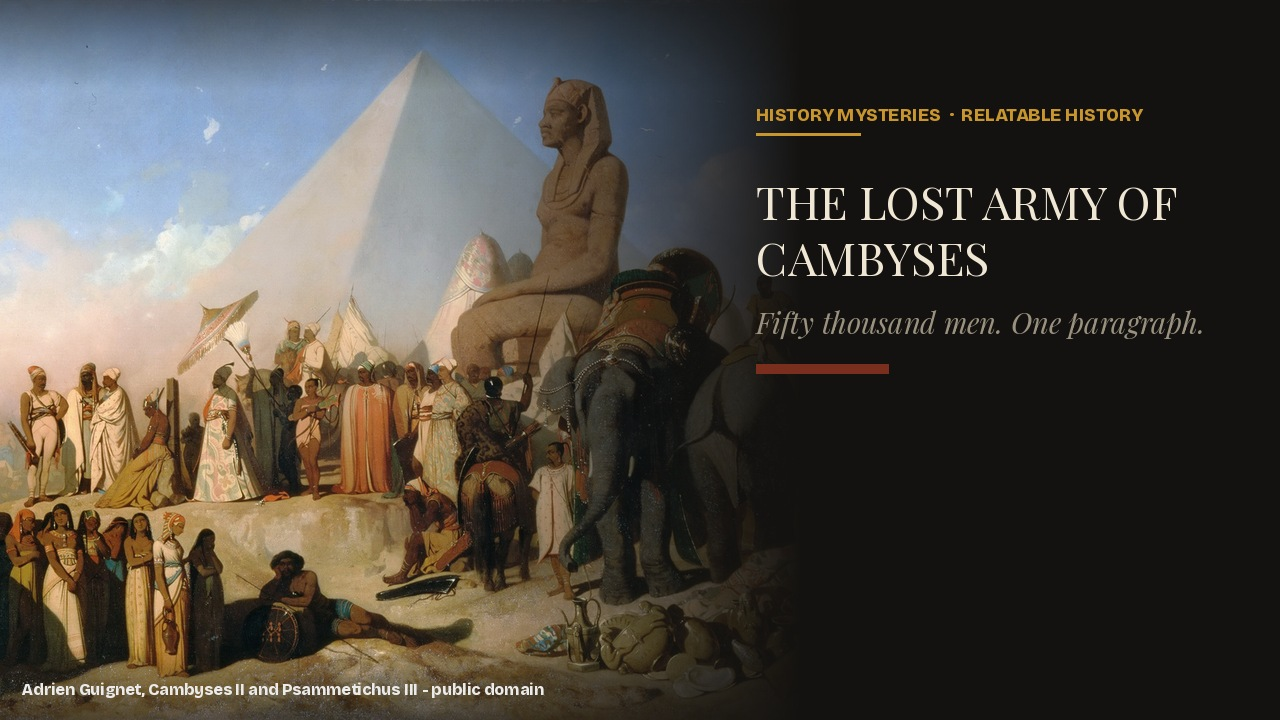
No one has ever produced a single object tied to fifty thousand missing men. By one ancient account, a column of the Persian army marched into the Egyptian desert in 525 BC and simply did not come out the other side — no buckle, no blade, no bone that anyone has managed to connect to the event in twenty-five centuries of looking, despite at least four funded expeditions that went looking for exactly that.
The entire story rests on one writer, working from one secondhand account, set down roughly eighty years after the fact. That alone would make most historians cautious. What makes the story persistent instead of forgotten is that the surrounding facts — the conquest, the oracle, the desert route — are all independently solid. It is only the ending that nobody can nail down.
This article lays out the theories behind Cambyses’ lost army: what the ancient record actually says, what a $250,000 Harvard-backed dig found in that desert (short answer: an old jerry can), the disputed 2009 claim that made world headlines, and the 2014 theory that may finally explain where the column really went — and it does not involve weather at all.
A conquest that is not in question, and a march that mostly is
Start with the part no one disputes. In 525 BC, Cambyses the Second, son of Cyrus the Great, led a Persian army into Egypt, defeated the pharaoh Psamtik the Third at Pelusium, took Memphis, and had himself crowned. Egypt became a Persian satrapy and stayed one for well over a century. Administrative records, inscriptions and later Persian chronology all agree on this much.
What Herodotus adds, and what nothing else corroborates, is a second act. With Cambyses ruling from Memphis, he says the king sent a force west out of Thebes with orders to reach the oracle of Amun at Siwa, several hundred kilometres into the desert. The oracle was a serious target: it was respected enough that Alexander the Great made the identical crossing about two centuries later specifically to consult it, and came back using what he heard there to claim divine parentage.
Herodotus also describes a second, unrelated expedition launched around the same time, sent south against the Ethiopians, which he says ran out of food, ate its own pack animals, then resorted to casting lots and eating every tenth man before Cambyses recalled what was left of it. The two campaigns get conflated constantly online. Only the western one is the subject of a disappearance.
The one paragraph everything rests on
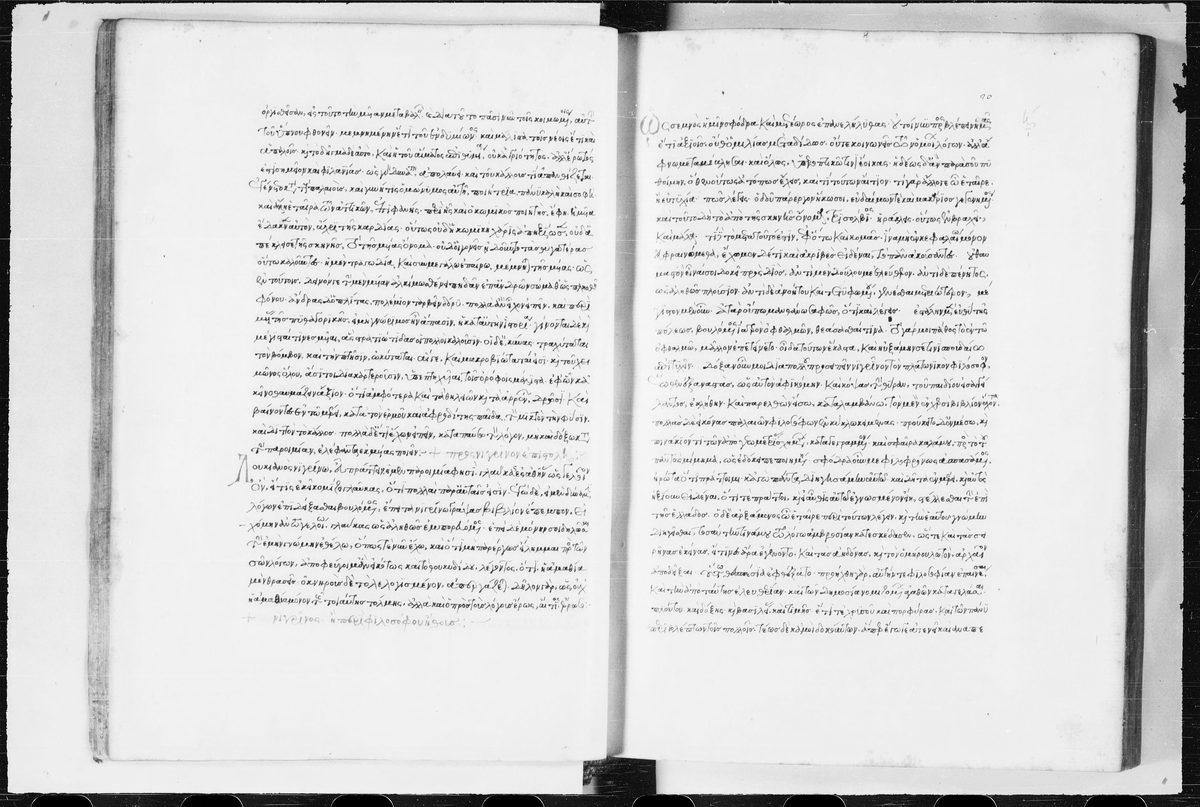
The claim itself takes up a few sentences in Book Three of the Histories. Herodotus says the column took seven days to cross from Thebes to a place he calls simply “the Oasis,” almost certainly the Kharga depression. From there the route ran north-west toward Siwa. Partway along it, he writes, while the men were eating, a violent south wind rose and buried them under moving walls of sand. They neither reached Siwa, he says, nor returned.
Read the passage as a journalist would and it shows its own limits. Herodotus attributes the account to the Ammonians — the people of Siwa, the one community the column never reached — and says plainly that this is their story, not his own observation. He wrote it down something like eighty years after the fact, had never crossed that stretch of desert himself, and had no Persian source for it at all. No commander is named. No survivor is named. No location is given beyond “partway.”
The figure itself deserves the same scrutiny. Fifty thousand is a conspicuously round number in a genre that specialises in round numbers, and classicists who have worked through Herodotus’s army sizes in detail generally treat them as inflated rather than counted. The logistics argue the same way independent of any of that: moving that many men across days of open desert, with no dependable wells along most of the route, is an arithmetic problem on its own, before any weather gets involved.
A quarter of a million dollars and nothing to show for it
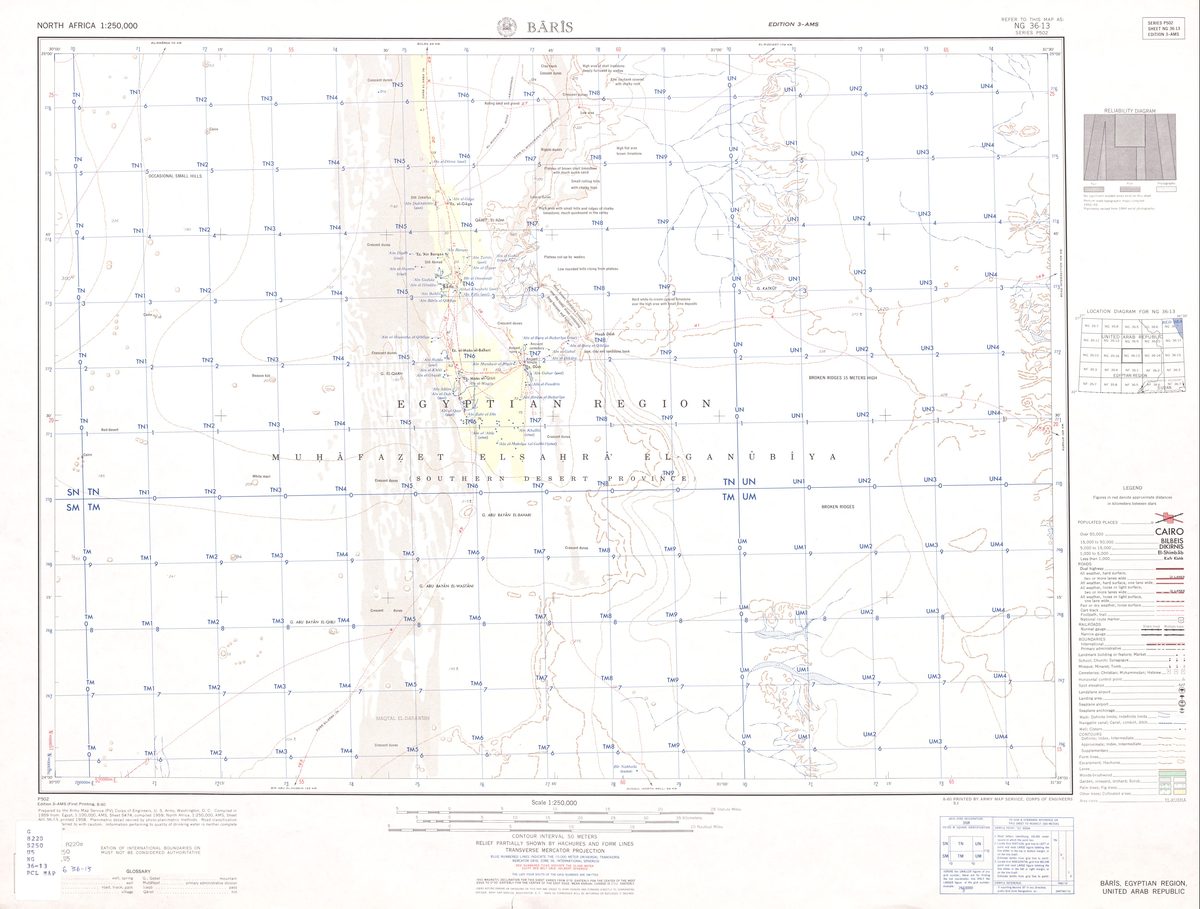
The most serious attempt to actually find the column, rather than argue about it, ran from September 1983 to February 1984. It was led by the journalist Gary Chafetz and backed jointly by Harvard University and the National Geographic Society, with a budget of roughly $250,000 — a six-month operation with about twenty Egyptian geologists and field workers, a National Geographic photographer, two Harvard filmmakers, and ground-penetrating radar.
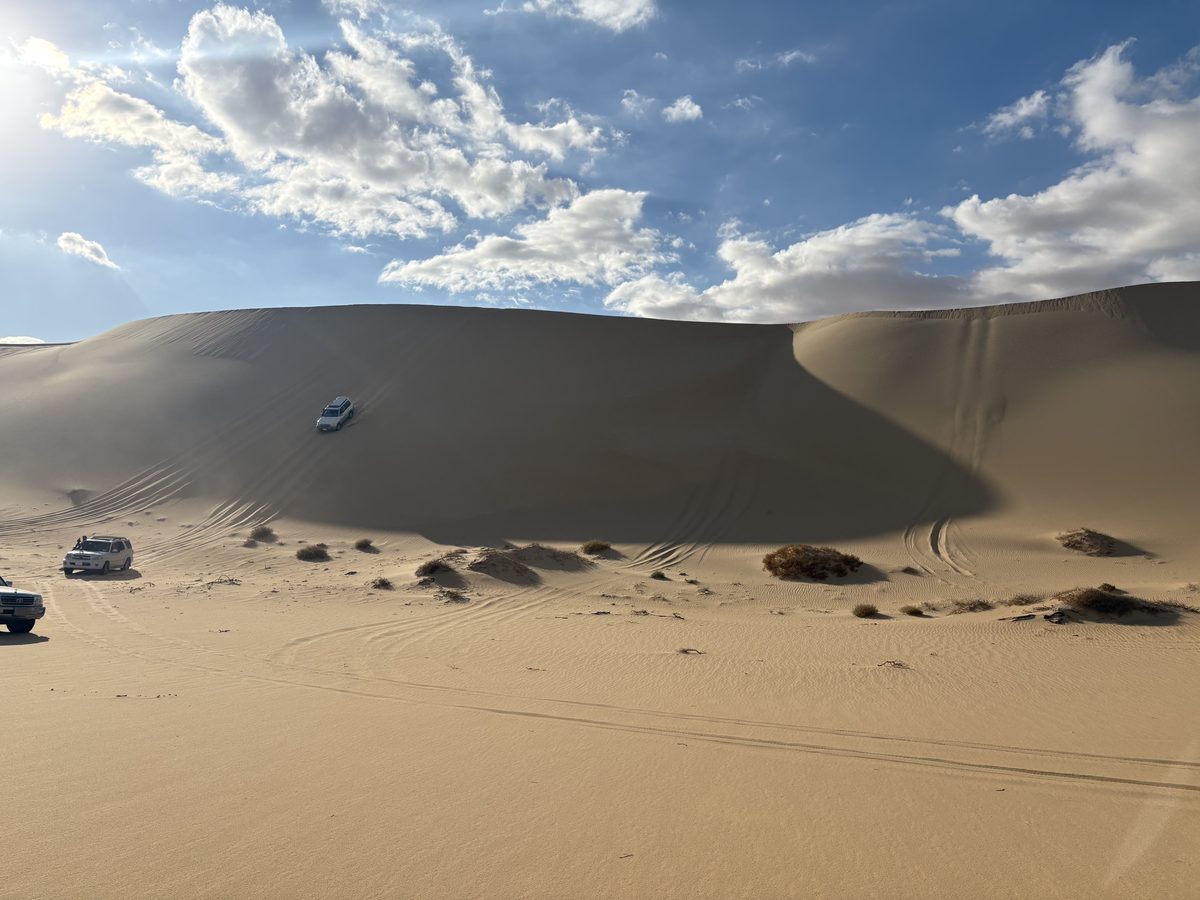
The team searched some hundred square miles of the dune field known as the Complex Dunes, southwest of the Bahariya oasis. By Chafetz’s own account, written years later, it found no trace of the army at all. What it did find was a scattering of stone cairns marking an old caravan path, and a rusted jerry can left behind by a 1939 expedition. A well-funded, well-equipped, multi-institution search came back with a gasoline tin and nothing else.
Bones, bracelets, and a very public argument
That has not stopped anyone else from trying, or from announcing success. In 2000, a team under Dr. Mohamed el-Saghir of Egypt’s Supreme Council of Antiquities planned a satellite survey of the desert near Siwa and DNA testing on human bones already recovered there, with el-Saghir telling reporters he expected to find the army. His own colleague, the Council’s secretary-general Gaballah Ali Gaballah, was openly more cautious, pointing out that the sandstorm story comes from Greek sources alone and that the western desert is simply too vast to search on hope. No confirmed result was ever published.
Then, in November 2009, came the claim that actually made world news. An Italian-led team reported finding bronze weapons, a silver bracelet, an earring, pottery and hundreds of human bones in the Sahara near Siwa. Dario Del Bufalo of the University of Lecce, who was involved in the find, told reporters: “We have found the first archaeological evidence of a story reported by the Greek historian Herodotus.”
The response from Cairo was immediate and blunt. Zahi Hawass, then Secretary General of the Supreme Council of Antiquities, called the reports unfounded and misleading and noted that the team held no Egyptian excavation permit at all, which meant nothing they claimed to have found should be taken at face value. Chafetz, writing about it from the perspective of someone who had actually spent six months searching the same desert, was equally skeptical on different grounds: in the published photographs, he said, the bones looked too clean to have survived twenty-five centuries of sandblasting, more like plaster casts arranged for the camera than excavated remains.
An ambush with a name
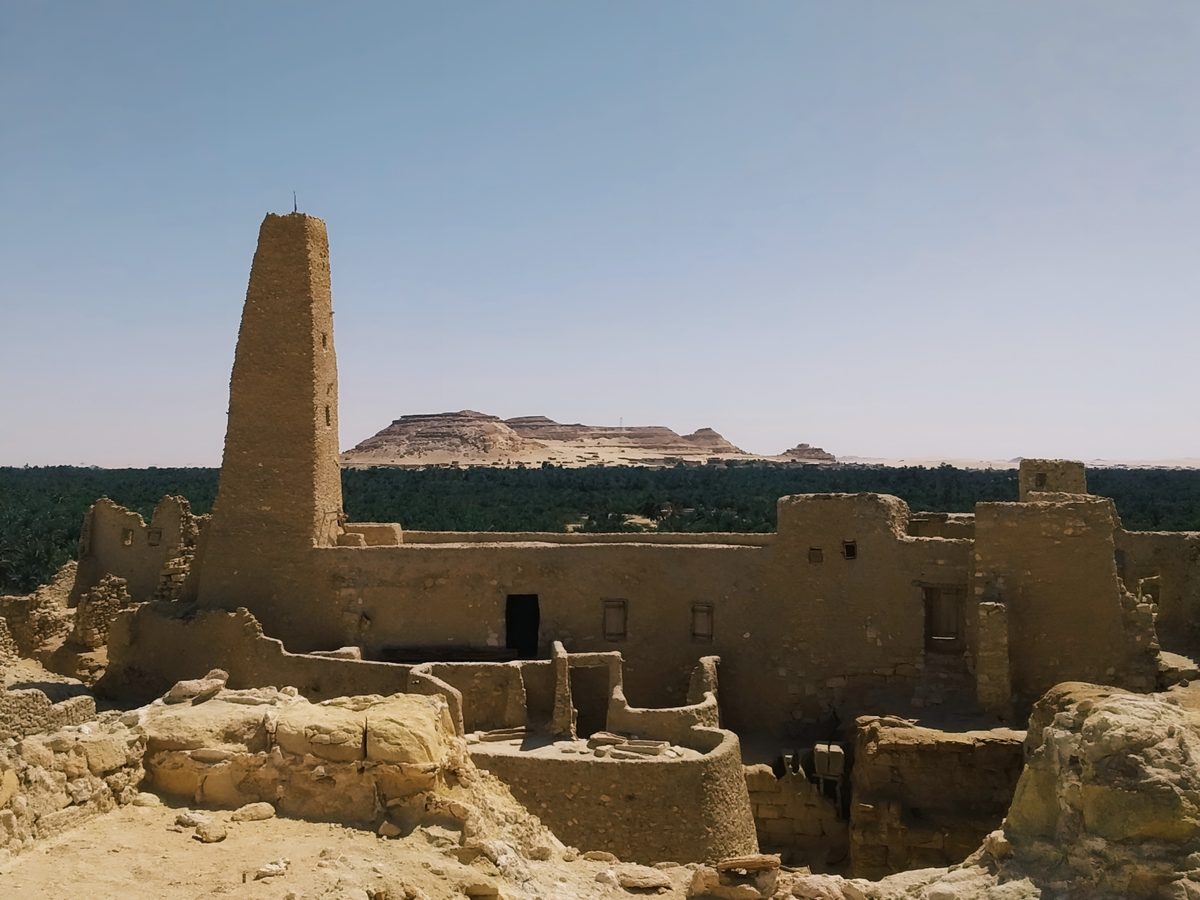
The most interesting development so far does not involve a search of the desert at all. In 2014, the Leiden University Egyptologist Olaf Kaper, working from roughly a decade of excavation at Amheida in the Dakhla Oasis, argued that the sandstorm never happened, because the Persian force was never actually wiped out. According to Kaper it was ambushed and defeated by an Egyptian rebel named Petubastis the Third, who used Dakhla as his power base to retake much of Egypt and briefly have himself crowned pharaoh at Memphis.
The evidence is not speculative on its own terms. Kaper had spent years deciphering temple blocks at Amheida carrying Petubastis’s full set of pharaonic titles, which is what moved him from a name in a fragmentary king list to a ruler who verifiably held territory at roughly the right moment. Combine that with Dakhla’s position on the same desert road the lost column was supposedly travelling, and the theory writes itself: Darius the First, who crushed Petubastis’s revolt about two years later, had every reason to prefer a story about weather to a story about an Egyptian rebel beating an imperial army.
What is still reconstruction, by Kaper’s own framing, is the ambush itself — no battlefield has been excavated, and no Persian casualty has been identified at Dakhla any more than one has been identified under a dune near Siwa. What the theory does is replace an unfalsifiable weather event with a specific, locatable, testable claim, which is more than the sandstorm story has ever offered.
Weighing the theories behind Cambyses’ lost army
There is a reason to think the sandstorm account, true or not, served someone’s purposes. Egyptian tradition remembered Cambyses as a sacrilegious foreign tyrant, and the specific charge against him was that he stabbed the Apis bull, Memphis’s sacred animal, in a fit of contempt for Egyptian religion. The physical record argues the opposite. An Apis bull did die during Cambyses’s reign, in August 525 BC, and it was buried with full ceremony in a granite sarcophagus that Cambyses himself paid for — his own name is carved into it, as the king who funded the burial.
That gap between the hostile legend and the physical evidence matters here, because it shows the pattern a sandstorm story would fit into. A foreign conqueror remembered as uniquely cursed, by people who had reasons of their own to remember him that way, is exactly the kind of figure a desert that swallows fifty thousand of his soldiers would attach itself to — whether or not the wind actually did it.
Watch the full history
The nine-minute video version walks through the march itself, the search expeditions, and the rival ambush theory in more visual detail.

Add it up and four serious attempts to find the column have produced one rusted gasoline tin, a set of bones nobody can agree on, and a single testable alternative that does not require a sandstorm at all. That is a thin return on a quarter of a million dollars, a satellite survey proposal, DNA testing, and a decade of excavation at Amheida — and it is a more honest state of the evidence than any of the headlines that have run every few years since 1933.
Part of why people keep funding the search is that this is an unusually testable ancient mystery. Most stories this old have no fixed geography to dig in and no named source to check against the ground. This one has both: a specific writer, a specific route between two oases, and now a specific rival explanation with an excavated name on it in Petubastis the Third. Most legends cannot be disproven. This one, in principle, still can be.
Until someone does, the sandstorm keeps its two-thousand-year head start, and the ambush has the only new evidence anyone has produced in a generation. On what has actually been dug up so far, only one of those two explanations has anywhere left to go.
Related reading
- What Happened to Rome’s Lost Ninth Legion?
- Why Was Göbekli Tepe Buried? What the Evidence Actually Shows
- Why No One Has Ever Deciphered the Indus Valley Script
Works cited
- Herodotus. The Histories, Book 3, chapters 25–26. Link.
- Asheri, David, Alan Lloyd, and Aldo Corcella. A Commentary on Herodotus Books I–IV. Edited by Oswyn Murray and Alfonso Moreno. Oxford University Press, 2007.
- Briant, Pierre. From Cyrus to Alexander: A History of the Persian Empire. Translated by Peter T. Daniels. Eisenbrauns, 2002.
- “Cambyses ii. Reign.” Encyclopædia Iranica. (iranicaonline.org/articles/cambyses — cited as print; the site blocks automated requests.)
- “Leiden Egyptologist Unravels Ancient Mystery.” Leiden University, 19 June 2014. Link.
- Saraceni, Jessica Esther. “Egyptologist Locates King Cambyses’s ‘Missing’ Army.” Archaeology, Archaeological Institute of America, 25 June 2014. Link.
- Theodoulou, Michael. “Using DNA to Unravel a 2,500-Year Persian Riddle.” The Christian Science Monitor, 8 Dec. 2000. Link.
- Chafetz, Gary S. “The Lost Army: Found At Last?” HuffPost, 13 Nov. 2009. (huffpost.com/entry/the-lost-armyfound-at-las_b_372293 — cited as print; the site blocks automated requests.)
- “Vanished Persian Army Said Found in Desert.” History News Network, 8 Nov. 2009. Link.