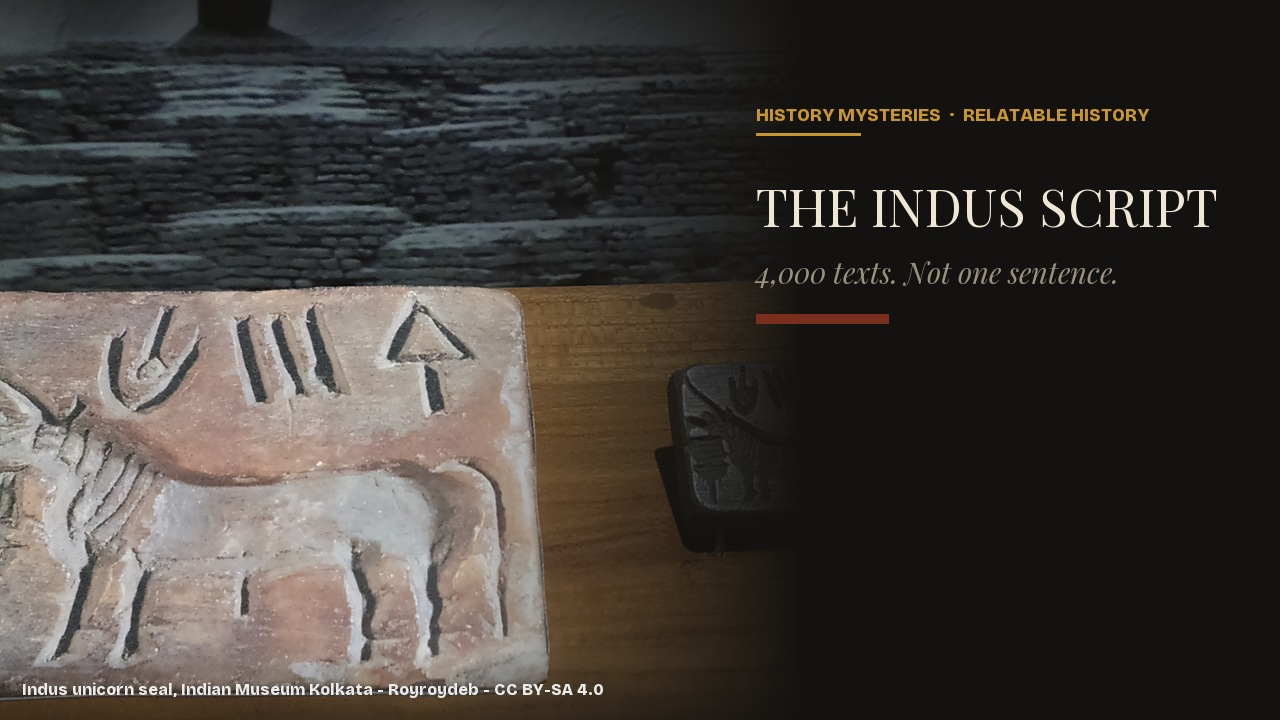
In 1875, a British army engineer named Alexander Cunningham published a drawing of a small, chipped square of stone that had come out of the ruins at Harappa, in what is now Pakistan’s Punjab province. Carved into one face was a bull; above it, a short row of unfamiliar marks. Cunningham guessed the marks might be a form of writing. He could not read them. A hundred and fifty years, several international research teams, a Soviet cryptanalyst who had already broken Mayan glyphs, and a standing cash prize later, nobody else can read them either.
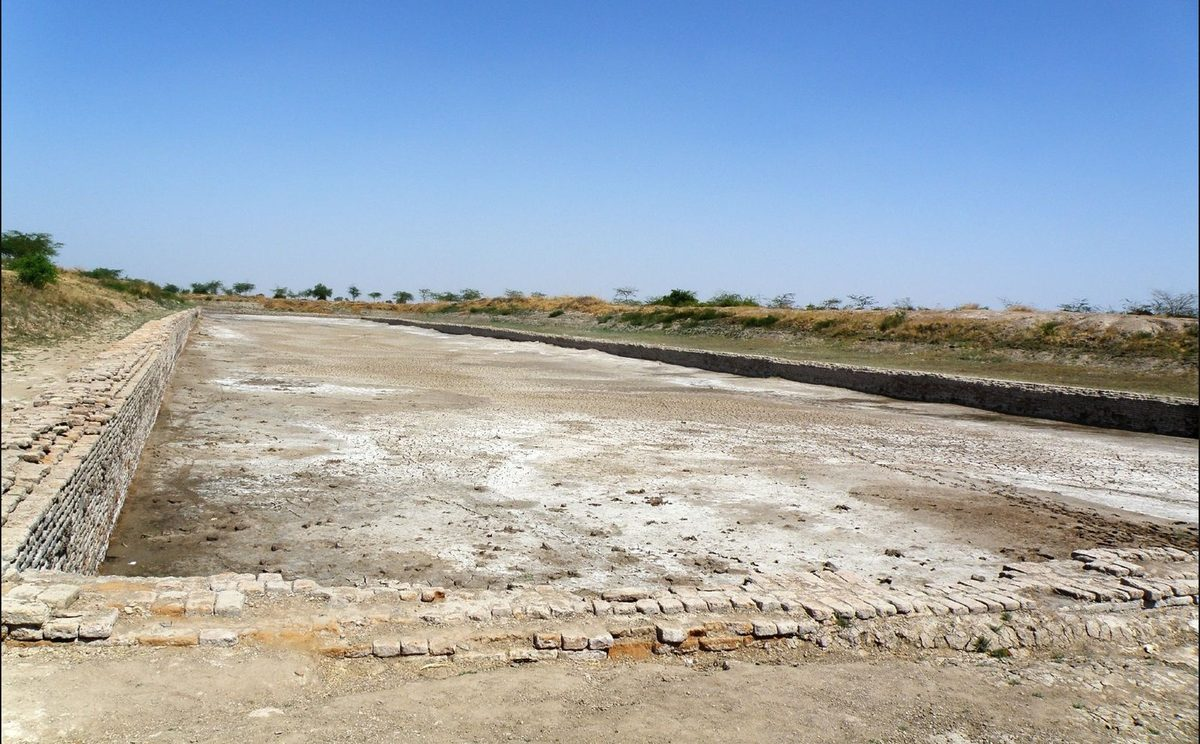
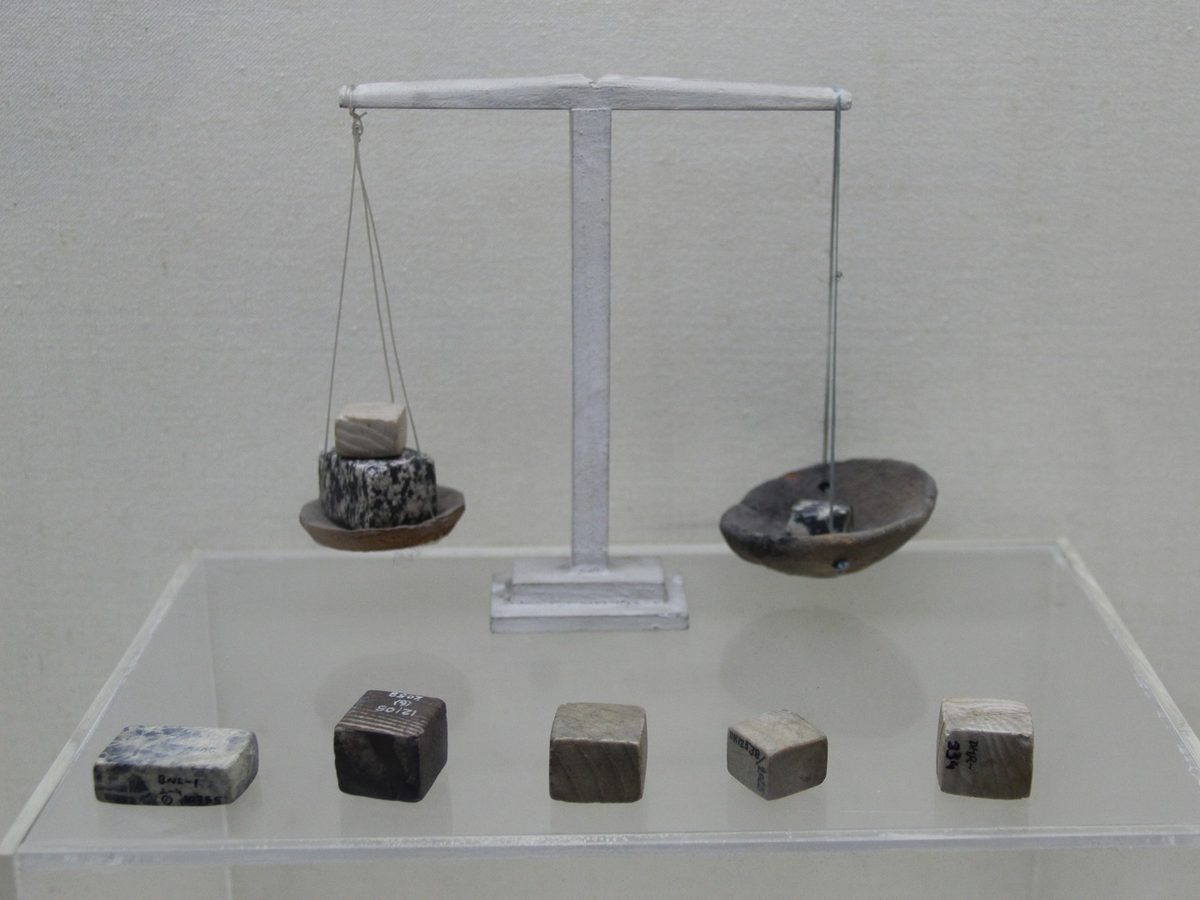
The scale of what’s unresolved is easy to understate. By the most recent published counts, roughly 4,000 inscribed objects survive from the Indus Valley civilisation — a Bronze Age society that, at its height, built grid-planned cities with covered brick drains, public baths, and a system of standardised stone weights so consistent that it shows up with the same cube ratios at sites hundreds of miles apart. This was a society organised enough to need record-keeping. The puzzle is that nobody can prove, in the strict sense, that it left any.
In January 2025, the government of the Indian state of Tamil Nadu put a figure on how badly it wants an answer: one million US dollars, offered publicly to anyone who can decipher the script to scholars’ satisfaction. As of this writing, nobody has come close to collecting it. Here is what the evidence actually shows — what the inscriptions say about themselves, why the usual comparisons to scripts that have been cracked don’t hold up, and why a serious minority of researchers think the entire hunt for a lost language is aimed at nothing.
Four thousand objects survive, and the typical one carries five signs
The corpus is small and the individual texts are smaller still. Most of what survives are stamp seals: flat squares of steatite, a soft and easily carved stone, typically under two inches on a side, each cut with an animal — most often a single-horned creature conventionally nicknamed the “unicorn” — and a brief row of signs above it. The rest of the corpus is copper tablets, pottery marks scratched in after firing, and a small number of ivory and bone rods.
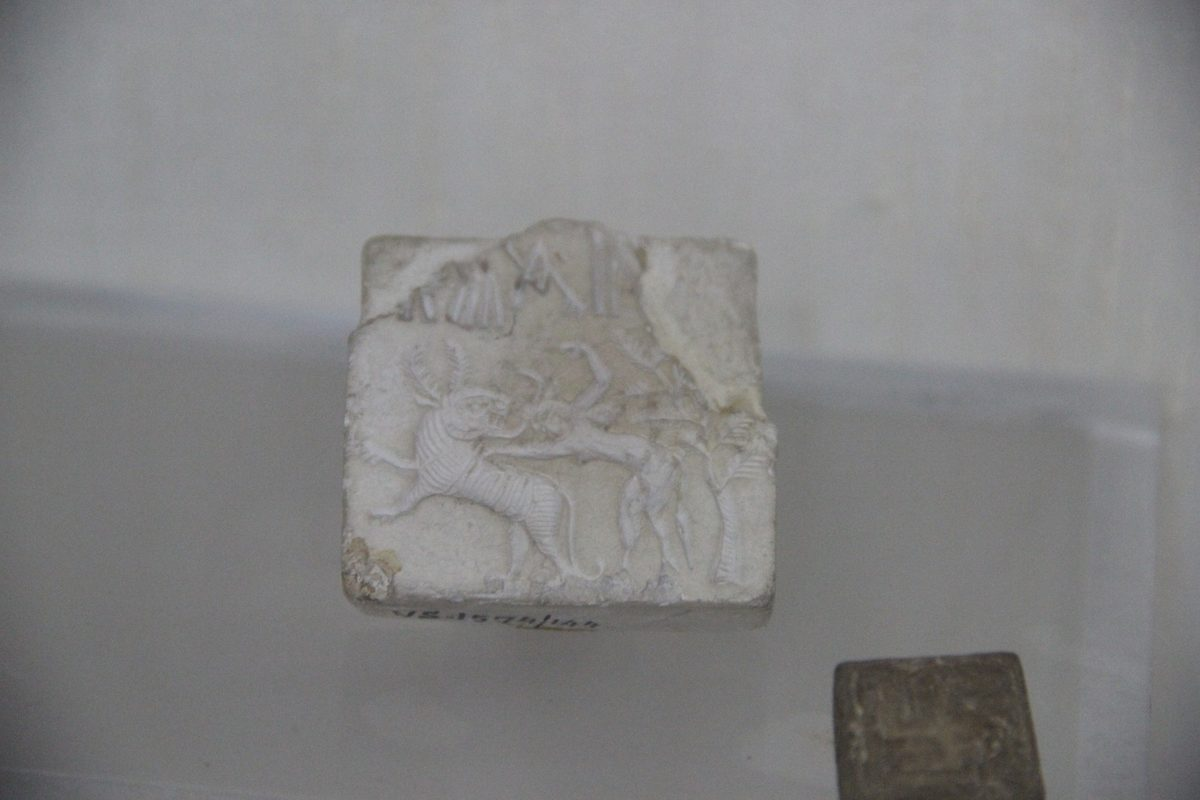
In a 1975 survey for the Journal of the Royal Asiatic Society, the Finnish Indologist Asko Parpola put numbers on the brevity problem that has shaped the field ever since: the average inscription runs to about five signs, and the longest continuous text found on a single surface — three lines on one object — comes to seventeen. Those figures have held up in the decades since. There is no Indus letter, ledger, proclamation, or king list in the record. Nothing that survives is longer than a sentence, if it is a sentence at all.
That brevity may not be a flaw in the record so much as a description of the job these objects did. A stamp seal’s most likely use was to be pressed into wet clay — on a bale of goods, a jar stopper, a storeroom door — to mark ownership, origin, or a transaction. Actual clay sealings bearing these impressions have been excavated both at Indus sites and at Mesopotamian ones: Indus seals and the clay they stamped turn up at Ur, and separate Sumerian administrative records describe trade with a place called Meluhha, which most historians identify with the Indus region. A 2018 study by the computer scientist Rajesh Rao goes further, arguing from a set of miniature inscribed tablets that some seals may have functioned less like ownership marks and more like ration tokens — recording fixed, repeated amounts of grain, labour, or goods rather than open language. If an Indus seal only ever needed to record a name, a quantity, or a transaction code, five signs may be all the system ever required, which does not make it less likely to be real writing so much as less likely to ever have produced a long text to find.
Nobody agrees on how many signs exist, and the disagreement matters
How many distinct signs make up this script is itself an open argument, which says something about how unsettled the whole field remains. In 1977 the Indian epigrapher Iravatham Mahadevan published a concordance of the known inscriptions — still the standard working catalogue — and counted 417 distinct signs. In 2015 the archaeologist Bryan Wells, working from an expanded corpus and different rules for what counts as a variant versus a genuinely new sign, put the number at 676, well over half again as many.
The gap is not carelessness on either side. It comes down to an unresolved question: when two carved marks differ slightly, are they the same sign cut by different hands, or two different signs? A true alphabet has a few dozen signs. A syllabary runs to a few hundred. A logographic system, in which each sign is closer to a whole word, can run into the thousands. Four hundred to seven hundred signs sits squarely in the range associated with a mixed logo-syllabic system — a similar scale to early Sumerian cuneiform or Egyptian hieroglyphs — which is one of the stronger indirect arguments that something language-like is happening. It is also, inconveniently for that argument, consistent with a non-linguistic symbol system that simply needed a large vocabulary of recurring marks, which is exactly what the skeptics on this question argue.
The Dholavira signboard is the one long inscription, and it still isn’t very long
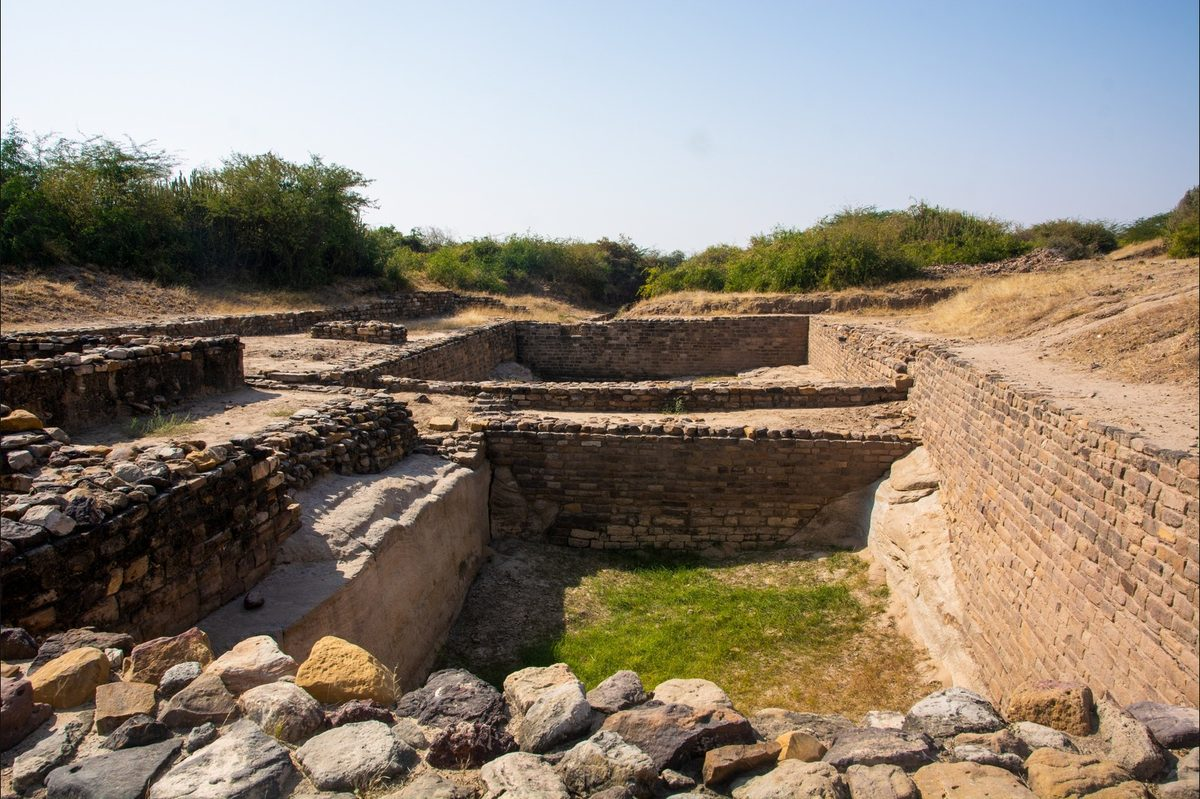
If the corpus has a single standout object, it is the signboard found at the northern gate of Dholavira, a major Indus city in the Rann of Kutch in modern Gujarat. Excavators found ten large signs, each roughly fifteen inches tall, made from pieces of inlaid white gypsum, with traces of decayed wood nearby suggesting the symbols had been mounted on a wooden board roughly eleven feet across and set above the gate.
Ten signs is nothing by the standards of scripts that have actually been read — a single line of a Linear B tablet routinely carries more than that — but by Indus standards it is the largest public text ever found, roughly double the length of the longest small-object inscription. Whatever it announced — a city’s name, a ruler’s title, a warning — it was judged important enough to carve at monumental scale and mount where every person entering the city would pass beneath it. A century and a half into the search, it remains the closest thing the Indus civilisation left to a sentence anyone can point to.
Why this isn’t like the scripts that have actually been cracked
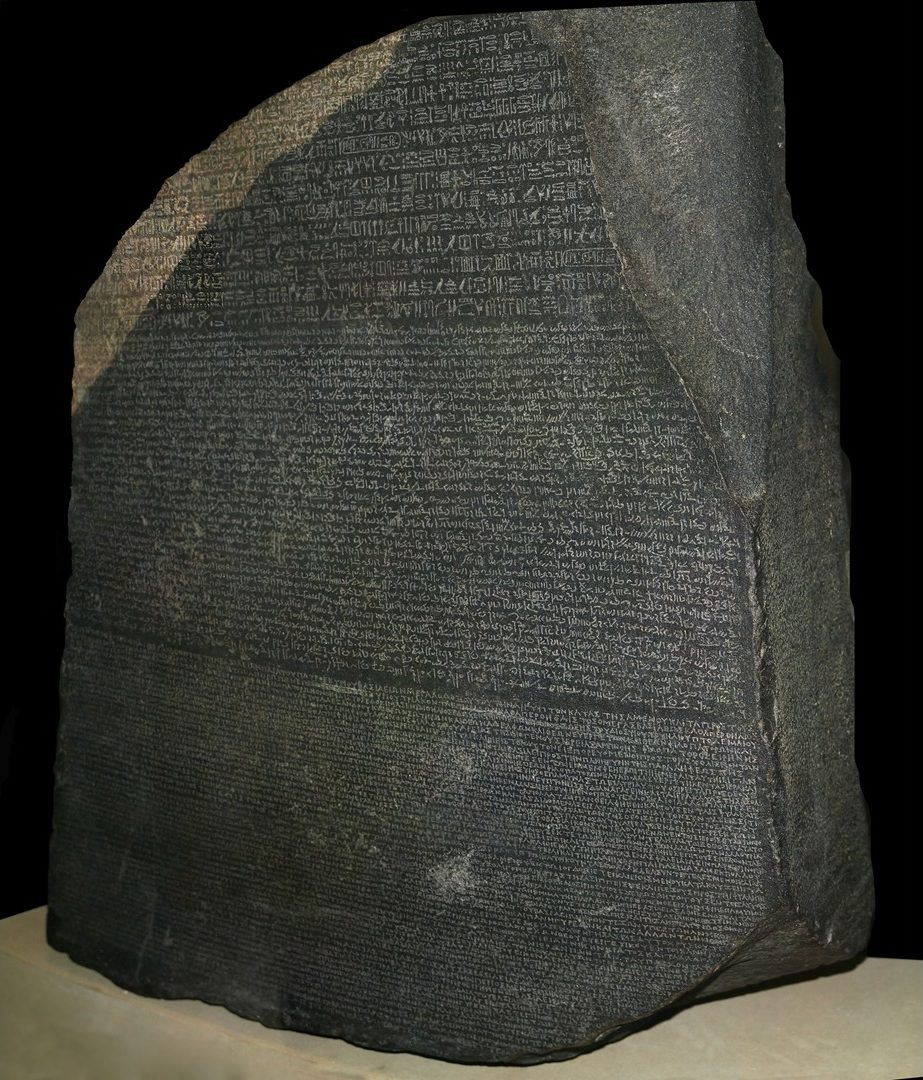
Every script that has genuinely been deciphered had one of two advantages the Indus script lacks entirely. Egyptian hieroglyphs fell because the Rosetta Stone carried an identical decree in three scripts, one of them readable Greek — a direct key. Linear B fell because Michael Ventris had hundreds of administrative tablets to work from, a strong guess at the underlying language, and enough repeated grammatical patterns to test that guess against. Mayan glyphs fell through a large corpus of long, dated, narrative inscriptions tied to known historical events and, eventually, surviving descendant languages.
The Indus script offers none of the three. No bilingual inscription pairing it with a known script has ever turned up, despite a century and a half of excavation. There is no narrative corpus — nothing resembling a chronicle, long enough to carry real grammar for a decipherer to test against. And there is no settled candidate for the underlying language, which means that even a longer text, if one surfaced tomorrow, might still be unreadable for want of knowing what language to read it as.
Two rival guesses at the language, and a horse-shaped problem
The leading candidate is Dravidian, the language family that today includes Tamil, Telugu, and Kannada, spoken mostly in southern India, well south of the Indus sites. In the 1960s a Soviet team led by Yuri Knorozov — the cryptanalyst who had already broken the Mayan script — ran the inscriptions through early computer analysis and concluded the underlying structure looked Dravidian; a Finnish team under Parpola reached a similar conclusion independently. Parpola’s best-known individual proposal involves a sign resembling a fish: in reconstructed early Dravidian, the words for “fish” and “star” are near-homophones, so a fish sign paired with a number might denote a star or constellation name. Mahadevan spent much of his career on the same hypothesis, and in 2014 proposed that one recurring four-sign sequence could be read, in early Dravidian, as a phrase close to “merchant of the city” — a claim he was careful to frame as supporting evidence for the Dravidian hypothesis, not as a completed decipherment.
A rival camp, associated most with the Indian marine archaeologist S. R. Rao, has argued instead for an early Indo-Aryan language, ancestral to Sanskrit. That case runs into an awkward archaeological fact: Vedic literature, the earliest textual layer of Indo-Aryan culture, is saturated with horses and spoke-wheeled chariots, and Indus sites have produced essentially no horse remains and no chariot technology from the civilisation’s mature period. A language family whose foundational texts are built around an animal that is largely missing from the material record it is supposed to belong to is a hard case to make.
Is it even writing? The argument that split the field in 2004
In 2004 three scholars — Steve Farmer, Richard Sproat, and Michael Witzel — published a paper arguing the entire premise was wrong: the Indus signs, they said, were never writing in a linguistic sense at all, but a system of non-linguistic emblems, closer to clan or guild marks than to a sentence. Their case rested on the brevity already discussed, on the high proportion of signs that appear only once or twice across the whole corpus, and, their sharpest point, on the observation that the rate of these rare “singleton” signs seems to increase rather than decrease across the roughly seven centuries the mature script was in use — the opposite of what happens as a working script standardises over time.
The rebuttal came on two fronts. Parpola pointed out that the near-total absence of long texts may simply reflect what the Indus people wrote them on: perishable materials such as cloth, palm leaf, or birch bark do not survive four thousand years in South Asia’s monsoon climate, while the surviving corpus is skewed toward durable stone and copper. And in 2009 Rajesh Rao, working with Mahadevan and a team that included Nisha Yadav of the Tata Institute of Fundamental Research, published a statistical study in Science measuring the conditional entropy of Indus sign sequences — essentially, how predictable the next sign is given the one before it — and found the pattern sat closer to natural languages, Old Tamil among them, than to clearly non-linguistic sign systems. A companion paper the same team published in the Proceedings of the National Academy of Sciences modelled the sign sequences with a Markov chain and reached a similar conclusion. Sproat replied that the entropy test was too coarse to actually separate language from other kinds of structured symbol systems. Neither side has conceded, and both papers are still actively cited today. Yadav’s more recent work applies machine-learning methods to the same sequences, hunting for grammar-like structure rather than meaning — a deliberately smaller claim than an actual translation.
Watch the full history
The video version walks through the inscriptions, the rival decipherment attempts, and the 2004 argument that the script may not be writing at all, in about nine and a half minutes.

Related reading
- Why No One Can Read the Phaistos Disc — or Agree That It’s Real
- Why Nobody Can Read the Voynich Manuscript
- What Happened to Rome’s Lost Ninth Legion?
- Why Was Göbekli Tepe Buried? What the Evidence Actually Shows
Shop the history
- Deciphering the Indus Script, by Asko Parpola — the standard scholarly account of the Dravidian decipherment case this article draws on.
Works cited
- Parpola, Asko. “Tasks, Methods and Results in the Study of the Indus Script.” Journal of the Royal Asiatic Society 107, no. 2 (1975): 178–209. Link.
- Rao, Rajesh P. N. “The Indus Script and Economics: A Role for Indus Seals and Tablets in Rationing and Administration of Labor.” arXiv:1812.00049 (2018). Link.
- Farmer, Steve, Richard Sproat, and Michael Witzel. “The Collapse of the Indus-Script Thesis: The Myth of a Literate Harappan Civilization.” Electronic Journal of Vedic Studies 11, no. 2 (2004): 19–57. Link.
- Rao, Rajesh P. N., Nisha Yadav, Mayank N. Vahia, Hrishikesh Joglekar, Ronojoy Adhikari, and Iravatham Mahadevan. “Entropic Evidence for Linguistic Structure in the Indus Script.” Science 324, no. 5931 (2009): 1165. Link.
- Rao, Rajesh P. N., Nisha Yadav, Mayank N. Vahia, Hrishikesh Joglekar, Ronojoy Adhikari, and Iravatham Mahadevan. “A Markov Model of the Indus Script.” Proceedings of the National Academy of Sciences 106, no. 33 (2009): 13685–13690. Link.
- Mahadevan, Iravatham. The Indus Script: Texts, Concordance and Tables. Memoirs of the Archaeological Survey of India, no. 77. New Delhi: Archaeological Survey of India, 1977.
- Parpola, Asko. Deciphering the Indus Script. Cambridge: Cambridge University Press, 1994.
- Robinson, Andrew. “Cracking the Indus Script.” Nature 526, no. 7574 (2015): 499–501. Link.
- “Correction: Cracking the Indus Script.” Nature 532, no. 7599 (2016): 308. Link.
- Alagappa, Harish. “The Oldest Billboard in the World?” Atlas Obscura, January 20, 2023.
- “$1 Million Prize Offered for Deciphering the Indus Valley Script.” HeritageDaily, January 2025.