
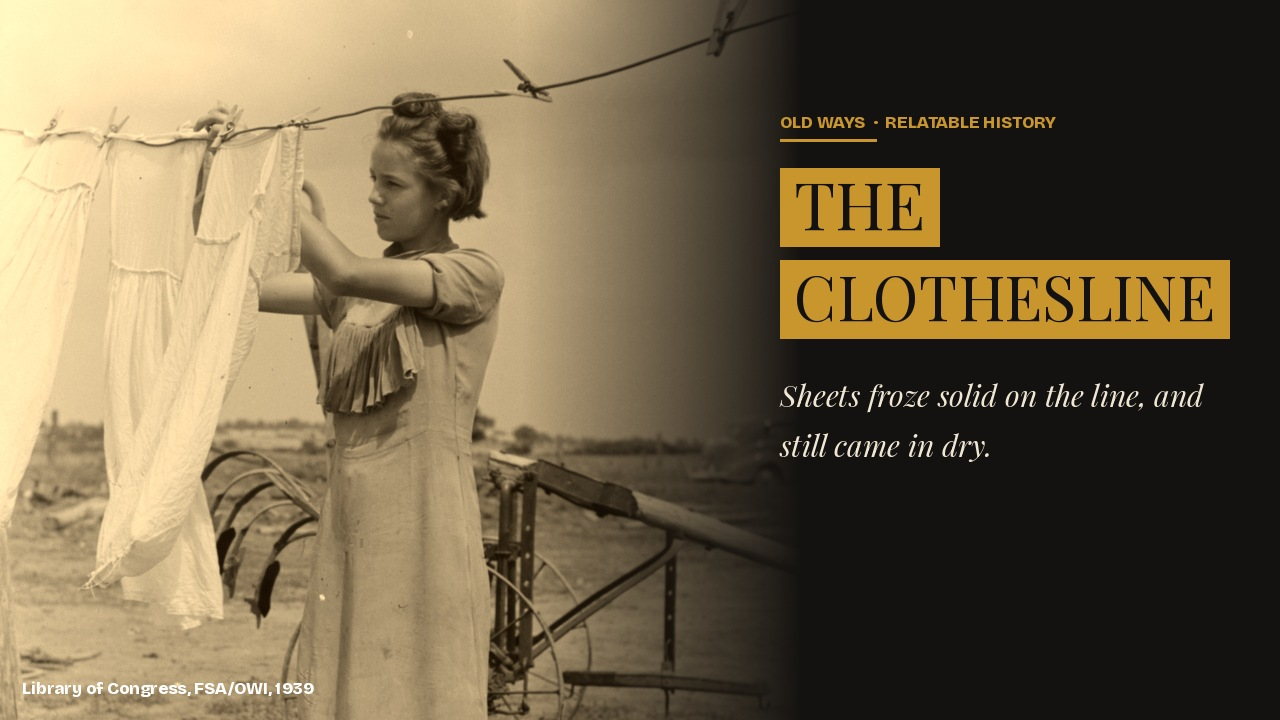
Between 1852 and 1887, the United States Patent Office granted a hundred and forty-six separate patents for a device that does exactly one job: pinch a piece of wet cloth against a piece of rope. That clothespin patent history is an extraordinary amount of engineering attention for something this small, and it is a useful clue that the clothesline was never as simple as it looked.
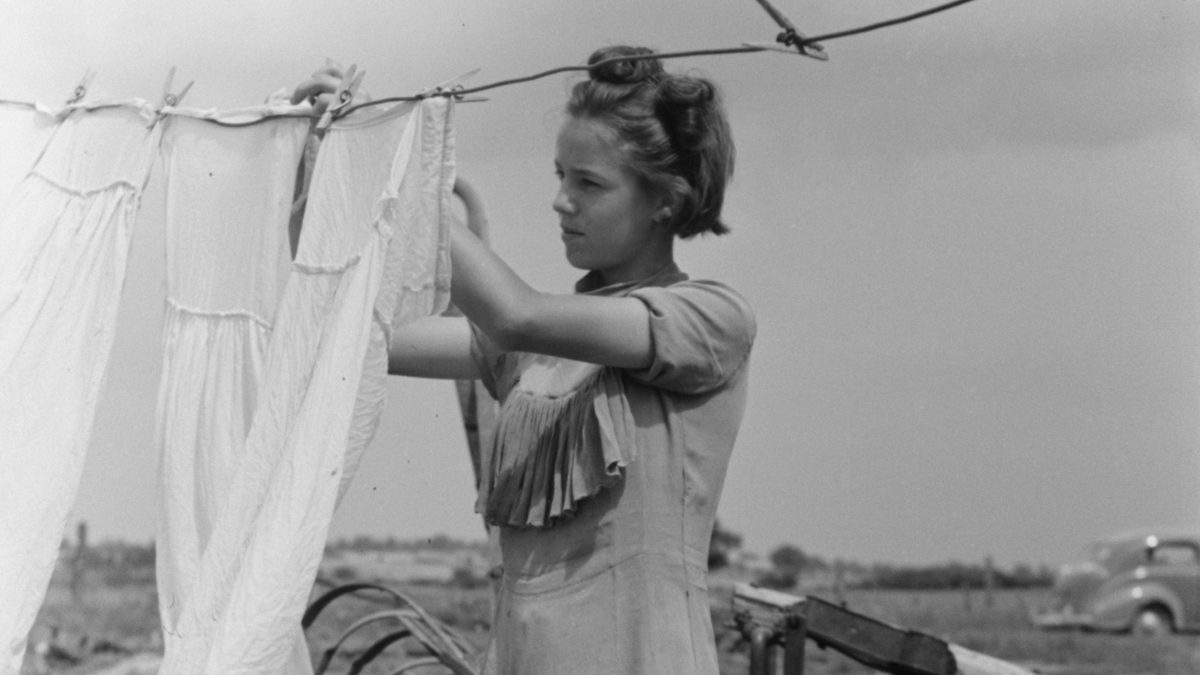
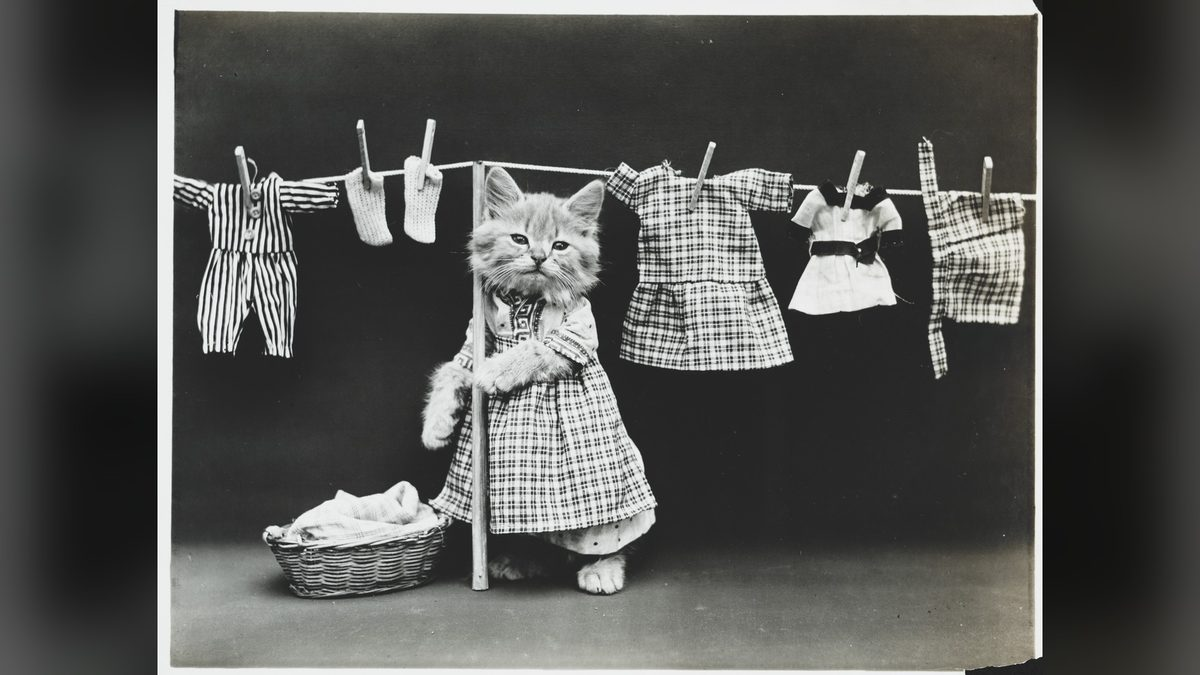
For most of American history, a family’s wash dried outdoors, on a line strung between two posts or from the porch to the nearest tree, in every season the calendar produced. What actually made that work — the mechanics of the pin, the physics of a below-freezing wind, the science behind why sunlight did more than just bleach — was mostly invisible to the people using it. This is the machinery behind the rope: who patented the pin, what the sun and cold were actually doing to the cloth, how the ritual of Monday wash day structured a household, and how a lawsuit-adjacent tangle of homeowners associations and state legislatures ended up deciding, decades later, whether you’re even allowed to use one.
The clothespin patent history behind that one small spring
Before there was a spring clothespin, there was just a peg: a length of willow or ash whittled into two legs, split partway up the shaft, that straddled the line by friction alone. Peddlers sold them by the dozen, they cost almost nothing, and they worked poorly in any real wind, since nothing was holding the two legs together but the wood’s own spring.
David M. Smith of Springfield, Vermont, filed the first serious fix in October 1853: a “spring-clamp for clothes-lines” that used a small separate metal spring to force two carved wooden jaws shut. It worked, but it needed a spring and two matched wooden halves manufactured and assembled as three parts. Thirty-four years later, in March 1887, Solon E. Moore of Swanton, Vermont, patented the fix that stuck: a single length of wire, coiled once in the middle to act as both the spring and the hinge, holding two identical grooved wooden legs together with no separate fastener at all. Reducing the part count from three pieces to two, one of them a single bent wire, is the whole reason Moore’s design could be stamped out cheaply by the gross — and it is, essentially unchanged, the spring clothespin sold today.
Vermont turned that redesign into an industry, though not through the man who patented it. The U.S. Clothespin Company was chartered in Montpelier in August 1887 to manufacture under Moore’s improved design. One of its employees, Allen D. Moore — no relation to Solon — refined the spring further for cheaper manufacture, and in 1909, backed by local businessman Fred Blanchard, struck out on his own with a twenty-employee shop called the National Spring Clip Company. That company moved into a larger, three-story wood-frame factory on Granite Street in 1918, was sold in 1929 to a buyer who trademarked its pins “Klos Klips,” and took the name it kept for the rest of its history, the National Clothespin Company, in 1939. By the 1930s the industry Moore’s employer and his rival had built between them ran fifteen factories across New England, two of them in Montpelier alone — productive enough that, writing in 2017, intellectual-property historian Neil Wilkof noted that the New York Times had once called the area the Silicon Valley of nineteenth-century clothespin technology.
The end came slowly and then all at once. Postwar demand fell as the electric dryer spread; cheap European and then Asian imports undercut the domestic price through the 1960s and after; a 1982 lobbying push to get Congress to restrict clothespin imports failed, by which point only five New England factories and 427 workers were left in the trade. Maine’s Penley Corporation, founded in 1923, gave up manufacturing clothespins in the 1990s and switched to importing and distributing them instead; Forester Inc. of Wilton, Maine, made its last one in 2003. The National Clothespin Company outlasted every domestic competitor and filled its own final purchase order that November, according to the factory’s own National Register nomination — making it, at the end, the sole survivor of an industry that had once run fifteen strong. The Granite Street building was added to the National Register of Historic Places two years later, in 2005, a rare case of the designation marking the close of an industry rather than the preservation of one still running.
Why a frozen sheet comes in dry: the physics nobody had to understand to use
A wet sheet hung out at ten degrees Fahrenheit freezes solid within minutes, and it looks, at that point, like the process has simply stopped. It has not. Below freezing, ice has its own vapor pressure — a measurable tendency for water molecules to escape the solid directly into the surrounding air — and on a bright, dry, windy day that vapor pressure is higher than the moisture already in the air. Water molecules leave the ice a few at a time, without ever passing through a liquid stage, until the sheet is dry and stiff rather than wet and stiff. The technical name for that jump from solid straight to vapor is sublimation, and it is the exact mechanism, run in reverse of temperature, that a modern freeze-dryer uses to pull water out of coffee or a vaccine without heating it. A January clothesline and a pharmaceutical lyophilizer are doing chemically identical work.
Warm-weather drying runs on a related but separate principle: moving air constantly replaces the humid layer clinging to wet fabric with drier air from farther off, which is why a breezy, overcast day can outdry a still, sunny one. The line itself was usually strung to catch the prevailing wind rather than to face the sun, and a fully loaded line sagged enough under its own weight that a forked wooden prop — a second post cut on purpose to lift the middle — was standard equipment, not an improvisation.
Sunlight wasn’t just cosmetic — it was doing real disinfecting work
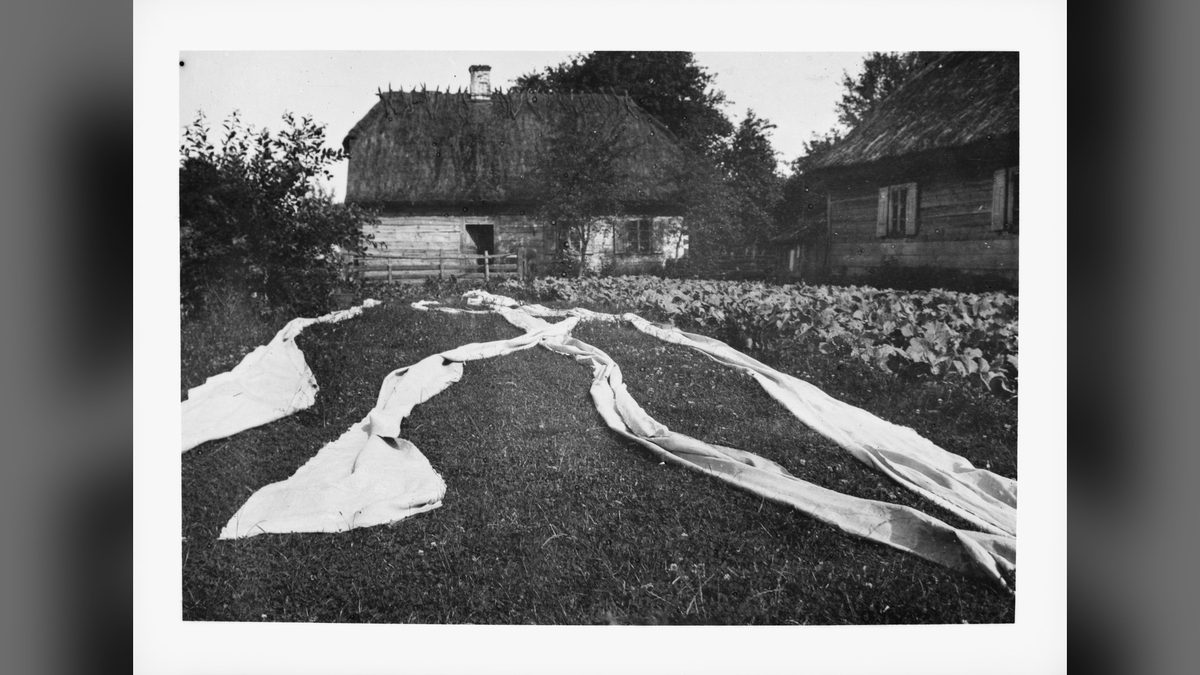
Long before commercial bleach, households laid their whitest linens flat on the grass, rather than pinned to a line, specifically to whiten them in direct sun — a practice old enough to have its own name, a “bleach green,” and its own etiquette about which part of the yard was reserved for it. What the sun was doing went beyond appearance. Ultraviolet-B radiation damages the genetic material of bacteria and fungi directly, and a 2014 study in the Israel Medical Association Journal put a number on it: researchers took fifty-two socks worn by patients being treated for athlete’s foot, left half of them outdoors in the sun for three days and half indoors as a control, then cultured both groups. The sun-exposed socks came back fungus-negative at a significantly higher rate than the indoor ones. A household with no germ theory at all had, by trial and habit, arrived at a genuinely effective disinfection method, and simply called it hanging out the wash.
The line “sunlight is said to be the best of disinfectants” is older than the study and did not originate with laundry at all — Louis Brandeis coined it in 1913 to argue for financial transparency, not hygiene. It turns out to be literally true for a pile of wet cotton as much as for a company’s books.
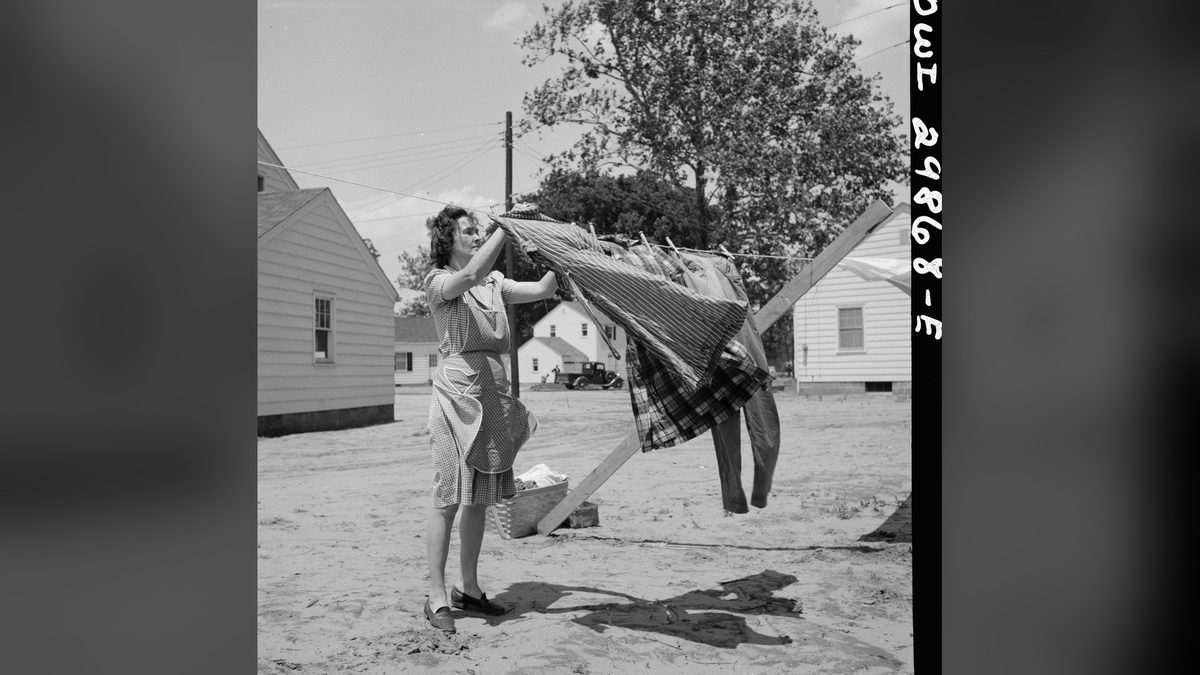
“Blue Monday” had nothing to do with anyone’s mood
The name comes from laundry bluing, a dye added to the final rinse that counteracted the yellow-gray cast plain washing left on white cotton, and by the mid-nineteenth century the name for the dye had become the name for the day it was used on. The scale of the job is what fixed that day in place: water hauled and heated in a copper boiler, clothes scrubbed on a board, boiled, wrung by hand and rinsed twice, all before a single item could go on the line — which is also why the ironing that followed needed a whole separate day of its own.
The labor was heavy enough that households that could not really afford it still paid to avoid it. A 1909 Russell Sage Foundation survey of working-class New York City families found that sixty percent of the 391 households studied spent some money on outside laundry help, even though hiring it out competed directly with rent and food in a tight weekly budget. A full line, hung early and in good order, was also read by the whole street as a small public verdict on the household running it — which is part of why the line had rules at all, sheets on the outer rows and small clothes hidden behind them, and why a line still hanging wash on a Sunday was the kind of thing neighbors noticed and mentioned.
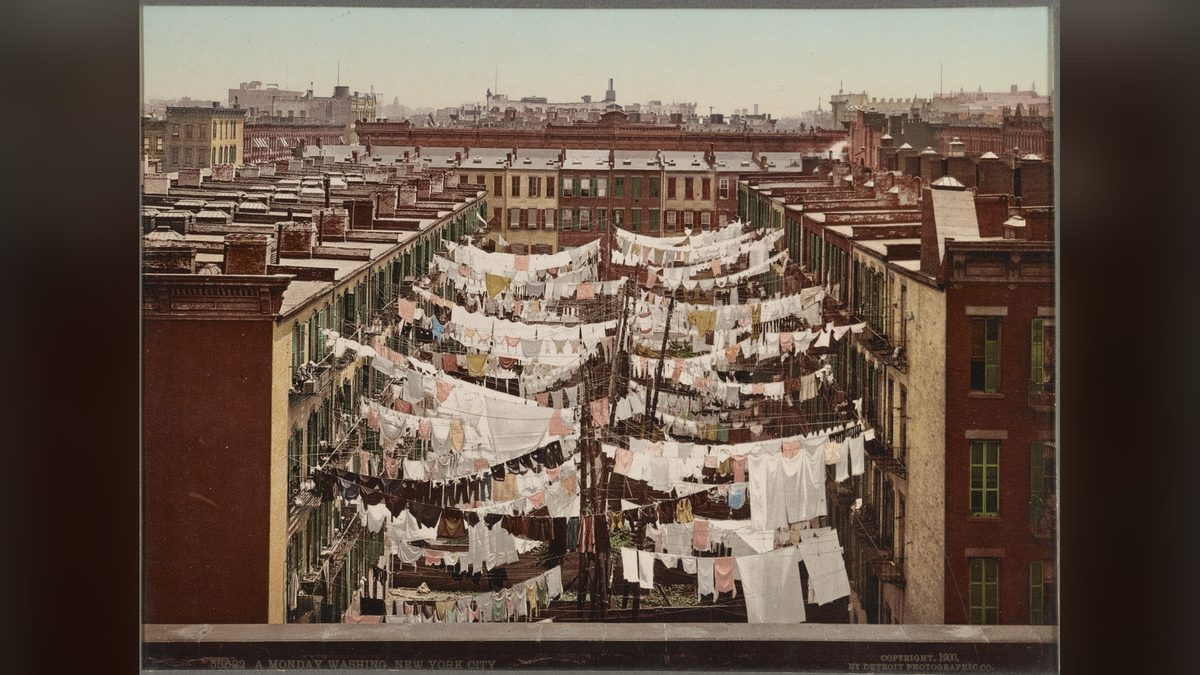
The man who ended it was getting even with North Dakota winters
J. Ross Moore grew up on a North Dakota farm hanging wet laundry in an unheated shed through winters far harder than anything most of New England saw, and he started experimenting with an electrically heated drum to replace that shed as early as 1915. It took him roughly two decades of tinkering, largely alone and without backing, before he found a manufacturer willing to build it: the Hamilton Manufacturing Company of Two Rivers, Wisconsin, which put his design on sale in 1938 under the name “June Day” at $230 a unit — equivalent to roughly $1,600 in year-2000 dollars, according to the Bureau of Labor Statistics’ own retrospective pricing analysis of the clothes dryer market. It was not a fast changeover. By the Bureau’s figures, only about ten percent of American households owned a dryer by the mid-1950s, a share that climbed to roughly forty-five percent by 1970 and about seventy-eight percent by 1997 — a sixty-year transition, not the overnight one the appliance’s advertising implied. Vermont’s last clothespin factory closed in 2003, near the tail end of that curve, when the market for its product had finally thinned past the point of running a factory.
The line never fully disappeared, and now it’s written into law
As dryer ownership climbed through the postwar decades, the clothesline itself started to be treated, in the newer suburbs being built around those same dryers, as a problem to zone away. Homeowners associations and condominium covenants across the country began writing outright bans on outdoor drying, usually filed under the same aesthetic rules that governed paint colors and fence heights. Advocacy against those bans, led in part by the nonprofit Project Laundry List, produced a wave of state legislation instead: nineteen states have now passed laws that explicitly override a homeowners association’s power to prohibit a clothesline or drying rack, some through direct right-to-dry statutes and others through broader solar-access laws written for solar panels but worded to cover a line as well. Vermont, the state that patented the modern clothespin and then built an industry on it, is on that list.
None of this made the electric dryer optional again. What it did was turn a piece of household equipment nobody thought twice about for most of the country’s history into something a legislature had to specifically protect the right to use. A rope and a bag of pins went from universal to regulated in under a century, which is its own kind of evidence for how completely the object at the other end of that line — the dryer — had won.
Watch the full history
The six-minute version covers the same ground with the winter freeze-dry trick at the center, in about five minutes.

Related reading
- The Stereoscope Craze That Swept Victorian Parlours
- The WPA Sanitary Privy Program That Built Two Million Outhouses
- How the Sedan Chair Actually Worked, and Why It Started as a Scandal
- The Chemistry Inside a Sauerkraut Crock, and Why It Actually Works
For further reading
Irene Rawlings and Andrea VanSteenhouse, The Clothesline (Gibbs Smith, 2002), gathers the history, rituals and folklore of line drying in one short book: The Clothesline on Amazon.
Works cited
- Vermont Historical Society. “The Humble Vermont Clothespin.” Link.
- Smith, David M. “Spring-Clamp for Clothes-Lines.” U.S. Patent 10,163, filed October 1853. Google Patents. Link.
- Moore, Solon E. “Clothes-Pin.” U.S. Patent 365,755, filed March 1887. Google Patents. Link.
- Wilkof, Neil. “Patents and the Silicon Valley of Clothespins.” The IPKat, February 26, 2017. Link.
- National Register of Historic Places Registration Form: “National Clothespin Factory,” Montpelier, Vermont. U.S. National Park Service, listed December 16, 2005 (Reference No. 05001422). Link.
- U.S. Bureau of Labor Statistics. “Hedonic Quality Adjustment Methods for Clothes Dryers in the U.S. CPI.” Consumer Price Index research series.
- Amichai, Boaz, Marcelo H. Grunwald, Batya Davidovici, and Avner Shemer. “‘Sunlight Is Said to Be the Best of Disinfectants’: The Efficacy of Sun Exposure for Reducing Fungal Contamination in Used Clothes.” Israel Medical Association Journal 16, no. 7 (July 2014): 431-433. Link.
- Living History Farms. “Blue Monday: Wash Day.” Link.
- Eriksmoen, Curt. “This North Dakotan Made Laundry Day Much Simpler by Inventing the Automatic Clothes Dryer.” The Forum (Fargo, ND) / InForum. Link.
- Neil, Martha. “19 ‘Right to Dry’ States Outlaw Clothesline Bans; Is Yours Among Them?” ABA Journal, August 14, 2013. Link.
- Sightline Institute. “Clothesline Bans Void in 19 States.” February 21, 2012. Link.