
A butter churn is a stick in a bucket, and for most of human history that was the entire machine. It is also, by a fair reckoning, one of the longest-running unmodified pieces of technology still in use: the paddle that agitates cream today does the same job, at roughly the same tempo, as a skin bag a Bronze Age herder slung over a pack animal’s back. What changed over the centuries was not the physics of separating fat from milk. It was who, or what, did the agitating.
At various points that answer has been a housewife with a sore arm, a farm dog walking an inclined treadmill, a rotating wooden barrel, and finally a spinning steel bowl that finished the job in seconds. Threaded through that sequence are a Gothic cathedral tower financed by the right to keep eating butter during Lent, roughly five hundred lumps of prehistoric butter still sitting in Irish peat, and two centuries in which a bucket of cream that refused to turn was treated as evidence of witchcraft. This is the mechanism behind all of it, and the record of exactly when each part changed.
Butter was invented by accident, repeatedly, before anyone built a churn for it
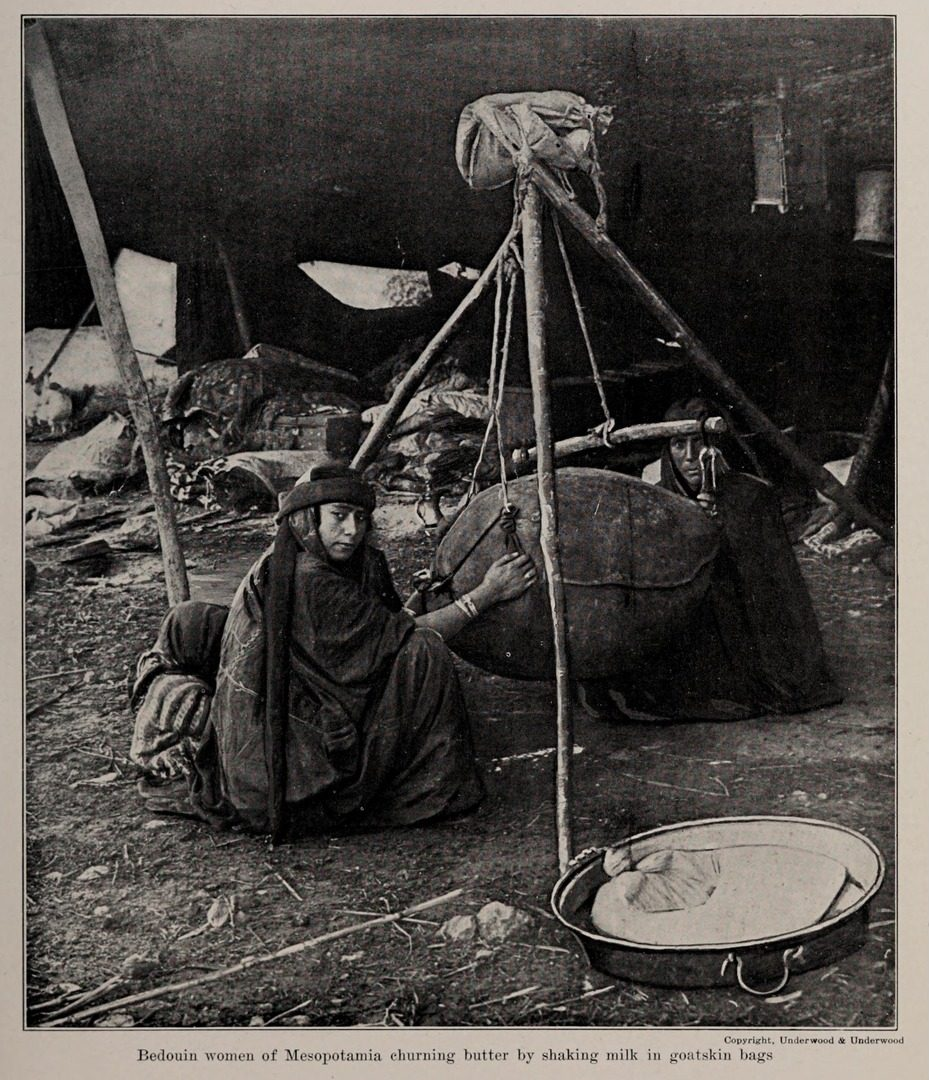
The oldest method of making butter needed no dedicated equipment at all. Nomadic herders poured milk into a bag made from an animal’s stomach or hide, tied it to a pack animal, and let a day’s walking do the agitating. By the time camp was made, the jostling had separated the fat. Anyone who carried milk any distance for long enough would eventually have produced butter without meaning to, which is one reason variants of the same accidental process show up independently across the ancient Near East, the Eurasian steppe, and East Africa.
Greek and Roman writers knew about butter and were not impressed by it. Pliny the Elder describes it in his Natural History as the most exquisite food of the barbarous nations to the north, a line that reads as backhanded because it was meant to be: Rome ran on olive oil, and butter was what people beyond the frontier ate instead. Roman and Greek medical writing treats it mainly as a salve, something to rub on burns or work into a wound dressing, not an ingredient for the table. The contempt was cultural rather than practical — butter keeps and travels less well than oil in a Mediterranean climate, but the tone of the sources goes well beyond a shelf-life complaint.
The same substance became sacred rather than suspect in Vedic India
Set the Roman sneer against the Indian subcontinent and the contrast is almost total. Ghee, milk fat clarified by simmering off the water and milk solids, appears throughout the Rigveda, one of the oldest surviving religious texts, where it is poured into ritual fire as an offering to the gods. Clarifying rather than simply churning was a practical response to a hot climate that spoils plain butter quickly, but the Vedic texts treat the transformation itself as meaningful: milk becomes butter becomes ghee, a progressive purification that Hindu cosmology echoes directly. One of the central myths of Hinduism, the Samudra Manthan, has gods and demons churning an entire ocean to draw out the treasures, including immortality, hidden inside it. Butter, in other words, was doing metaphysical work in South Asia at almost exactly the period Roman writers were treating it as a barbarian ointment.
Ireland buried its surplus butter for roughly three and a half thousand years
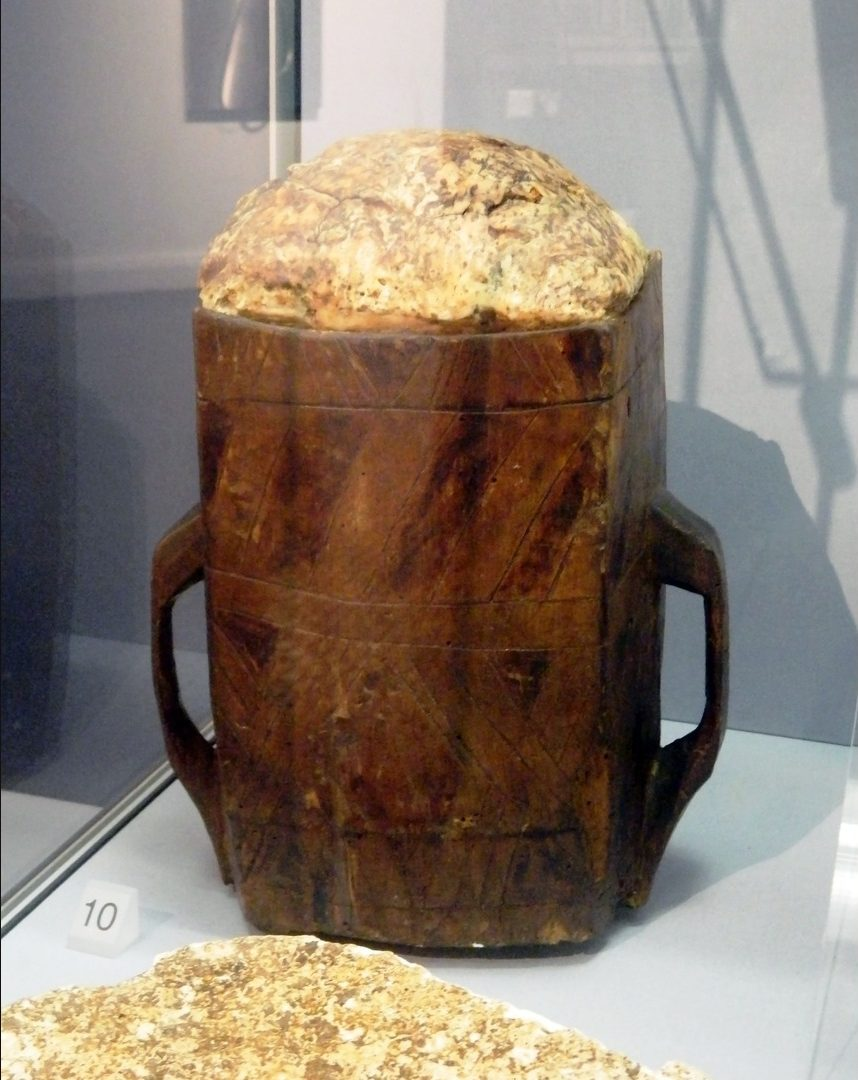
Nothing about butter’s later history is stranger than the Irish evidence. Across Ireland and parts of Scotland, people cutting peat for fuel keep finding butter: pale, waxy, usually still packed into a wooden vessel, sometimes a hollowed log, occasionally a churn itself. Roughly five hundred of these finds have been formally recorded. A 2019 study in Scientific Reports, using compound-specific stable isotope analysis on samples held by the National Museum of Ireland, confirmed what earlier researchers had suspected but not proven: the material is genuinely dairy fat, and radiocarbon dating puts the tradition across roughly 1700 BCE to the seventeenth century CE — about 3,500 years of continuous practice.
Why anyone buried it is still argued. A bog is cold, acidic and starved of oxygen, which makes it a near-perfect natural refrigerator — the same cold-storage logic a later farm would get from digging a root cellar instead of a peat bank — so storage is the straightforward explanation for at least some of the finds. But researchers who have worked on the material point out that a lot of it was never collected, which sits oddly with pure food storage and has led some to treat certain deposits as votive offerings instead. Because the containers vary so much in age and construction, both explanations are probably correct for different finds, and nobody can reliably sort one category from the other after the fact.
A cathedral tower in Normandy was financed by the right to keep eating butter
By the medieval period, the churn had settled into the shape most people picture: an upright wooden barrel worked by a plunger called a dash, a design so standard it gave dash churns their name. Lent, however, banned butter along with meat and eggs, and in Normandy that was a genuine hardship, because Norman cooking runs on butter in a way that Mediterranean cooking does not. The Church’s solution was to sell dispensations: for a payment, a household could keep eating butter through Lent.
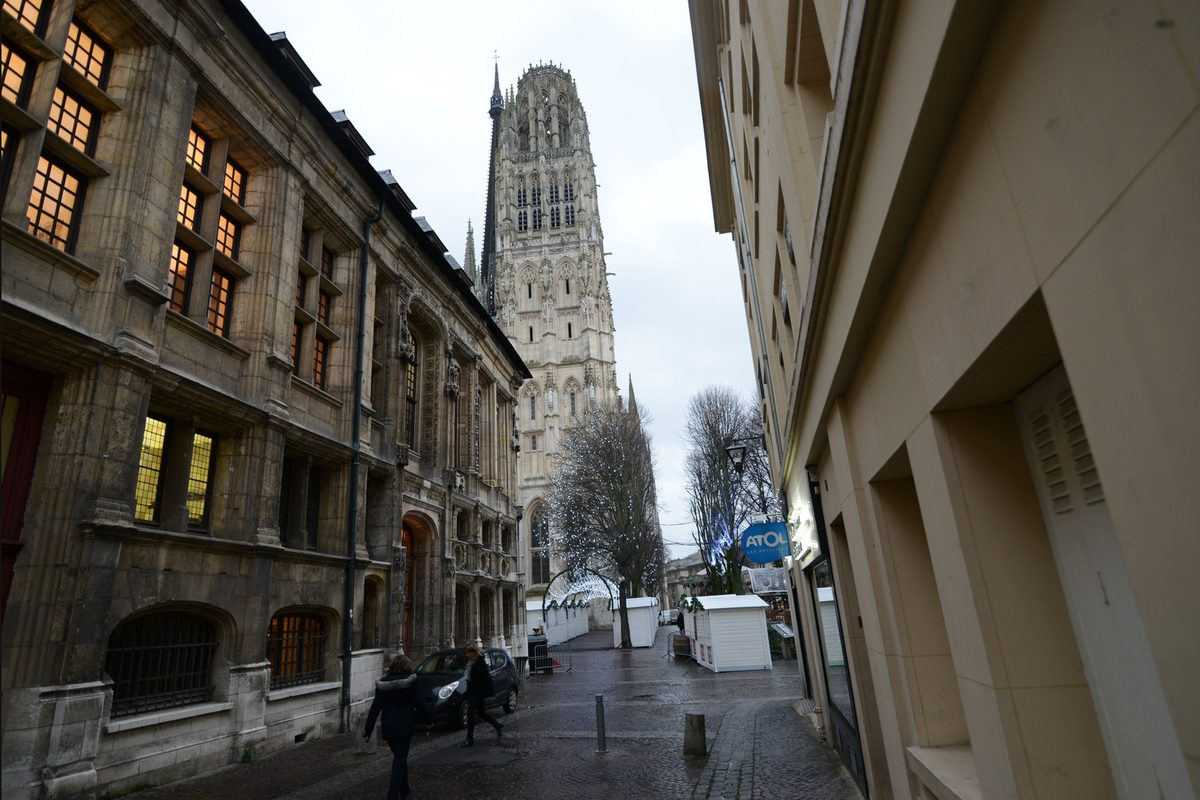
In Rouen, the money raised from those Lenten butter dispensations helped fund a new tower on the cathedral, built under the archbishops Guillaume Pontifs and then Jacques Le Roux between 1487 and 1507. It is still standing, and it is still called the Tour de Beurre — the Butter Tower. Historians of the building are not actually unanimous on why: a scholarly account in the French heritage journal In Situ notes a rival explanation, that the unusual yellow Oise stone used in construction simply looked like an enormous pat of butter to Rouen’s residents. Both stories may be true at once — a nickname earned by color, kept alive by the more memorable story about how the tower was paid for.
When cream refused to turn, the accusation was witchcraft
Hand-churning a dash churn took the better part of an hour of steady plunging, and the process was far more temperature-sensitive than force-sensitive: cream too cold simply never came together, cream too warm turned to grease, and there was no reliable way for a sixteenth-century dairymaid to know which problem she had. In a world with no theory of butterfat chemistry, an hour of unexplained mechanical failure looked exactly like malice, and failed churning became one of the most common specific accusations behind European and later American witch trials, catalogued in sources from the Malleus Maleficarum onward.
Recent research into the pattern is more precise than the folklore suggests. A 2025 study by the historian Philippa Carter, working from the casebooks of the Jacobean astrologer-physician Richard Napier, found seventeen recorded cases of magical interference with dairying and traced all ten of the accusers who raised the complaint to housewives — the people whose household reputation rested specifically on the quality and quantity of the butter, cheese and beer they produced. Dairy work had become gendered, and that made the women who did it the first people blamed when it failed. Farms answered the suspicion with counter-magic of their own: dropping a horseshoe, a needle or a knife into the churn to break a supposed spell, blessing the cream with holy water, or thrusting a red-hot poker into it — a remedy that, incidentally, would have changed the cream’s temperature and may occasionally have worked for reasons nobody involved understood.
American farmers solved the same hour of labor by hiring the dog
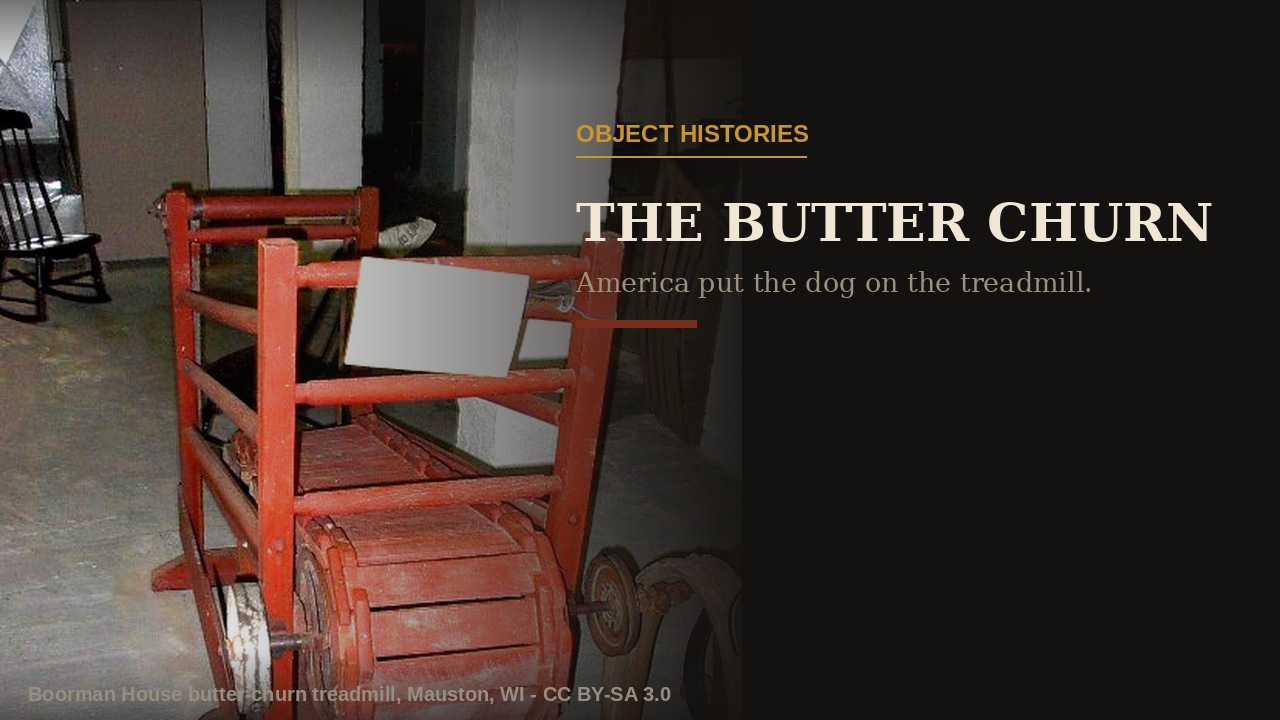
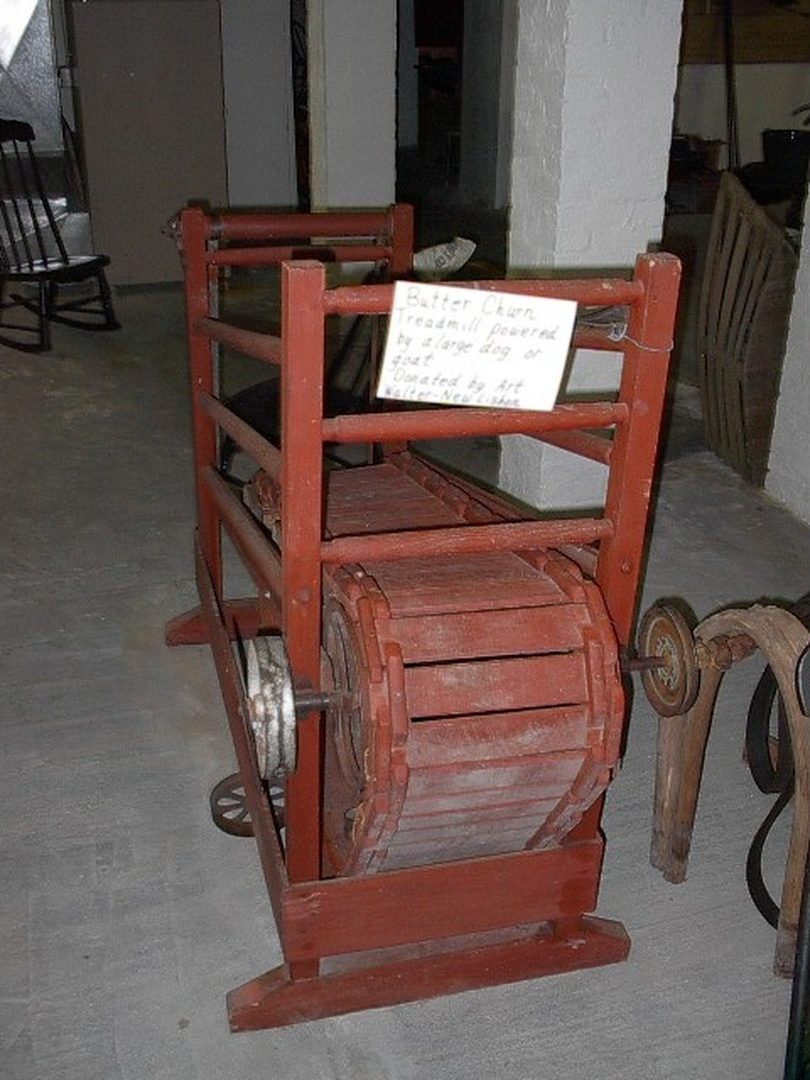
The dash churn’s real weakness was never mysterious: it needed roughly an hour of continuous human effort, almost always a woman’s, for every batch. By 1832, farms along New York’s Hudson Valley had a mechanical answer that used no new principle at all, just a different source of motion. A dog, sometimes a goat or a sheep, walked an inclined treadmill wired to a flywheel and a pitman rod, which drove the dasher up and down for as long as the animal kept walking. Dexter C. Slater patented a general dog-power mechanism in 1859, H. M. Childs of Utica, New York patented a churn-specific version in 1871 — the Smithsonian’s National Museum of American History holds his patent model — and Nicholas Potter’s “Enterprise Dog Power” followed around 1881.
The same small treadmills were geared to more than churns. Trade catalogues and surviving units, including one likely built by the Vermont Farm Machine Company, show them belted to grindstones, corn shellers and fanning mills as well, which meant that for a few decades a mid-sized farm dog was, in a real if informal sense, listed as equipment. The device was never efficient in any absolute sense — it substituted one exhausted worker for another rather than reducing the actual labor — and it did not last much beyond the turn of the century once better alternatives appeared.
What finally replaced both the dog and the dash
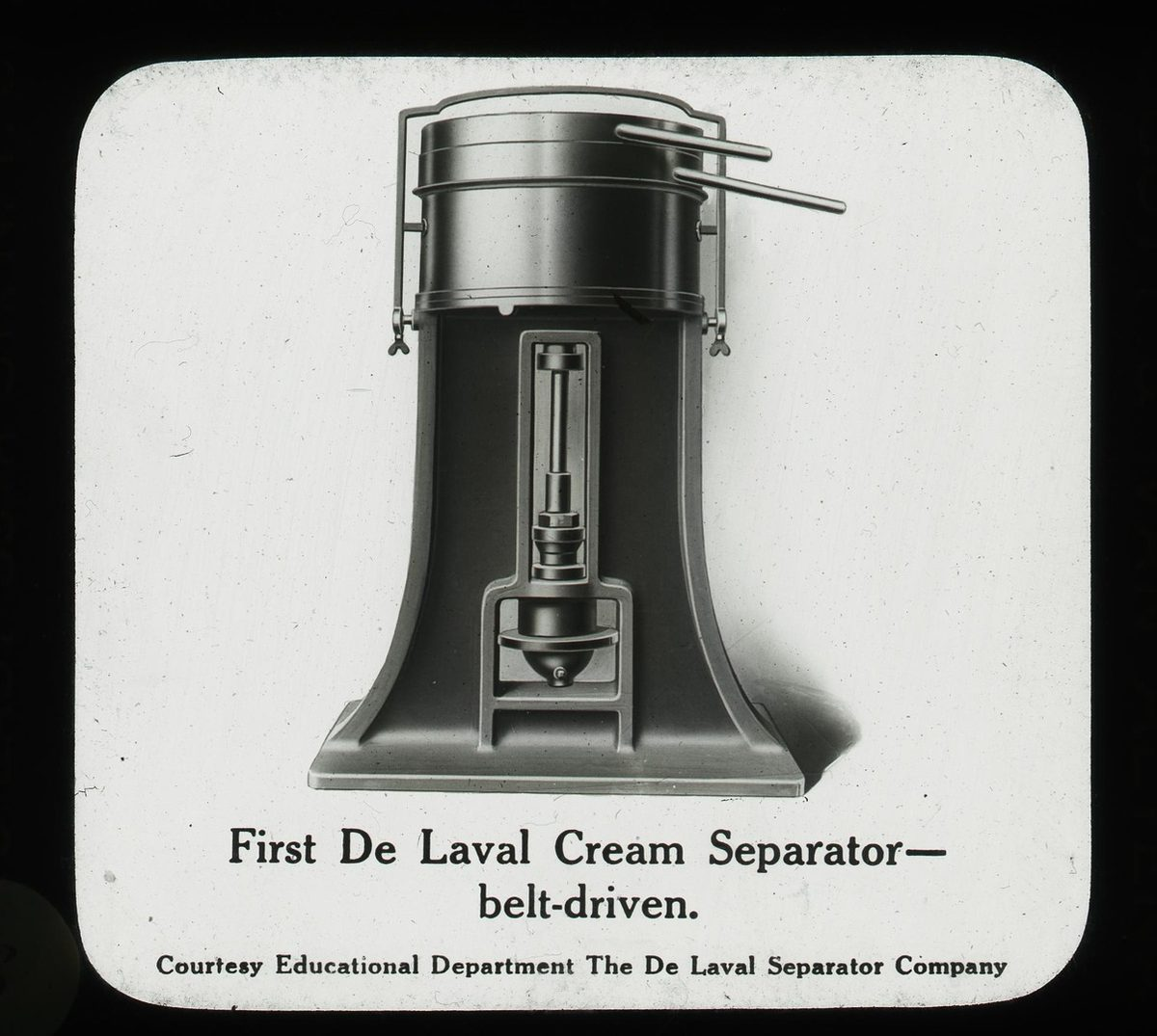
Two separate improvements ended the dog-power era, and neither of them involved training the dog harder. The first was the revolving barrel churn, which replaced the up-and-down dasher stroke with a simple rotation and could be turned by a hand crank a child could manage, making the treadmill largely redundant on an ordinary farm. The second, more consequential change arrived in 1878, when the Swedish engineer Gustaf de Laval patented the first continuously running centrifugal cream separator. Spinning milk at speed threw the heavier skim milk outward and left the cream to be drawn off from the center, a process that took minutes rather than the week of standing and settling that traditional cream collection had required. By the turn of the century, hand-cranked separators — de Laval’s and his many competitors’ — were standard equipment on dairy farms across Europe and the United States, and the entire question of how to power a dash churn became irrelevant, because nobody needed a dash churn anymore.
What the churn’s whole run shows, end to end, is that a single unchanging bit of physics — agitate fat out of milk — can carry an enormous amount of unrelated cultural weight on its back. The same action was a barbarian’s food, a god’s offering, a prehistoric Irish family’s cold storage, a cathedral’s building fund, evidence in a witch trial, and a job description for a dog, often within the same few centuries as each other rather than in some tidy sequence. None of that changed how butter is actually made; a stick in a bucket separates fat exactly the way a spinning steel bowl does, just slower.
What did change was the tolerance for slowness. Once a machine existed that could do in three minutes what a person or a dog spent an hour doing, the whole apparatus of dash churns, treadmills and counter-witchcraft charms became a museum piece almost overnight, the same way a wood cookstove eventually made the open hearth obsolete. The next time something in your kitchen takes an hour of tedious manual effort, it is worth asking who, historically, got assigned the job before you — and whether the family dog would have been on the shortlist.
Watch the full history
The video version covers the same sweep, from bog butter to the retired farm dog, in about six and a half minutes.

Related reading
- How the Wood Cookstove Ran the American Kitchen for a Century
- Drying Fruit and Herbs: How a Farm Kept Food Without a Freezer | Old Ways
- How a Smokehouse Cured a Year’s Worth of Meat With Only Salt, Smoke, and Time
- How a Root Cellar Kept Vegetables All Winter: The Farm’s Biggest Refrigerator Was a Hole in the Ground
Works cited
- Khosrova, Elaine. Butter: A Rich History. Algonquin Books, 2016.
- Pliny the Elder. Natural History, Book 28.133, on butter as “the most exquisite food among barbarous nations.” Latin text via LacusCurtius, University of Chicago. Link.
- Alimentarium (Nestlé food museum, Vevey). “Ghee” fact sheet.
- Mattiangeli, V., Bond, J., Sabin, R., et al. “Four millennia of dairy surplus and deposition revealed through compound-specific stable isotope analysis and radiocarbon dating of Irish bog butters.” Scientific Reports 9, 4055 (2019). Link.
- University College Dublin. “Irish bog butter proven to be ‘3,500 years’ past its best before date.” UCD News, March 2019. Link.
- “Le beurre et la couronne.” In Situ: Revue des patrimoines, no. 1 (2001), on the funding and disputed naming of the Tour de Beurre. Link.
- Carter, Philippa. “Work, Gender and Witchcraft in Early Modern England.” Gender & History (2025). Link.
- University of Cambridge. “Witchcraft accusations were an ‘occupational hazard’ for female workers in early modern England.” Cambridge news, September 2023. Link.
- Smithsonian National Museum of American History. “Dog-powered Butter Churn Patent Model,” object record, H. M. Childs patent, Utica, New York, 1871.
- “Powered by Animal Tread Power.” Farm Collector, Ogden Publications. Link.
- Tekniska museet (Swedish National Museum of Science and Technology). “Gustaf de Laval — The Milk-Cream Separator.” Link.