
In November 2017, a team of particle physicists announced that there is a space at least thirty metres long inside the Great Pyramid of Giza that nobody knew was there. They found it without drilling, without moving a single stone, and without setting foot inside it. They found it by counting subatomic particles that fall out of the sky.
The announcement named it the Great Pyramid’s Big Void, and it was, by any reasonable measure, the most significant addition to the pyramid’s known interior in close to a century and a half. A smaller anomaly turned up alongside it, behind a set of limestone blocks on the north face; that one has since been photographed. The big one has not. Both are still being argued about.
This is the full record: what was already known before 2015, how a detector can see through a hundred metres of stone, what the three independent teams actually found and when, who objected and why, and where the one genuinely untouched space inside one of the most studied buildings on Earth stands today.
What was already mapped before anyone counted a muon
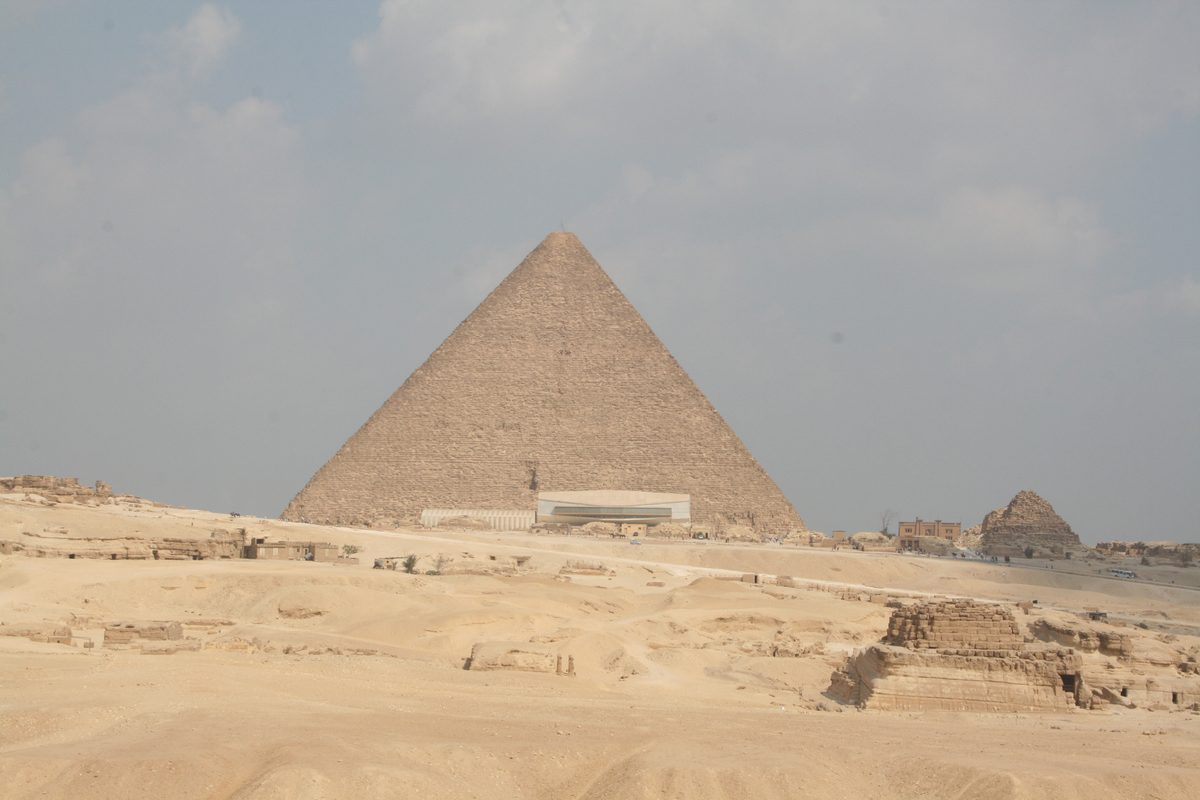
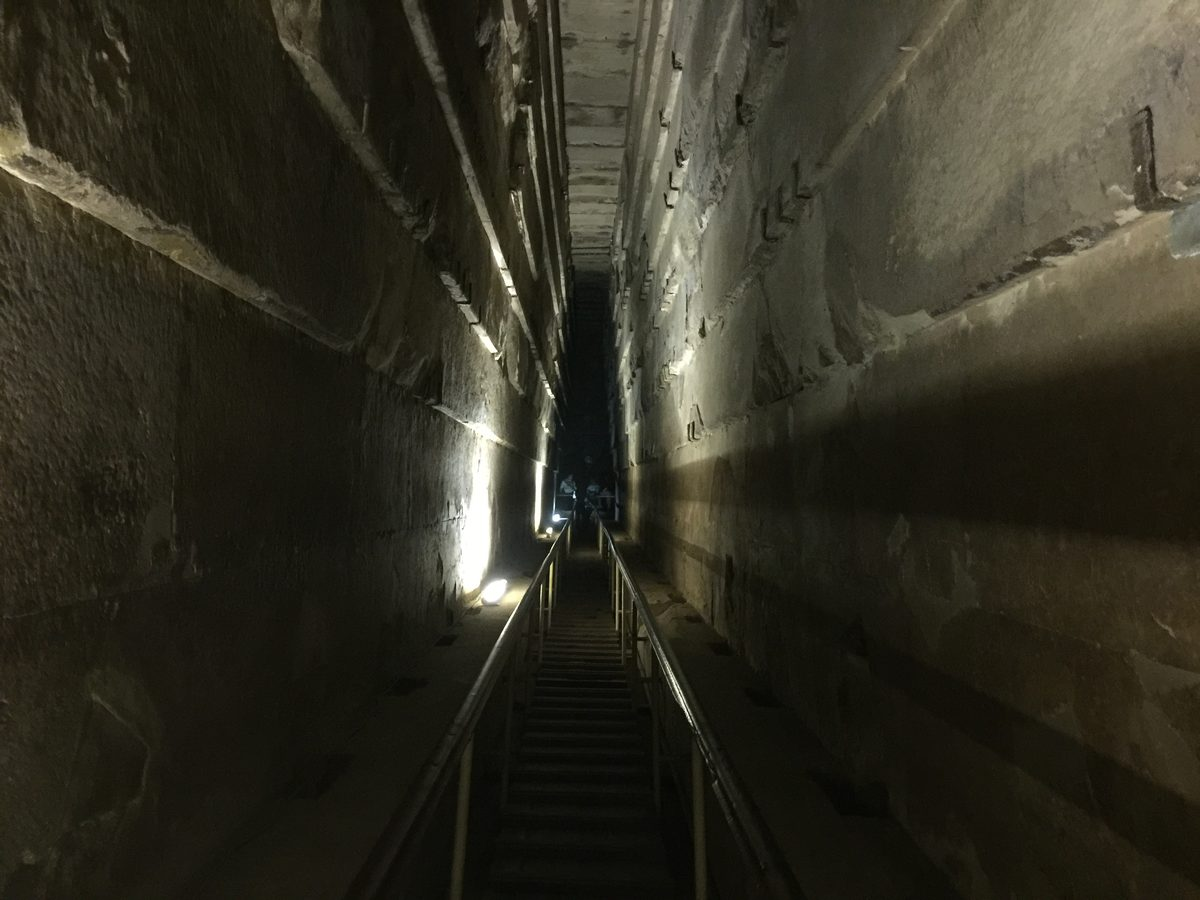
By 2015 the interior of Khufu’s pyramid had been surveyed, remeasured and argued over for close to two hundred years, and its major spaces were not in doubt. There is the Descending Corridor, cut down into the bedrock below the structure; the Ascending Corridor and the Grand Gallery above it, a soaring corbelled passage nearly fifty metres long; the Queen’s Chamber and the King’s Chamber; and, stacked directly above the King’s Chamber’s flat ceiling, five low compartments that Georgian and Victorian surveyors concluded were built purely to carry the weight of the masonry above it rather than crush the chamber below.
Visitors today enter through a rough, forced opening rather than the pyramid’s sealed original entrance. That tunnel was cut by workers under the Abbasid caliph al-Ma’mun around the year 820, hunting for treasure and striking the Ascending Corridor more or less by luck. Everything inside has since been measured to a fraction of an inch: Richard Howard Vyse and John Perring surveyed it in the 1830s, Charles Piazzi Smyth in the 1860s, and Flinders Petrie, with the most rigorous instruments of the three, in the early 1880s.
Against that record, one fact stood out: the last genuinely new interior space anyone had found was a pair of narrow shafts behind the Queen’s Chamber, located by the engineer Waynman Dixon in 1872. Dixon, working with the physician James Grant, had set out specifically looking for shafts that might connect the Queen’s Chamber to the pyramid’s outer walls, matching the pair already known in the King’s Chamber above it, and found them. For the next 143 years, nothing changed. Egyptologists kept refining dates, kept arguing over how the stone was moved, but the floor plan itself — the actual list of rooms and passages — was considered, in practical terms, complete, the kind of consensus that holds right up until someone finds a new way to test it — much as happened with the argument over why Göbekli Tepe was buried in the first place.
A muon detector sees stone the way an X-ray sees tissue
Cosmic rays strike the upper atmosphere constantly, and the collisions produce a shower of particles, among them muons: heavy cousins of the electron that rain down on every square metre of Earth’s surface at a rate of roughly one per minute. Muons pass through solid rock, but not for free — the more stone a muon has to cross, the more of them get absorbed before reaching a detector on the other side.
That is the entire method. Place a detector inside or beneath a structure, point it at the stone above, and count how many muons arrive from each direction over weeks or months. A direction with measurably more muons than the surrounding rock predicts has less material in the way — an empty space. Nothing is drilled, nothing is emitted into the monument, and nothing needs to be moved. The pyramid itself becomes the only intervention, which is precisely why a non-invasive mission was willing to try it on a structure nobody is allowed to damage.
The method is also slow, by design. A single day’s muon count from one direction is not enough to distinguish a void from ordinary statistical noise; the signal only separates from the background after detectors have sat in place logging arrivals for weeks or months. That is the trade the whole technique makes: in exchange for touching nothing, it asks for patience measured in seasons rather than hours.
Three teams ran three different technologies on purpose
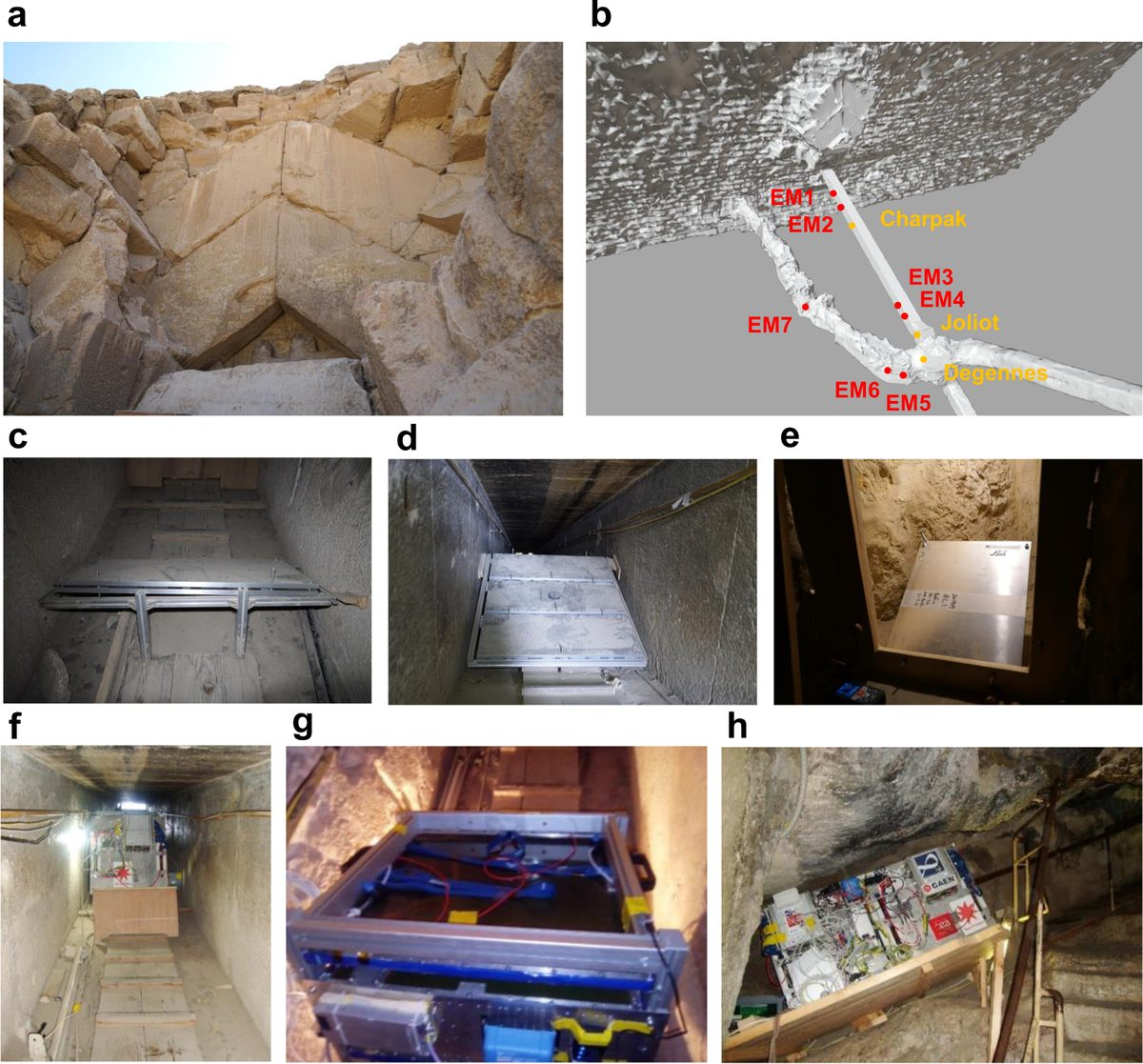
The detection work was carried out by ScanPyramids, a mission co-directed by Cairo University and the French non-profit HIP Institute that began surveying Giza’s pyramids with non-invasive techniques in October 2015. For the Great Pyramid, three institutions each deployed a different detector technology from a different vantage point: Nagoya University’s nuclear emulsion films, placed inside the Queen’s Chamber; KEK’s scintillator hodoscope; and the French Commissariat for Atomic Energy’s Micromegas gas detectors, set up in the Descending Corridor and in the tunnel al-Ma’mun’s workers had cut. The redundancy was deliberate: if only one detector type had seen the anomaly, it could plausibly have been an artefact of that specific technology. Three unrelated methods seeing the identical shape from three different angles is much harder to explain away.
The first anomalies showed up in October 2016. By the time the team published in Nature on 2 November 2017, all three detector sets agreed: a void at least thirty metres long, with a cross-section comparable to the Grand Gallery, sitting directly above it. The paper was carefully worded. It reported the void’s existence and rough dimensions and did not claim to know its purpose, its age, or whether it was a single space or several. The pattern — a genuine structure recovered from an instrument reading rather than a shovel — has precedent: the gearing inside the Antikythera mechanism went unread for decades until X-ray and CT imaging finally resolved it.
The announcement split archaeologists immediately
Zahi Hawass, Egypt’s best-known Egyptologist and a former antiquities minister, was blunt within two days: “the pyramid is full of voids and that does not mean there is a secret chamber or a new discovery,” he told reporters. Mustafa Waziri, then head of the government’s Supreme Council of Antiquities, added that the project needed to proceed through ordinary scientific review rather than press conferences. Neither man disputed the muon data. What they disputed was the inference being drawn from it.
That inference split into three competing explanations, none of them confirmed. The Egyptologist Mark Lehner proposed a structural purpose, consistent with the five known relieving compartments above the King’s Chamber: a gap built to redirect the weight of the masonry above the Grand Gallery rather than let it bear straight down. Salima Ikram suggested something more practical — a space the original construction crews needed in order to manoeuvre blocks into position, left in place once the work was done. Giulio Magli went further, proposing in his own published paper that the void could be an upper chamber connected to funerary equipment described in the Pyramid Texts, speculating it might hold a ceremonial throne. Magli’s own language called the idea tentative. Nothing about the Big Void has been examined closely enough to settle any of the three, and the pyramid is not alone in that: nobody has proven what Roman dodecahedra were for either, more than three centuries after the first one was dug up.
A second anomaly turned out to be a real, photographed corridor
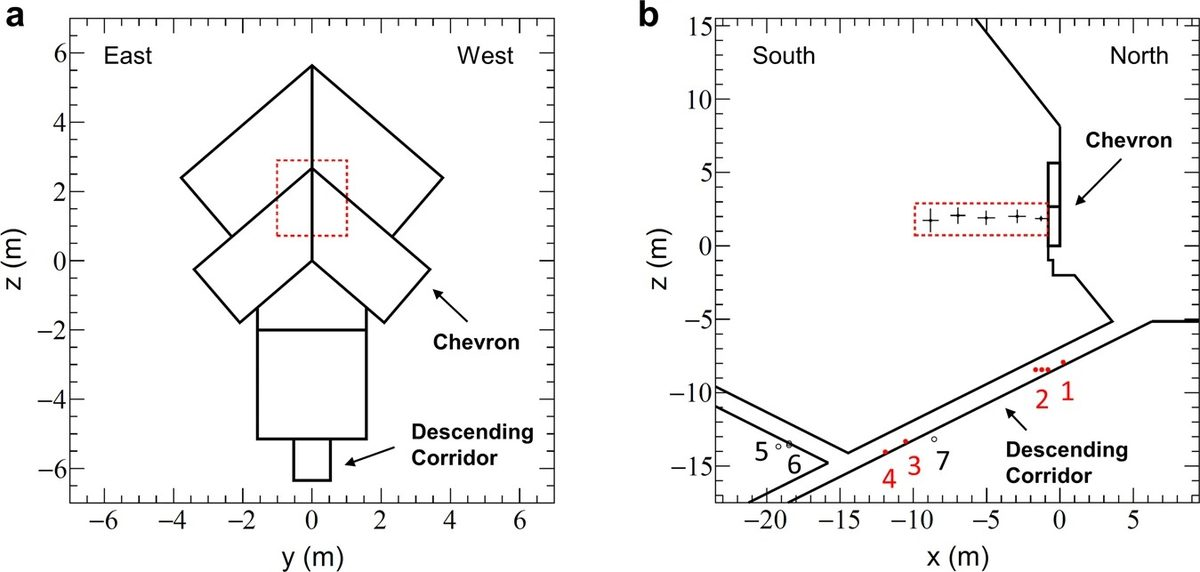
While the Big Void sat unexplained, the same muon surveys picked up a second, much smaller anomaly: a corridor-shaped space behind the chevron-shaped limestone blocks built into the pyramid’s north face, directly above the original entrance. Egyptian officials and the ScanPyramids team announced it on 2 March 2023, and the peer-reviewed measurement followed that December in Nature Communications: a corridor roughly nine metres long and about 2.1 metres wide, with a gabled, chevron-shaped ceiling, sitting between seventeen and twenty-three metres above ground level.
Unlike the Big Void, this one was small enough, and close enough to the surface, to look inside. Egyptian engineers threaded a five-millimetre endoscope camera through a joint between two of the chevron stones and recorded the first images of the corridor’s interior since it was sealed roughly 4,500 years ago. What the camera found was unremarkable in the most informative way: an empty, vaulted passage, with nothing inside it. The leading explanation mirrors the structural theory for the Big Void — another weight-relieving gap, this one protecting the original entrance rather than the Grand Gallery.
Two more teams checked the same spot with different physics
Once muons had marked a target, other non-invasive survey teams went back to test whether completely different physical principles would find the same thing. In 2023 a team led by Mohamed Elkarmoty combined ground-penetrating radar with ultrasonic testing, fusing the two reconstructions into a single image, and reported what they called a strong air anomaly at exactly the position and depth the muon data predicted. In November 2025 a separate team led by Polina Pugacheva ran electrical resistivity tomography over the same stones and found a high-resistivity anomaly roughly 2.5 by 2.5 metres — about half a metre larger in each dimension than the muon-measured corridor, a gap the authors attributed to the ordinary margin of error between such different techniques.
By the end of 2025, the North Face Corridor had been located by cosmic-ray muons, confirmed by radar and ultrasound, measured again by electrical resistivity, and finally seen directly by camera — four independent methods, resting on four different branches of physics, agreeing on the same nine-metre space behind the same stones. Very few claims in archaeology get checked that many times.
The Big Void itself has never been touched
Set against that, the contrast is stark. Nothing has been drilled toward the Big Void, no camera has been threaded near it, and no team has reported finding an access point at all. ScanPyramids operates on a strictly non-invasive mandate, and unlike the North Face Corridor, the Big Void sits deep inside solid masonry above the Grand Gallery with no known joint or gap to work a camera through.
The most serious plan to go further comes from outside the original mission: a collaboration between Fermilab, the University of Virginia, Cairo University’s geophysics department and the University of Chicago, operating as the Exploring the Great Pyramid Mission. Egypt’s Ministry of Antiquities approved the project in 2018. Its goal is a far more sensitive muon telescope system — the team’s own published design targets roughly a hundred times the sensitivity of the 2017 detectors, enough, in principle, to produce an actual tomographic image of the void’s interior rather than a single confirmed shadow. As of the project’s own 2022 paper, the work remained in the design and simulation stage, carried on existing Fermilab resources and a University of Chicago research grant rather than a dedicated field deployment. No image of the inside of the Big Void has been published since.
What the last decade actually added to the Great Pyramid’s floor plan, then, is not one new room but two unequal ones. The North Face Corridor went from a statistical anomaly to a photographed, cross-confirmed space in roughly six years — found by muons, checked by radar, checked again by resistivity, and finally seen with a camera the width of a pencil lead. The Great Pyramid’s Big Void, the larger and more interesting of the two, has done none of that. It has been detected once, by three independent teams working at the same time, and left exactly where it was found.
That gap between the two is the real headline here, more than either void on its own. A building that has been climbed over, measured, drilled into and argued about for roughly 4,500 years still has at least one interior space that nobody living has ever seen, in a shape nobody can yet confirm, for a purpose nobody can yet prove. The instruments that found it did not need to open the pyramid at all. What they still can’t do is tell you what’s inside — which puts the Great Pyramid’s Big Void on a short list with what actually happened to the Ark of the Covenant: cases where the evidence for something’s existence is stronger than the evidence for what it is.
Watch the full history
The eleven-minute version walks through the full ScanPyramids record, the three competing explanations, and the 2023 endoscope footage in order.

Related reading
- How the Antikythera Mechanism Predicted Eclipses
- Why Was Göbekli Tepe Buried? What the Evidence Actually Shows
- What Were Roman Dodecahedra Actually Used For?
- What Actually Happened to the Ark of the Covenant?
Works cited
- Procureur, S., Morishima, K., Kuno, M., et al. Discovery of a big void in Khufu’s Pyramid by observation of cosmic-ray muons. Nature 552, 386–390 (2017). Link.
- Procureur, S., Morishima, K., Kuno, M., et al. Precise characterization of a corridor-shaped structure in Khufu’s Pyramid by observation of cosmic-ray muons. Nature Communications 14, 1144 (2023). Link.
- Elkarmoty, M., Rupfle, J., Helal, K., et al. Localization and shape determination of a hidden corridor in the Great Pyramid of Giza using non-destructive testing. NDT & E International 139 (2023). Link.
- Pugacheva, P., Allam, H., Fath-Elbab, M., et al. Investigation of the North Face Corridor in the Great Pyramid of Giza using Electrical Resistivity Tomography. Scientific Reports (November 2025). Link.
- Bross, A. D., Dukes, E. C., Ehrlich, R., et al. Tomographic Muon Imaging of the Great Pyramid of Giza. arXiv:2202.08184 (2022). Link.
- Magli, G. Gigantic void in Khufu’s Pyramid: any new insight from the Egyptian Pyramid Texts? arXiv:1711.04617 (2017). Link.
- Wei-Haas, Maya. “Massive Void Found Within Great Pyramid of Giza.” Smithsonian Magazine, November 2, 2017. Link.
- Agence France-Presse. “Egypt Archaeologist Criticizes Pyramid Void ‘Discovery’.” The Times of Israel, November 4, 2017.
- Felton, James. “The Hidden Corridor Inside The Great Pyramid Of Giza Has Been Photographed For The First Time.” IFLScience, March 6, 2023. Link.
- Petrie, W. M. Flinders. The Pyramids and Temples of Gizeh. Field & Tuer, 1883.