
Plimpton 322 is usually introduced as the oldest trigonometric table in the world — proof that Babylonian scribes understood angles some two thousand years before Hipparchus. For most of the twentieth century after its acquisition, that is roughly what historians of mathematics believed. In 2001, the historian Eleanor Robson looked closely at what the tablet’s four columns of cuneiform numerals were actually doing, and the trigonometry reading did not survive the look.
The point isn’t really about one clay tablet. It’s about how easily the tools people built to do arithmetic get misread, this one included. The abacus has a tidy origin story — four thousand years, Babylon to Rome to China to Japan — that gets repeated in almost every short account of it, usually sanded down to fit a few minutes of narration. What that story tends to skip is more interesting: how an abacus actually works, bead by bead, well enough to beat a trained human operator on a machine; what physically survives of the oldest versions and what’s reconstructed from later written accounts; and what happened to the idea once calculators made it technically redundant.
The oldest math record we have was misread for fifty years
Plimpton 322 is a Babylonian clay tablet of four columns and fifteen rows of cuneiform numerals, dated by Robson, of the University of Oxford, to within forty years of 1800 BCE and traced to the city of Larsa. For decades it was treated by many mathematicians as a trigonometric table, or as evidence that Babylonian scribes had a method for generating Pythagorean triples. Robson’s 2001 paper in Historia Mathematica argued that both readings import a modern idea — the measurement of angles — that would not exist for another two thousand years. Science News covered the reassessment at the time, quoting her description of the tablet not as “a freakish anomaly” but as “the epitome of Mesopotamian mathematical culture at its best.”
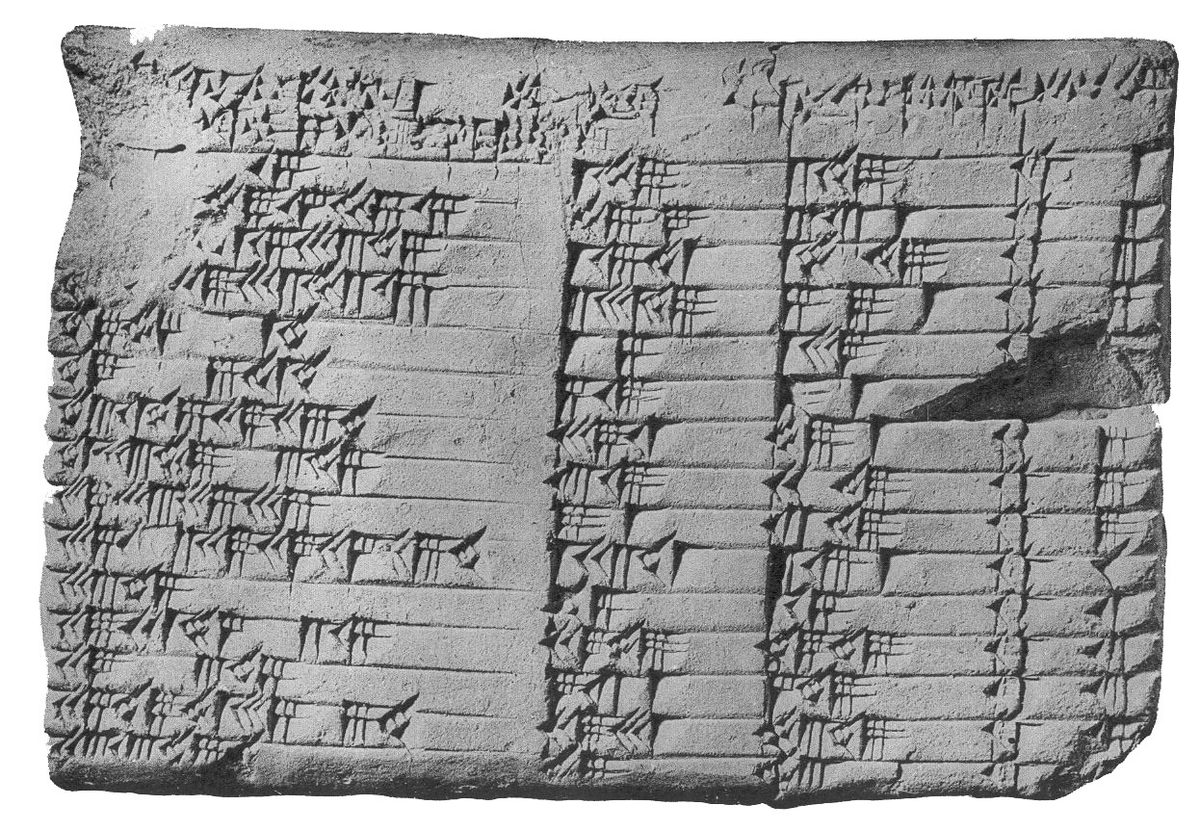
Her alternative reading is less dramatic and more useful: the tablet is a teacher’s list of worked problems about squares and reciprocals, the kind of document a scribe would use to generate a sequence of homework questions with numbers that happened to work out cleanly. That matters here for a specific reason — it’s a caution against assuming any surviving written record shows a physical counting device at all. Mesopotamia has left plenty of clay tablets recording the results of calculations. It has left no physical counting board. Everything said about how Sumerian and Babylonian clerks actually moved pebbles around to reach those results is reconstructed from later written descriptions, not dug up as an object.
The oldest counting board you can actually see is Greek
The earliest counting device that survives as a physical object is the Salamis Tablet: a slab of white marble roughly 149 by 75 centimeters, found on the Greek island of Salamis in 1846 and now held by the National Archaeological Museum in Athens. It’s usually dated to around 300 BCE — sixteen centuries before anyone built the Antikythera Mechanism, a Greek device so much further beyond a counting board’s abilities that nothing matched its complexity for another thousand years.
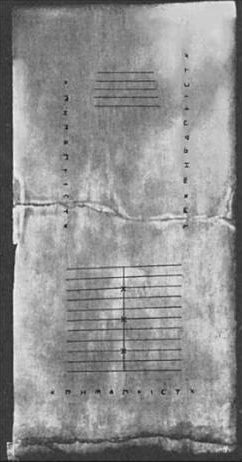
A counting board didn’t calculate on its own; it gave the user’s hands somewhere to hold a number steady while the next step got worked out. The Salamis Tablet is scored with five sets of parallel lines, with Greek acrophonic numerals — symbols standing for 1, 5, 10, 50 and so on — carved along three of its edges to label what each line was worth. A user set out pebbles along the lines roughly the way a modern person carries a digit on paper: a counter on the “10” line, moved up to the next line once ten of them had accumulated, the same function a comma or a decimal point performs today, done by hand, one object at a time. The tablet’s own cataloguers hedge on what it was actually for: the lines are also consistent with an ancient board game, and nothing inscribed on the marble settles which it was.
Rome shrank the same idea into something you could carry
The Romans built a portable, metal version: a small bronze hand abacus with grooved slots and sliding studs, compact enough to carry in a toga. Very few originals survive, and most of what people handle today, including the pair held by London’s Science Museum, is a working replica — theirs was cast in 1974, not excavated from a Roman villa.
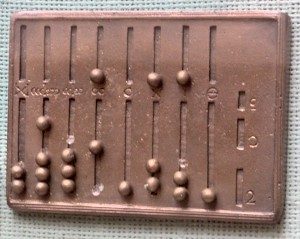
The mechanism, reconstructed by historians of computing including Herbert Bruderer, used seven decimal columns. Each column’s lower section held beads worth 1, 10, 100 and so on; the upper section held beads worth five times that, so sliding beads from the upper and lower sections together could represent any digit from zero through nine — the same five-plus-one logic a Chinese bead frame would use centuries later, with rods instead of grooves. A separate, smaller slot tracked ounces, because Roman accounts kept a pound at twelve rather than a clean ten. Here the sources genuinely disagree: the commonly repeated account assigns that slot’s beads values of one-half, one-quarter and one-third of an ounce, but Bruderer argues that assignment can’t actually represent every fraction from a twelfth up to eleven-twelfths, and reports that the historians Alain Schärlig and Jérôme Gavin reject it outright. Bruderer’s own proposal gives the lowest beads a value of one-twelfth each instead. Nobody has settled which reading is correct.
How an abacus actually works, according to a 1592 manual
The device most people picture — a wooden frame of beads sliding on rods — is Chinese: the suanpan. Historians disagree about exactly when counting boards became bead frames, but the earliest complete printed description appears in 1592, in Suanfa Tongzong, a 595-problem arithmetic text written by a merchant’s son named Cheng Dawei. Cheng wasn’t a professional mathematician; by his own descendant’s account, he was a comfortably wealthy, self-taught arithmetician who travelled to book fairs collecting mathematical texts and questioning experienced practitioners as he went. His book was explicitly practical, written for merchants and clerks doing abacus arithmetic, and it stayed in print long after he died: a descendant wrote in 1716 that nearly everyone studying mathematics owned a copy, and historians in 1964 were still finding editions in circulation across China.
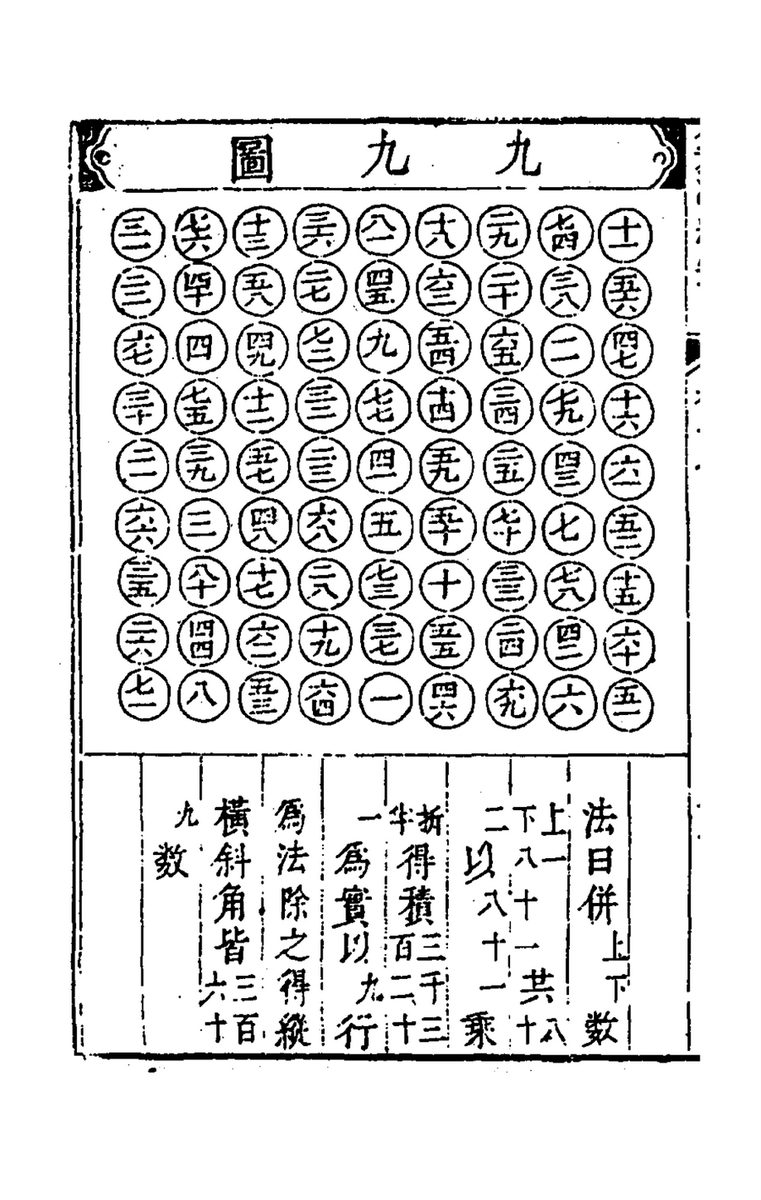
The suanpan’s arithmetic runs on exactly the principle the Roman hand abacus used in metal: each rod holds beads worth 1 apiece below a central bar and beads worth 5 apiece above it, giving a rod a maximum single-digit value of 9. Addition and subtraction don’t happen by counting one at a time; they happen by complements. To subtract 7 from a column, a trained operator doesn’t move seven beads — they add the complement, 3, and carry a 10 into the column to the left, the same add-and-carry trick a fast mental calculator uses, just performed on beads instead of in the head. Multiplication and division ran on a second set of memorized tables rather than repeated addition, which is why becoming a competent operator meant years of rote drilling, not just manual dexterity.
Japan cut the beads down and turned arithmetic into an exam
The suanpan reached Japan by way of Korea and China and became the soroban, trimmed down over three centuries to the one-bead-above, four-beads-below layout still used today — a change the reference work Japan Encyclopedia dates to a final adjustment in 1891. What that reform produced wasn’t just a lighter tool; it produced a national qualification. The soroban’s decline after cheap calculators arrived is usually told as a single clean break, but the numbers are messier than that. Students taking Japan’s qualifying abacus exams had fallen to about 20,000 by 2005 — roughly one-tenth of peak enrollment — and public radio reporting on the decline found regular abacus classes returning to a handful of elementary schools specifically because they were credited with boosting math scores, even though the evidence for any broader brain-training benefit remains thin. One Tokyo-area teacher, Haruka Iwai, was still running a Saturday class of about twenty children two decades after calculators were supposed to have ended the need for it.
The most demanding modern version of the skill has no physical frame at all. Advanced students learn anzan, doing arithmetic by picturing the beads move in their heads, and the fastest competitors do it against a clock in a format called flash anzan: strings of numbers flash on a screen for a fraction of a second each, and the competitor calls out the running total from memory, no pen or physical abacus involved. The current record, set by Rikako Miyamoto at the 72nd Nakano Abacus Competition on February 18, 2024, is 1.61 seconds to correctly add fifteen sets of three-digit numbers — a hundredth of a second faster than the record it broke.
The same bead logic was eventually built for hands that can’t see
In 1962, a rehabilitation specialist named Terence “Tim” Cranmer adapted the soroban’s bead layout into a tool for blind users. Cranmer had been blind from childhood himself; before joining Kentucky’s Division of Rehabilitation Services for the Blind in 1952, he’d made and sold plastic jewelry and spent ten years working as a piano technician. The device he designed replaces the wooden frame with a black plastic box lined in red felt, so beads don’t slide out of place, with thirteen rods, one bead above the bar and four below each, and raised dots and slashes along the crossbar and rim that let a user find any column by touch alone.
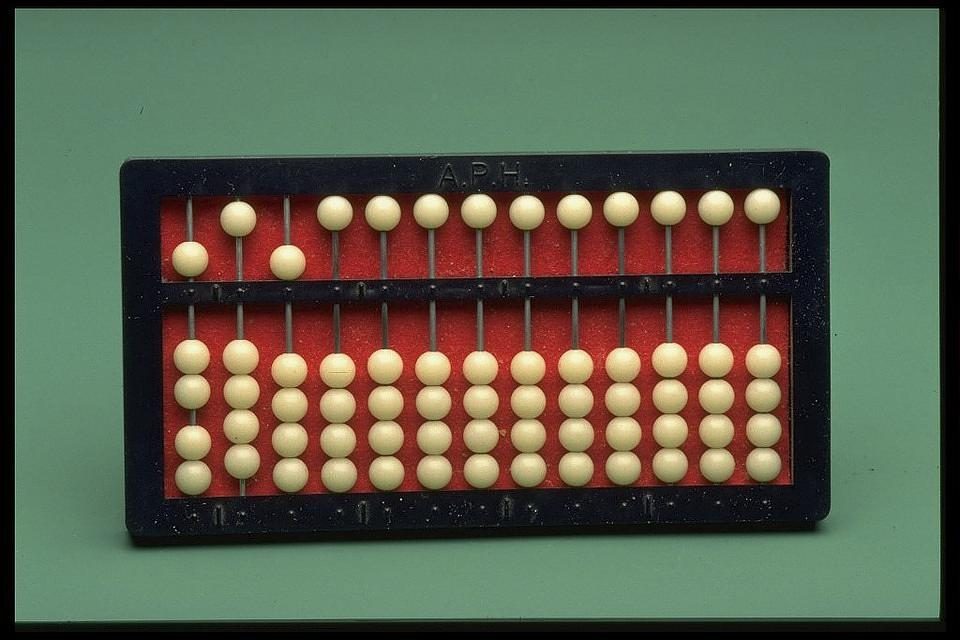
The American Printing House for the Blind began manufacturing it soon after, and still does. The Smithsonian’s National Museum of American History holds one, donated by Russell Kletzing, a blind lawyer from Sacramento who had taken on a Civil Service rule barring blind attorneys from a government register, and his wife Ruth. For a sighted clerk in the 1940s, the soroban was one option among several for doing arithmetic fast. For a student using a Cranmer abacus today, the frame in their hands isn’t an alternative to a calculator’s screen — it’s simply the only calculator they have.
Watch the full history
The video version covers the beads, the 1946 contest, and the four-thousand-year timeline in under six minutes.

None of this makes the abacus a mystery object. It’s almost insultingly simple — a frame, some rods, some beads — which is exactly what makes its four-thousand-year run strange to sit with. It never needed a factory, a patent, or electricity, and for most of that run, that was the entire appeal: a working calculator in the hands of anyone who could afford a few beads and was willing to drill the arithmetic into muscle memory, not entirely unlike the way player pianos briefly out-performed the trained pianists they were built to replace.
What’s changed is who still needs that muscle memory. The soroban’s near-disappearance from Japanese classrooms wasn’t really a defeat by a smarter machine — a trained operator could still out-calculate one, which is exactly what happened in that Tokyo theater in 1946. It was a decision, made by schools over the following decades, that the years of drilling weren’t worth the time anymore once a pocket calculator could do the same job untrained. The version that survived that decision in the largest numbers is the one built for people with no alternative at all: a student reading a column of beads by touch isn’t choosing an abacus over a screen. For that student, Cranmer’s thirteen-rod frame simply is the calculator, in a lineage of mechanical calculating devices that includes the gear-driven engines Charles Babbage spent his career failing to get funded.
So: would you trust a bead frame over a calculator? It depends whether anyone ever drilled four thousand years of practice into your hands — or whether, like Cranmer’s students, you never had a screen to choose instead.
Related reading
- Charles Babbage and the Organ Grinders He Hated — the next leap in mechanical calculation, and the obsession that nearly sank it.
- How the Antikythera Mechanism Predicted Eclipses — a 2,000-year-old Greek calculating device far more complex than any counting board.
- Why Player Pianos Outsold Real Pianos in 1924 — another mechanical device that briefly out-performed the skilled humans it was built to replace.
- The Jamestown Pocket Sundial That Told the Wrong Time — a different early portable calculating tool, and how easily one can mislead its own user.
Shop the abacus
Shop the styles/items featured in this video:
- Yellow Mountain Imports 17-column soroban abacus
- Complete Abacus Mind Math: a step-by-step guide to soroban mental math
Works cited
- Robson, Eleanor. “Neither Sherlock Holmes nor Babylon: A Reassessment of Plimpton 322.” Historia Mathematica 28, no. 3 (2001): 167–206. Link.
- Peterson, Ivars. “Reassessing an Ancient Artifact.” Science News, January 27, 2001. Link.
- Norman, Jeremy. “The Salamis Tablet, the Earliest Surviving Counting Board.” HistoryofInformation.com. Link.
- Science Museum Group Collection. “Roman Abacus” (replica, object co59965). Link.
- Bruderer, Herbert. “How Did the Romans Calculate?” Communications of the ACM, Blog@CACM. Citing Alain Schärlig and Jérôme Gavin on the disputed ounce-slot reading.
- O’Connor, J. J., and E. F. Robertson. “Cheng Dawei.” MacTutor History of Mathematics Archive, University of St Andrews. Link.
- Kojima, Takashi. The Japanese Abacus: Its Use and Theory. Tokyo: Charles E. Tuttle, 1954. Link.
- Frédéric, Louis. Japan Encyclopedia. Cambridge, MA: Harvard University Press, 2002, pp. 303, 903.
- Guinness World Records. “Fastest Flash Mental Arithmetic.” Link.
- “Modern Japan Hopes Ancient Abacus Aids Academics.” NPR, December 24, 2010. Link.
- Smithsonian National Museum of American History. “Cranmer Abacus” (object record nmah_690534).