
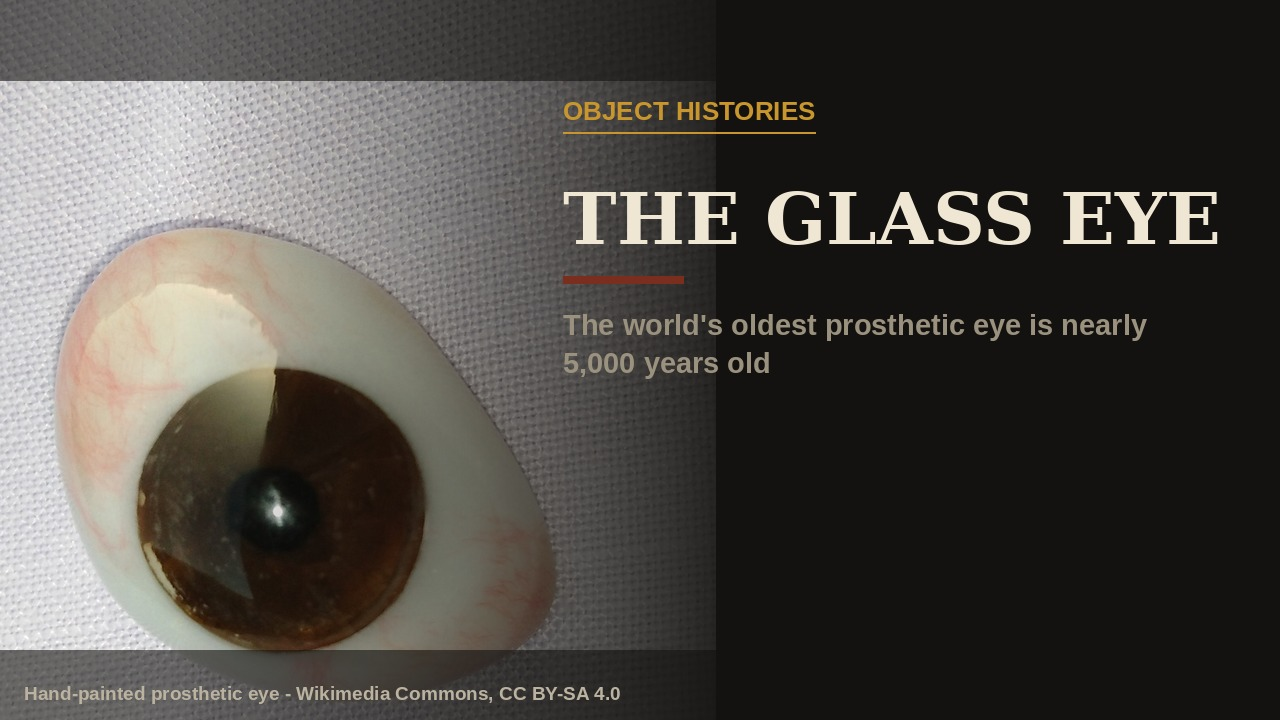
In 2007, a team excavating a grave at Shahr-e Sukhteh — the “Burnt City,” in what is now southeastern Iran — found a skeleton with something lodged in its left eye socket. It was roughly hemispherical, coated in a thin layer of gold, and engraved with fine radial lines fanning out from a central circle like the rays of a drawn sun. The woman it belonged to had died between 2900 and 2800 BC, around the age of thirty, and the object had almost certainly been worn in life rather than placed there afterward. It is the oldest known artificial eye in the world, and the start of a five-thousand-year story about how artificial eyes were made.
The physician who later described the find in the Iranian Journal of Public Health went further than cataloguing it. He noted that the radiating lines on the eye’s surface resemble sunrays, and floated the idea that the design hints at an early, informal theory of vision — the ancient notion that sight worked by something leaving the eye, rather than light entering it. That reading is speculative and the author says so himself; what is not speculative is that someone, five thousand years ago, thought carefully enough about what an eye looks like to engrave one onto a woman’s socket rather than leaving it empty.
For most of the five thousand years since, the story of how artificial eyes were made is less a story of ambition than of settling: for something that looked a little less alarming than an empty socket, and not much more. Glass eyes that could actually sit inside the socket — rather than strap over it like a patch — did not exist until the 1500s. A single Venetian craft guild controlled that trade for nearly three centuries afterward. Germany did not break the monopoly until the 1830s, and held the new one so completely that it took two world wars, fought over nothing to do with eyes, to force the invention of the acrylic eye millions of people wear today.

Before glass, an artificial eye sat over the socket, not inside it
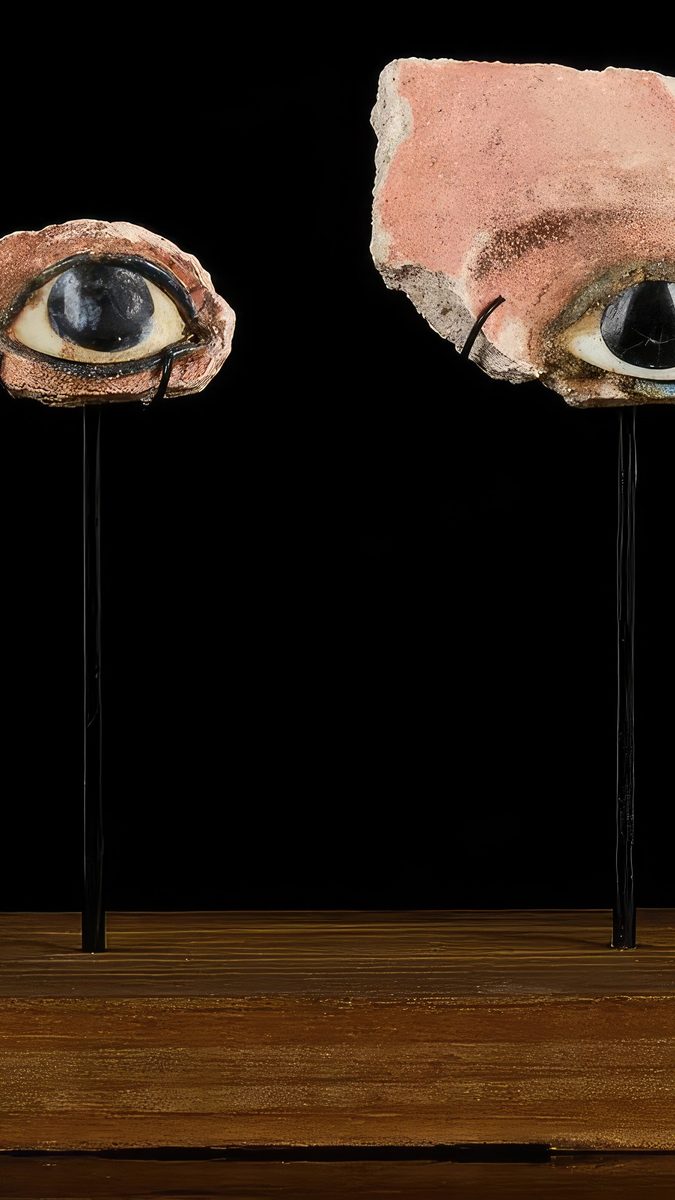
The Burnt City eye is a genuine outlier. Nothing closely resembling it survives from the next several thousand years, and for a long stretch of ancient history, the more common artificial eye was not made for a living person at all: Egyptian and Mesopotamian craftsmen set glass and stone eyes into the sockets of statues and funerary masks, to make a god or a mummy look alert in the afterlife rather than to help a living person see or be seen. That is a related tradition, not a continuous one — a separate answer to a separate problem.
The first clear evidence of artificial eyes worn by living people comes from sixteenth-century France, and the device was not convincing. The military surgeon Ambroise Paré described two basic types: an external metal or leather plate that covered the socket from outside the lids, which he called the hypoblepharon, and a lighter spring-mounted version worn under the lids, the ekblepharon. Both were painted discs of gold, silver or enamel rather than anything shaped like an eyeball, and neither sat inside the socket the way a modern prosthesis does. This was still a world without reliable anesthesia or antiseptic technique — the era when a surgical amputation was raced against the clock rather than numbed — so a device that merely stayed in place without infecting the socket already counted as medicine.
How artificial eyes were made in Venice, and why the method was a secret
Real glass eyes, shaped to fit inside the socket and curved to mimic a cornea, appeared on Murano, Venice’s glassmaking island, in the later 1500s. The breakthrough was less about sculpting a convincing eyeball than about controlling the glass itself: Murano’s furnace workers already knew how to melt, color and blow glass thin enough to be light in the socket without being so thin it shattered on contact. They kept the specific method — the exact furnace temperatures, the sequence of colored layers that built an iris and a web of fine red veins — inside the guild, the same way Venice guarded every secret of its glass trade.
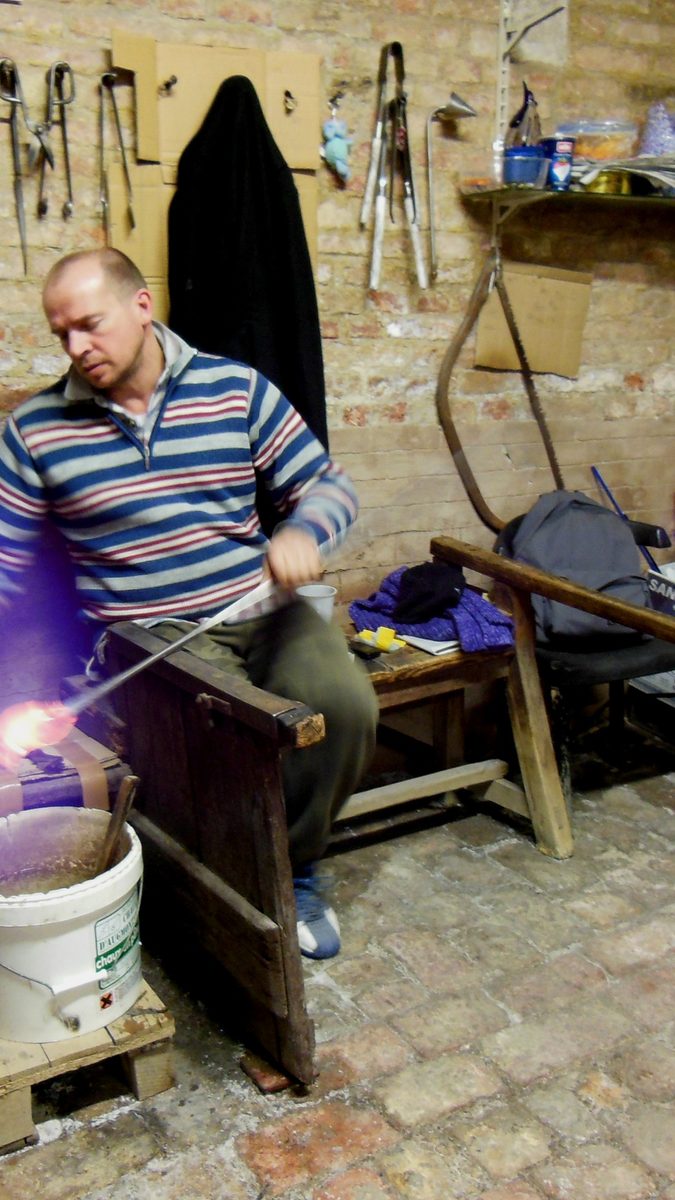
What that secrecy produced for the wearer was not comfort. Murano eyes were thin glass shells, prone to clouding, chipping and outright cracking inside the socket, and doctors of the period recommended replacing one every six months to a year. For more than a century, they were also simply the best option available anywhere, and Venetian craftsmen traveled to sell them across Europe. Paris developed its own glass-eye makers by the early 1800s, borrowing Venetian technique and producing eyes an 1856 medical article still dismissed as “very inferior articles.”
One German family turned glassblowing into an eye-making industry
The craft’s center of gravity shifted to Germany almost by accident. Lauscha, a glassblowing town in Thuringia founded in 1557, already had generations of experience melting and coloring glass in small home workshops, much of it for the toy trade in neighboring Sonneberg. In 1832, a Wurzburg professor named Heinrich Adelmann went looking for someone who could grind him a better glass eye and found a young glassblower in Lauscha named Ludwig Müller-Uri. Three years later, Müller-Uri produced what is generally credited as the first German-made glass eye, refining the Venetian approach into a repeatable, teachable technique.
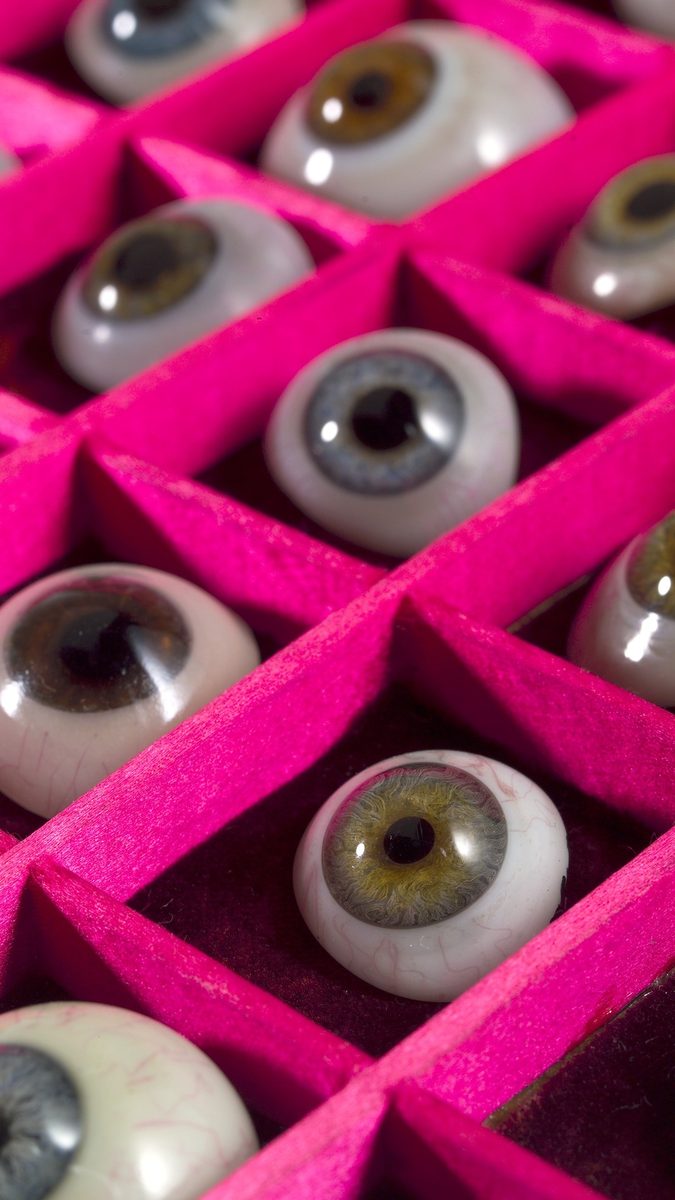
Müller-Uri’s sons and their successors kept improving the material rather than the basic method. Around 1870, Lauscha glassmakers developed cryolite glass — a sodium aluminum fluoride formula that was harder and lighter than earlier lead-based glass, and that could hold color without the lead glass’s tendency to discolor in the socket over time. By the 1888 World Exhibition in Paris, Lauscha-made eyes were winning medals on a trade that had started a little over fifty years earlier in one family’s workshop. German glass became the unquestioned global standard, and the rest of the ocular-prosthesis world mostly stopped trying to compete with it.
A German monopoly on optical glass became a wartime weakness
That dominance turned out to be a liability the moment Europe went to war. German manufacturers did not just make the finished eyes; they controlled much of the raw optical glass the rest of the world needed for prosthetics, microscopes and other precision instruments. By 1912, the German Empire was exporting close to 400,000 pounds of optical glass a year, roughly a quarter of it to Britain and the United States. When the First World War cut off that supply, Britain and the United States discovered they had almost no independent capacity to make their own.
By 1917, the American War Department recognized the shortage as a genuine problem, not a minor inconvenience: wounded soldiers needed glass eyes, and there was very little glass to make them from. Bausch & Lomb in Rochester, the Pittsburgh Plate Glass Company and the Spencer Lens Company in Buffalo scrambled to start producing optical glass from scratch, essentially reverse-engineering a craft Germany had spent eighty years perfecting. Within a year, the three firms together had produced roughly 650,000 pounds of glass for the war effort — proof that the capacity could be built domestically, but only under the pressure of a war that had already made the shortage dangerous.
None of this was abstract industrial policy. Every pound of that glass existed because a soldier somewhere had lost an eye to shrapnel, and the Allied armies of the First World War produced eye injuries on a scale the pre-war glass-eye trade, however well-organized in Lauscha, had never been built to supply at wartime volume from a single blocked source. The shortage was really a lesson about what happens when one country quietly becomes the world’s only supplier of something nobody thinks about until they need it.
The Second World War’s shortage is why glass eyes went extinct
The fix did not hold. German glass flowed back into the American market between the wars, and by December 1943, an Army ophthalmologist, Colonel Derrick Vail, was describing a “critical shortage of artificial eye supply” almost identical to the one from 1917 — only now multiplied by a much larger war and many more eye injuries. This time, the U.S. Army did not try to rebuild German-style glassmaking. It started the Artificial Eye Program at Valley Forge General Hospital, with a specific goal: find a substitute for glass rather than a domestic source of it.
The material the program settled on was methyl methacrylate — a clear dental acrylic that was already used for denture bases, and that had three advantages no glass eye had ever offered. It did not shatter inside the socket, which glass could do under pressure or impact with occasionally serious consequences for the eye tissue around it. It was cheaper and faster to produce in volume than hand-blown glass. And it could be shaped and polished with more precision than a glassblower working at a furnace, which made it easier to match a prosthesis to the specific contour of an individual socket. By the end of the war, acrylic had effectively ended the five-century run of the glass eye as the standard prosthesis, and no major manufacturer has gone back to glass since.
Every artificial eye today is still painted by hand
What acrylic did not change is the part of the process that actually makes an artificial eye convincing, which has stayed stubbornly manual since Murano. A specialist called an ocularist begins by taking a gel impression of the patient’s socket, usually starting about six weeks after whatever surgery created it, since the socket’s shape typically does not stabilize for three to four months. From that impression, the ocularist casts a wax pattern, then an acrylic shape sized and angled to match the patient’s gaze.
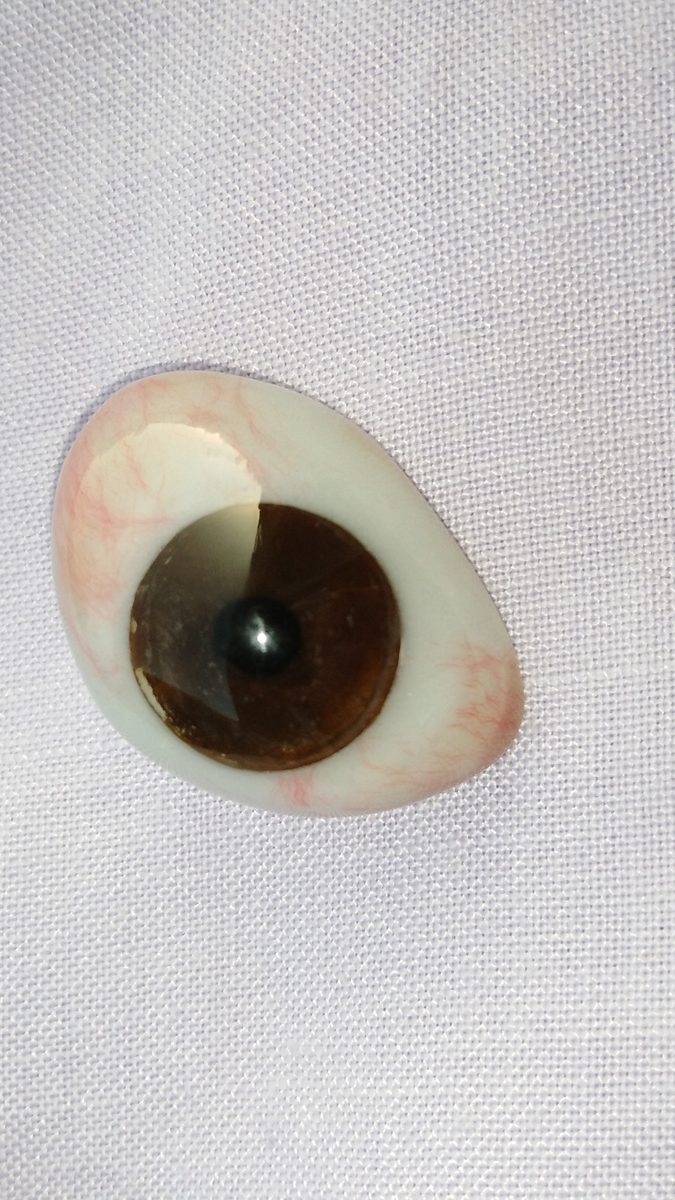
The iris and surrounding sclera are then hand-painted, with the ocularist working from direct observation of the patient’s remaining eye — matching color, the fine red threading of veins, and the exact placement of flecks in the iris, one layer of pigment and lacquer at a time, sealed and built up until it reads as tissue rather than paint. A clear acrylic cornea is cast separately and bonded over the painted iris, then the whole prosthesis is polished to a smoothness that will not catch on the eyelid thousands of times a day. None of that has been automated. A machine can grind the acrylic shape; matching one specific human eye, by hand, is still a skill an ocularist spends years training to do.
The glass eye belongs to a particular shelf of nineteenth-century medical history, one crowded with objects that promised more normalcy than they usually delivered — the dental key that pulled teeth by brute leverage, the leech jar that still had paying customers into the 1860s. The artificial eye is the rare entry on that shelf that mostly did what it promised, from the first Venetian shells onward, even though it took four centuries, one family business in a small German town, and two world wars to arrive at a material that did not shatter inside someone’s head. The oldest known one was still gold and tar, buried with a woman in Iran five thousand years ago, convincing no one but doing the one thing every version since has had to do: sit still, and look back.
Watch the full history
The original minute-long short covers the Burnt City discovery and the jump to Murano glass in under two minutes — here is the rest of the story, from Lauscha to the modern ocularist’s table.

Related reading
- Why Amputation Before Anesthesia Meant Racing the Clock — surgery before anesthesia had the same stakes as a prosthesis that had to work the first time
- How the Dental Key Worked, and Why It Took a Century to Retire — another body-part replacement that took a century to get right
- Why Doctors Drained Blood to Treat Almost Any Illness — the bloodletting bowl, from the same shelf of 19th-century medical objects
- The Bloodletting Craze That Nearly Wiped Out Europe’s Leeches — the leech jar, a contemporary of the German glass-eye trade
Shop the styles/items featured in this video
Works cited
- Moghadasi, Abdorreza Naser. “Artificial Eye in Burnt City and Theoretical Understanding of How Vision Works.” Iranian Journal of Public Health 43, no. 11 (2014): 1595–1596. Link.
- Roche, Dan. “The Ancient Art and Intimate Craft of Artificial Eyes.” Popular Science / The MIT Press Reader, August 9, 2025. Adapted from Eyes by Hand: Prosthetics of Art and Healing (MIT Press). Link.
- “In the Blink of an Eye: From Eye Inlays to the Artificial Eye.” Neues Museum, Staatliche Museen zu Berlin, in cooperation with the Glasmuseum Lauscha, exhibition, April–July 2011. Link.
- Augenprothetik Lauscha GmbH. “Tradition.” Company history of the Lauscha ocular-prosthetics trade and the Müller-Uri workshop, accessed 2026. Link.
- Sullivan, Evan P. “The Eye at War: American Eye Prosthetics During the World Wars.” Nursing Clio, September 25, 2017. Link.
- Muller, Marcia. “History of the Artificial Eye.” University of Michigan, Department of Materials Science and Engineering.
- Hughes, Michael O. “The Fourth ‘O’ in Eye Care: Ocularists.” Virtual Mentor (AMA Journal of Ethics) 12, no. 12 (2010): 950–954. DOI: 10.1001/virtualmentor.2010.12.12.imhl1-1012.