
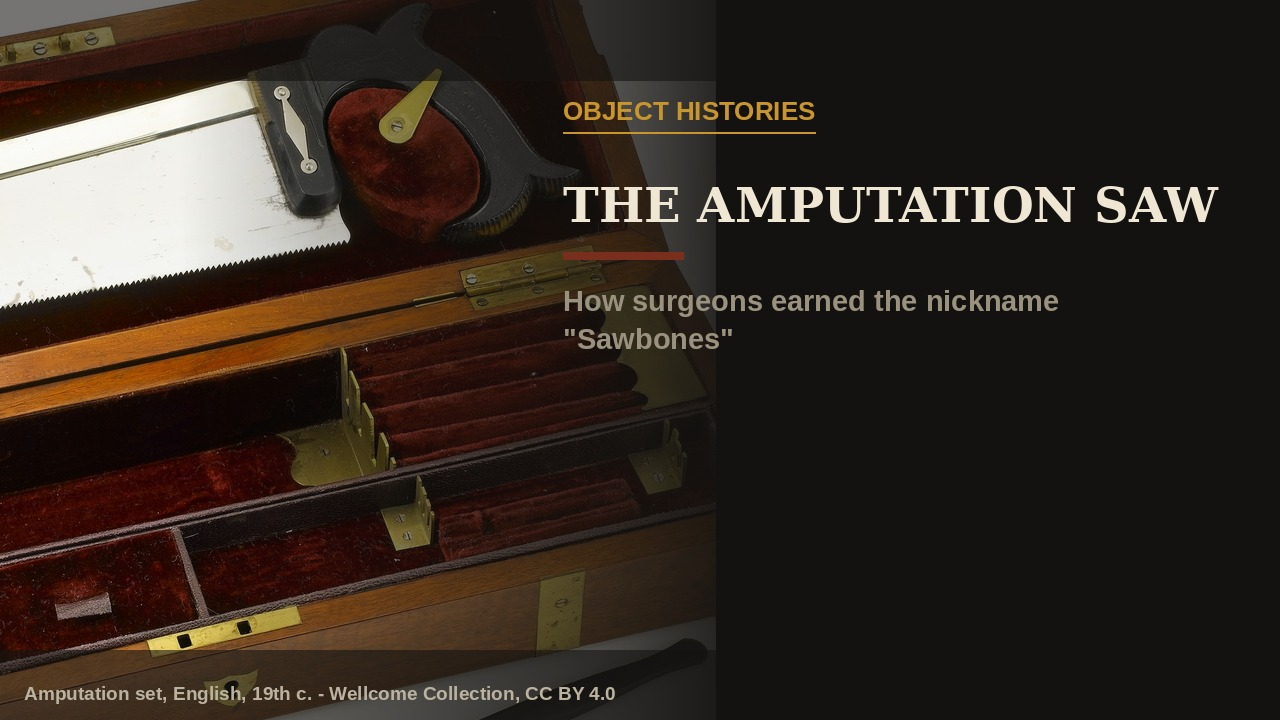
Until 1745, the organisation licensed to remove a Londoner’s leg was called the Company of Barber-Surgeons — the same body that cut your hair. That was not an accident of naming. For most of recorded history, cutting flesh and cutting bone were treated as one trade, practiced by whoever already owned sharp blades and had no particular squeamishness about blood. The saw that did the cutting changed almost nothing about its own design for three centuries, because the thing that needed improving was never the tool. It was everything around it.
Amputation before anesthesia was the fastest procedure a surgeon could perform, and speed was the entire point. A patient held down by assistants, fully conscious, could survive a sixty-second operation in a way they often could not survive a five-minute one — the shock of the pain itself could kill, independent of blood loss or infection. What follows is the real sequence behind that saw: who slowed the bleeding down into something survivable, who sped the cutting up to compensate, and what finally let surgeons stop racing the clock altogether.
Surgeons were barbers, and amputation was the whole job
In medieval and early modern Europe, physicians — university-trained, Latin-reading, largely theoretical — considered surgery beneath them. Cutting was manual labour, and manual labour belonged to craftsmen. Barbers filled the gap: they already owned razors, already practiced on living tissue, and were willing to pull teeth, lance boils, and take off a gangrenous limb alongside a shave. In England, the Worshipful Company of Barbers and the Guild of Surgeons were formally merged into a single Company of Barber-Surgeons under Henry VIII in 1540, and stayed merged for two uneasy centuries.
The split finally came in 1745, when the surgeons, pushed by the anatomist William Cheselden and the growing number of hospitals in London, won a separate Company of Surgeons of their own. It took another fifty-five years, until 1800, for that body to become the Royal College of Surgeons. Dentistry sat in the same overlap for even longer: the instrument used to pull a tooth sat in the same kit as the one used to take a hand, which is part of why the dental key and the amputation saw have such a similar silhouette — they were built by the same craftsmen, for practitioners who had not yet been told their jobs were different.
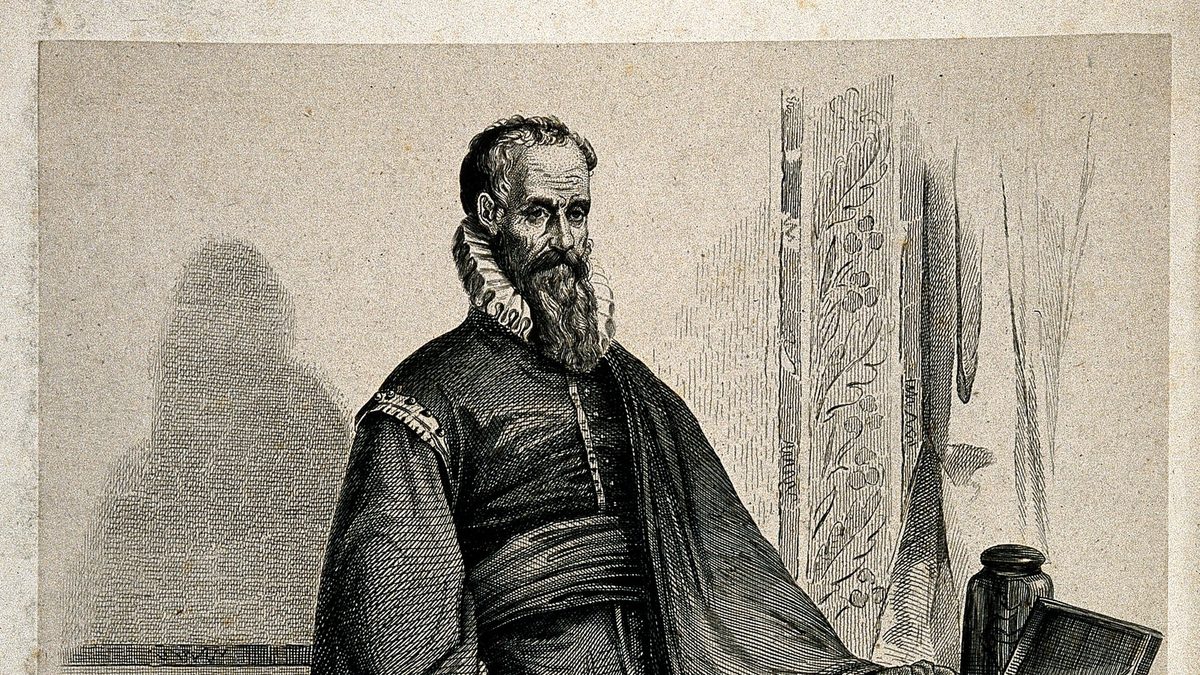
Ambroise Paré replaced the cautery iron with a knot
The deepest problem with pre-modern amputation was never the cutting. It was stopping the bleeding afterward. The standard method, inherited from antiquity, was cauterization: searing the stump with a red-hot iron or pouring boiling oil directly into the wound, which sealed the vessels through sheer destruction of tissue. It worked, in the sense that patients sometimes lived. It also meant a second, enormous injury stacked directly on top of the first.
A French army barber-surgeon named Ambroise Paré changed that, by accident, during a 1536 campaign. Battlefield doctrine held that gunshot wounds were poisoned by the gunpowder itself and had to be treated with boiling oil. One night, according to his own later account, Paré ran out of oil and improvised a milder dressing instead — by his own later telling, a salve of egg yolk, rose oil, and turpentine. He expected the untreated men to be worse off by morning. Instead they were in less pain and healing faster than the men who had gotten the boiling oil. Paré drew the obvious conclusion and spent the rest of his career promoting ligature — tying off severed blood vessels with thread — as a replacement for cautery in amputation.
At the siege of Danvillier in 1552, Paré used ligature in a leg amputation for what is usually cited as the first time, sparing the patient the iron entirely. He wrote up his cases in French rather than the Latin of the physicians who looked down on him, which is partly why his most quoted line survives in more than one translation. Historians render it as “I dressed the wound and God healed him” or “I bandaged him and God healed him,” depending on the source — a small discrepancy, but a telling one, since it was written as a rebuke to any surgeon who took personal credit for a recovery nature had mostly managed on its own.
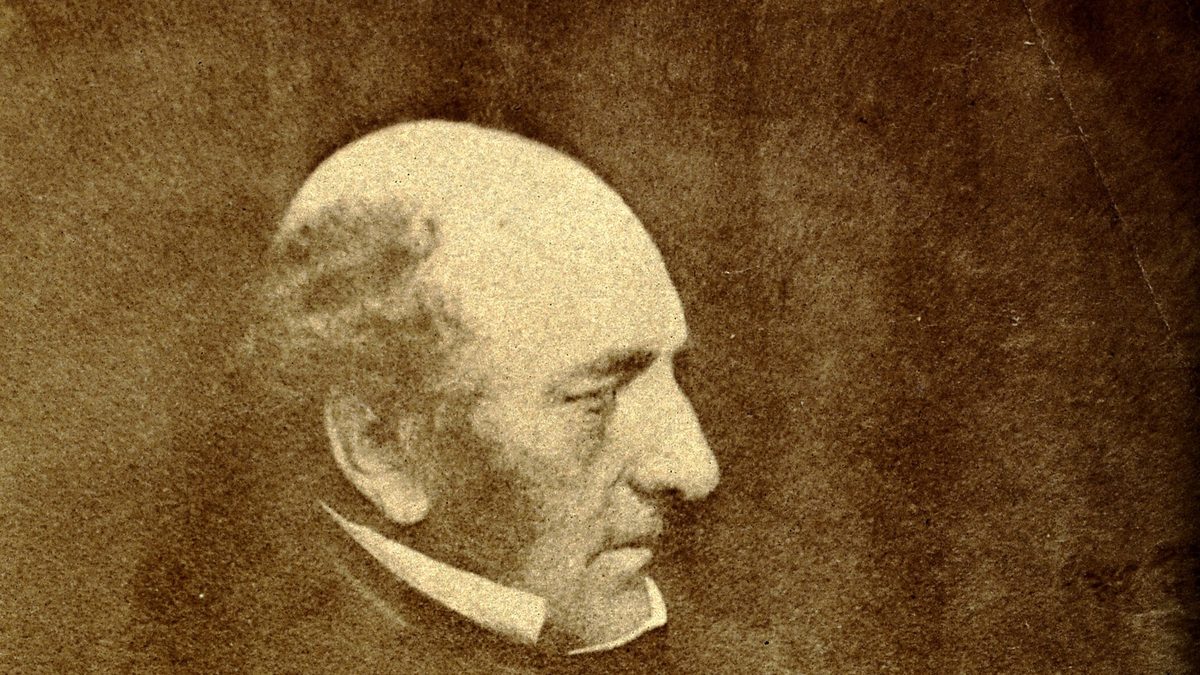
Robert Liston and the last years of amputation before anesthesia
Paré solved the bleeding. Nobody solved the pain for another three hundred years, and in that gap, speed became the single most prized skill a surgeon could have. A conscious, unanaesthetized patient strapped to a table experiences every additional second as additional suffering and additional risk of fatal shock, so surgeons trained like athletes for raw velocity.
The most famous of them was Robert Liston, a Scottish surgeon working in London in the 1830s and 1840s, reputed to complete a thigh amputation in under a minute — some accounts say under thirty seconds — and known for inviting spectators to time him with a pocket watch. Liston genuinely was fast, and by the standards of the era genuinely careful: he is also credited with a markedly lower death rate than most of his contemporaries, in part because he kept his instruments and his own clothing cleaner than most surgeons bothered to. A story often attached to him, in which a rushed amputation allegedly cost an assistant two fingers and killed both the assistant and a terrified onlooker — a single operation with a claimed 300 percent mortality rate — has no surviving primary source behind it. It is worth repeating precisely because it is almost certainly embellished: it tells you less about Liston than about how badly Victorian medicine wanted a cautionary tale about speed for its own sake.
What is well documented is less theatrical and more telling. Before anesthesia, the single best predictor of surviving an amputation was how little time you spent on the table, which is a strange thing to optimise a profession around. The same pressure shaped trepanation, the even older practice of cutting into the skull, where survival rates were likewise driven less by anatomical knowledge than by how quickly and cleanly the operator worked.
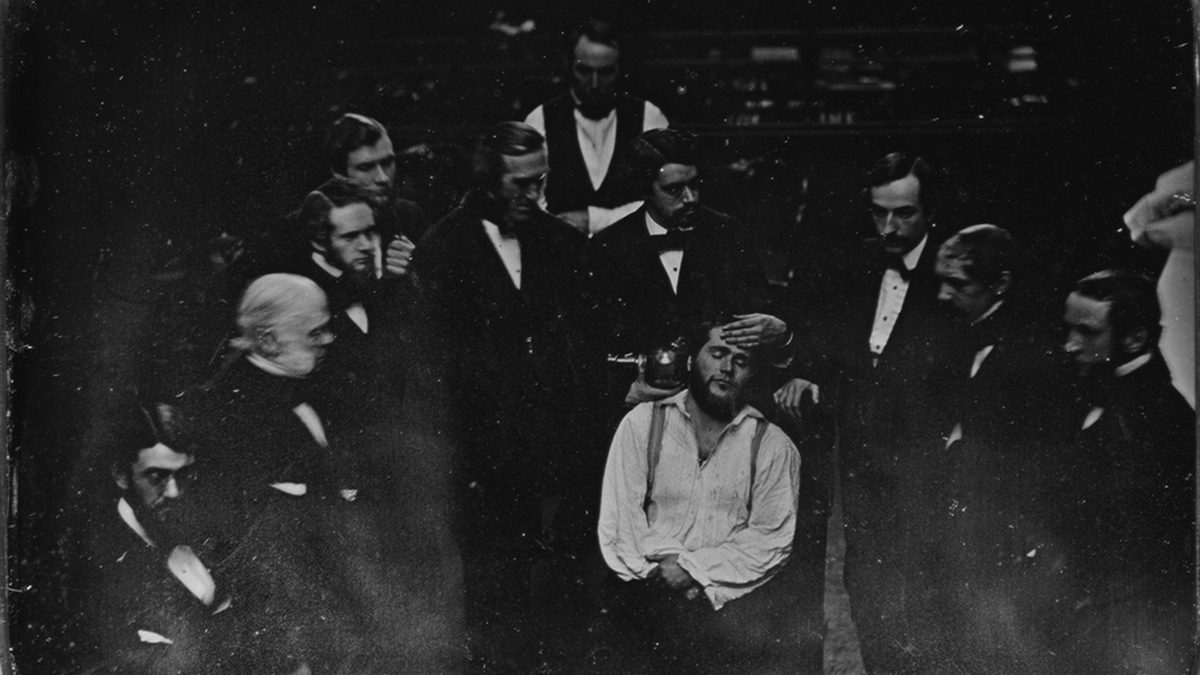
Ether ended the era of racing the clock
On 16 October 1846, in the surgical amphitheatre at Massachusetts General Hospital now known as the Ether Dome, a dentist named William Morton administered inhaled sulfuric ether to a patient, Edward Gilbert Abbott, before surgeon John Collins Warren removed a tumor from Abbott’s neck. Abbott stayed still and silent throughout. Warren turned to the assembled physicians and students and said, “Gentlemen, this is no humbug.” News of a working surgical anesthetic spread to Europe within weeks. The fuller story of who actually deserved credit for the discovery — a dispute that ruined most of the men involved — is its own long and bitter chapter.
Robert Liston himself performed one of the first ether operations in England barely two months later, on 21 December 1846, and is reported to have told his audience afterward, “This Yankee dodge beats mesmerism hollow.” For the first time since amputation had existed as a procedure, a surgeon could work at a deliberate pace. The saw itself did not need to change to take advantage of this. Only the person holding it did.
The Civil War made “Sawbones” into slang
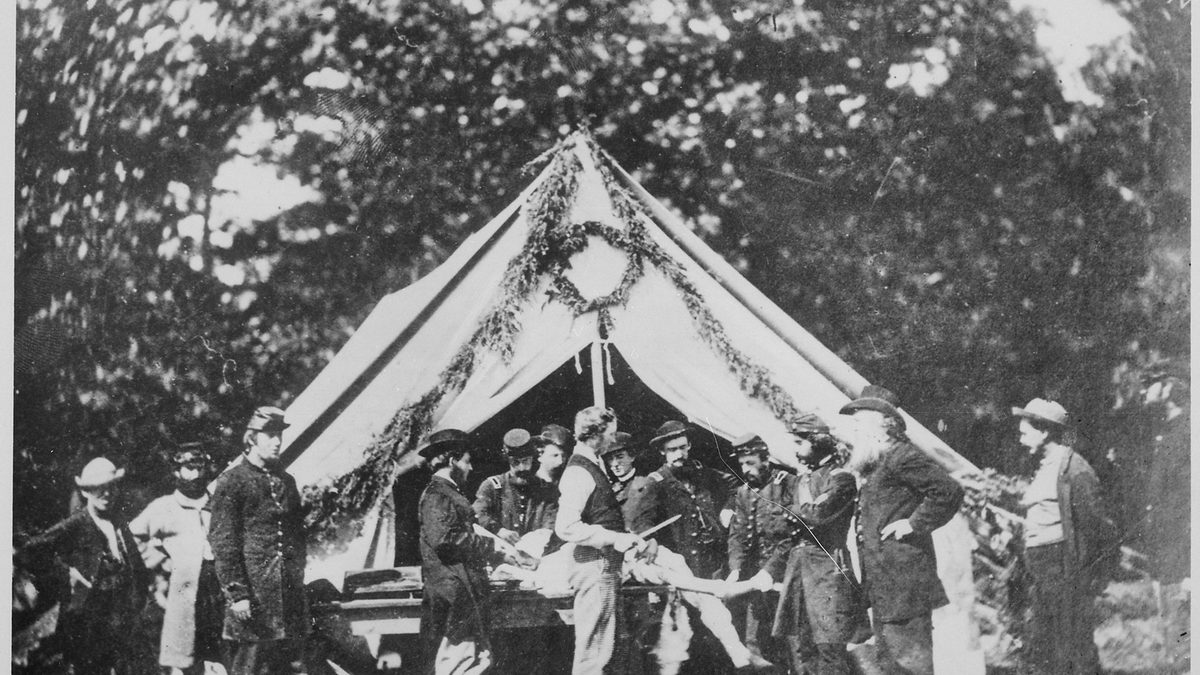
Anesthesia solved pain. It did nothing for infection, because nobody yet understood that infection was caused by living organisms rather than bad air or an imbalance of humours. That gap defined the next major chapter for the amputation saw: the American Civil War, fought in the fifteen years between ether’s arrival and the first workable theory of antisepsis. According to the National Library of Medicine’s history of the war’s medical toll, roughly sixty thousand amputations — about three in every four operations performed — were carried out by Union and Confederate surgeons between 1861 and 1865.
Field hospitals ran close to an assembly line. A wounded soldier arrived, was given whatever anesthetic was on hand — usually chloroform by that point in the war — and a surgeon worked through a standard kit built around a saw much like this one, cutting through bone in a handful of practiced strokes before moving to the next case. Soldiers nicknamed their surgeons “Sawbones” for exactly this reason, and not as an insult: an amputated limb, however brutal it looked, was frequently the only thing standing between a soldier and fatal gangrene, since nobody on either side yet had a way to treat a deep wound infection directly.
Joseph Lister solved the problem anesthesia couldn’t
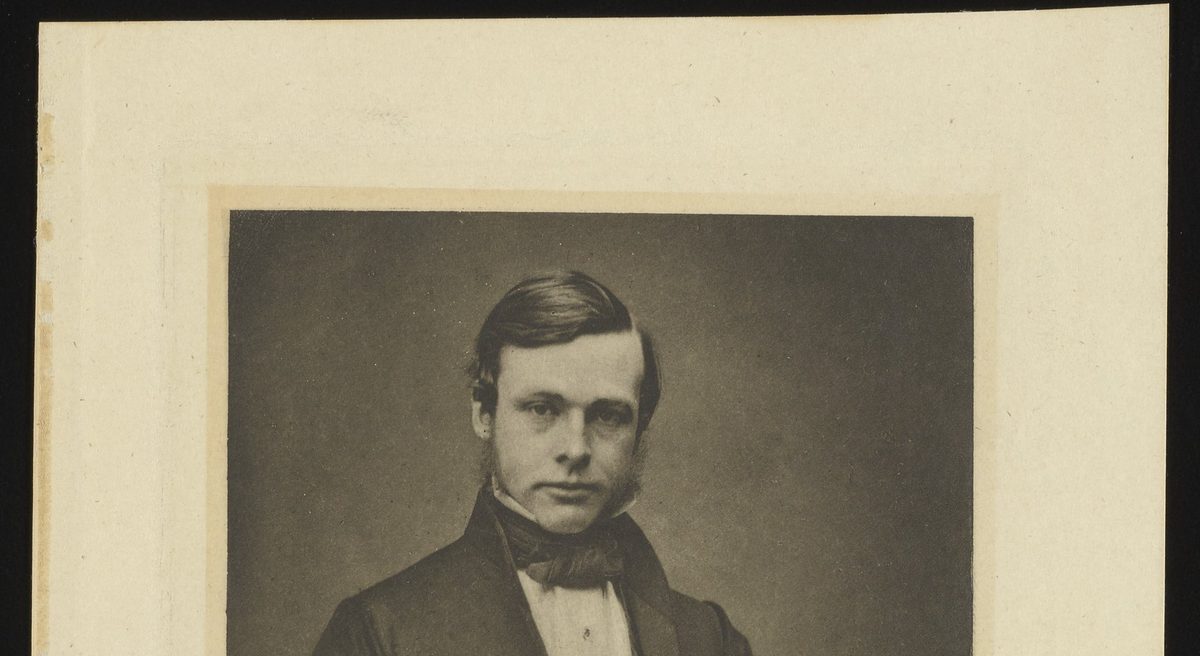
The missing piece arrived in 1867, when a British surgeon named Joseph Lister published a method for applying Louis Pasteur’s still-contested germ theory directly to the operating table. Lister had learned that carbolic acid, already used to deodorise sewage, could kill the organisms responsible for wound infection. He began washing wounds, dressings, and eventually his instruments and the air of the operating theatre itself with it. In an early case, a compound leg fracture that would previously have been “unhesitatingly condemned to amputation” healed without infection. Lister’s own published results showed eleven consecutive compound-fracture cases with no deaths from sepsis, at a time when such wounds killed close to half of all patients who received them.
Antisepsis did two things to the amputation saw’s history at once. Combined with anesthesia, it finally made amputation a controlled, survivable procedure rather than a desperate last resort. And by letting surgeons treat and save limbs that would once have had to come off, it made amputation itself steadily rarer — the same pattern that eventually displaced routine bloodletting once doctors had an actual mechanism to treat disease instead of an inherited ritual. The saw outlived both problems it had been built to work around. Its shape barely changed for another century, because a hand saw remains, mechanically, one of the most reliable ways to cut through bone; it was the twentieth century before powered oscillating saws began replacing it in most operating rooms.
A saw like this one usually turns up today behind museum glass, nested in a velvet-lined case beside a set of amputation knives, looking almost indistinguishable from ordinary carpentry hardware — because in the early decades of surgery it frequently was made by the same craftsmen who built woodworking tools. That resemblance tends to unsettle visitors more than the history does: the instrument meant to save a patient’s life was, in every visible way, a saw from a toolbox, carried by a man whose formal training in a great many cases amounted to an apprenticeship in shaving beards.
What changed between Paré’s improvised salve and Lister’s carbolic spray was not the saw. It was everything the saw no longer had to compensate for. Ligature removed the need for a red-hot iron. Ether removed the need for inhuman speed. Antisepsis removed the need to treat infection as an unavoidable cost of survival. Each breakthrough quietly retired one more reason amputation had to be brutal, until the operation that once defined a surgeon’s entire skill set became, by the early twentieth century, a comparatively ordinary procedure — performed less often, because fewer limbs needed to come off at all.
Ether is not even two hundred years old. Reliable antisepsis is younger still. For nearly all of human history before those two breakthroughs arrived within two decades of each other, the fastest, steadiest hand on a saw like this one was, quite literally, the difference between living and dying on the table.
Watch the full history
The short version of this story — how the saw got its nickname, and what changed between Paré’s era and the Civil War — runs about ninety seconds.

Related reading
- Who Discovered Ether Anesthesia? The Feud That Ruined Three of the Four Men Who Claimed It
- How the Dental Key Worked, and Why It Took a Century to Retire
- Why Doctors Drained Blood to Treat Almost Any Illness
- The Bloodletting Craze That Nearly Wiped Out Europe’s Leeches
Shop the styles/items featured in this video
- Civil War medicine and surgery (book)
- Antique-style surgical instrument collectible
- A history of surgery (book)
Works cited
- Ellis, Harold. “Ambroise Paré: Pioneer of Trauma Surgery.” British Journal of Hospital Medicine 71, no. 3 (March 2010): 168. Link.
- VanderVeer, Joseph A., Jr. “Hero #2: Ambroise Paré.” The Oslerian, American Osler Society newsletter, 17, no. 2 (August 2016). Link.
- “Liston Amputation Knife.” Object record, Thackray Museum of Medicine, Leeds. Link.
- Witherspoon, Doug. “A 300 Per Cent Mortality Rate for One Surgery: Fact or Fiction?” Medical Independent, 13 October 2025. Link.
- “Ether Dome.” Scientist of the Day, Linda Hall Library of Science, Engineering & Technology. Link.
- “The Maimed Men.” Life and Limb: The Toll of the American Civil War, National Library of Medicine exhibition. Link.
- Eschner, Kat. “The Idea of Sterilizing Surgical Instruments Is Only 150 Years Old.” Smithsonian Magazine, 16 March 2017. Link.
- Brief College History. Royal College of Surgeons of England, Archives. Link.