
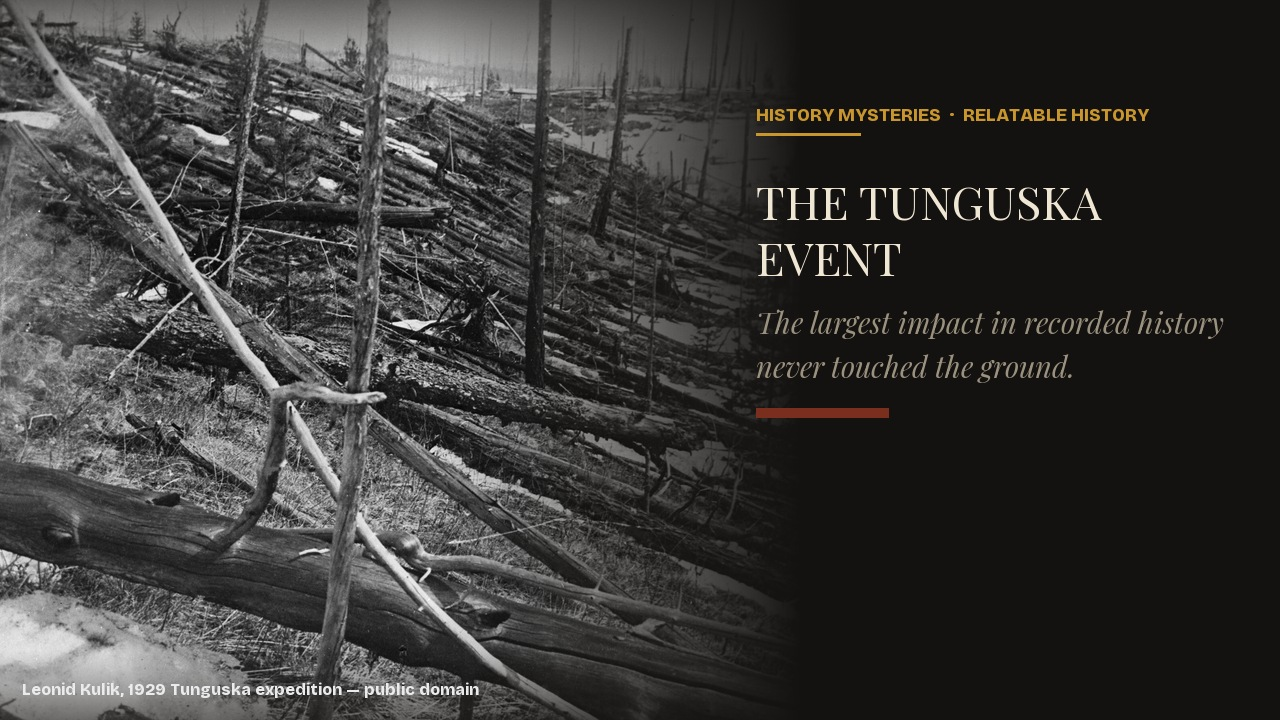
At about a quarter past seven on the morning of June 30, 1908, the sky over a stretch of Siberian forest nobody important lived near tore open. Witnesses sixty kilometres away were knocked off their porches by heat they thought had set their own shirts on fire. Instruments in western Europe, thousands of kilometres from the source, picked up the pressure wave. For two nights afterward, the sky over London and much of northern Europe stayed bright enough at midnight to read a newspaper by.
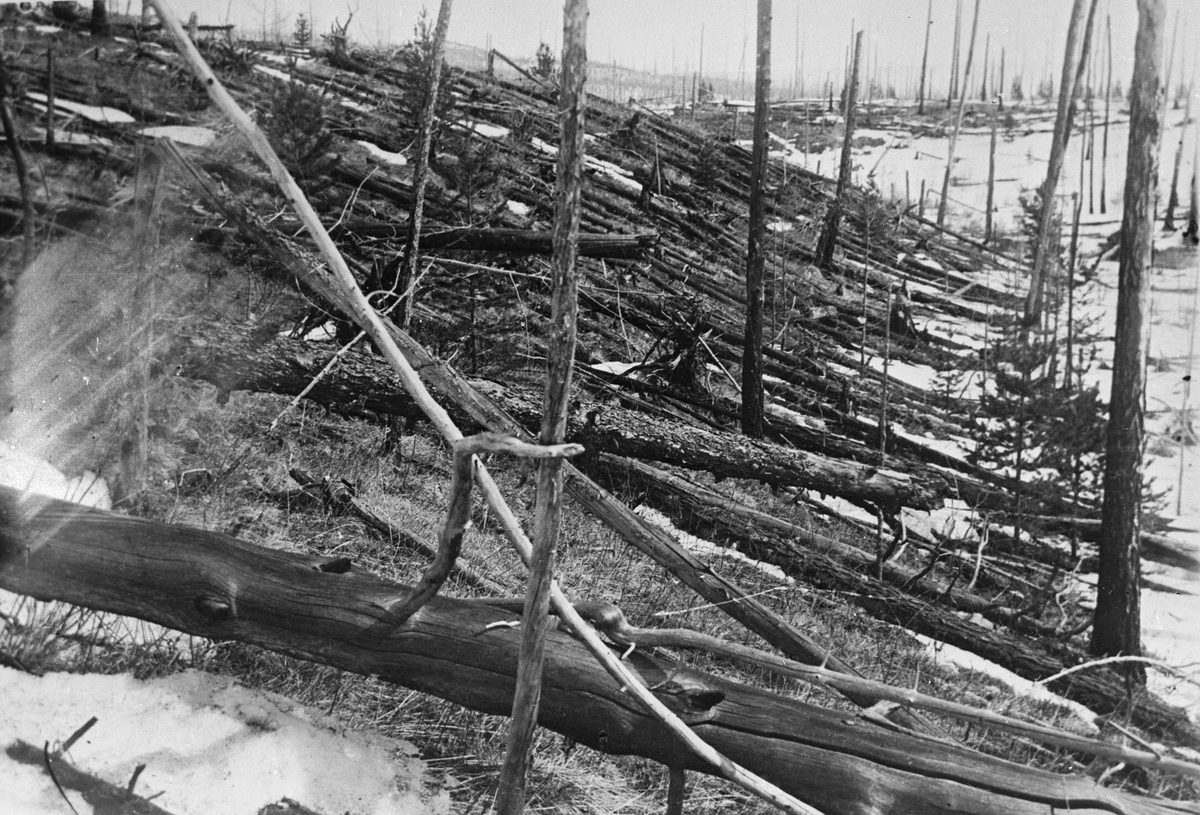
Nothing fell. That is the detail that has kept the Tunguska event an open case for well over a century. An explosion big enough to flatten an estimated 80 million trees across 830 square miles of taiga left no crater, and despite a dozen expeditions across a hundred years, no one has ever recovered a fragment that scientists agree came from whatever caused it. The leading explanation, built from decades of modelling, is a stony asteroid that detonated in mid-air with the force of a large nuclear weapon — and then was almost completely erased by its own blast.
What follows is the shape of that explanation, how long it took to arrive at it, and what is still genuinely unresolved.
A blast measured on the other side of the planet
The event happened above the basin of the Podkamennaya Tunguska River, in what is now Krasnoyarsk Krai, deep in central Siberia. There was no town at the epicentre to record a death toll and no observatory nearby to point an instrument at it — the nearest settlement of any size, the trading post at Vanavara, sat about sixty kilometres to the south. That remoteness is the only reason this qualifies as a mystery rather than a well-documented disaster.
It was not, however, a local event. Barograph traces in Britain recorded an atmospheric pressure wave that had travelled across Eurasia. For the following two nights, observers across Europe and parts of Asia reported skies that would not fully darken: luminous high-altitude clouds and unusually colourful sunsets stretched from roughly 47 to 60 degrees north latitude, bright enough in places that people described reading outdoors at midnight without a lamp. A 2012 study attributed the effect to a vastly enlarged field of noctilucent cloud, kicked up by the explosion’s shockwave high in the mesosphere, with a reflective area estimated at roughly ten thousand times that of an ordinary noctilucent cloud display.
Energy estimates vary with the method used to reconstruct them, which is itself worth noting plainly: this is reconstructed physics, not a measured number. Most modelling converges on something in the range of 10 to 20 megatons of TNT-equivalent, with one widely cited review putting the likeliest figure closer to 15 megatons — on the order of a thousand times the Hiroshima bomb, released not at ground level but several kilometres up.
Nineteen years passed before anyone went to look
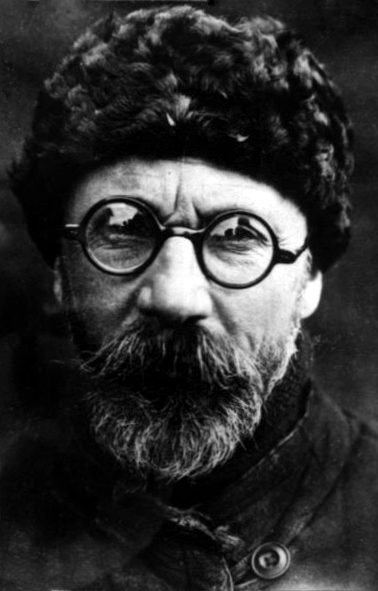
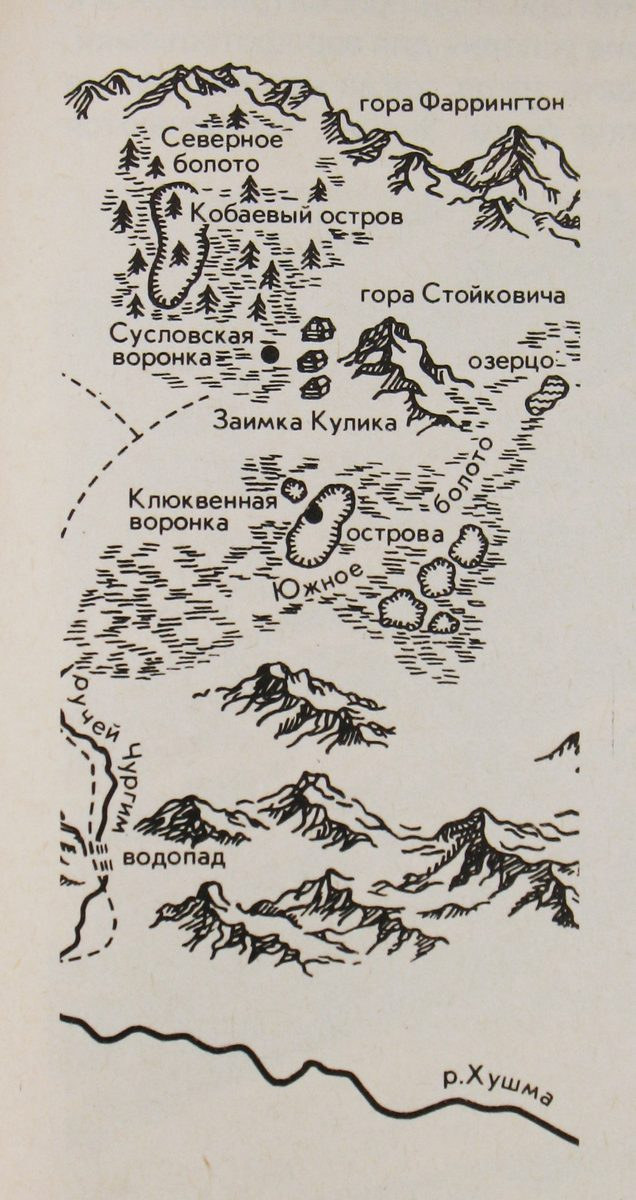
Scientific investigation did not begin in 1908. It began in 1927, and the gap matters: in between sat the First World War, the Russian Revolution, and a civil war that made an expedition into remote Siberia a low priority for anyone. The man who eventually organised one was Leonid Kulik, a mineralogist with the Soviet Academy of Sciences who had spent years chasing an earlier, unrelated newspaper report of a meteorite in the same general region before focusing on Tunguska specifically.
When Kulik’s party finally reached the site, they found something stranger than a crater. At the centre of the devastation stood bare, branchless tree trunks, still rooted and upright, while trees for miles in every direction around them had been thrown flat, pointing away from the centre. A tree that absorbs a blast wave from directly above loses its branches but can stay standing; a tree hit from the side gets knocked down. Kulik was looking at the signature of an explosion that had gone off above the forest, not one that had struck it.
He returned several more times through the 1930s, convinced a crater and a meteorite had to be somewhere in the area. He even identified a set of shallow, water-filled depressions as candidate impact craters and had them partially drained and probed. They turned out to be ordinary thermokarst pools, a routine feature of permafrost terrain with nothing to do with the blast. Kulik died in 1942, in a German prisoner-of-war camp, having spent the better part of two decades on a search that never produced the object he was sure was there.
The forest fell in the shape of a butterfly
Later surveys mapped the full extent of the treefall and found it was not a simple circle. It formed an asymmetric pattern, wider on one axis than the other and often described as butterfly- or bowtie-shaped, with the zone of scorching concentrated differently from the zone of flattening. For decades this shape was simply recorded as a curiosity. It has since become one of the better pieces of physical evidence for what actually happened.
Computer modelling published by NASA researchers in 2018, which for the first time incorporated the real terrain of the Tunguska basin rather than treating the ground as flat, reproduced that specific north-south asymmetry when it simulated an object entering at a shallow angle and detonating as it travelled. The same modelling put the most probable burst height at around eleven and a half kilometres, with peak energy release occurring over a range of roughly ten to thirteen kilometres up, and estimated ground-level winds in the most powerful scenarios at over sixty metres per second — category-five-hurricane force, arriving in a single pulse with no warning.
That a shape nobody could explain in 1908, or for decades afterward, turned out to be reproducible from first-principles physics a hundred and ten years later is, on its own terms, a genuine piece of the case closing rather than staying open.
What a century of searching never found
No impact crater has ever been identified at Tunguska, and that is treated as a real finding, not a gap in the research. An object travelling at hypersonic speed that disintegrates violently several kilometres above the ground delivers its energy to the ground as a blast and a thermal pulse, not as a projectile, which is exactly consistent with flattened forest and no hole.
What investigators have found is smaller and more ambiguous. Expeditions from the late 1950s onward recovered tiny glassy spheres and dust from the peat and soil of the fall zone, some of it carrying chemical traces — nickel, cobalt, traces of iridium — associated with meteoritic material rather than ordinary terrestrial rock. A 2013 re-examination of decades-old rock samples from the site reported further material consistent with an extraterrestrial origin. None of this amounts to a recovered fragment anyone can point to and say, unambiguously, this fell from the object that caused the explosion. It is suggestive of a cosmic origin rather than proof of one, and the honest state of the evidence, even now, is circumstantial.
That gap is exactly why alternative explanations survived as long as they did. A comet made mostly of ice would explode with similar violence and leave behind almost nothing solid at all, which made it a serious competing hypothesis for years. A handful of more exotic proposals — a pocket of natural gas igniting beneath the swamp, among them — were floated and did not hold up against the airburst evidence. The absence of a smoking-gun fragment is not, by itself, evidence against the asteroid explanation; it is exactly what the asteroid explanation predicts.
A stony asteroid that went off like a bomb, mid-flight
The explanation that has held up best since it was first modelled in detail in 1993 is straightforward to state and genuinely hard to picture. A stony asteroid roughly fifty to eighty metres across entered the atmosphere at tens of thousands of kilometres per hour. Atmospheric pressure built faster than the rock’s own strength could withstand, and it did not hit the ground so much as come apart catastrophically in flight, converting its enormous kinetic energy into a single airburst several kilometres up.
Researchers modelling the physics in the 1990s showed this is the ordinary fate of a stony object of that size hitting a planet with an atmosphere — iron asteroids of comparable energy tend to punch through to the ground and leave a crater, while icy or carbon-rich bodies tend to disintegrate even higher up and more gently. A mid-sized rocky body threading that gap, breaking apart at just the altitude to dump its energy into the air rather than the ground, is not a freak outcome. It is, on these numbers, close to the default one.
The people nearest the blast nearly didn’t survive it
A detailed study of surviving testimony published in 2019 identified at least thirty people who had been in or near the treefall zone itself, mostly reindeer herders. Several lost consciousness; at least three died as a direct result of the blast, whether from the heat, the shockwave, or injuries sustained when it threw them. At Vanavara, far enough away to survive but close enough to be knocked flat, one witness later described sitting on his porch facing north when “the sky was split in two” and the whole northern half of it appeared to catch fire; he said the heat felt as if his shirt had ignited, and he was thrown several metres before losing consciousness. A second witness at the same outpost described fire pouring from a sky that had opened “brighter than the sun.”
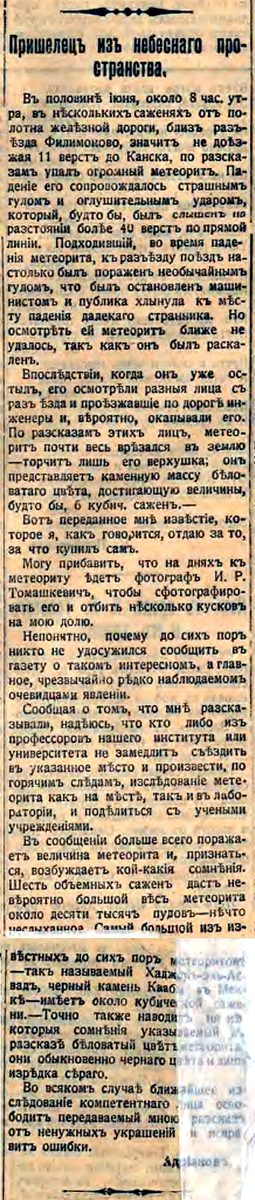
Set against those accounts, it is worth being honest about how thin contemporary scientific attention to the event actually was. There was no telegraph line to the site, no scientific expedition for almost two decades, and the first published account — a short item in the regional paper Sibirskaya Zhizn, twelve days after the fact — ran as a provincial curiosity, not a national story. Early, informal explanations ranged from a stricken spacecraft to a miniature black hole to a particle of antimatter annihilating on contact with Earth’s atmosphere, none of which had anything resembling the eyewitness and physical evidence behind them that the stony-asteroid explanation eventually accumulated.
Why a 1908 blast still matters to planetary defence today
The closest modern comparison, the airburst over Chelyabinsk, Russia, in February 2013, involved an object roughly a quarter the estimated size of the Tunguska body and released on the order of five hundred kilotons — still enough to injure around 1,500 people, almost entirely from flying glass shaken loose by the blast wave, in a city the original object’s size class was never expected to threaten. Run the Tunguska numbers over a populated area instead of empty taiga and the casualty figures stop being an academic exercise.
That is also, more or less explicitly, why the United Nations General Assembly proclaimed June 30 — the Tunguska anniversary — as International Asteroid Day in December 2016, an occasion built specifically around raising public awareness of near-Earth object risk and planetary defence research. A century-old unsolved mystery became, somewhat unusually, the calendar date attached to a modern research priority.
Watch the full history
The short version covers the blast, the nineteen-year wait, and the search that never found a crater in under a minute.

Related reading
- What the Records Actually Show About the Shag Harbour UFO — the one Canadian UFO case with physical evidence and a Navy dive log, not folklore
- What Really Made the Crew Abandon the Mary Celeste — another case where the physical evidence had to carry the whole explanation
- What Actually Happened to the Amber Room — a different kind of vanishing act, this one with no airburst to blame
- Was the Baghdad Battery Real? What the Evidence Actually Shows — an object mistaken for something far stranger than it was, resolved the opposite way
Works cited
- Jenniskens, Peter, Olga P. Popova, Dmitry O. Glazachev, Elena D. Podobnaya, and Alexandra P. Kartashova. “Tunguska Eyewitness Accounts, Injuries, and Casualties.” Icarus 327 (2019): 4–18.
- Chyba, Christopher F., Paul J. Thomas, and Kevin J. Zahnle. “The 1908 Tunguska Explosion: Atmospheric Disruption of a Stony Asteroid.” Nature 361 (1993): 40–44. Link.
- Vasilyev, N. V. “The Tunguska Meteorite Problem Today.” Planetary and Space Science 46, nos. 2–3 (1998): 129–150.
- Morrison, David, ed. Tunguska Workshop: Applying Modern Tools to Understand the 1908 Tunguska Impact. NASA Technical Memorandum NASA/TM-2019-220174, 2018. Link.
- Gladysheva, O. G. “Atmospheric Anomalies in the Summer of 1908: Skyglow.” Geomagnetism and Aeronomy 52, no. 4 (2012): 526–532. Link.
- United Nations Office for Outer Space Affairs. “United Nations General Assembly Proclaims 30 June as International Asteroid Day.” Press release, 6 December 2016. Link.
- NASA. “115 Years Ago: The Tunguska Asteroid Impact Event.” NASA History Office, 2023. Link.
- Planetary Science Institute. “1908 Siberia Explosion: Reconstructing an Asteroid Impact from Eyewitness Accounts.” PSI Education and Public Outreach. Link.
- Anderson, Paul Scott, and Kelly Kizer Whitt. “The Tunguska Explosion Rocked Siberia.” EarthSky, June 30, 2026. Link.
- Peplow, Mark. “Rock Samples Suggest Meteor Caused Tunguska Blast.” Nature, news article, June 2013. Link.