
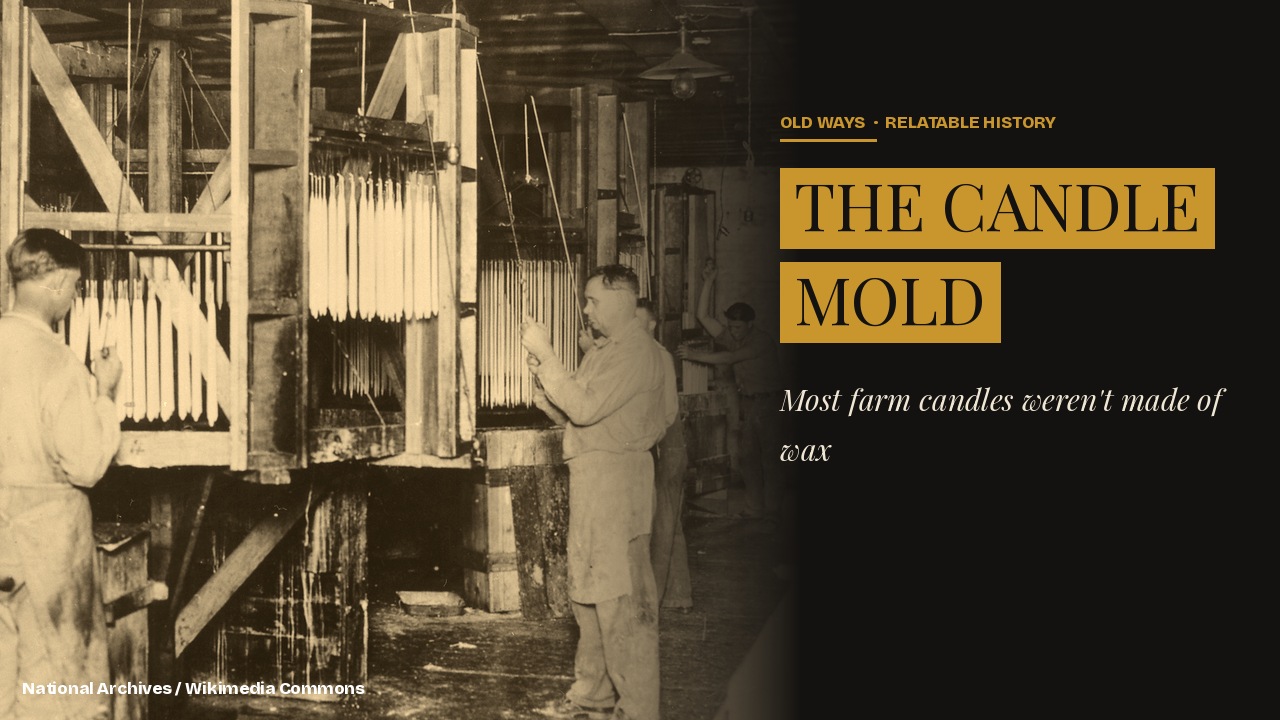
In 1754, a Maryland man named John Smith died, and whoever appraised his estate for probate walked through his kitchen and wrote down sixteen pounds of myrtle wax, a pound and a half of wicking, and five separate candle molds. Archaeologists who later excavated his cellar found the charred remains of the bayberry bushes that supplied the wax. That inventory is about as close as anyone gets to a receipt for how tallow candles were made in an ordinary 18th-century household: not a purchase, but a small stock of raw material and equipment, counted and valued like livestock or tools, because making your own light was itself a form of household manufacturing.
The tin mold at the center of that operation is a simple enough object on its own. What is harder to see from the object alone is everything that surrounded it: a trade that put tin tools into nearly every kitchen in the country, a substitute wax that cost real money and real labor to gather, and specialist makers who turned a plain farm tool into something closer to a craft piece. And then, in under a century, a chemist’s accident with coal and a federal electrification program between them made the whole practice disappear — one of them so thoroughly that some communities threw the replacement lamp a literal funeral.
What a Dead Man’s Inventory Reveals About How Tallow Candles Were Made
Probate inventories are blunt instruments — an appraiser walking room to room, putting a value on everything a household owned so its worth could be divided — and that bluntness is exactly what makes John Smith’s 1754 list useful. He did not own candles. He owned the makings of candles: wax by the pound, wicking by the pound, and five molds, which researchers at the Maryland Archaeological Conservation Laboratory read as a sign that Smith was almost certainly making candles for his own household rather than to sell. Archaeobotanist Justine McKnight later identified charred bayberry remains in the same cellar, deposited sometime in the 1740s or 1750s when the kitchen was renovated — physical confirmation, buried for over two hundred years, of exactly what the paper inventory said was in the house.
Owning five molds rather than one also says something the mold itself can’t: candle-making capacity was something a household built up over time, mold by mold, the way it built up any other piece of kitchen equipment. A single pour from a single mold was never going to cover a winter on its own; what mattered was how many pours a kitchen could run through its molds, one batch of rendered fat at a time, before the fat ran out or the wicking did.
Bayberry Wax Was the One Candle in the House Worth Bragging About
Tallow did most of the work because it was free. Bayberry, or wax myrtle, was the aspirational alternative, and it had been since the earliest English settlers in Virginia noticed what the shrub’s berries could do. The planter Robert Beverley, writing in 1705, described the berry as yielding “a hard brittle Wax” once boiled down — and boiling down is the operative phrase, because getting wax out of bayberries was its own small industry inside the larger one of candle-making. Pickers gathered the berries in late autumn, boiled them, skimmed the floating wax, then boiled and skimmed again until what remained ran clear and pale green. Historians estimate it took anywhere from six to fifteen pounds of berries to yield a single pound of wax, a range wide enough that it was clearly labor-intensive work regardless of where in it a given harvest landed.
That labor bought something real: a candle that burned cleaner and smelled, by multiple accounts, faintly of strawberries, instead of the acrid animal reek of plain tallow. It was priced accordingly — second only to spermaceti whale-oil candles in cost — which is why most makers cut it with tallow rather than using it straight, and why even a founding father went looking for the pure version. Thomas Jefferson specifically wanted bayberry candles made without any tallow mixed in, and his own supplier told him the plain myrtle wax only came to market in small lots of four to ten pounds at a time, sold by country people who had gathered and rendered it themselves. A president of the United States, in other words, was competing for the same small-batch cottage product as everyone else’s neighbors.
A Candle Mold Came From a Tin Peddler, Not a Chandler’s Shop
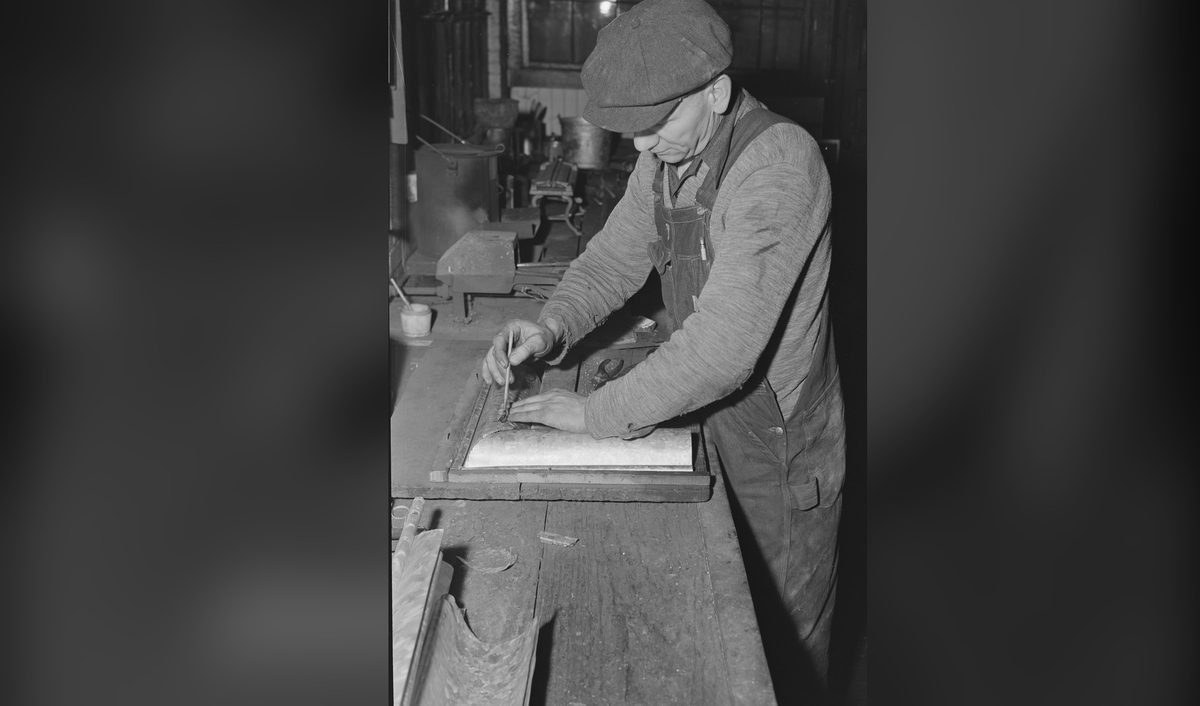
Almost nobody in rural America bought a candle mold from a shop that specialized in candles. They bought it from a peddler who also sold pots, pans, and needles, and that distribution network has its own origin story. Around 1740, two Scottish brothers, William and Edward Pattison, settled in what is now New Britain, Connecticut, found the local farmland wanting, and fell back on a trade they’d learned at home: tin making. They picked up sheets of imported English tin in Boston, carried them home on horseback, and turned them into kitchenware they sold door to door out of a sack — then, as the business grew, out of baskets slung over a horse’s back so they could reach farms further afield.
The Pattisons’ little operation became the template for an entire regional trade. Tin making took almost no capital and almost no specialized labor, and rural households wanted finished tin goods badly enough to buy from whoever showed up with a cart. By the early 1800s, Connecticut peddlers were running circuits of six to eight months at a stretch, as far as Albany and Richmond, selling the same kind of tinware the Pattisons had started with. A mold bought this way was never a specialty purchase. It was one more item in a peddler’s basket, next to the pots and the needles, which is exactly why it ended up in so many kitchens that never saw a dedicated candle shop in their lives.
Shaker Workshops Turned the Same Tool Into a Craft Piece
Not every mold stayed at peddler-basket quality. The Shaker community at Enfield, New Hampshire — active from 1793 into the 1920s and known well beyond their own membership for refining ordinary household tools — made at least one candle mold that survives today with a leather-wrapped handle instead of a plain tin strap, now held by the Hood Museum of Art at Dartmouth College. Surviving examples elsewhere show the same basic design scaled in both directions: the Concord Museum holds a two-tube mold, barely ten inches long, dated to the late 1700s or early 1800s, while the New Bedford Whaling Museum’s four-tube mold, with a folded sheet-tin handle, is cataloged to around 1850. None of the three is the twenty-four-tube production model a large household might have run; they’re a reminder that the mold’s basic form stretched across both a full century of use and a wide range of household sizes.
Kerosene Didn’t Improve the Candle — It Replaced the Whole Idea of One
The chemist usually credited with ending all of this was working on something else entirely. In 1845, the Nova Scotian geologist Abraham Gesner started distilling coal and bituminous rock in search of a cheap lamp oil, and by August 1846 he was lighting public demonstration lamps on Prince Edward Island and in Halifax with oil distilled from a rock called albertite. He named the product kerosene, after the Greek for wax, and patented the American version in 1850 using Trinidad pitch as the feedstock. He moved to New York in 1853, sold his patents the following year, and by 1859 the company that held them — by then renamed the New York Kerosene Oil Company — was turning out roughly five thousand gallons a day at about a dollar a gallon. Gesner himself never got rich from any of it; he was a salaried chemist for the company he’d helped found, and he was laid off that same year, just as the Pennsylvania petroleum boom made his coal-derived process obsolete almost as fast as it had made tallow obsolete.
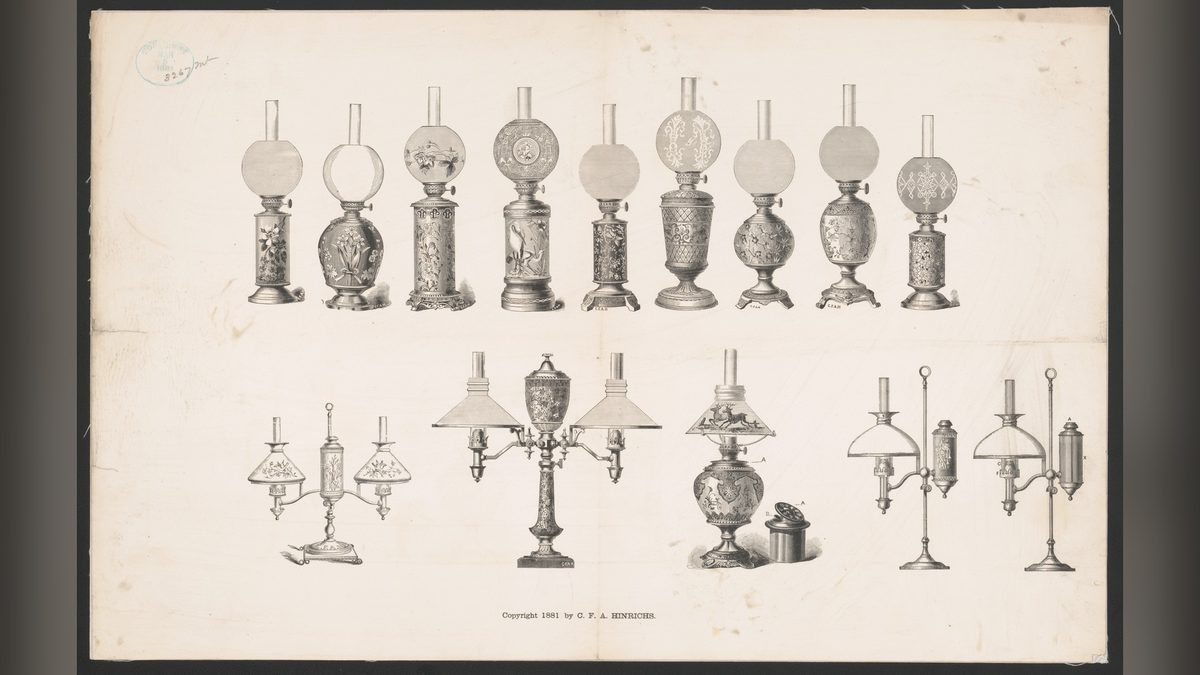
Kerosene alone wasn’t what put a lamp on every table, though. That took a specific piece of hardware: an inexpensive flat-wick lamp with a glass chimney, imported from Vienna by the Austen brothers, simple enough to manufacture cheaply and safe enough to leave burning on a kitchen table. It was this import, not the fuel by itself, that became known simply as the kerosene lamp, and it is the reason the shift away from candle molds happened household by household rather than all at once, as each family weighed the lamp’s cost against a candle mold they likely already owned outright.
Rural Electrification Buried the Kerosene Lamp, Literally
The lamp that replaced the candle mold eventually got the same treatment the mold had, and the record of it is stranger than anything that happened to the mold itself. After the federal Rural Electrification Administration was founded in 1935, some farm communities began holding what historians have called “lantern funerals” — staged as mock mourning for the kerosene lamp, but really a celebration of the wired bulb replacing it. Adams Electric Cooperative in Pennsylvania buried a kerosene lamp on May 3, 1941, under a tombstone that declared it “abolished for all time,” and REA-backed media, including the 1940 film Power and the Land, leaned hard into the same contrast: kerosene light as dim, cramped, and backward, electric light as a kind of literal enlightenment.
The numbers behind the theater were real enough on their own. A contemporary engineering study found that electric light saved farm households roughly an hour and a half a day that had gone into managing kerosene lamps, and put the new bulbs at sixteen to twenty times brighter than what they replaced. How bright a kerosene lamp actually was is one of the few places the sources disagree: the industry’s own trade history estimates a typical lamp put out light equivalent to roughly a 25-watt bulb, while a 1935–36 Montgomery Ward catalog advertised a specific 90-candlepower model as brighter than a modern 60-watt bulb. Both can be true at once — lamps varied enormously by design and upkeep — which is itself a reminder that “a kerosene lamp” covered a wider range of actual light output than either the funerals or the catalog ads let on. The shift was also less total than the staged burials implied: plenty of families kept a lantern in a drawer for the power outages that were common in the first years of rural service, the same way a candle mold itself was kept on for years after most households had already moved on to oil.
What ties all of this together is not the tin itself but the logic behind it: nothing in a pre-industrial kitchen went to waste if it could possibly be turned into something else first. Fat that would otherwise have been scraped into the stock pot became a winter’s light instead, and the mold that made that possible stayed essentially unchanged for roughly a hundred and fifty years because nothing came along that was cheaper. The moment something did — first a fuel, then a federally subsidized wire — the whole arrangement came apart within two generations, candle mold and kerosene lamp alike, each one buried in turn by whatever replaced it.
How would you light a whole winter’s evenings with no lamp oil and no switch? For about a hundred and fifty years, the answer sat in a tin mold on a kitchen shelf, refilled once or twice a season, and almost nobody who owned one wrote down why it worked, because everyone already knew.
Watch the full history
The long-form video walks through the same rendering, pouring, and unmolding process in just under seven minutes, filmed to show each step in sequence.

Related reading
- The Spinning Wheel’s Economics Were Worse Than You Think — the same kind of vanished household manufacturing, done by hand before a machine took it over
- How Kerosene Lamps Worked — the lamp that directly replaced the candle mold in most households
- Homemade Lye Soap History — made in the same rendering kettle, often on the same day as candles
- How Wood Cookstoves Worked in American Kitchens — the hearth and stove where the tallow was rendered down in the first place
Works cited
- Donovan, Alex. “New Britain’s Yankee Peddlers Boost 18th-Century Economy.” Connecticut History (a CTHumanities project), January 17, 2022. Link.
- Chaney, Edward, and Alexandra Glass. “Candle In The Wind (Or Actually, In The Ground).” Curator’s Choice, Jefferson Patterson Park & Museum / Maryland Archaeological Conservation Laboratory, December 2016. Link.
- New Bedford Whaling Museum. Candle Mold, circa 1850. Sheet tin, 9 3/8 in. Object no. 1987.28.3.
- Concord Museum. Candle Molds, late 1700s–early 1800s. Tin, soldered. Object no. H0200.
- Hood Museum of Art, Dartmouth College. Tin Candle Mold with Turned and Fluted Edges, 19th century. Made by an unidentified Enfield Shaker community maker, Enfield, New Hampshire. Accession no. 46.22.16391. Link.
- Rovang, Sarah. “Bury the Lantern: The Other Side of Promoting Farm Electrification.” Society of Architectural Historians, April 23, 2015. Link.
- “Then & Now: Farm Lighting Before Electrification.” RE Magazine, National Rural Electric Cooperative Association. Link.
- “Abraham Gesner.” Engineering and Technology History Wiki, IEEE. Link.