
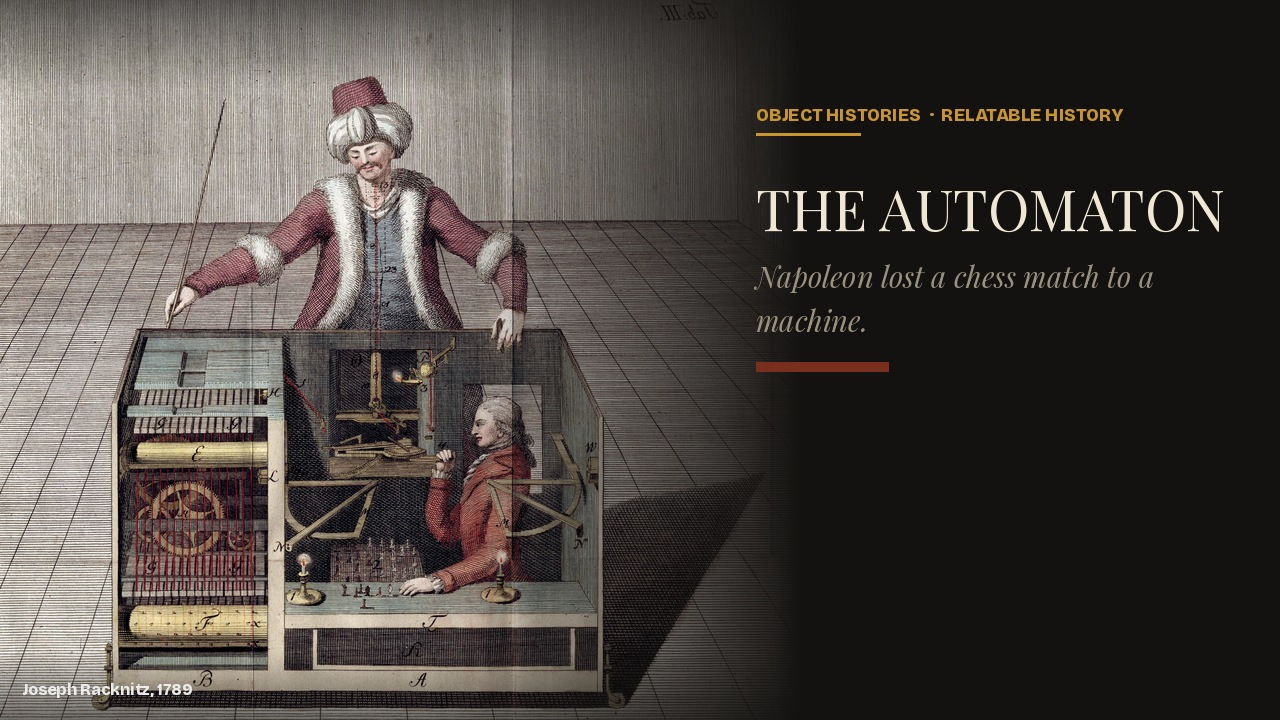
How the Mechanical Turk worked was the single most argued-over question in Europe and America for fifty-seven years, and almost nobody guessed the real answer, which was also the simplest one: there was a chess master folded inside a wooden cabinet, working by candlelight, the entire time. The machine beat Napoleon Bonaparte. It beat most people who sat down across from it. It was never, for one single move, actually thinking.
Kempelen Built It Out of Irritation, for an Empress
Wolfgang von Kempelen was a Hungarian-born inventor and advisor at the Habsburg court, and the Turk began, by most accounts, as a boast. After watching a French conjuror perform for Empress Maria Theresa, Kempelen told her he could build something more impressive. She let him try. About six months later, in 1770, he returned with a life-sized figure in robes and a turban, seated behind a cabinet with a chessboard built into its top. Its first opponent that day lost quickly. So did everyone else.
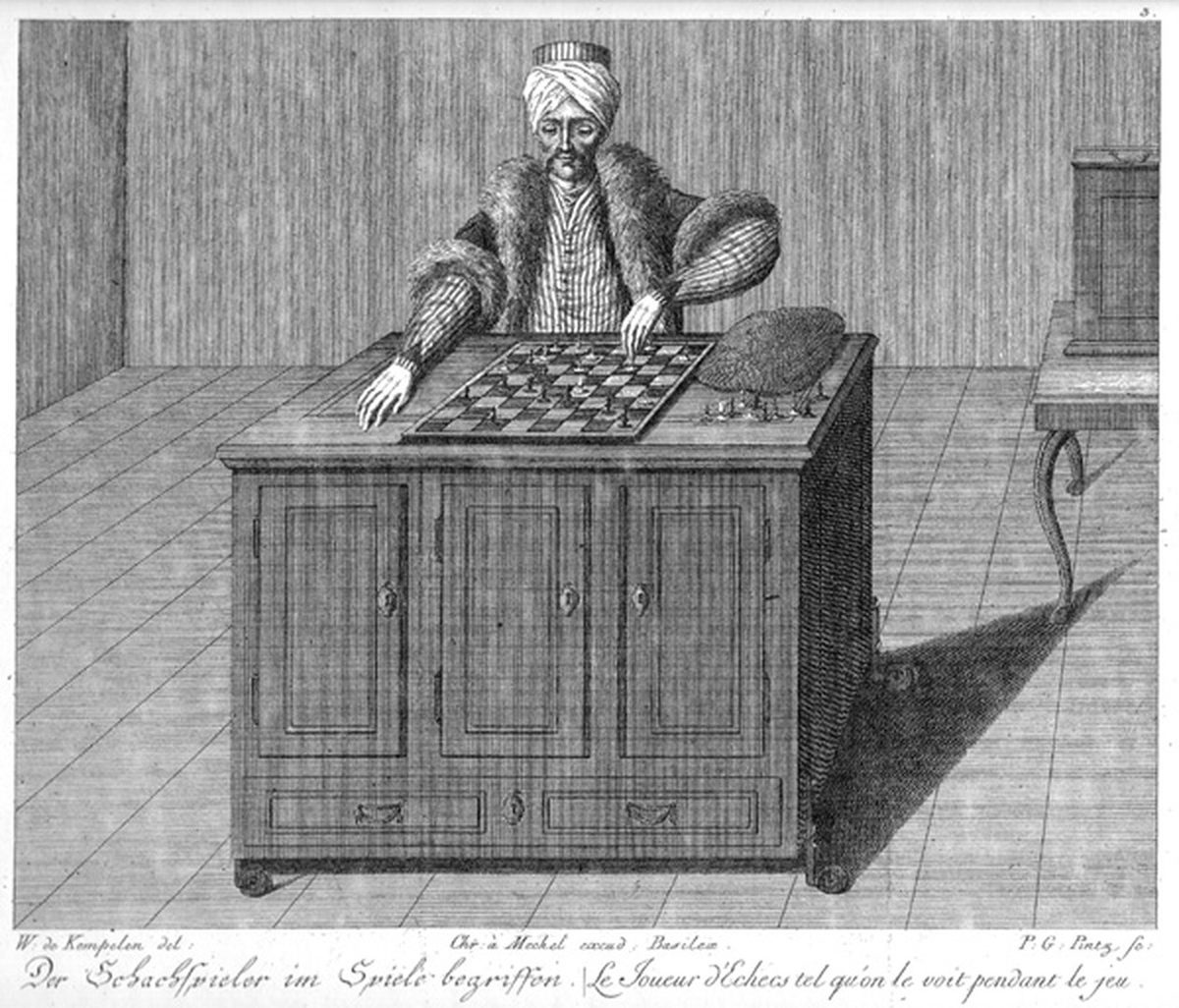
The performance itself was built to defeat suspicion before the first move was even played. Kempelen opened the cabinet’s doors one at a time, holding a candle up to the interior so the audience could inspect the gears, cylinders, and levers inside. Nothing in view could plausibly hide a grown man. Then he closed the doors, wound a key, and the figure reached out and played, well enough to beat most challengers, and with an apparent temper: an opponent who attempted an illegal move would watch the Turk calmly replace the piece, and a second attempt would see it refuse the move outright.
Napoleon Tried to Cheat, and Was Shut Down Twice
The Turk’s most famous match came in 1809, when Johann Népomuc Mälzel, who by then owned the machine, arranged a game against Napoleon Bonaparte at Schönbrunn Palace in Vienna. By multiple period accounts, Napoleon tested the machine with an illegal move. The Turk returned the piece to its square. He tried again; it returned the piece a second time. On a third attempt, the automaton swept every piece off the board entirely, refusing to continue under those terms. Napoleon then played a legitimate game and resigned after nineteen moves. Benjamin Franklin had his own brush with the Turk decades earlier, as American ambassador to France: a surviving letter from Kempelen to Franklin, dated Paris, 28 May 1783, personally invites him to a demonstration of “mon automate joueur d’échec” at Kempelen’s residence. Whether Franklin actually sat down to play it himself isn’t settled by that letter, only that the two men corresponded directly about arranging a viewing. Franklin’s interest wasn’t just politeness, either: he had a standing fascination with reasoning machines generally, and he later wrote separately recommending Kempelen to others as a genius worth cultivating.
How the Mechanical Turk Worked: a Sliding Seat in the Dark
The actual mechanism, pieced together by investigators over decades, turned the open-doors routine itself into the trick. A hidden chess player sat on a seat mounted on rails. As Kempelen opened each compartment door in sequence, the operator slid silently to whichever section was still closed, dragging a false panel of nonfunctioning machinery into the space he had just vacated. The audience genuinely saw every part of the cabinet’s interior. They simply never saw all of it at the same time.
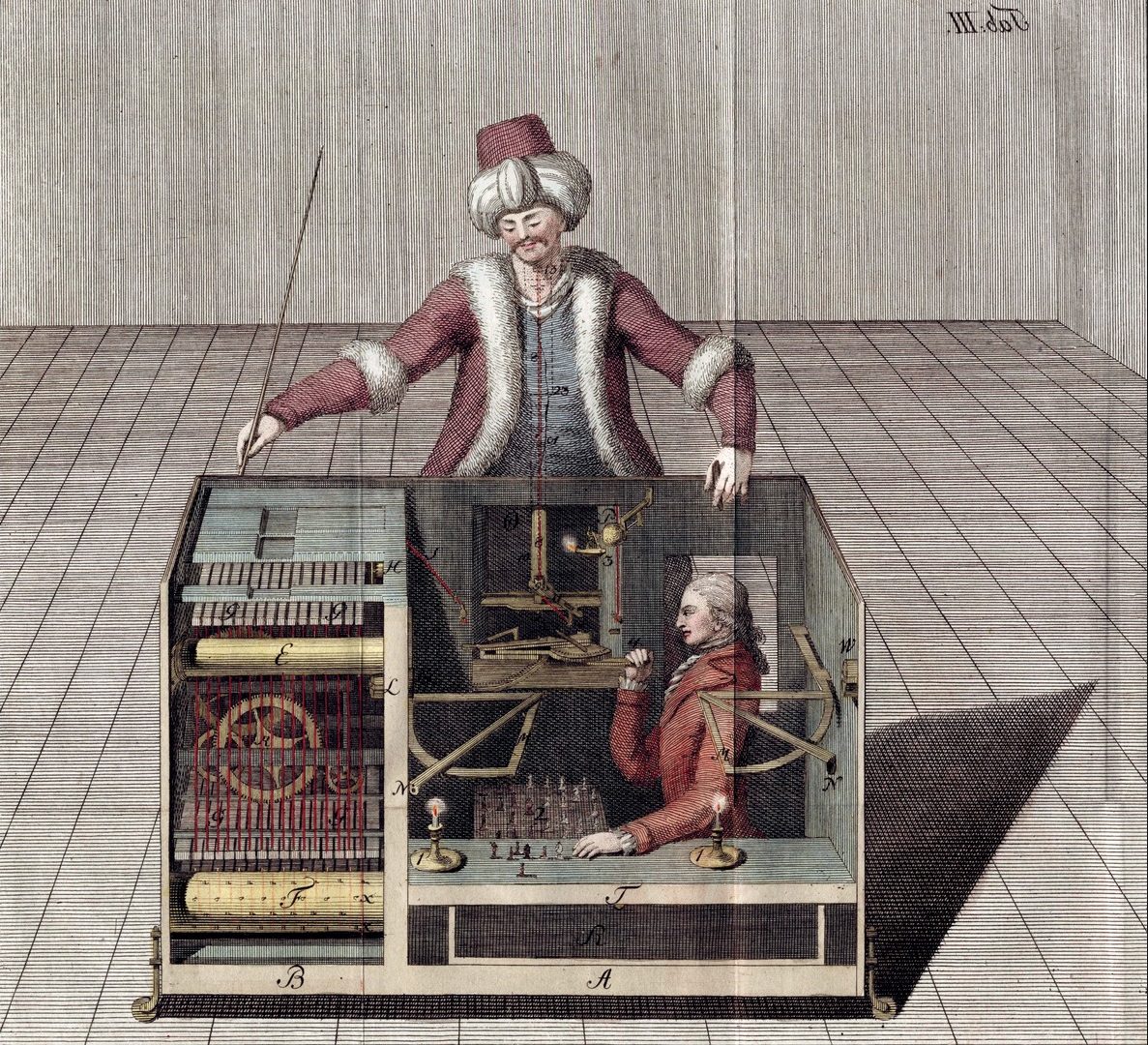
Working in near-total darkness by a single shielded candle, the hidden player read the game through a set of magnets: each chess piece on the board above carried a small magnet in its base, which attracted a corresponding metal disc on strings below, letting him track the position without seeing the board directly. He moved his own pieces on a small peg-board chess set in his compartment, and a mechanical linkage translated his hand movements into the turbaned figure’s arm and fingers above. A succession of some of the strongest chess players in Europe took the job over the decades the Turk toured, Kempelen and later Mälzel having to continually recruit new operators as old ones moved on, retired, or were lost to history entirely; whoever played the very first matches for Kempelen in 1770 has never been identified at all.
Fifty-Seven Years of Guessing Before the Truth Came Out
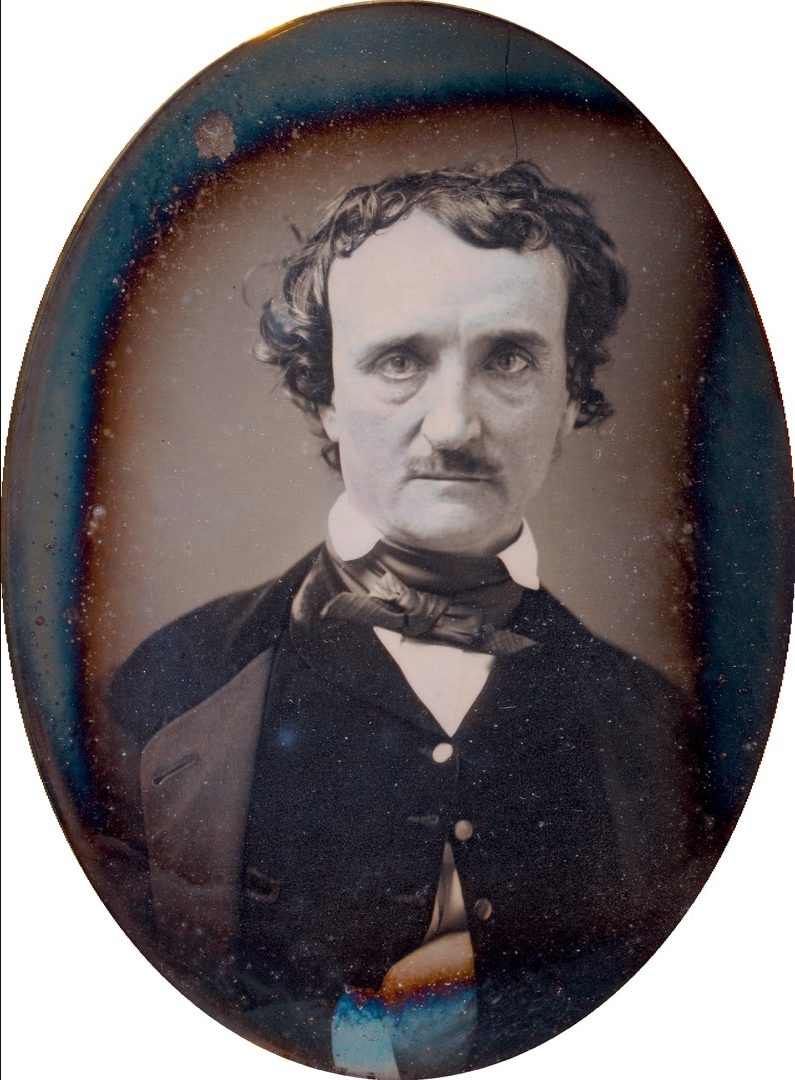
The secret held for decades, through a string of competing theories rather than any single decisive unmasking. In 1784, a writer named Philip Thicknesse argued the operator had to be a child, small enough to fit where an adult could not. In 1789, Joseph Racknitz published an influential cutaway engraving, reasoning out an operator folded into the cabinet’s base, closer to the truth than Thicknesse but still wrong on the specific machinery. Robert Willis published his own detailed mechanical analysis in 1821, the same year Charles Babbage is said to have seen the Turk perform in England, not long before Babbage began his own work on mechanical computation. Edgar Allan Poe saw a performance in Richmond, Virginia, in the 1830s and published an essay arguing, correctly, that a hidden human mind had to be directing the machine, reasoning that its play was “regulated by mind, and by nothing else,” even though his own guess at the mechanism itself was largely mistaken.
Mälzel died in 1838 during an Atlantic crossing from Cuba, and the Turk eventually passed to a syndicate led by Dr. John Kearsley Mitchell, who exhibited it in Philadelphia before donating it to that city’s Chinese Museum. A fire tore through the museum on July 5, 1854, and destroyed the automaton before anyone could save it. It was Mitchell’s own son, the physician Silas Weir Mitchell, who finally published the complete, accurate explanation of how the Turk had worked, free at last to tell the whole story now that the machine itself, and the need to protect its secret, were both gone. For the better part of six decades, the Turk had done something no honest machine of its era could: it made audiences argue, in print, across three continents, about where the line between mechanism and mind actually sat, which is a strange kind of achievement for a piece of furniture with a man folded up inside it.
The Honest Automata Got a Fraction of the Fame
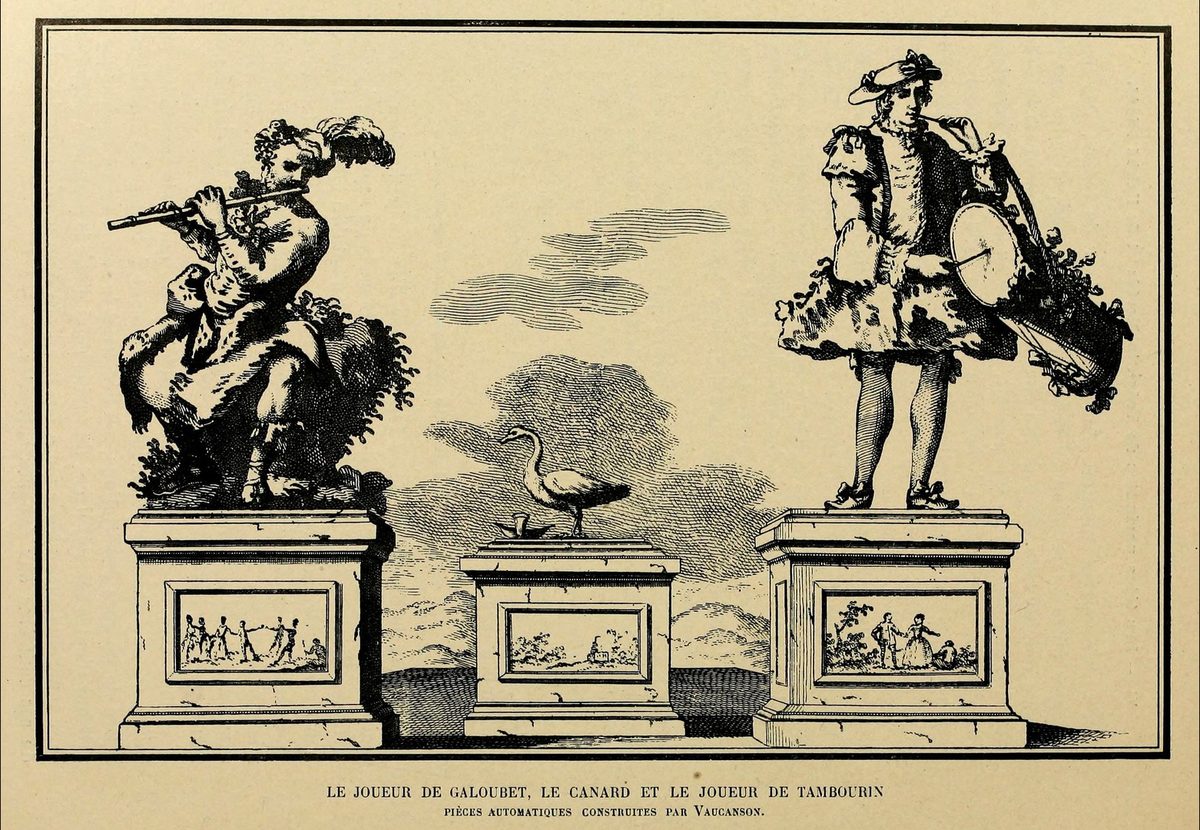
While the Turk toured Europe and America as a sensation built on deception, automata that performed exactly as advertised were working away with far less fanfare. Decades earlier, in February 1738, the French engineer Jacques de Vaucanson unveiled a life-sized Flute Player in Paris, modeled on a marble statue of a flute-playing faun in the Tuileries Gardens, that genuinely played the instrument: internal bellows supplied real breath, and separate mechanisms controlled its lips, tongue, and fingers well enough to perform about a dozen actual melodies, well enough to draw a formal visit from the French Academy of Sciences. Later that same year, Vaucanson followed it with the Digesting Duck, which appeared to eat grain and then excrete waste from the other end. That part actually was a trick: the ingested food collected in one internal chamber, while the “waste” came from a separate reservoir of pre-loaded, dyed breadcrumbs, a deception the magician Jean-Eugène Robert-Houdin finally exposed decades later. The flute player’s music, unlike the duck’s digestion and unlike the Turk’s chess, was never in question.
Jaquet-Droz Built a Machine That Actually Writes
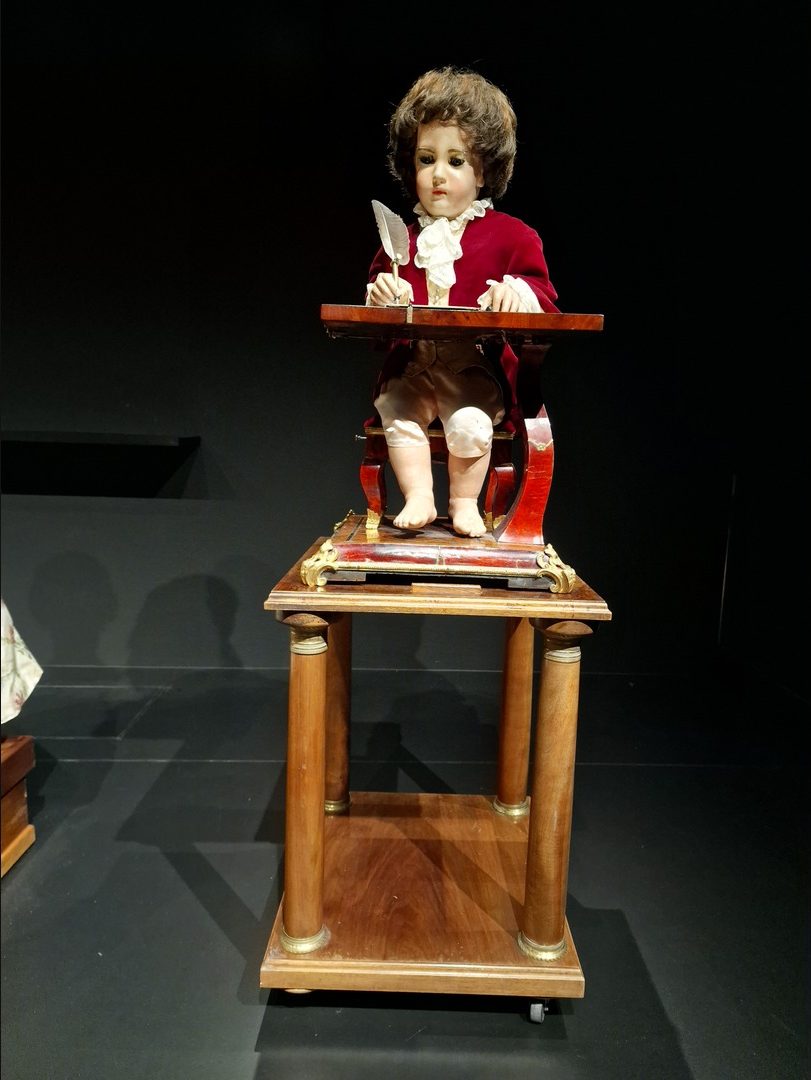
The purest counterexample to the Turk sits in a museum in Switzerland today. Between 1768 and 1774, the watchmaker Pierre Jaquet-Droz, his son Henri-Louis, and Jean-Frédéric Leschot built three automata in Neuchâtel, among them a small seated boy called the Writer, built from roughly 6,000 individual parts. The Writer dips an actual goose quill into an inkwell, shakes off the excess, and writes any text up to 40 characters, its eyes following its own hand across the page as it works. Its program isn’t trickery or a hidden operator; a stack of 40 interchangeable cams physically encodes each character, a genuine mechanical read-only memory built more than a century before anyone had a word for that concept. The Writer still operates today, on display at Neuchâtel’s Musée d’art et d’histoire, roughly two hundred and fifty years after it was built, doing exactly what its creators claimed it would do from the very first demonstration.
Line the two up and the lesson is almost unfair: the fraud became famous enough to beat an emperor and outlast its own inventor’s reputation, while the genuine article has spent two and a half centuries quietly writing to no one in particular, exactly as advertised, in a museum most visitors walk past without stopping. One machine lied about what was happening inside it for fifty-seven years and is still the one people remember first. The other has been telling the truth the entire time, in forty characters or fewer, and mostly gets treated as a footnote to the machine that cheated.
Watch the full history
The video below covers the Turk’s full run, Napoleon’s match, the Baltimore-era doubts, and the Jaquet-Droz automata in more visual detail.

Related reading
- The Real History of the Fortune Teller Machine
- How Tarot Became Fortune Telling, 300 Years Later
- Who Really Invented the Ouija Board?
- How Iceboxes Worked Before the Electric Refrigerator
Works cited
- Kempelen, Wolfgang von. Letter to Benjamin Franklin, 28 May 1783. The Papers of Benjamin Franklin, Founders Online, National Archives.
- Andrews, Evan. “How a Phony 18th-Century Chess Robot Fooled the World.” History.com. Link.
- “Object of Intrigue: The Turk, a Mechanical Chess Player That Unsettled the World.” Atlas Obscura.
- “Jacques de Vaucanson.” Linda Hall Library, Scientist of the Day. Link.
- “This Month in Physics History: February 1738, Vaucanson’s Flute-Playing Automaton.” APS News, American Physical Society.
- “Jaquet-Droz Automata.” HistoryOfInformation.com. Link.