
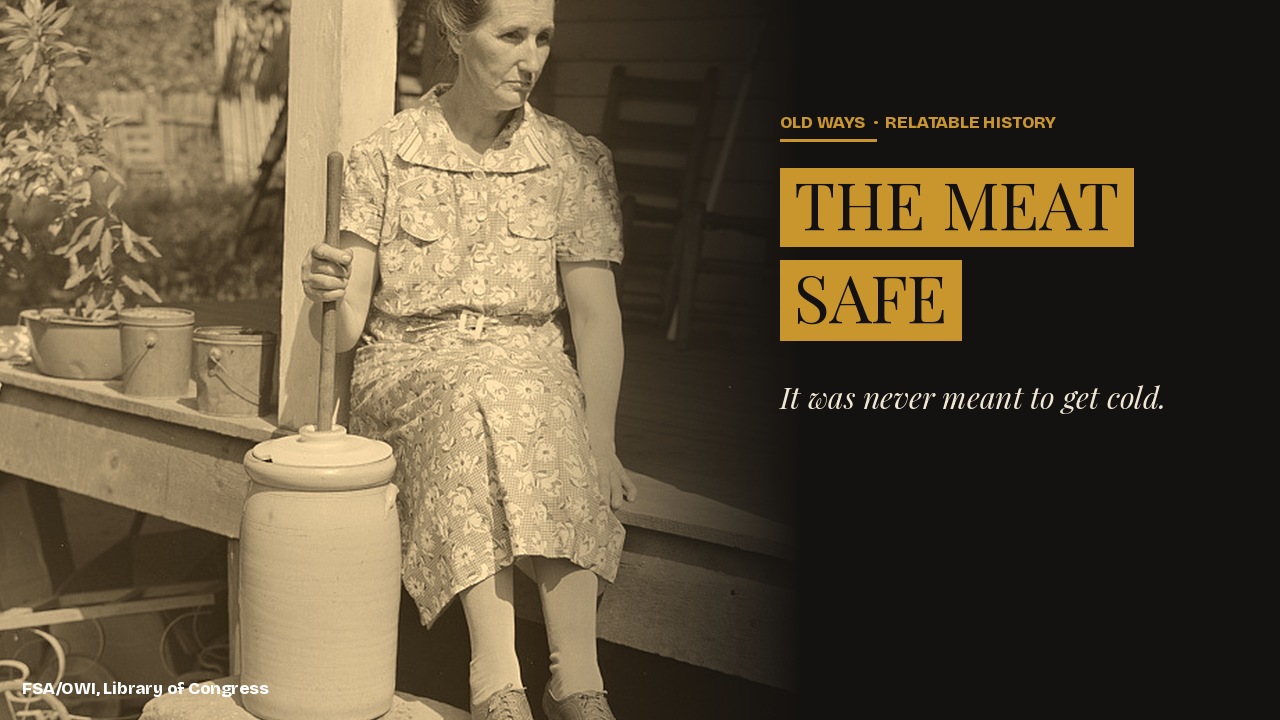
In 1775, a Virginia planter named Robert Beverley placed an order for iron wire, meant to be woven into mesh and built into a wooden cabinet whose entire purpose was to not keep anything out except insects. A Virginia dairy inventory from a quarter-century earlier, in 1750, already lists something similar: an oak “safe” standing among the churns and pans. These are some of the earliest documented traces of a piece of furniture almost nobody today could name, though it quietly ran American and British kitchens for roughly two and a half centuries — longer, by most measures, than the icebox that eventually replaced it.
The object is the meat safe, sometimes called a fly safe, and in the American South a pie safe. It solved exactly one problem: how to keep food from attracting insects in the hours before it could be eaten, salted, smoked, or carried down to a springhouse. It did this with a trick simple enough to feel like a joke at technology’s expense: build the walls out of holes.
By the time electricity finally reached most American farms, that trick had outlasted the Revolution, survived the Civil War, carried two centuries of punched tin and woven wire, and been reinvented independently on the far side of the planet. As late as 1940, after a decade of federally subsidized rural electrification, barely more than a quarter of American farms had electric power of any kind. For the other three-quarters, a box with mesh for walls was still the only thing standing between supper and spoilage.
The Box That Started as Cloth, Not Tin
The earliest American food safes weren’t metal at all. The Colonial Williamsburg Foundation holds one built of yellow pine and linen, catalogued at roughly 1750 but labeled as probably made on Virginia’s Eastern Shore in the last quarter of the eighteenth century. Linen panels stretched over a wood frame did the same airflow job punched tin would later do, just less durably. The museum’s own label cites that 1750 dairy inventory and a second one, from 1772, listing pine safes kept in the cellar of a Yorktown tavern — evidence the furniture type was already ordinary well before the Revolution. Beverley’s 1775 order for iron wire shows the material already shifting toward something insects couldn’t simply chew or rot through, and that incidentally kept mice out as well as flies.
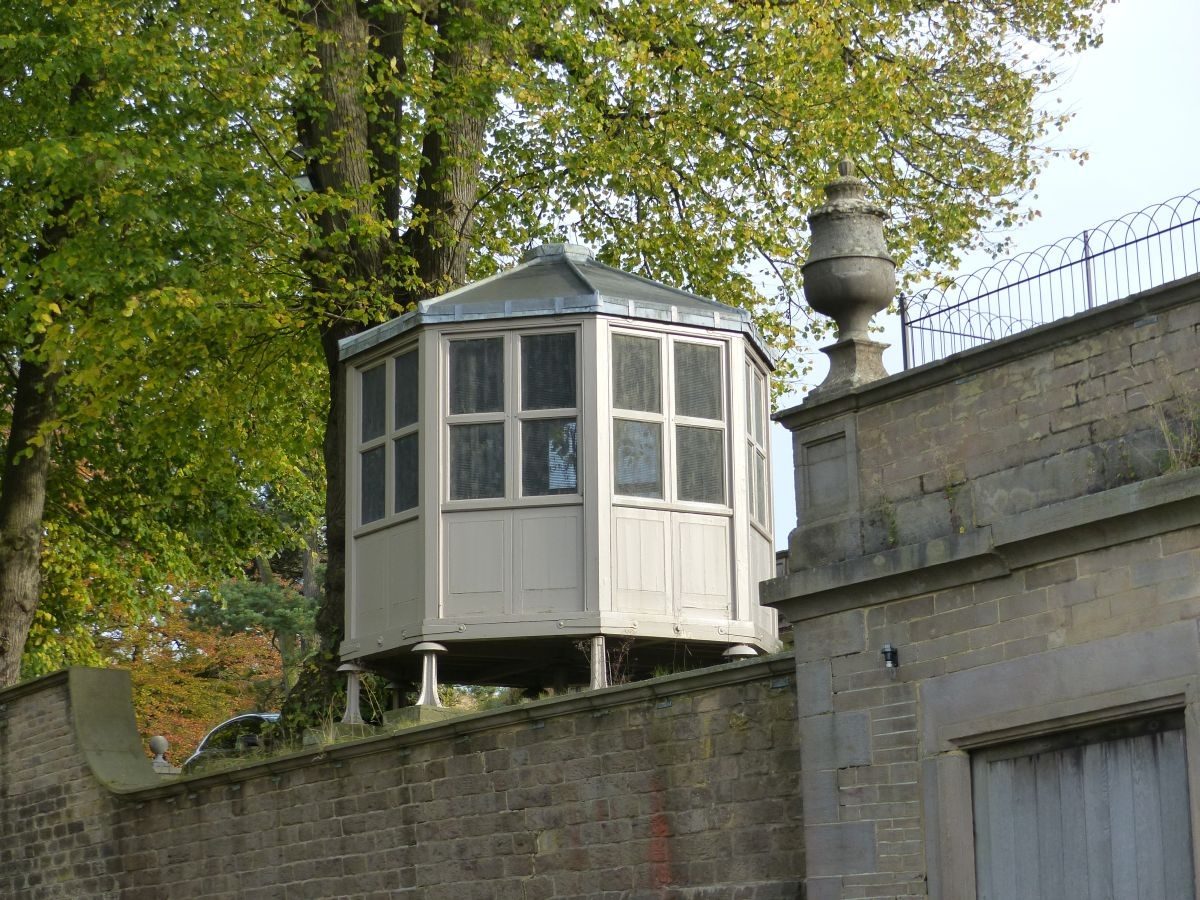
Britain built the same solution under a different name. There it was usually just a “safe” or a “larder safe,” often hung outside a scullery window on a cool, shaded wall, or built into a below-ground larder in grander houses, since many terraced city homes had no spare room for a freestanding cupboard. Whatever the material — linen, tin, or wire — the job never changed: let air move freely through the walls while stopping anything that crawled or flew.
Punched Tin Becomes a Folk Art
By the 1830s, American safes had largely shifted to a design that is now its own recognized category of folk art: thin tin panels, punched full of patterns with nothing more than a nail and a wooden mallet. Nicole Corrigan, researching a High Museum of Art acquisition through the Andrew W. Mellon Foundation’s fellowship program, traced the tulip-and-urn motifs common on these panels back to German-immigrant chest painters working around Jonestown, Pennsylvania, whose style migrated south with settlers into Wythe County, Virginia. From there, a tinsmith named Fleming K. Rich ran a shop in Wytheville that turned out large urn-and-grape panels in the 1830s, patterns other makers across the region copied for generations. East Tennessee craftsmen added their own vocabulary on top of it, working in Masonic imagery — the compass, the square, the arch.
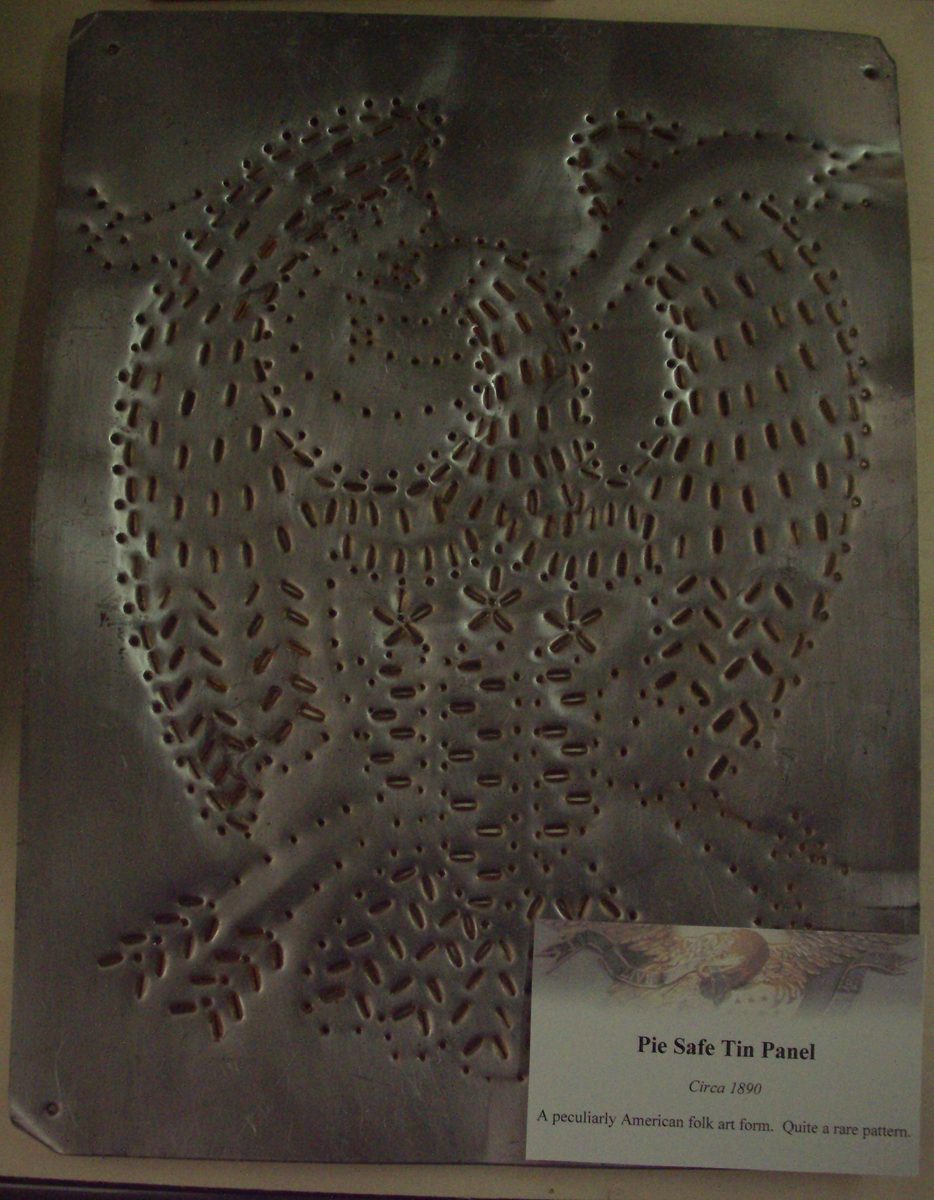
A second Colonial Williamsburg piece, a tin-paneled safe dated to roughly 1830–1845, carries exactly that regional signature: arches, hearts, stars, and a double-handled vase, a combination the museum’s own catalogue notes is strongly associated with East Tennessee work specifically. Roddy Moore, longtime director of the Blue Ridge Institute at Ferrum College, spent some fifteen years photographing and cataloguing panels like these across Southwest Virginia and East Tennessee, territory he considered to hold the richest body of designs anywhere — a research project that exists only because so much of this supposedly disposable kitchen furniture survived.
The cabinets themselves were built to last, which is the other reason so many survive to be studied today. The Colonial Williamsburg safe dated to 1830–1845 is joined with mortise-and-tenon frames pegged with double through-pegs, its tin panels fitted into grooved dadoes and backed with thin wooden strips so the sharp punched edges wouldn’t snag a sleeve, and its drawer fronts half-blind dovetailed — cabinetwork well beyond what a disposable kitchen fixture would need. The museum’s catalogue notes that the wooden case and the tin panels were frequently the work of two different craftsmen entirely: a cabinetmaker for the frame, a tinsmith for the punched sheets, assembled together at the end. A safe built that well in walnut or cherry, with fine joinery and turned legs, sometimes stood in the dining room rather than the kitchen, used as much for show as for keeping flies off supper.
Wire Replaces Tin, Care of a Connecticut Tannery
Tin panels needed a skilled tinsmith and real patience. Woven wire mesh needed neither, once a mill could turn it out by machine. The company most responsible for that shift started, oddly, in leather. Benjamin Gilbert, a tanner in Georgetown, Connecticut, began weaving horsehair and cattle hair into sieves as a sideline; the business grew into Gilbert & Bennett after Sturgess Bennett joined around 1828, and the firm bought a permanent mill site in 1834. The company’s own National Register of Historic Places nomination credits it with producing “the first insect screening in the United States,” woven at first on hand carpet looms, before Gilbert & Bennett built a dedicated wire mill in 1863 and moved the work onto power looms. A fire in 1874 cost the company an estimated $200,000 and forced a reorganization into a joint-stock corporation; by 1900 it employed 147 people, close to a fifth of Connecticut’s entire wire-industry workforce.
Once mills like this could produce woven wire cloth cheaply, it spread fast. By the 1890s, a safe built with wire mesh on all four sides and a wire-paneled door, not tin, had become the standard version on both sides of the Atlantic — faster to build, and it let in more air for the same fly-proofing.
Keeping Flies Off Food Became a Public Health Crusade, Decades Late
Nobody building a safe in 1830 could have explained exactly why a hole needed to be a certain size; generations of trial had simply shown that it worked. It wasn’t until 1965 that a controlled study put a number on the folk wisdom: the entomologist J. R. Busvine, writing in the Journal of Hygiene, found that a wire gauze with about ten holes to the inch, each roughly two millimetres across, reliably stopped houseflies, while anything coarser let a share of them straight through. Mosquitoes, he found, needed mesh nearly twice as fine. Families building meat safes by eye had already been working to close to that tolerance for well over a century.
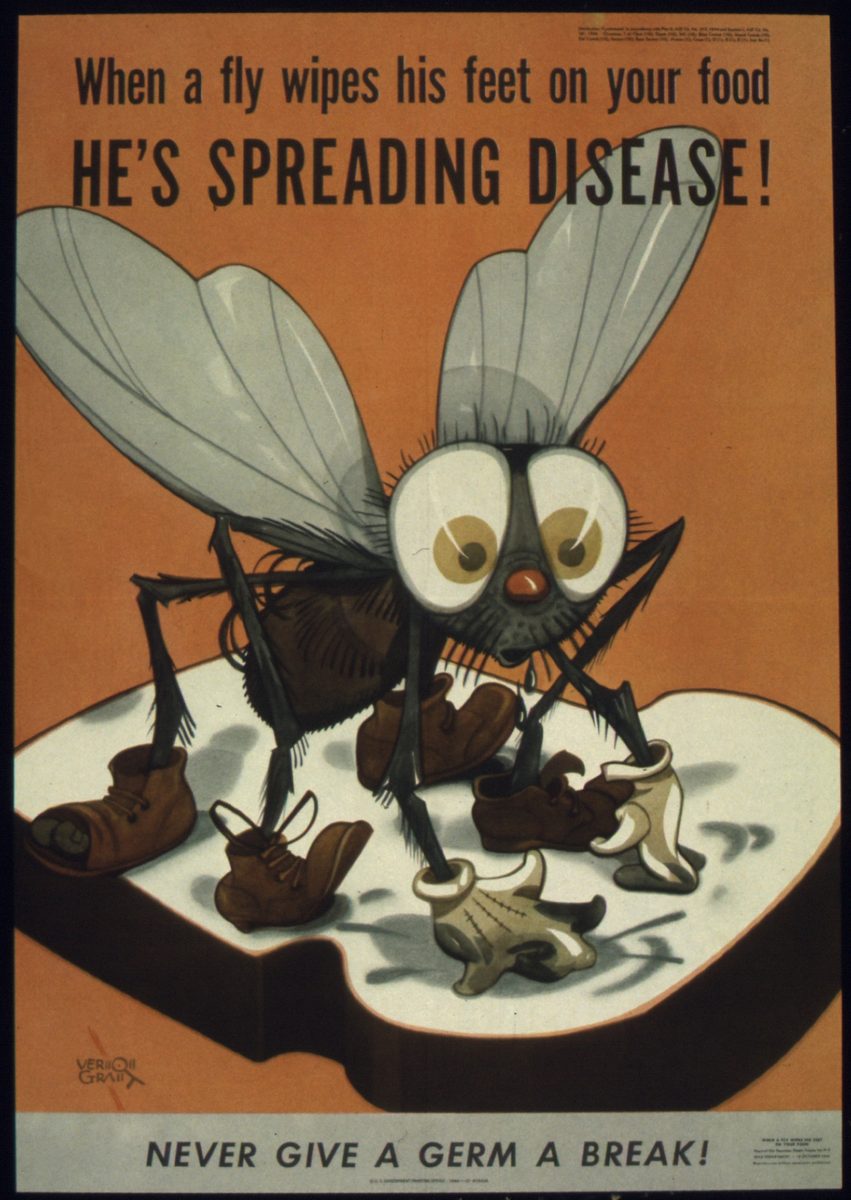
What took far longer to arrive was any official backing for the idea that flies mattered in the first place. Well into the nineteenth century, communities blamed summer sickness on “bad air” or vague “summer complaint” rather than insects landing on exposed food. That started to change, loudly, in Kansas. Samuel J. Crumbine, the state’s part-time secretary of the Board of Health from 1904, built a public campaign around the house fly, warning that it spread typhoid and other disease and urging people to screen their windows and “swat the fly.” By 1905 that campaign had produced the tool still named for the slogan: Kansas Boy Scouts, according to the Kansas Historical Society, nailed spare window screen to yardsticks to build the first purpose-made flyswatters, handed out free at state fairs. Decades later and much further south, the same logic scaled up further still: campaigns run through the Rockefeller Foundation and state health departments in the 1930s paired mosquito control with systematic window and door screening, and are credited with eliminating malaria from the rural South by the 1950s. The meat safe had been doing its own small, unscientific version of that work for a hundred years before anyone could say exactly why it worked.
What Finally Retired It
Electric refrigerators existed by the 1920s, but for most of a decade they stayed a city luxury. The real turning point for farm kitchens was the Rural Electrification Act of 1936, and the numbers behind it are stark: a 1945 United States Department of Agriculture report put the share of American farms with central-station electricity at just 3.2 percent in 1925, 9.0 percent in 1930, and still only 26.2 percent in 1940. Economists Carl Kitchens and Price Fishback, studying the program’s rollout for the National Bureau of Economic Research, found that a Rural Electrification Administration loan to a county roughly doubled the number of electrified rural homes there within five years. By 1943, an REA estimate cited in that same USDA report found refrigerators already running in 40 percent of the farms that had power at all. The meat safe didn’t disappear on a single day; county by county, it went quiet as the lines reached further out from town.
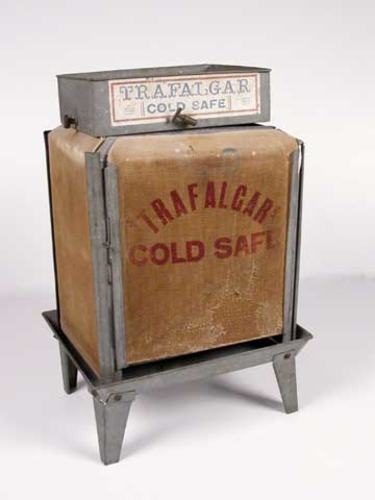
It didn’t disappear everywhere, and the idea wasn’t only American. Halfway around the world, in the gold-rush town of Coolgardie, Western Australia — founded after gold turned up there in 1892 and, by 1898, already the colony’s third-largest town — a contractor named Arthur Patrick McCormick, later mayor of nearby Narrogin, noticed that a wet cloth bag left over a bottle cooled its contents as the water evaporated. He built that observation into a cabinet: a wire-mesh box topped with a water tray, feeding a hanging strip of wet hessian sacking by capillary action, cooled by evaporation rather than airflow alone, according to Museums Victoria’s collection records. Because it actually chilled the food rather than just protecting it, commercial versions of the Coolgardie safe — legs standing in water trays to foil ants, exactly the trick used on meat safes half a world away — spread across Australia through the early 1900s, and in parts of the outback stayed in genuine daily use into the 1950s and 1960s, wherever the power lines simply hadn’t arrived yet.
Watch the full history
The video version covers the construction, the daily upkeep, and the slow arrival of the fridge in about seven and a half minutes.

No Single Inventor, No Patent, Just Two Centuries of Holes
What the meat safe never got was credit for being technology at all. It has no patent worth remembering and no single inventor — just generation after generation of cabinetmakers, tinsmiths, and farm families cutting holes in a box and hanging the box somewhere breezy. Set beside the refrigerator that eventually replaced it, that looks almost primitive. Set beside how long it actually worked, and how little it cost to keep working, it looks like one of the quietest long-term successes any kitchen has ever had.
It also outlasted its own explanation. Nobody punching tin in 1830s Wytheville could have told you the millimetre at which a fly’s body stops fitting through a hole, and nobody needed to. The device worked whether or not the physics behind it was understood — a fair description of most household technology before the twentieth century made explaining things fashionable. So: no screen door, no fridge, high summer, and a joint of ham that has to make it to supper. The answer, for roughly two hundred and fifty years, was a wooden cabinet, some tin or wire, and a shaded spot with a breeze. It wasn’t a bad answer. It just took the better part of three centuries to become unnecessary.
Related reading
- How Outdoor Bread Ovens Worked, and Where Owning One Was Against the Law
- How Hog Killing Day Worked on the American Farm
- The Dangerous History of Face Powder — From Roman Lead Paint to a Flapper’s Compact
- What Was a Quern Stone? The Hand Mill That Outlasted Empires
Works cited
- Colonial Williamsburg Foundation. “Food Safe,” collection object record no. 47246. Dated circa 1750; the object label places it in the last quarter of the eighteenth century, probably Virginia’s Eastern Shore.
- Colonial Williamsburg Foundation. “Safe, Food,” collection object record no. 99600. Dated circa 1830–1845, southwestern Virginia or East Tennessee.
- Corrigan, Nicole. “Pie Safe, ca. 1830–1860, Unidentified Maker, Eastern Tennessee.” Andrew W. Mellon Foundation Graduate Fellowship Program in Object-Centered Curatorial Research, High Museum of Art, 2016. Link.
- “Gilbert & Bennett Company Historic District.” National Register of Historic Places Nomination Form, reference no. 87000343. National Park Service, U.S. Department of the Interior. Link.
- Busvine, J. R. “Wire Mesh Screening for the Exclusion of Houseflies.” Journal of Hygiene 63, no. 3 (1965): 305–311. Link.
- “Samuel J. Crumbine.” Kansas Historical Society. Link.
- “Coolgardie Safe, Cooling Chest.” Museums Victoria Collections.
- Kitchens, Carl, and Price Fishback. “Flip the Switch: The Spatial Impact of the Rural Electrification Administration, 1935–1940.” NBER Working Paper No. 19743. National Bureau of Economic Research, December 2013. Link.
- Interbureau Committee on Post-War Programs. Rural Electrification After the War. United States Department of Agriculture, February 1945. Link.
- Moore, Roddy, quoted in “Blue Ridge Institute Director Researches Punched-Tin Pie Safes.” The Mountain Laurel, March 1984. Link.