
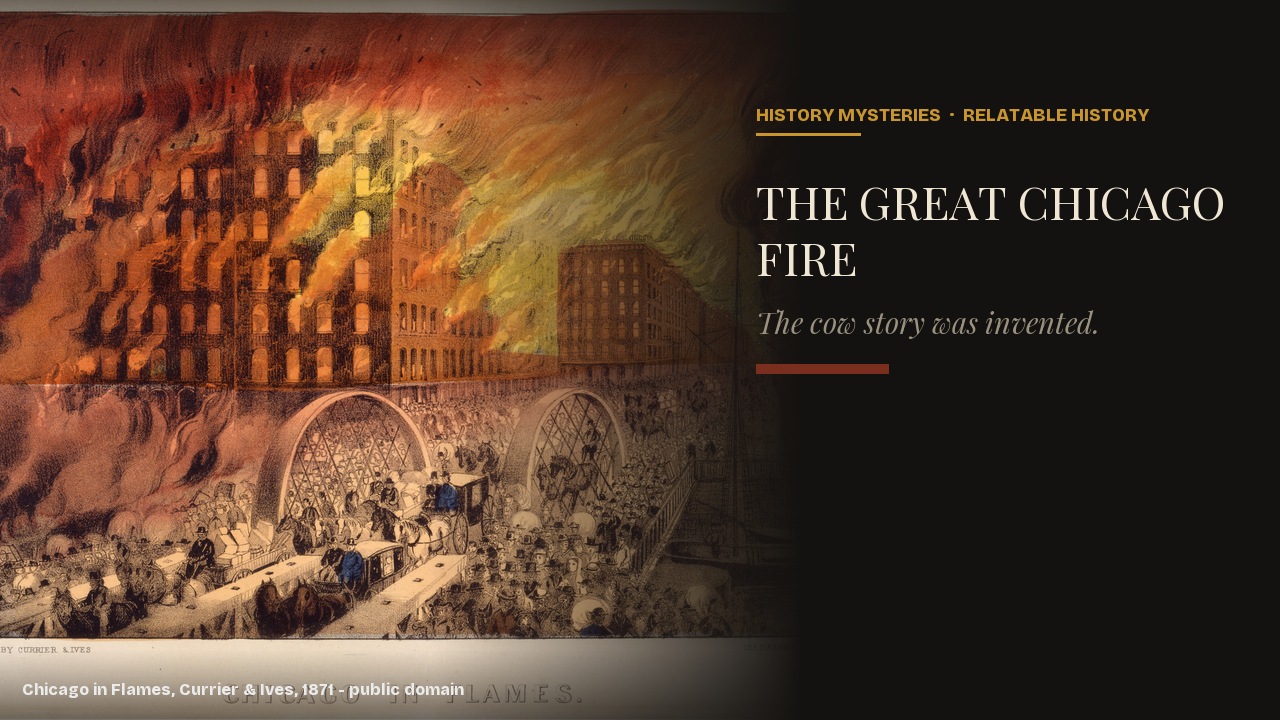
The official investigation into the Great Chicago Fire of 1871 took sworn testimony from fifty people over nine days, filled more than eleven hundred handwritten pages, and ended without naming a cause. The single detail almost everyone associates with the fire — a cow, a lantern, a barn — appears nowhere in that record. It came from a newspaper story, and the reporter who wrote it admitted twenty-two years later that he had made it up.
That is the shape of the Mrs. O’Leary cow myth: a real inquiry that could not reach a conclusion, and a fabricated one that reached everyone. The gap between those two things is wide enough to hold a newspaper industry’s worth of ethnic caricature, a gambling fortune, a 126-year-late city council apology, and a regional weather system that burned down parts of three other states the same night. All of it is documented. Almost none of it involves a cow.
What follows is the paper trail: the actual sworn record, the man who replaced it with a better story, the woman who paid for that story for the rest of her life, and what became of her family once the fire stopped being news.
Chicago’s official fire inquiry took testimony for nine days and concluded nothing
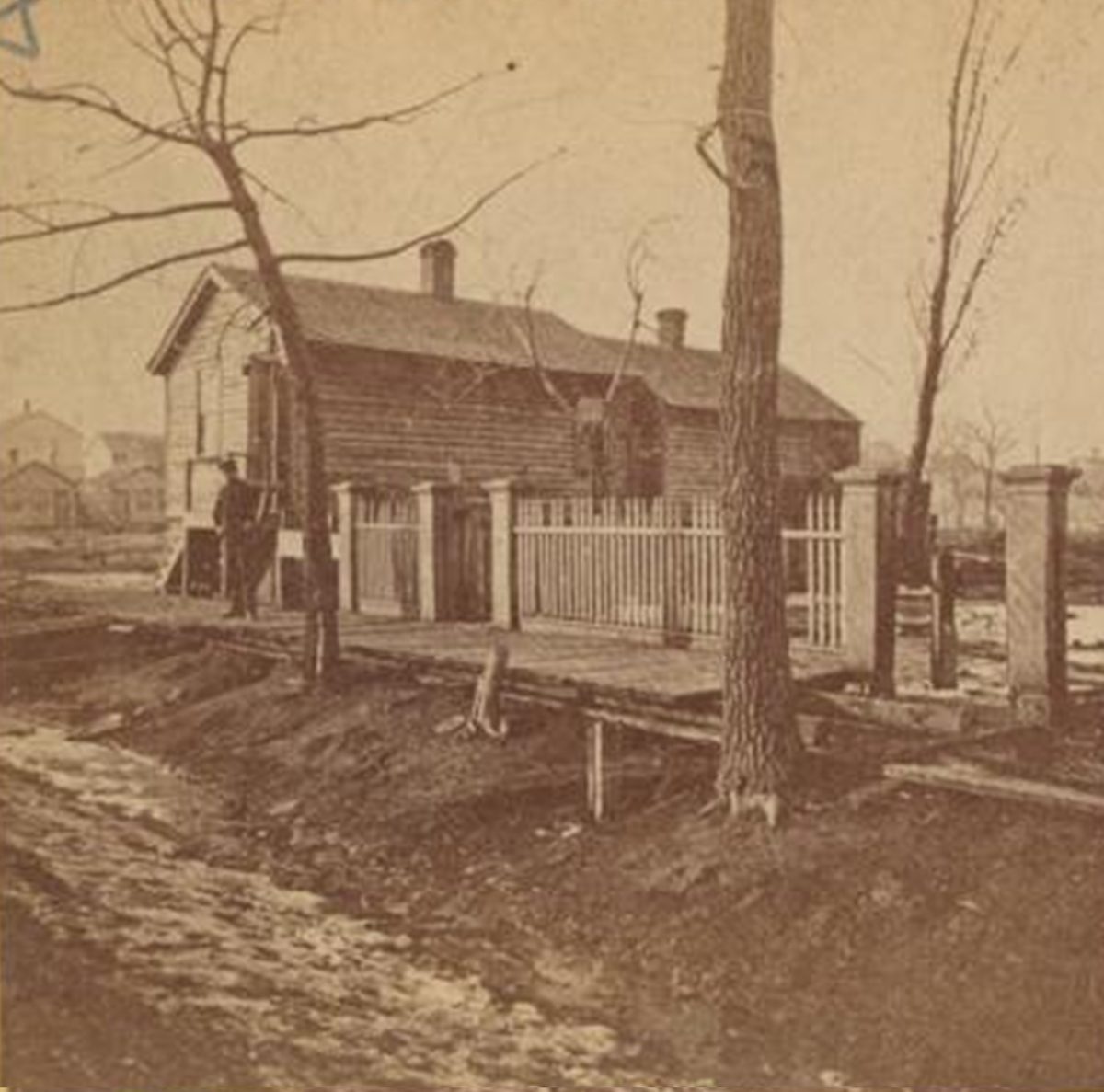
Within weeks of the fire, Chicago’s Board of Police and Fire Commissioners opened a formal inquiry into its cause. Over nine days it questioned fifty witnesses under oath, including Catherine O’Leary herself, who testified that she had gone to bed before the fire started, and her neighbor Daniel Sullivan, who said he had been at a party nearby and tried to free the animals once he saw the flames. The transcript ran past eleven hundred pages.
The commissioners’ finding, recorded in their own words, was that whether the fire began from a spark off a chimney or was set by human hand, they were unable to determine which. That is the entire verdict. No suspect, no accident, no ruling on the O’Learys at all — the hearing cleared nobody because it convicted nobody. Chicago’s own courthouse, which held a great many of the city’s municipal and historical records, burned down early the same Monday morning the fire reached downtown, taking an unknown amount of paperwork with it. The inquiry’s own transcript survived only because it was compiled and kept afterward; the chronicler A. T. Andreas reprinted long sections of it in his 1885 history of the city, which is the reason the record is still readable today rather than lost along with everything else the courthouse held.
That surviving transcript has done real work since. In the 1990s the researcher Richard Bales went back through it alongside land and insurance records and argued that Daniel Sullivan’s own account placed him somewhere he could not have seen the barn from, which would make his sworn story harder to trust than the one the commissioners already couldn’t verify. No new conclusion has followed from that either. The inquiry’s actual legacy is not an answer; it is a record thorough enough that people are still testing theories against it a century and a half later.
The Mrs. O’Leary cow myth was invented by a reporter who later admitted it
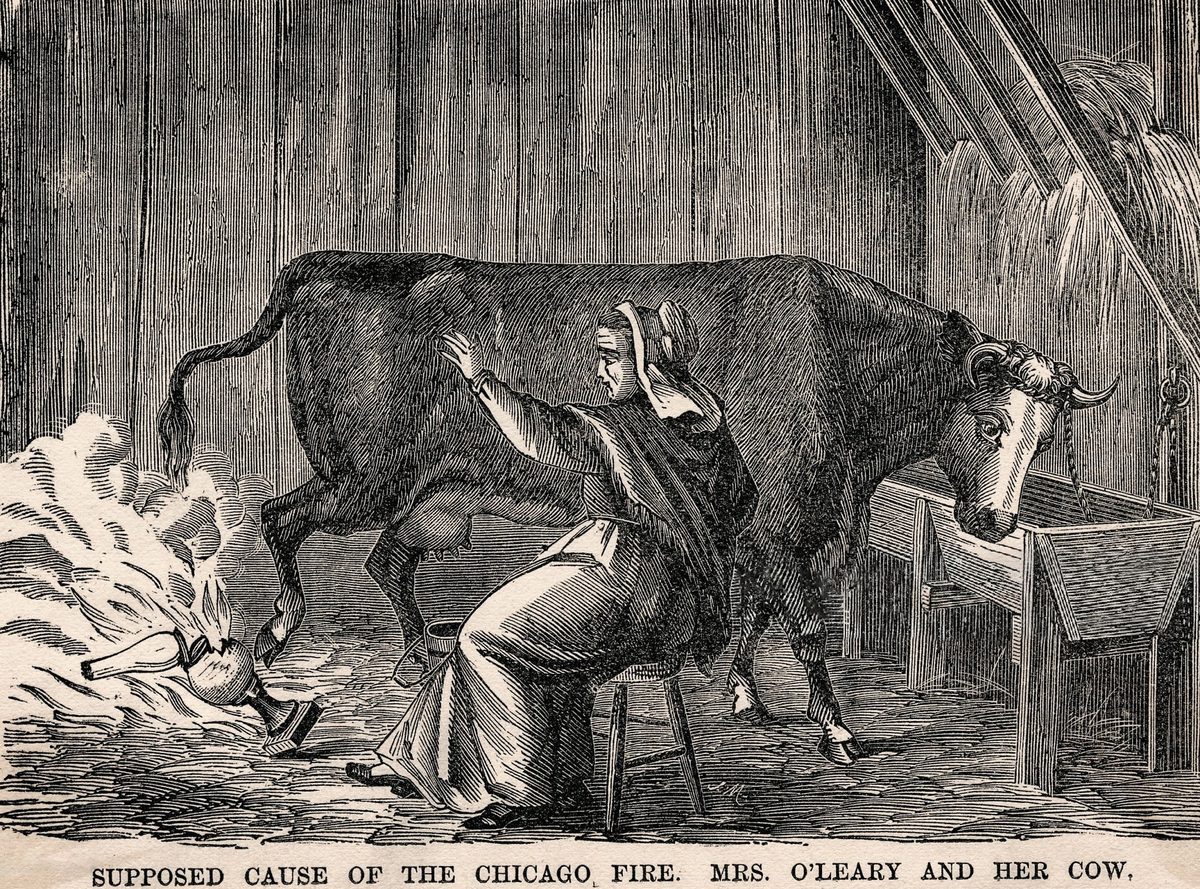
The cow enters the story through a different document entirely: a news report filed in the days after the fire by Michael Ahern, a reporter for the Chicago Republican. Ahern’s version had a cow being milked late at night kicking over a lantern in the O’Leary barn. He did not put Catherine O’Leary’s name on the story at first. He did not have to — the fire had started on her property, and that was association enough for every paper that picked the detail up.
Ahern kept the byline but not the credit for long. Twenty-two years on, in 1893, he told the Chicago Tribune that he and two colleagues, both dead by then, had invented the lantern-kicking cow outright, reportedly to give a dry fire story some color. A longtime colleague later filled in an uglier coda: he said he had ghost-written the 1893 confession under Ahern’s own byline, because by that point, in his words, drink had left Ahern unable to do the work himself. Even the admission, in other words, may not be entirely Ahern’s own prose — which is a very appropriate complication for the origin story of a hoax.
None of this means the question is fully settled. Other names have surfaced over the decades as possible co-authors or independent inventors of the same basic image, and a separate, later claim holds that a man named Louis Cohn started the blaze at a card game in the barn, with a lantern knocked over as players scattered. Historians treat Ahern’s confession as the best-documented account of where the cow came from, not as a verified, singular fact. What is not in dispute is that the story the public received bore no relationship to anything in the sworn testimony fifty witnesses had already given.
An Irish immigrant widow was a convenient person to blame
The lantern-kicking cow found such a durable home around Catherine O’Leary partly because 1871 Chicago was primed to receive it there. The Chicago Times described her in print as a forty-four-year-old “old Irish woman,” language built to invite contempt rather than report an age, and the city’s Irish immigrant population was already a target of the nativist suspicion common to American newspapers of the period. An immigrant woman with livestock and no public voice of her own was, in the press logic of the day, exactly the kind of person a story could be hung on without anyone checking first.
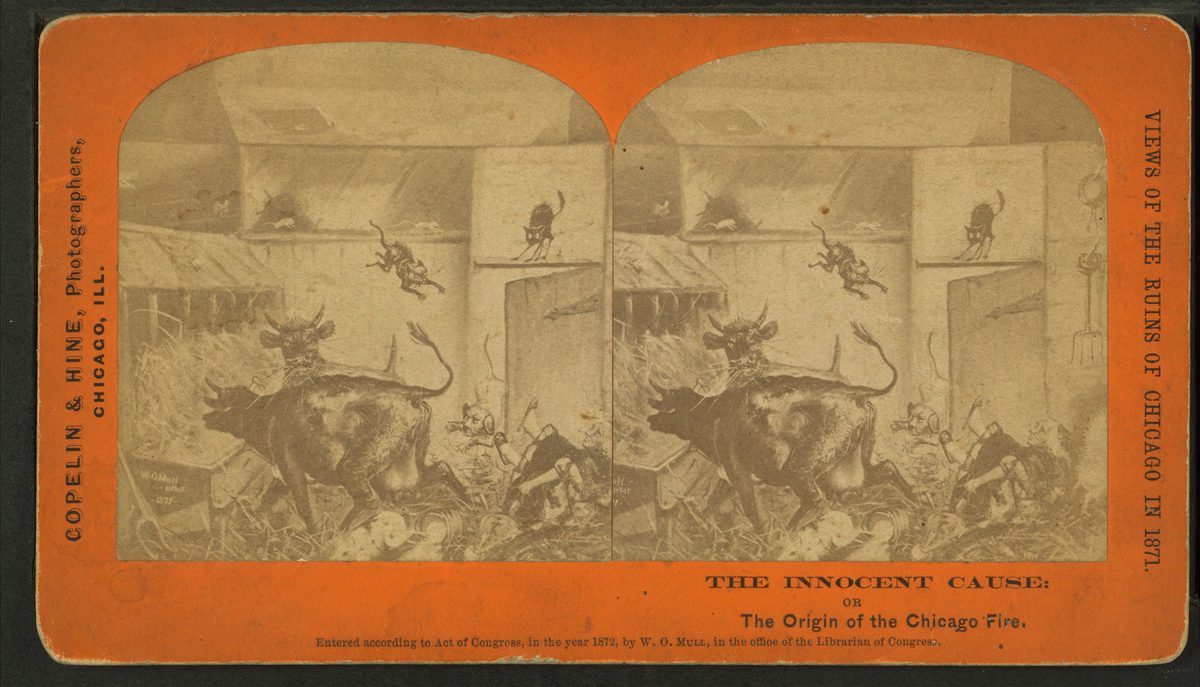
The commercial culture around disaster moved just as fast as the newspapers. Stereograph cards — paired photographs viewed through a handheld stand to create a 3-D effect, the era’s most popular home entertainment medium — were already a staple way to relive disasters at a safe distance, and publishers moved quickly to add Chicago to the catalogue. Within the fire’s first year, printers were selling cartoons, lithographs and stereograph cards built around the cow, including one sold under the title The Innocent Cause — a souvenir industry manufacturing a punchline out of a catastrophe that had killed roughly three hundred people. Catherine O’Leary lived with the result rather than the royalties. She stopped appearing in public, refused every interview request and every photograph for the rest of her life, and in 1894 her own physician told the press that the blame she carried was, in his words, the grief of her life. She died of pneumonia the following July. Neighbors said it was a broken heart.
The same storm that burned Chicago was already burning three other states
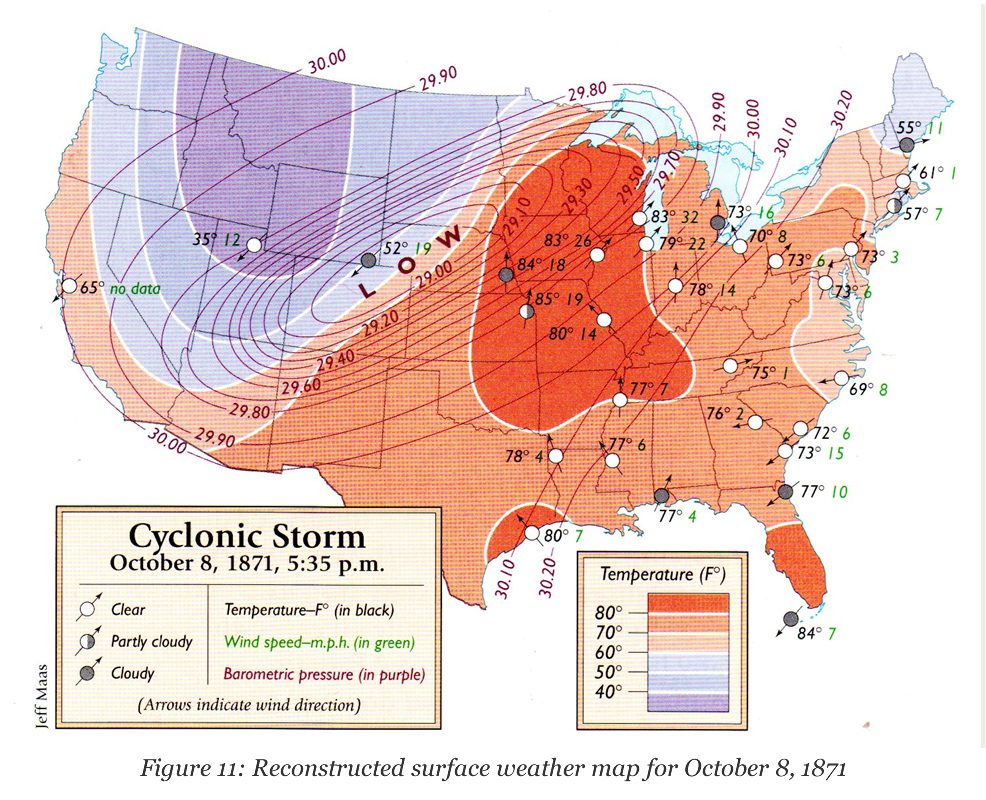
Chicago’s fire is the one with the famous myth attached, but it was not an isolated event. NOAA’s reconstruction of the surface weather for October 8, 1871, shows a strong low-pressure system crossing the central Plains that day, arriving on top of a region that had spent the entire summer under an unusually warm, dry upper-level ridge. Weather observers at Fort Embarrass, Wisconsin, had logged dense smoke in the air for days before the fire and recorded temperatures in the 70s on the eighth itself. The same system that fanned Chicago’s flames northeast through the city pushed strong winds across the entire upper Midwest at once.
Those Fort Embarrass readings exist at all because of how new American weather observation still was in 1871. The U.S. Army Signal Service had taken its first synchronized national weather readings, from twenty-five stations, less than a year earlier, on the morning of November 1, 1870. The network that let NOAA reconstruct this one storm nearly a century and a half later had been running for less time than the O’Leary cow story had already been in print by the time anyone retracted it.
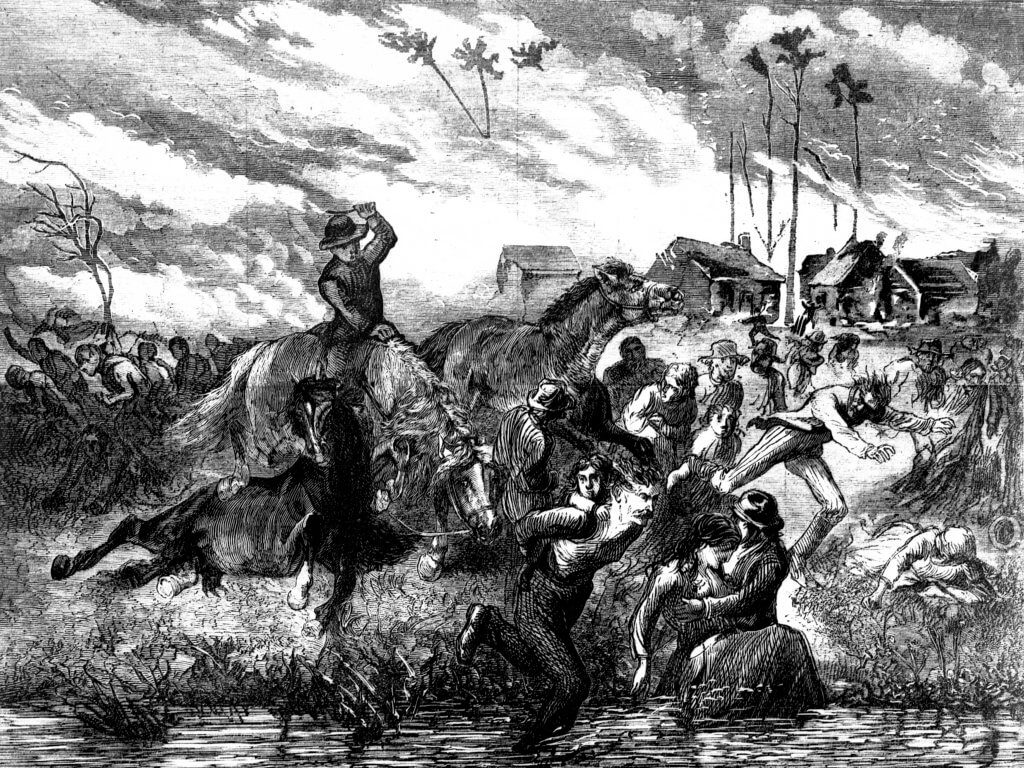
That is why four separate fire disasters share the same date. Peshtigo, Wisconsin, burned the same night, killing an estimated twelve hundred to twenty-four hundred people across roughly a million and a half acres — it remains the deadliest fire in American history, and relatively few people outside Wisconsin have heard of it. Holland, Port Huron and Manistee, Michigan, burned the same night as well, with a combined death toll the National Weather Service puts at likely over five hundred. A theory that fragments of a comet ignited all of these fires simultaneously has circulated since the 1980s; meteorologists reject it, since meteorite material arrives cold rather than burning, and the weather data already supplies an ordinary mechanism that covers every fire that night without needing one.
The O’Leary family got rich anyway — just not from the fire
Catherine O’Leary did not live to see her family’s fortunes turn, but her son James did. He was two years old the night the barn burned, and he grew up to become “Big Jim” O’Leary, one of Chicago’s best-known gambling bosses, working the Union Stock Yards trade for decades out of a saloon at 4185 South Halsted Street. His breakthrough stake reportedly came from a heavy bet on James Corbett over John L. Sullivan in the 1892 heavyweight title fight. He went on to run a floating casino and, later, the Luna Park amusement grounds, and in 1901 he built himself a thirty-three-room Renaissance Revival mansion on Garfield Boulevard, designed by Zachary Taylor Davis, the architect who would go on to design Wrigley Field. O’Leary died there in 1925, leaving an estate officially valued at just over ten thousand dollars, despite a lifetime of claiming to be a millionaire several times over.
The mansion still stands in Englewood, and as of this writing it is vacant, cited for code violations, and sitting in demolition court. In September 2026, Landmarks Illinois and Preservation Chicago asked the city’s landmarks commission for preliminary protection, arguing the building deserves to survive on its own architectural and historical merits. Whatever the commission decides, the mansion is a more honest monument to what the O’Leary name actually produced than any cow ever was: not an accident, but a fairly ordinary Gilded Age gambling fortune.
It took 126 years for Chicago to say so, formally
The city’s own reckoning with the myth came slowly and, when it finally arrived, carried no real legal weight. In October 1997, Chicago alderman Edward Burke sponsored a City Council resolution formally exonerating Catherine O’Leary and her cow of starting the fire. It was timed to the anniversary and widely covered — NPR ran a segment on it the same week — but a council resolution is a statement of opinion, not a finding of fact, and it named no alternate cause. It corrected the record without completing it, which is about as much as anyone has managed in a hundred and fifty-five years.
What endures is the mismatch between how carefully Chicago investigated its own disaster and how carelessly the story that replaced that investigation got made. Fifty witnesses and eleven hundred pages produced a shrug. One newspaper story, confessed as a fabrication within a generation, produced a folk tale still being taught as fact. The inquiry asked the right question and couldn’t answer it. The cow answered a question nobody with the facts had actually asked.
Watch the full history
The video version walks through the fire’s thirty-one hours block by block, from the barn on DeKoven Street to the collapse of the waterworks, using the inquiry’s own testimony.

Related reading
- What Really Made the Crew Abandon the Mary Celeste — another official inquiry that took sworn testimony and still couldn’t name a cause
- Why the 1787 Constitutional Convention Met Entirely in Secret — the historical record of a decision made, deliberately, out of public view
- The Mystery of the Beale Ciphers, Explained — a different nineteenth-century American mystery that outgrew its own evidence
- Rohonc Codex Deciphered? Inside a 450-Page Mystery — a manuscript mystery where the experts disagree just as much as they do here
Works cited
- Smith, Carl. Urban Disorder and the Shape of Belief: The Great Chicago Fire, the Haymarket Bomb, and the Model Town of Pullman. University of Chicago Press, 1995. Link.
- Sawislak, Karen. Smoldering City: Chicagoans and the Great Fire, 1871–1874. University of Chicago Press, 1995. Link.
- Bales, Richard F. The Great Chicago Fire and the Myth of Mrs. O’Leary’s Cow. McFarland & Company, 2002.
- Chicago History Museum. “The O’Leary Legend.” The Great Chicago Fire and the Web of Memory. Link.
- Chicago Public Library. “Whodunit? The Mystery of Mrs. O’Leary’s Cow.” Chicago Public Library blog, September 30, 2014. Link.
- Kahler, Abbott. “What (or Who) Caused the Great Chicago Fire?” Smithsonian Magazine, October 4, 2012.
- “Mrs. O’Leary’s Cow.” All Things Considered, NPR, October 7, 1997. Link.
- National Weather Service Heritage. “The Great Midwest Wildfires of 1871.” NOAA. Link.
- National Weather Service Heritage. “The First Synchronized Weather Observations.” NOAA. Link.
- National Weather Service, Green Bay/Milwaukee. “The Peshtigo Fire.” Link.
- Mowry, Larry. “Great Chicago Fire of 1871: How Weather Played a Role.” ABC7 Chicago (WLS-TV), October 8, 2021. Link.
- Schmidt, John R. “The True Story of Little O’Leary.” WBEZ Chicago, October 9, 2012. Link.
- Bey, Lee. “Preservationists Seek Landmark Status for Englewood Mansion Built by Mrs. O’Leary’s Son.” Chicago Sun-Times, September 21, 2026. Link.