
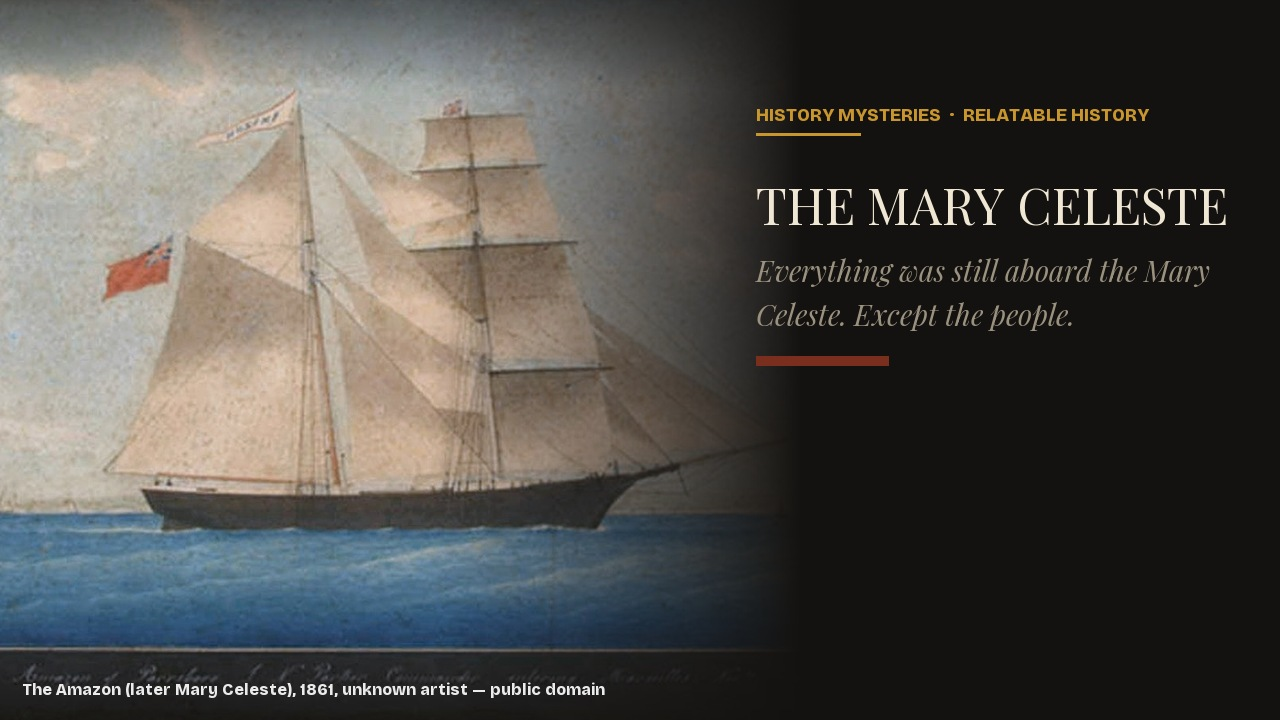
On 4 December 1872, a small Nova Scotian brig called the Dei Gratia came across a ship moving oddly under partial sail, roughly 400 miles east of the Azores. When her crew rowed over and boarded, they found a vessel that was, by every ordinary measure, fine. The cargo was intact. Six months of food and water sat in the stores. The captain’s family bed showed the recent impression of a sleeping child. What the boarding party did not find, anywhere on the ship, was a single person.
The ship was the Mary Celeste, out of New York for Genoa, and the disappearance of her captain, his wife and daughter, and seven crewmen has never been explained. No bodies were ever recovered. No wreckage from a lost boat was ever identified. No one came forward, in a century and a half, with a credible account of what happened to ten specific people in the nine or ten days between the last log entry and the moment the Dei Gratia found the ship empty.
What does have an answer — a tested, replicated, remarkably unglamorous answer — is the question underneath the one everyone asks. Not what happened to the people, which may never be recoverable, but why would an experienced captain abandon a seaworthy ship in good weather. The Gibraltar court that investigated the case in 1872 could not answer it and strongly suspected a crime. Two separate groups of chemists, in 2006 and again in 2026, built working reconstructions of the ship’s hold and got the same explosive answer twice.
She was built in Nova Scotia as the Amazon, not the Mary Celeste
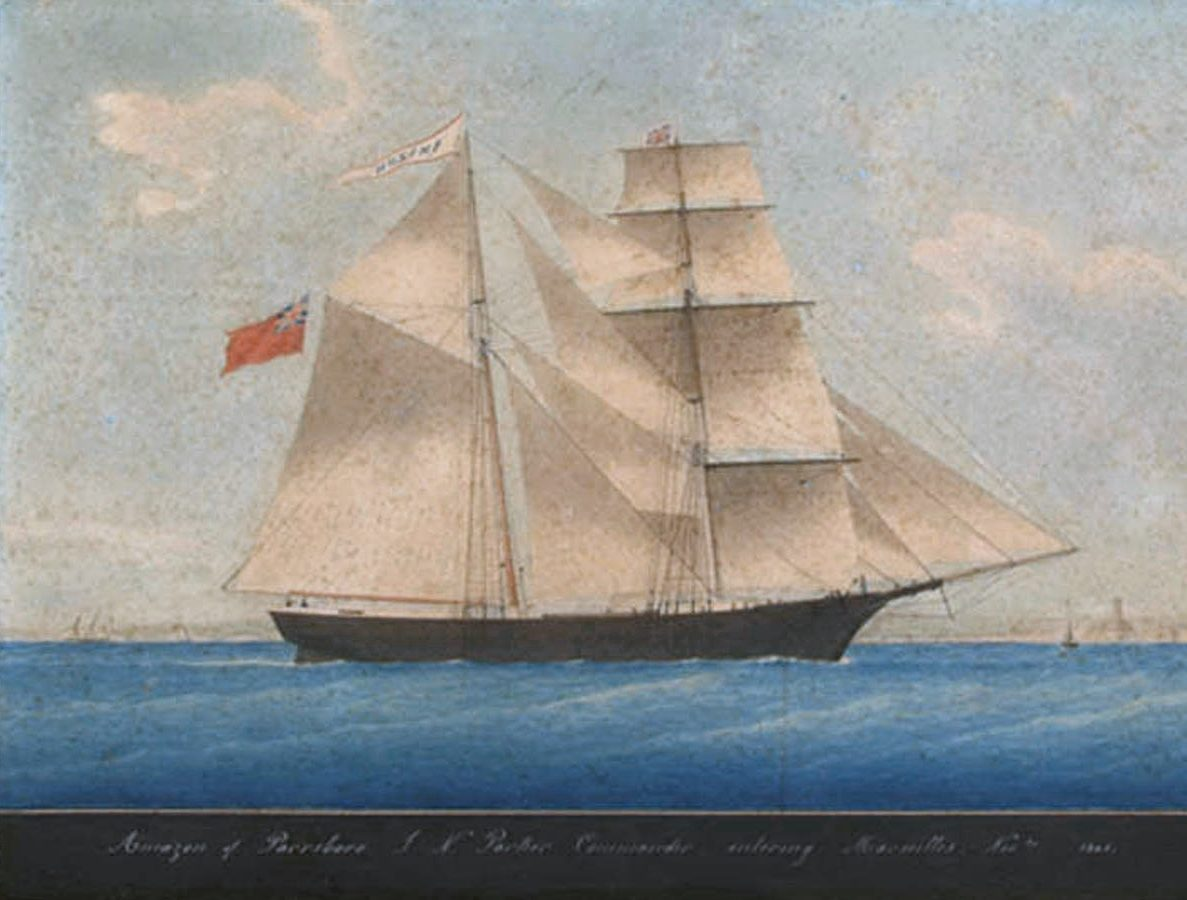
The ship that vanished with ten people aboard in 1872 was not originally built or named for that voyage. She was launched in 1861 at Spencer’s Island, Nova Scotia, a small shipbuilding community on the Bay of Fundy, and christened the Amazon — a half-brig of just under 200 tons, built for the ordinary Atlantic cargo trade rather than anything unusual. She changed hands and flags more than once over the next several years, as merchant vessels of her size routinely did, and was renamed Mary Celeste in 1868 after a change of registry. It was under that second name, not her birth name, that she was eventually sold to a group of part-owners that included a Massachusetts sea captain named Benjamin Spooner Briggs.
None of this ownership history was exotic by the standards of 1870s merchant shipping, which is worth stating plainly: whatever happened to the Mary Celeste in 1872, it did not happen to a ship with an unusual pedigree. She was a normal, competently built cargo brig with a normal paper trail, which is part of what made the case so hard for investigators to explain away. There was no obvious structural fault to blame, and no owner with an obvious motive.
Captain Briggs sailed with his wife, his daughter, and a flammable cargo
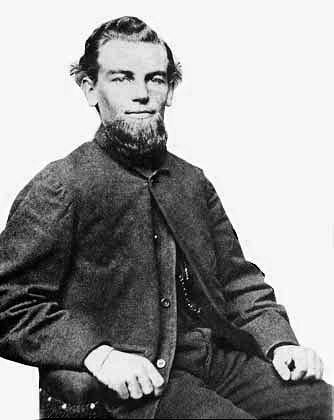
Benjamin Briggs left New York on 7 November 1872 bound for Genoa, Italy, with seven crewmen, his wife Sarah, and their two-year-old daughter Sophia aboard. He had a reputation as a careful, sober captain, from a Massachusetts seafaring family in Marion, and taking his family on a transatlantic crossing was not unusual for a commander of his standing; it reads, if anything, as a sign of confidence in the voyage rather than recklessness.
The cargo was 1,701 barrels of crude industrial alcohol, destined for fortifying Italian wine, packed below deck for a six-to-eight-week crossing. It was unglamorous freight and an entirely routine one for the New York–Mediterranean run. Almost nothing about the preparations for this voyage reads, in hindsight, as a warning sign. That is precisely why the case resisted easy explanation for so long: nothing about the departure was reckless, and nothing about the ship’s condition when found was consistent with disaster at sea.
The Dei Gratia found her still under sail, completely empty
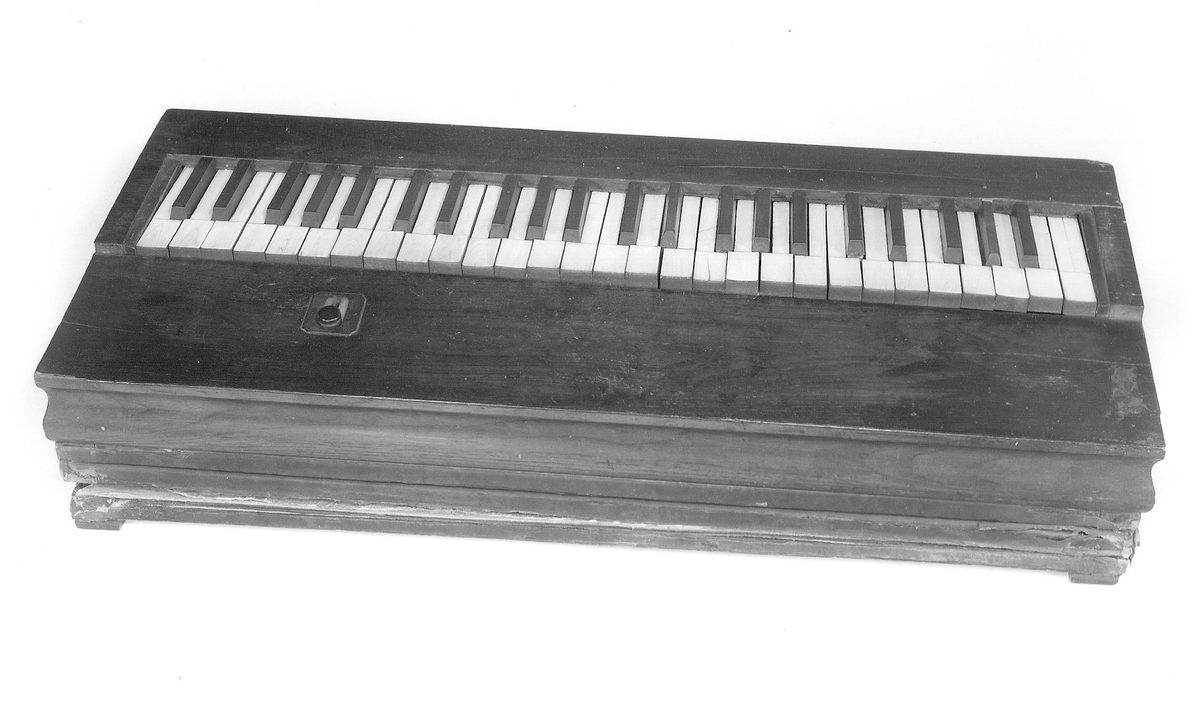
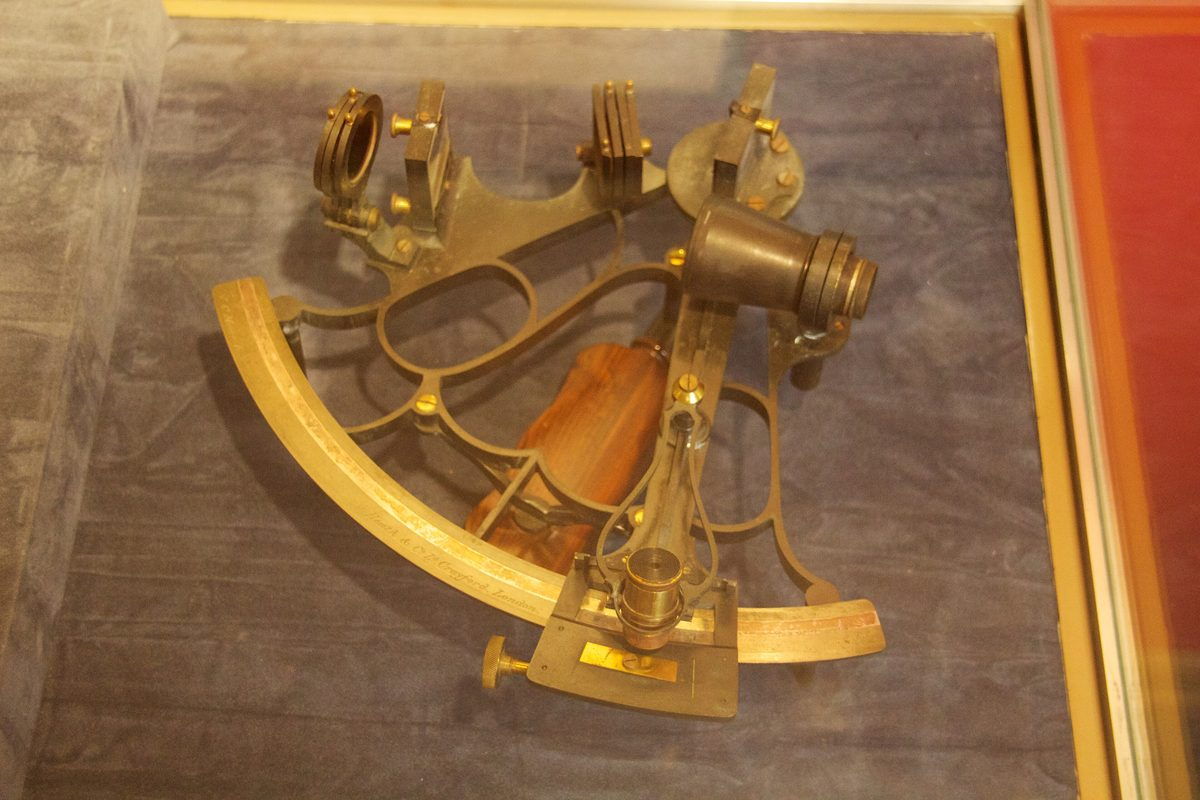
The ship’s last log entry was dated 25 November, placing her near Santa Maria Island in the Azores — nine or ten days before Captain David Morehouse of the Dei Gratia spotted her drifting. Morehouse sent a boarding party under his first mate, Oliver Deveau, and second mate John Wright. What they logged was specific and strange: about three and a half feet of water in the hold, one of the ship’s pumps dismantled, the main hatch covers secured, one lifeboat missing along with the ship’s chronometer, sextant and papers, and the cargo of alcohol barrels still largely in place. The galley stove had been dislodged from its setting. Sarah Briggs’s sewing machine and the family’s belongings were untouched in the cabin.
Deveau and a skeleton crew sailed the Mary Celeste under her own rigging to Gibraltar for the salvage hearing, which is itself a useful data point: the ship was entirely seaworthy. She needed no towing, no emergency repair, no pumping out before she could be sailed several hundred miles by a crew of three. Whatever drove ten people to leave her, it was not that she was actually sinking.
A prosecutor in Gibraltar was convinced it was murder
The salvage hearing before the British vice-admiralty court in Gibraltar should have been a formality: establish that the Dei Gratia‘s crew had legitimately rescued an abandoned vessel and award them a share of its value. Instead the queen’s advocate and attorney general, Frederick Solly-Flood, became convinced that the crew of the Mary Celeste had broken into the alcohol cargo, mutinied, murdered the Briggs family, and fled. He ordered the ship searched for physical evidence and had a sword found aboard tested for the dark stains on its blade.
The stains were not blood. Contemporary chemical testing, described in the surviving record of the hearing, found nothing to support the mutiny theory, and no trace of violence was ever documented anywhere on the ship. The court’s eventual ruling, handed down in March 1873, found no evidence of foul play and awarded the Dei Gratia‘s crew a salvage payment of roughly one-sixth of the ship and cargo’s insured value of about $46,000 — a relatively low share, reflecting lingering suspicion that was never resolved one way or the other. Solly-Flood’s theory did not die with the ruling: it fed the first wave of sensational newspaper coverage, and a decade later gave Arthur Conan Doyle the raw material for his 1884 short story “J. Habakuk Jephson’s Statement,” a work of fiction that invented a massacre by stowaway freedmen and that much of the public has mistaken for history ever since.
Why modern chemists think the crew fled an invisible explosion
The explanation that has held up best under actual testing starts with a detail the Gibraltar hearing noted and more or less set aside: nine of the ship’s 1,701 barrels of industrial alcohol, when later inspected, were found completely empty. That is roughly 300 gallons of ethanol that did not spill as liquid but escaped as vapour, because those nine barrels, unlike the rest of the cargo, happened to be made of more porous red oak rather than tight white oak staves.
In 2006, chemist Andrea Sella at University College London built a scale reconstruction of the Mary Celeste‘s hold using paper cubes standing in for barrels and butane gas standing in for alcohol vapour, and demonstrated that a vapour cloud of that kind could ignite in a pressure-wave flash violent enough to blow open a hatch without scorching or charring the surrounding wood — because the flame front simply moves faster than heat can transfer into the timber. Twenty years later, researchers Jack Rowbotham and Frank Mair at the University of Manchester built a more faithful 1:18 scale model using actual wood and ethanol rather than paper and butane, and reproduced the same result: at Atlantic winter temperatures the spark did nothing, but once the model was heated to the temperatures the Mary Celeste would have reached approaching the Azores in late November, the vapour ignited, the hatch cover ejected, and the deck buckled — with no charring left behind. “We’ve now advanced Professor Sella’s experiment,” Rowbotham said, “because he used butane and paper, while we used wood and ethanol,” calling the result “a very convincing case as to what may have happened.”
Put together with the ship’s own damage report, the theory reads like this: a dull thump and a brief flash from the hold, no fire anyone could see, a hatch blown loose, and a captain with a fouled chronometer that had already put him some 120 miles from where he thought he was, and pumps gummed with coal dust from an earlier cargo that made it impossible to quickly check how much water the ship had actually taken on. Briggs did not know his ship was fine. He had every reason, in that moment, to believe she might go up or go down within minutes, and a very ordinary reason to get his family and crew into the lifeboat and stand off at a safe distance on a towline, rather than risk being belowdecks if the hold went again. The frayed rope end later found trailing from the ship is consistent with exactly that: a boat that was meant to be recoverable, lost when the line parted in rough water, leaving everyone aboard it at the mercy of the Atlantic with no ship to return to.
The ship herself was never the same
The Mary Celeste went back to ordinary cargo service after the Gibraltar hearing, but she carried her notoriety with her, and her later owners did not do well by her. In January 1885, under Captain Gilman Parker, she was deliberately run onto a reef near Haiti as part of a fraudulent insurance claim on her cargo. The wreck did not cooperate: the ship failed to break up or sink as planned, the scheme was exposed, and what remained of a once-ordinary Nova Scotian cargo brig was written off as a hull not worth salvaging.
It is a bleakly fitting coda. A ship found empty but structurally sound in 1872 ended her career deliberately wrecked and valued, by the people who actually owned her, as worth more broken than afloat.
Watch the full history
The short video covers the discovery and the court’s search for a culprit in just under a minute; the chemistry below is the part it didn’t have time for.

The Mary Celeste is not an isolated case of people vanishing without explanation. Three centuries earlier, the colonists of Roanoke left behind a single carved word and no bodies at all, and in 1900 the keepers of a Scottish lighthouse disappeared from a locked station in weather that should not have stopped them, a case the Flannan Isles mystery shares almost exactly the same evidentiary shape with: intact belongings, no violence, no bodies, and a court or inquiry left to guess.
Related reading
- What Happened to the Lost Colony of Roanoke? — another case of people vanishing with no bodies and no clear answer
- The True Story Behind the Flannan Isles Lighthouse Mystery — the closest sister mystery: vanished crew, undisturbed quarters, no violence
- What Actually Happened to the Amber Room — a famous disappearance investigators never fully solved either
- What Caused the Bronze Age Collapse? — a bigger-scale collapse of the same Mediterranean trade networks this cargo of alcohol belonged to
Works cited
- Wizevich, Eli. “An Abandoned Merchant Ship Was Discovered Floating in the Atlantic in 1872. The Mystery of Its Missing Crew Was Never Solved.” Smithsonian Magazine, December 4, 2024. Link.
- De Kay, Ormonde. “The Mystery Of The Mary Celeste.” American Heritage 32, no. 2 (February/March 1981). Link.
- Davidson, Lucy. “Ghost Ship: What Happened to the Mary Celeste?” History Hit, November 8, 2022. Link.
- Transcript of the Vice Admiralty Court of Gibraltar for the Mary Celeste, December 1872. Sippican Historical Society, Marion, Massachusetts (REF446.001), Captain Briggs’s home port. Link.
- “Mary Celeste Ghost Ship Mystery ‘Solved’.” University College London, UCL News, on Dr Andrea Sella’s 2006 ethanol-vapour reconstruction. Link.
- “Chemists Think They Know What Happened on Board the Mary Celeste.” Chemistry World (Royal Society of Chemistry). Link.
- Puiu, Tibi. “Chemists Solved the Ultimate Ghost Ship Mystery of the Mary Celeste.” ZME Science, April 22, 2026. Link.
- Fay, Charles Edey. Mary Celeste: The Odyssey of an Abandoned Ship. Peabody Museum of Salem, 1942.