
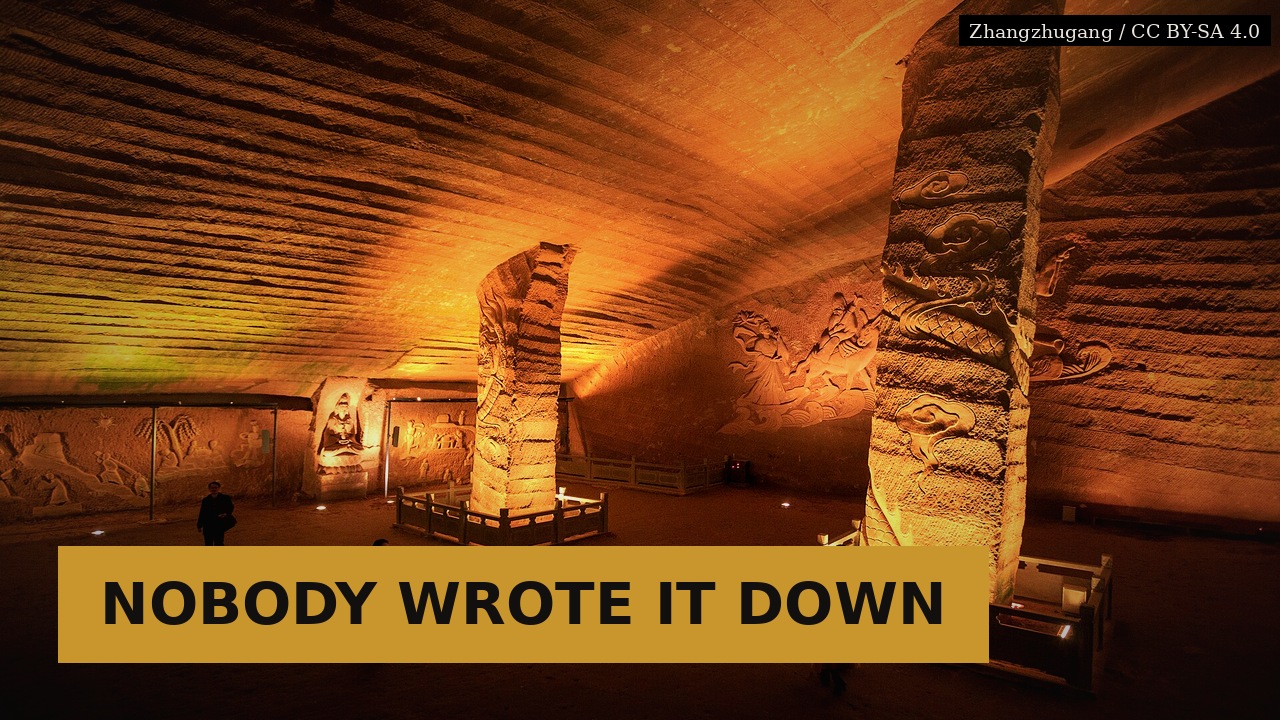
In June 1992, four farmers in a village in Zhejiang province set four pumps running on a pond the village had always called bottomless. They were after fish. Seventeen days later the water dropped past the level of something that was not pond bottom: a wall, cut by hand. Behind it was a chamber thirty metres down, with a vaulted ceiling and free-standing pillars, and not a single fish.
Twenty-three more chambers turned up nearby within the year. Geologists, archaeologists and structural engineers have been surveying the complex since 1998, mapping every pillar and chisel mark and modelling the stress in the roofs. More than thirty years on, the purpose of the Longyou Caves has still not been settled, and the gap between what the surveys have actually proven and what every tour guide and tourist pamphlet confidently asserts is wide.
Here is what the physical evidence supports, where it runs out, and the one detail about the whole site that works against almost every theory on offer, including the most popular one.
Four pumps, seventeen days, and a wall no one expected
The caves sit inside Fenghuang Hill, a modest rise only 69 metres above sea level, near the village of Shiyan Beicun on the north bank of the Qu River in Longyou County, Quzhou prefecture. A cluster of ponds there had a local reputation for being bottomless and, conveniently, full of fish. In early June 1992 a man named Wu Anai and three others decided to settle the fish question for good.
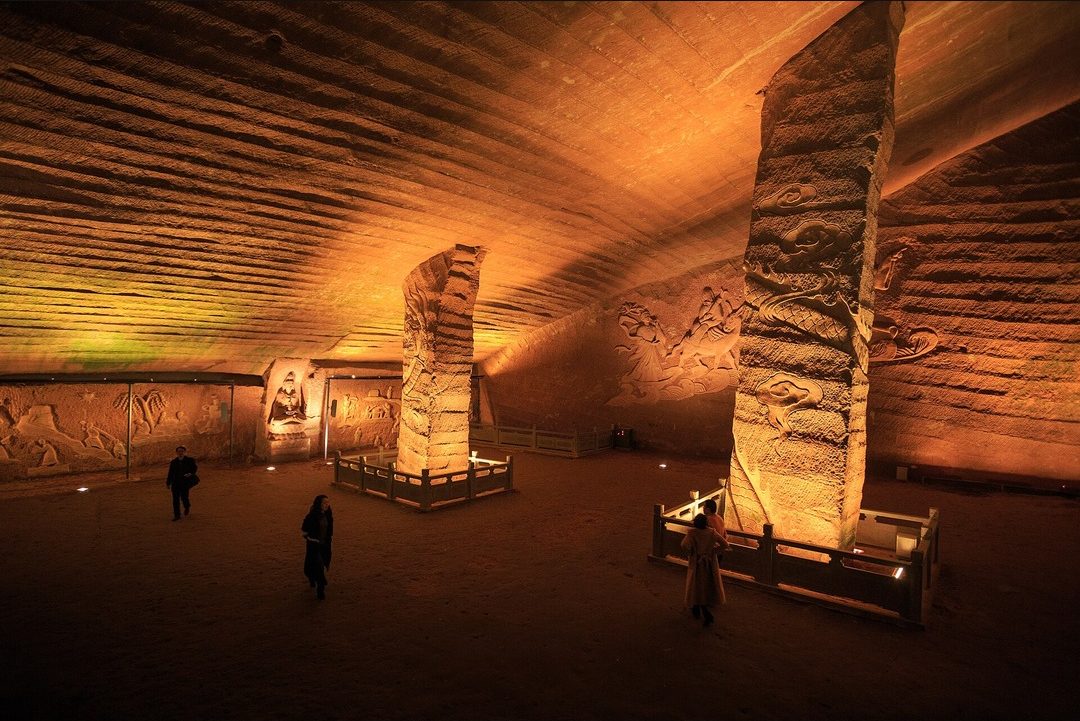
What stopped the pumps was not an empty pond but a wall that had no business being there. Once the rest of the ponds were drained, the count of discovered chambers in that one small patch of ground, roughly 350 by 280 metres, reached twenty-four within months. Chinese state media reporting on the site’s thirtieth anniversary puts Longyou Grottoes among the country’s recognised national key cultural relic sites, and local accounts describe a wider cluster of caverns beyond the twenty-four that have actually been cleared and studied.
Only one chamber is open to the public today. The other twenty-three are preserved largely as they were found: dim, waterlogged at the edges, and covered end to end in tool marks that nobody now alive watched being made.
Thirty thousand square metres of floor, cut from rock that barely holds together wet
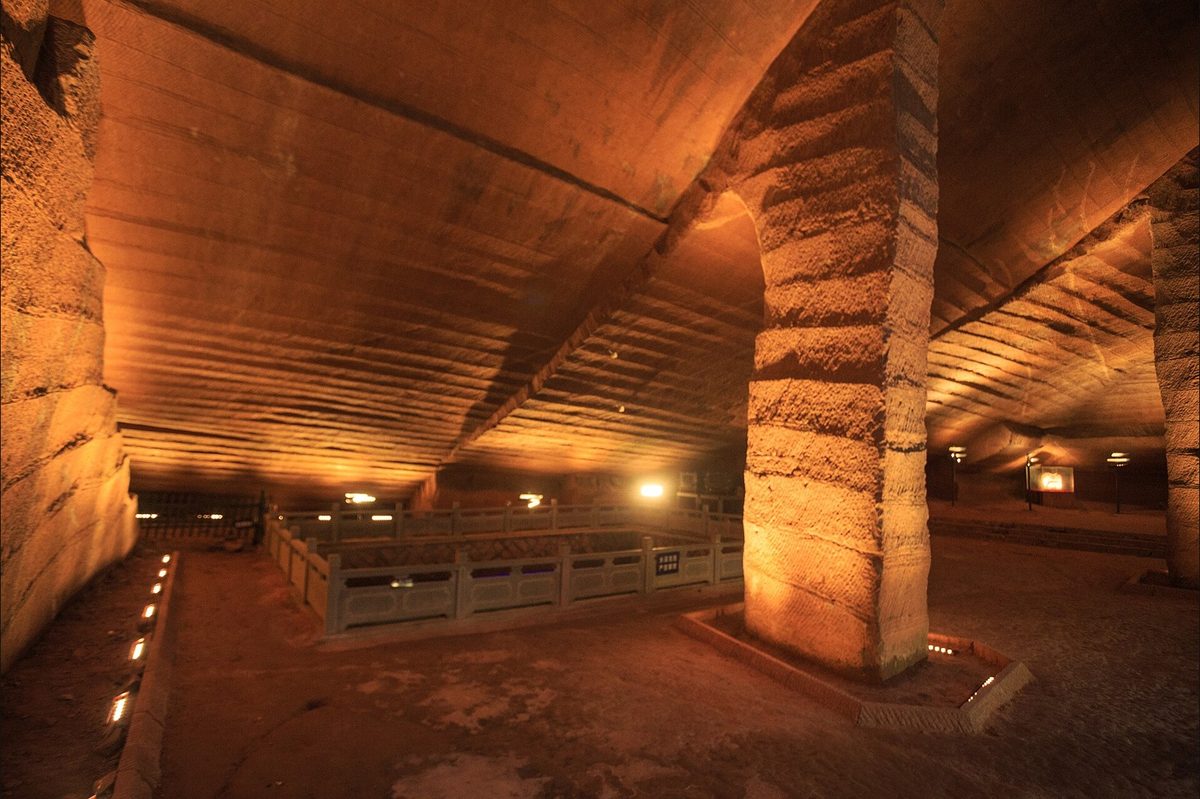
The scale is the first thing any theory about the caves has to account for. The individual chambers measured so far run from roughly 370 square metres of floor to just over 1,000; put together, the complex comes to more than 30,000 square metres cut out of solid rock. Spans between walls reach 34 metres. Ceilings stand as high as 18 metres — some secondary accounts give figures closer to 20 metres, a spread that is typical of a site measured independently by different teams over three decades rather than evidence of disagreement about the site itself.
The rock being cut was Cretaceous argillaceous siltstone, which matters more than the name suggests. A 2009 engineering-geology survey published in Tunnelling and Underground Space Technology found it takes about 31 megapascals of pressure to crush the stone dry, and as little as 18 wet — a drop of nearly half its strength the moment it gets damp, in a river valley that floods. That is soft enough to work with a steel chisel and a wooden mallet, and weak enough that leaving a 34-metre span standing in it, rather than filling it back in with pillars, was not a small engineering decision.
The chisel pattern reads like a set of instructions
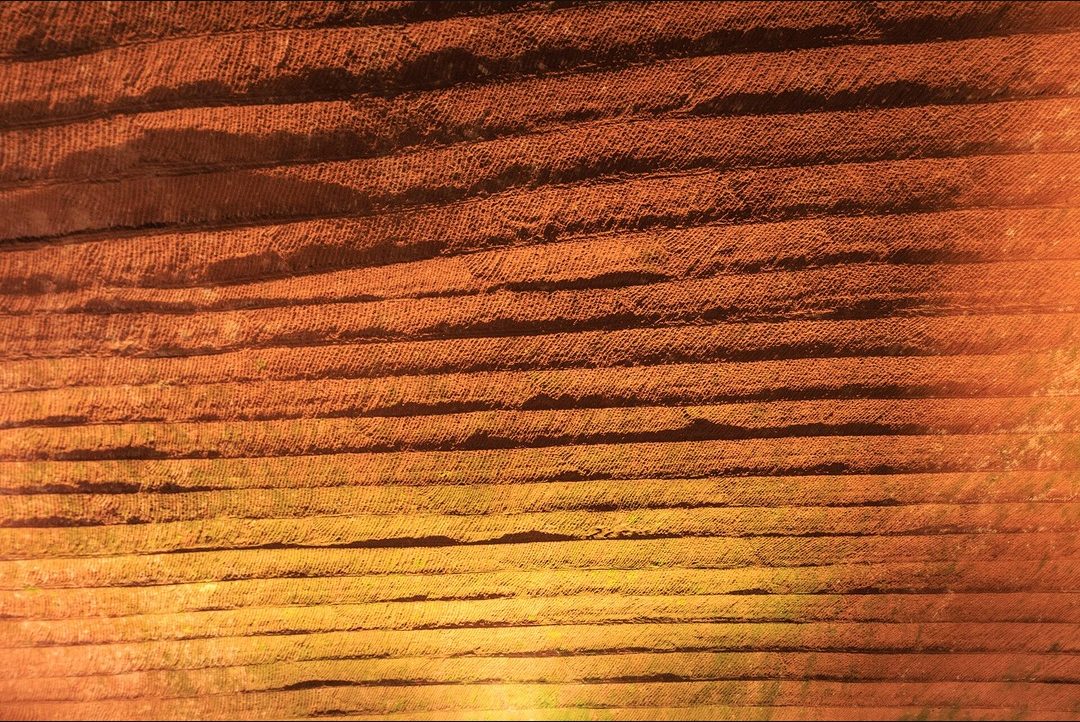
Every wall, pillar and ceiling in the complex carries the same finish: straight troughs cut in groups of two or three, spaced 500 to 600 millimetres apart, with short curved troughs about half a metre long running between them and meeting the straight lines at 60 to 75 degrees. Each groove runs 6 to 14 millimetres deep. The order of cutting can be read straight off the stone — top down, layer by layer, each layer roughly the thickness of two neighbouring grooves.
That alone would establish a method. The 2009 study went further. The ceilings, it found, are not flat or randomly angled — they dip at an average of about 22 degrees, within two degrees of the direction the rock’s own bedding planes dip. Whoever cut these roofs was cutting along the grain of the stone, not against it. The side walls lean inward for the same structural reason. The pillars run 4.5 to 12 metres tall on cross-sections of only 1 to 5 square metres, with rounded junctions where they meet the roof, and the chambers have drainage built into their floors.
Most tellingly, in twenty-four chambers packed into one small hill, with no view of the surface and no way to check a neighbour’s progress, not one accidental breakthrough connects one room to another. A 2020 structural-failure study of Cavern No. 5, published in the Chinese Journal of Underground Space and Engineering, is one of several since to take that record of near-misses seriously enough to model; the original 2009 authors went so far as to suggest the builders were using a compass-like surveying instrument underground. This was planned work, by people who understood the material. What it was planned for is a separate question, and a much harder one.
The only dates come from what was left behind, not what was cut away
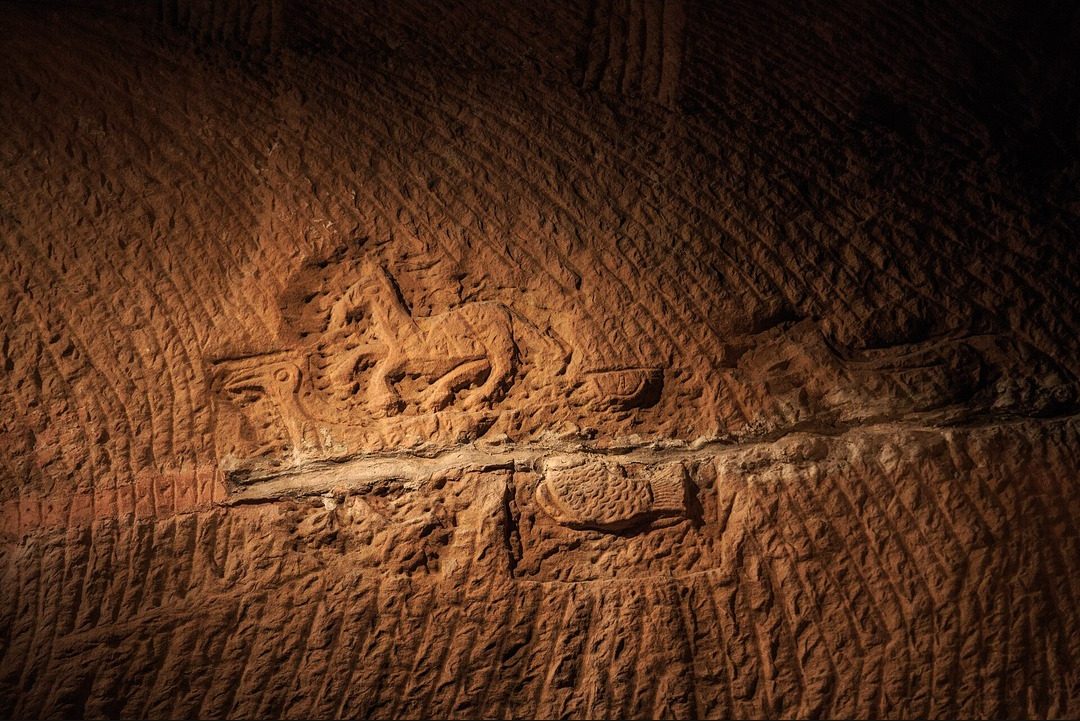
No method exists to date an excavation directly in bare rock, so every date attached to the Longyou Caves is really a date attached to something found inside them. Glazed clay pots recovered from the silt of Cavern Two are of a Western Han type, placing them somewhere between 206 BCE and 23 CE. A relief carving in Cavern One has been assigned by some researchers to a window spanning roughly four centuries. Two poems from the Song dynasty, and one written between 1626 and 1676 by a scholar named Yu Xun, may or may not be describing this specific site.
Pots in a chamber date the pots. They do not date the chiselling that made room for them to be dropped there, possibly centuries later. The 2009 study’s own authors are blunt about this: they use “about two thousand years” as a working convenience and state plainly that the actual construction date cannot be determined from the evidence available. Reporting on the site has occasionally collapsed that caveat into a firm number, which is how the same caves get described in different places as Han-dynasty, pre-Han, and, in at least one popular retelling tied to a king defeated in battle in 494 BCE, several centuries older than the pottery would suggest. No one version is well enough supported to call it settled.
Seven explanations for the purpose of the Longyou Caves, each with a hole in it
At least seven or eight explanations circulate, depending on who is counting, and the strongest has the clearest problem.
A quarry is the most popular theory, and room-and-pillar working — cutting out material while leaving columns to hold the roof — is a genuine quarrying technique used worldwide. It explains the method cleanly. It explains the site badly: the only way in is down a stairwell cut through the ceiling, the opposite of what a crew hauling stone out would want, no building anywhere nearby has ever been matched to this particular rock, and the stone itself is poor construction material that loses nearly half its strength the moment it is wet, in a valley that floods routinely.
A tomb has been proposed, though the chambers hold nothing a burial would and are far larger than one needs. Underground storage for grain or supplies fits the cool, drained conditions but not the years of labour a cellar would never justify. A secret military encampment would explain why the site was hidden, but not why its builders cared so much about the geometry of the ceilings. One version of the military theory, repeated in several 2023 retellings, credits King Goujian of Yue with ordering the caves dug to hide soldiers after a defeat in 494 BCE — a story that, if true, would make the caves several centuries older than the Han pottery implies, a contradiction none of those retellings resolve. A Taoist retreat, a site for ceremonial offerings, and a palace have each been floated too; each explains the craftsmanship on display, and none of them explains why there are twenty-four.
The nearest comparison is a thousand years too young to help
About 200 kilometres to the north-west, on the Xin’an River, sit the Huashan Grottoes: man-made caverns similar enough to Longyou’s that the two sites are routinely discussed together. In 2013, a study in the Journal of Archaeological Science used lichenometric dating — measuring the growth of lichen colonising the cut rock surfaces — to place Huashan’s excavation in the late Ming dynasty, between 1551 and 1667.
That is more than a thousand years after even the conventional estimate for Longyou. What it confirms is that cutting enormous, pillared rock chambers for an unstated purpose was not a one-off act at one site in one century; people in this part of China kept doing it, in broadly the same style, across a very long span of time. What it does not do is explain either site, since Huashan’s own purpose is argued over just as inconclusively as Longyou’s.
Twenty centuries of record-keeping, and not one line about this
China has one of the longest unbroken traditions of written record-keeping on earth. Local gazetteers logged floods, harvests, temple repairs, bridge construction and the comings and goings of officials in often tedious detail. A public work on the scale of the Longyou Caves — the planning, the labour, the years it would have taken — is exactly the kind of thing that record-keeping tradition exists to capture.
There is no construction account. No inscription names a builder, a patron or a date. No imperial order survives, no local report, no tally of workers paid or fed. The caves were cut, finished to a consistent and careful standard, and then simply not written about by anyone whose words have come down to us. At some point they flooded, and the memory of what they were went with them so completely that the villagers above them, centuries later, believed they were looking at a bottomless natural pond.
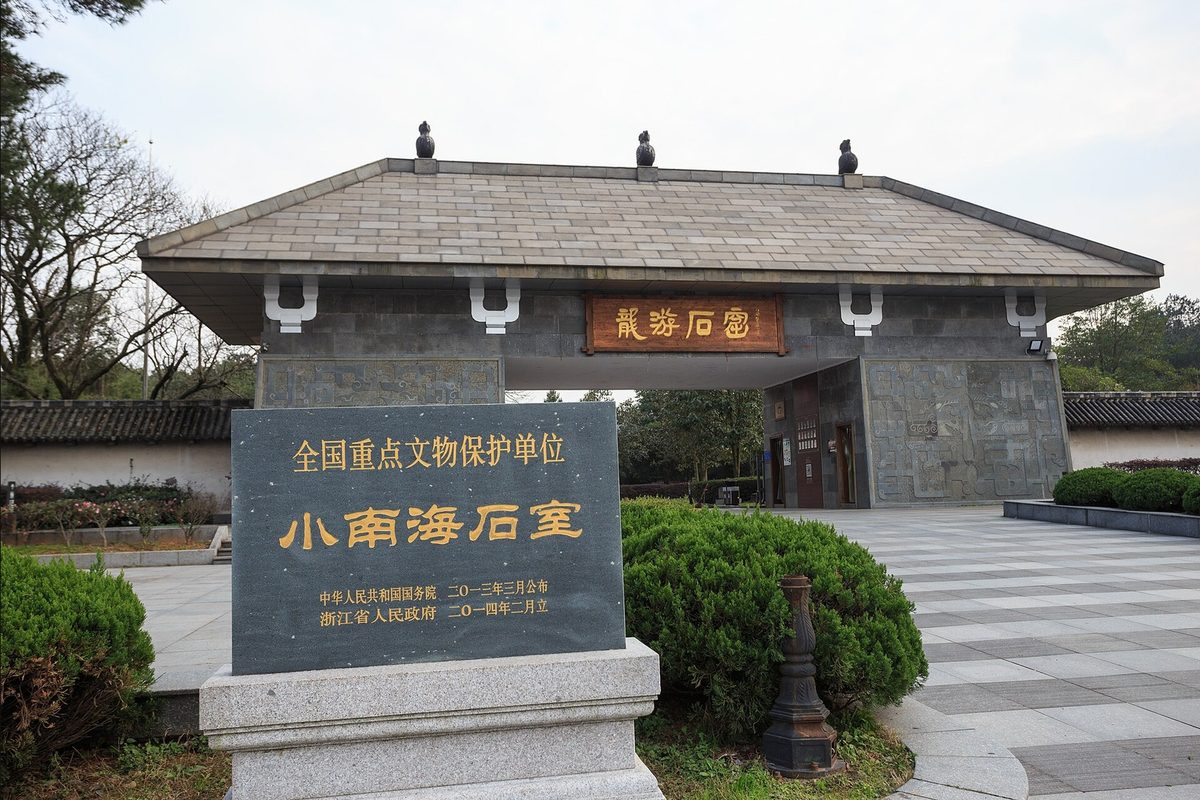
Longyou Grottoes has been a national key cultural relic protection unit since 2013, built on a 4A tourism rating the site earned a decade earlier, and continues to draw dedicated research funding and international interest, including a cooperation agreement discussed with the Discovery Channel at the site’s thirtieth-anniversary event in 2022. And the engineers who studied the structure reached a conclusion worth sitting with: nothing in the construction suggests the builders were designing for two thousand years of stability. The caverns most likely survived because the water that hid them also kept the stone at a constant moisture, which is exactly what this type of rock needs to avoid breaking down. The flooding that erased the caves from memory is very probably the reason there was anything left to drain in 1992.
Watch the full history
The eight-and-a-half-minute video version walks through the discovery, the engineering survey, and all seven explanations in sequence.

Related reading
- Were the Ulfberht Swords Really Made With Crucible Steel?
- What Was the Wow! Signal? Inside Astronomy’s Most Famous Unsolved Case
- What Actually Happened to Alexander the Great’s Tomb?
- Why Kryptos K4 Is Still Unsolved, Even After a $962,500 Sale
Works cited
- Li, L.H., Z.F. Yang, Z.Q. Yue, and L.Q. Zhang. “Engineering geological characteristics, failure modes and protective measures of Longyou rock caverns of 2000 years old.” Tunnelling and Underground Space Technology 24, no. 2 (2009): 190–207. Link.
- Zhu, Cheng, Li Wu, Tongxin Zhu, Feng Li, and Yun Zhang. “Lichenometric dating and the nature of the excavation of the Huashan Grottoes, East China.” Journal of Archaeological Science 40, no. 5 (2013): 2485–2492. Link.
- Yu, Chaoyun, Huihui Zhang, and Chun’an Tang. “Study on Failure Mechanism of Cavern No. 5 in Longyou Grottoes.” Chinese Journal of Underground Space and Engineering 16, no. 1 (2020): 106–113. Link.
- “30th Anniversary of Discovery of Longyou Grottoes and Launch Ceremony of Cultural Gene Decoding Project Held in Longyou.” PR Newswire, December 11, 2022. Link.
- “Longyou Grottoes.” China Daily, November 26, 2018. Link.
- Milligan, Mark. “The Mystery of the Longyou Caves.” HeritageDaily, August 28, 2020.
- Hale, Tom. “China’s 2,000-Year-Old Longyou Caves Will Blow Your Mind.” IFLScience, July 4, 2023. Link.