
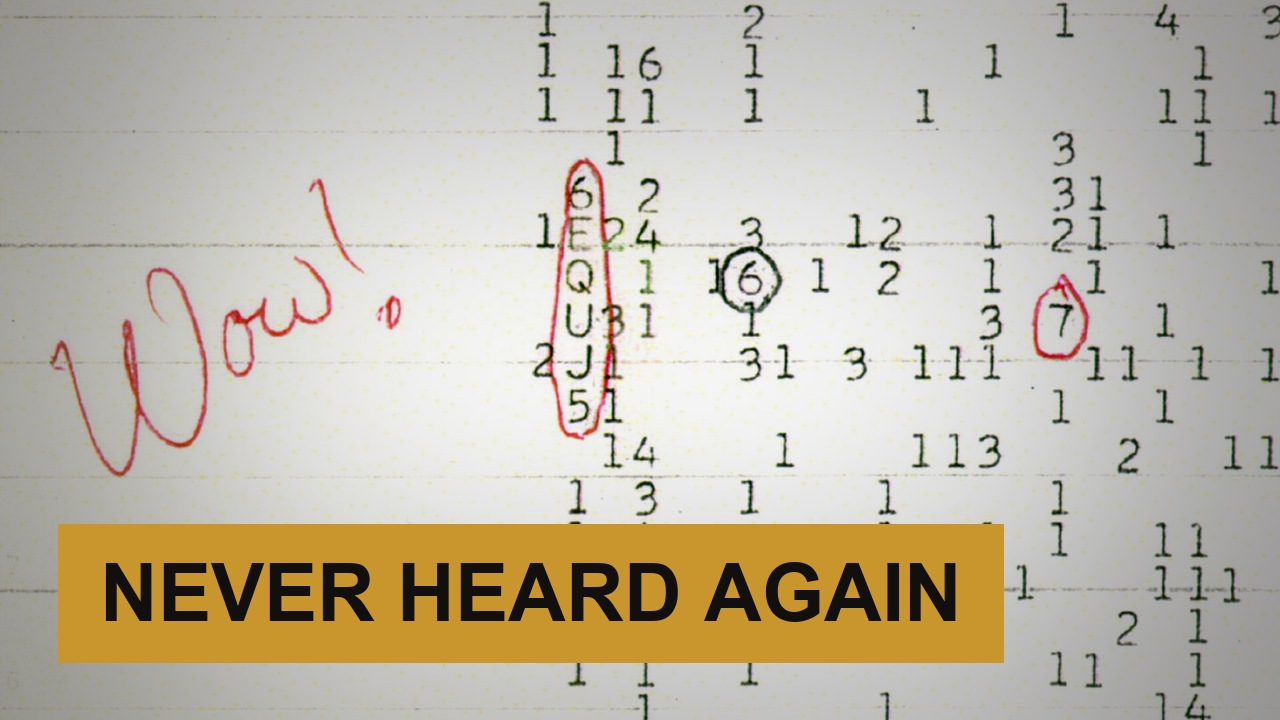
On a summer night in 1977, a volunteer reviewing stacks of computer printouts in Ohio circled six characters, wrote one word in red pen beside them, and created the single most famous unsolved case in the history of the search for intelligent life beyond Earth. Nearly fifty years on, nobody has answered the simple question at the center of it: what was the Wow signal?
It is not for lack of trying. Four separate research teams, with four different instruments, have pointed telescopes at the patch of sky it came from. None has heard it again. The explanations on offer range from a reflection off space debris to a comet’s breath to, most recently, a kind of natural radio flare nobody has ever directly observed. Every one of them runs into the same wall: a single design choice in a homemade Ohio telescope that made the signal both undeniable and, in the one way that would have settled it, permanently incomplete.
Here is what the record actually documents, in the order the evidence arrived.
A Telescope Built to Map the Sky, Not Find Aliens
The instrument that caught it was not built to search for extraterrestrial signals at all. John D. Kraus, a radio-astronomy pioneer on the Ohio State University faculty, designed it and built it with undergraduate and graduate students starting in 1956, on leased farmland outside Delaware, Ohio, beside Ohio Wesleyan University’s Perkins Observatory. Construction finished in 1961 and the telescope, nicknamed Big Ear, went on the air in 1963, for roughly $250,000 — a flat, tiltable reflector and a fixed curved one, three football fields of steel mesh standing in for a dish many times the size.
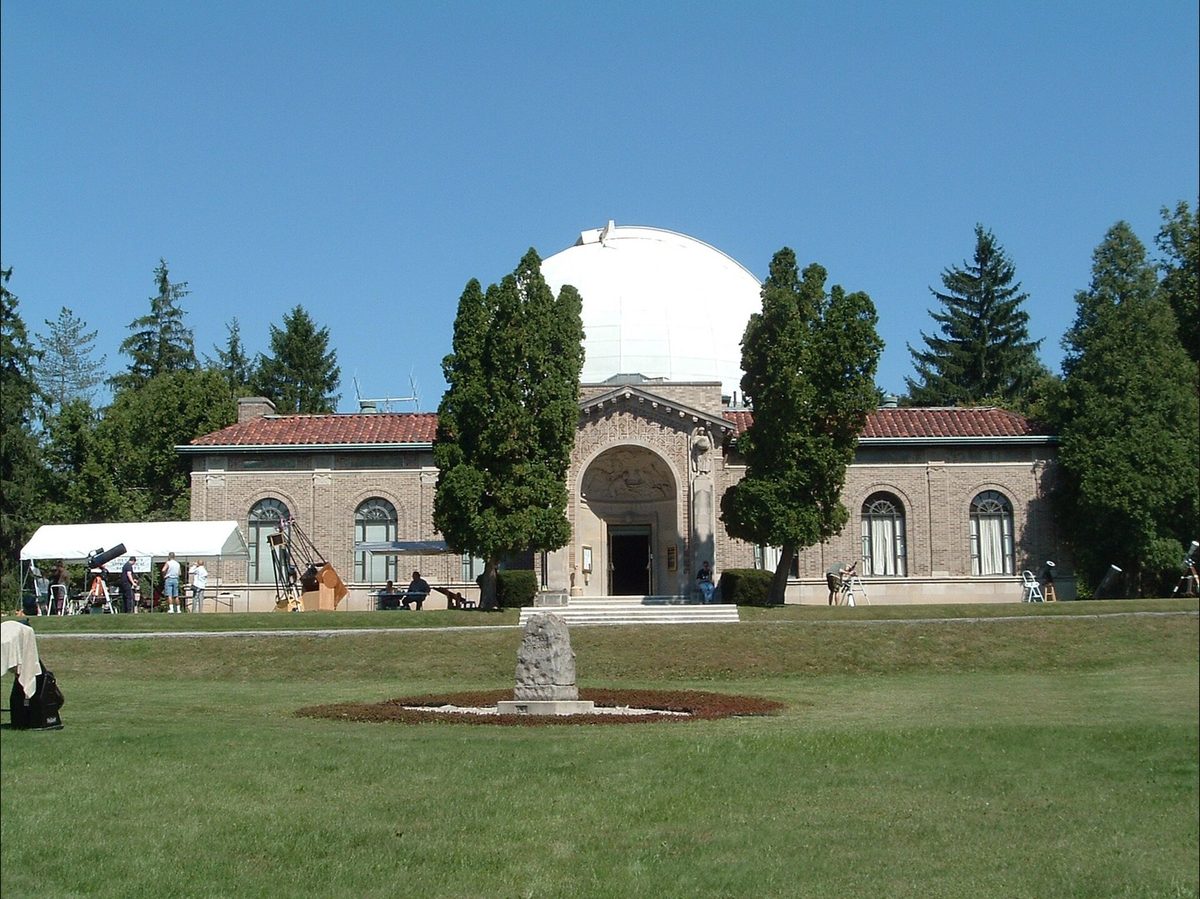
Its first job was mapping. Through the 1960s it surveyed the sky for natural radio sources and catalogued more than 19,000 of them, over half never previously detected. It was only afterward, once NSF funding for the original survey dried up in 1972 and Kraus’s research associate Jerry Ehman had to leave his paid position and stay on as an unpaid volunteer, that the observatory turned the instrument toward a different question. On December 7, 1973, Big Ear began the search that would make it famous: a full-time hunt for an artificial signal from somewhere else, one of the first dedicated SETI programs anywhere, and by some measures the longest-running one ever conducted.
Two Horns, Fifty Channels, and One Very Specific Frequency
Big Ear could not steer in the ordinary sense. It was fixed in direction and adjustable only in how high it tilted; everything else was done by the Earth turning beneath it, sweeping its narrow beam across a strip of sky once a day. Its receiver split that beam into fifty channels, each ten kilohertz wide, clustered around 1420 megahertz — the frequency at which neutral hydrogen, the most common element in the universe, naturally radiates. If another civilization wanted a frequency every radio astronomer in the galaxy would already be listening to, this was the argument for it.
The detail that made the detection possible, and the one that would later make it impossible to fully resolve, was that Big Ear had two feed horns rather than one, aimed at slightly different points in the sky. A fixed object drifted through the first horn’s beam, then drifted through the second roughly three minutes later. Two matching detections, three minutes apart, was what a genuine point source in the sky was supposed to look like on this instrument.
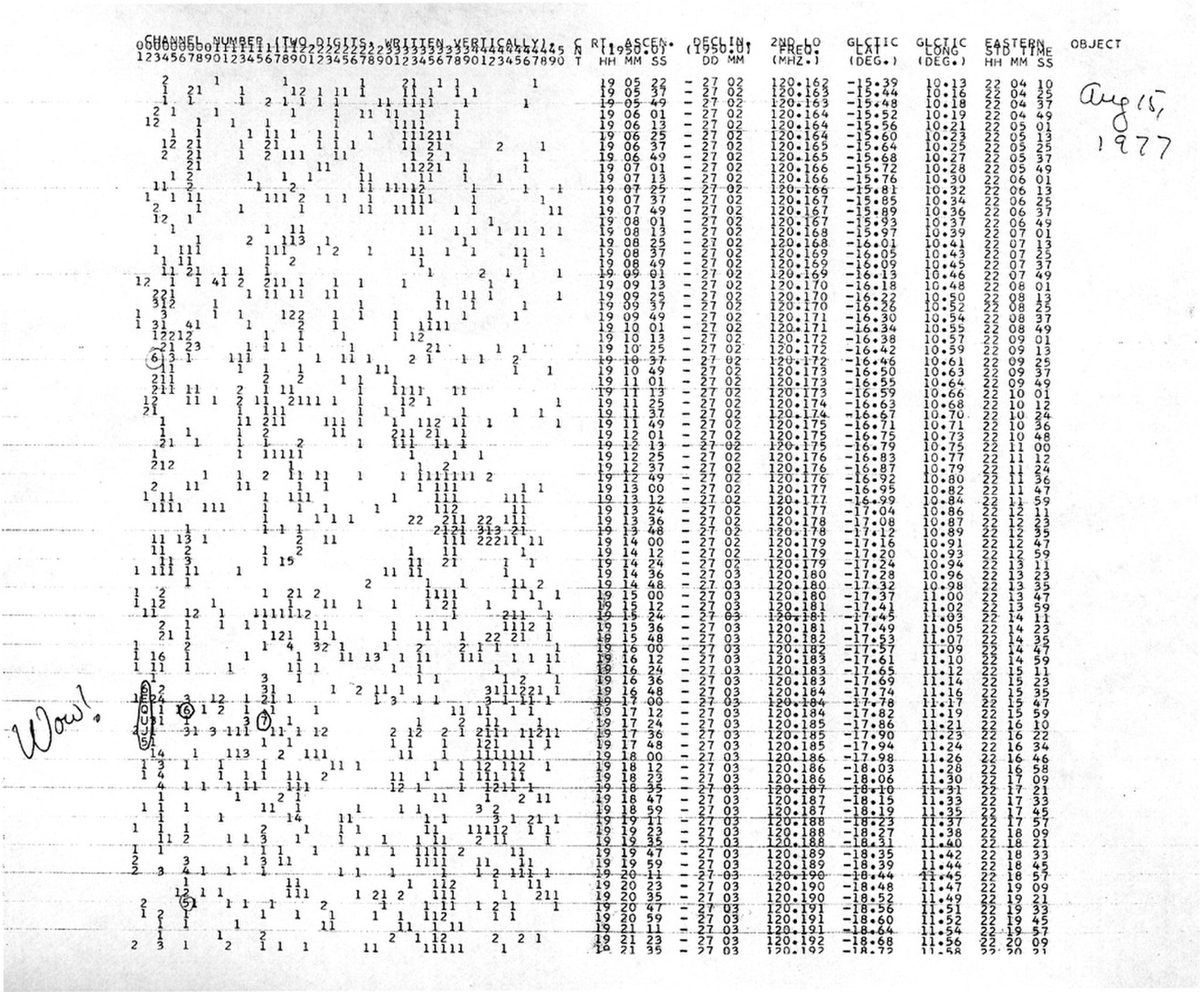
At around 11:16 p.m. local time on August 15, 1977, channel two recorded a narrowband signal at 1420.4556 megahertz, about fifty kilohertz off the hydrogen line’s rest frequency — close to what a source moving relative to Earth would produce. It climbed for about thirty-six seconds, peaked at roughly thirty standard deviations above the background noise, and fell away again. Total length: 72 seconds, which was not a round number anyone chose. It was exactly how long Big Ear’s beam took to sweep across any single fixed point in the sky.
What came out on the printout was a string of characters: 6EQUJ5. It has been read as a hidden message more times than its discoverers would like. It is not one. Each character is a ten-second average of signal strength, in standard deviations above background; digits mean themselves, and letters continue the scale past nine, so A is ten or eleven, and U — the peak of this signal — is roughly thirty or thirty-one. Ehman found the printout a few days after the fact, reviewing the backlog by hand. He circled the six characters and wrote “Wow!” in the margin, a reaction he has since described as close to involuntary.
The One Detail No Explanation Has Ever Solved
This is the part that keeps the case open. The same patch of sky should have crossed Big Ear’s second horn about three minutes after it crossed the first. It never did; that window shows nothing but ordinary noise. On its own, a one-horn detection would be a solvable problem. What makes it permanent is that the way the 1977 data was processed makes it impossible to go back now and determine which of the two horns actually caught the signal in the first place.
That single missing fact is the reason there is no one set of coordinates to search, only two. Ehman’s own corrected calculations give a right ascension of 19 hours, 22 minutes, 25 seconds for the positive horn or 19 hours, 25 minutes, 17 seconds for the negative one, each accurate to about ten seconds, with declination at −27 degrees, 3 arcminutes, accurate to about twenty arcminutes — a patch of Sagittarius, not a point. Even the signal’s brightness is contested: two independent analyses of the same printout put its flux density at 54 and 212 janskys respectively, a fourfold disagreement that traces back to which horn’s antenna pattern you assume did the work.
It is a strange kind of evidence problem. Most unsolved historic cases turn on what was destroyed, lost or never recorded in the first place — the missing confession behind who actually wrote the Monteagle letter is the same shape of gap. Here, everything was recorded. The printout survives in full. The one thing lost is a single bit of information — left horn or right horn — that nobody thought to preserve because nobody expected to need it.
Every Search Since Has Come Back Empty
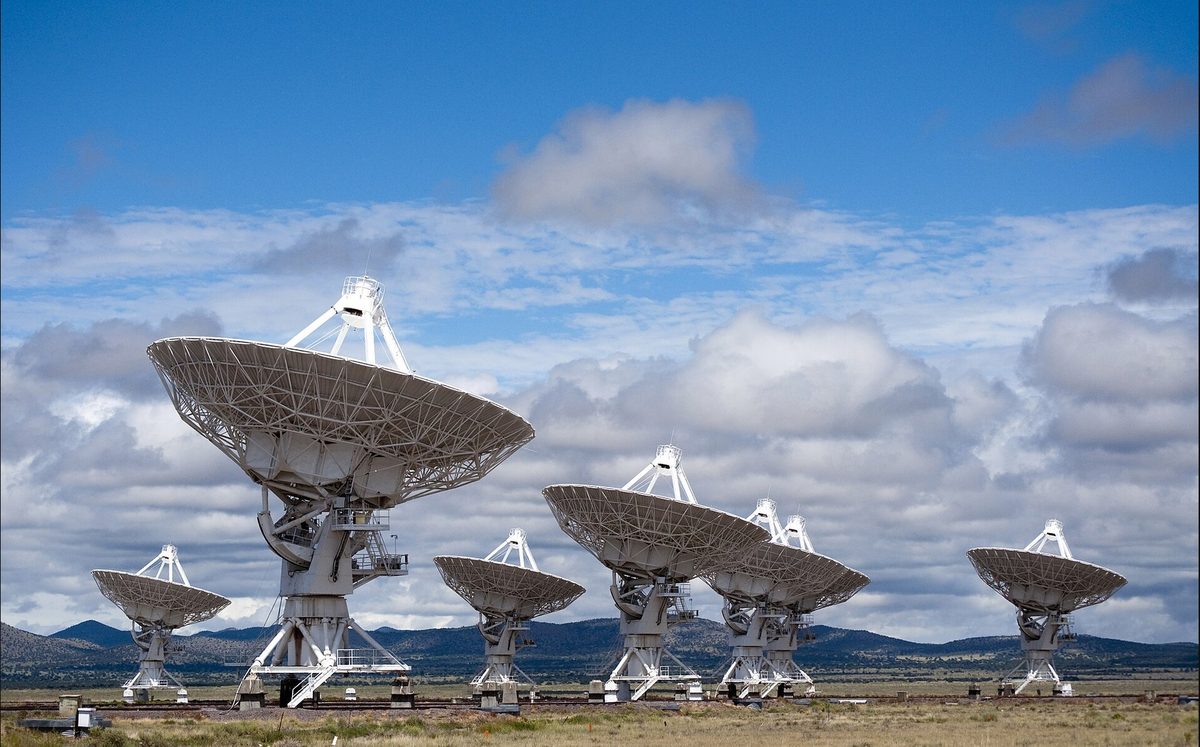
Big Ear’s own team checked the same strip of sky periodically in the weeks and months after the detection and heard nothing. The searches that followed only got more capable. In 1995 and 1996, Robert Gray and Kevin Marvel used the Very Large Array in New Mexico, vastly more sensitive than Big Ear had ever been, and published a null result in The Astrophysical Journal in 2001. In 1999, Gray and Simon Ellingsen ran six fourteen-hour sessions on a 26-metre dish at the Mount Pleasant Radio Observatory in Tasmania, looking specifically for any periodic repeat of the signal; that came back empty too, published in 2002.
The most sensitive attempt yet came on May 21, 2022, when Breakthrough Listen pointed the Green Bank Telescope and the Allen Telescope Array at a specific candidate star inside the Wow region — 2MASS 19281982−2640123, about 1,788 light-years away, identified the same year by astronomer Alberto Caballero as one of only a few Sun-like stars that actually fall within Big Ear’s old beam. The two telescopes observed simultaneously for a combined nine minutes and forty seconds, the first time, according to lead researcher Karen Perez, that anyone had run a targeted search aimed at a specific star rather than the general region. It found no technosignature candidate.
The Mundane Explanations, Tested and Mostly Rejected
The least exotic explanation is a terrestrial one: a ground transmitter, or its reflection off a piece of space debris. The 1420 megahertz band is formally protected for radio astronomy, but the protection has never been airtight, and Ehman himself favored a reflection explanation for years before concluding that no plausible piece of orbital debris has the reflective properties the arithmetic would require. It also does not explain why a ground source would happen to rise and fall on exactly the seventy-two second schedule of a fixed point crossing a sky-scanning beam.
The most publicized rival theory arrived in 2017, when researcher Antonio Paris proposed that hydrogen gas surrounding two comets, 266P/Christensen and P/2008 Y2 (Gibbs), had drifted through Big Ear’s beam and produced the signal. It drew immediate pushback. Robert Dixon, who had directed Ohio State’s SETI program, told reporters that nobody in the field believed comets emit anywhere near enough hydrogen radiation to produce a thirty-sigma spike, and SETI Institute astronomer Seth Shostak noted a more basic problem: the comets were not actually positioned to pass through the beam at the recorded time, and — like every other proposal — the hypothesis still could not explain why only one horn caught it.
A New Hypothesis From an Old Telescope’s Archive
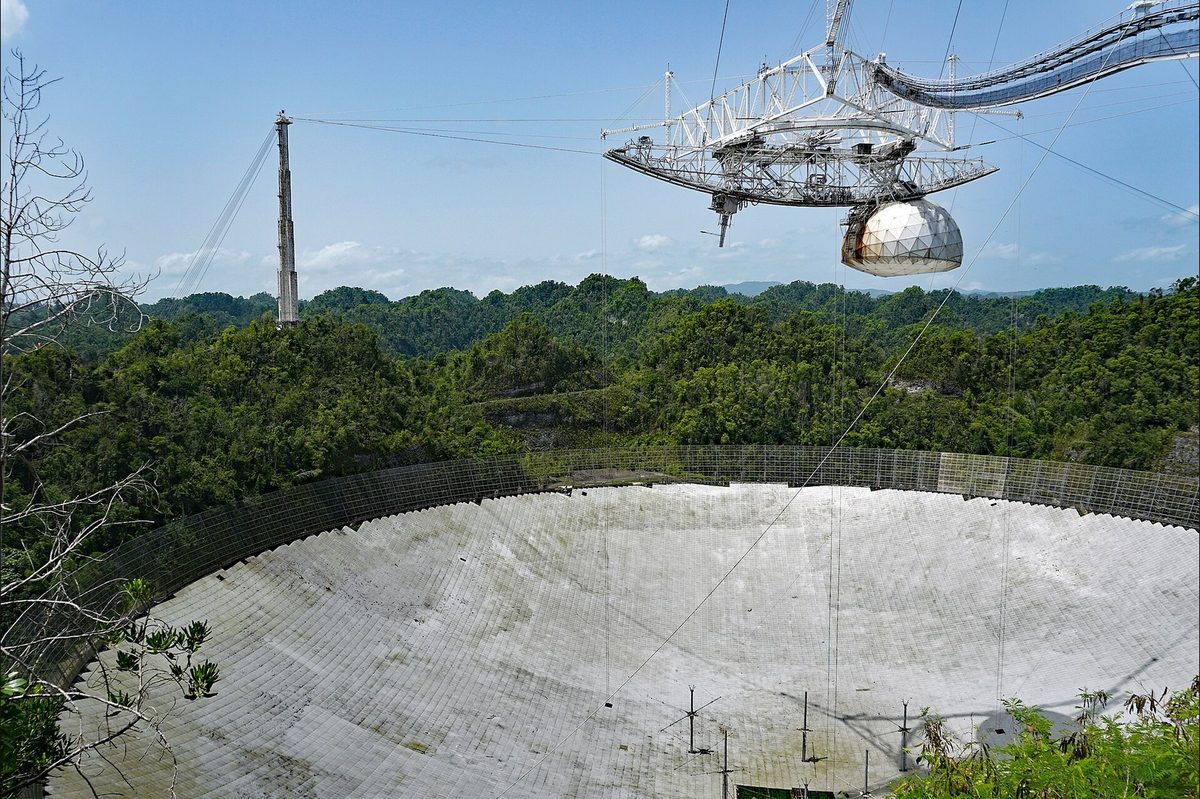
The newest candidate explanation did not come from a new telescope. In August 2024, Abel Méndez, Kevin Ortiz Ceballos and Jorge Zuluaga, working at the Planetary Habitability Laboratory at the University of Puerto Rico at Arecibo, published a preprint built on archived Arecibo data gathered between February and May 2020, in a sky survey that scanned in much the way Big Ear once did. Buried in that archive they found several narrowband signals close to the hydrogen line with a shape like the Wow signal’s — though roughly a hundred times fainter — each coinciding with a cold cloud of interstellar hydrogen gas.
Their proposal is that a sudden, violent burst of radiation, such as a magnetar flare or a soft gamma repeater, striking one of those clouds could briefly turn the gas itself into a natural maser: an amplifier that flares bright for a matter of seconds and then goes quiet, leaving no trace once it passes. If that mechanism is real, the Wow signal becomes its first recorded example, and a previously unrecognized source of false positives for anyone hunting deliberate signals. The catch is that it is still a preprint, not yet through peer review, and no one has ever directly observed a hydrogen-line maser flare of this kind — which means one unconfirmed event is currently being explained by another phenomenon that has itself never been confirmed.
So, What Was the Wow Signal?
The honest answer is that nobody knows, and the record as it stands may not contain enough information for anyone ever to know. What survives is specific: a single sheet of printer paper, now held in the Ohio History Connection’s archives as part of the North American Astrophysical Observatory’s records, open to any researcher who asks to see it in the reading room. What does not survive is the telescope itself. Big Ear’s land lease expired at the end of 1997, and by early May 1998 the last sections of the two reflectors had been taken down, clearing the site for a 381-lot housing development and an expansion of the Dornoch Golf Club. There is nowhere left to point a telescope from.
What remains is a genuinely rare kind of case: not a mystery manufactured by missing records or a reluctant witness, but one produced by a single unrecorded fact inside an otherwise complete and well-documented dataset. Every later search has had more sensitivity than Big Ear ever had, and every one of them has had nowhere precise enough to point it.
Watch the full history
The video covers the detection itself, the printout, and the chain of failed re-detections in just over eight minutes.

Related reading
- What the Declassified Tehran UFO Documents Actually Say
- Why Kryptos K4 Is Still Unsolved, Even After a $962,500 Sale
- Drift Bottle Science: How Sealed Notes Helped Map the World’s Oceans
- Who Wrote the Monteagle Letter? Six Suspects, No Confession
Works cited
- Ehman, Jerry R. “The Big Ear Wow! Signal: What We Know and Don’t Know About It After 20 Years.” North American AstroPhysical Observatory. Link.
- Kawa, Barry. The Plain Dealer Sunday Magazine (Cleveland), September 18, 1994. Reprinted at bigear.org. Link.
- Center for Land Use Interpretation. “Big Ear Radio Observatory Site.” Land Use Database. Link.
- Delaware County Historical Society. “Delaware Had the Big Ear.” delawareohiohistory.org, March 9, 2020, citing Susan Kelley, The Delaware Gazette, May 8, 1998. Link.
- Gray, Robert H., and Kevin B. Marvel. “A VLA Search for the Ohio State ‘Wow’.” The Astrophysical Journal 546, no. 2 (2001): 1171–1177. Link.
- Gray, Robert H., and Simon Ellingsen. “A Search for Periodic Emissions at the Wow Locale.” The Astrophysical Journal 578, no. 2 (2002): 967–971. Link.
- Paris, Antonio. “Hydrogen Clouds from Comets 266P/Christensen and P/2008 Y2 (Gibbs) Are Candidates for the Source of the 1977 ‘Wow’ Signal.” Journal of the Washington Academy of Sciences 103, no. 2 (2017). Link.
- Shostak, Seth. “Was It E.T., or Just a Comet?” SETI Institute, June 13, 2017. Link.
- SETI Institute. “1st Coordinated Green Bank Telescope/Allen Telescope Array Observes Possible Source of the WOW! Signal.” seti.org, September 29, 2022. Link.
- Méndez, Abel, Kevin Ortiz Ceballos, and Jorge I. Zuluaga. “Arecibo Wow! I: An Astrophysical Explanation for the Wow! Signal.” arXiv preprint, August 16, 2024. Link.
- Ohio History Connection. “Wow! Radio Signal.” North American Astrophysical Observatory Records, MSS 1151. (Cited as print.)