
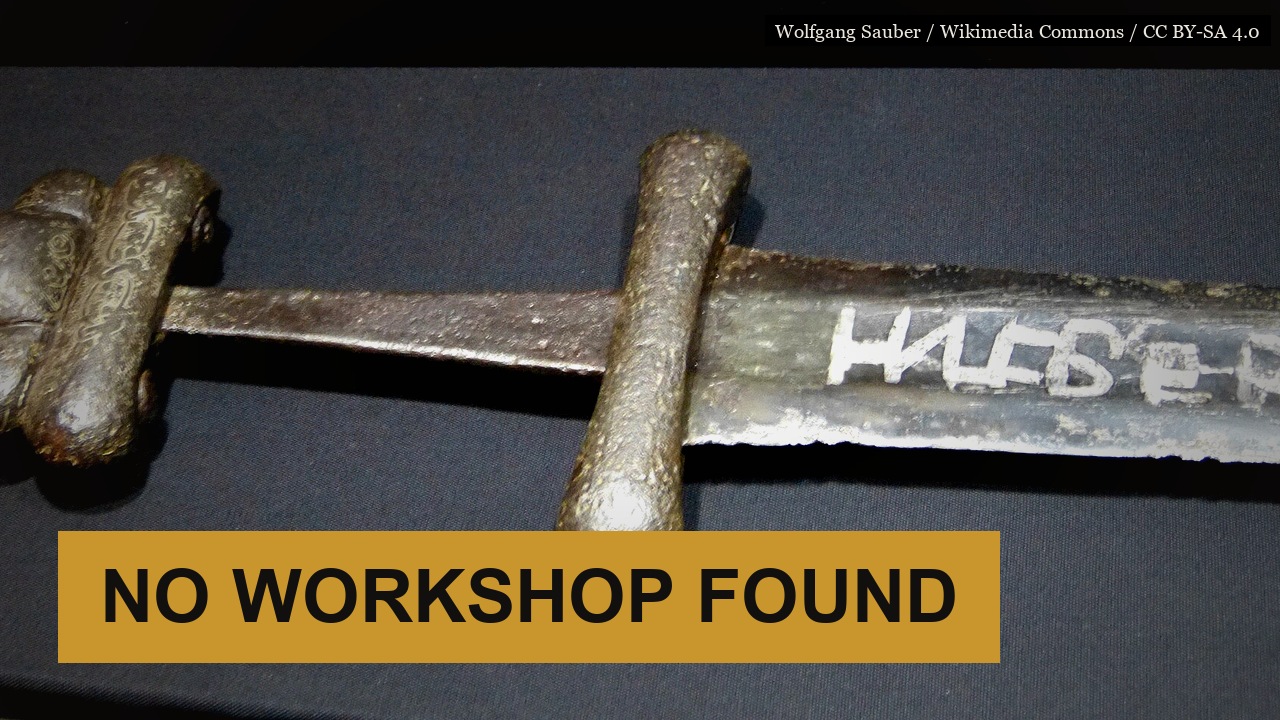
In the spring of 2012, a dredging crew clearing gravel from the River Weser near the village of Großenwieden, in Lower Saxony, pulled up a sword. Corroded and missing its grip, the blade was still intact enough to read the letters inlaid along its length in iron: a cross, V-L-F-B-E-R-H, another cross, T. It was the first sword of its kind ever found in Lower Saxony, and roughly the 170th known example of a weapon that has been dividing historians and metallurgists for more than a century.
What makes the Ulfberht swords a genuine open question, rather than just an old curiosity, is that some of them appear to be better than they should be. A share of the blades are harder than European smiths of the ninth and tenth centuries are generally thought to have been capable of forging — hard enough that one of the field’s leading metallurgists has argued the steel in the best examples was smelted somewhere else entirely, in furnaces Europe did not yet have. Other specialists, working from the very same blades, say the case for that claim is thinner than it looks.
The Großenwieden sword is a useful place to start, because it is one of the only Ulfberht blades ever run through a modern materials laboratory from the ground up — sampled, scanned, and isotope-tested — and what the lab found complicates both sides of the argument at once.
A Sword Pulled From a Riverbed, and What It Is
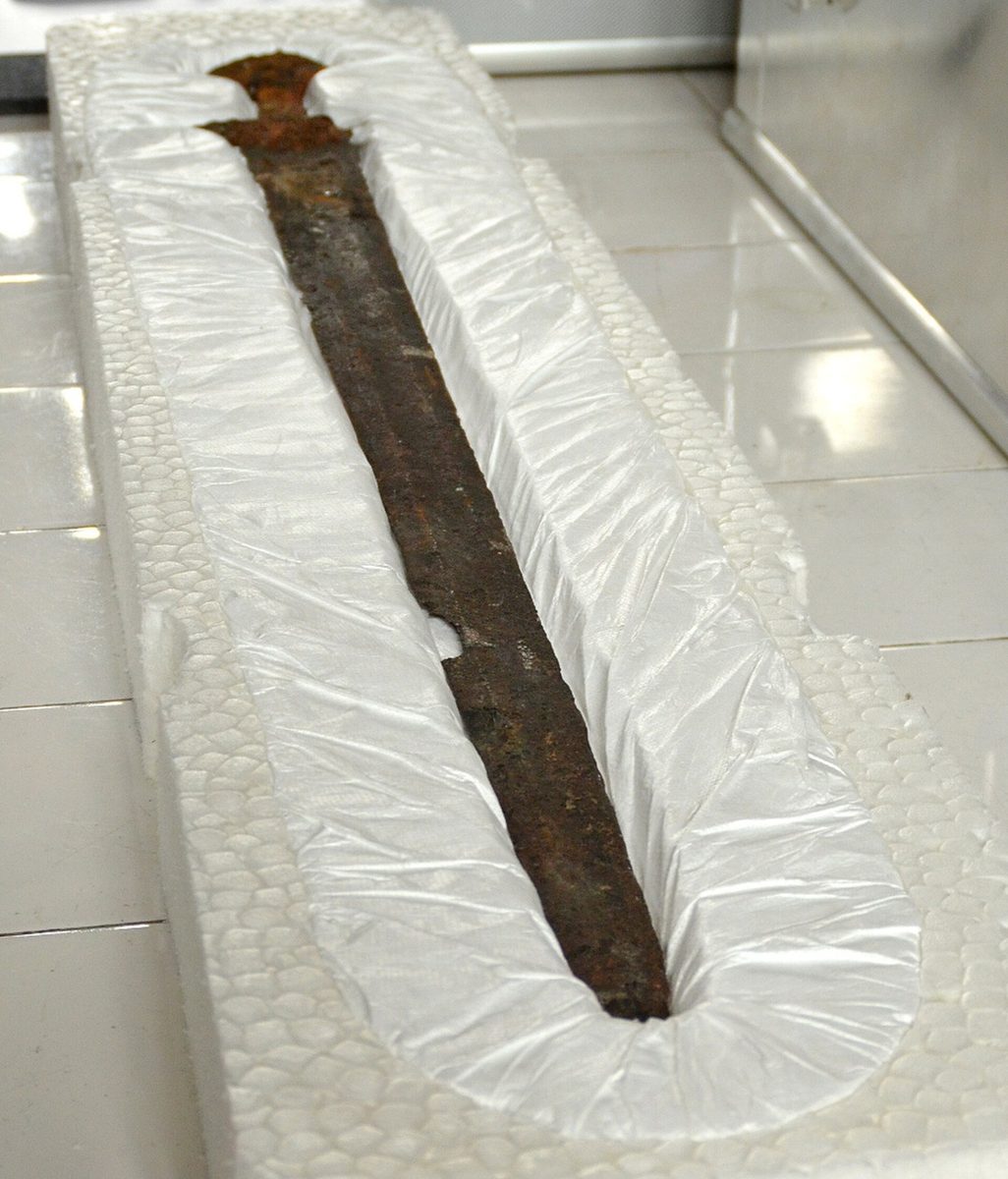
The find itself was almost accidental. Dredging on the Weser in 2012 turned up a nearly complete iron sword, recovered by a local man, R. Kleine, from material already excavated from the riverbed. At 96 centimetres long and weighing just under a kilogram in its corroded state, it falls into the typology the Norwegian archaeologist Jan Petersen worked out in the early twentieth century as a Type V, a style Petersen placed in the first half of the tenth century — a window that fits most Ulfberht finds.
Along the front of the blade, the name sits in its most common correctly spelled form, +VLFBERH+T, bracketed by crosses the way a medieval scribe might bracket his own name on a charter. The back carries a braided geometric pattern that shows up often enough on these swords to count as a second, wordless half of the signature. What is genuinely unusual is how rare this exact combination — this sword shape paired with this inlay style — turns out to be: the only other known match comes from a find at Schestovizy, in Ukraine, more than 1,800 kilometres away.
A Name Forge-Welded Into the Metal
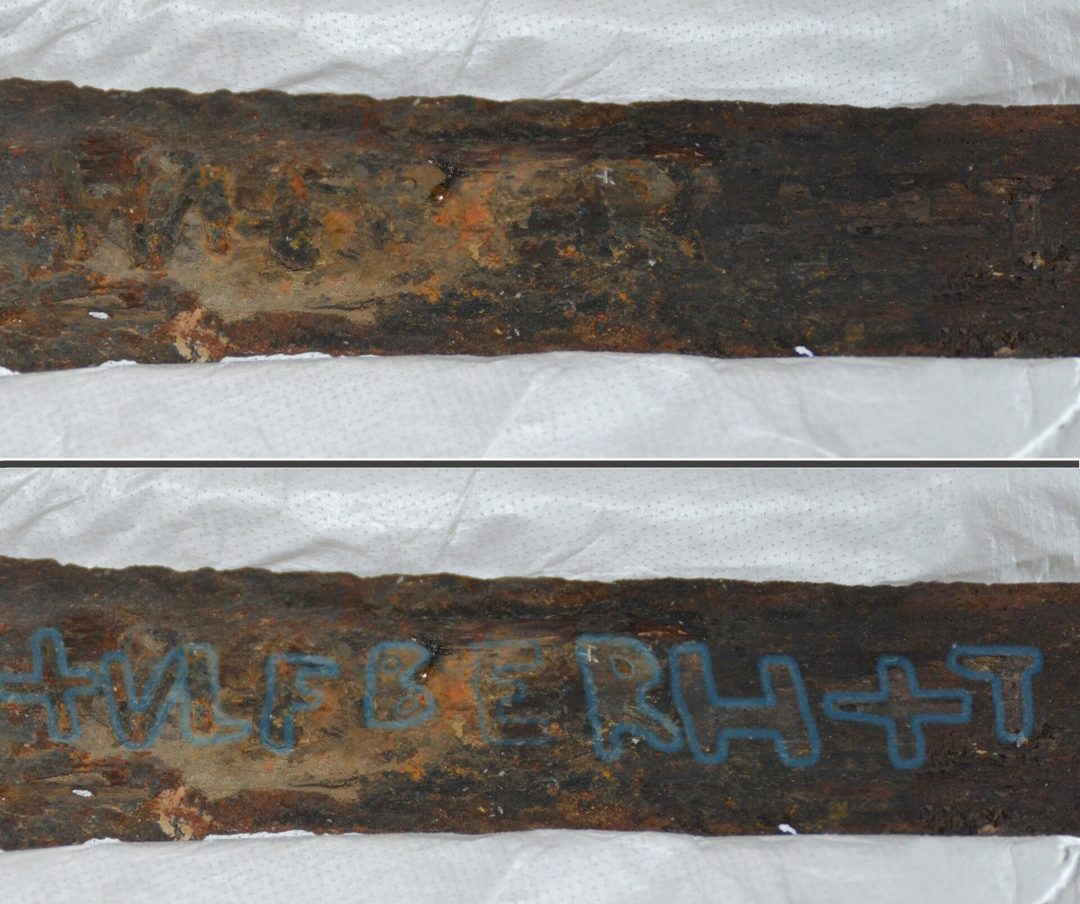
The lettering on an Ulfberht sword was never applied to the surface. Smiths cut a shallow channel lengthwise into the blade while it was still being forged, laid strips of iron into the channel in the shape of the letters, and hammer-welded the whole assembly until the inlay sat flush with the surrounding steel. Done correctly, the name becomes part of the object rather than a mark on it, which is part of why these inscriptions have survived a thousand years of corrosion well enough to still be legible.
Robert Lehmann’s laboratory analysis of the Großenwieden blade found that its inlay was not even the same metal as the rest of the sword: the lettering used a nickel-bearing steel, tougher and more corrosion-resistant than the manganese steel of the blade proper, and easier to weld without burning out. That is a real design decision, not a cosmetic flourish — someone chose a specific alloy for a specific job inside one object, centuries before metallurgy existed as a word.
How difficult the welding itself was is easy to underestimate from a photograph. When the documentary series NOVA built an episode around reconstructing an Ulfberht from scratch, the bladesmith Ric Furrer, known for making his own steel by historical methods, took viewers through building one using only techniques available in the period. Getting inlaid letters to weld flush without distorting or being swallowed by the surrounding steel is the kind of step that separates a workshop with real specialisation from an improvising amateur.
The Catalogue Nobody Can Quite Agree On
Much of what is known about the Ulfberht swords as a group comes from one scholar’s decades of cataloguing: the archaeologist Anne Stalsberg, whose 2017 book pulled together the fullest accounting of the finds to date. Even her own totals shift depending on how fragments and uncertain readings are counted — 167, 168, or “about 170” are all defensible numbers for the same body of evidence.
The geography is lopsided in a way that is easy to misread. Norway alone has produced 44 of the known examples, more than any other country, with Sweden, Finland, Germany, and a scatter of finds running east through Russia, the Baltic states, Poland, and Ukraine, and as far afield as Spain, Italy, Switzerland, and Iceland. Even single countries disagree with themselves: Stalsberg counts 14 Ulfberht swords in Finland, while a more recent survey by the archaeologist Jukka Moilanen puts the figure at 31. None of this proves the swords were made in Scandinavia. Scandinavia buried its dead with their weapons through the Viking Age, while Frankish custom did not, so a blade forged in the Rhineland and traded north had a far better chance of surviving in a Norwegian grave than in the ground where it was made. Tellingly, no Norwegian Ulfberht is dated later than the mid-eleventh century — exactly when Norway’s conversion to Christianity ended the practice of burying the dead with grave goods at all, a shift documented in the same wave that leaves other medieval engineering projects just as hard to date precisely.
Fifty-Five Blades Under a Microscope
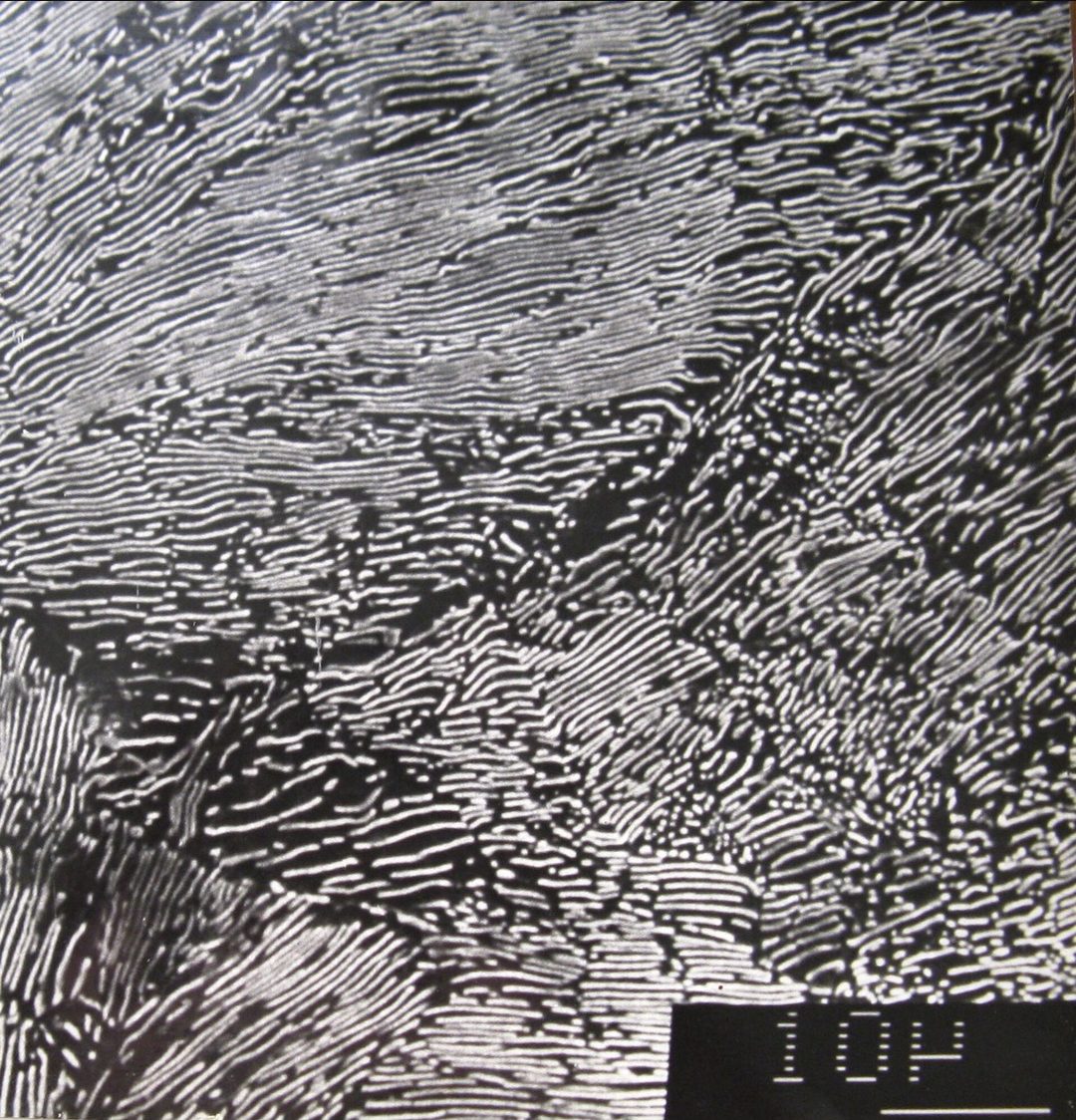
The metallurgist Alan Williams examined 55 Ulfberht and related Viking-age blades for a 2009 study in the journal Gladius, cutting cross-sections and measuring carbon content, then sorted the results into five grades. Nine blades came in above 0.8 percent carbon, a hardness Williams judged beyond what European bloomery furnaces of the period could reliably produce. Five more sat right at that threshold. Fourteen had hardened edges around a softer core; sixteen had unhardened edges around plain wrought iron; and eleven, nearly a fifth of the sample, turned out to be wrought iron the whole way through, with no meaningful carbon content at all — not steel in any useful sense, whatever the name on the blade claimed.
Williams read the top nine as crucible steel: iron melted inside a sealed clay crucible rather than worked solid in a bloomery hearth, a process that removes the slag inclusions weakening an ordinary blade and allows carbon content high enough to produce an unusually hard edge. Crucible steel of this kind is well documented in Central Asia and the Islamic world by the ninth and tenth centuries — doctoral research by the archaeometallurgist Ann Feuerbach, based on an excavated workshop at Merv in modern Turkmenistan, traces the technique in detail — and Williams proposed that ingots made this way travelled north along the Volga and Dnieper river systems, the same corridor that carried Islamic silver coins into Scandinavian hoards by the thousand. A second, less favoured route runs the opposite direction, through Muslim Iberia to Frankish smiths.
The Case Against “Impossible” Steel
The crucible-steel reading has not gone unchallenged, and the objections are specific rather than reflexive. Writing in response to Williams in the same journal, Eva Elisabeth Astrup and Irmelin Martens argued that genuine crucible steel should show large, continuous slag-free regions under the microscope, while the published images of the Ulfberht samples show only small ones — a pattern that ordinary high-carbon European iron can also produce. One blade Williams classified as crucible steel, they noted, shows banding consistent with folded and hammer-welded iron rather than melted and cast steel. Neither reading has been independently repeated by a separate laboratory, which is exactly the kind of forgery-by-imitation problem that makes telling a genuine artefact from a confident copy so hard across this whole category of object.
A later reassessment by the researcher Ingo Petri, published in 2019, revisited the metallurgy alongside Stalsberg’s inscription catalogue and ran into the same tension the field keeps rediscovering: the chronology that best explains the spelling variants on the blades does not line up neatly with the quality grades the metallurgy produces. If the best-made blades were simply the earliest, and later ones were debased copies by smiths who could not read the mark they were imitating, spelling quality and metal quality should track each other. Stalsberg’s own dating suggests they do not — which is either a problem for the imitation theory or a problem for the dating, and nobody has yet shown which.
The Großenwieden sword adds a data point neither side of the argument accounts for. Lehmann’s direct analysis found its blade steel to be a manganese alloy, not the high-carbon crucible steel Williams described — and manganese content is itself the detail Lehmann used to rule out a crucible origin for this particular blade. One sword, tested properly, turned out to belong to neither extreme of the debate.
What the Weser Sword’s Own Lab Results Showed
Großenwieden’s real contribution is precision. Most Ulfberht swords have never been tested at all; this one was tested unusually thoroughly, using methods — including a laser-ablation technique for reading lead isotopes that Lehmann himself described as new to sword studies — that produced numbers rather than impressions.
The blade turned out to be a hardenable manganese steel, roughly 0.5 percent carbon with about 1 to 1.5 percent manganese and a trace of nickel. The inlaid letters, as noted above, were a separate, tougher nickel alloy. The guard was a softer, lower-grade steel carrying a notable amount of arsenic — read by Lehmann as a sign of poorer ore rather than a deliberate choice — and the guard and pommel had both originally been coated in a thin tin-lead foil, a cheaper stand-in for a silver finish that would have made the hilt gleam when new.
It is the lead in that foil that gave the sword its clearest answer. Lead-isotope ratios measured from the coating matched the signature of the Rhenish Slate Mountains, narrowed specifically to the Hintertaunus district — and, intriguingly, bordering a manganese-rich ore region in the Siegerland that could separately explain the blade’s own manganese content. Both the Taunus and Fulda, the great Carolingian monastery with documented rights in that mining district, are plausible production candidates; a monastery far to the south, St. Gallen, was ruled out on distance alone. It is still one sword. Repeating this kind of analysis across even a fraction of the other 169 known examples would do more to settle the Ulfberht question than another century of arguing over spelling.
Eighty Years of Frankish Kings Trying to Stop This
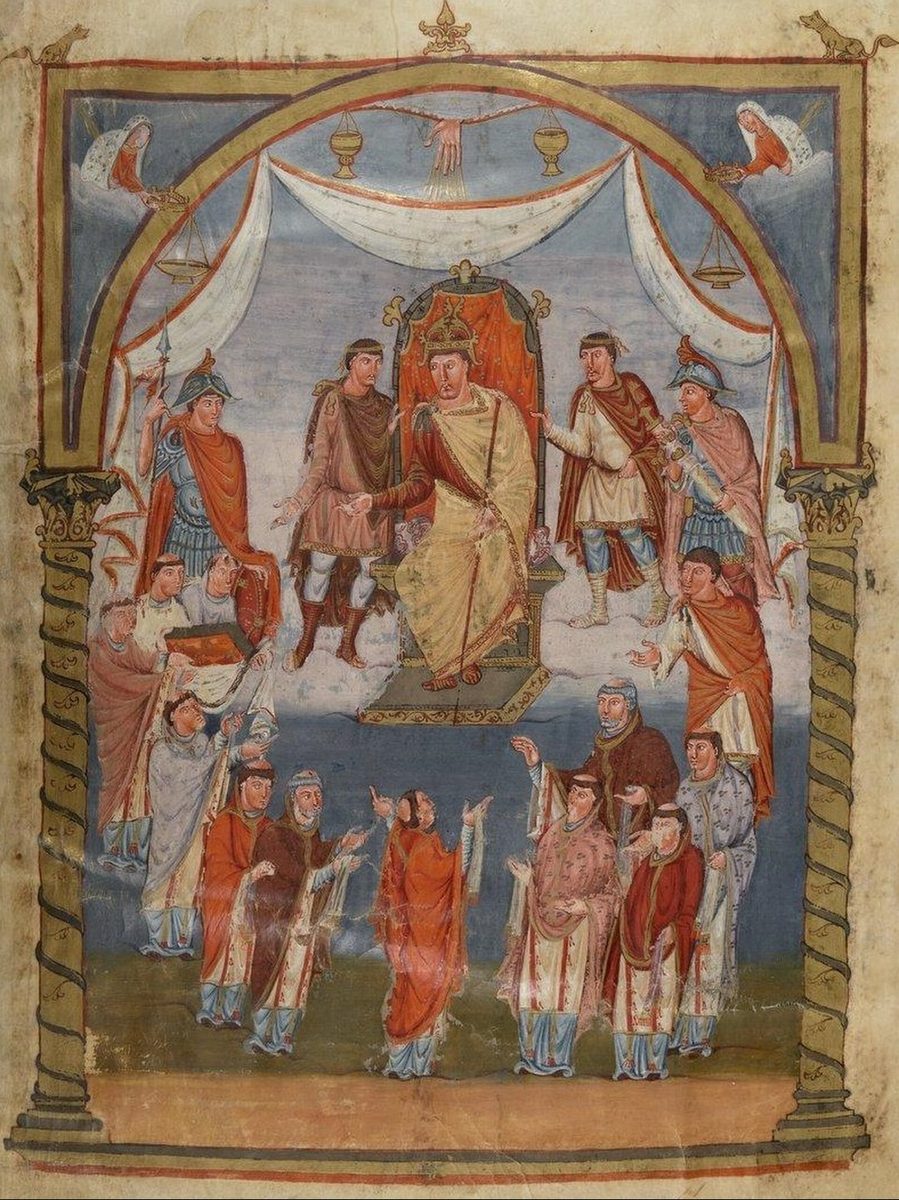
If the swords really were a Frankish product, there is a good reason the paper trail runs cold: the Franks spent most of the ninth century trying to make sure it would. A series of royal capitularies, administrative edicts issued in the names of Charlemagne and his successors, repeatedly targeted the export of weapons and armour to groups outside the kingdom. The Capitulary of Boulogne, issued in October 811 under Charlemagne, states plainly that no bishop, abbot, or abbess “is to give or sell a coat of mail or a sword to any outsider without our permission” — a clause preserved in P. D. King’s standard English edition of the Carolingian capitularies. Earlier and later edicts extended similar restrictions specifically to the Avars and Slavic peoples on the empire’s eastern frontier.
The penalties escalated over time. By 864, Charles the Bald had reissued the earlier restrictions and, according to modern scholarship on Frankish arms and armour, set the punishment for anyone caught supplying weapons to the Northmen — the Vikings raiding the kingdom’s coasts and rivers by that date — at death. That a Carolingian king felt the need to threaten execution over the arms trade, more than once and over decades, is itself evidence that the trade was real, persistent, and profitable enough that fines alone were not stopping it.
For the Ulfberht mystery specifically, these laws cut both ways. They are the strongest circumstantial argument that the swords, or at least the best of them, were Frankish products smuggled rather than legally exported. And they are the reason no bill of sale, workshop record, or merchant’s ledger has ever turned up to settle the question: a sword leaving the kingdom in violation of a capital law does not get an invoice.
Watch the full history
The video version walks through the catalogue, the metallurgy debate, and the Frankish laws in about eight minutes.

What the Ulfberht swords ultimately demonstrate is not a lost technology so much as a lost supply chain — a network of ore, charcoal, smiths, and traders precise enough to put a recognisable mark on a weapon, and secretive enough, under threat of death, to leave almost no trace of how it worked. The swords that survive are the end point of a system nobody wrote down, because writing it down was illegal.
Großenwieden is one sword out of roughly 170, tested once, by one team, with one set of answers. Most of the others are still sitting in museum drawers and grave-good displays, unsampled. Who was entitled to put that name on a blade, and whether the hardest of them really came from furnaces an ocean away, remains exactly as open as it was before the Weser gave one of them back.
Related reading
- How to Tell Real Berlin Wall Pieces From the Fakes
- How Old Is Diwali, Really? What the Written Record Actually Shows
- How Derinkuyu’s Underground City Actually Worked
- Why Is It Called a Fob? The Pocket Before the Chain
Works cited
- Wulf, Friedrich-Wilhelm. “Das ULFBERHT-Schwert aus Großenwieden, Ldkr. Hameln-Pyrmont. Archäologische Untersuchungen.” Nachrichten aus Niedersachsens Urgeschichte 84 (2015): 155–166. Link.
- Meier, Michael. “Restaurierung und Befundanalyse am Ulfberht-Schwert.” Nachrichten aus Niedersachsens Urgeschichte 84 (2015): 167–178. Link.
- Lehmann, Robert. “Archäometrische Analysen am Ulfberht-Schwert.” Nachrichten aus Niedersachsens Urgeschichte 84 (2015): 185–192. Link.
- Williams, Alan. “A Metallurgical Study of Some Viking Swords.” Gladius 29 (2009): 121–184.
- Williams, Alan. The Sword and the Crucible: A History of the Metallurgy of European Swords up to the 16th Century. Brill, 2012.
- Stalsberg, Anne. Vlfberht, The Sword Master: A Re-evaluation Based on 9th-11th Century Swords with the Signature Vlfberht on the Blade and on Contemporary Written Sources. The Edwin Mellen Press, 2017. Link.
- Astrup, Eva Elisabeth, and Irmelin Martens. “Studies of Viking Age Swords: Metallography and Archaeology.” Gladius 31 (2011): 203–206.
- Petri, Ingo. “Material and Properties of VLFBERHT Swords.” In The Sword: Form and Thought, edited by Lisa Deutscher, Mirjam Kaiser, and Sixt Wetzler. Boydell & Brewer, 2019. Link.
- Feuerbach, Ann M. Crucible Steel in Central Asia: Production, Use and Origins. PhD thesis, University of London, 2002.
- King, P. D., trans. Charlemagne: Translated Sources. Kendal, 1987. Capitulary of Boulogne (811), article 10, as hosted by De Re Militari. Link.
- Hampton, Valerie Dawn. “Viking Age Arms and Armor Originating in the Frankish Kingdom.” The Hilltop Review 4, no. 2 (2011). Link.
- “Viking ‘Ulfberht’ Sword Stars on NOVA Tonight.” BLADE Magazine, 2012.