
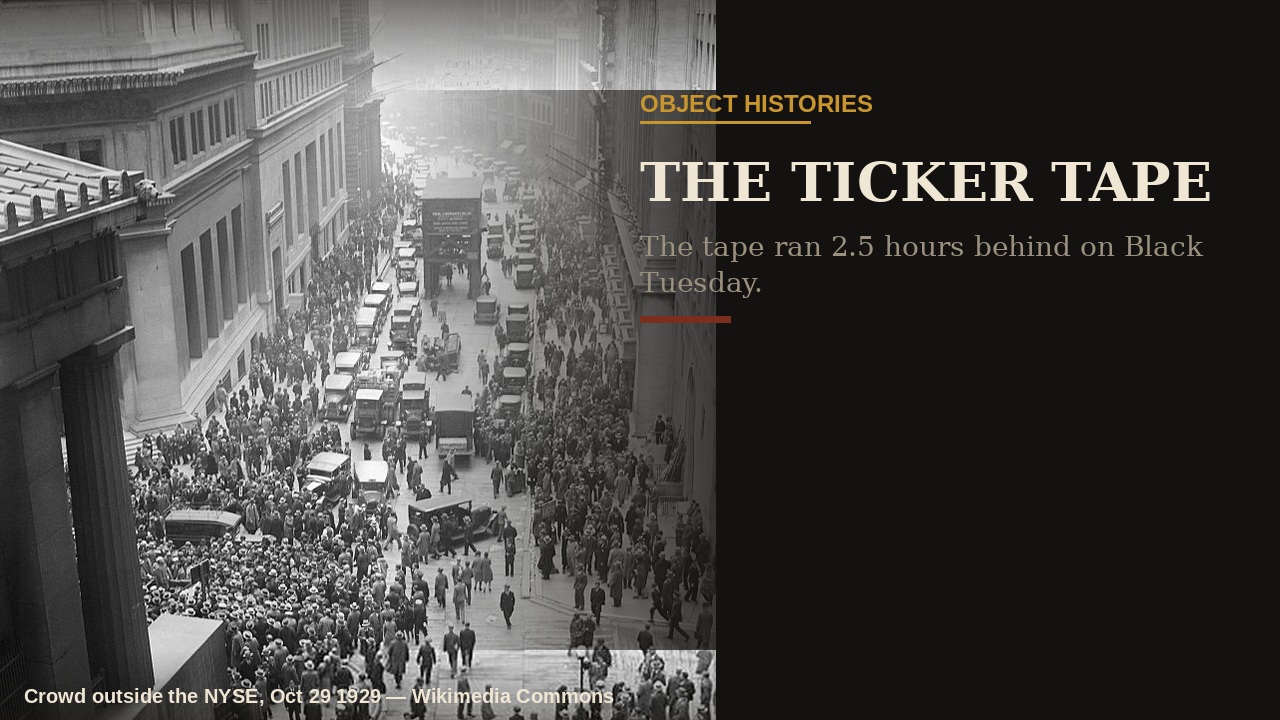
Every ticker-tape parade New York City has ever thrown started as office trash. For most of a century, the paper spooling out of a stockbroker’s desk ticker got crumpled and binned, or flung out a window onto the crowd below, the moment the trade it recorded was done. The city eventually turned that nuisance into its highest civic honor, saving real ticker tape for astronauts and kings. The machine that produced all that paper had a rougher life than the parades it accidentally invented. On the worst trading day Wall Street had ever recorded, that same machine fell so far behind the real market that men were buying and selling against prices that, by the time they read them, had already stopped being true.
That’s the other half of the ticker tape’s story — the half that doesn’t fit into six minutes of narration. The short version is the machine. The long version is everything the machine made possible once it existed: an entire industry of illegal stock-market gambling, a Supreme Court case about who gets to own a number, and — buried in the middle of the history of ticker tape parades — a 1929 crash that the ticker didn’t just report, but actively made worse.
A Telegraph Printer Solved Wall Street’s Oldest Problem
Before 1867, knowing a stock’s current price meant sending a runner to ask, which is a poor system when the price changes by the minute and the runner takes ten. Edward A. Calahan, a Western Union telegraph operator, devised a fix that year and patented it the next: a telegraph receiver that printed letters and numbers directly onto a narrow paper tape, so one operator at a central office could broadcast the same quotation to every subscribing broker’s desk at once. Western Union ran the service through its Gold and Stock Telegraph Company subsidiary, and the printer’s distinctive stutter — not a bell, not a voice, just type striking tape in rhythm — is where the name “ticker” came from.
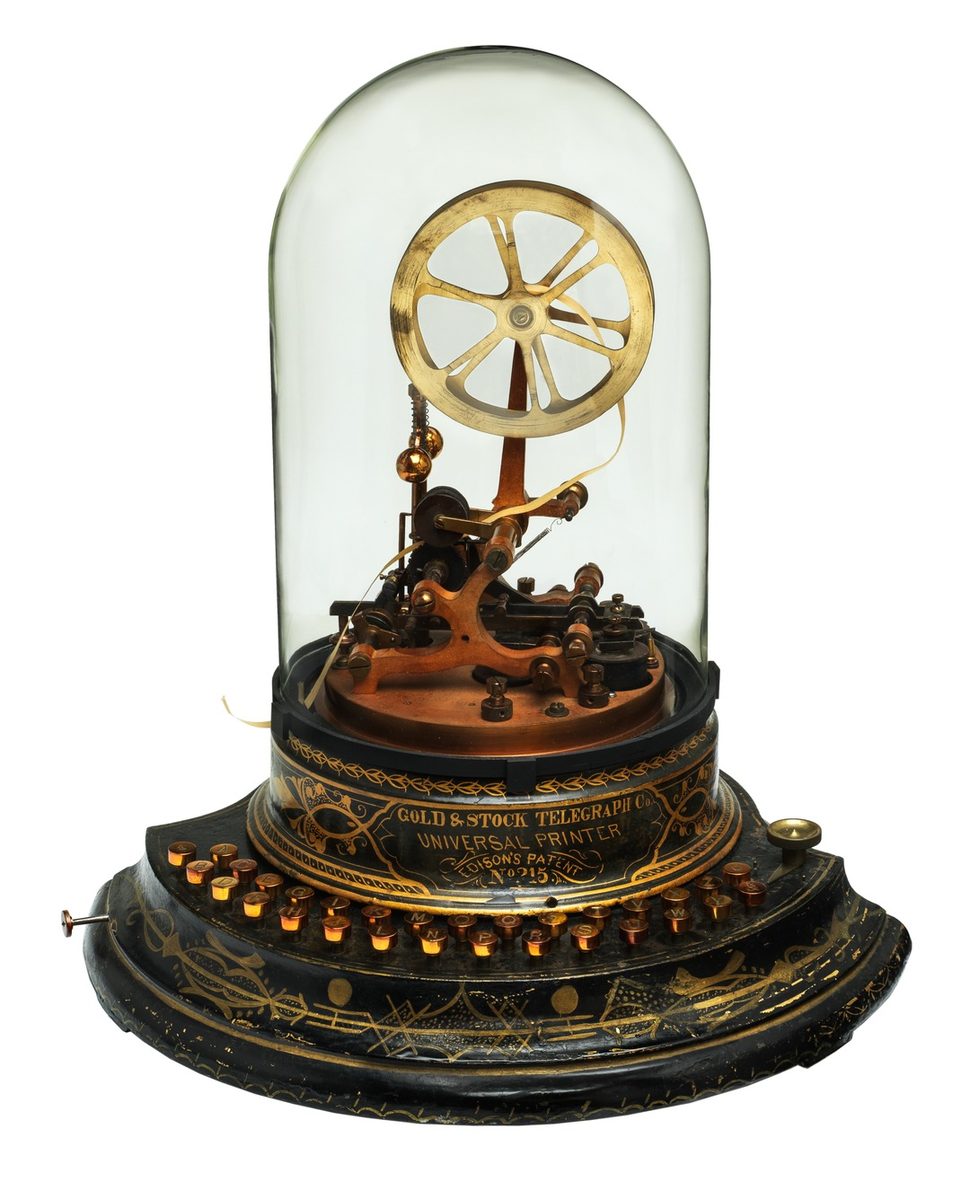
A young Thomas Edison, then working telegraph jobs around Boston and New York, spent the next few years building a better version. His improvement, the Universal Stock Printer of 1871, added a synchronizing mechanism that kept every receiver in a brokerage locked to the same character as the transmitter, so the printers stopped drifting out of alignment with each other over a trading day. It worked well enough that nearly five thousand Universal tickers sold between 1871 and 1874, the best-selling model on the market, and the proceeds are what let Edison set up an independent laboratory at Menlo Park instead of continuing to work telegraph jobs for other men’s companies. The machine that would later embarrass Wall Street had, a few years earlier, helped finance the birth of the modern research lab.
The Same Signal Built an Entire Gambling Industry
The ticker’s quotations were meant for brokers executing real trades. Almost immediately, they went somewhere else too. By around 1880, storefronts called bucket shops had opened in cities across the country, subscribing to the same ticker feed as a legitimate brokerage and letting customers bet directly on whether a stock’s price would rise or fall. No shares changed hands and no order ever reached an exchange floor — the shop simply paid out or kept the difference, the way a bookmaker runs odds on a horse it has never seen. It was, as the historian David Hochfelder documents, a way for people with a few dollars and no brokerage account to speculate on Wall Street anyway, and by the turn of the century hundreds of shops were doing exactly that. One New York firm, Haight & Freese, claimed more than ten thousand active accounts in 1902 and took wagers as small as a few dollars.
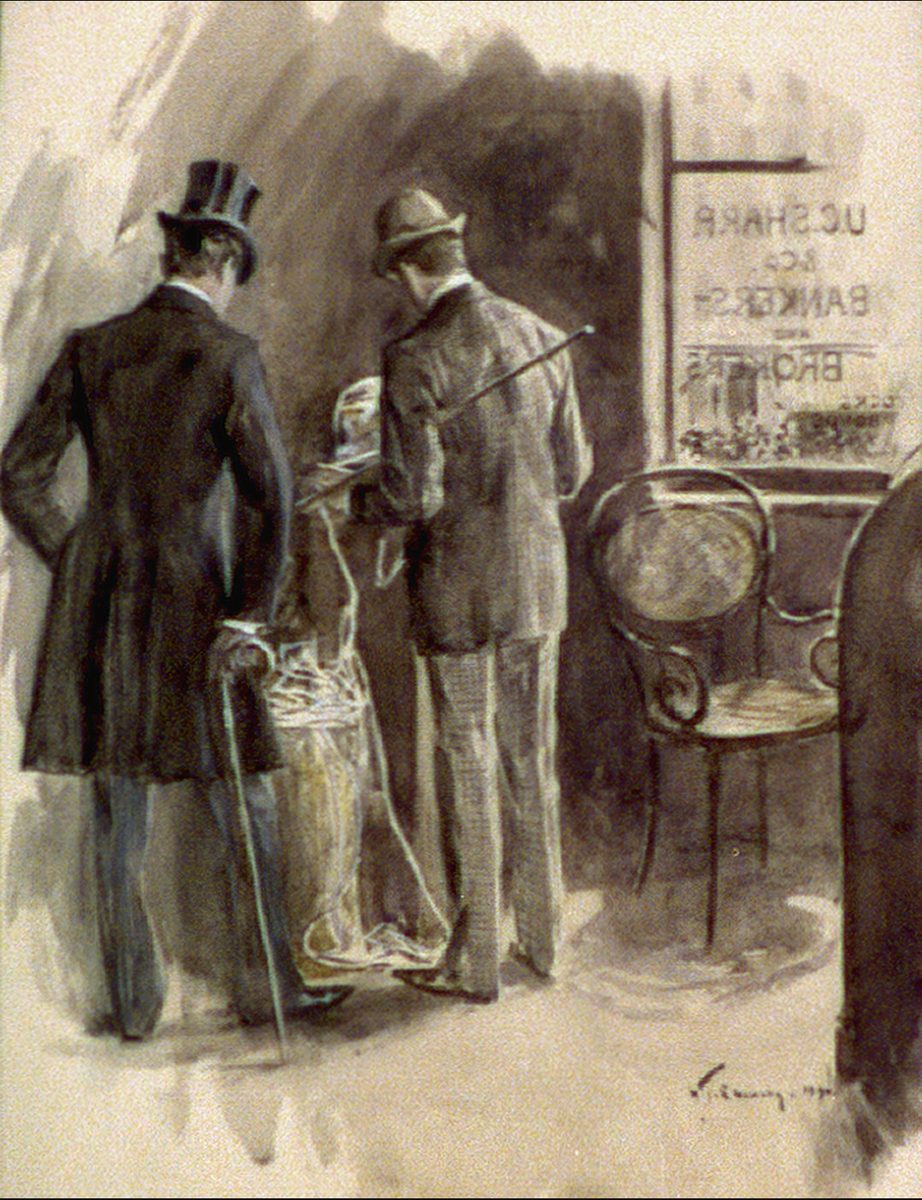
Exchanges hated bucket shops for siphoning off trading volume and, more to the point, for reselling the exchange’s own price data without paying for it. The irony is that the exchanges’ own floors did not always look very different: federal appellate judges in 1903, weighing whether the Chicago Board of Trade could cut bucket shops off from its quotations, described most of the Board’s own grain transactions as gambling in every sense that mattered. The two sides were not as far apart as either wanted to admit. What finally separated them was not virtue. It was who owned the number.
The Supreme Court Decided Who Owned a Stock Price
That question reached the Supreme Court in 1905 as Board of Trade of the City of Chicago v. Christie Grain & Stock Co. The Board collected continuous price quotations from its own trading pits, at its own expense, and distributed them through telegraph companies under contracts that barred resale to bucket shops. Christie Grain obtained the quotations anyway and argued, among other things, that because the Board already shared its prices with so many recipients, they had effectively become public information, free for anyone to use. The company also pointed out that a few centuries earlier, wooden tally sticks had served England’s own treasury as a record-keeping system with no such claim to secrecy attached.
Justice Oliver Wendell Holmes, writing for the majority, disagreed with Christie Grain. The quotations, he held, were the Board’s property in the same sense a trade secret is property: the Board had paid to generate them, and distributing them under confidential contract to approved subscribers did not forfeit its right to control who got them next. It did not matter, Holmes added, that some of the Board’s own trading looked like gambling — information does not stop being property because of what it describes, any more than a city’s crime statistics stop being the city’s data because they describe crimes. The ruling let exchanges cut bucket shops off from the one thing they needed to operate. Without a live feed there was nothing to bet on, and the shops that had defined popular stock speculation for a generation were mostly gone within a decade.
On the Worst Trading Day on Record, the Machine Could Not Keep Up
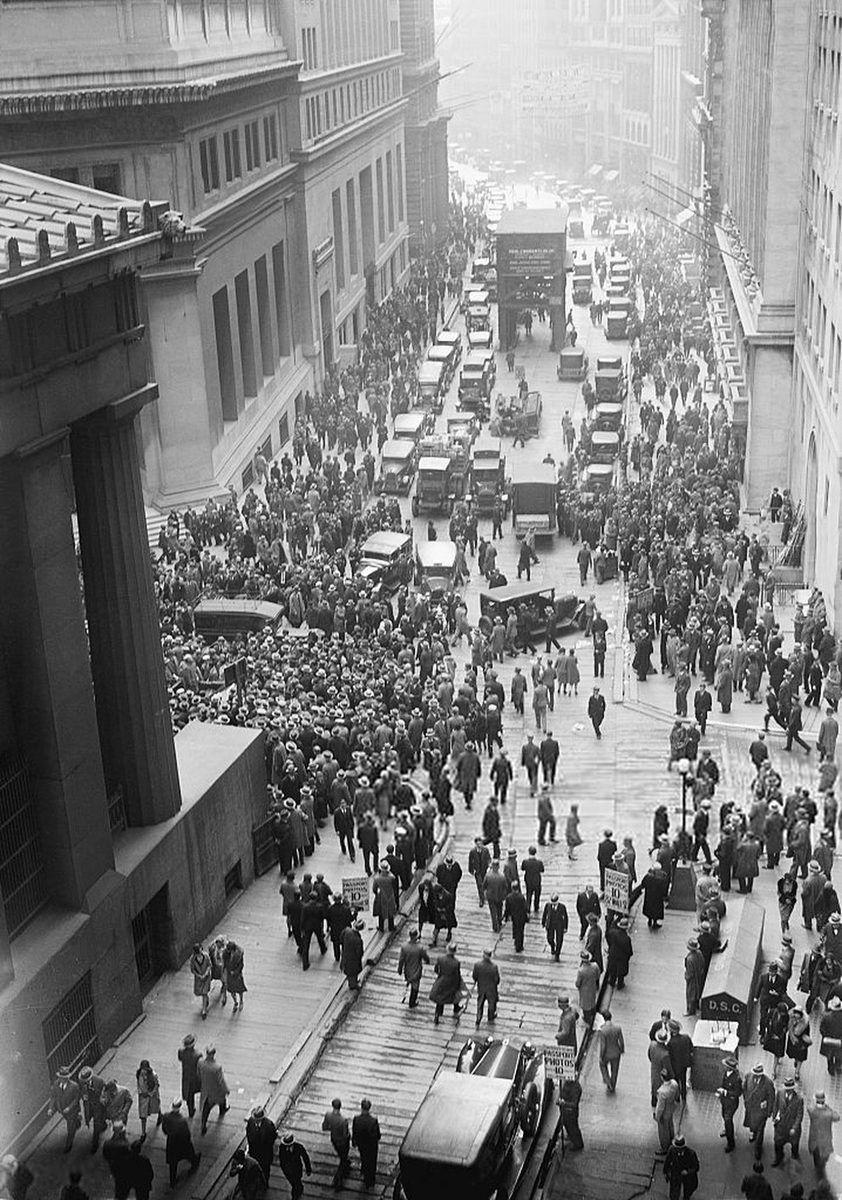
By 1929 the ticker had survived six decades of booms, panics, and steady mechanical improvement — a faster, self-winding model had appeared around 1900 specifically to handle rising volume. None of it prepared the machine for the last week of October. On Thursday the 24th, a record 12,894,650 shares traded; the financial editor of the Pittsburgh Press reported tickers running more than three hours behind, and the historian Thomas Fleming has written that machines did not finish printing that day’s business until 7:08 that evening, nearly four hours after the closing bell. The following Monday, the lag at the 3 p.m. close was clocked at 167 minutes.
Tuesday the 29th — Black Tuesday — is the day the crash is remembered by, and it was worse again: 16,410,030 shares sold by the closing gong, more than three million shares above Thursday’s fresh record, by John Kenneth Galbraith’s count in The Great Crash, 1929, with the ticker running 152 minutes late by the time it finally caught up, according to a University of Washington retrospective on the crash’s surviving ticker tape. The exact lag differs session to session depending on which account you read and which hour it describes, but none of them disagree on the direction: every trading day that week, the gap between the real market and the printed one grew wider than the day before.
Not Knowing Was the Real Panic
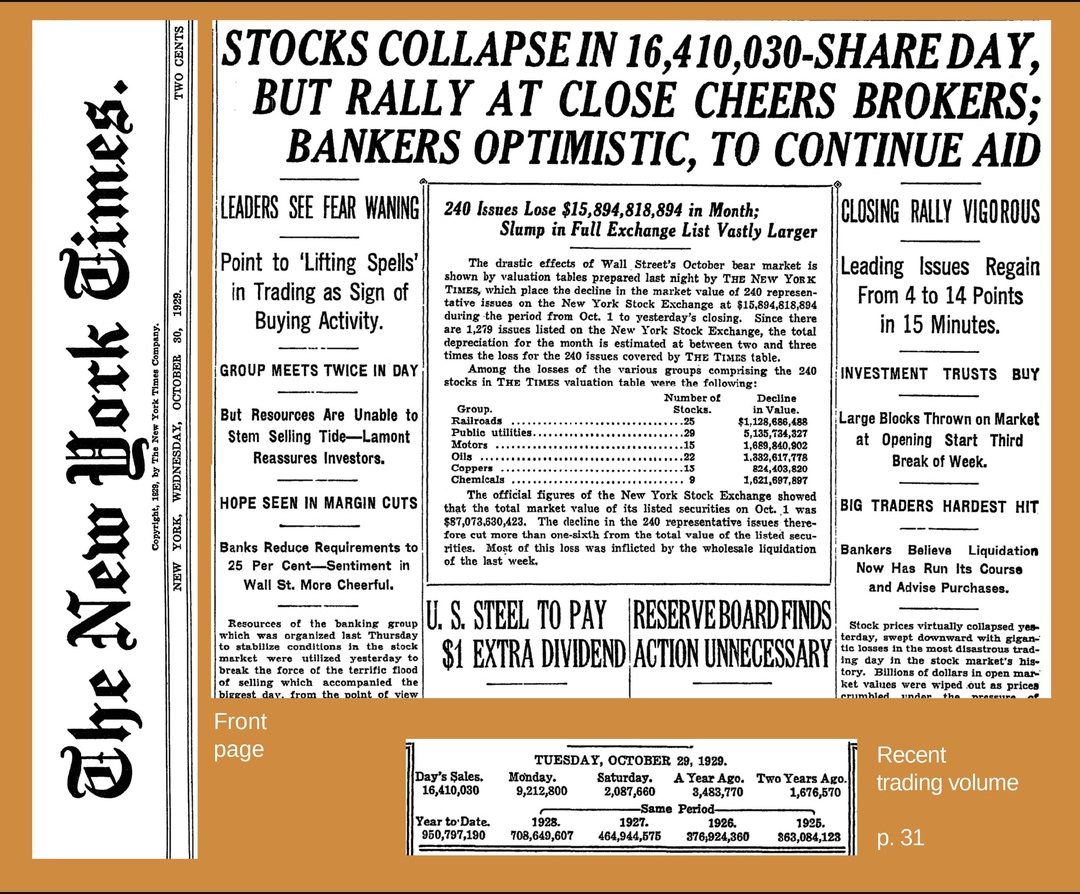
A late ticker is not simply old news — it is actively misleading, because a trader reading it has no way to tell how old it is. Fleming’s account notes that the standard ticker abbreviated a quotation to its last digit only, so a reader watching “Radio” scroll past had no way of knowing, from the tape alone, whether the stock had printed at 66, 56, or 46 a few minutes — or a couple of hours — earlier. The separate bond ticker, running its own quotations, was by some accounts printing floor prices ten to twenty points below what the stock ticker showed for the same securities, so two machines sitting a few feet apart were telling two different stories about how bad the day actually was.
The effect, Fleming wrote, was that men on the floor and in brokers’ offices across the country were being reminded, hour by hour, that they “could be wiped out without even knowing it.” A pool of major bankers organized out of J.P. Morgan & Co. had tried to stop the slide on Black Thursday by buying stock in full public view on the floor, the same tactic that had calmed the Panic of 1907. It bought a day of calm and little more. By Tuesday the pool’s own purchases could not find sellers willing to stop at any price, and the ticker — the one instrument every trader on the floor was relying on to tell them where the bottom was — was by then reporting a market that no longer existed.
Where the History of Ticker Tape Parades Actually Begins
The machine’s other legacy started decades earlier and far more cheerfully. In 1886, with lower Manhattan packed for the dedication of the Statue of Liberty — whose original torch turned out to be a chronically disappointing lighthouse — somebody in a Wall Street office had the idea of adding the day’s spent ticker tape to the paper already falling from building windows. It worked well enough to repeat. A parade for Admiral George Dewey in 1899 was the first to honor a single person rather than an event, and by the time Charles Lindbergh came home from Paris in 1927, a ticker-tape parade up Broadway had become the city’s default way of saying congratulations.
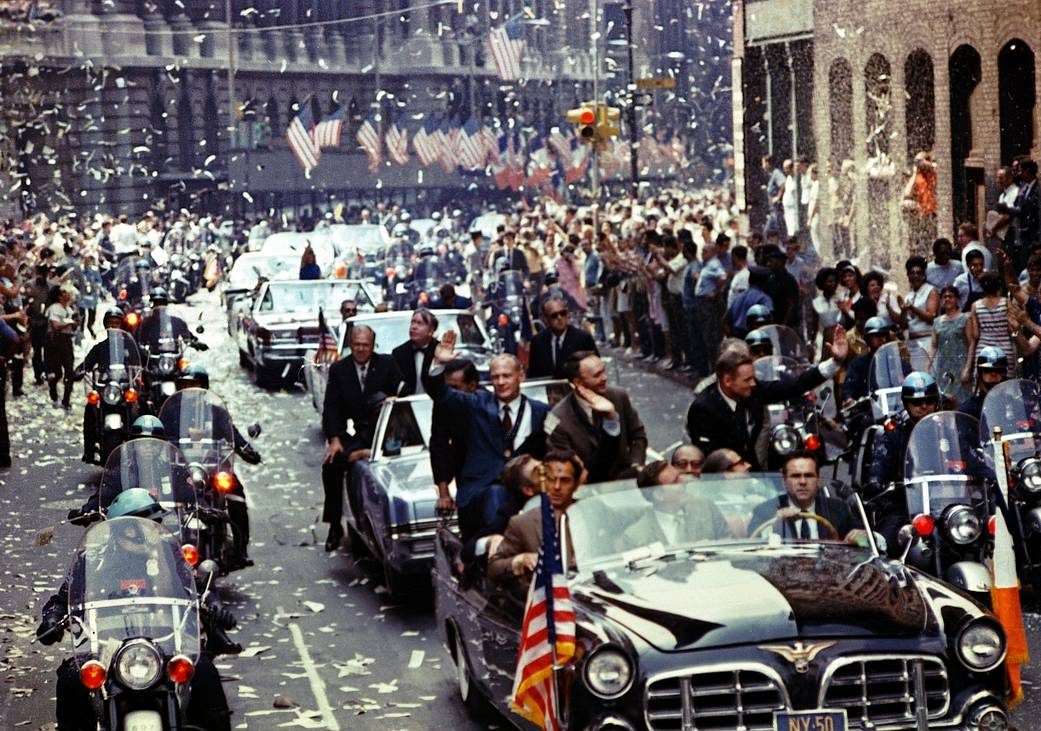
By the mid-twentieth century the honor had become almost routine — New York held roughly 130 ticker-tape parades between 1945 and 1965 alone, enough that downtown businesses complained about the disruption and incoming mayor John Lindsay said in 1966 that he intended to replace most of them with smaller, more tailored receptions. Then Apollo 11 came home. The parade for its astronauts on August 13, 1969, ran the full route from Bowling Green up Broadway to City Hall, cheered by thousands — and by the city’s own account, almost none of what fell on the motorcade was real ticker tape at all. Mechanical tickers were already being retired for electronic displays, so the city trucked in confetti and shredded paper for building tenants to throw instead. The tradition had outlived the machine that started it, and nobody watching from the sidewalk could tell the difference.
That is the real shape of the ticker’s afterlife. The device itself stopped being manufactured around 1960 and was functionally gone from trading floors within another decade, replaced by the electronic quote displays still in use today. The parades kept going without it — much like one small Washington town kept using its own emergency currency years after the crisis that created it had passed — because by then the paper had stopped being data and started being a symbol of data — which is, in its own way, a tidier ending than anything that happened to the machine on Black Tuesday. Wall Street’s ticker never did catch up to the market that day in 1929. The city it served just kept throwing its paper anyway.
Watch the full history
The six decades above compress into about five minutes on video: the 1867 invention, the sixty-plus years it ran Wall Street without much drama, and the one week in 1929 when it couldn’t.

Related reading
- Tenino’s Wooden Money: Inside the Depression’s Strangest Currency — what one small town did when the same Depression emptied its banks
- The Statue of Liberty’s Torch Was Once a Legal Lighthouse — the 1886 dedication day that gave New York its first ticker-tape parade
- Who Really Invented the Telegraph Key (It Wasn’t Samuel Morse) — the telegraph technology the ticker was built on top of
- How Wooden Tally Sticks Ran England’s Treasury for 600 Years — an older financial record-keeping system with its own property fights
- Inside the Pneumatic Tube Networks That Once Ran a City’s Mail — another real-time urban information network that outlived its own usefulness
Works cited
- Hochfelder, David. The Telegraph in America, 1832–1920. Johns Hopkins University Press, 2012.
- Galbraith, John Kenneth. The Great Crash, 1929. Houghton Mifflin, 1955.
- Fleming, Thomas. “Good-bye To Everything!” American Heritage, vol. 16, no. 5, August 1965. Link.
- Board of Trade of the City of Chicago v. Christie Grain & Stock Co., 198 U.S. 236 (1905). U.S. Reports, U.S. Government Publishing Office. Link.
- “Universal Stock Ticker, 1872.” Collections, The Henry Ford. Link.
- “Stock Ticker.” Engineering and Technology History Wiki (ETHW), IEEE. Link.
- “Ticker Tape Parades.” Inside Adams (blog), Library of Congress, November 2022. Link.
- “The Apollo 11 Ticker Tape Parade: August 13, 1969.” NYC Municipal Archives, NYC Department of Records & Information Services. Link.
- “Documents that Changed the World: Delayed Stock Market Ticker Tape, 1929.” University of Washington Information School, May 2017. Link.