
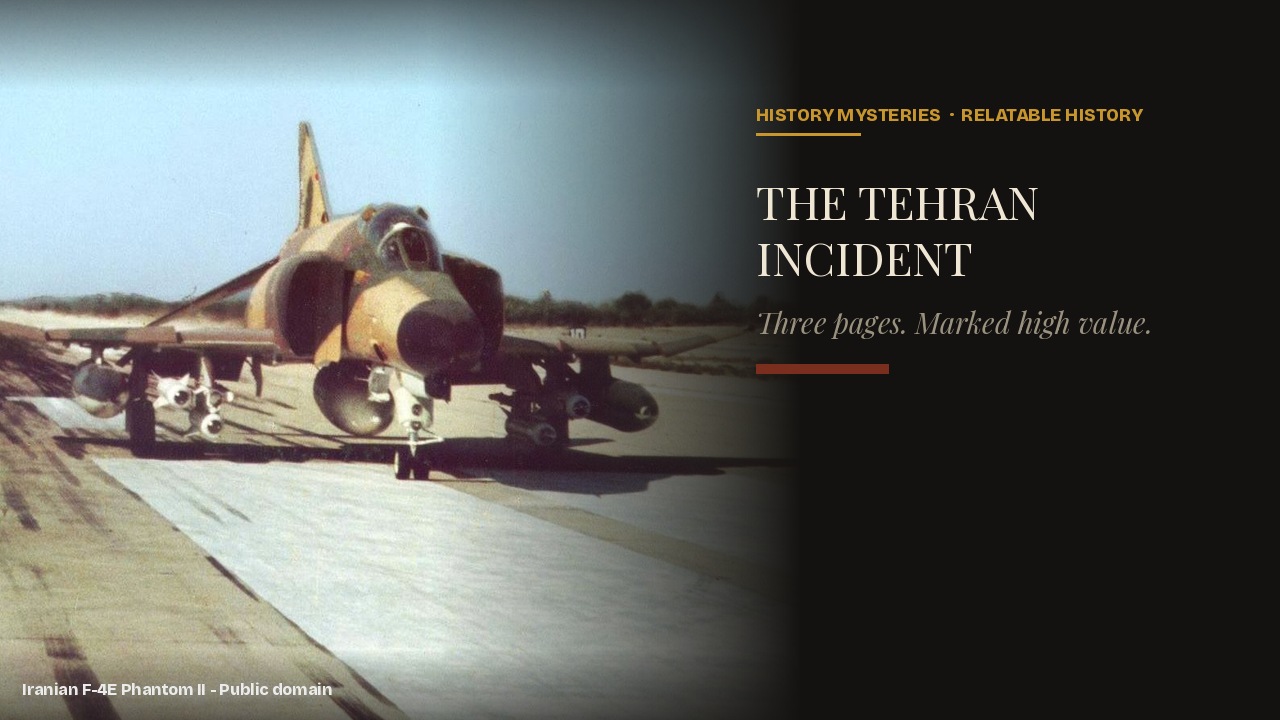
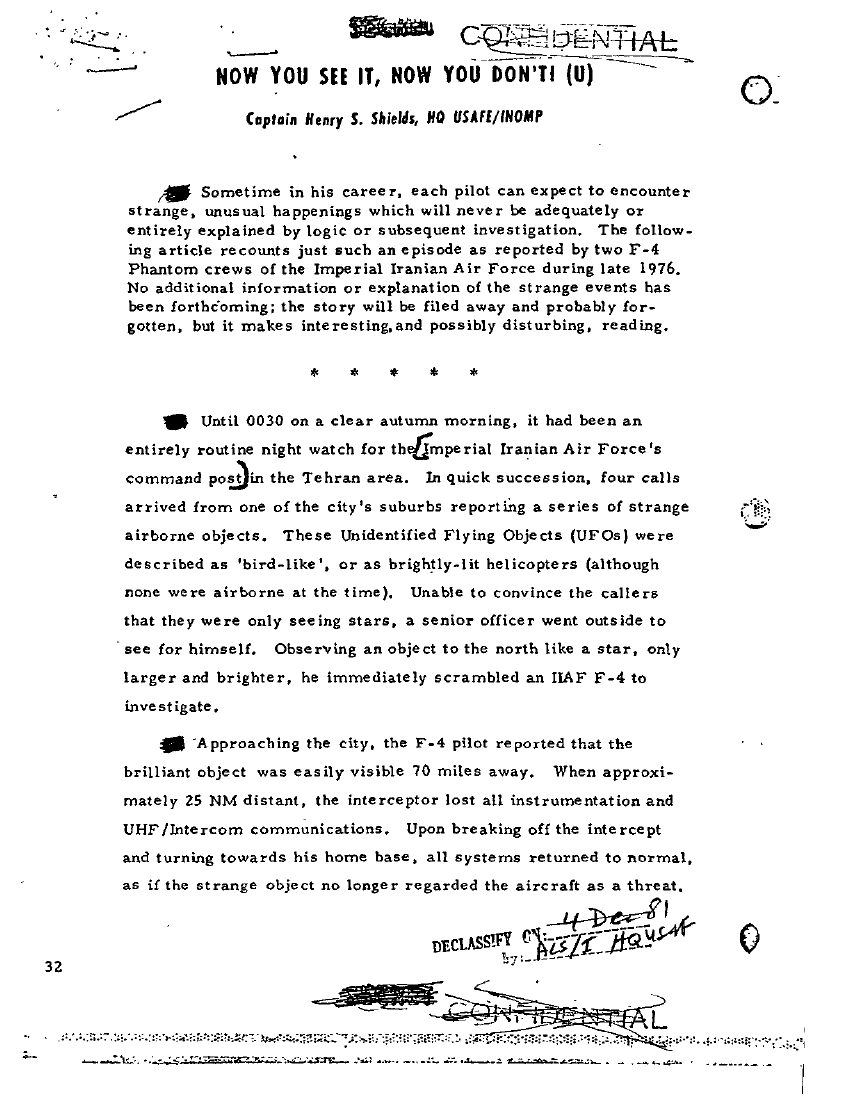
The Tehran incident of 1976 is not famous because of what was seen. It is famous because of what survived: a three-page US government message report, a routing slip, and an intelligence analyst’s evaluation form with a verdict typed into the comment box. All of it was released under the Freedom of Information Act in August 1977, and all of it still sits in public reading rooms today, including the National Security Agency’s own FOIA archive. You can read every word without taking a position on what was in the sky.
That paper trail is the actual subject of this article. Most accounts of the night retell the sighting and stop. Fewer look closely at the document itself, at what an intelligence evaluation form is actually for, or at the maintenance records that turned up once skeptics went looking for them. Those details change what the case can honestly be said to show.
The case has carried the label “best documented UFO sighting in history” for decades, and the label is usually left to do all the work on its own. Documented is doing something specific there: it means a government paper trail exists and can be checked, not that the paper trail reaches a conclusion. Those are different claims, and this article is mostly about the gap between them.
Four phone calls from one hillside turned into a military intercept
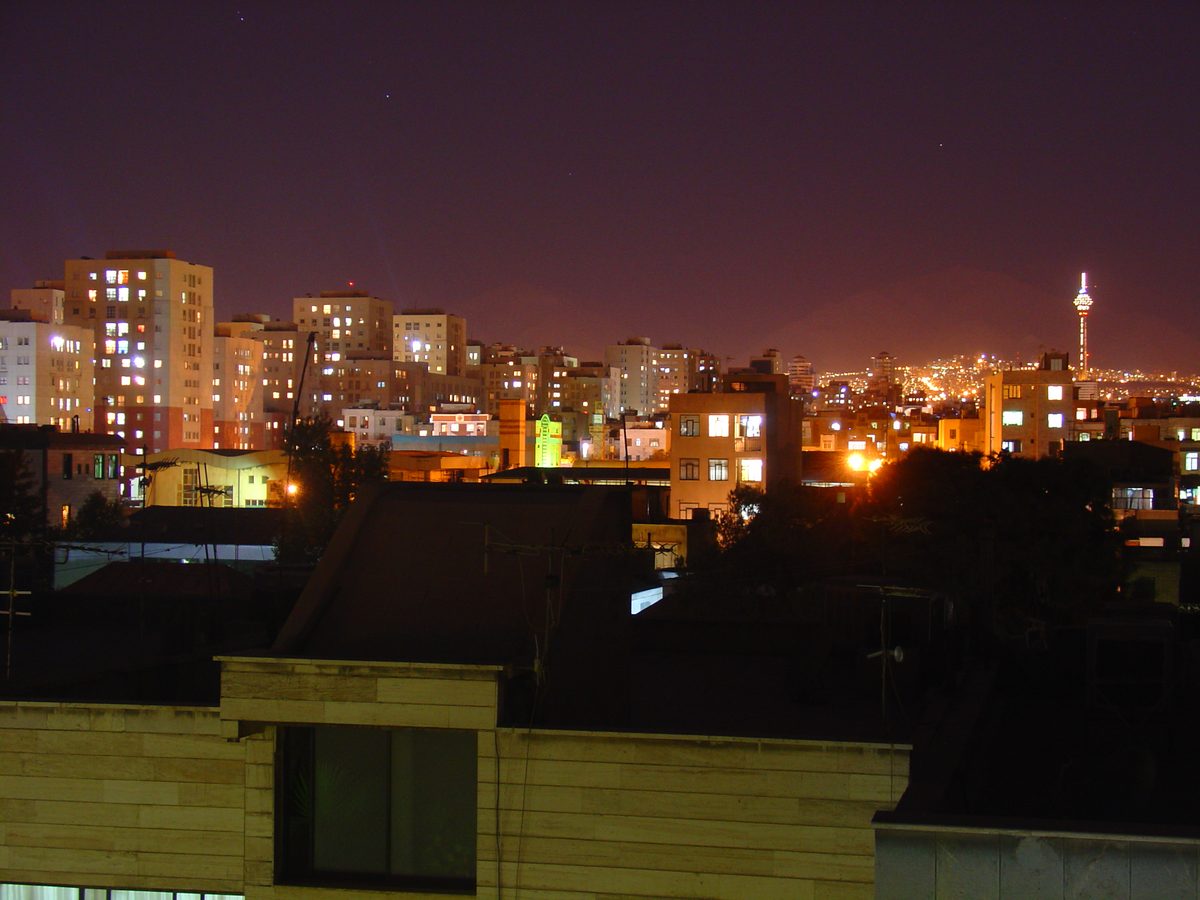
Just after midnight on 19 September 1976, residents of Shemiran, in the hills on Tehran’s northern edge, began telephoning the control tower at Mehrabad Airport. At least four separate calls reported a bright object overhead. The tower controller took the calls, then stepped outside to look for himself. He did not describe a star or a planet. He reported something rectangular, with a large light at each end and a smaller red light circling its middle.
The report went up the chain to the Imperial Iranian Air Force command post. The general who took the call walked onto his own balcony, saw the object himself, and ordered an intercept. That one decision is why this night left a paper trail at all. A light reported by a few civilians is a rumor. A light that a general puts his name behind, and scrambles fighters against, becomes an official event with a file number.
The first Phantom lost its instruments; the second lost its weapons at the moment it tried to fire
Around 1:30 a.m., an F-4 Phantom lifted off from Shahrokhi Air Base at Hamadan, roughly two hundred miles west of the capital. Closing to about twenty-five nautical miles, the crew reported losing their flight instruments, their UHF radio and their intercom, all at once. The pilot broke off the approach. As the distance from the object opened back up, every system came back on its own.
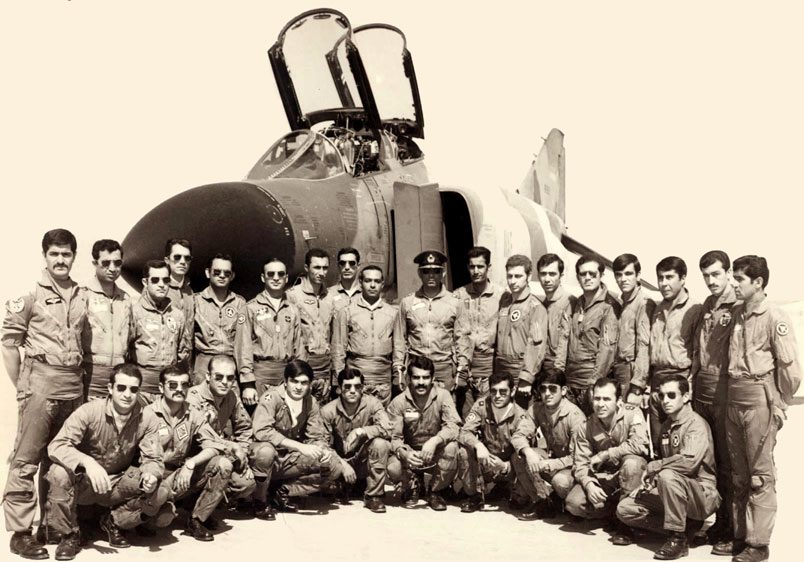
A second Phantom launched roughly ten minutes later, flown by squadron commander Parviz Jafari. His crew got a solid radar lock at twenty-seven nautical miles, twelve o’clock high, closing at a hundred and fifty knots; the return on the scope, they said, was the size of a tanker aircraft. At about twenty-five miles the object began holding a constant distance ahead of them, no matter what speed they flew. Then the lights changed: an intense, rapid sequence of blue, green, red and orange, bright enough to erase whatever shape was behind them. A smaller light detached from the object and came straight at the fighter. Jafari reached to fire an AIM-9 Sidewinder, and in that instant his weapons control panel and his radio both went dead. He threw the aircraft into a diving turn. The smaller light turned inside him and rejoined the larger one.
At sunrise the search party found an empty lake bed
The object then descended, apparently settling on the ground and giving off enough light to illuminate two or three kilometers of desert. Jafari’s crew dropped from twenty-five thousand feet to fifteen thousand trying to pin down the position, and reported the glare was bright enough to cost them their night vision. A civilian airliner in the area separately reported a communications failure at the same time.
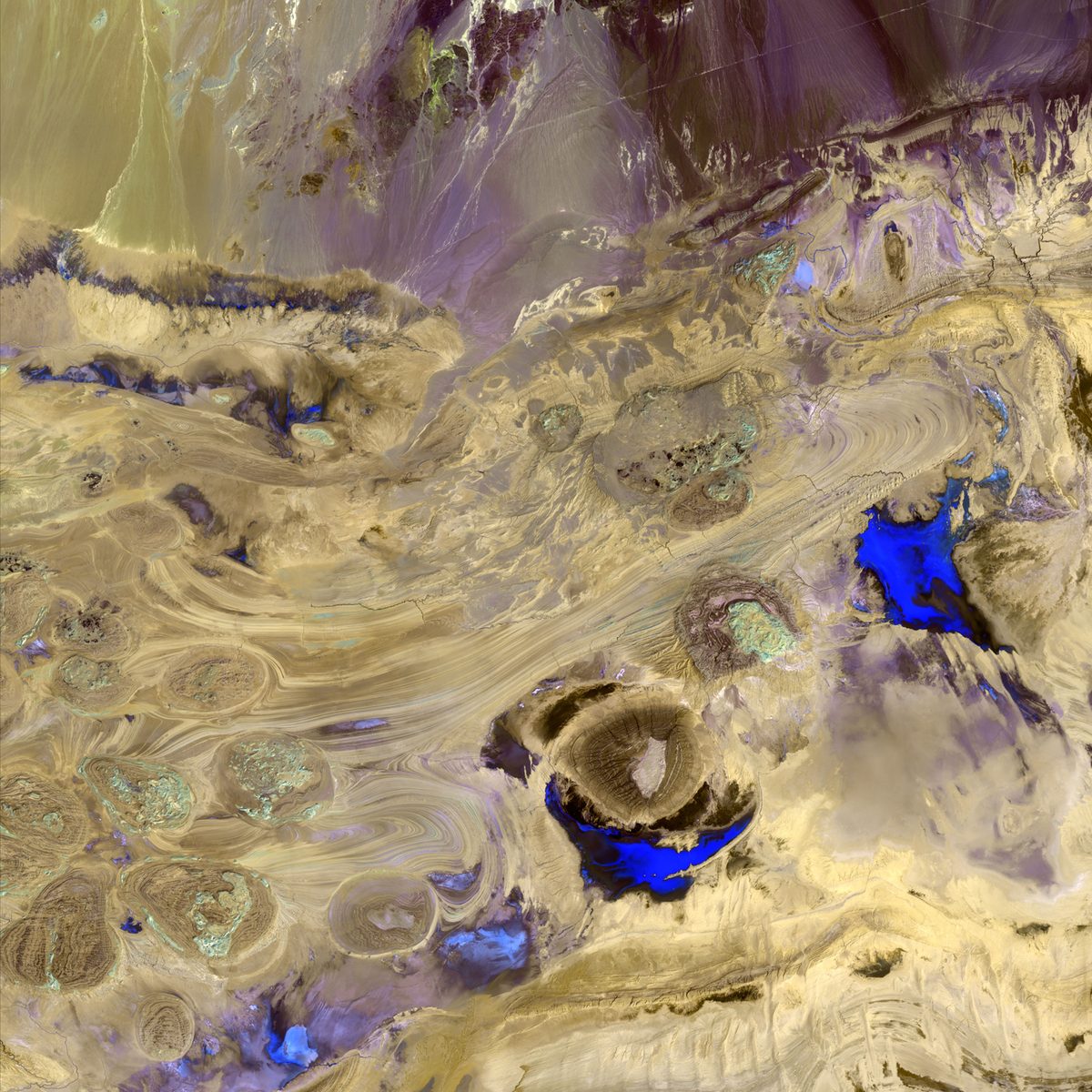
A helicopter went back to the site at daylight. The crew found a dry lake bed in the Dasht-e Kavir and nothing on it. Nearby, they picked up a steady beeping signal, which a memo from an American officer later attributed to a beacon shaken loose from a transport aircraft crossing the mountains. A house at the foot of the slope reported a loud noise and a bright flash the previous night. A radiation survey of the area was arranged. Its results, if any were ever filed, have not surfaced.
An intelligence evaluation form says something narrower than most retellings claim
Within hours, the US Defense Attaché office in Tehran wrote the night up as a message report and sent it out. The distribution list reads like a government directory: the Secretary of State, the Central Intelligence Agency, the White House, the service chiefs, the Defense Intelligence Agency, and a string of American and European commands. That was not special treatment. Iran was a close American ally flying American aircraft on the Soviet Union’s southern border, and in 1976 anything unusual in its airspace went to that same distribution list as a matter of routine.
Attached to the report is a standard intelligence evaluation form, and someone filled it in. Reliability of the information: confirmed by other sources. Value of the information: high, described as unique, timely and of major significance. In the comment box: an outstanding report, a classic that meets the criteria for a valid study of the phenomenon. The form lists those criteria — multiple witnesses in different places, credible observers including a general and trained aircrews, a visual sighting confirmed on radar, apparent electromagnetic effects on three aircraft, and what it calls an inordinate amount of maneuverability.
Read slowly, that form is not a conclusion that something unexplained flew over Tehran. It is a judgment about the quality of a report — that the account was well sourced, internally consistent and worth studying further. An analyst praising a report’s reliability is not an agency confirming a craft. That distinction is the whole difference between this case and the ones that rest on nothing but a retelling.
Two years later, the Air Force filed its own account under ‘interference,’ not ‘contact’
In 1978, Captain Henry S. Shields published an account of the night in the US Air Force’s own newsletter on electronic jamming and interference, under the deadpan title “Now You See It, Now You Don’t.” The filing category matters as much as the content. The Air Force’s internal system did not log Tehran as a contact event. It logged it as a case study in instruments failing under unexplained electronic conditions — a subtly different claim, and the one the service was actually willing to put its name on.
Jupiter, a meteor shower, and a Phantom with a known electrical fault
The skeptical case was built mainly by Philip Klass, who argued that the steady light the civilians and the tower controller first saw was simply the planet Jupiter, unusually low and bright that week. It is the explanation that best accounts for the one detail no exotic theory handles well: that no aircraft, at any speed, ever closed the distance on it. Several minor meteor showers were also active on 19 September, which researchers have suggested could explain the brief, fast-moving lights reported separately from the main object.
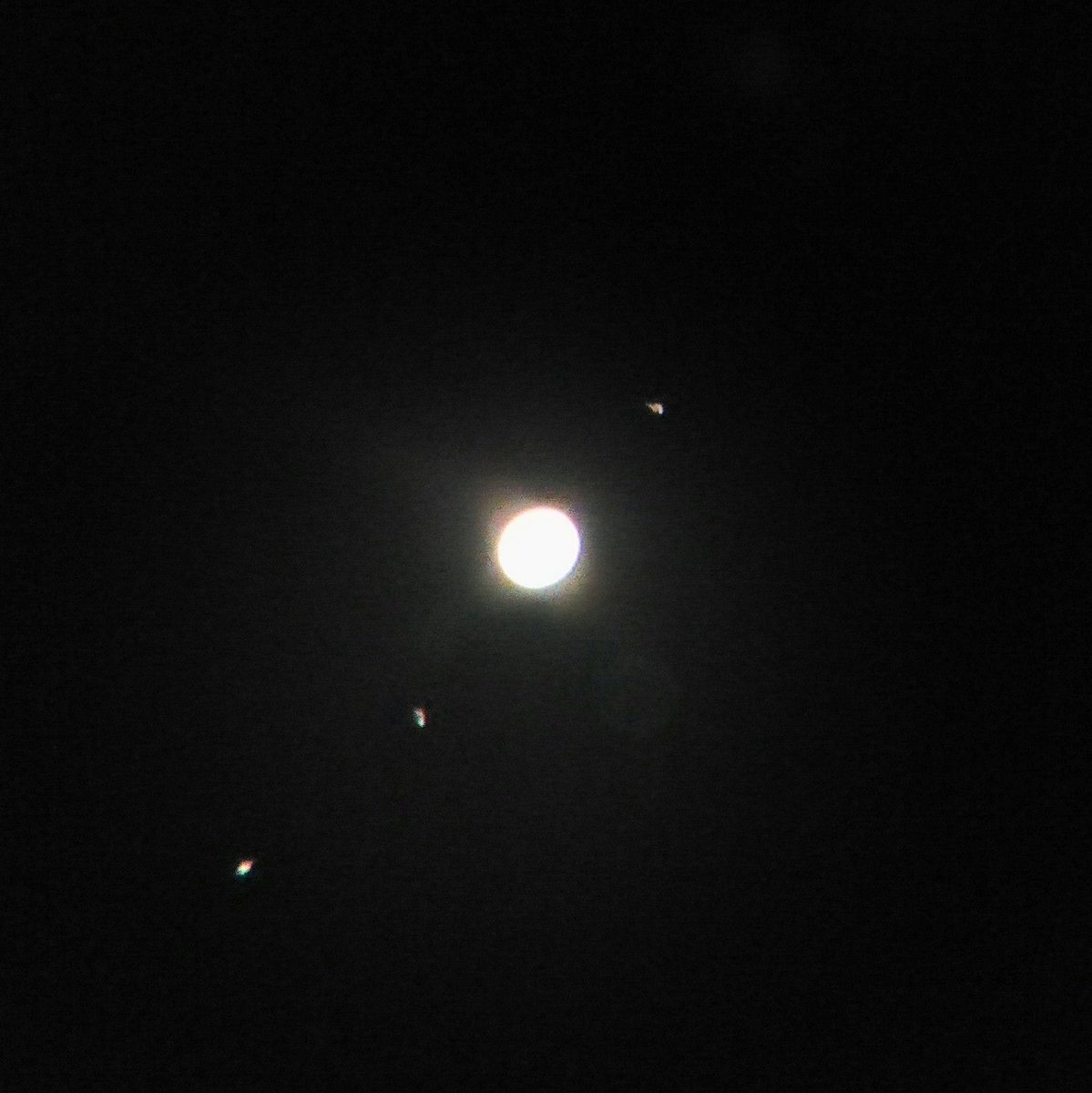
Klass went further and pulled maintenance records on the two Phantoms. According to technicians interviewed afterward, only Jafari’s aircraft, not the first Phantom, had any history of electrical trouble that night, and that airframe had a documented, unresolved pattern of intermittent electrical outages the Iranian air force had never managed to fix. A radar technician was called in to service that same aircraft’s set about a month later, and separately suggested its weapons officer could have slipped into manual radar tracking mode without realizing it — a mode that will hold a return on the scope that is not actually there. Both technicians described the home base at Shahrokhi as notorious for poor maintenance and worse record-keeping.
Not every researcher who has looked at the file reads it as fully closed. The philosopher of science Martin Bridgstock, surveying the case in a 2009 study of paranormal claims, treats Klass’s maintenance findings as a serious and probably correct explanation for the instrument failures, while noting that they do not, by themselves, account for every detail two separate aircrews independently reported on radar and by eye. That is a narrower disagreement than it sounds — nobody serious argues the case proves an exotic craft — but it is a real one, between an explanation that resolves the paperwork and one that resolves the whole night.
What the file still doesn’t answer
No radar tape, no gun-camera film and no photograph from the night was ever released. The radiation survey results are not in the file. Iran’s own air force investigation was reported to run to an inch and a half of paper, and it never became public — the government that held it fell within three years. And there was no American investigation to pick the case up at the time, because Project Blue Book, the US Air Force’s UFO study, had already been shut down in 1969. The cable went out, an analyst praised it, and the office that might once have followed up no longer existed.
Jafari himself spoke about the night publicly decades later, describing it to an international panel of pilots and officials that the Coalition for Freedom of Information convened in Washington in November 2007. His account there matched the declassified file: the glare that nearly blinded him on approach, and the instrument, radio and weapons failures at the exact moments they mattered most.
The case keeps resurfacing for exactly that reason. Whenever a new unexplained light over Tehran makes the news, outlets reach back for the 1976 file because it is the rare example in this genre with an actual record to reach for, rather than a retelling of a retelling. That is a low bar, but it is the bar this case clears and most others in its category do not.
None of that adds up to proof of anything exotic. It also does not collapse into a simple mistake. What the file actually documents, read on its own terms, is a well-corroborated report whose most dramatic details — the instrument failures — line up suspiciously well with one aircraft’s known maintenance history, while its most basic feature, a light nobody could ever catch up to, lines up with the sky itself. Both things can be true of the same night.
Watch the full history
The video version walks through both intercepts in sequence and reads directly from the evaluation form, in about eight minutes.

Related reading
- The Robertson Panel UFO Report, Explained — the other half of this story: how the US government graded incoming UFO reports for credibility, decades before Tehran’s own evaluation form did the same.
- How Project Blue Book Investigated UFO Reports — the US investigative body that had already been shut down by 1976, which is exactly why no one followed up on Tehran.
- The Nimitz Tic Tac Encounter: What the Official Record Actually Says — a modern military intercept with the same pattern of credible witnesses and instrument anomalies, decades later.
- What the Records Actually Show About the Shag Harbour UFO — another case whose reputation rests on an official record rather than retellings.
Works cited
- U.S. Defense Attaché Office, Tehran. Message report on the sighting of an unidentified flying object near Tehran, 19 September 1976, with attached intelligence evaluation form. Declassified under the Freedom of Information Act, released August 1977. National Security Agency, FOIA Reading Room: UFO Documents.
- Shields, Capt. Henry S. “Now You See It, Now You Don’t.” MIJI Quarterly (Meaconing, Intrusion, Jamming and Interference newsletter), U.S. Air Force, 1978. National Security Agency, FOIA Reading Room: UFO Documents.
- Klass, Philip J. UFOs: The Public Deceived. Prometheus Books, 1983.
- Bridgstock, Martin. Beyond Belief: Skepticism, Science and the Paranormal. Cambridge University Press, 2009, p. 125ff.
- Kean, Leslie. UFOs: Generals, Pilots, and Government Officials Go on the Record. Harmony Books, 2010, pp. 63–64.
- Dunning, Brian. “The Tehran 1976 UFO.” Skeptoid, episode 315, 19 June 2012. Link.
- Lekhi, Raunaq. “Mystery Lights Over Tehran Revive Memories of Iran’s 1976 UFO Encounter.” ThePrint, 22 September 2026. Link.