
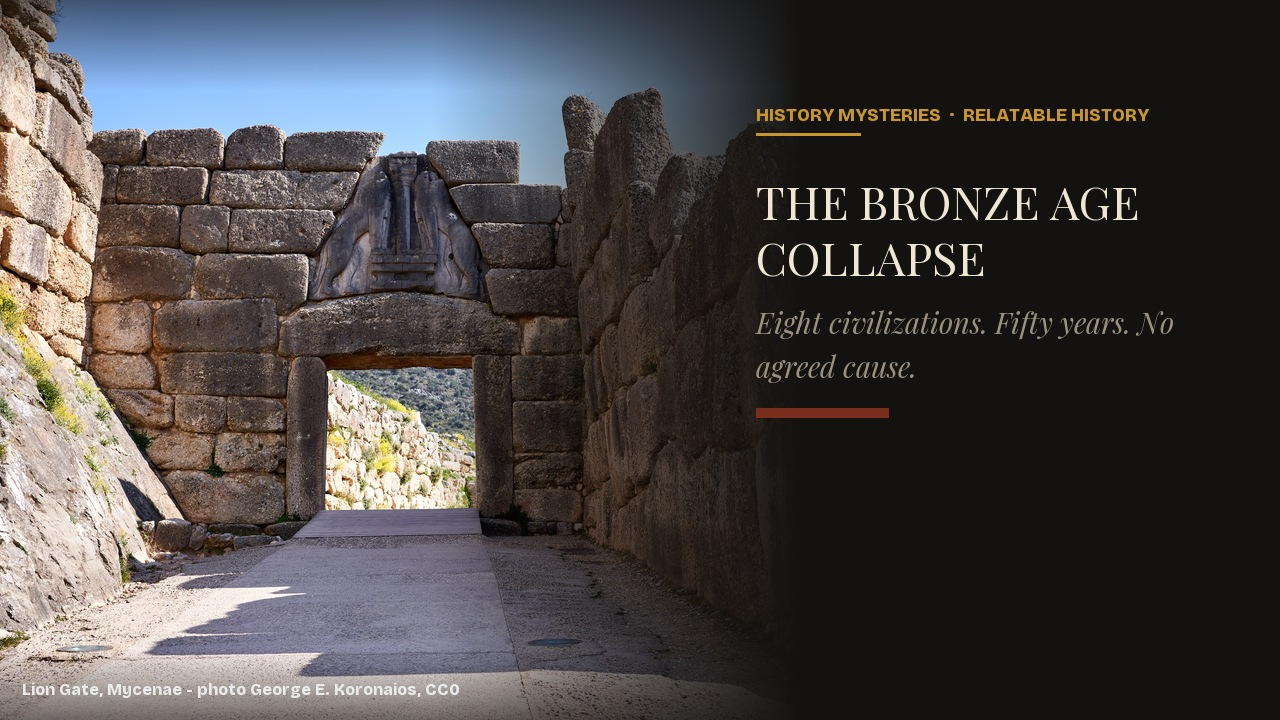
What caused the Bronze Age collapse is one of archaeology’s longest-running arguments, and the reason is not a shortage of evidence. At its peak, the Late Bronze Age eastern Mediterranean supported roughly eight major powers trading and corresponding as equals: Egypt, the Hittite Empire, Assyria, Babylon, Mycenaean Greece, Cyprus and the port kingdoms of the Levantine coast. Kings addressed one another as brothers in cuneiform letters written on clay. A single trading vessel could carry cargo from seven different cultures at once. It is, by most measures, the first genuinely international system in recorded history.
Within roughly fifty years on either side of 1200 BC, most of that system stopped existing. It remains one of archaeology’s most argued questions, because the thing that ended was not one kingdom but nearly the entire network at once. Palaces burned. A capital city was abandoned. An entire writing system dropped out of use for four centuries. And the specific combination of causes is still disputed, not because the evidence is thin, but because there is now enough of it to support several answers that all look partly right.
This is not a case of a lost civilization with no records. It is closer to the opposite problem: a flood of documents, inscriptions and archaeological strata, pointing in at least four directions at once.
For roughly a century, five powers ran a single interlocking trade machine
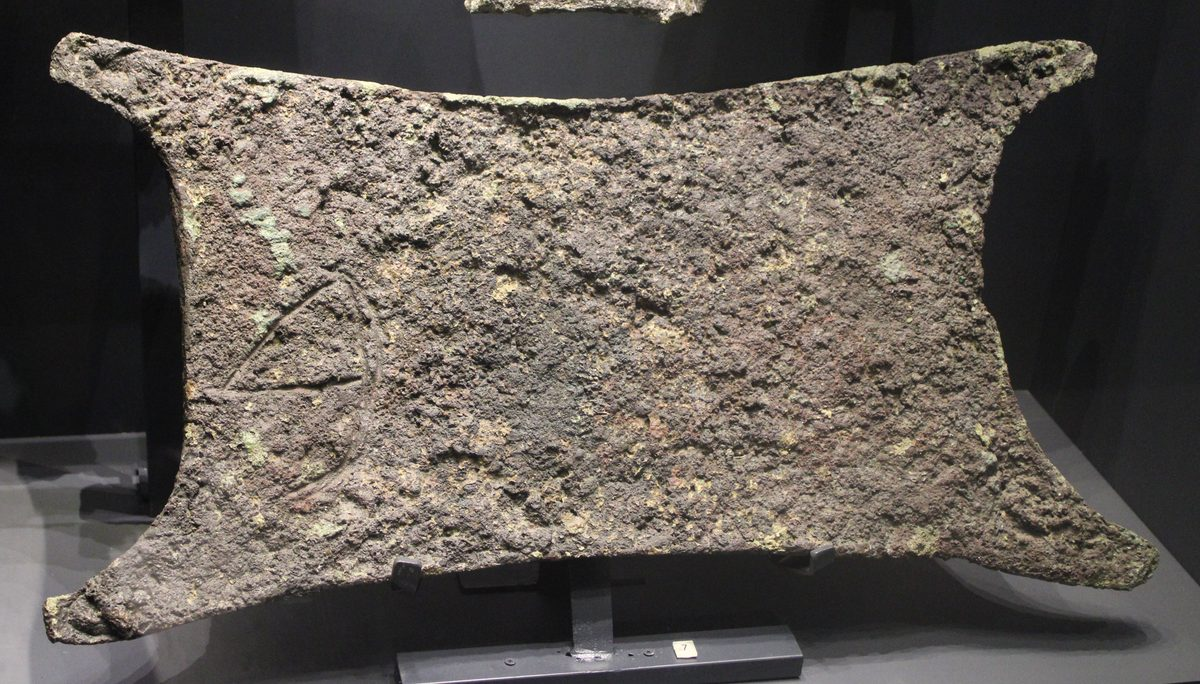
Bronze requires copper and tin in a ratio of about ten to one, and almost nowhere in the eastern Mediterranean had both. Cyprus supplied copper in industrial quantities; usable tin sources sat much further away, in Anatolia and possibly as far as Afghanistan or Cornwall, depending on the route reconstructed from a given cargo. That mismatch forced every bronze-using state into the same network, whether or not its rulers particularly liked one another.
The clearest single artefact of that network is a shipwreck. In 1982, a sponge diver off Uluburun, on the southern Turkish coast, found what he described as metal biscuits with ears. They were oxhide-shaped copper ingots, and the wreck beneath him, excavated by the Institute of Nautical Archaeology over eleven seasons, turned out to be carrying roughly ten metric tons of Cypriot copper and about a metric ton of tin — plus glass ingots, elephant tusks, ostrich eggshells, and Canaanite, Egyptian, Mycenaean and Kassite Babylonian goods packed into a single hull. One ship, sailing around 1300 BC, was already a miniature model of the entire trading system.
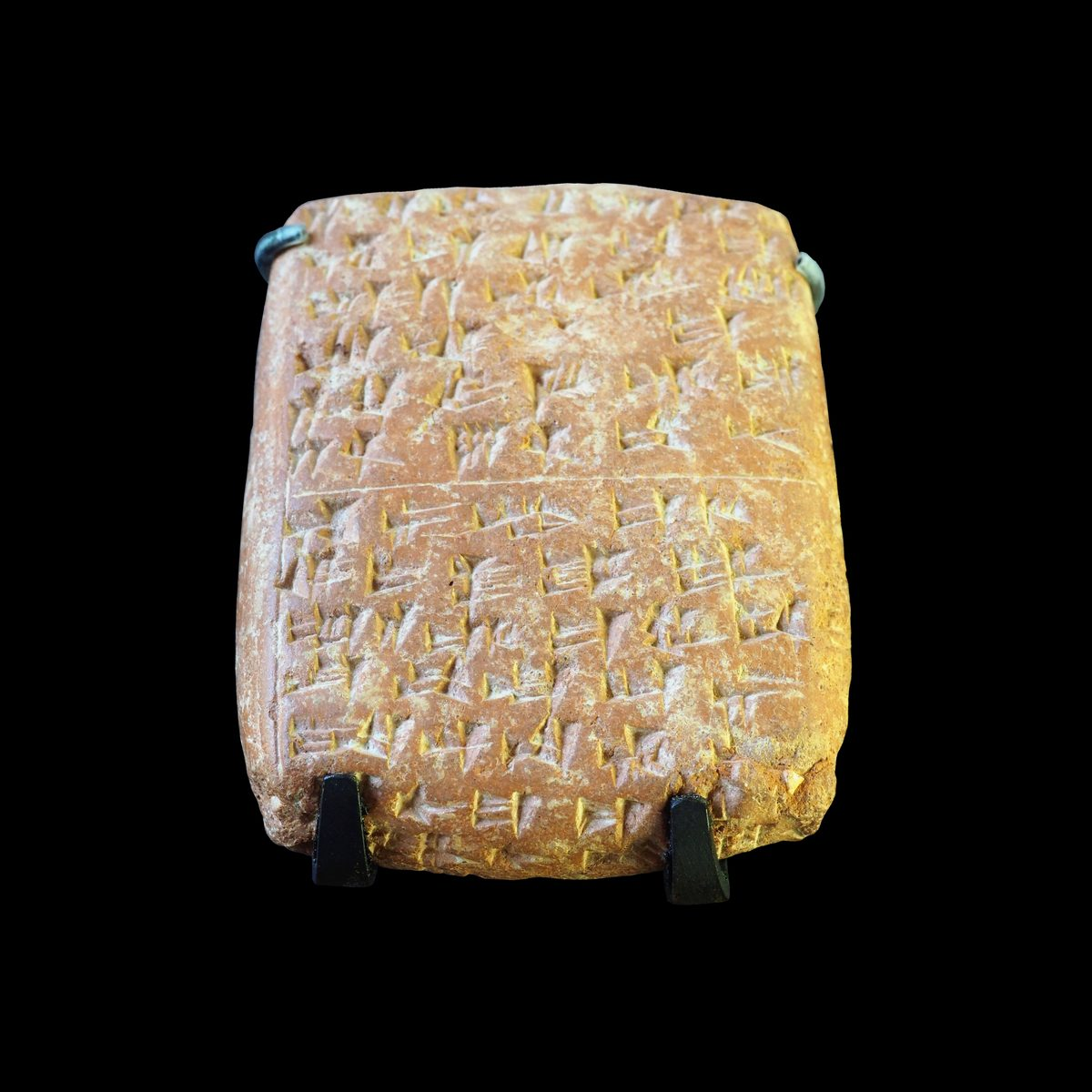
Diplomacy ran on the same logic as the metal did. The Amarna letters, a cache of clay correspondence found at the Egyptian royal city of Akhetaten, show the kings of Egypt, Babylon, Assyria and the Hittites writing to each other as equals, negotiating royal marriages, gold shipments and trade grievances in the same diplomatic language used across the whole region. No single kingdom in this system could opt out of it without losing access to bronze, and none of them did — until, within about two generations, most of them stopped being able to.
Then, in about fifty years, most of it burned, emptied, or both
The archaeological pattern is not subtle. The Hittite capital of Hattusa, in central Anatolia, was emptied and burned. Its last documented king, Suppiluliuma II, simply stops appearing in the record. Across the Aegean, the Mycenaean palaces at Pylos, Tiryns and Mycenae itself were destroyed. Ugarit, a wealthy port on the Syrian coast, was destroyed around 1190 BC and never rebuilt. Researchers cataloguing the region have counted several dozen cities destroyed, abandoned or reduced in this same narrow window.
Because Ugarit was never reoccupied, its final archive stayed exactly where it fell, and the fire that killed the city baked its clay tablets into durable ceramic rather than destroying them. One of the last letters is a reply from Ugarit’s king, Ammurapi, to the king of Cyprus, who had written asking whether enemy ships had been sighted. Ammurapi’s answer describes his fleet away in Lycian waters, his army committed to the Hittites, and seven enemy ships already burning his towns. It reads like an explanation for why help will not be arriving, and no reply to it survives.
Not everything ended in fire, and not everywhere ended at the same time. Egypt, Assyria and Babylon all survived the collapse, diminished and in Egypt’s case territorially reduced, but intact as states. Some Levantine port cities that avoided destruction went on to become the Phoenician trading centres of the following centuries. The Bronze Age collapse thinned the network rather than erasing every node on it — which is part of why a single cause has been so hard to settle on.
The oldest explanation for what caused the Bronze Age collapse names an army nobody can identify
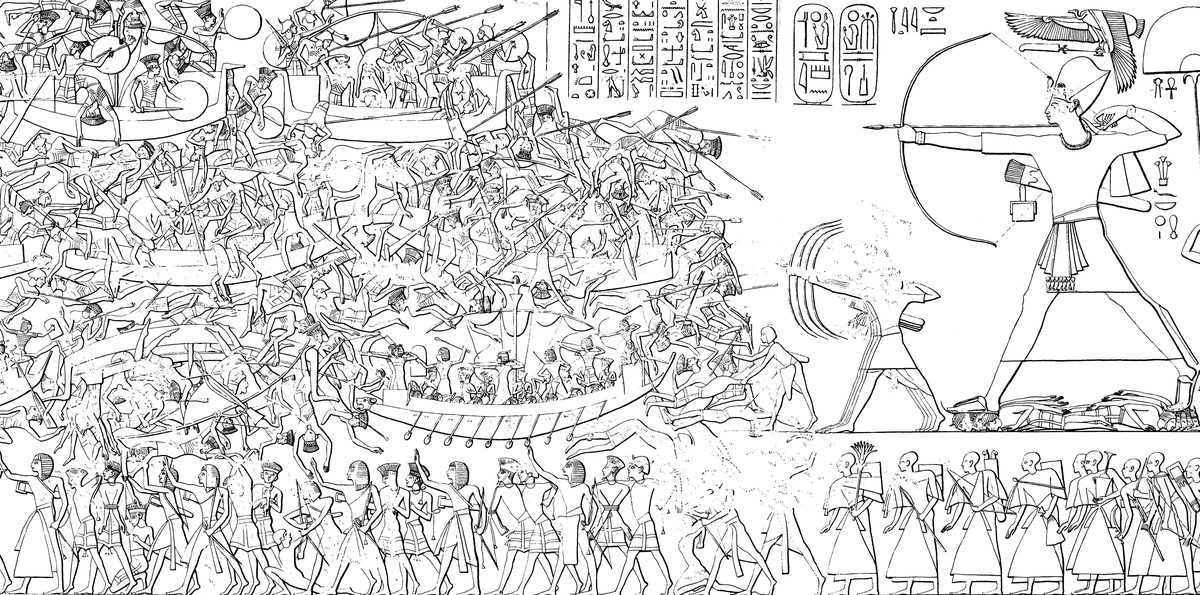
The earliest written source for an invasion is Egyptian. An inscription from the reign of Merneptah, around 1207 BC, describes a coalition of foreign groups attacking the Nile Delta alongside Libyan forces, and names several of them: the Ekwesh, Sherden, Lukka, Teresh and Shekelesh. A generation later, the mortuary temple of Ramesses III at Medinet Habu describes and depicts a larger battle, in his Year 8, in which a coalition arrived by land and sea with wagons, women and children, apparently intending to settle rather than simply raid. Ramesses claims to have destroyed them in the Nile Delta, in reliefs that record what modern historians call the Battle of the Delta.
Nineteenth-century Egyptologists grouped these named raiders under a single label, the Sea Peoples, and the label stuck so thoroughly that it now sounds like an established ethnic group rather than a modern shorthand for a loose and disputed list of names. None of the individual groups has a secure, agreed identification: Sherden are sometimes linked to Sardinia, Ekwesh to the Achaean Greeks, Lukka to western Anatolia, and scholars disagree on all three. The inscriptions describing them are also royal victory propaganda, carved to celebrate Ramesses, not neutral reporting — which means the one written source closest to the events is also the hardest one to take at face value.
Three centuries of drought is the newer, harder-to-dismiss case
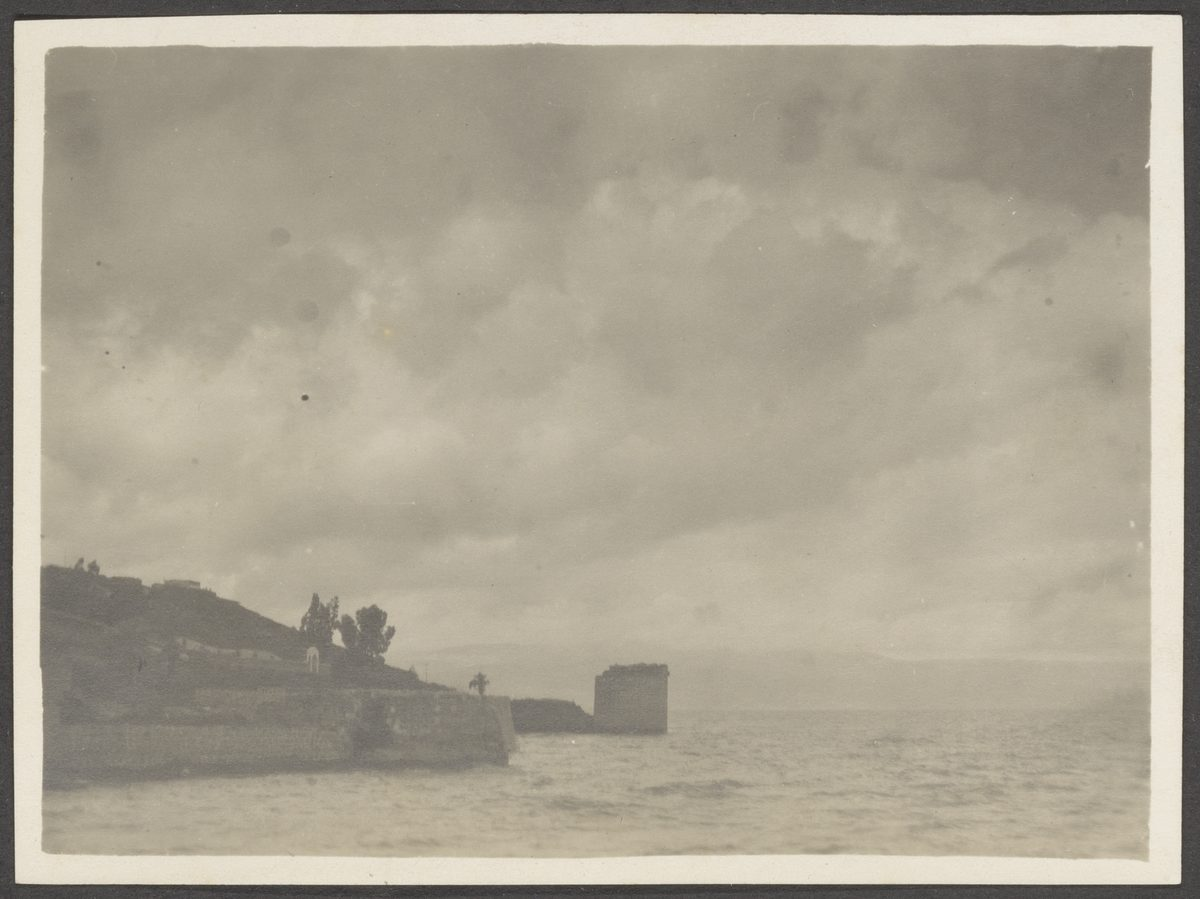
The evidence that has shifted the argument furthest in the last fifteen years is not textual at all. In 2013, a team led by David Kaniewski analysed pollen grains from sediment cores drilled beneath the Sea of Galilee, sampled at roughly forty-year intervals across the Bronze and Iron Ages. Across the interval from about 1250 to 1100 BC, water-demanding tree pollen drops sharply while drought-tolerant species such as olive increase — the driest and longest such stretch in the entire sequence, sitting squarely across the collapse. Parallel evidence from Cyprus and Anatolian lake cores points the same direction.
A separate, more recent line of evidence reinforces the timing specifically for the Hittites. Tree-ring analysis of preserved wood from Gordion, on the empire’s western edge, published in 2023, shows the surrounding forests under unusually severe stress for three consecutive years, 1198 to 1196 BC — right at the point the Hittite state was unravelling. Excavated grain stores at Hattusa and the Hittite site of Sapinuwa were found empty, and surviving letters have Hittite kings requesting emergency grain shipments from Egypt and the Levant, in terms one royal correspondent described as a matter of life and death.
Drought does not, on its own, explain a burned city or a vanished writing system. What it explains is famine, and famine explains why a state already straining under trade disruption and raiding might not have the reserves, or the loyal population, to survive either one.
Earthquakes, and a change in how armies fought, complicate the picture further
A third strand of evidence is geological. In 2000, the geophysicist Amos Nur and the historian Eric Cline proposed that the region experienced an earthquake storm between roughly 1225 and 1175 BC — a sequence in which a major quake on one fault triggers others nearby over months or years, a documented pattern in the twentieth-century seismic record for the same region. Mapping the twentieth-century quake sequence against the cities destroyed in the Bronze Age collapse produced a striking overlap, and at several sites — including Sapinuwa, in Hittite territory, where floors and walls show visible rippling from seismic shock — there is no accompanying evidence of human attackers at all.
A fourth argument is military rather than environmental. The historian Robert Drews argued in 1993 that a shift in battlefield technology, from small numbers of chariots to larger infantry forces using cheap bronze weapons and the new, slashing Naue II sword, let raiding bands overwhelm fortified cities that had been built and garrisoned to withstand chariot warfare. On this argument the Sea Peoples were less a single invading nation than a symptom: any state whose army had not adapted was suddenly vulnerable to forces that had.
None of these four explanations — invasion, drought, earthquakes, military obsolescence — individually accounts for every destroyed site, and the leading synthesis, laid out by Eric Cline in 1177 B.C.: The Year Civilization Collapsed, argues that none of them has to. Cline’s case is that this was a systems collapse: a network so specialised and interdependent that drought, raiding, earthquakes and a few years of bad harvests could compound each other faster than any bureaucracy of the period could respond, each failure making the next one harder to survive.
Even Hattusa’s ending turns out to be less violent than assumed
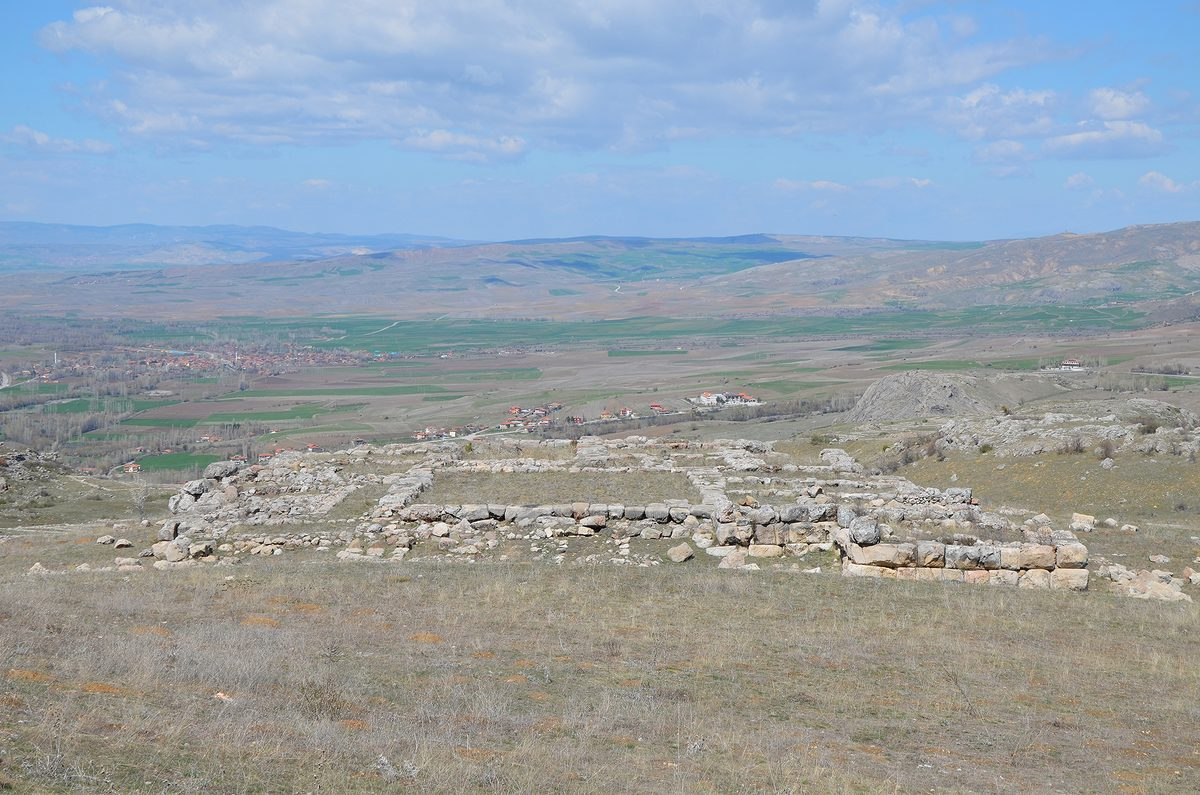
Excavation at Hattusa itself has revised one part of the story recently enough that older popular accounts of the collapse get it wrong. Fieldwork led by Andreas Schachner of the German Archaeological Institute has found no mass graves, no toppled fortifications and no other signature of a final battle at the Hittite capital. Temple storerooms that inventories describe as full of gold and silver vessels were found empty. The evidence points to a methodical evacuation — the royal family, the court and the portable wealth removed in an orderly withdrawal — with the burning that ultimately destroyed the city happening afterward, to a capital that had already been abandoned.
That sequence produced an accidental archive. The clay tablets that recorded four centuries of Hittite administration were too heavy to evacuate, and the fire that came later baked them hard enough to survive more than three thousand years underground. The collapse that erased the Hittite state as a political entity is also the reason its paperwork exists to be read at all.
Watch the full history
The video traces the same evidence — Ugarit’s last letter, the Egyptian reliefs, the pollen core and the earthquake and systems-failure arguments — in about four minutes.

Related reading
- The Mystery of the Beale Ciphers, Explained — another unresolved case built on a document nobody can fully verify
- The Nimitz Tic Tac Encounter: What the Official Record Actually Says — a different kind of mystery argued entirely from primary documents
- The Coal Scuttle Helmet: Why British Troops Named It That — how a battlefield technology shift reshapes an army, the same argument Drews makes for 1200 BC
- Wax Cylinder Recordings: How an Office Machine Ended Up Saving Languages — another case where the record that survives is not the one anyone planned to keep
Shop
The single-volume account referenced throughout this article: 1177 B.C.: The Year Civilization Collapsed, by Eric H. Cline.
Works cited
- Cline, Eric H. 1177 B.C.: The Year Civilization Collapsed. Revised ed. Princeton University Press, 2021.
- Drews, Robert. The End of the Bronze Age: Changes in Warfare and the Catastrophe ca. 1200 B.C. Princeton University Press, 1993.
- Kaniewski, David, et al. “Environmental Roots of the Late Bronze Age Crisis.” PLoS ONE 8, no. 8 (2013): e71004. Link.
- Nur, Amos, and Eric H. Cline. “Poseidon’s Horses: Plate Tectonics and Earthquake Storms in the Late Bronze Age Aegean and Eastern Mediterranean.” Journal of Archaeological Science 27, no. 1 (2000): 43–63.
- Curry, Andrew. “The Hittite Empire Transformed the World — and Then the World Forgot It.” National Geographic, 15 April 2025. Link.
- Institute of Nautical Archaeology. “Uluburun Late Bronze Age Shipwreck Excavation.” Texas A&M University. Link.
- The Epigraphic Survey. Medinet Habu, Volume I: Earlier Historical Records of Ramses III. Oriental Institute Publications 8. University of Chicago Press, 1930. Link.
- Mark, Joshua J. “Sea Peoples.” World History Encyclopedia. Link.