
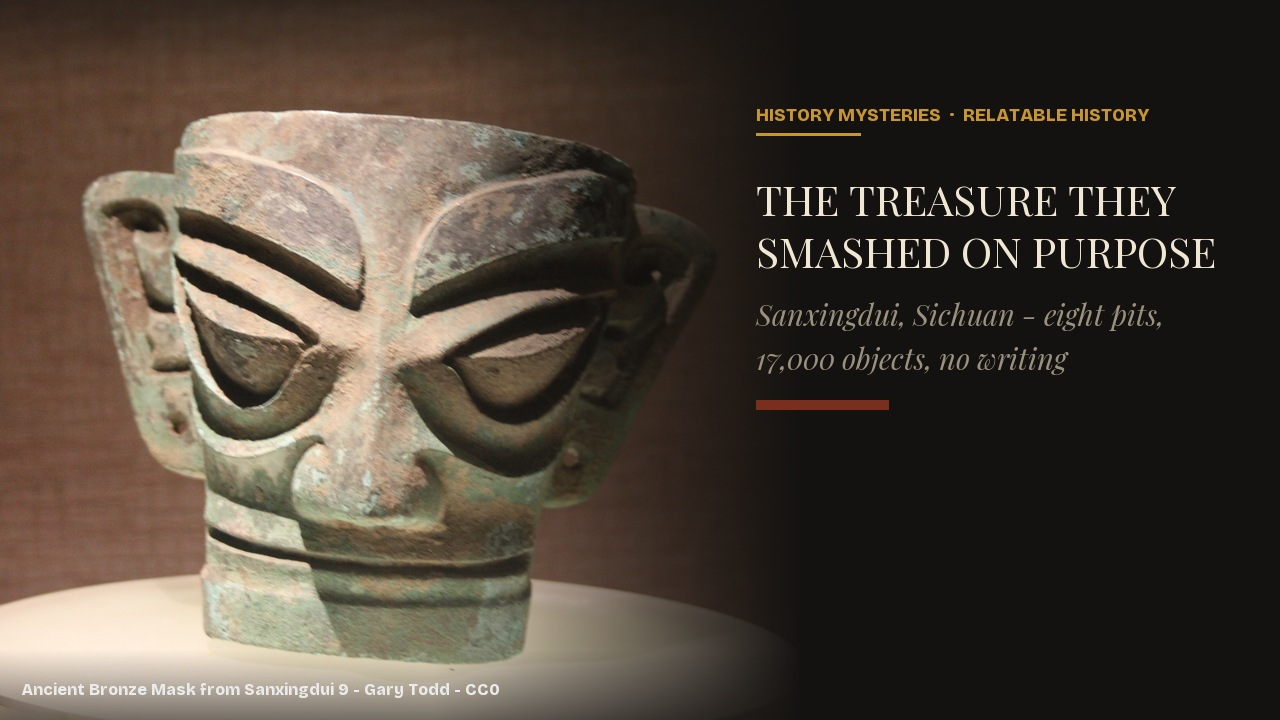
In the summer of 1986, workers digging clay at a brick factory near Guanghan, in China’s Sichuan province, cut into a pit that had no business being there. Inside were bronze heads with gold foil still stuck to their faces, a mask more than a metre wide with pupils that project straight out of the eye sockets like telescope barrels, and elephant tusks stacked in layers. Twenty metres away, a second pit held more of the same.
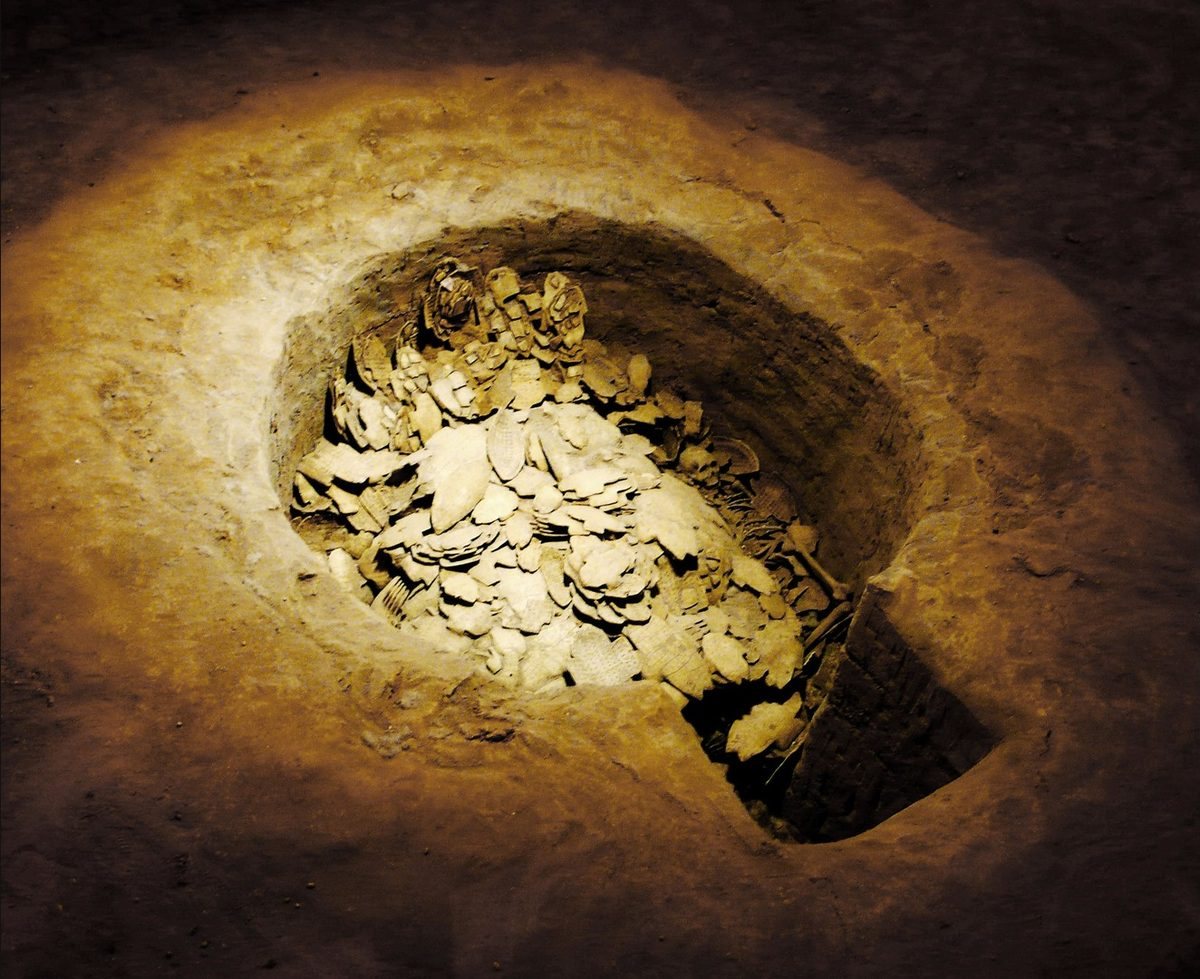
Almost every significant object in both pits had been deliberately broken and burned before it went into the ground. Nothing had been carried off, so it was not looting. The layers were orderly, not dumped, so it was not panic. Someone took the most valuable objects their society possessed, smashed them, burned them, and buried them on purpose — and then, as archaeologists would only learn decades later, did it again at least seven more times.
Eight pits have now been opened at Sanxingdui. Radiocarbon dating places the burials in the same century Shang dynasty scribes, a thousand kilometres to the northeast, were carving questions into ox bone. Sanxingdui left no writing at all. Here is what the physical evidence actually shows, and the three explanations historians can’t yet rule out.
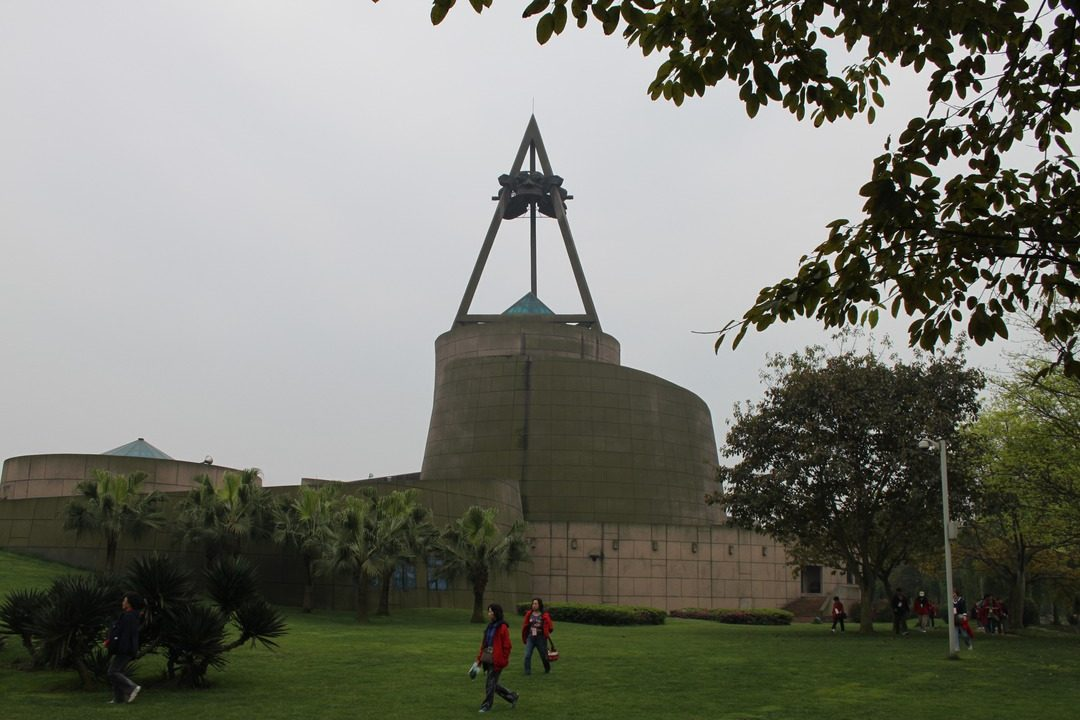
Two pits, found by accident in 1986, held a civilisation nobody had catalogued
Sanxingdui was not entirely unknown before 1986. In the late 1920s a farmer clearing an irrigation ditch near Guanghan turned up a cache of jade, and in 1934 David C. Graham, curator of the West China Union University museum, ran a short excavation at the find spot. The dig was cut off after ten days by looting, and the site then went largely quiet for half a century.
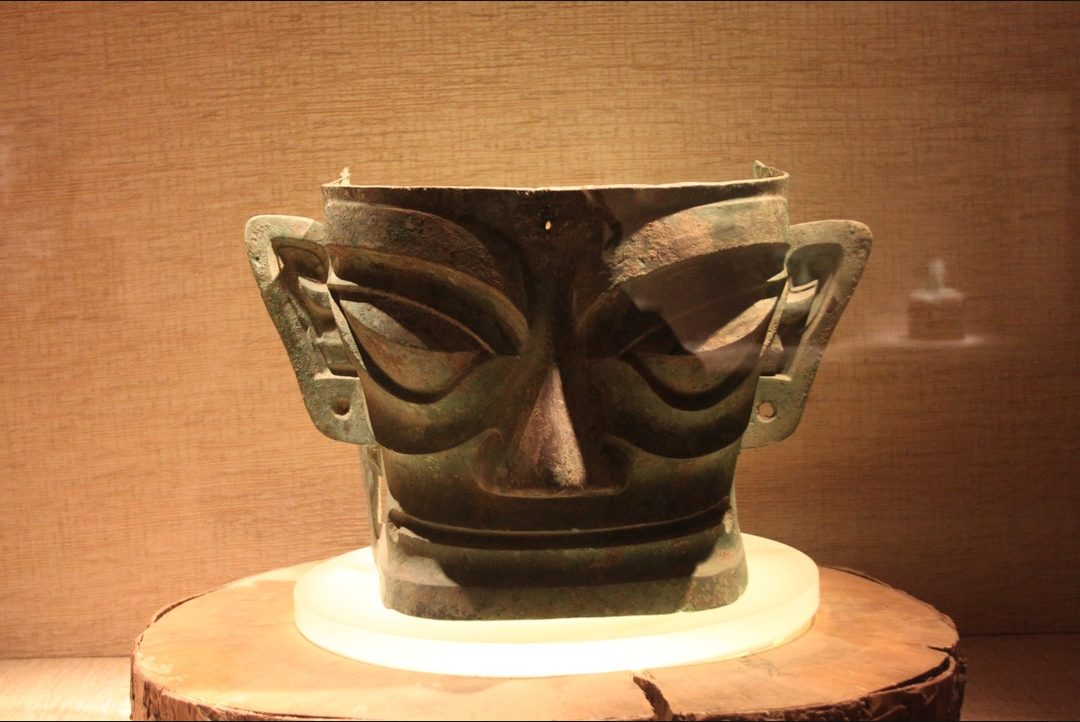
The 1986 discovery changed that overnight. The two sacrificial pits — simply named Pits 1 and 2 — yielded more than 900 bronze, gold, jade and ivory objects between them: a bronze figure over two and a half metres tall standing on a pedestal, its oversized hands curled around something now missing; a bronze tree reassembled from fragments, just under four metres high; dozens of bronze heads, several still carrying gold foil; and the masks, flat-faced, square-eared, with those distinctive projecting pupils. There were also cowrie shells that could only have travelled from the Indian Ocean, thousands of kilometres away, and a gold-covered ceremonial staff.
Archaeologists spent years afterward simply working out what kind of event the pits represented. No human remains were found inside them, so these were not graves in the ordinary sense. A hurried disposal of loot ahead of an attack seemed possible at first, but the care taken with the layering argued against panic from the start, and the precise vocabulary for what to call the pits — sacrificial, votive, or simply ritual disposal — has been debated for decades since.
Nothing about the style matched bronze work found elsewhere in Bronze Age China. The site itself turned out to be a substantial walled settlement on the Chengdu plain, covering roughly twelve square kilometres and occupied for centuries, with a river running through it and rammed-earth walls enclosing the core — evidence that a second major centre of early Chinese civilisation had developed far from the Yellow River basin traditionally treated as its cradle. Most historians before 1986 assumed Chinese civilisation radiated outward from a single origin point in the north. Sanxingdui made that assumption very hard to defend.
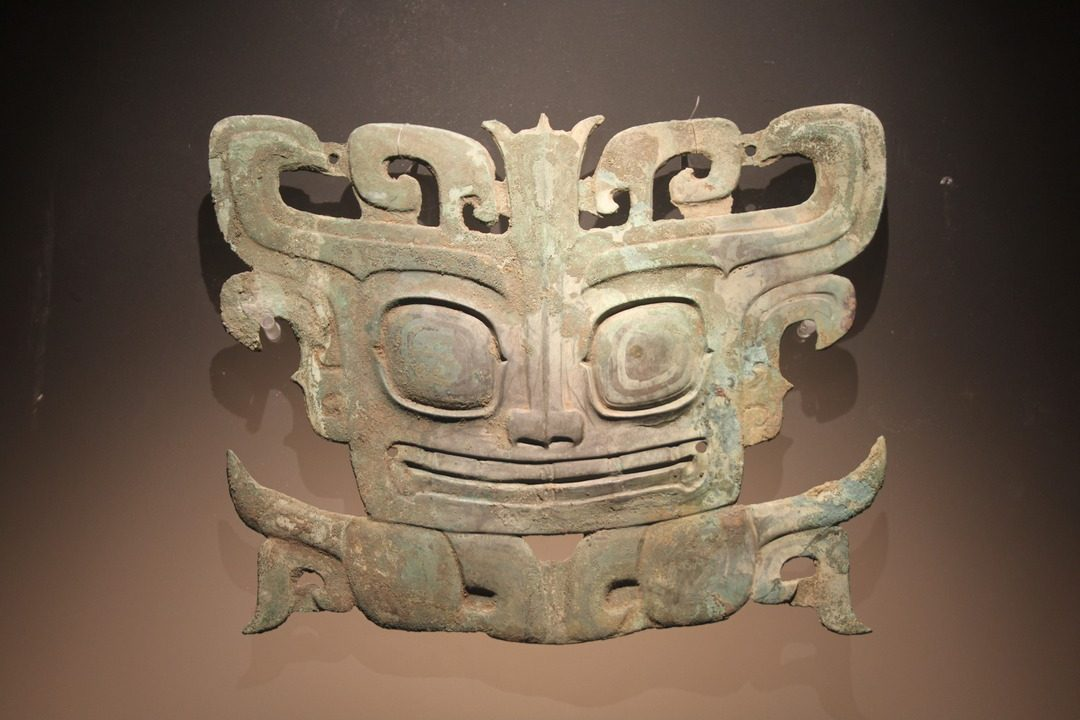
Every major object was destroyed before it went into the ground
The detail that reframed the whole question was the damage. Bronzes in both 1986 pits show heat deformation, soot, and fracture patterns consistent with deliberate breaking and burning, not decay or later disturbance. The ivory was charred. Yet the fill was placed in distinct layers — ivory above, bronze and gold below — which rules out a hurried dump. Somebody planned this burial with the same care that had gone into casting the objects in the first place.
That combination — valuable, deliberately wrecked, carefully arranged — is the signature of ritual destruction rather than disaster or theft. Comparable practices are documented elsewhere in the world: on the island of New Ireland, in Papua New Guinea, communities still carve elaborate wooden memorial sculptures and then ceremonially smash and burn them. The question at Sanxingdui was never really whether the destruction was intentional. It was why.
A second discovery, thirty-three years later, multiplied the evidence by ten
For thirty-three years, Pits 1 and 2 were the whole picture. That changed during renovation work near the Sanxingdui Museum in November 2019, when a new pit turned up close to Pit 2, with the same orientation and layered structure. Five more followed. By 2022, eight pits had been identified in total.
The programme that opened Pits 3 through 8, launched in September 2020, involved more than thirty universities and research institutes and ran nothing like the 1986 rescue dig. Four climate-controlled cabins were built directly over the pits to hold temperature and humidity steady. Archaeologists worked from suspended platforms so the ground itself was never walked on, wore protective clothing to avoid contaminating samples, and used hyperspectral imaging and 3D scanning to record each excavated layer before it was removed.
The new pits alone produced more than 17,000 objects. Pit 5 held a gold mask weighing around 280 grams, made from a gold-silver alloy roughly 85 percent gold — the largest and heaviest gold mask yet found from the Shang or Zhou periods anywhere in China. Pit 6 contained a wooden chest painted with cinnabar red. In Pits 7 and 8, excavators found a bronze box with a tortoise-shell-shaped lid holding jade dragon heads, with traces of silk fabric preserved around it — the first hard physical evidence of silk this far southwest at this date — and a bronze sculpture fusing a snake’s body with a human head, tusks and horns. Pits 3, 4, 7 and 8 repeated the same layering seen in 1986: ivory above, bronze and gold beneath.
The radiocarbon dates land in the exact century Shang scribes were writing
More than a hundred samples, mostly charcoal and bone residue, have now gone for radiocarbon analysis, though the burned condition of most organic material at the site makes dating difficult. Early results from a Peking University team put Pit 4 at roughly 1199 to 1017 BC. A fuller set of six dates, published later from the same pit, refined that range to 1260 to 924 calibrated BC. Combined with pottery styles and the way the bronzes fit back together across pits, specialists now place Pits 1 through 4, 7 and 8 in the late Shang period, with Pits 5 and 6 slightly later, in the early Western Zhou.
That dating lands the Sanxingdui burials in the same span of decades when scribes at Anyang, the Shang capital roughly a thousand kilometres to the northeast, were inscribing questions to their ancestors on ox scapulae and turtle plastrons — China’s earliest confirmed writing system. Sanxingdui, despite casting a four-metre bronze tree in sections and welding a kneeling figure to a ritual vessel with a precision that still shows tool marks today, left behind no accepted script of its own. A handful of marks on Shu-era objects have been proposed as proto-writing, but nothing has been deciphered, and no bilingual text exists to test it against.
That absence carries more weight than it might seem to. Metallurgy, a writing system and cities have traditionally been treated as the three defining markers of a civilisation, a framework built largely on Egypt and West Asia. Sanxingdui had the metallurgy and the city but, on current evidence, not the script, which is part of why specialists increasingly argue that the old three-part checklist undersells how varied early civilisations actually were. A society capable of alloying bronze precisely enough to cast a four-metre tree in matched sections did not need writing to organise that work.
The one written clue arrives a thousand years too late to fully trust
The closest thing to a contemporary caption comes from a text written well over a millennium after the pits were filled. The Huayang Guo Zhi, a gazetteer of southwest China compiled in the fourth century CE, lists a sequence of legendary early rulers of the ancient Shu kingdom — Cancong, Boguan, Yufu, Duyu and Kaiming — and says that Cancong had protruding eyes.
It is hard to read that line without immediately picturing the telescope-pupil masks, and the connection gets made constantly in popular accounts of the site. It deserves some caution, though. The gazetteer’s author had no access to any Shu-era written record, because none is known to have existed; he was working from oral tradition that had already passed through many centuries, in a kingdom that had been conquered and absorbed by the state of Qin in 316 BCE. The description may preserve something genuine about how the Shu remembered their own founding rulers. It may equally be a later writer doing exactly what people do now — looking at strange, evocative objects and reaching for a story that fits them. Either way, it is not contemporary evidence of what the masks meant to the people who made and broke them.
Three explanations fit the evidence, and none of them are ruled out
Why destroy objects of this value at all? Three explanations circulate among specialists, and the physical record is consistent with all three.
The first is disaster. A major flood, or some other calamity, convinces the community that the deities represented by these images have failed them, and the response is to deconsecrate the sacred objects the only way that is possible — by destroying them — before burying them and abandoning the site.
The second is succession. A ruling lineage ends, and the regalia of the old order is ritually broken so a new order can cast its own. On this reading the pits are not evidence of catastrophe but of a planned transition, and further, still-buried pits from earlier successions may exist.
The third is relocation. Around fifty kilometres away, at Jinsha inside modern Chengdu, a closely related culture appears at roughly the point Sanxingdui was abandoned, sharing the same gold-working techniques, the same sun-and-bird imagery, and similar ivory deposits. Most specialists read Jinsha as Sanxingdui’s continuation, and some have proposed that an earthquake forced the move. If the political and religious centre was shifting, the old regime’s sacred objects could not simply be carried along intact — they had to be put permanently beyond use first.
Excavation is still running, and a complete archaeological report on the six newer pits is not expected until around 2025. A rebuilt Sanxingdui Museum opened in 2023 and now displays bronzes reassembled from fragments recovered across pits dug thirty-six years apart, joined back together the way the rest of this story has been: patiently, and without a caption to confirm any of it. The objects came back. The explanation for why they were broken in the first place did not.
Watch the full history
The video version walks through the 1986 discovery, the pupil-projecting masks, and what the six newly opened pits added to the picture.

Related reading
- Why Linear A Still Can’t Be Read
- Was the Baghdad Battery Real? What the Evidence Actually Shows
- What Were Roman Dodecahedra Actually Used For?
- How the Magic Lantern Became Europe’s First Horror Show
Works cited
- Li, Yingfu, Tian Qiu, Jianbo Guo, and Yuniu Li. “New discoveries at the Sanxingdui Bronze Age site in south-west China.” Antiquity 97, no. 391 (2023): e4.
- Zhao, Weijie. “New archeological marvels of ancient Shu civilization.” National Science Review 8, no. 7 (2021): nwab071. Link.
- “Ancient artifacts unearthed from sacrificial pits shed new light on China’s Sanxingdui ruins.” NBC News, 2022. Link.
- “3,000-Year-Old Artifacts Unearthed in Southwestern China.” Archaeology (Archaeological Institute of America), March 2021. Link.
- “Scientists discover 3,000-year-old silk at China’s mysterious Sanxingdui ruins.” South China Morning Post.
- “The lost world of Sanxingdui: fabulous finds from a forgotten civilisation.” Current Archaeology.
- “The Faces of Sanxingdui: Mysterious Masks of the Ancient Shu Kingdom.” Google Arts & Culture, in partnership with Sanxingdui Museum. Link.