
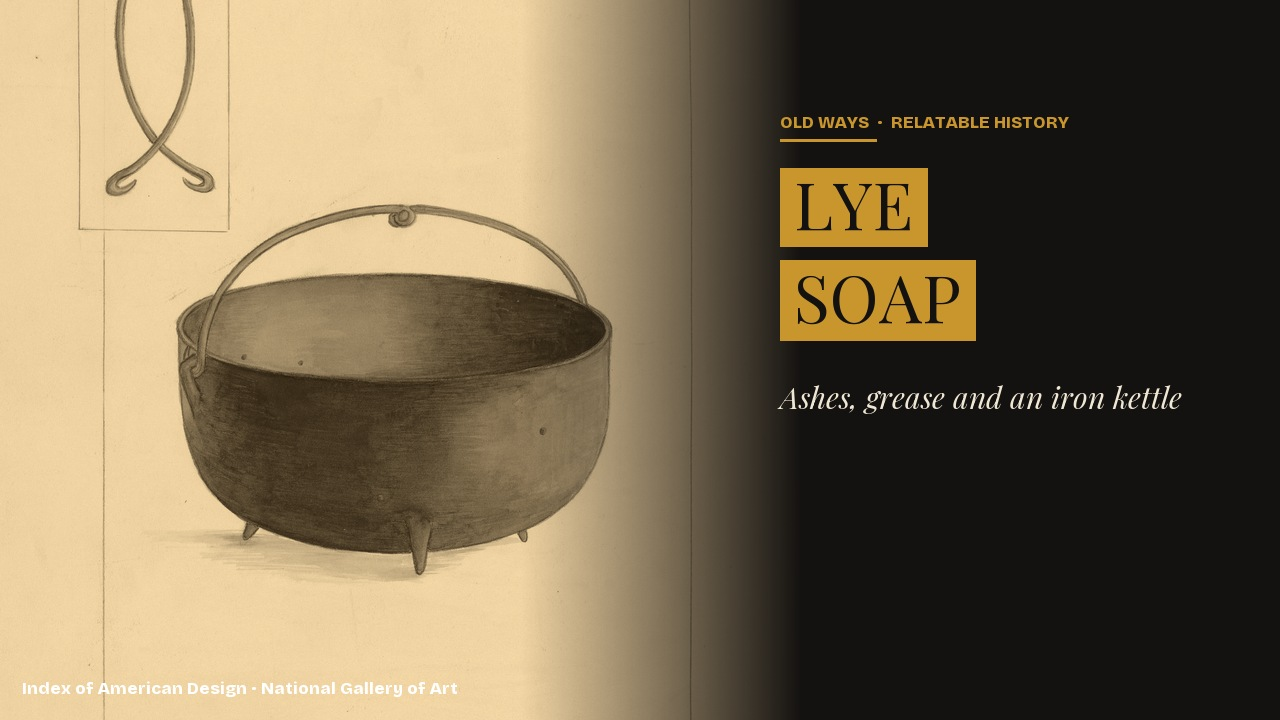
Picture old-fashioned soap and you probably picture a bar — something you could pick up, turn over, set on a dish by the sink. For most of American history, that picture is wrong. The soap a farm family made from a barrel of wood ashes and a year of saved grease did not harden. It came out of the kettle a soft brown jelly, ladled into a stoneware crock, and it stayed that way. Nobody was cutting it into bars, because it could not be cut into bars.
That single fact is the hinge this whole story turns on. The chemistry that made homemade soap possible — potassium hydroxide leached out of hardwood ash — is a different chemistry from the one that makes a bar of soap hold its shape. Getting a hard bar required an industrial alkali that almost no farm household could produce for itself, and the century-long argument over who could make that alkali, and how cheaply, is most of why home soapmaking nearly disappeared twice and came back twice anyway.
It starts with a hole in the ground, or close enough: a bottomless barrel, a bed of straw, and the ashes that were going to be thrown out regardless.
The farm made its own alkali from a barrel of ashes
Wood ash is not one substance. Burn a hardwood — oak, hickory, maple, beech — and the ash left behind carries roughly 5 to 15 percent potassium carbonate by weight. Burn a softwood like pine or fir instead, and that figure drops to 2 to 5 percent, diluted further by resins that fouled the lye. Farm households that never measured a percentage in their lives still knew this by the plainest possible test: pine-ash lye did not make soap, so pine went in the fireplace and hardwood went in the ash barrel.
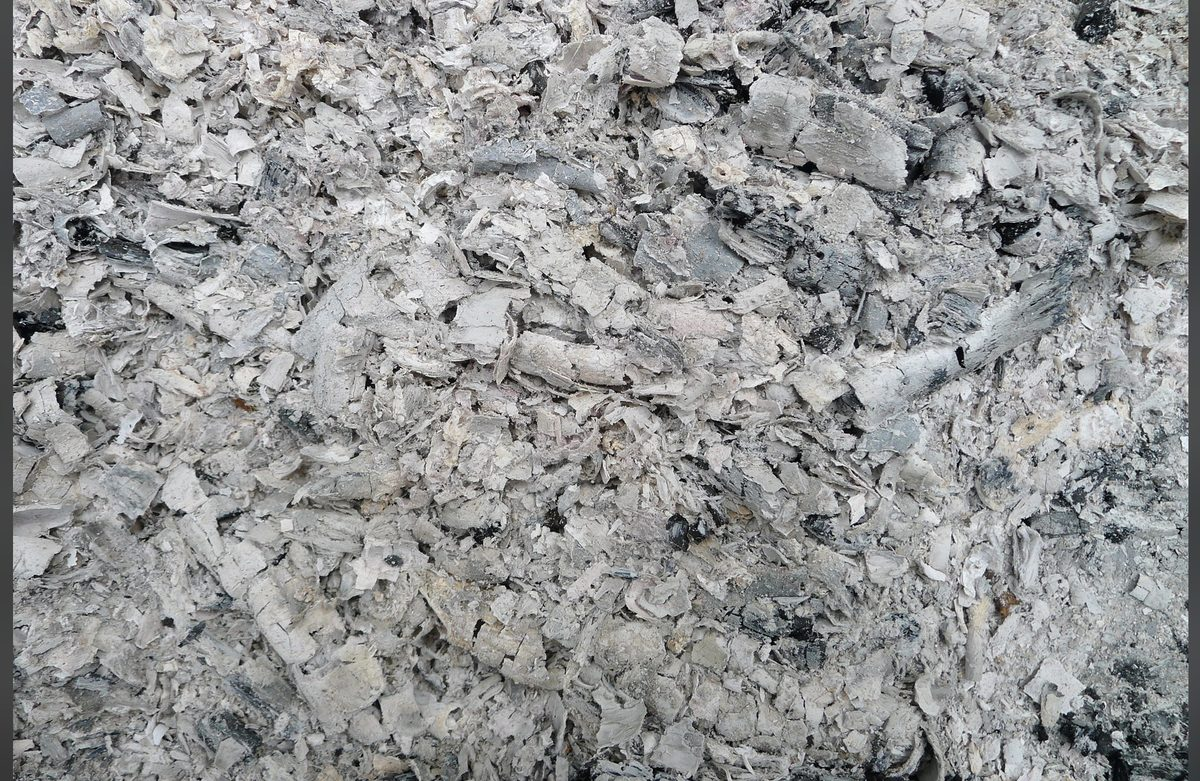
The extraction apparatus was called an ash hopper: an upside-down wooden cone or a barrel with the bottom knocked out, set over a stone slab carved with a drainage groove, lined inside with straw and small sticks so the ash itself would not wash through. Ashes went in year-round, saved from the kitchen fire specifically for this. When the hopper was full, water was poured over the top and allowed to filter slowly down through the ash bed, dissolving out the potassium carbonate as it went and emerging at the bottom as a brown, caustic liquid: lye. The hopper itself lived in a shed, kept dry, because an unplanned rain could leach the whole batch away before anyone was ready to collect it.
This was not a marginal household chore. Wood ash, and the potash refined from it, was the first significant chemical export of the American colonies. Settlers at Jamestown were producing “soap ashes” for shipment to England within a year of founding the colony, and by the eighteenth century potash was essential not just to soap but to glass, dyes and gunpowder-related saltpetre production. It was valuable enough that Samuel Hopkins of Philadelphia received the first patent ever issued by the United States government — number one, signed by George Washington on July 31, 1790 — for an improved furnace process for making potash and pearl ash. Newspaper advertisements for potash kettles ran regularly in the same colonial papers that carried notices for land and livestock, which is a fair measure of how central the trade was to a working farm’s income.
An egg decided when the lye was strong enough
There was no thermometer for this and no litmus paper. The test that generations of soapmakers actually used was a fresh egg, or failing that a potato, dropped into the collected lye. Lye of roughly the right concentration is close enough to the density of an egg that the egg floats rather than sinks — and the specific benchmark, repeated in recipe after recipe, was that a properly strong lye would float the egg with a circle of shell about the size of a coin showing above the surface. American sources describe that circle as the size of a quarter; earlier British and colonial versions describe it as the size of a ninepence, which tells you the test crossed the Atlantic before the coinage did.
If the egg sank, the lye was too weak and needed another pass through the ash bed. If it rode too high out of the liquid, the lye was too caustic and needed dilution, or the resulting soap would burn skin and fabric rather than clean them. It is a genuinely elegant piece of applied chemistry for a household with no instruments at all: density used as a stand-in for concentration, calibrated against an object everyone already had in the kitchen.
Boiling ash lye with saved fat made soap, not a bar
Soapmaking itself is a reaction chemists call saponification: a fat or oil, which is chemically a triglyceride, is broken apart by a strong base. Each of the three fatty-acid chains that made up the triglyceride comes loose from its glycerol backbone and combines with a metal ion from the base to form a new compound — soap — while the glycerol is released as a separate byproduct. On the farm, the base was the potassium hydroxide leached out of hardwood ash, and the fat was whatever had been rendered and saved over the previous year: bacon grease, kitchen trimmings, the fat from butchering.
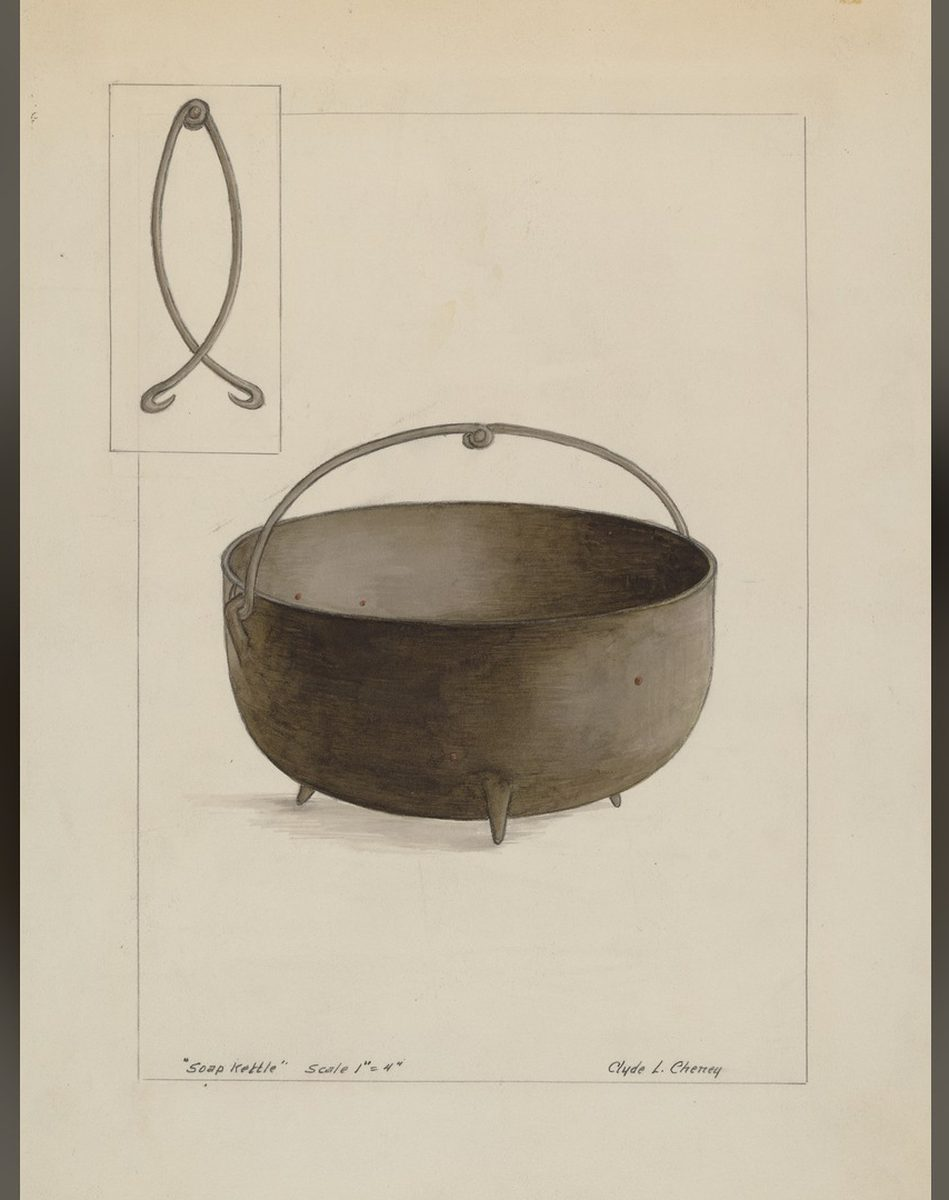
The two were combined in a great iron or copper kettle over an outdoor fire and boiled for hours, stirred constantly with a wooden paddle — never metal, because the caustic lye would attack it. And here is the detail the popular image leaves out entirely: potassium-based soap does not set hard. Sodium hydroxide produces a firm, opaque bar. Potassium hydroxide produces a soft, translucent soap that stays close to a gel at room temperature, which is exactly the basis of liquid soap today. Wood-ash lye is potassium hydroxide. The farm kettle, worked correctly, could not have produced a bar if it tried. What it produced was “soft soap,” dipped out by the cupful from a stoneware crock for as long as it lasted, which for a well-run household was most of a year.
Cheap manufactured soda nearly ended the practice
Home soapmaking’s first real competitor was not another soap but an industrial process for making the other kind of alkali. Sodium carbonate — soda ash — is what turns fat into a hard bar, and through the eighteenth century it was scarce and expensive, produced in small quantities from burned plants and seaweed. The French chemist Nicolas Leblanc found a workable synthetic route in the 1780s, but his process was filthy, expensive and released hydrochloric acid as a waste gas. It took the Belgian industrialist Ernest Solvay, refining a reaction between ammonia, salt and carbon dioxide, to make soda ash cheap. His first plant, started in 1861, exploded; by 1869 he had solved the engineering problems, and by 1900 the Solvay process supplied roughly 95 percent of the world’s soda ash.
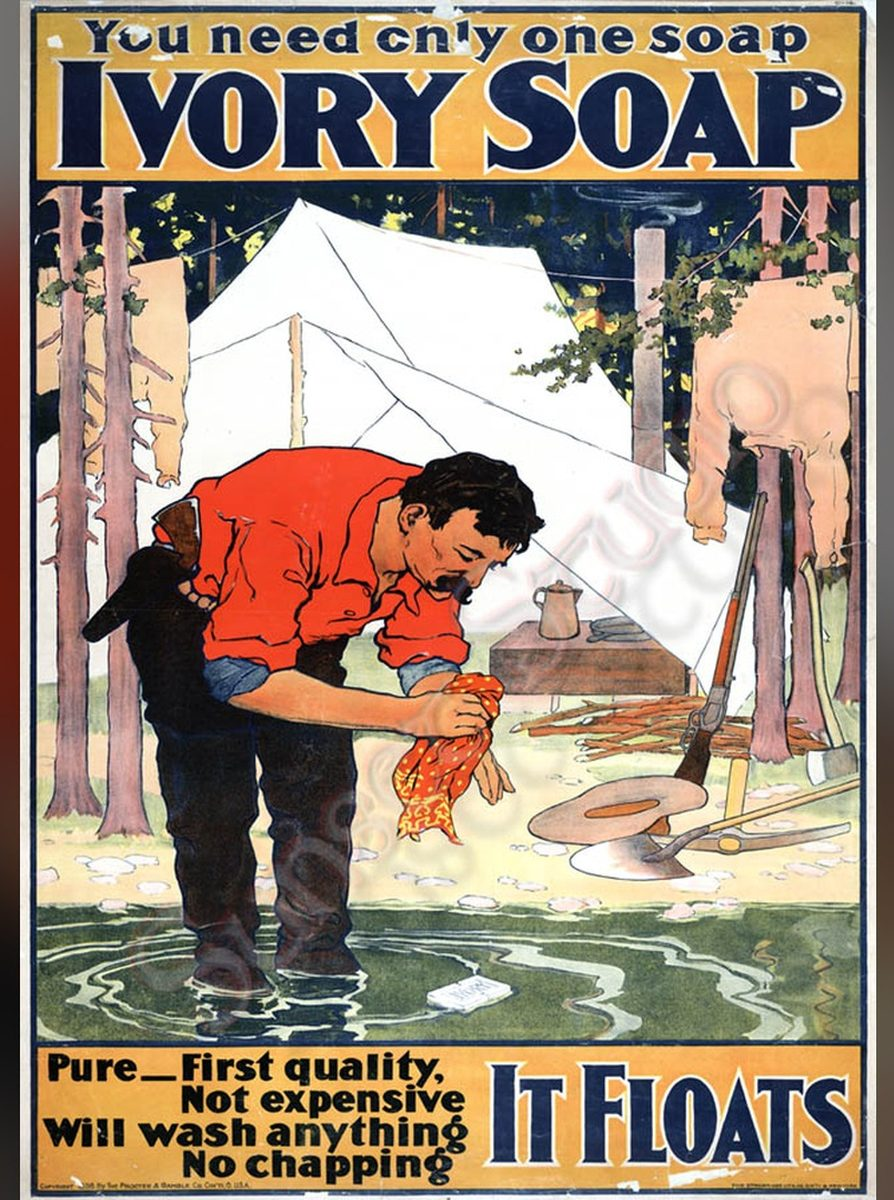
Cheap sodium hydroxide made cheap hard soap possible at an industrial scale, and Procter & Gamble’s Ivory, introduced in 1879, is the product everyone remembers. Company lore for decades held that Ivory’s famous ability to float was a happy accident — a factory worker who left a mixing machine running through lunch, whipping extra air into the batch. In 2004 a P&G company archivist found a notebook entry from chemist James N. Gamble dated 1863, sixteen years before Ivory’s launch, reading “I made floating soap today. I think we’ll make all of our stock that way.” The float was deliberate; the story about the accident was better marketing. Either way, a hard, floating, cheaply mass-produced bar selling for pennies undercut the entire economic case for spending a day at a smoking outdoor kettle, and by the turn of the twentieth century home soapmaking had become mostly a rural, cash-poor household’s activity rather than every household’s.
The Depression and two world wars brought it back
Store-bought soap requires cash, and cash was exactly what disappeared during the Depression and again during wartime rationing, so the old kettle came back out. World War II gave the practice a second and stranger revival: soap manufacture produces glycerine as a byproduct, and glycerine is a key ingredient in nitroglycerine. Beginning in 1942, the American Fat Salvage Committee ran a nationwide campaign asking households to strain and save cooking fats — bacon grease, pan drippings, rendered trimmings — and turn them in to a butcher for a few cents a pound and a couple of ration points. Government posters did the arithmetic in the most vivid terms available: one tablespoon of saved fat a day was pitched as enough to load 1,542 machine-gun bullets a year; one pound was framed as enough to fire four anti-aircraft shells.
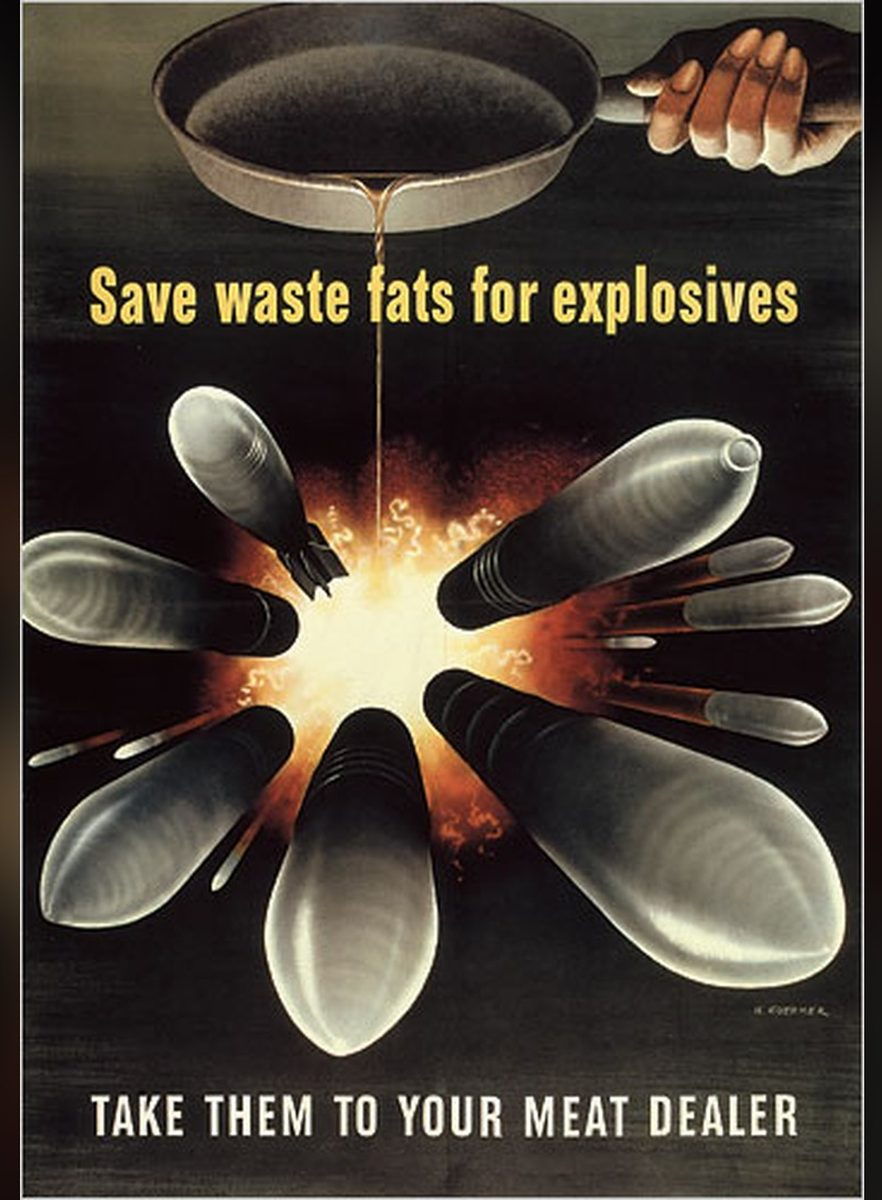
Between August 1942 and the program’s end, American kitchens turned in more than half a billion pounds of fat, the great majority of it from civilian households rather than military mess halls. Salvaged fat covered only about 12 percent of the soap industry’s total wartime need, but the campaign did something the tonnage figures do not capture: it put the ash-hopper generation’s basic chemistry — fat plus alkali plus heat equals soap and glycerine — back into ordinary conversation for a few more years, in kitchens that had mostly forgotten it. Rural households in places like Appalachia kept making genuine wood-ash soft soap well into the twentieth century regardless of what was on sale at the store, less out of necessity by then than out of habit and preference for what it did to laundry and floors.
The object itself — ash hopper, iron kettle, wooden paddle, stoneware crock — never needed updating, because the chemistry it depended on had not changed since the Mishnah-era world had nothing to do with it and a Vermont patent office had everything to do with it. What changed around it was the price of the alternative. Every time that price dropped far enough, the kettle went back in the shed. Every time it rose again, out it came.
Watch the full history
The video version covers the same ash hopper, the egg test and the kettle in under five minutes, built entirely around the objects themselves.

Related reading
- The Contested History Behind Blue Monday Washday
- How Kerosene Lamps Actually Worked (And Sometimes Exploded)
- The Warming-Pan Baby: The Bed-Warmer Behind a Royal Scandal
- The Coal Scuttle Helmet: Why British Troops Named It That
Shop
The book, lye and crock featured in the video, all verified working Amazon links:
- The Soapmaker’s Companion by Susan Miller Cavitch
- Sodium hydroxide (lye) for modern soap making
- Ohio Stoneware 1-gallon preserving crock
Works cited
- U.S. Government Publishing Office. “Anniversary of the First Patent Issued in the United States.” GovInfo, July 29, 2022. Link.
- Keyes, Carl Robert. “Potash Kettles.” The Adverts 250 Project, Assumption University.
- National Museum of American History, Smithsonian Institution. “History of Ivory Soap.” Ivory Soap Advertising Collection, NMAH.AC.0791.
- Mikkelson, Barbara. “Ivory Soap Origin.” Snopes.com, last updated May 19, 2011. Link.
- Martin, Christy, and Brigitte Van Tiggelen. “Making the Process.” Distillations, Science History Institute, December 5, 2011. Link.
- Pitman, R. M. “Wood Ash Use in Forestry — A Review of the Environmental Impacts.” Forestry: An International Journal of Forest Research 79, no. 5 (2006): 563–588.
- “Saponification.” Research Starters, EBSCO. Link.
- Springate, Megan E. “Material Drives on the World War II Home Front.” National Park Service, The American Home Front and World War II, last updated May 16, 2024. Link.