
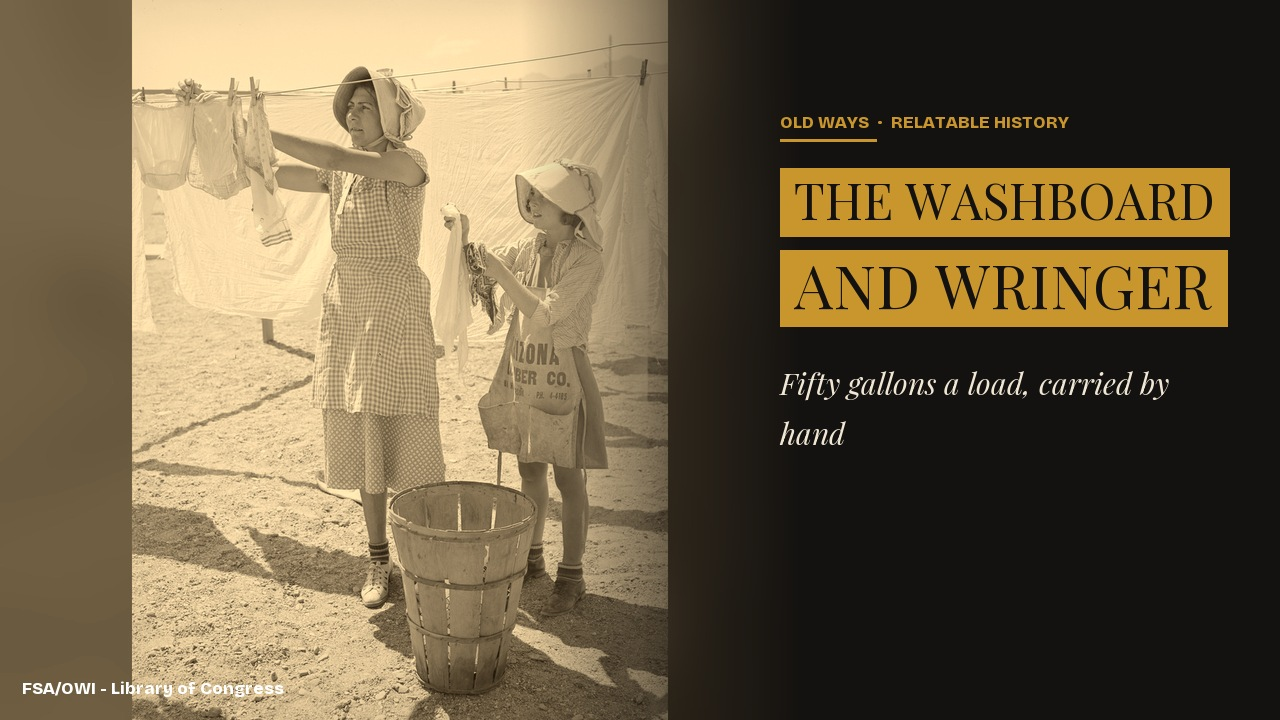
Ask most people about Blue Monday washday and they will give you the same tidy answer: Monday got the nickname because of bluing, the dye housewives added to the rinse water to keep whites from yellowing. It sounds plausible enough that nobody thinks to check it. Historians who have actually gone looking for the phrase’s origin have found something messier.
The name shows up in American writing as early as the 1830s, and in that earlier usage it has nothing to do with laundry at all — it describes the sour, hungover mood of a workforce dragging itself back to the job after a weekend of drinking. Only later, sometime around the 1860s, did the same phrase get attached to the weekly wash. Whether that attachment happened because of the bluing rinse, or because Monday was already a dreaded day and washday made a convenient peg to hang the old phrase on, is a question nobody has settled. An 1896 piece in Good Housekeeping blamed the color directly on dye that ran in the wash. Other writers think that gets the causation backwards.
That small dispute is a useful way into the larger one. The washday routine itself — the board, the boiler, the wringer, the line — is well documented and not really in question. What is more interesting, and less often explained, is the chemistry that actually made the routine work, the inventor written out of its history, the injury it gave a name to, and the strange place the washboard ended up once nobody needed it for laundry anymore.
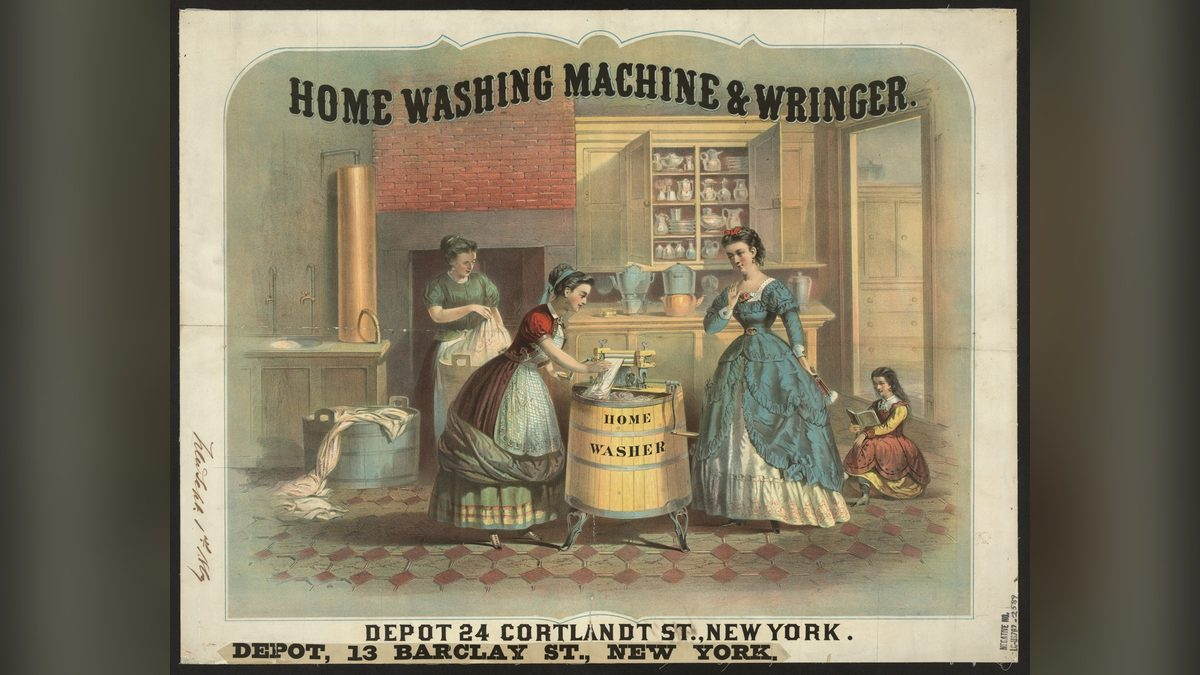
Where ‘Blue Monday’ Washday Actually Comes From — and Why Historians Disagree
Victorian household manuals did their part to cement Monday as wash-day, treating it as settled etiquette: everything had to be scrubbed, dried, and put away well before Sunday, so Monday was where the week’s dirtiest, longest job had to go. That much every source agrees on. What they don’t agree on is whether the word ‘blue’ was already riding along with Monday before the laundry connection, or whether the wash invented it.
The case for the older meaning is straightforward: ‘Blue Monday’ as a description of post-weekend gloom predates its laundry sense by roughly thirty years in the written record. The case for the bluing-dye explanation is that it is vivid, easy to picture, and got repeated in print often enough — the Good Housekeeping item among them — that it hardened into received wisdom. Both things can be true at once: a mood-word and a laundry chemical converging on the same day for different reasons, then blurring together in folk memory until nobody could say which came first. That is, in fact, the more likely answer, and also the least satisfying one to put in a single sentence, which is probably why the tidier version won.
The Chemistry Nobody Explains: Lye, Fat, and a Floating Egg
Before there was a bar of soap in the house, there was an ash hopper. Hardwood ashes from the winter’s fires were saved and packed into a barrel set over a bed of straw and gravel, and rainwater was poured through them again and again until it ran out the bottom carrying the ash’s potassium salts with it — lye water. Getting the strength right had no thermometer or hydrometer behind it. The traditional test was to drop in a fresh egg or a small potato: sink, and the lye was too weak; float too high, and it was too strong; settle and hover about halfway under the surface, and it was ready.
That lye was then boiled together with rendered animal fat — kitchen grease, usually, saved all year for exactly this purpose — in a kettle over an open fire, sometimes for the better part of a day, until the fat and the alkali finished the chemical reaction called saponification and turned into soft soap. It is the same reaction that makes any soap, then or now: fat plus a strong base yields soap plus glycerin. What is different is the margin for error. A batch made with lye that was too weak stayed greasy and never fully hardened; too strong, and it was caustic enough to take skin off with the dirt, which is exactly what generations of washday hands experienced firsthand.
The rinse water’s blue tint worked on a completely different principle, and it is genuinely counterintuitive once you know it: bluing does not make cloth whiter. Cotton and linen yellow slightly with age and washing, and blue is yellow’s complementary color, so a trace of it — originally ground smalt or indigo, later synthetic ultramarine sold commercially from the 1850s on under brand names such as Reckitt’s — cancels the yellow cast to the eye. The fabric reflects slightly less light than before, not more. It looks whiter because the color has been corrected, not because anything got cleaner. It is an optical trick that housewives were running, expertly and by feel, a century before anyone described it in those terms.
The Woman Who Improved the Wringer — and Was Paid $18 for It
In 1888, a Washington, D.C. domestic worker named Ellen Eglin designed an improved clothes-wringer, the kind of practical, labor-saving mechanism that period patent offices saw constantly. Eglin did not file the patent herself. She sold the rights to an agent for eighteen dollars and let him take it to market under his own name, and by her own account the reasoning was blunt: white customers would not buy a wringer if they knew a Black woman had invented it.
She said as much directly, in an 1890 interview with the magazine The Woman Inventor, one of the only contemporary sources that preserves her voice on the subject at all. The wringer itself went on to sell well. None of that success reached her. Eglin told the same interviewer she was already working on a second invention and intended to patent that one under her own name, specifically so her identity as its inventor could not be erased the way the first one had been. What that invention was, and whether she ever filed for it, is not recorded anywhere historians have found.
Eglin’s case is not an isolated anecdote. It is one documented instance of a pattern that recurs across nineteenth-century patent history: inventions by Black Americans and by women routinely reaching the market through an intermediary’s name, because the inventor’s own name was judged a liability. The wringer in your grandmother’s basement, humming along on rollers patented by a man whose name is on record, may well owe a design improvement to a woman whose name very deliberately is not.
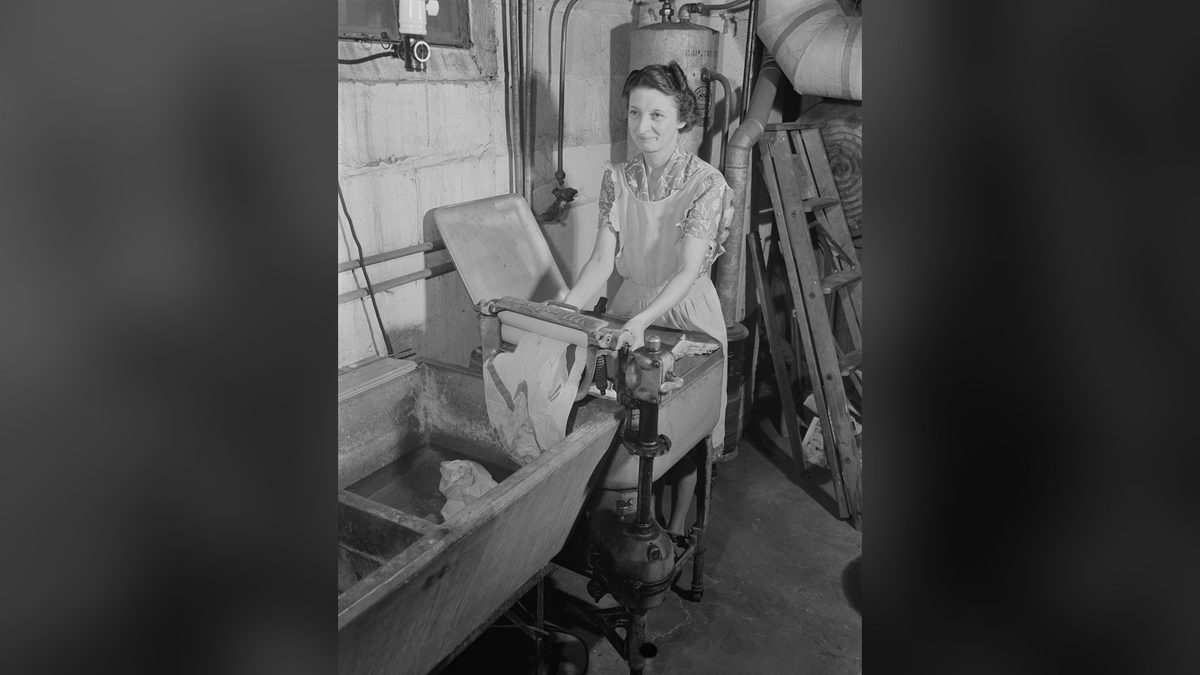
‘Wringer Arm’: The Injury the Machine Age Invented
Feed a wet sleeve between two spring-loaded rollers turning toward each other and the same mechanical squeeze that presses out water will just as readily draw in a hand, and does not know the difference between a shirt cuff and a wrist. By the mid-twentieth century, physicians treating the resulting crush-and-friction injuries had given it a specific clinical name, ‘wringer arm,’ and were publishing treatment guidance for it in major medical journals. Most of the patients were not the housewives running the machines but children who wandered too close while one was in use.
The injury was common enough to generate its own literature and, eventually, its own regulation. Underwriters’ Laboratories eventually set a standard requiring that a wringer’s emergency release bar disengage the rollers under no more than twenty pounds of pressure, reachable from either side of the machine — a design fix aimed squarely at the fact that by the time someone screamed, the rollers needed to let go in less than a second. Reported cases declined sharply once quick-release mechanisms became standard equipment rather than an option, and again as centrifugal spin-drying replaced the roller wringer through the 1950s and ’60s.
It is worth pausing on how strange that timeline is. The wringer itself — two rubber rollers and a crank — is one of the least mechanically complicated objects discussed in this piece. It still took the better part of a century, a body of clinical literature, and a safety standard with a specific numeric threshold before its most dangerous flaw was engineered out.
How a Scrub Board Became a Musical Instrument
Long after washing machines emptied it out of American laundry rooms, the corrugated board found a second job almost nobody predicted: rhythm. Tapped or scraped with thimbles, spoons, or bottle openers, its ridged surface produces a bright, dry percussion sound that early twentieth-century jug bands in Louisville and Memphis built directly into their lineups, alongside homemade instruments like the washtub bass and the stovepipe. The washboard’s role there traces back further still, to the body-percussion tradition called hamboning that enslaved musicians carried into the Americas and adapted to whatever was on hand.
The instrument then crossed the Atlantic and came back transformed twice over. In 1950s Britain, teenagers with no money for real instruments built a skiffle craze around a cheap guitar, a tea-chest bass, and a washboard scraped with sewing thimbles — the scene that gave a young John Lennon his first band. In Louisiana, the musician Clifton Chenier is credited with taking the idea a step further and having a washboard’s corrugated front panel built as a standalone vest, worn strapped to the chest and played with metal scrapers; his brother Cleveland made the instrument, now called the frottoir, central to zydeco.
The Columbus Washboard Company, the last laundry-washboard maker left in the country, now sells a line built specifically for musicians alongside the ones still meant for a basin of soapy water — a business a founder in 1895 could not have anticipated, arrived at only because the object outlived the chore it was built for.
Watch the full history
The video traces the washboard and wringer through the actual mechanics of washday — the patents, the water, the order of the wash — in a little under four and a half minutes.

Related reading
- How Kerosene Lamps Actually Worked (And Sometimes Exploded)
- The Warming-Pan Baby: The Bed-Warmer Behind a Royal Scandal
- The Coal Scuttle Helmet: Why British Troops Named It That
- Water Bath vs Pressure Canning: Why the 240-Degree Difference Exists
Shop
For the full social history of American housework, Susan Strasser’s Never Done: A History of American Housework is the standard reference.
Works cited
- Dickerman, Elliot. Clothes-Wringer. U.S. Patent 27,781, filed 1860. Link.
- “How the 1833 Washboard Patent Changed Early American Laundry.” Farm and Dairy. Link.
- “Housework in Late Nineteenth-Century America.” Digital History, University of Houston. Link.
- White, Kelly. “Good Old Fashioned Clean: Five Facts about Colonial Soap.” Pennsbury Manor. Link.
- “Reckitt’s Blue.” CAMEO: Conservation & Art Materials Encyclopedia Online, Museum of Fine Arts, Boston.
- “Who Invents and Who Gets the Credit?” Lemelson Center for the Study of Invention and Innovation, Smithsonian Institution.
- “Ellen Eglin (1849–?).” BlackPast.org. Link.
- “The Treatment of Wringer-Arm Injuries.” New England Journal of Medicine 247, no. 20 (1952): 771–774.
- “Only One Factory in North America Still Makes Washboards, and They Are Flying Off of Shelves.” Smithsonian Magazine. Link.
- “Skiffle.” Encyclopaedia Britannica.
- “How the American Washboard Made a Surprise Comeback.” The Statesider. Link.