
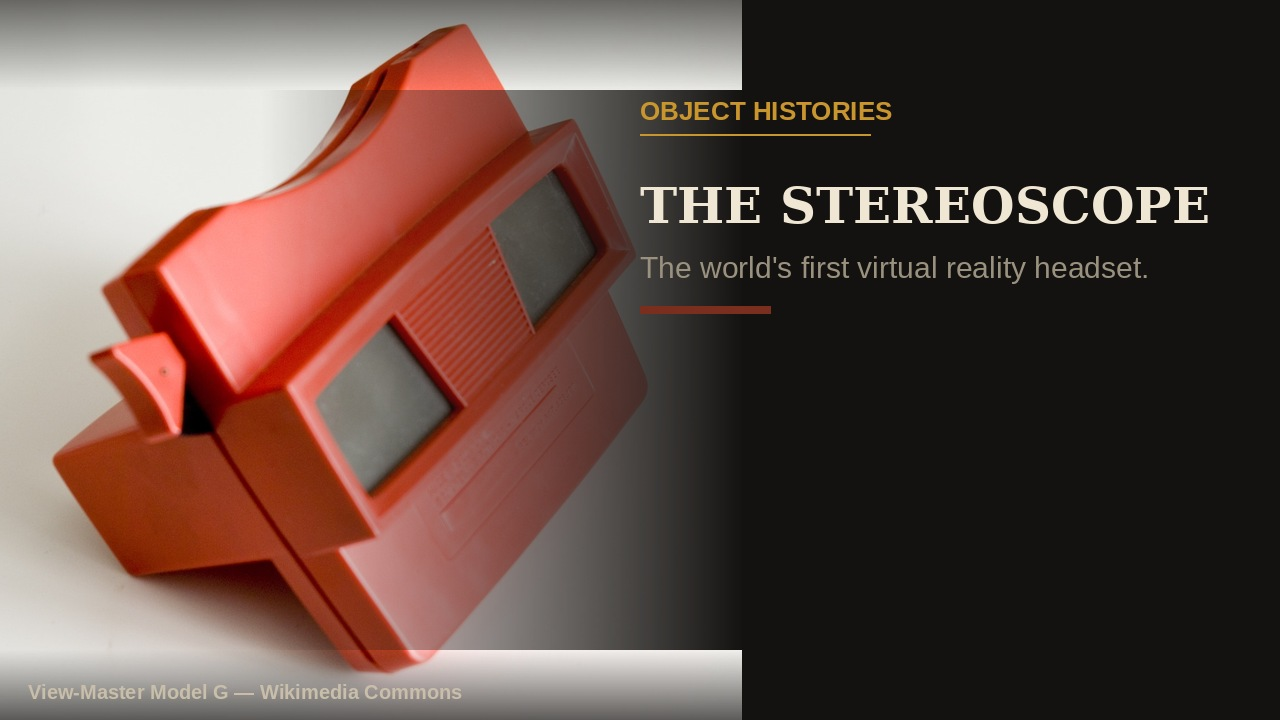
In 1838, a London physicist demonstrated a device that produced a convincing illusion of three-dimensional depth — a full year before photography existed. Charles Wheatstone’s stereoscope worked on hand-drawn diagrams, not photographs, because there was nothing else to put in it yet. Depth perception, it turned out, didn’t need a camera. It needed two slightly different flat pictures and a way to show one to each eye.
That single insight went on to power a Victorian parlour craze, an entirely new way of documenting war, an industry that printed photographs by the tens of millions, and, eventually, the View-Master and the VR headset. The object itself barely changed in that time. What changed was what people put inside it, and what they used it for.
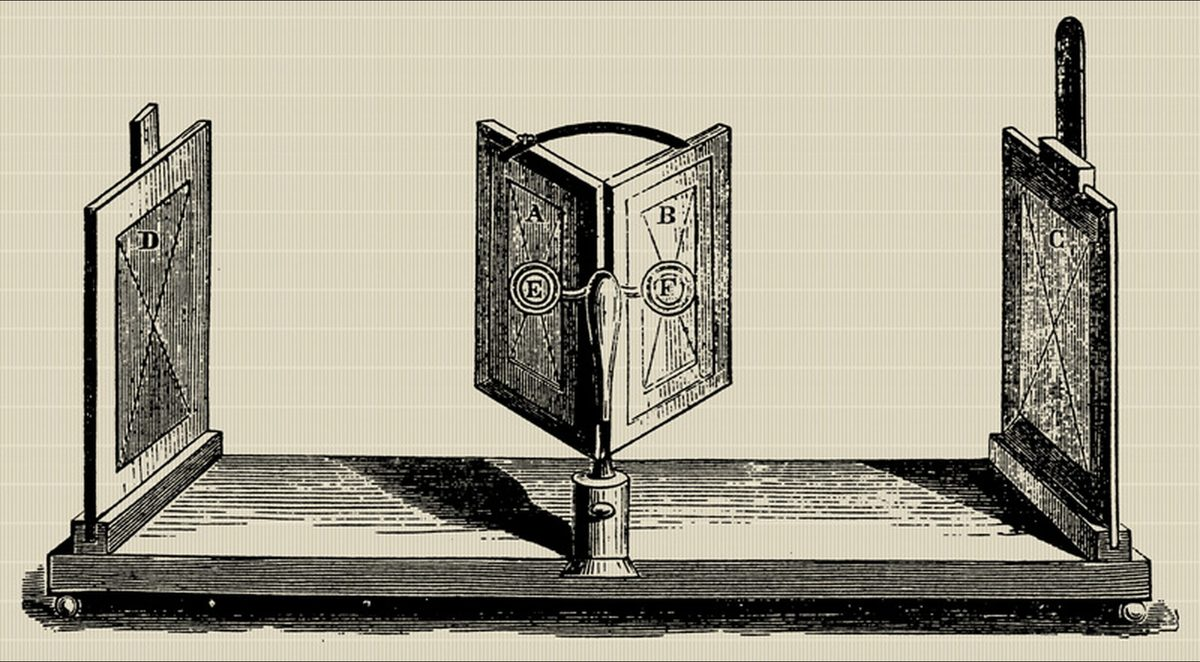
Wheatstone built it to study eyesight, and Brewster made it sell
Wheatstone read his paper, “Contributions to the Physiology of Vision,” to the Royal Society on 21 June 1838. His actual subject was binocular vision: the discovery that each eye receives a slightly different image of a nearby object, and that the brain fuses the two into a single perception of depth. The stereoscope, built from two angled mirrors, was the proof. Look into it, and two flat drawings snapped into a single solid-looking shape.
Wheatstone’s own early stereo images were not photographs at all — they were simple line drawings, carefully rendered twice from two slightly different angles, just far enough apart to mimic the distance between a pair of human eyes. He was confident enough in the underlying principle to write that a skilled artist could draw “flowers, crystals, busts, vases” in stereo pairs so convincing they would be indistinguishable from the real objects. The following year, William Henry Fox Talbot showed the Royal Society a reliable way to fix a photographic image on paper, and Wheatstone immediately saw the fit: by 1840 he had Talbot photographing stereo pairs at Lacock Abbey. But it was the Scottish physicist David Brewster who made the instrument something people would actually buy. In 1849 Brewster designed a small lens-based box in place of Wheatstone’s mirrors — cheaper, portable, and far easier to use. British instrument makers turned him down, so he took the design to the Paris optician Jules Duboscq, who agreed to manufacture it. The two men later fell into a bitter public dispute over who deserved credit for the underlying idea, a quarrel serious enough that Brewster eventually conceded, in writing, that he was “not the discoverer of the Stereoscope,” only of the lenticular version in common use.
The Great Exhibition made it fashionable, though not quite the way the story usually goes
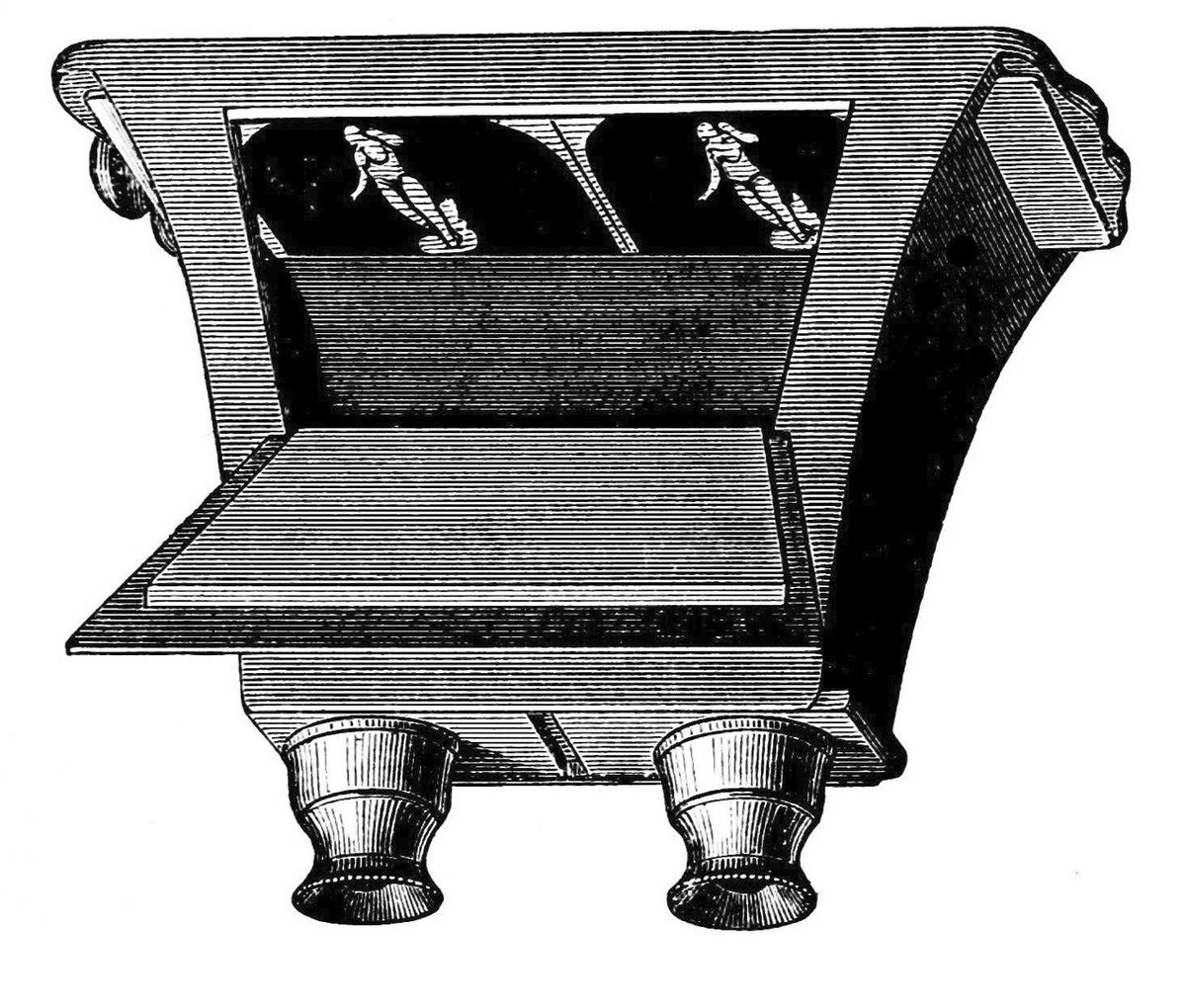
The standard version of what happened next says that Queen Victoria tried Duboscq’s stereoscope at the Great Exhibition in 1851, loved it, and triggered a rush that sold a quarter of a million viewers within months. That figure comes from period accounts and has been repeated by historians ever since. It may also be wrong, or at least early. Research published by the London Stereoscopic Company in 2021 found no actual evidence that Victoria saw Duboscq’s device at the exhibition at all — she did buy a stereoscope, but from a different maker, Antoine Claudet, in late 1852 — and argues the real public craze did not take off until the end of 1856. Some of the myth appears to trace back to Brewster’s own promotional writing.
Whichever date is right, the craze itself is not in dispute. A firm literally named the London Stereoscopic Company launched in 1854 with the slogan “no home without a stereoscope,” and by the 1860s a middle-class parlour without one looked oddly bare. Photographers built special twin-lens cameras, spaced roughly the width of a human face, to shoot the paired images a stereo card needed. What they photographed covered nearly everything: Niagara Falls and the Alps for people who would never travel, comic staged scenes, ethnographic images from colonial expeditions, celebrity portraits, and — sold more quietly — explicit cards that made the stereoscope Victorian society’s most private public entertainment.
The Civil War turned it into the first mass war reporting
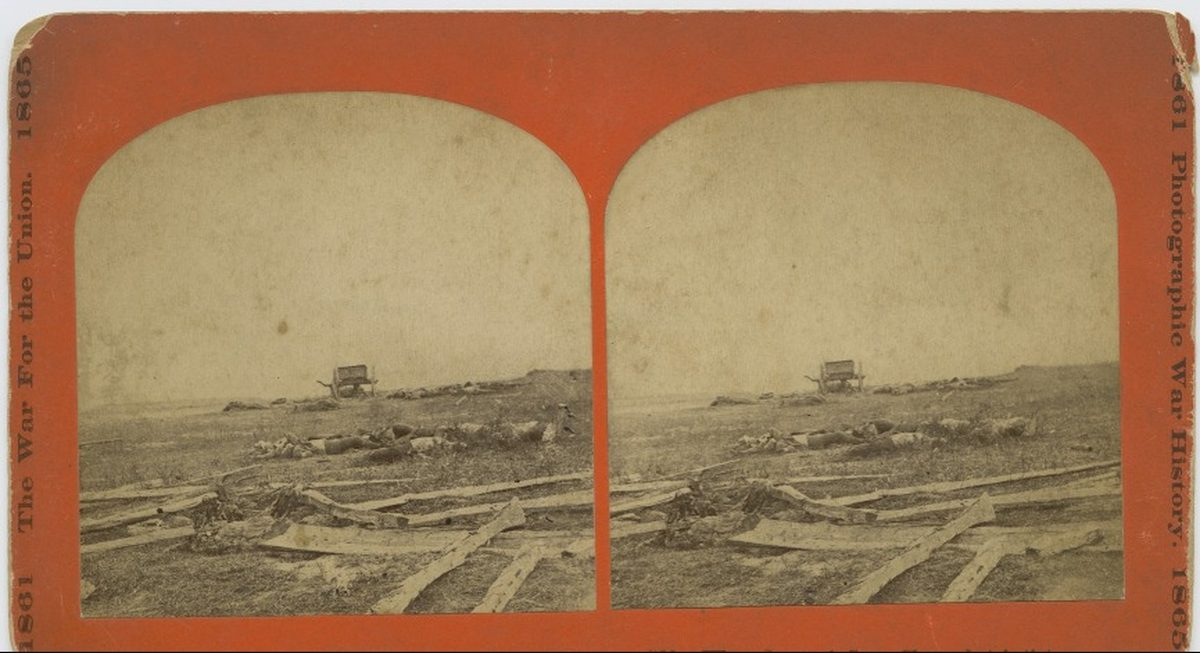
In September 1862, two days after the Battle of Antietam, Alexander Gardner and James Gibson arrived at the battlefield with cameras, chemicals and a portable darkroom, working for Mathew Brady’s New York studio. They photographed the dead where they lay, in stereo, before burial parties had done their work. It was the first time American civilians could look through a viewer in their own parlour and see, in convincing depth, exactly what a battlefield looked like. Crowds lined up at Brady’s gallery to see the results.
Oliver Wendell Holmes, the physician and essayist who would soon design his own stereoscope, wrote about viewing the Antietam series in the Atlantic Monthly the following year, and did not soften it: he called the sight “a repulsive, brutal, sickening, hideous thing,” and admitted he had put the cards away in a drawer rather than look again. That reaction is worth sitting with. The same object that sold Niagara Falls as parlour entertainment also delivered the first photographic war dead directly into American living rooms, and nobody who saw it mistook the two experiences for the same thing.
Holmes designed the version everyone still pictures, and refused to own it
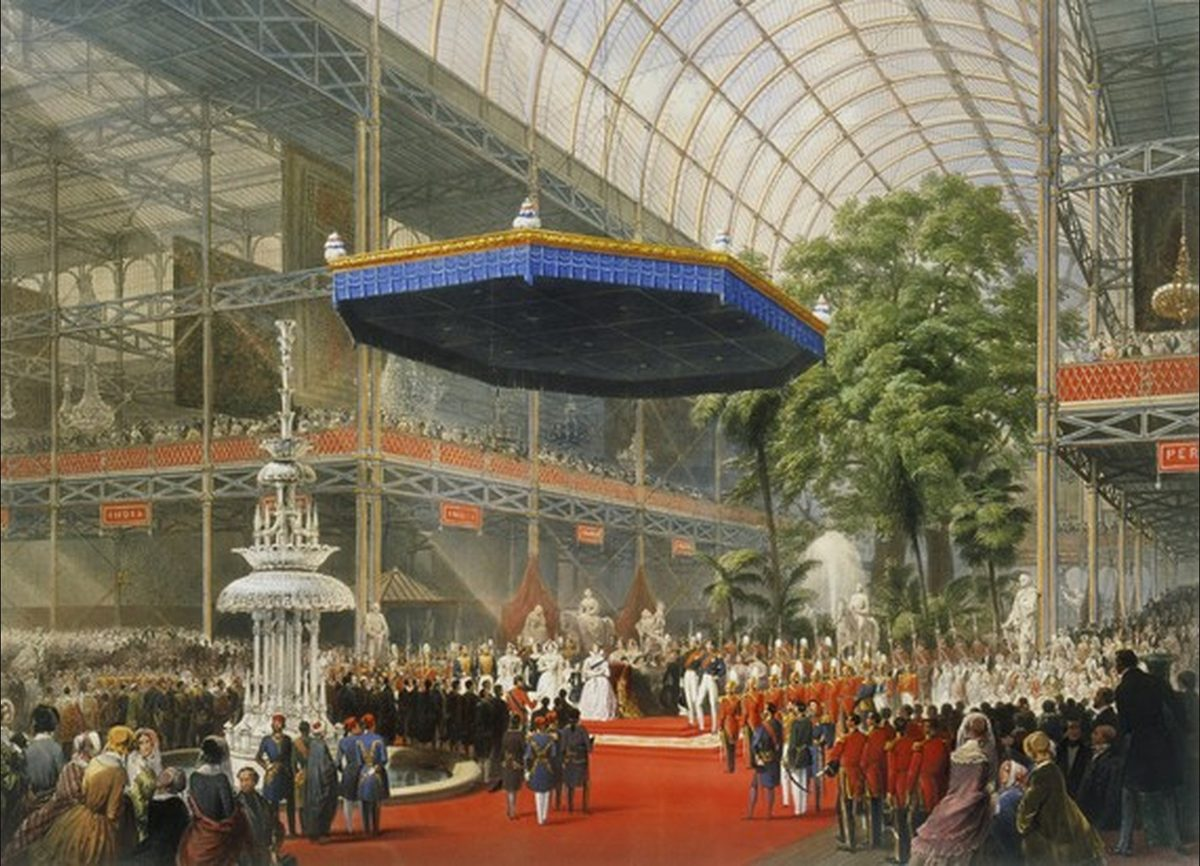
In 1861, Holmes designed a stripped-down handheld viewer: an open wooden frame, a hood to block stray light, and a sliding holder to adjust focus for the user’s own eyes. It was lighter and far cheaper than Brewster’s closed box. Holmes then declined to patent it, writing that he wanted stereo viewing to spread as widely as possible — an open design released free, more than a century before that became a recognisable idea in technology. Manufacturers such as Joseph L. Bates built and sold it by the thousand, and the Holmes stereoscope became the standard American viewer for the next fifty years. It is, by a wide margin, the shape most people still picture when they imagine a Victorian stereoscope.
Holmes is also sometimes credited with coining the word “stereograph” for the paired photograph itself, based on his own 1859 essay proposing the term. The record is messier than that: the word was already circulating in photographic exhibitions and publications before his essay appeared, and Holmes used several other terms for the same thing in the very same piece. It is a small correction, but a useful reminder that even a man closely associated with an invention is not always the source everyone assumes.
By 1900 stereo cards were an industrial product, not a novelty
What had started as a scientific curiosity became, by the turn of the century, a genuine manufacturing operation. Underwood & Underwood, founded by two brothers who began as door-to-door stereograph salesmen in Kansas, was by 1901 publishing roughly 25,000 stereograph cards a day and had produced somewhere between 30,000 and 40,000 distinct titles. Its chief rival, the Keystone View Company of Meadville, Pennsylvania — founded in 1892 by a former Underwood & Underwood salesman — spent the 1910s buying up its competitors’ negative archives, and absorbed Underwood & Underwood’s own stereo stock in 1921–23, building a combined library approaching a million images. Both firms packaged sets for classrooms: boxed “travel systems” of stereo views with guidebooks and maps, delivering geography lessons through a viewer decades before textbooks had colour photographs.
That scale did not survive the arrival of cinema. As moving pictures matured in the early twentieth century, they pulled attention away from static cards, and by the 1920s the parlour stereoscope had become the kind of thing more likely to turn up in an attic than a sitting room. Keystone itself read the writing on the wall: in 1939, the same year a different stereo device was about to have its debut, the company quietly discontinued new stereograph production and moved into visual optometry testing equipment instead, though its archive kept circulating in schools for years afterward.
The same trick came back as a toy, then a wartime tool, then VR
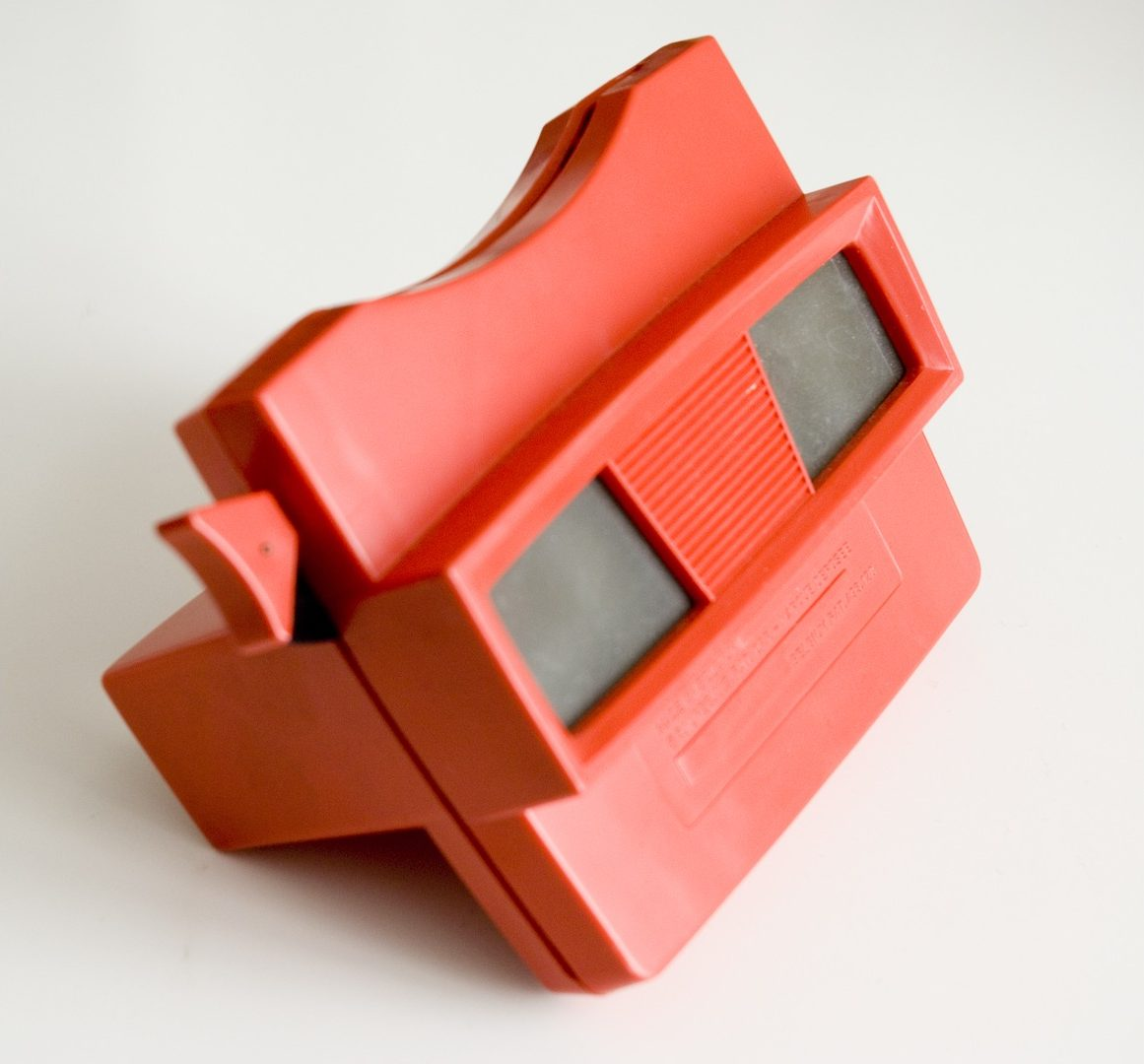
In 1939, an Oregon photographer and piano tuner named William Gruber met a Sawyer’s postcard-company employee, Harold Graves, while on holiday near the Oregon Caves. Gruber had been experimenting with mounting tiny stereo pairs of Kodachrome film onto paper reels; Graves saw a souvenir product in it. The two men, with a third partner, launched the View-Master at the 1939 New York World’s Fair. It ran on exactly the optical principle Wheatstone had demonstrated a century earlier, repackaged as a spinning cardboard disc.
The View-Master’s biggest early customer was not a child. During the Second World War the U.S. military bought more than 10,000 viewers and some six million reels to train personnel on aircraft and equipment identification — a scale of institutional adoption the stereoscope had not seen since the classroom sets of Keystone and Underwood & Underwood. Returning servicemen, impressed by the device overseas, drove much of its postwar consumer demand at home. Every 3D film watched through polarized glasses, and every headset strapped on for virtual reality since, runs on the same underlying fact Wheatstone proved in a lecture room in 1838: show each eye a slightly different image, and the brain does the rest.
Watch the full history
The video version covers the same arc — Wheatstone to Brewster to the parlour craze to the View-Master — in about six minutes.

Related reading
- The WPA Sanitary Privy Program That Built Two Million Outhouses
- The Chemistry Inside a Sauerkraut Crock, and Why It Actually Works
- How Quill Pens Were Actually Made, and Why Steel Killed Them
- How Sod Houses Were Built on the Nebraska Prairie: The Construction, the Homestead Act, and the Life Inside
Works cited
- Wheatstone, Charles. “Contributions to the Physiology of Vision.—Part the First. On Some Remarkable, and Hitherto Unobserved, Phenomena of Binocular Vision.” Philosophical Transactions of the Royal Society of London, vol. 128, 1838, pp. 371–394. Link.
- Mills, Virginia. “180 Years of 3D.” Royal Society blog, 13 Aug. 2018. Link.
- “The Perpetual Myths of Stereoscopy.” The Stereoscopy Blog, 19 Oct. 2025.
- Kellem, Betsy Golden. “In the Stereoscope, Another World.” JSTOR Daily, 25 Sept. 2024. Link.
- Holmes, Oliver Wendell. “Doings of the Sunbeam.” Atlantic Monthly, July 1863, pp. 1–15. Link.
- Furgurson, Ernest B. “Alexander Gardner Saw Himself as an Artist, Crafting the Image of War in All Its Brutality.” Smithsonian Magazine, 8 Oct. 2015. Link.
- Haberstich, David. Guide to the Underwood & Underwood Glass Stereograph Collection, NMAH.AC.0143. Archives Center, National Museum of American History, Smithsonian Institution.
- Rossen, Jake. “Chakka-Chhh: The Hidden History of View-Master.” Mental Floss, 21 June 2017. Link.