
When Ibn Battuta passed through the Maldives in the 1340s, he did the arithmetic a travelling merchant does automatically: what is this actually worth. In Malé, where the shells were harvested straight out of the lagoon, a single gold dinar bought something on the order of four hundred thousand cowrie shells. Seven years later, more than a thousand miles away in the Kingdom of Mali, the same species of shell — the identical object, off an identical reef — traded at roughly eleven hundred to the dinar. It had travelled a long way, and along that route it had become worth several hundred times what it cost where it was picked up.
That gap is close to the whole story in miniature. This is the history of cowrie shell money: a sea snail’s shell that functioned as real money across four continents for roughly four thousand years — longer than any coin, note or metal standard humanity has used since — and of why, once it stopped being hard to get, it collapsed within a single generation. Along the way it filled Bronze Age tombs, minted itself off a coral reef with no forge and no mint, and left a fingerprint in a language that hundreds of millions of people still write every day.
None of it required a government. That is the detail worth holding onto through everything that follows.
A Shell With No Manufacturer Was the Perfect Currency
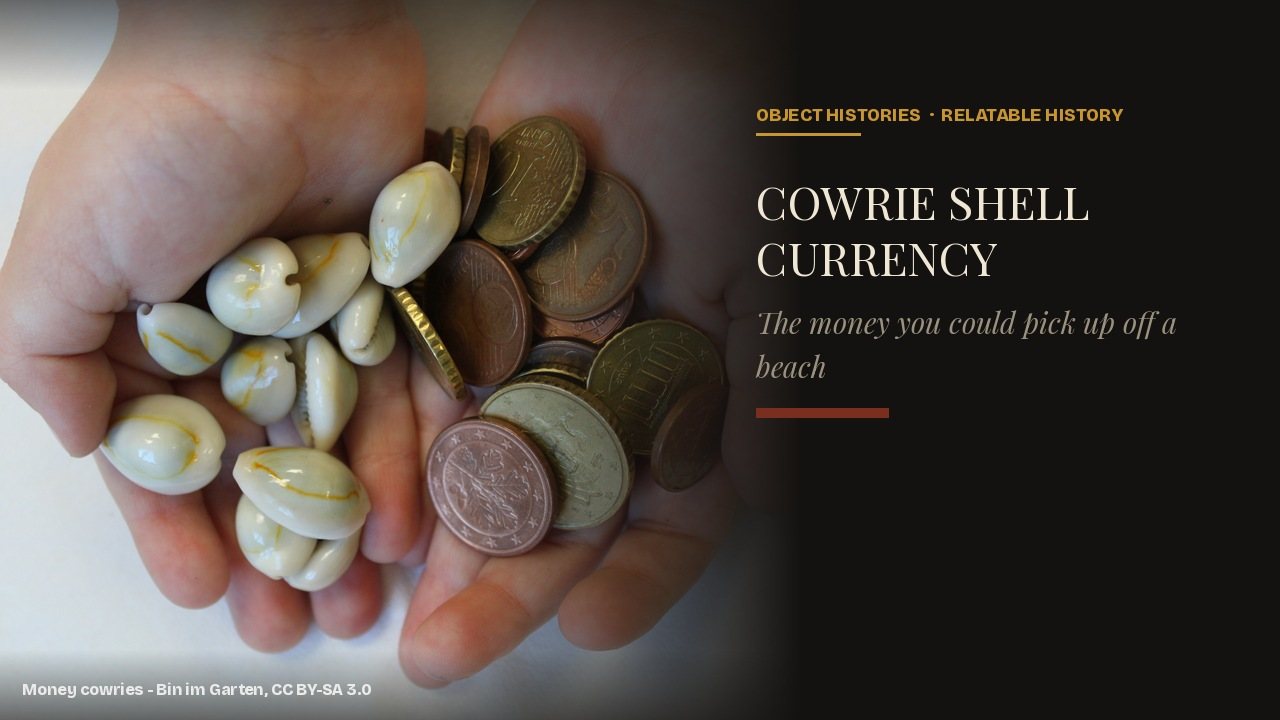
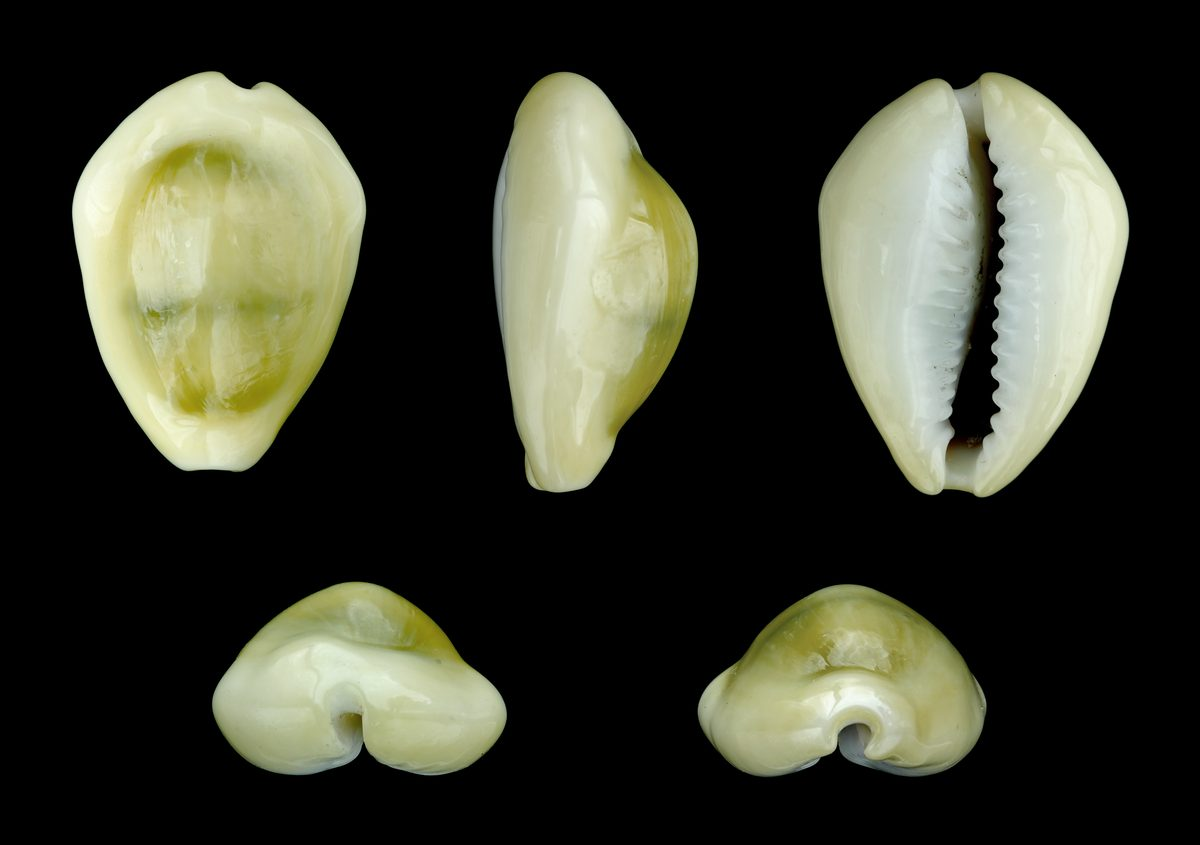
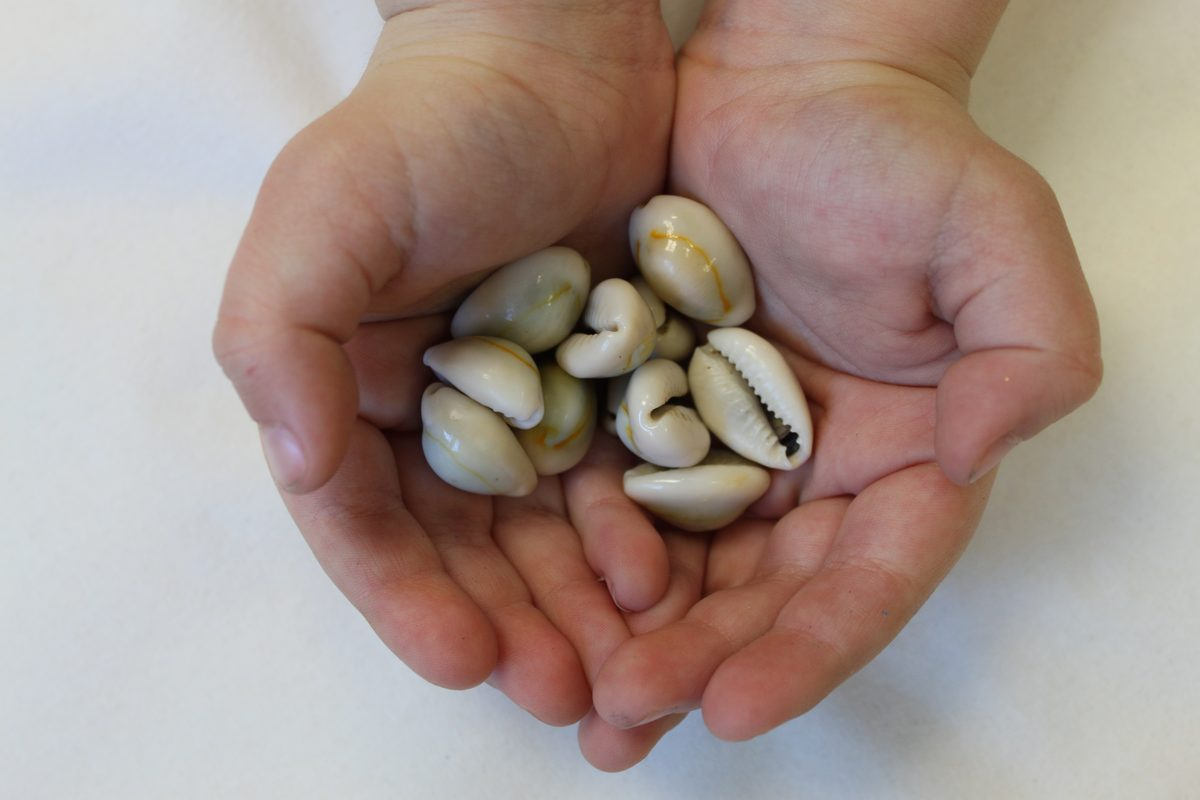
The species doing all this work is Monetaria moneta, the money cowrie: a sea snail found on shallow reef flats across the Indian Ocean and the tropical Pacific, rarely longer than three centimetres, with a glossy porcelain-like shell and a toothed slit running along its underside. It is durable enough to survive millennia buried in the ground, light enough to carry and count by the thousand, and—critically—it has never been successfully counterfeited at any scale. Nobody has worked out how to fake a convincing one, which is more than can be said for hammered coin.
What really disciplined its value, though, was biology rather than law. The snail breeds only in specific warm, shallow lagoons, so the total supply of shells in the world was capped by nature, not by a mint or a monarch deciding how much to issue. For most of its working life, that made it about as stable a store of value as anything humans have used. A related, larger, and slightly less prized species, Monetaria annulus, the ring cowrie, circulated more cheaply in parts of East Africa — a detail that becomes important later, when someone worked out how to ship it somewhere it wasn’t cheap.
China Buried Its Dead With a Fortune in Shells
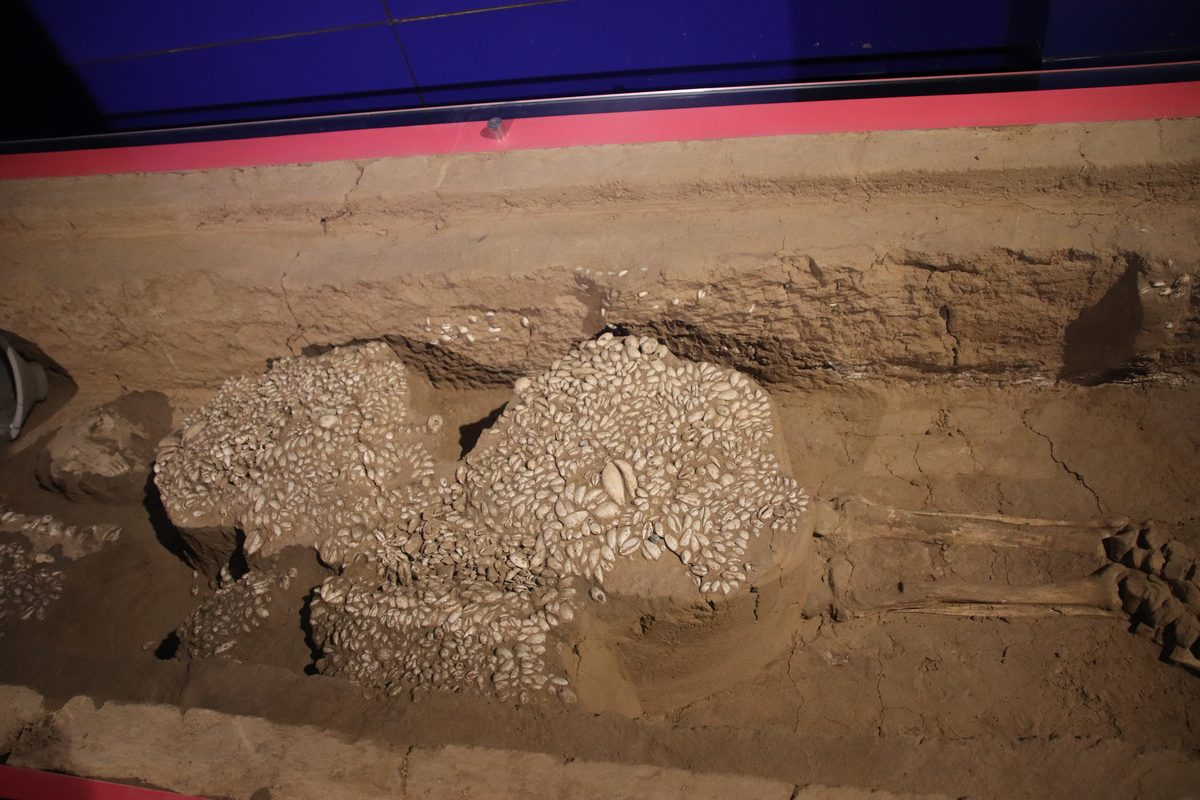
Cowries are not native to inland China, so every shell that ended up there had already travelled a long way before anyone spent it. The earliest substantial hoards come from Shang dynasty sites beginning around the sixteenth century BCE, and the clearest single example is the tomb of Fu Hao, a royal consort and military commander under King Wu Ding, excavated at Anyang in 1976. It is the only Shang royal burial ever found undisturbed by looters, and alongside its bronze vessels, jades and sacrificial remains, archaeologists recovered roughly 6,900 cowrie shells — a private fortune in small change, sealed underground for three thousand years.
Bronze inscriptions from the same period record kings rewarding officers with gifts of strung cowrie shells, which is about as good a sign as exists that the shells were treated as a serious medium of value rather than a curiosity. And when demand eventually outran what the trade routes could supply, Chinese workshops did something telling: rather than give up on shell money, they started counterfeiting it themselves, casting imitation cowries first in bone and jade and eventually in bronze. Actual coinage arrived only later, and displaced the real shells for good once the Qin standardised currency after unification.
The shell never left the language, though. The oracle-bone pictograph of a cowrie became the character bèi (贝), and it still sits as the radical inside most Chinese characters to do with money: wealth, goods, buying, selling, expensive, cheap. More than three thousand years after the last shell changed hands for anything, the outline of one is still there on the page.
The Maldives Ran a National Mint on a Coral Reef
By the time written records pick up the trade in detail, nearly the entire global supply of Monetaria moneta was coming from one archipelago: the Maldives, a chain of low coral atolls southwest of the tip of India. The harvesting method used there for over a thousand years needed no tools beyond what grew on the islands already. Bundles of coconut palm fronds were sunk in the shallow lagoon; cowries climbed aboard to graze on the detritus that collected on the leaves, especially in the days bracketing the full moon, when tidal movement concentrated them. The loaded fronds were hauled onto the beach, the shells were killed in the sun and buried in pits until the flesh had rotted away, then washed, sorted by size, and packed for export.
No smelting, no dies, no bullion. The entire operation ran on leaves, sun, sand and patience, and it supplied money to a meaningful share of the medieval and early modern world.

One Shell, a Thousand Different Prices
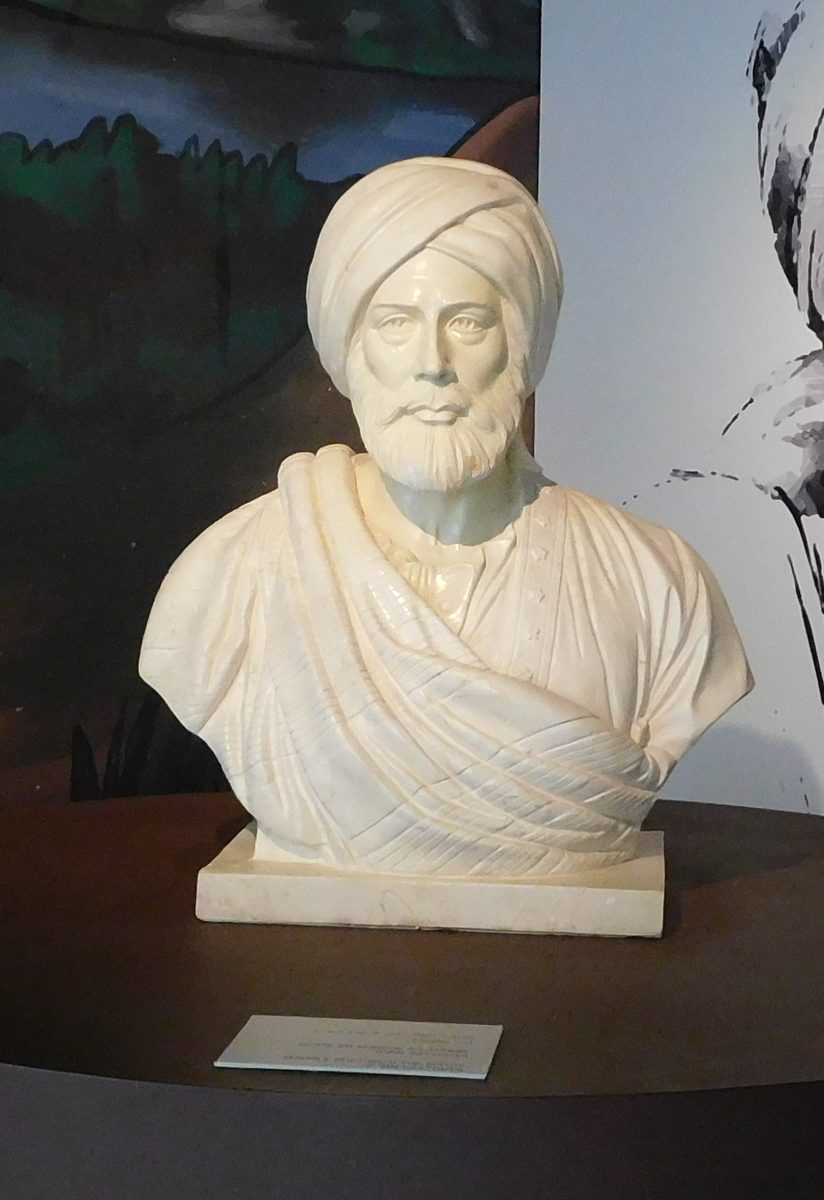
Ibn Battuta spent close to two years in the Maldives across the 1340s, serving for a time as a judge, and his account — dictated afterward to Ibn Juzayy and preserved in the Rehla — is the earliest detailed eyewitness record of the trade’s sheer scale that survives. He put the annual export at more than forty shiploads of cowries a year, sailing mostly for Bengal, traded directly for rice: the one staple a coral atoll cannot grow.
Once ashore, the shells didn’t just change hands, they got counted into an entire nested accounting system. Regional practice varied, but a common Bengali reckoning ran four cowries to a ganda, then up in stages through budis, panas and kahans until a fixed number of kahans equalled one silver rupee. As late as 1821, a rupee in Bengal was still officially reckoned at roughly 2,568 cowries. The shells were doing exactly the job small-denomination coinage does today: pricing the transactions too small for silver to bother with.
Shells Went West, and the Volume Changed Everything
From the seventeenth century, Dutch and English trading companies began buying Maldivian cowries in bulk and carrying them not east to Bengal but west, around Africa, to the coast of West Africa — where cowries had already been arriving for centuries via trans-Saharan caravan. What European shipping added was volume on a scale the overland routes never matched. Over the following two centuries cowries became the standard small-denomination currency across a vast stretch of West Africa, used to price a chicken, a day’s labour, a length of cloth — the ordinary transactions of ordinary life.
That volume of shipping did not move in a vacuum. Much of it passed through the same Atlantic ports, in the same period, as the trade in enslaved people, and the two economies were entangled: cowries were among the currencies used on the West African coast to price and purchase captives bound for the Middle Passage. That is serious enough that the standard modern academic study of the shell’s economics in the region is titled, plainly, The Shell Money of the Slave Trade. A currency’s history is inseparable from what it was used to buy.
The Shell That Broke Itself
The system had held for centuries because nobody could simply manufacture more cowries. That protection ended in 1845, when a Hamburg trading firm bought a cargo of the cheaper ring cowrie, Monetaria annulus, abundant off Zanzibar, and sold it at Whydah, in the Kingdom of Dahomey. It was a slightly different shell, and slightly less prized, but close enough to pass. Other European firms followed the pattern, and over the following decades something on the order of sixteen billion shells entered West African markets from the Zanzibar supply alone.
Historians call what followed the “great cowrie inflation,” though it is worth saying where the evidence gets thinner: Hogendorn and Johnson, whose research the popular version of this story rests on, caution that direct proof of one sharp inflationary collapse is harder to pin down than the label suggests, and that West African markets may have absorbed a good share of the new supply through expanded trade rather than pure currency debasement. What is well documented is the long trend: at Kano, a major trading city in what is now northern Nigeria, the shell-to-dollar exchange rate moved from roughly 2,000 cowries in 1820 to roughly 2,500 by the 1850s, and kept climbing. Counting large sums became its own chore — moving enough shells to buy anything substantial was, by the end, a haulage problem before it was a price problem.
What Cowrie Shell Money Left Behind
By the time colonial administrations began insisting on their own coins and notes in the late nineteenth and early twentieth centuries, the cowrie was already a wounded currency, and the paperwork of empire finished the job in most places within a generation or two. It did not vanish outright: cowries kept circulating for the smallest daily transactions well into the twentieth century in markets where new coinage was scarce, and they never left ritual life at all — sewn onto cloth, headdresses and divination trays across West Africa, a role that has now outlasted their use as money by well over a century.
And in the one place the shell’s monetary career began, its trace never left at all. Every time a Chinese speaker writes a word for wealth, for buying, for selling, for something expensive, they are still drawing — without necessarily knowing it — the outline of a cowrie first sketched onto an oracle bone more than three thousand years ago. A currency is supposed to need a government behind it. This one ran on a coral reef, a bundle of palm leaves, and roughly four thousand years of everyone simply agreeing that it worked — until, all at once, in the space of one overstuffed generation, it stopped.
Watch the full history
The video companion covers the same currency in about six minutes, from the Shang tombs to the shiploads Ibn Battuta counted leaving the Maldives.

Related reading
- What Caused the Bronze Age Collapse?
- Butter and Egg Money: How Farm Wives Financed the Household
- The Farm Soap That Almost Never Hardened Into a Bar
- The Mystery of the Beale Ciphers, Explained
Works cited
- Yang, Bin. Cowrie Shells and Cowrie Money: A Global History. Routledge, 2019.
- Johnson, Marion. “The Cowrie Currencies of West Africa, Part I.” The Journal of African History 11, no. 1 (1970): 17–49. Link.
- Hogendorn, Jan, and Marion Johnson. The Shell Money of the Slave Trade. Cambridge University Press, 1986. Link.
- Ibn Battuta. The Rehla of Ibn Battuta. Translated by Mahdi Husain. Gaekwad’s Oriental Series, Baroda, 1976. Link.
- “War and Sacrifice: The Tomb of Fu Hao.” Smarthistory. (Accessed via smarthistory.org; cited as print due to bot-wall access restrictions.)
- “Cowrie.” Banglapedia, Asiatic Society of Bangladesh. Link.
- “Currency System.” Banglapedia, Asiatic Society of Bangladesh. Link.
- Qiu Xigui. Chinese Writing. Translated by Gilbert L. Mattos and Jerry Norman. Society for the Study of Early China and Institute of East Asian Studies, University of California, Berkeley, 2000.
- “Shell Money.” The Conchological Society of Great Britain and Ireland. Link.