
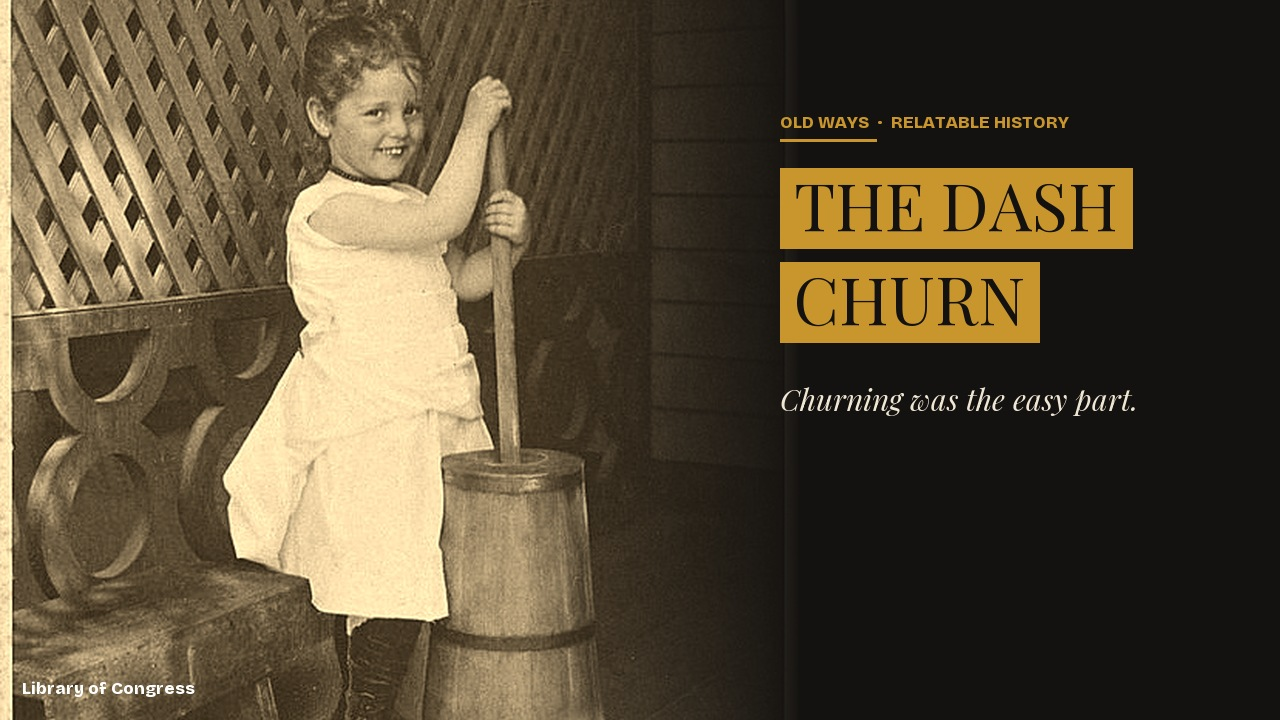
In 1840, the dairy manufactures of the United States were valued at roughly $33.8 million — almost all of it butter and cheese made in farm kitchens, by women, with no factory anywhere near it. That number is easy to skate past. It is worth pausing on, because for a great many nineteenth-century women it represented something rare: money that was recognized, in practice if rarely in law, as theirs.
Butter and egg money is the name historians and the women themselves gave to this income. It was not a wage, not an inheritance, and not the household’s farm income proper — that belonged, on paper and mostly in fact, to the man who held the deed. It was the separate, informal economy built out of the things a farm wife raised and made herself: eggs, garden produce, and butter, sold or bartered at the local store, one basket and one crock at a time.
The dash churn is where a great deal of that money started. Not because churning itself was skilled or valuable — it mostly wasn’t — but because of what a woman was allowed to do with the crock of butter that came out the other end.
Whose income butter and egg money actually was
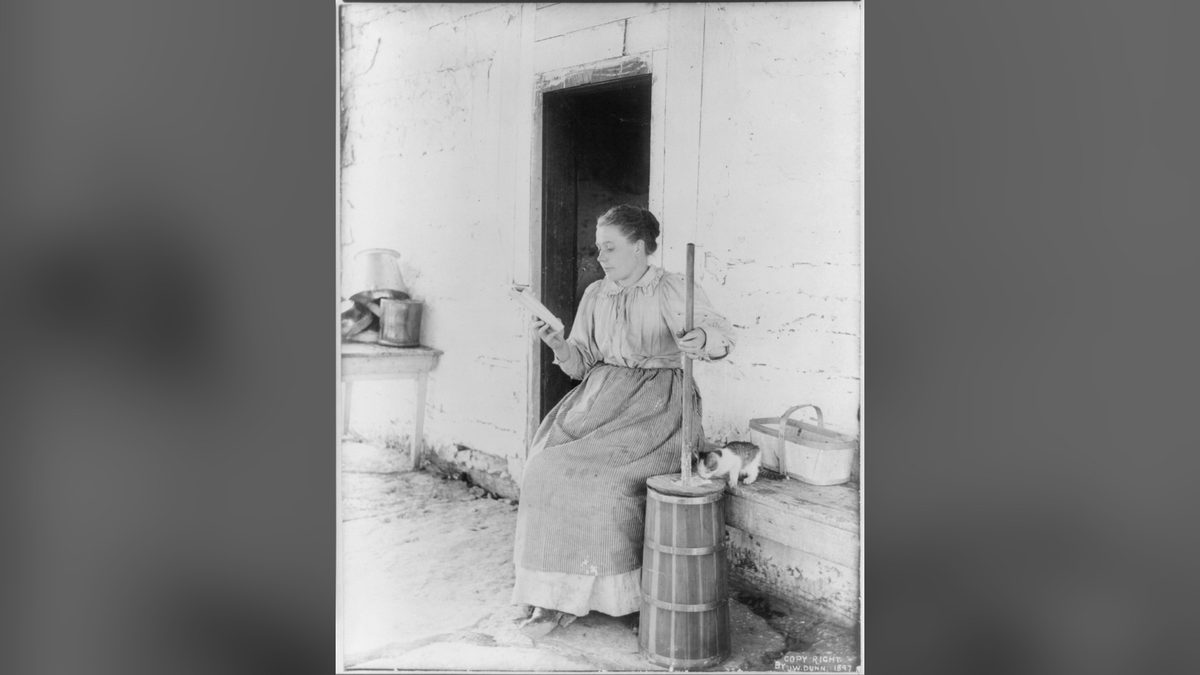
The legal position through most of the nineteenth century was blunt: a married woman’s earnings, in most states, belonged to her husband. Married Women’s Property Acts chipped away at this state by state from the 1840s onward, but enforcement and custom lagged the statute books by decades. Butter and egg money persisted alongside that legal reality rather than because of it. Historian Sally Ann McMurry, who studied dairying households in Oneida County, New York, found that the money from butter, cheese and eggs was treated, by common household agreement, as the wife’s own — hers to spend on coffee, cloth, a subscription, a doctor’s visit, without asking.
That distinction mattered because farm cash was otherwise chronically scarce. A nineteenth-century farm ran mostly on barter and credit; actual coin showed up rarely, and when it did it was earmarked for taxes, seed, or a mortgage payment. Butter and egg money was, for long stretches, the only truly discretionary cash in the house, and it flowed through the wife’s hands first. McMurry’s account of Oneida County dairying makes a further point that cuts against a simple story of drudgery: many women eventually welcomed handing the heavy dairy labor over to factories precisely because it did not cost them this income — cheese factories and creameries paid out in cash for milk delivered, and a household could redirect a wife’s freed-up hours into other paid work without losing the butter-money habit entirely.
How much this amounted to is unusually well documented for one Maryland tobacco farm, because the wife kept a diary. Elizabeth Bourne Robinson, who ran the dairy, garden and poultry side of Ferndale Farm near Brandywine in Prince George’s County, recorded her butter and egg totals at the close of every month from 1951 onward. In 1951 she logged $151.90 from butter and $85.35 from eggs, $237.25 together, against 5,062 eggs collected that year. In 1952 the total was $211.30; in 1953, $255.80. Her diary tracks almost nothing else in dollar figures — not the tobacco crop, not her husband’s earnings — which is itself a clue to which money in the household was hers to account for.
The churn was cheap on purpose, and that was the point
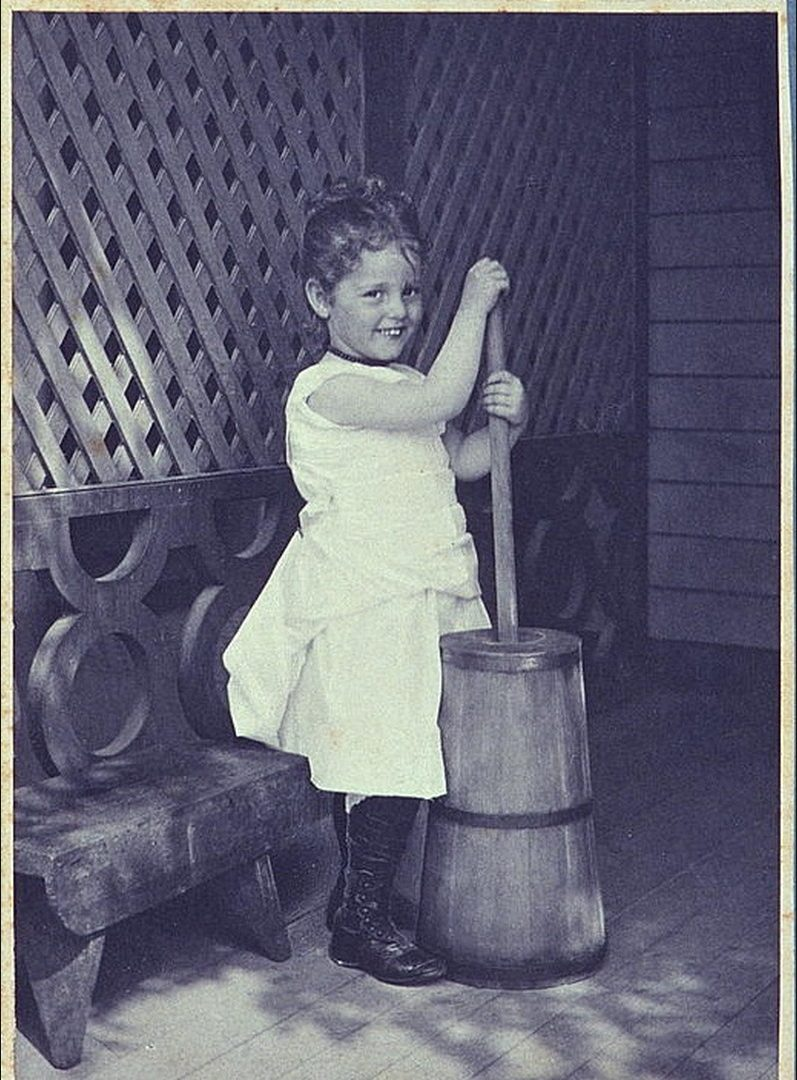
A dash churn cost a dollar or two and lasted a generation, which is part of why it survived so long alongside faster barrel and crank churns that farms could also afford. It required no engineering expertise to operate or repair, which meant it was never treated as specialized equipment reserved for a hired hand or the man of the house. It belonged, by default, to whoever worked it, and whoever worked it was almost always a woman or a girl.
Not every churn stayed this simple. American patent offices logged dozens of churn designs across the century, from rocking box churns to the frankly startling dog-powered churn: a small treadmill connected by a flywheel and pitman rod to a dasher, so that a dog or goat trotting in place did the agitating. The Smithsonian’s National Museum of American History holds a patent model of one, credited to H. M. Childs of Utica, New York, in 1871. None of these mechanized versions displaced the dash churn on most small farms. They cost more, needed upkeep, and solved a problem — the labor of agitation — that was never really the expensive part of making butter.
Barrel and box churns, mounted on a frame and turned by a crank, did genuinely cut the working time and found their way onto larger or wealthier farms through the second half of the century. Even there, the dash churn tended to survive as the second churn: the one used for a small batch, or handed to a child as a first chore, long after the household could afford something faster. Its persistence was not really about performance. A tool that cost almost nothing, belonged to no one in particular, and asked nothing of a man’s cash or a man’s workshop was, functionally, a tool that stayed under a woman’s control by default.
What made butter valuable was the part after the churning
Cheap, interchangeable churns meant that butter itself was not a scarce skill. What was scarce, and what actually set the price, was a reputation for consistently good butter — properly washed, worked free of buttermilk, evenly salted, and packed clean. Potteries across Ohio and Pennsylvania turned out huge quantities of salt-glazed stoneware churns and butter crocks through the second half of the century for exactly this trade; the Henry Ford museum’s collection includes an eight-gallon stoneware churn from 1865 to 1880 typical of the type, cobalt-decorated and stamped with its capacity.
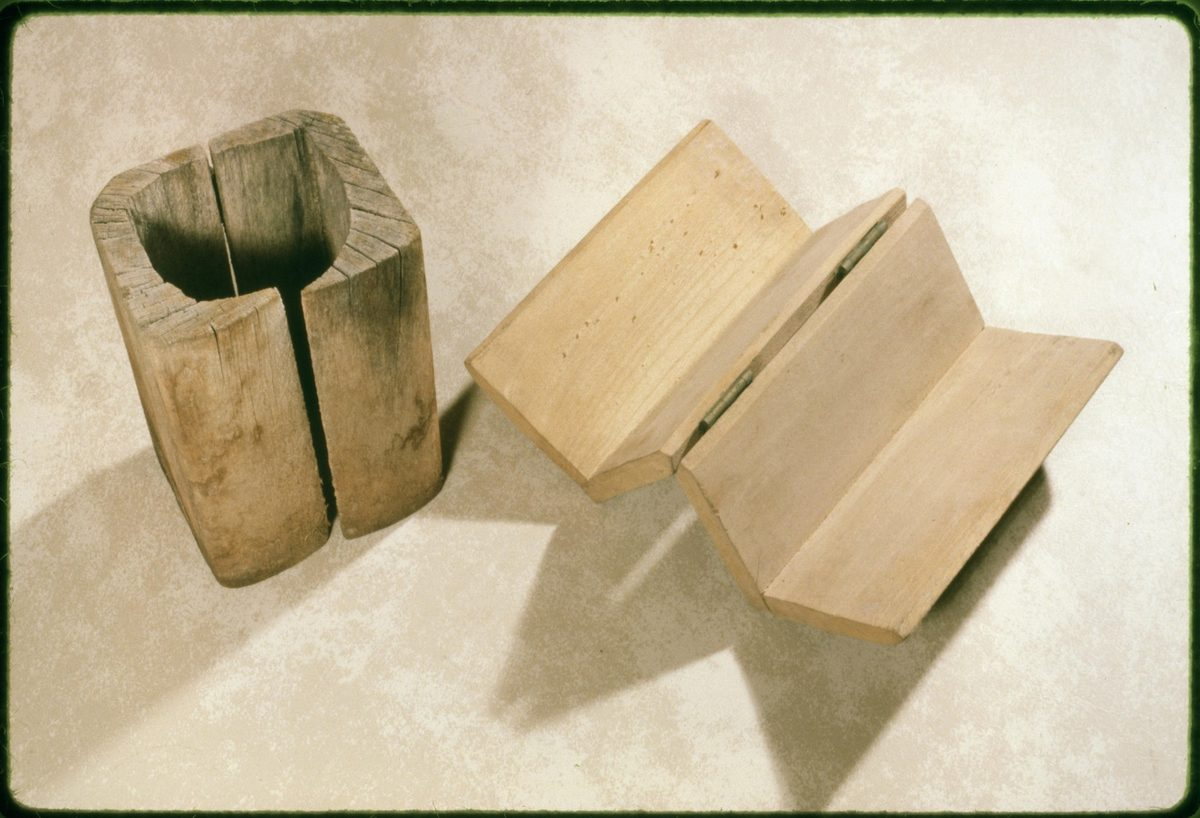
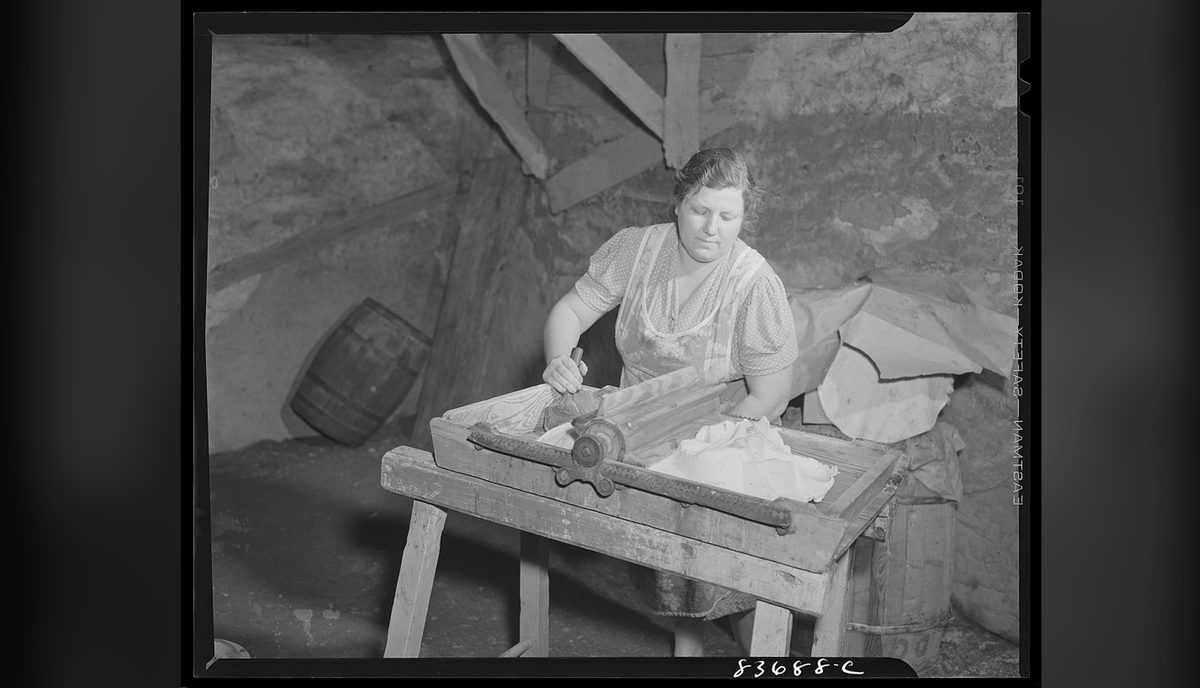
The final step in the process was branding, literally. A wooden butter print carved with a sheaf of wheat, an acorn, or a cow stamped a maker’s mark into every pound before it went to the store. A storekeeper who saw that mark knew immediately whose butter it was and what it was worth. A woman whose butter reliably held up earned a real premium over the going rate; a woman whose butter went rancid on the shelf got trade credit at a discount and no negotiating room the next time. The churn made the raw material. The print and the reputation behind it made the money.
The dairy industry sued, lobbied and taxed to protect this market
Butter’s value depended on scarcity holding, and by the 1870s that scarcity was under direct threat. A French chemist working under a prize offered by Napoleon III had developed a cheap butter substitute from beef fat, called oleomargarine, and by the mid-1870s American companies were manufacturing and selling it at a fraction of butter’s price. Because it could be colored to look exactly like butter, it also threatened something the dairy trade could not easily replace: trust in a maker’s mark.
Dairy interests responded with the political tools available to a well-organized industry. Congress passed the Oleomargarine Act in 1886, imposing a two-cent-per-pound tax on the product and licensing fees on manufacturers and dealers steep enough to discourage the trade outright. States went further. Beginning with Vermont in 1884, a wave of state legislatures required margarine to be dyed an unappetizing pink before sale, on the theory — stated almost openly in the legislative debates — that no one would willingly buy pink butter. The laws worked as intended for over a decade. They were finally struck down by the U.S. Supreme Court in Collins v. New Hampshire in 1898, which held that a law designed purely to make a legal product repulsive to buyers exceeded a state’s regulatory power. Congress responded in 1902 by taxing artificially colored yellow margarine instead, a workaround that stayed on the books until 1950.
It is worth being plain about what this fight actually protected. Framed in Congress as a matter of public health and honest labeling, the practical effect of the tax and the color laws was to prop up the price of butter against a cheaper competitor for as long as politically possible — and every cent of that price difference passed through, eventually, the same crock and the same kitchen table where butter and egg money was counted out.
The technology that ended the dash churn also moved the money
The dash churn’s real replacement was never a better churn. It was Gustaf de Laval’s continuous centrifugal cream separator, patented in Sweden in 1878 and sold in the United States from the 1880s, first as large machines installed at creameries and then, after 1885, as smaller versions a single farm could own. A separator pulled cream out of whole milk in minutes rather than the day or more that gravity settling in pans required, and it did it well enough that creameries could buy cream by the can and turn out a more consistent, more cheaply produced product than most individual farm kitchens could match. By 1900, factory butter output had overtaken farm butter output for the first time.
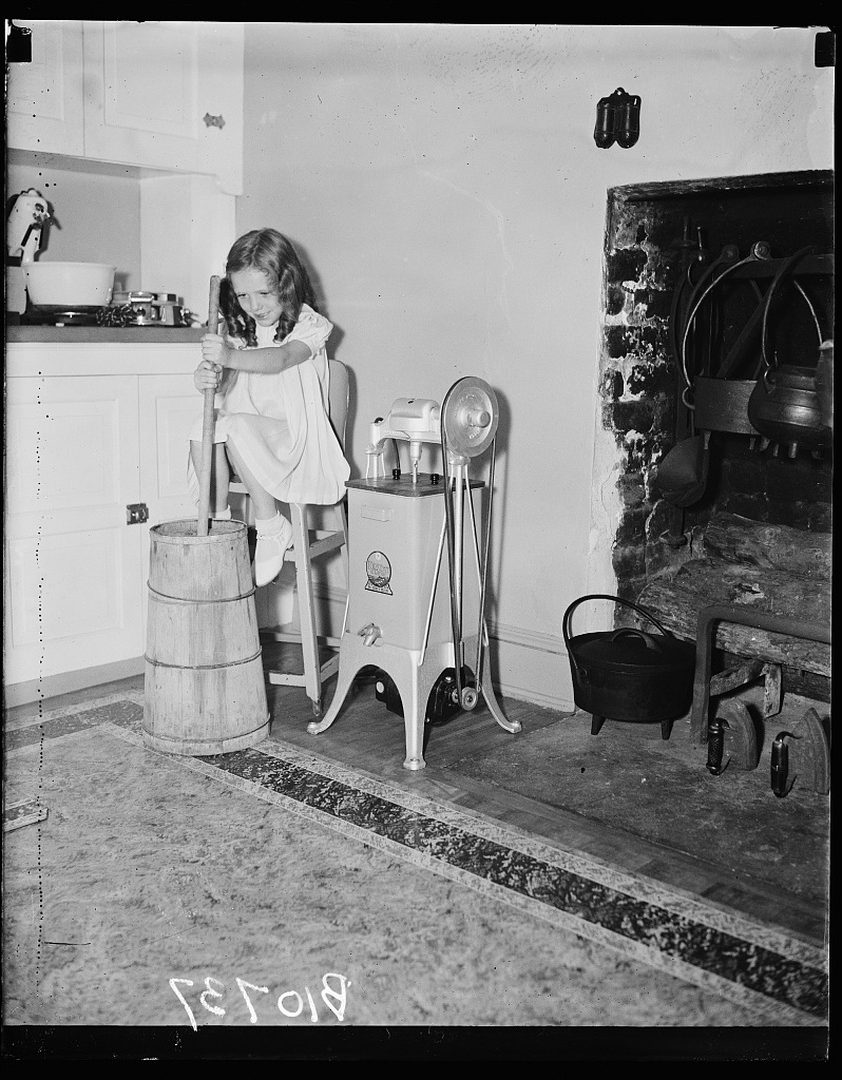
That shift did more than retire the dash churn to a corner of the porch as an umbrella stand, which is largely where they ended up. It moved the last stage of butter-making, and the income built on top of it, out of the farmhouse kitchen and into a facility that paid the farm household in cash for raw milk or cream delivered, rather than paying a woman directly for a finished, branded product she had made and stood behind herself. McMurry’s research suggests many women were glad to be rid of the labor. Whether they were equally glad to see where the money went next — increasingly into a household account rather than a butter crock with her name effectively on it — is a harder question, and not one the record answers neatly.
Elizabeth Robinson’s diary is again a useful marker here, because it runs well past the dash churn’s working life on most American farms. Her own butter-and-egg tally continued into the 1950s all the same, kept separately from the farm’s books in the same way her predecessors had kept theirs a century earlier. The churn itself was, by then, largely gone from active use. The habit of a woman totting up what was unmistakably her own money, in her own column, at the end of the month, outlasted it.
Watch the full history
The video companion to this piece covers the mechanics of the churn itself — the temperature science of churning, and the washing, working and salting that turned grains of fat into butter worth selling.

Related reading
- Why the World’s First Bicycle Craze Collapsed in Eighteen Months
- The Farm Soap That Almost Never Hardened Into a Bar
- The Contested History Behind Blue Monday Washday
- How Kerosene Lamps Actually Worked (And Sometimes Exploded)
Shop
Sources on the fuller story of butter, and a modern churn built to the same dash-churn principle:
Works cited
- Lampard, Eric E. “Dairy Industry.” In Dictionary of American History, 3rd ed. New York: Charles Scribner’s Sons, 2003.
- McMurry, Sally Ann. Transforming Rural Life: Dairying Families and Agricultural Change, 1820–1885. Baltimore: Johns Hopkins University Press, 1995. Link.
- Rønholt, Stine, Ann S. Madsen, Jacob J. K. Kirkensgaard, Kell Mortensen, and Jes C. Knudsen. “Effect of Churning Temperature on Water Content, Rheology, Microstructure and Stability of Butter during Four Weeks of Storage.” Food Structure 2, no. 1–2 (2014): 14–26.
- U.S. Census Office. Report on the Manufactures of the United States at the Tenth Census (June 1, 1880), Vol. 2. Washington, D.C.: Government Printing Office, 1883. Link.
- National Museum of American History, Smithsonian Institution. “Dog-Powered Butter Churn Patent Model.”
- The Henry Ford. “Eight Gallon Stoneware Churn, 1865–1880.” Link.
- Daley, Jason. “The 1870s Dairy Lobby Turned Margarine Pink So People Would Buy Butter.” Smithsonian Magazine, June 1, 2017.
- U.S. House of Representatives, Office of the Historian. “The Oleomargarine Act.” History, Art & Archives. Link.
- Collins v. New Hampshire, 171 U.S. 30 (1898).
- Tekniska museet (Swedish National Museum of Science and Technology). “Gustaf de Laval — The Milk-Cream Separator.” Link.
- Stowe-Alekman, Lily. “Butter and Egg Money.” Smithsonian Collections Blog, Archives Center, National Museum of American History, January 24, 2022. Link.