
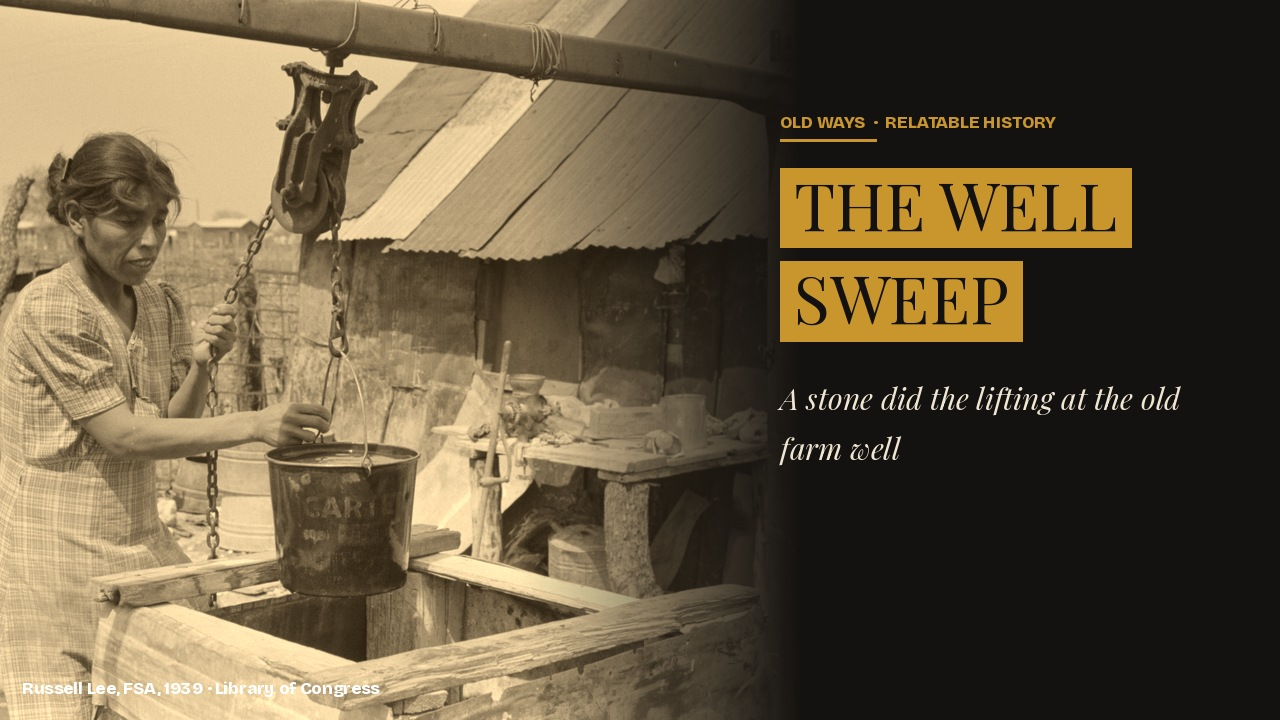
A full bucket of well water weighs about twenty-five pounds, and for most of human history somebody had to lift that weight with their arms, one bucket at a time, however deep the well. The well sweep got around that problem without gears, without a motor, and without much more than a tree trunk and a rock. It is one of the oldest labor-saving machines still recognizable today, and on many American farms it was doing its job within living memory of the automobile.
What made it work was not cleverness about water. It was cleverness about weight — specifically, about never actually lifting a full bucket at all. Understood as a piece of engineering rather than a piece of nostalgia, the sweep explains a great deal about how a farm household budgeted its labor before electricity, and about how much of that labor a single well-placed stone could absorb.
The lever did almost all of the lifting
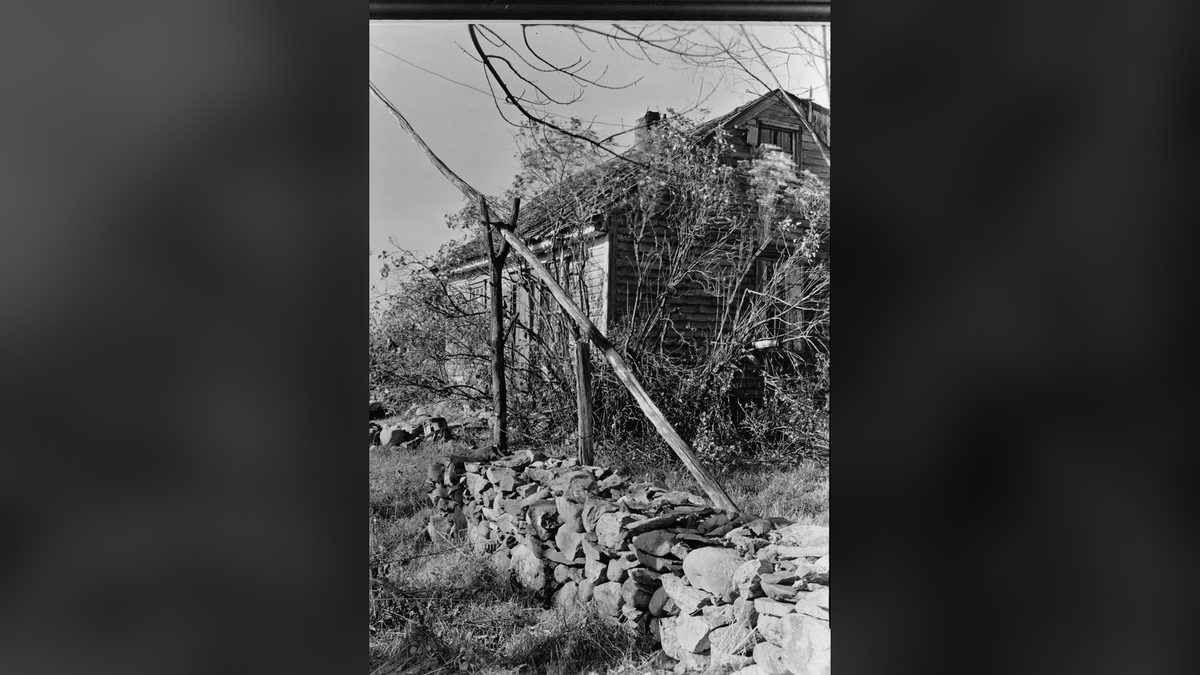
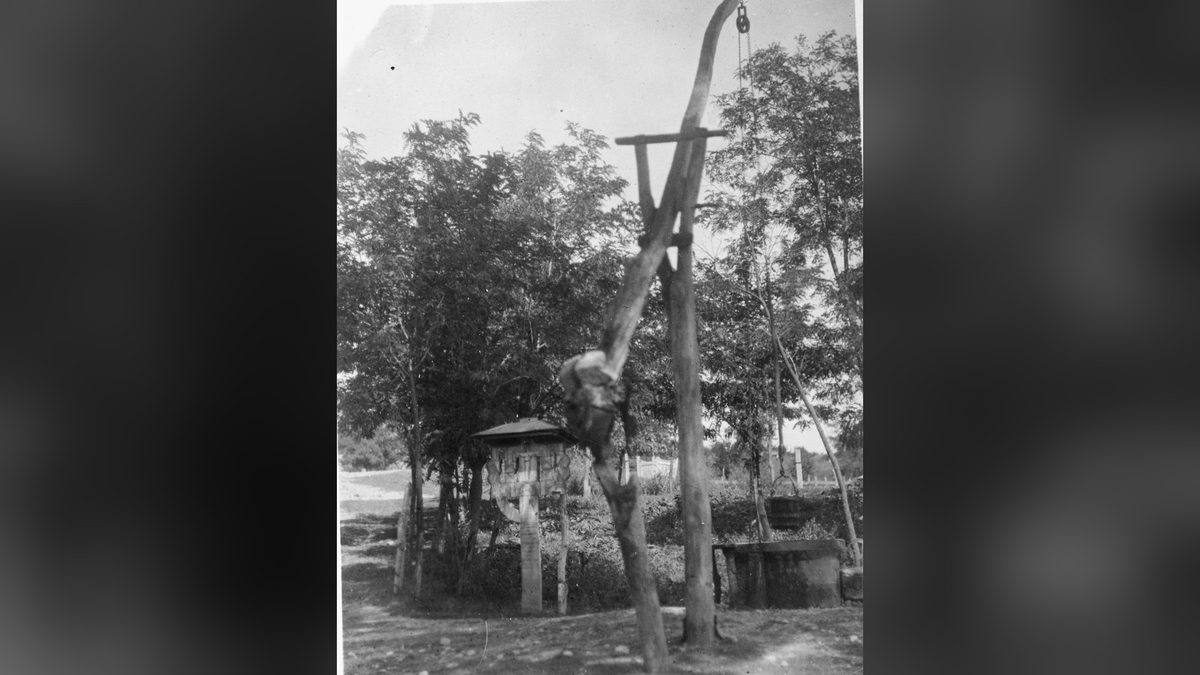
A sweep is a second-class lever mounted on a pivot, the same family of machine as a seesaw or a wheelbarrow. A forked post held a long pole — often a peeled sapling twenty feet or more — balanced across it on a wooden pin. One end, the heavy end, carried a stone or a chunk of log lashed on as a counterweight. The other end reached out over the well curb, with a shorter pole or a length of chain hanging from it and the bucket on the end of that.
The counterweight was not there to help lift the bucket. It was sized to roughly match an already-full bucket’s weight, so that the system rested in equilibrium with water aboard. Hauling water meant pulling the light end down by hand — fighting the counterweight on the way down, not on the way up — which sank the bucket into the well and let it fill. Release the pole, and the counterweight did the rest, swinging the loaded bucket up to curb height on its own. The operator’s own strength was spent lowering an empty bucket, the easiest half of the job; gravity handled the hard half.
The design had one hard limit: reach. A pole can only pivot through so many feet before the geometry stops working, so a sweep was a shallow-well machine, generally good to perhaps twenty feet of lift. Where a farm’s water sat deeper than that, the fix was a windlass instead — a horizontal drum turned by a hand crank, winding in a rope with each revolution and holding a full bucket in place with a ratcheting pawl when the crank was let go. A windlass traded the sweep’s near-effortless lift for unlimited depth, at the cost of real, if geared, muscle.
The same lever appears on a wall painted three thousand years ago
The well sweep’s counterweighted cousin, the shadoof, is one of the best-documented machines of the ancient world precisely because Egyptian artists kept painting it. A garden scene from the tomb of Ipuy, a sculptor who worked at Deir el-Medina under Ramesses II, shows the device in use irrigating a formal garden; the painting, now held in facsimile at the Metropolitan Museum of Art, dates to roughly 1295 to 1213 BC. The mechanism it depicts — a pivoted pole, a counterweight, a vessel on a cord — is functionally identical to the wooden sweep still standing in New England dooryards in the twentieth century.
That continuity is not an accident of limited imagination. There are only so many ways to move water uphill with no external power source, and a counterweighted lever is close to the simplest possible answer: it needs no fitted parts, no lubrication, and nothing that cannot be replaced with a hatchet and a length of rope. The device outlived the empire that first painted it, crossed into medieval and early modern Europe, and arrived in North America with the earliest English and Dutch settlers, who built it the same way their counterparts had for well over two thousand years.
Digging and placing the well was its own kind of hazard
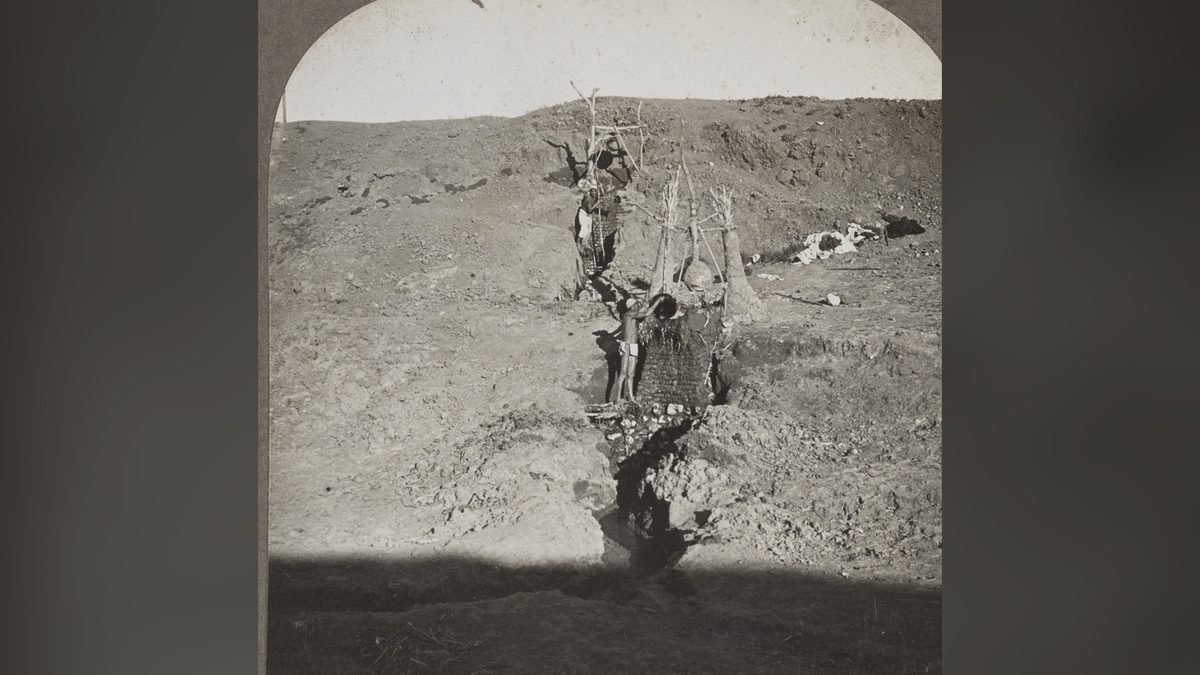
The lifting machinery got most of the attention, but the hole beneath it was arguably the more consequential piece of engineering. A farm well was dug by hand, usually three to four feet across, down to a reliable water table — commonly ten to thirty feet on land east of the Mississippi — and lined as the digging progressed with dry-laid stone to keep the walls from collapsing. It was slow, dangerous work: a caving trench at that depth could bury a digger before help arrived, and there was no code requiring shoring or inspection.
Where the well went mattered as much as how it was dug, and this is where the historical record gets uncomfortable. A 1918 U.S. Department of Agriculture bulletin on farm water systems surveyed existing wells and found that roughly three out of every four sat within seventy-five feet of the back door — sited for the convenience of the person hauling water, not for water quality. The same bulletin flagged the obvious consequence: a well anywhere downhill from a barnyard or a privy was pulling in whatever seeped through the soil between them, and typhoid outbreaks on farms with exactly that layout were common enough to be a named public-health concern rather than a rare accident — the same siting problem that, a generation later, drove the federal program to replace unsafe backyard privies described in the WPA’s sanitary privy campaign. The bulletin’s own recommended fix — moving the well uphill and further off, and capping it properly — was cheap advice that plenty of farms could not practically follow, since the well usually came first and the outbuildings grew up around it.
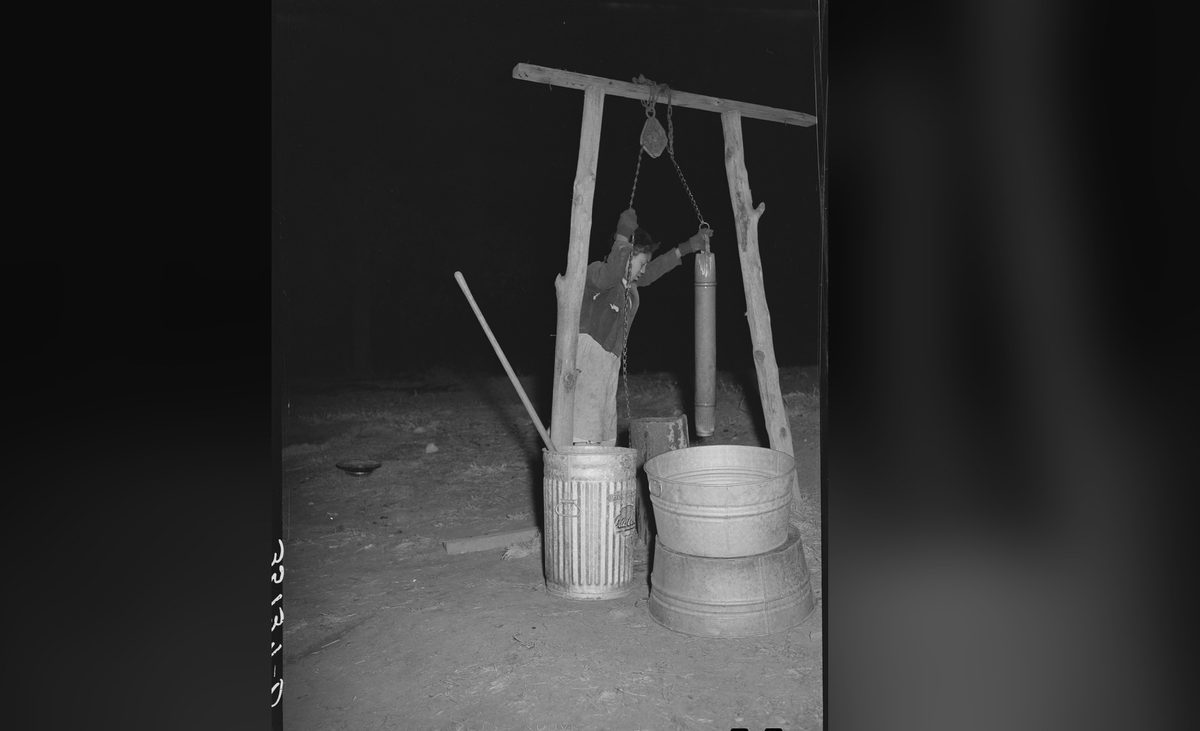
The arithmetic of hauling water by hand
The 1918 bulletin also put a number on ordinary household use: close to fifteen gallons a day per person where a hand-operated kitchen pump was in use, a figure that assumes people economized hard, because every gallon had been carried. A full pail meant a trip; wash day meant dozens of them. Historian Robert Caro, researching the Texas Hill Country boyhood of Lyndon Johnson for The Path to Power, found a federal study putting the figure at closer to forty gallons per person once the 1930s are reached — and heard directly from women who had done the hauling themselves, carrying buckets on wooden yokes worn like cattle harness, work hard enough that it had visibly changed their posture by middle age.
That labor was not evenly distributed. Drawing and hauling water was overwhelmingly a chore assigned to women and children, done before breakfast and repeated through the day for cooking, washing and stock. A covered well also doubled as refrigeration — a jug of milk or a crock of butter lowered on a cord and left to hang just above the waterline stayed markedly cooler than anything left in the kitchen, a use that persisted on farms without an icehouse well into the twentieth century. The well curb, not the kitchen table, was often where the household’s day effectively began — one stop in a longer circuit of hand labor that also ran through the washday clothesline and the root cellar.
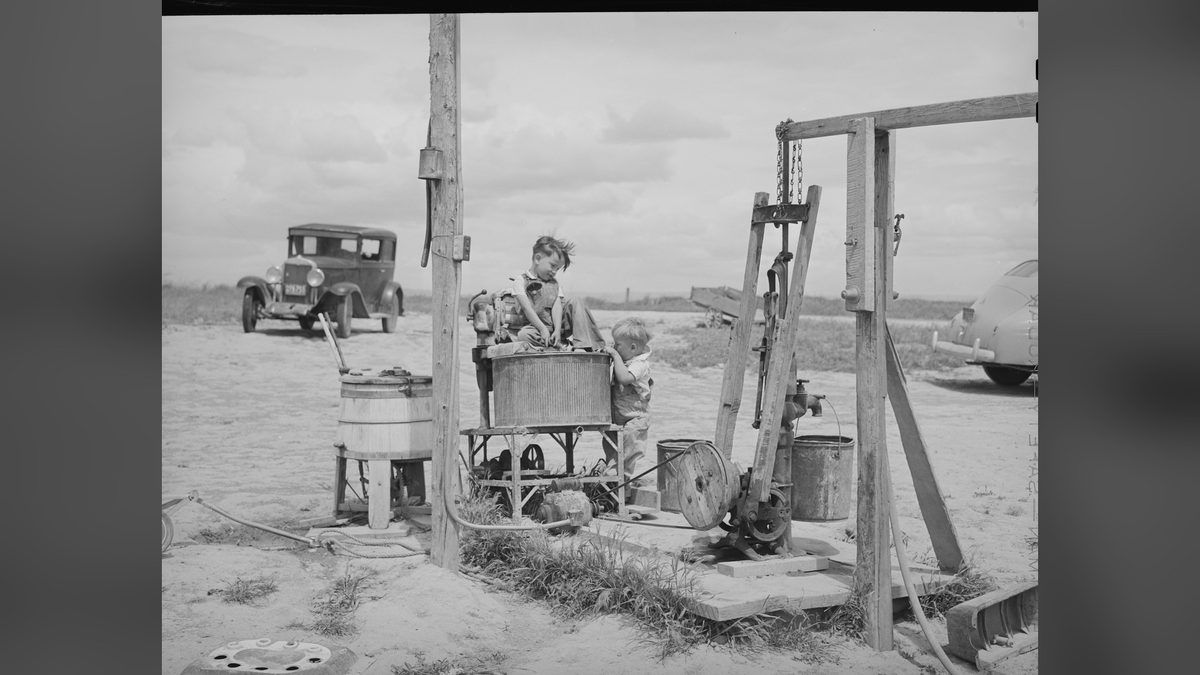
Why the sweep finally came down
The first serious competitor arrived from a foundry rather than a farm. In 1848, Seabury S. Gould oversaw the casting and assembly of what is generally credited as the first all-metal pump, built in Seneca Falls, New York, for the firm that became Goulds Pumps. Cast iron pitcher pumps spread from there through mail-order catalogs over the following decades, cheap enough and durable enough to displace the sweep on any farm that could spare a few dollars — though plenty could not, and the bucket-and-sweep combination persisted wherever cash was tight.
Even where farms could afford a pump, drawing water was still manual labor; what changed the equation completely was electricity, and electricity came late to rural America. President Franklin Roosevelt created the Rural Electrification Administration by executive order on May 11, 1935, specifically because private utilities had judged farm customers too scattered and too unprofitable to wire; at the time, only about one farm in ten had power. The agency’s low-interest loans to member-owned cooperatives changed that fast enough to be startling: nine farms in ten had electricity by 1950. Running water lagged behind even that. The 1945 Census of Agriculture recorded piped water in the farmhouse on just 10.0 percent of farms in 1920 and only 28.7 percent by 1945 — which means that for a majority of American farms, the sweep, the windlass, or a pump worked by hand was still the entire water system in the year the Second World War ended.
Watch the full history
The video companion walks through the same well, the same sweep, and the same counterweight in about four minutes, with the Library of Congress photographs this article draws from.

What the well curb still has to say
It is easy to read the well sweep as a symbol of hardship and stop there, but that undersells what the arrangement actually accomplished. A forked post, a pole, and a stone turned the single hardest physical problem a household faced — getting water uphill — into a task a child could manage unassisted. Measured against the alternative, hauling every gallon up an open shaft hand over hand, the counterweight was already a triumph of applied mechanics, even if it looks primitive next to a tap.
What finally retired it was not a better idea about levers. Nobody improved on the shadoof’s basic geometry in three thousand years; there was nothing to improve. What changed was the cost of an alternative power source, first coal-fired and gravity-fed municipal systems for towns, then a cast-iron pump within a farmer’s budget, and finally a wire strung to the property line. The sweep did not lose to a smarter machine. It lost to cheaper energy, which is a different thing and a pattern that keeps recurring in household technology long after the well itself is capped and forgotten.
Related reading
- How Home Food Drying Fed American Farms for 150 Years
- The Clothespin Patent History Behind America’s Favorite Free Dryer
- The Stereoscope Craze That Swept Victorian Parlours
- The WPA Sanitary Privy Program That Built Two Million Outhouses
Get the manual
Curious what digging and lining a well by hand actually involves? Hand Dug Wells and Their Construction (S. B. Watt & W. E. Wood, Practical Action Publishing) is the standard practical manual on digging, lining and finishing a well by hand, still in print.
Works cited
- Warren, George M. Water Systems for Farm Homes. USDA Farmers’ Bulletin 941. Washington, DC: Government Printing Office, 1918.
- U.S. Bureau of the Census. Census of Agriculture: 1945, Volume III, Farm Facilities, Roads, and Farm Machinery. Washington, DC: Government Printing Office, 1946. Link.
- Scituate Historical Society. “Old Oaken Bucket Homestead.” Scituate, Massachusetts.
- Davies, Norman de Garis (facsimile artist). Garden Scene, Tomb of Ipuy. New Kingdom, Ramesside period, ca. 1295–1213 B.C. The Metropolitan Museum of Art, accession 30.4.114.
- “Rural Electrification Administration.” EH.net Encyclopedia. Economic History Association.
- Caro, Robert A. The Path to Power: The Years of Lyndon Johnson, Volume 1. New York: Alfred A. Knopf, 1982.
- R Street Institute. “Bringing Up Water, Bucket by Bucket, from Deep Wells.” Review of Working, by Robert A. Caro. April 9, 2019. Link.
- “Goulds Pumps, Inc.” Encyclopedia.com, adapted from the International Directory of Company Histories. Link.