
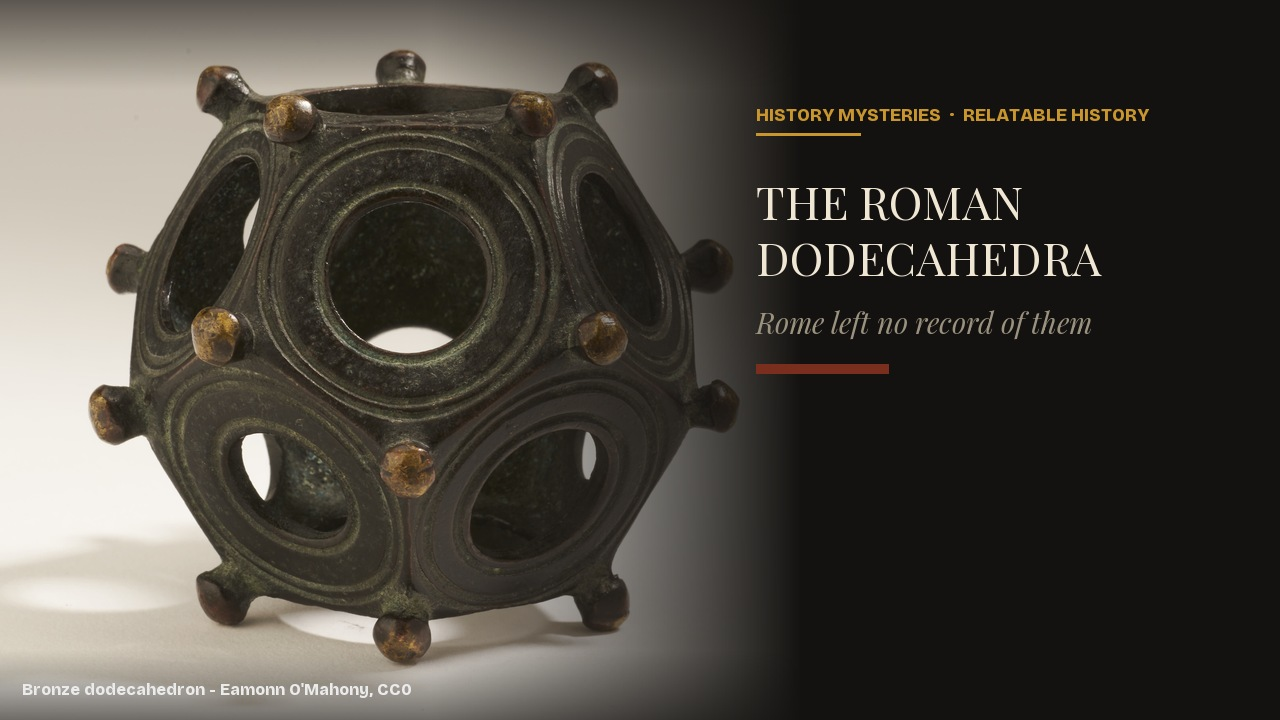
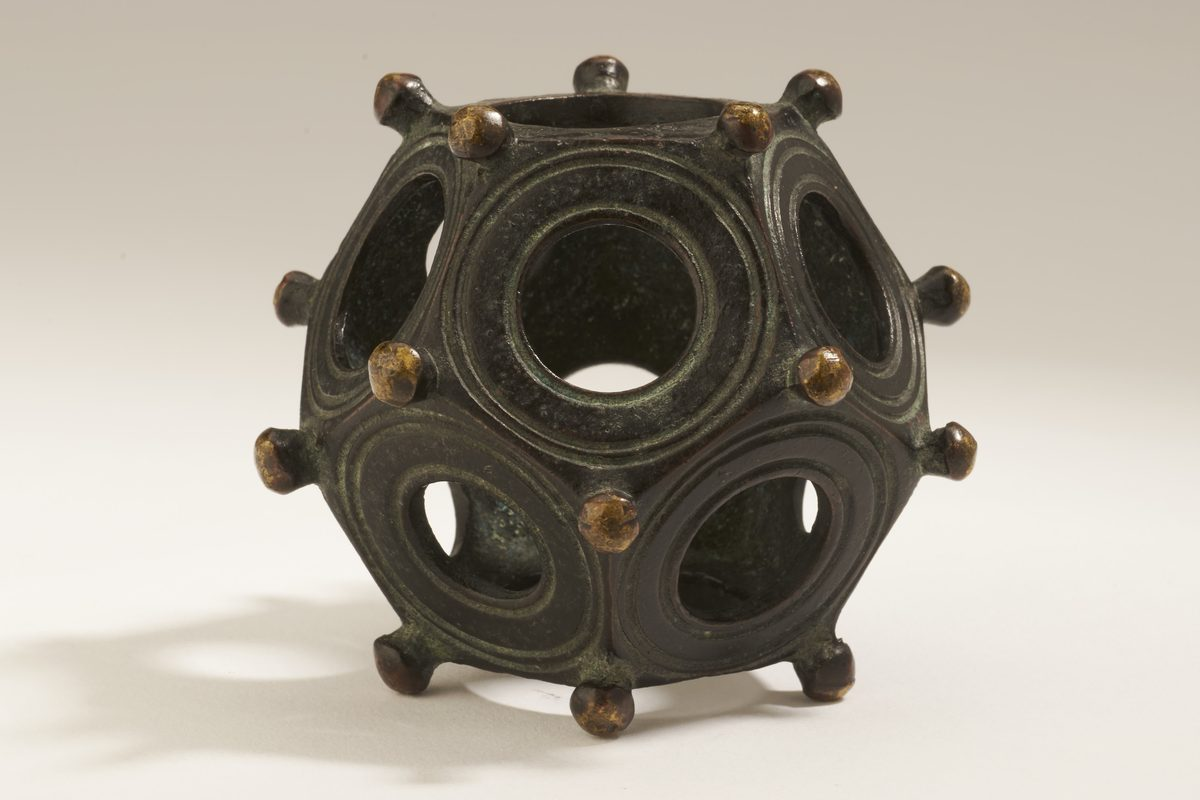
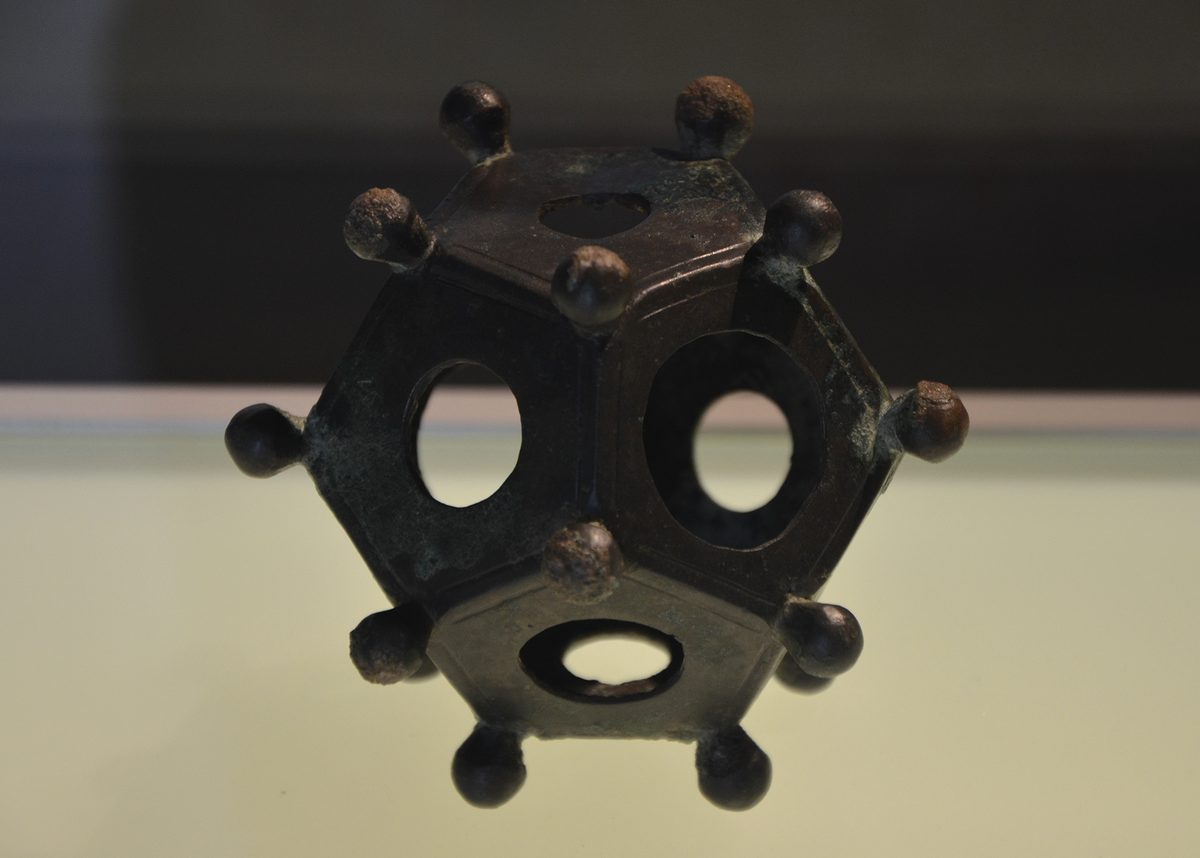
More than 130 bronze objects survive from the Roman world that nobody, in nearly three centuries of study, has been able to name. They are hollow, cast in copper alloy, twelve-sided, with a round hole through the middle of each face and a small ball perched on every one of the twenty corners. Archaeologists call them dodecahedra, which is simply the Greek word for a twelve-sided solid — a label of convenience, not a Roman one, because no Roman ever left behind the word they used.
The first was dug up in the English Midlands in 1739. The most recent, and one of the best-preserved of all of them, came out of a rubbish-filled quarry pit in Lincolnshire in the summer of 2023, found by a volunteer community dig on the second-to-last day of the season. Between those two finds lies a genuinely open question in Roman archaeology: an empire that wrote down its grain rations, its military pay slips and its neighbourly disputes left not one sentence explaining what these objects were for.
This is not a case of a lost explanation waiting to be rediscovered in some unread scroll. Dozens of theories have been proposed since the eighteenth century — more than fifty, by one count — and the honest state of the evidence is that most of them can be ruled out, a few remain plausible, and none has been proven. What follows is not a single answer, because there isn’t one yet. It is the case for and against each serious candidate.
More Than a Hundred of Them, and All From One Corner of the Empire
The objects range from about four to ten centimetres across and weigh anywhere from thirty grams to nearly six hundred. Their walls are thin for their size, which means casting one took real skill: a founder had to pour molten bronze around a core that left the hollow interior and twenty knobbed corners intact, then finish the piece by hand. They were not cheap or quick to make.
Roughly sixty per cent of the known examples come from Gaul and the Germanic provinces, with another fifth from Roman Britain, and further finds scattered across Austria, Belgium, Hungary, Luxembourg, the Netherlands and Switzerland. Not one has been found in Italy, and none anywhere around the Mediterranean rim. Whatever these were, their maker and their user both lived on the northern, formerly Celtic edge of the empire, in provinces that had been conquered, not provinces that had conquered. The classical archaeologist Michael Guggenberger, who has spent more than two decades cataloguing every known example, treats them as a specifically “Gallo-Roman” product for exactly this reason, rather than as something that originated in Rome itself and simply happened to survive at the fringes.
An Empire That Documented Everything Left No Word for These
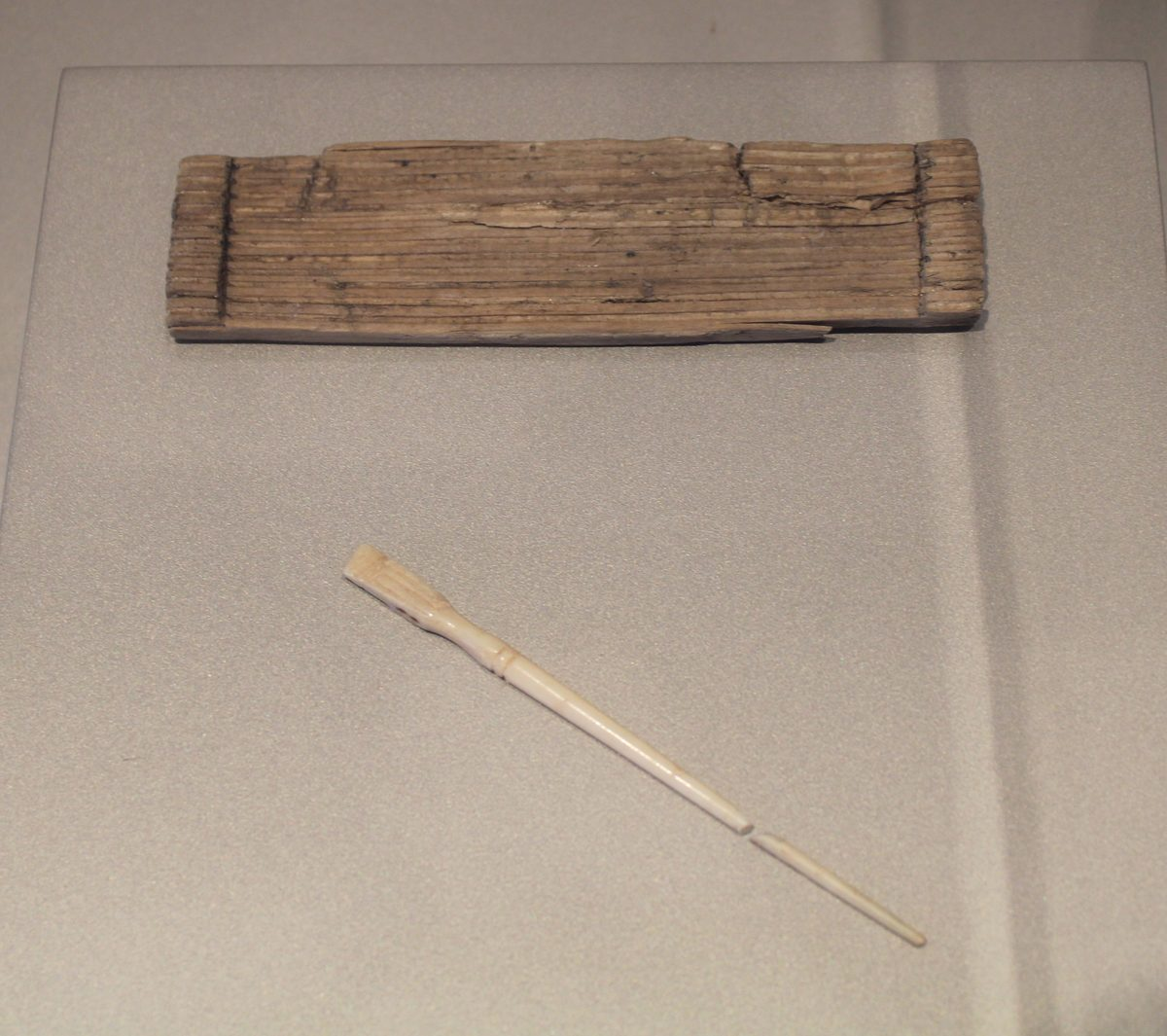
Rome is one of the best-documented societies of the ancient world. Its administrators kept records of grain distributions. Its soldiers wrote home about the weather and asked for socks. Its shopkeepers scratched price lists into wax. Curse tablets, complaint letters, tax receipts, army pay records and private correspondence survive by the thousand, in Latin and in the everyday hand of ordinary people, not just emperors and senators.
None of it mentions a dodecahedron. No inscription names one, no mosaic depicts one, no wall painting shows a person holding one, and no ancient author — not Pliny, cataloguing every craft and curiosity he could find, not Vitruvius, writing at length on surveying and measurement — describes anything resembling one. Every name the object has today, historians invented afterward. That silence is unusual even by the standards of archaeology, where plenty of everyday tools go unmentioned in literature: dodecahedra were expensive, skilfully made, and clearly meant to be seen, which makes the total absence of a contemporary reference to them stand out rather than blend in.
No Two Are Alike, and That Rules Out More Than It Explains
Put a row of dodecahedra side by side and the first thing you notice is that none of them match. The holes on a single object are different diameters from face to face, and the specific pattern of those differences changes from object to object. There is no standard size, no standard hole arrangement, and no numbering or marking of any kind on any known example.
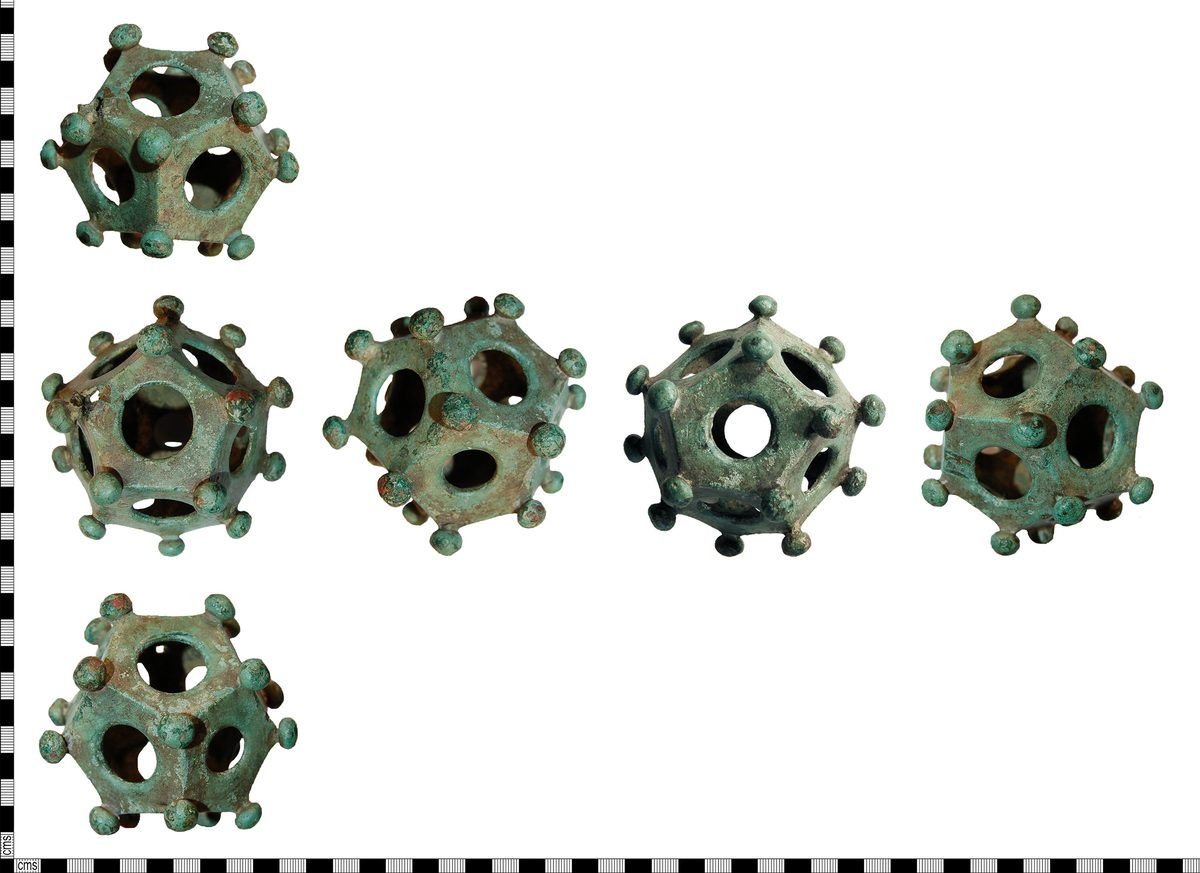
That single fact does most of the work of eliminating theories. A measuring or surveying instrument needs a fixed, repeatable standard — a Roman foot is the same length in Gaul as it is in Italy — and these objects have none. A gauge for sizing something manufactured, whether that is pipe fittings or the fingers of a glove, needs the same thing. Candle holders and dice have both been suggested, and while one example genuinely was found with wax residue inside, a dodecahedral shape is a strange and expensive way to hold a candle when a simple cup does the job for a fraction of the metal and effort, and a proper Roman die was cast quite differently, in a shape not biased by an irregular hollow interior. The knitting-gauge theory, popularised in recent years by hobbyist reconstructions on video, runs into the same wall along with a bigger one: there is no evidence that knitting, as a technique, existed anywhere in Europe until roughly a thousand years after the last dodecahedron was cast.
The Norton Disney Dig Showed What Decades of Old Finds Couldn’t
Most dodecahedra in museum collections are old finds, dug up by antiquarians or construction crews long before modern excavation recorded exactly where and how an object lay in the ground. That makes it hard to say anything about the context an object was actually deposited in, which is often as informative as the object itself.
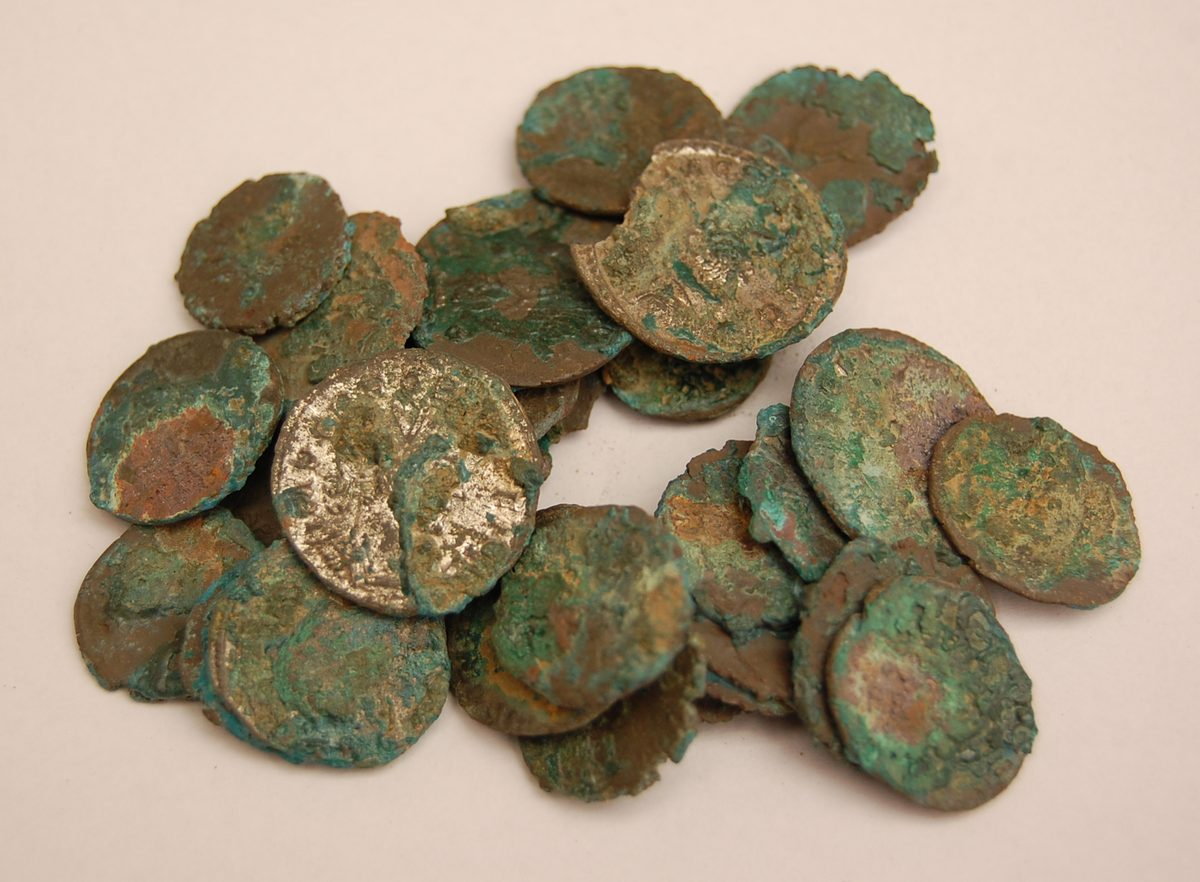
In the summer of 2023, the volunteer Norton Disney History and Archaeology Group, working with the commercial firm Allen Archaeology near Lincoln, opened a trench over a Roman sand-quarrying pit that had later been used as a rubbish dump. Near the top of that pit’s fill, close to the end of the dig season, they found a dodecahedron roughly eight centimetres tall and weighing 245 grams — the thirty-third recorded example from Britain and the first from the English Midlands. A coin of the emperor Claudius II, who reigned from 268 to 270, was found just above it in the fill, giving a useful earliest date for when the pit was closed.
Handheld X-ray fluorescence analysis by archaeometallurgist Gerry McDonnell found the object was cast from an alloy unusually high in lead — around a quarter of its weight — likely added to help the molten metal flow into the mould’s intricate cavities. More strikingly, after some seventeen centuries underground the object showed no wear at all: no thinning at the knobs, no polish around the holes, none of the scuffing a tool gets from being handled thousands of times. It had not simply been lost. It had gone into the ground, alongside broken pottery and animal bone, looking close to how it left the workshop.
The Leading Theory Isn’t a Practical One at All
The pattern of where dodecahedra turn up — buried in graves, tucked into coin hoards, discarded in pits alongside genuine rubbish, but never found worn down by daily use, never found in matched sets, and never found in a workshop context that would suggest a trade tool — has pushed most specialists away from practical explanations altogether and toward a symbolic one.
Guggenberger’s own preferred interpretation, laid out across several studies and developed further in a 2025 paper co-written with the classicist Stephen Leach, connects the object to a strand of Platonic and Pythagorean thought in which the dodecahedron, as the fifth and final regular solid, stood for the cosmos itself — the other four solids having already been matched to fire, air, water and earth. Writers in the Roman period, including Plutarch, kept that older Greek association alive, and Guggenberger and Leach argue that a specific, previously overlooked passage in Iamblichus’s life of Pythagoras may point toward how that philosophical idea could have reached craftsmen in the Celtic provinces and been rendered as a physical, portable object — something closer to an amulet or a symbol of the ordered universe than to a tool with a job to do.
One particular grave find lends the idea some physical support. A dodecahedron excavated at Gellep, in Germany, in 1966 was found lying directly beside a rod-shaped bone object in a woman’s grave — a pairing that has been read as the remains of a staff, with the dodecahedron mounted at its end like the head of a ceremonial sceptre. It is a single grave, not a pattern repeated across dozens of burials, so it cannot carry the whole theory on its own. But it is the closest thing to physical evidence of how one of these objects might actually have been held, displayed or used, rather than simply owned.
The Rangefinder Idea, and Why It Hasn’t Persuaded Archaeologists
Not every researcher has abandoned a practical explanation. The physicist Amelia Carolina Sparavigna has argued, based on the differing hole sizes on a well-documented example from Jublains in France, that a soldier could sight an object of known height through opposite pairs of holes and, by finding the pair where the two openings appeared to align exactly, estimate its distance by simple geometry — a compact battlefield rangefinder, worn on a cord and small enough to carry into the field.
The method genuinely works as described, and people have built working replicas that reproduce it. What it does not explain is why the specific angles of view would differ from one dodecahedron to the next, when a rangefinder used across an army would be far more useful if every unit’s instrument agreed with every other. It also does not explain the examples found in what appear to be women’s graves and civilian coin hoards, well away from any military context. Most archaeologists working on the objects today treat the rangefinder idea as a demonstration that the geometry could be made to work, rather than as evidence that it was the reason the objects were made.
What is genuinely missing, after nearly three hundred years of study, is not evidence. There are more than 130 of these objects sitting in museum collections from Newark to Bonn, individually weighed, measured, photographed and in a growing number of cases chemically analysed down to their trace metals. What is missing is the one thing none of that analysis can supply: a sentence, written by someone who actually held one, saying what it was called and what it was for.
Watch the full history
The video version walks through the Norton Disney dig and the leading theories in just under four minutes.

Related reading
- How the Magic Lantern Became Europe’s First Horror Show
- How the Well Sweep Drew Water Before There Were Pumps
- What Actually Happened to the Ark of the Covenant?
- What Caused the Bronze Age Collapse?
Works cited
- Guggenberger, Michael, and Stephen Leach. “The Gallo-Roman Dodecahedron and the Receptacle of All Becoming.” The Antiquaries Journal 105 (2025): 31–54. Link.
- Guggenberger, Michael. Die römischen Dodekaeder: Eine Gesamtdarstellung. University of Innsbruck, 1999. Link.
- Killgrove, Kristina. “Roman Dodecahedron: A Mysterious 12-Sided Object That Has Baffled Archaeologists for Centuries.” Live Science, July 14, 2025. Link.
- Tipper, Samantha. “Beautifully Crafted Roman Dodecahedron Discovered in Lincoln — But What Were They For?” The Conversation, May 2, 2024. Link.
- Hilts, Carly. “A Multi-Sided Story: Examining the Norton Disney Dodecahedron in Its Wider Context.” Current Archaeology, issue 429 (November 2025): 20–25.
- Sparavigna, Amelia Carolina. “Ancient and Modern Rangefinders.” arXiv:1205.2078 [physics.pop-ph], 2012. Link.
- Norton Disney History and Archaeology Group. “The Norton Disney Dodecahedron.” Link.
- University of Nottingham Museum, Lakeside Arts. “The Norton Disney Dodecahedron” exhibition. Link.