
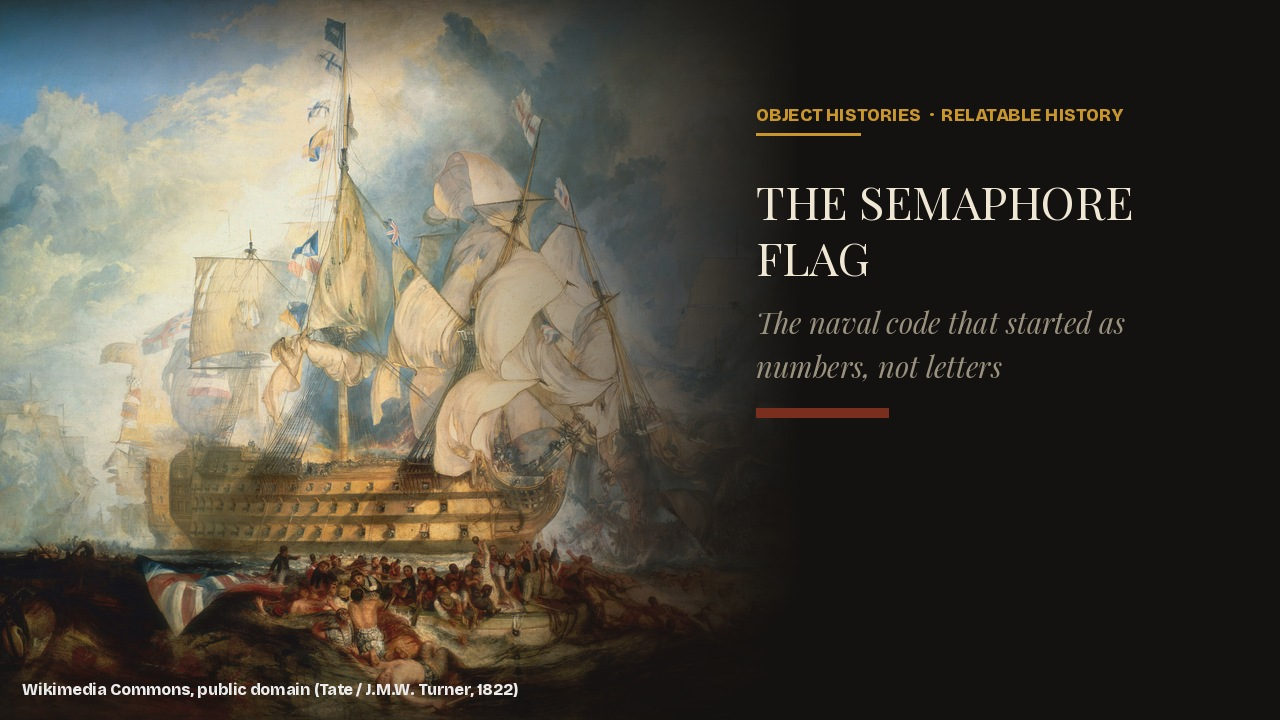
For most of the eighteenth and nineteenth centuries, two rival governments spent enormous sums building networks of signal towers across their own countryside — and neither one could read what the other’s towers were saying. That was the entire point. The naval flag alphabet most people picture when they hear the word “semaphore” today, one signaller with two flags spelling letters in the open, wasn’t invented until the secrecy stopped being the priority. Getting there took a forgotten lecture, a burned-out inventor, a captured codebook, and a mystery that wasn’t solved until 1908.
This is the mechanical side of that story: how three different, genuinely incompatible signalling systems — French mechanical arms, British wooden shutters, and Royal Navy numbered flags — all tried to solve the same problem of moving information faster than a horse, and why none of them looked anything like the two-flag alphabet that eventually replaced all three.
A lecture that sat in a drawer for a hundred years
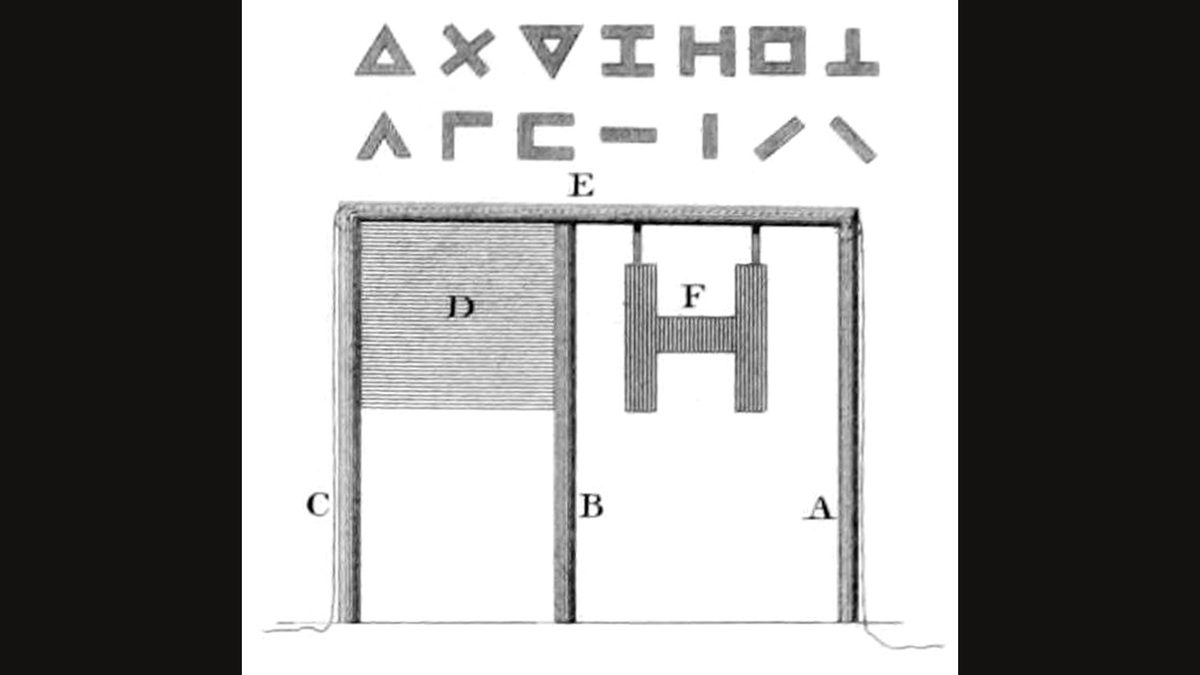
The first detailed proposal for a long-distance visual signalling system in Britain came from Robert Hooke, the Royal Society’s curator of experiments, in a lecture titled “On Showing a Way How to Communicate One’s Mind at Great Distances,” delivered on 21 May 1684. Hooke’s design used a wooden frame from which large cut-out symbols could be hung and read through a telescope from a neighbouring station. Crucially, those symbols did not spell letters — they stood for entries in a shared reference vocabulary, the same basic principle every working system on this list would later use.
Hooke’s timing tells you why he bothered: the lecture came less than a year after the 1683 Battle of Vienna, when the slowness of long-distance communication had been a live military anxiety across Europe. Despite that, nobody built Hooke’s system. It sat published but unrealised for well over a century, a design with no network attached to it, until the French Revolution created the specific kind of national emergency that could pay for one.
France built a working network. Britain built a different one to spy on it.
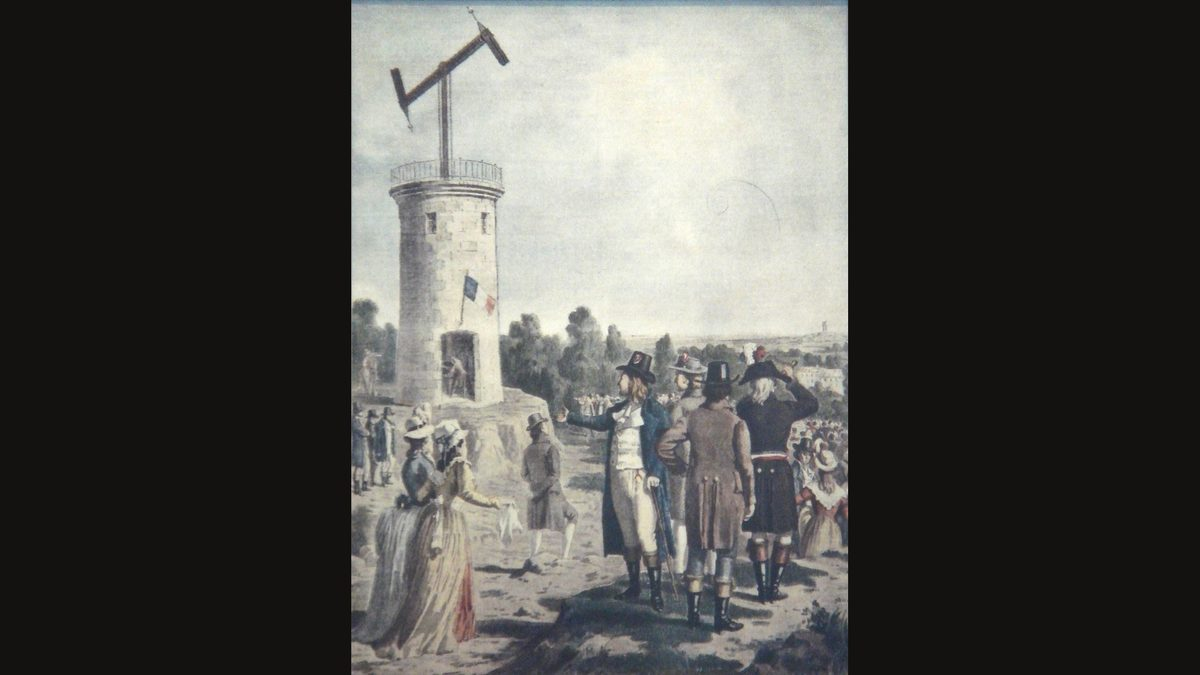
Claude Chappe’s optical telegraph, first demonstrated publicly in 1791 and operational as a line by 1792, used a very different mechanism from Hooke’s: a mast topped with a moving crossbar and two shorter arms, capable of a large number of distinct shapes, each shape corresponding to an entry in a codebook locked inside each station. The French state expanded the Chappe network aggressively through the 1790s and into the Napoleonic period, eventually covering roughly 3,000 miles of French territory and carrying military and government traffic in minutes rather than days.
Britain’s answer, built starting in March 1796, was not a copy of Chappe’s design — it was a completely different piece of engineering aimed at the same problem. Rev. Lord George Murray proposed a shutter telegraph: a twenty-foot timber frame mounted on a station roof, carrying six large hinged shutters that could each be opened to show sky, or closed to show a dark panel, in combinations that again pointed to a codebook rather than spelling words directly. The Admiralty adopted it within the year. A contractor built fifteen stations running east from London to Deal, with a branch to Sheerness, and ten more running south to Portsmouth by the end of 1796. A signal could travel from the Admiralty building at Charing Cross to the English Channel coast in about a minute.
The British network kept growing after that first push. A second line, using an improved shutter design, extended the system roughly seventy miles further from London down to Portsmouth by 1808, and intermediate relay stations along both routes — often little more than a purpose-built cottage with the signal frame bolted to the roof — became a fixture of the countryside they passed through for the length of the Napoleonic Wars. Several of those buildings still stand today, repurposed as private houses, with nothing about their current use hinting that they were once a node in Britain’s fastest information network.
So for roughly two decades, two nations at war with each other were each running a country-spanning relay of coded visual signals, built on entirely different mechanical principles, and each one’s codebook was exactly the classified document the other side most wanted. That arms-race framing rarely makes it into the shorter version of this story, but it’s the reason both systems were built as locked codebooks rather than open alphabets in the first place: an alphabet that anyone with a telescope could read was a security hole, not a feature.
At sea, the same problem needed a different fix
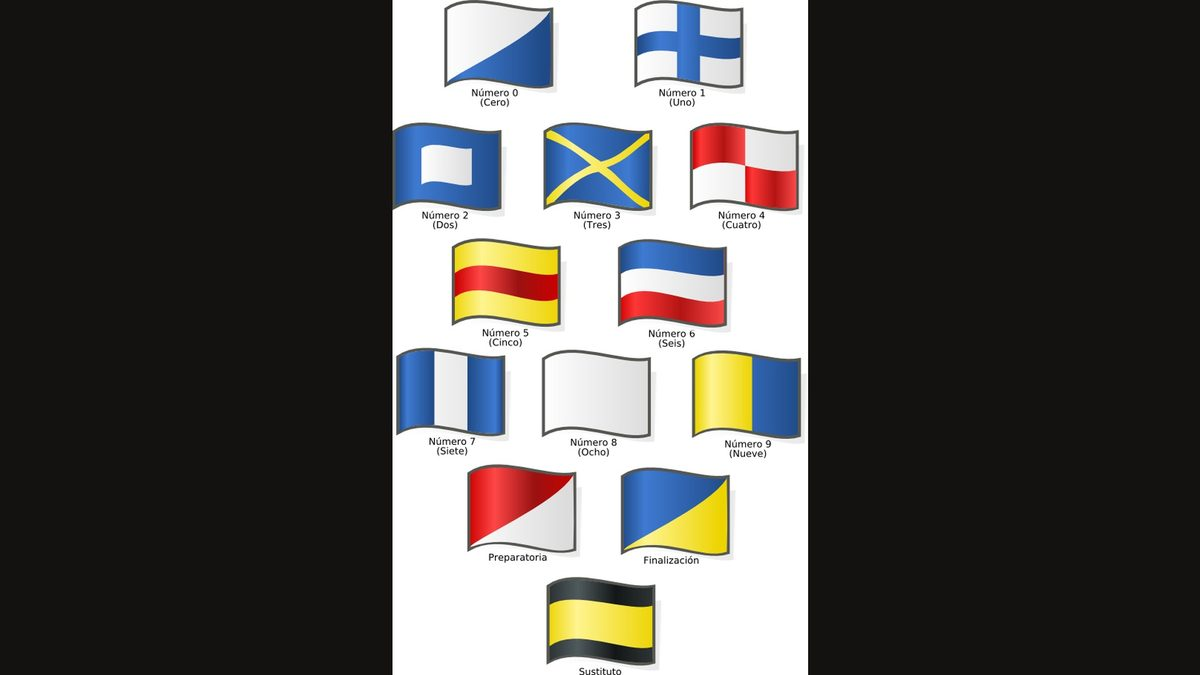
Neither Chappe’s towers nor Murray’s shutters worked on a moving ship, so the Royal Navy solved its own version of the problem separately. Admiral Richard Howe’s 1790 signal book used roughly 260 numbered flag combinations. Rear Admiral Sir Home Riggs Popham expanded that idea substantially, publishing Telegraphic Signals, or Marine Vocabulary in 1800 with a vocabulary running into the thousands of words and phrases, each addressed by a combination of ten flags representing the digits zero through nine. The Royal Navy adopted Popham’s system fleet-wide in 1803.
The codebook problem was not abstract. In August 1803, a copy of Popham’s signal book was captured by the French, forcing the Admiralty to issue new numeric assignments that November and a fully revised code in 1804. By September 1805, fifty copies of that revised code had been distributed to the British fleet gathering off Cadiz — a detail that matters because it is the code Nelson’s signal officer was working from a few weeks later, not the version captured two years earlier.
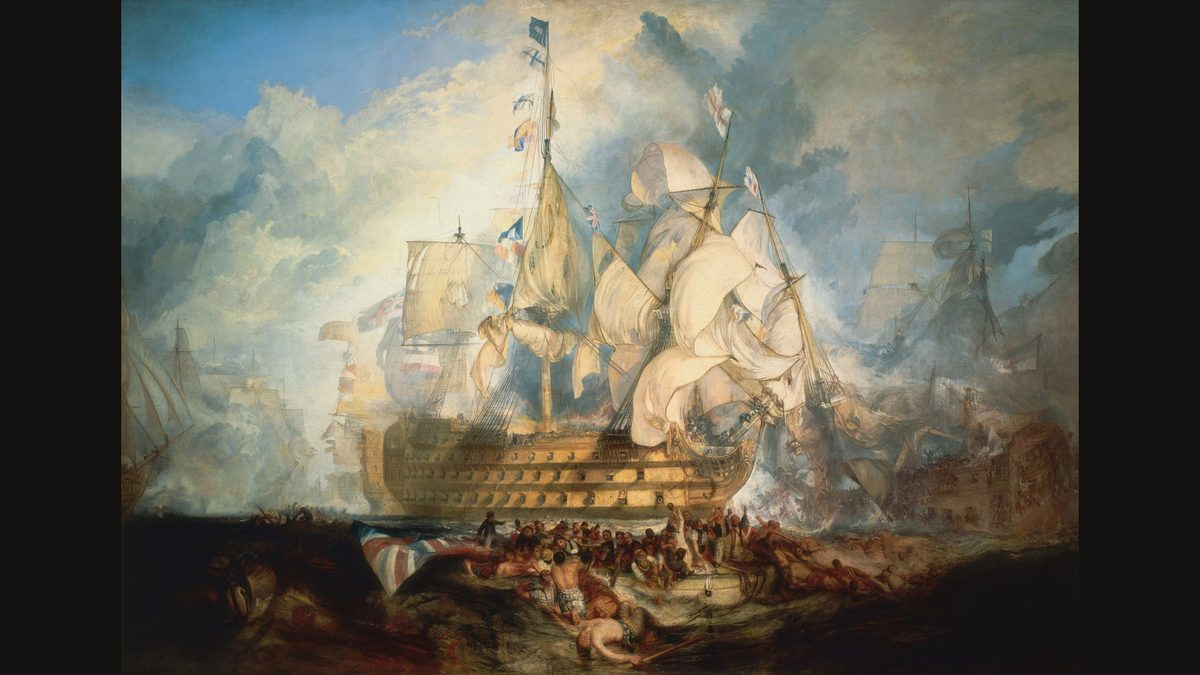
What actually went up the mast at Trafalgar
Nelson’s instruction to his flag lieutenant, John Pasco, was reportedly “England confides that every man will do his duty.” Pasco pointed out a practical problem: the word “confides” did not exist in the 1804 codebook and would have to be spelled out letter by letter, while “expects” was already a numbered entry. Nelson agreed to the substitution. “Duty” had no entry either and still had to be spelled, flag by flag, using the numeric values assigned to each letter. The message that made it into every history book was, in other words, shaped by what was and wasn’t already in the dictionary that morning.
Exactly which flags were raised stayed genuinely contested for a century. Because the 1804 revision had superseded the 1803 code so recently, and because near-contemporary accounts sometimes worked from the wrong edition, historians argued over the precise hoists until 1908, when W. G. Perrin, the Admiralty’s librarian, located the correct 1804 codebook and confirmed which version Victory’s signal party had actually been using. It is a reminder that “most famous signal in naval history” and “fully documented signal in naval history” are not the same claim — the second one took over a hundred years longer to settle.
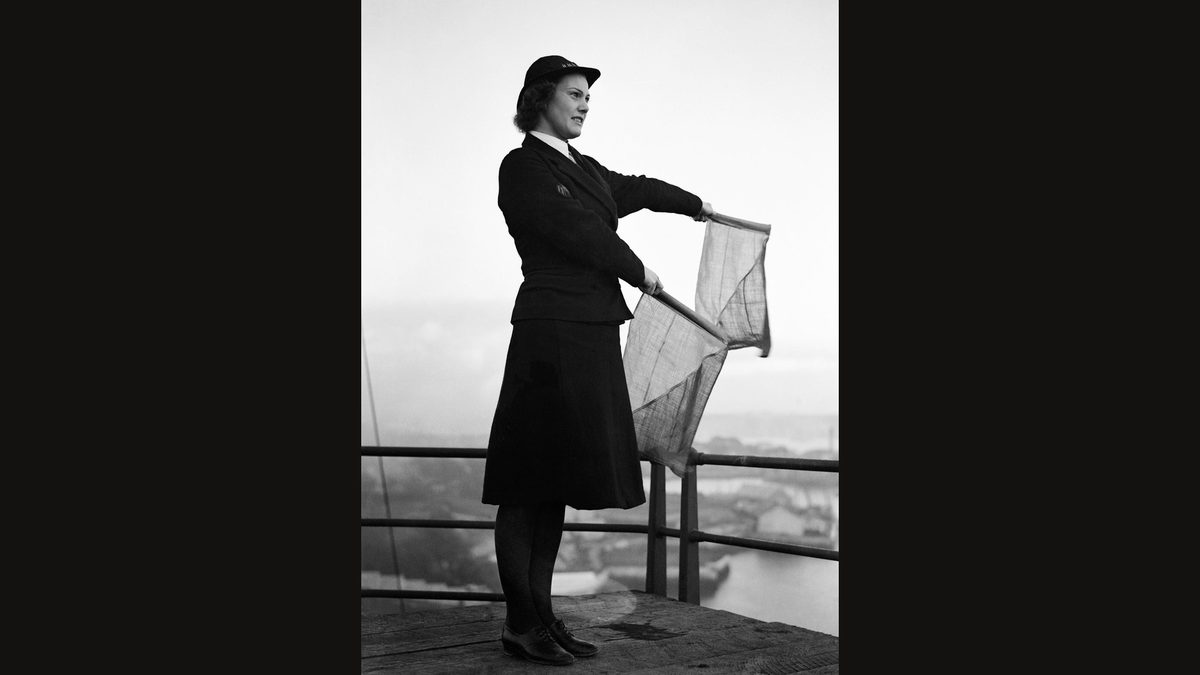
The codebook disappears, and the alphabet takes over
Every system so far, Hooke’s, Chappe’s, Murray’s, and Popham’s, shared the same design logic: a shape or a flag combination pointed to a locked reference book, and the signal was meaningless without it. The handheld version most people now call “semaphore,” one signaller with two flags held at eight possible angles per arm, arrived only in 1866, developed as a portable adaptation of Popham’s land semaphore work and refined by military engineer Charles Pasley. It threw out the codebook entirely. A signaller could spell any word, to anyone who knew the alphabet, with no shared reference document required on either end. That is a genuinely different kind of system from everything that came before it, not just a smaller version of the same idea.
An open alphabet with no security value turned out to be exactly what two very different institutions wanted next. The Scouting movement, founded in 1907, built flag semaphore into its signalling requirements almost immediately; American Scouting’s Signaling merit badge dates to the organisation’s original 1910 badge list. The Girl Guides, also founded in 1910, ran a parallel Signaller badge, and in August 1928 the junior Brownie version of that badge was formally changed to depict semaphore flags rather than Morse code once existing badge stock ran out — a small administrative note that marks semaphore’s shift from classified naval procedure to standard youth-programme curriculum in under seventy years.
Naval semaphore’s own second act came from a property none of the codebook systems ever had: it emits no radio signal an enemy can intercept or triangulate. In both World Wars, ships maintaining radio silence — sailing in formation, coordinating a manoeuvre, passing routine orders without giving away their position — fell back on flag semaphore precisely because it required a direct line of sight and left no trace on the airwaves. It is still listed as a backup signalling method in some navies today, not out of nostalgia but because the specific problem it solves, communicating without being detected, hasn’t gone away.
Put the two halves of this story side by side and the shape of it is almost a mirror image. The systems built first — Chappe’s arms, Murray’s shutters, Popham’s numbered flags — were designed to be fast and unreadable to anyone outside the network, which is exactly what a government fighting a war wants from its communications. The system that replaced all of them was designed to be readable by absolutely anyone who bothered to learn it, which is exactly what a scout troop, a merchant fleet, or a navy trying to stay invisible to radio direction-finders actually needed instead. The flags in your head, the two bright colours, the arms out at sharp angles, are the version of this idea that finally stopped needing a locked book to work.
Watch the full history
The video version follows the naval thread end to end, from Hooke’s proposal to a WWII signal deck, in under six minutes.

Related reading
- How Farmers Harvested Wheat With a Grain Cradle
- The 24 Years Wampum Was Legal Tender in Massachusetts
- Why Nobody Can Read Easter Island’s Own Writing System
- How the Magic Lantern Became Europe’s First Horror Show
Shop
Nelson’s Trafalgar: The Battle That Changed the World — Roy Adkins | Historical Signals and Semaphores: Collector’s Set | Official Semaphore Signal Flag Set (authentic replica flags)
Works cited
- Holzmann, Gerard J., and Björn Pehrson. The Early History of Data Networks. IEEE Computer Society Press, 1994. Link.
- Holzmann, Gerard J. “The Use of Optical Telegraphs in England and Elsewhere.” IEEE Annals of the History of Computing reprint. Link.
- “View of the Telegraph erected on the Admiralty Office, Charing Cross, in Feby 1796.” Royal Museums Greenwich, object PAH7392. Link.
- Popham, Home Riggs. Telegraphic Signals; or Marine Vocabulary. 1803/1812 editions. Royal Museums Greenwich, collections record. Link.
- “Nelson’s Last Signal at Trafalgar.” Royal Museums Greenwich, collections record. Link.
- “England Expects That Every Man Will Do His Duty.” Naval Marine Archive — The Canadian Collection, citing Nicolas, Dispatches and Letters of Lord Viscount Nelson (1844-46). Link.
- “Flag Signals and Semaphore.” Naval History and Heritage Command, U.S. Navy.
- “Flag, Signal, Pair of Hand Semaphore Flags.” Imperial War Museums, object 30016457.
- “Signs, Signals, and Codes Merit Badge.” Scouting America.
- “7 Badges from the Girlguiding Archive.” Girlguiding UK.