
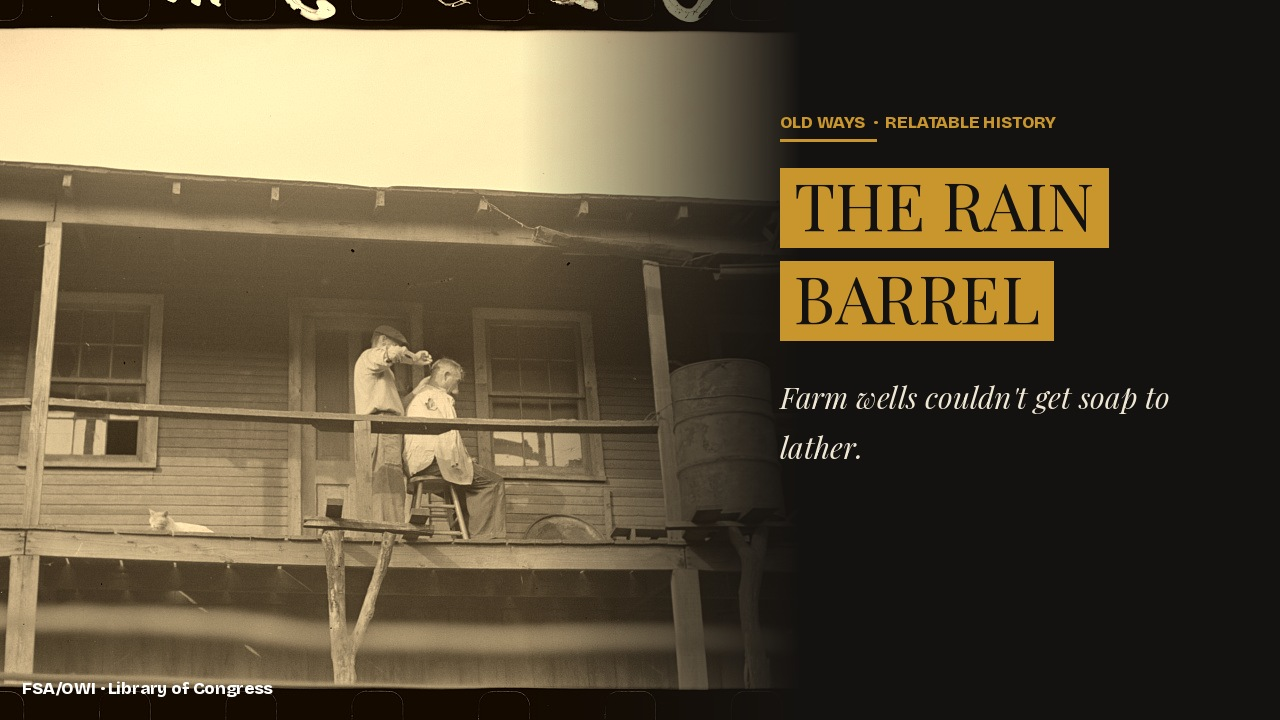
A working farm well in limestone country could run twenty grains of hardness to the gallon or more. Water caught straight off the roof, in a barrel set at the corner of the eaves, typically came in close to zero. That gap — not the barrel, not the gutter, just the mineral count — is the entire reason American farmhouses spent well over a century building a second water system that had no pump, no pipe, and no moving part of any kind.
The problem the rain barrel solved was specific and constant: ordinary soap would not lather in the water the well actually produced. Groundwater dissolves calcium and magnesium as it filters down through soil and rock, and those minerals react with soap to form a sticky, insoluble curd instead of suds — the same grey scum that still rings a hard-water sink. Rain falling out of a clear sky carries almost none of that load. So farmhouses ran a gutter off the roof into a cask at the downspout and caught every storm that passed over, for free, indefinitely.
What follows is the mechanism behind that one simple fact: how the water got from roof to barrel, what a fifty-gallon cask was actually used for, the mosquito problem nobody could avoid, and the specific piece of 1936 federal legislation that finally made the whole system unnecessary.
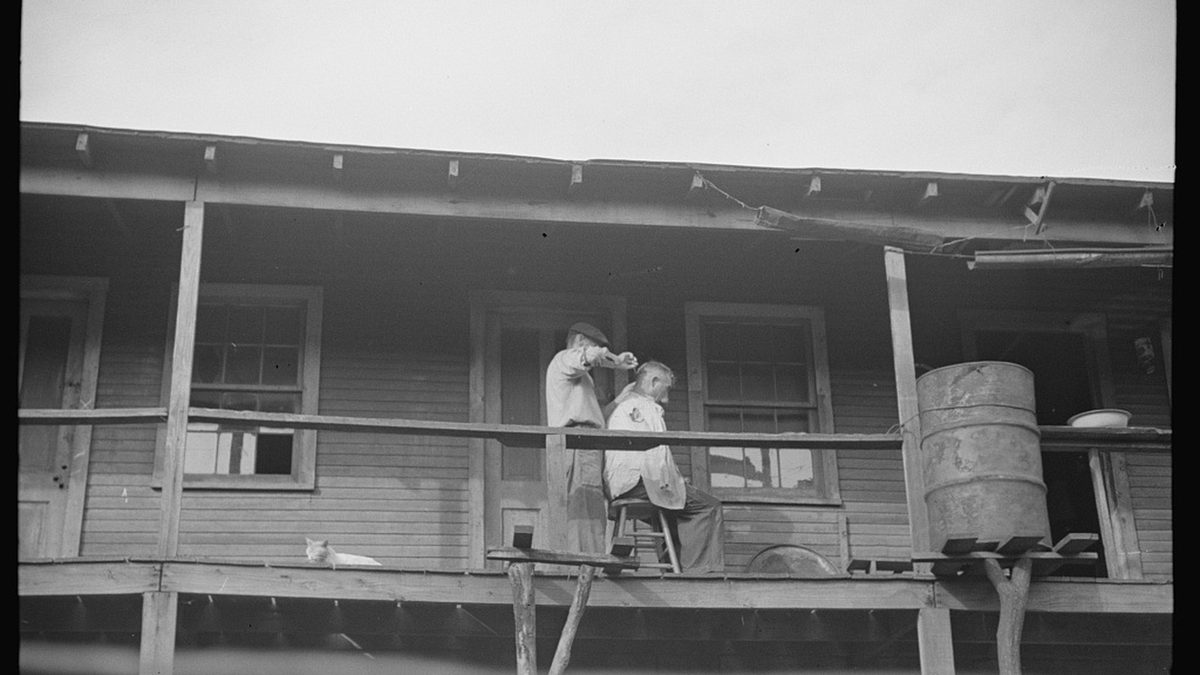
Hard water and soap do not mix, and farmers understood exactly why
Soap is a salt of a fatty acid — sodium stearate is the common example — and it works by suspending grease in water so it can rinse away. Calcium and magnesium ions, the two minerals that define hard water, react with that same fatty acid to form calcium and magnesium stearate, which are not soluble in water at all. Instead of suspending dirt, the soap precipitates as a waxy curd that clings to fabric, skin, and the sides of the tub. A housewife working hard well water needed noticeably more soap to get any lather at all, and what lather she got rinsed out poorly, leaving cloth stiff and hair dull.
Nineteenth-century households did not need a chemist to tell them this; they diagnosed it by trial and called the result what it looked like. Before manufactured water softeners existed, individual households experimented with whatever was on hand — lye, wood ash, even blood meal and wool fiber — to cut hard water down to something soap could work with. Catching rainwater before it ever touched the ground sidestepped the problem completely, which is exactly why the practice shows up across such a wide span of American climates and decades: it required no chemistry, only a roof.
Getting the water from roof to barrel was its own small trade
A rain barrel is only as good as the gutter feeding it, and gutters were not always the bent-metal strips sold today. The earliest American gutters, dating to the early 1700s, were wooden: two boards nailed together in a V, or a length of log hollowed out into a trough much the way a dugout canoe was carved. Both forms were fixed to the eave with wooden pins or wrought-iron brackets and sloped just enough to carry water sideways to a single downspout, which was itself often just a hollowed block of wood rather than a manufactured pipe.
Wood gutters had an honest weakness: they rotted, especially at the joints and wherever standing water sat after a storm. Metal gutters — first lead, later tin and galvanized steel — began replacing them through the middle and later 1800s as tinsmithing became a common rural trade, and by the early twentieth century a wooden gutter on a farmhouse already looked old-fashioned. The barrel at the end of the system changed much less: a stout cask, often not purpose-built at all but a repurposed pork, cider, or flour barrel, set on a low stand or a flat stone so its bottom staves stayed clear of wet ground and didn’t rot out first.
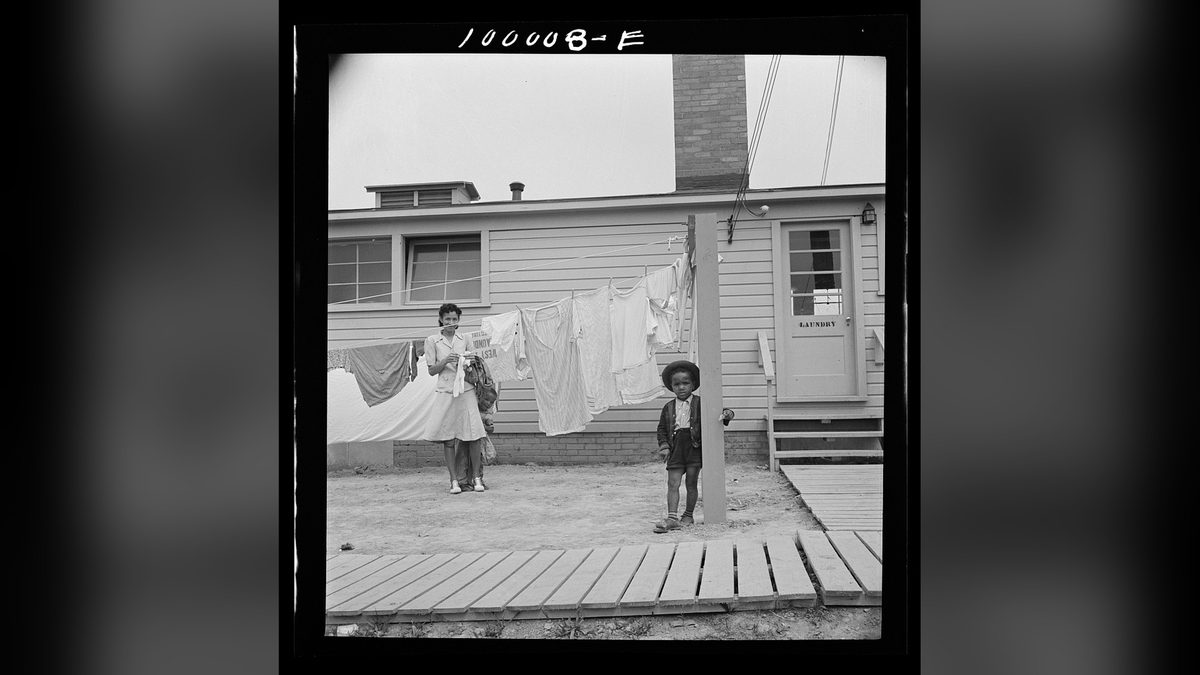
A full barrel ran the wash line, the wash basin, and the kitchen garden
A fifty-gallon barrel held enough for a wash day, or several days of hair-washing, and it cost nothing to refill. Laundry soap worked up a real lather in that water and rinsed cleanly instead of leaving grey residue in the weave, so barrel water went into the washtub and the boiler ahead of well water whenever a household had the choice. The same water filled the basin for washing hair, which is why farm diaries and household advice columns mention rain-barrel water specifically and by name: hard water left hair feeling stiff and dull in a way soft water simply didn’t.
Houseplants and porch ferns got the barrel’s water too, since mineral-heavy well water left a visible white crust on soil and leaves that rain never did, and overflow from a barrel that filled during a real downpour was typically just let run toward the kitchen garden, which got a free soaking out of the same storm. Households that were particular about water quality also practiced a version of what is now called first-flush diverting: after a roof had sat baking in a dry spell, the first few minutes of a new storm rinsed weeks of dust, ash, and bird droppings off the shingles, so that water was let run past the barrel and the downspout was only swung over to fill it once the roof had rinsed itself clean.
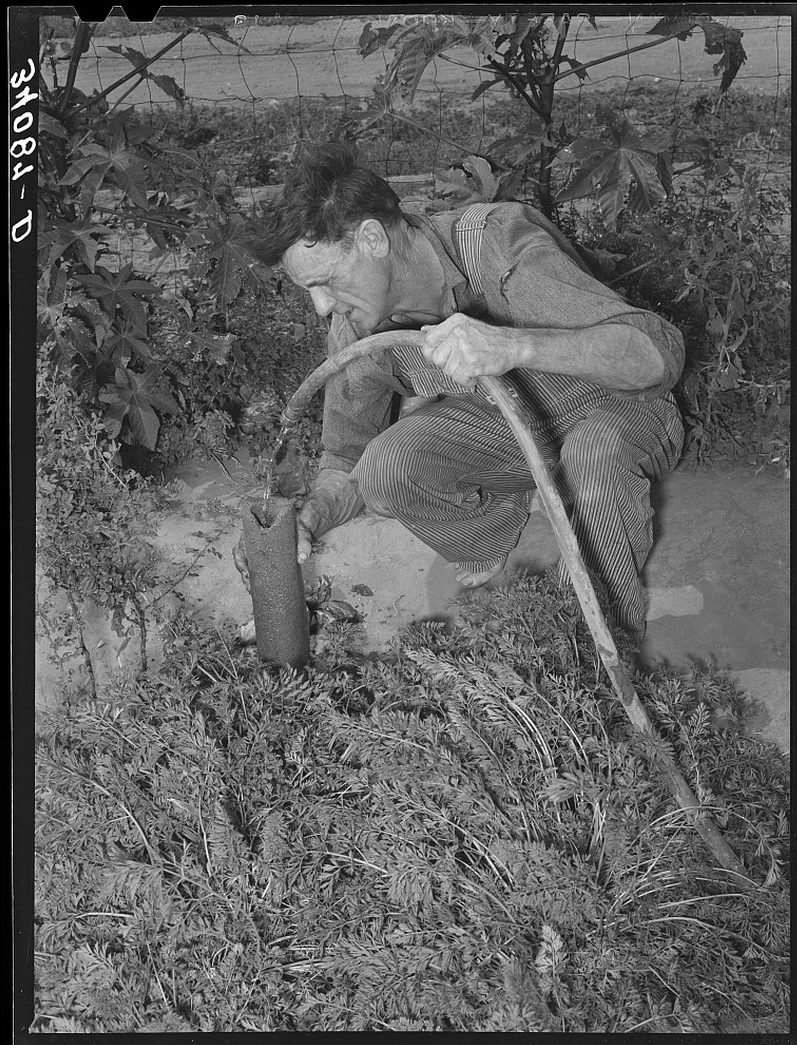
Every barrel was also, unavoidably, a mosquito nursery
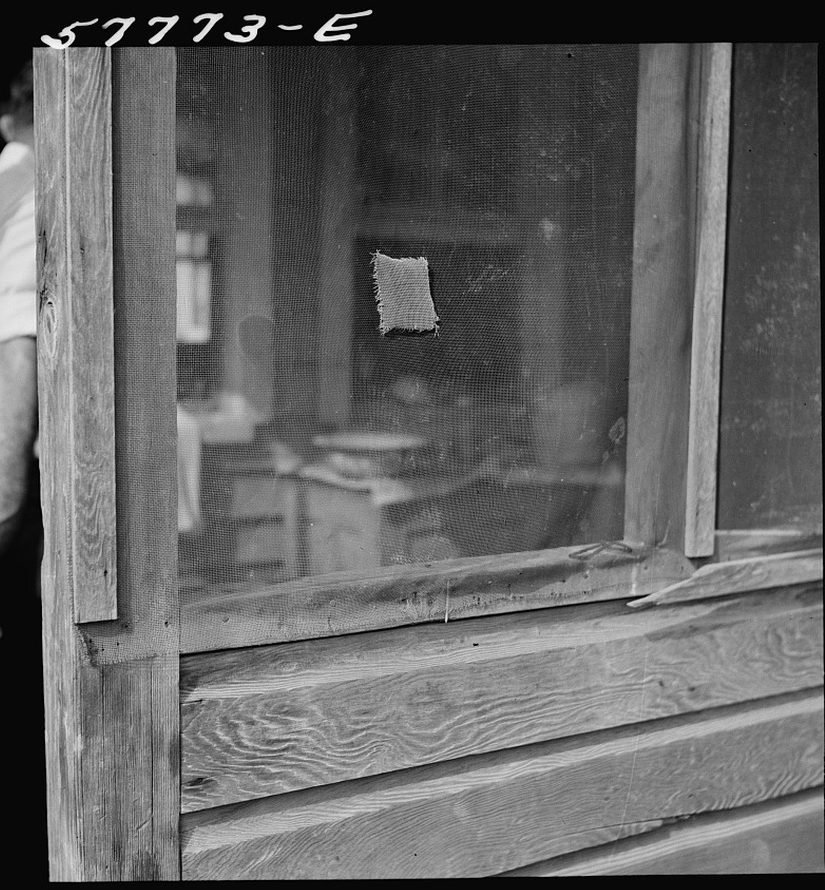
Standing water breeds mosquitoes, and a fifty-gallon barrel left open all summer is exactly the kind of container female mosquitoes favor for laying eggs: they need still water, not the moving kind, and a barrel under an eave offers weeks of undisturbed surface. Anyone who owned one eventually learned this by watching larvae — “wrigglers” — squirm just under the surface, and the two standard fixes were both cheap. A scrap of wire screen or cheesecloth stretched tight over the barrel’s mouth kept adult mosquitoes from laying eggs on the water at all. Failing that, a thin film of kerosene or other cheap oil floated across the surface sealed off the air that mosquito larvae need to breathe, killing them within a day or two — the same principle county mosquito programs still recommend for modern barrels today, minus the kerosene.
These were not folk remedies adopted on a hunch. Ronald Ross confirmed in 1897 that the Anopheles mosquito transmitted the malaria parasite, and the U.S. Army commission led by Walter Reed proved the same mechanism for yellow fever and the Aedes aegypti mosquito in 1900. Once the transmission route was established beyond argument, state and county health boards spent the following decades running public sanitation campaigns that named uncovered rain barrels specifically, alongside old tin cans and horse troughs, as exactly the kind of standing water a town most needed screened or emptied. A farm barrel kept screened and skimmed sidestepped the problem the health boards were fighting entirely; one left open became the community’s contribution to it.
Keeping a rain barrel productive was steady, small, unglamorous work
A screen needed checking after every real storm, since heavy rain could tear cheesecloth loose or wash grit and leaves across it. The barrel itself was heavy enough once full that water was dipped or bucketed out as needed rather than the whole cask moved, and whoever already ran the wash line and the kitchen garden was usually the person keeping an eye on it. None of this was difficult work; it was simply one more small chore layered onto a household routine that already had dozens.
Winter ended the barrel’s usefulness outright. Ice expanding inside a wooden cask splits its staves apart, ruining a barrel that might otherwise have served for a decade, so every fall before the first hard freeze, farm families emptied their rain barrels, tipped them over, or rolled them into a shed until spring. The ritual was as fixed a part of the farm calendar as bringing in the last of the harvest.
What ended the rain barrel wasn’t a better barrel
Rain barrels were never a single invention with a start date; households on both sides of the Atlantic had been catching roof runoff for washing water for as long as houses had roofs and eaves, well back into the 1600s. What gave the practice its long, near-universal run on American farms was necessity: through the 1800s and into the early 1900s, a working farm’s only water sources were a hand-dug well, worked by a pump or a windmill, and whatever fell from the sky. Neither of the first two produced soft water on its own, and the barrel filled that one remaining gap for free.
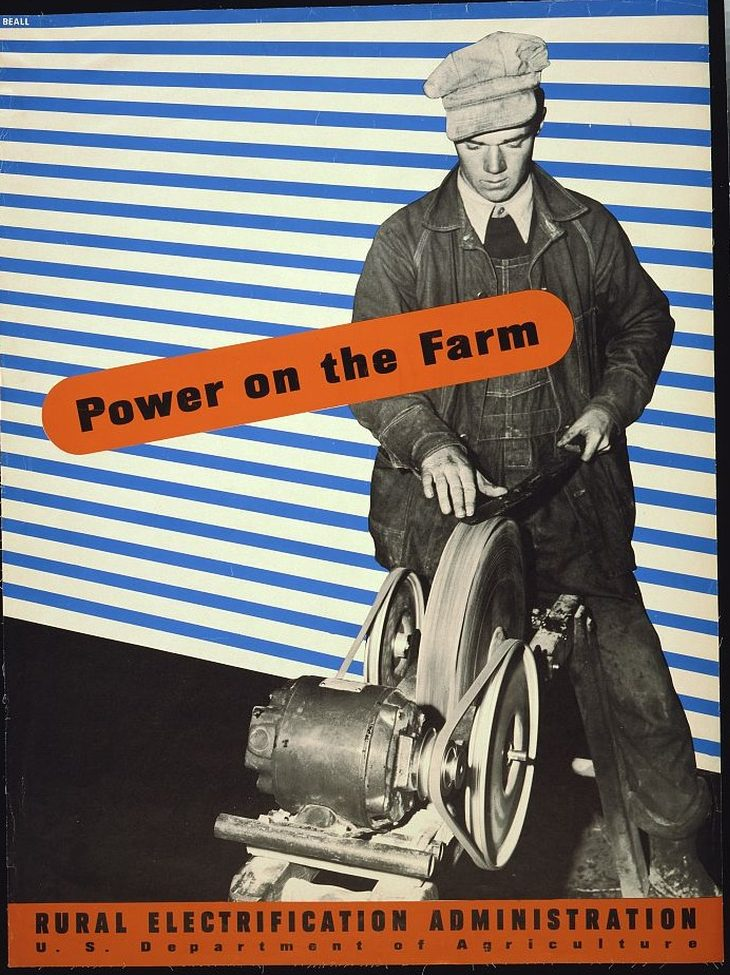
The Rural Electrification Act of 1936 is what finally closed the gap a different way. The Act funded federal loans to string power lines out to farms that had never had them — roughly ninety percent of American farms were without electricity when it passed — and one of the very first purchases an electrified farm made was an electric well pump paired with a pressure tank, which pushed running water into the house under real pressure for the first time. An electric pump ended the physical hauling of water outright; on hill-country farms that labor had amounted to a woman carrying literal tons of water a year from well to house. Once a farm kitchen had a tap, and manufactured detergents arrived that didn’t curdle in hard water the way lye soap did, the advantage of walking out to a barrel at the eave started to disappear. By the 1940s and 50s, a rain barrel still standing at a farmhouse corner was as likely to be a garden ornament as working equipment.
The object itself never really vanished, though; it changed jobs. Rain barrels are back today on suburban and city properties across the country, catching roof runoff to water a garden and take pressure off the municipal supply — the identical mechanism, the identical fifty-gallon logic, aimed at a flower bed instead of a washtub. The chemistry that justified the original barrel hasn’t changed either. Rain is still free of the minerals a well picks up underground; it’s simply that almost nobody still needs to avoid those minerals to get a load of laundry clean.
Watch the full history
The video version covers the gutters, the wash day, and the mosquito problem in about eight minutes.

Related reading
- The Maple Sugar Abolition Movement That Almost Worked
- How Cider, Not Beer, Became Colonial America’s Everyday Drink
- How Wooden Tally Sticks Ran England’s Treasury for 600 Years
- How a Water-Powered Grist Mill Turned Wheat Into Flour, No Cash Involved
Get the modern version
RTS Home Accents 50-Gallon Rain Barrel with Brass Spigot
Works cited
- Straub, Alexandra L. Making Water Pure: A History of Water Softening from Potash to Tide. PhD diss., Temple University, 2020.
- Chemistry LibreTexts. “Hard Water.” Descriptive Chemistry, Main Group Reactions, LibreTexts Inorganic Chemistry Library. Link.
- Townsend, Raymond R. “Coopers.” Colonial Williamsburg Foundation Library Research Report Series, no. 316, 1963.
- National Park Service, Technical Preservation Services. “Roofing for Historic Buildings: Gutters and Downspouts.” Link.
- Rutgers Cooperative Extension. “Rain Barrels and Mosquitoes.” Fact Sheet FS1240, Rutgers New Jersey Agricultural Experiment Station, 2014. Link.
- “The Legacy of Sir Ronald Ross: From Malaria Research to Multifaceted Achievements.” PMC, National Library of Medicine. Link.
- Kelly, Howard A. “The Work of Walter Reed and His Associates of the Medical Department of the United States Army.” American Journal of Public Health 23, no. 11 (1933): 1127–1132. (Publisher bot wall on request; cited as print.)
- Woods, Rebecca. “Rural Electrification Changed Farm Life Forever in Wyoming.” WyoHistory.org, Wyoming State Historical Society. Link.
- “Sam Rayburn and Rural Electrification.” East Texas History, East Texas Historical Association / Stephen F. Austin State University. Link.