
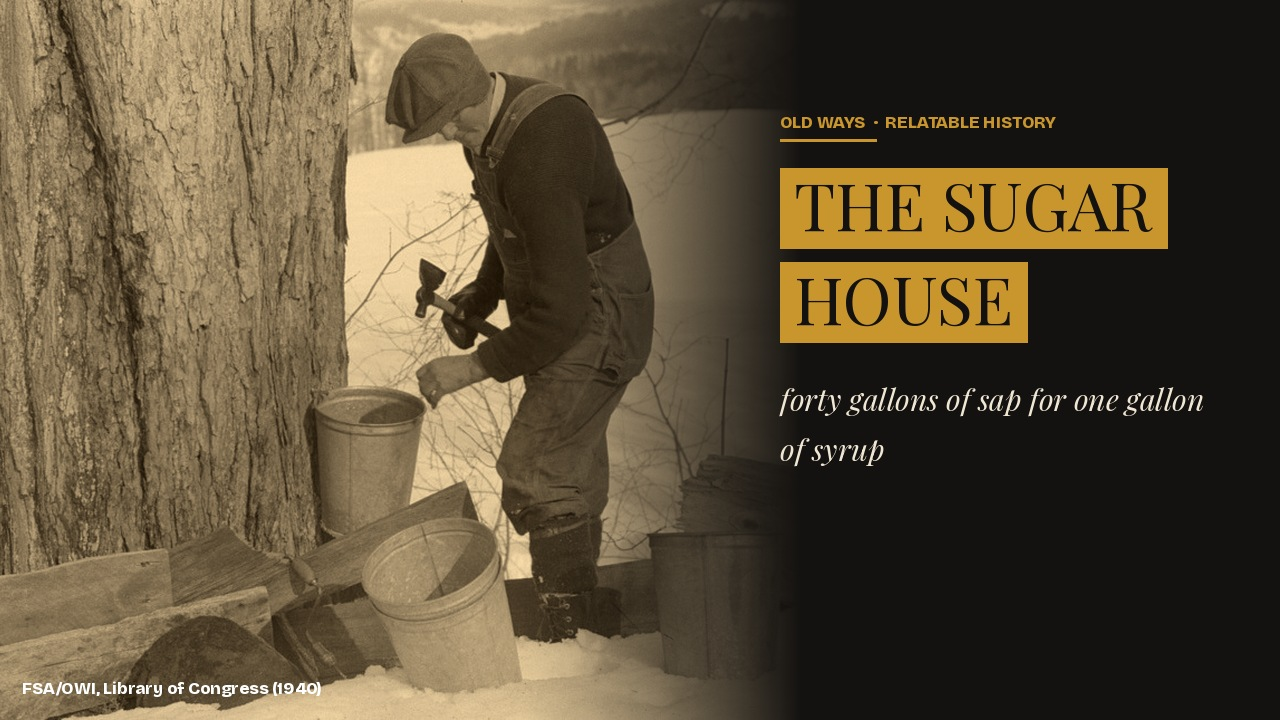
In 1794, a group of Dutch investors called the Holland Land Company bankrolled an unusual experiment in the woods north of what is now Utica, New York: a seventeen-acre sugarbush strung with wooden troughs, built to carry maple sap downhill to a boiling station without a single bucket being carried by hand. The point was not efficiency for its own sake. It was part of a wider plan, already underway in Philadelphia drawing rooms, to make maple sugar into something cane sugar could never be — a sweetener nobody had been enslaved to produce.
The wooden troughs cracked, warped and leaked within a season, and the investors gave up. But the larger idea behind it — the maple sugar abolition movement that briefly convinced Founding Fathers, Quaker reformers and at least one sitting cabinet officer that American maple trees could starve out the West Indian slave trade — lasted considerably longer, and came considerably closer to reshaping the country’s sugar bowl than most people now realize.
It also depended on a technique Native nations in the Northeast had already been practicing for centuries, using tools no more complex than a hatchet and a strip of bark.
Native nations were freeze-concentrating sugar long before contact
The commonly repeated origin story is that Native people noticed squirrels and birds gnawing at broken maple branches in late winter and chewing the ice that formed on the sweet sap beneath — so-called “sapsicles” — and worked backward from there. Timothy Perkins, director of the University of Vermont’s Proctor Maple Research Center, has written that this is the most likely path to the discovery, though written evidence only goes back to a 1557 French account and a Kanien’kehá:ka (Mohawk) oral tradition that treats the maple, or Wahta, as the first tree to wake in spring.
The processing method predates any metal kettle. A birch-bark vessel of sap was left out overnight; the water in it froze first, leaving the sugar concentrated below. Skim the ice, refreeze, skim again, and after several cycles what remained was thick enough to dry into a storable, portable sugar — poured into carved wooden molds shaped like animals and stars for trade and gifts, or packed into cone-shaped bark containers. Sap gathering happened during what several Haudenosaunee communities call the sugar moon, a specific and dangerous window: warm enough to loosen the sap, cold enough that a sudden storm could strand a gathering party in the woods.
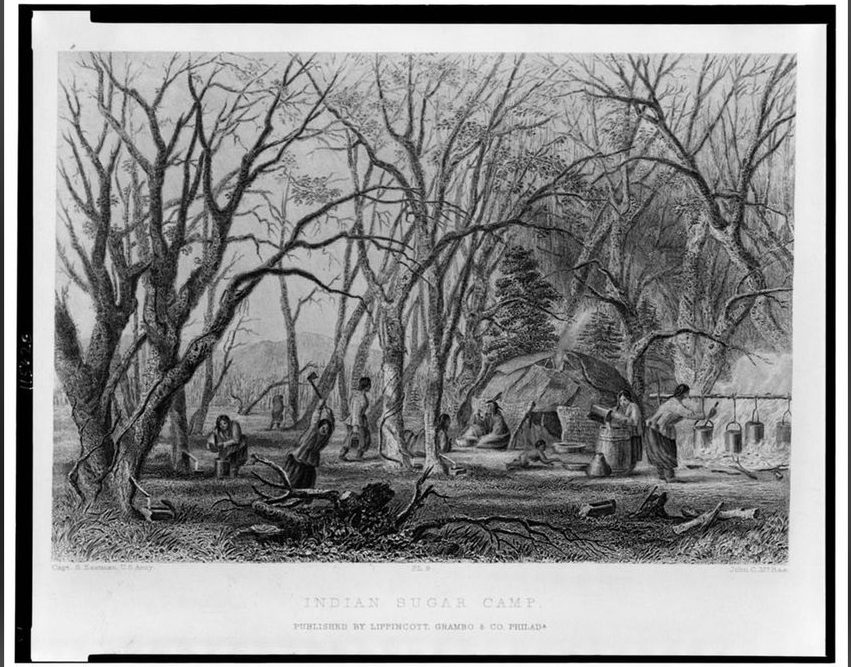
By the time European colonists arrived, the practice was old enough that fur traders and missionaries described it routinely, and it was colonists, not the other way around, doing the learning. Roughly forty gallons of sap boil down to one gallon of syrup, or five to six pounds of sugar — a ratio that shows up in accounts from the 1700s and hasn’t changed since, because it is set by the sugar content of the sap itself, typically two to three percent straight from the tree.
Sugar and syrup were never only a sweet treat in these communities. Maple sugar cured meat, masked the taste of bitter medicines, and doubled as a mild anesthetic; dried into slabs, it traveled well enough to serve as a trade good between nations that had never seen each other’s sugarbush. That combination — food, medicine and currency in one object — is part of why the tree carried so much symbolic weight later, when Americans went looking for a sugar with a clean moral story attached to it.
A Philadelphia doctor turned maple into an argument against slavery
The maple sugar abolition movement proper began in Philadelphia in the late 1780s, built around Dr. Benjamin Rush, a signer of the Declaration of Independence and one of the new nation’s best-known physicians. Rush had a simple, morally loaded argument: cane sugar came from Caribbean plantations worked by enslaved people, while maple sugar could be made entirely by free American farm families, using nothing but a woodlot, a kettle and the late winter thaw. In 1789 he helped found the Society for Promoting the Manufacture of Sugar from the Sugar Maple Tree alongside a group of Philadelphia Quakers, who were already boycotting slave-grown goods through the broader “free produce” movement.
William Cooper, a land speculator and maple sugar entrepreneur in upstate New York, became the movement’s most enthusiastic promoter, and Tench Coxe — assistant secretary of the Treasury under Alexander Hamilton — gave it an official platform, devoting a chapter of his 1794 economic survey of the United States to maple sugar’s potential, built largely on Cooper’s own inflated estimates. Rush’s pamphlet, aimed at farmers trying the craft for the first time, went further than economics: it claimed maple sugar was more hygienic than cane, since enslaved laborers, in his words, were not under “the same obligations to keep their persons clean” as free families working for themselves.
Thomas Jefferson joined the cause from Paris, where he was serving as minister to France, and pursued it with real seriousness once he returned. “What a blessing,” he wrote a friend in 1790, “to substitute a sugar which requires only the labour of children, for that which it is said renders the slavery of the blacks necessary.” In May 1791 he and James Madison rode nine hundred miles through New York and Vermont partly to scout the maple sugar trade firsthand, and in 1791 Jefferson planted sixty maple saplings at Monticello, urging any farmer who kept an apple orchard to keep a sugar orchard alongside it.
The boldest version of the plan was also a pipeline, and it failed in one season
The Holland Land Company’s 1794 sugarbush, under the direction of Gerrit Boon, was the movement’s most literal attempt to industrialize Rush’s vision: an interconnected network of milled wooden troughs meant to move sap by gravity alone, cutting out the backbreaking labor of hauling buckets by hand. Vermont farmer Calvin Thales Alvord tried a similar approach on steep hillsides decades later, describing 14- to 16-foot spruce “leading spouts” in an 1863 U.S. Department of Agriculture report, and in that same year Vermonters Moses Shelden and Wareham Chase patented a wooden spout design of their own.
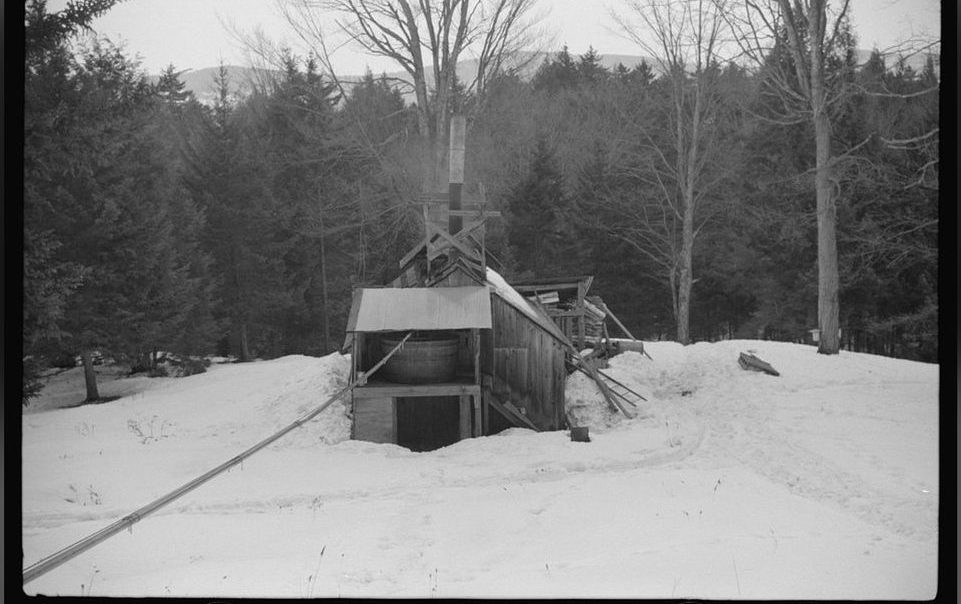
None of these wooden pipelines held up well against rain, debris and the ordinary warping of wet wood, and metal pipe sections eventually replaced them. The idea that sap could simply run downhill to the boiling pans, rather than being carried, was sound — it just took more than a century, and plastic instead of wood, to make it practical at scale.
The bubble popped, but the habit didn’t
Jefferson’s own maple orchard failed outright; his sixty saplings died within a few years, and two further shipments of trees fared no better. Cooper’s sugaring business folded after a run of short, warm springs cut into his sap yields. As a purely economic substitute for cane, the scheme never delivered what its boosters promised — but for decades afterward, maple sugar genuinely competed on price. It sold for about half the cost of imported cane sugar as late as 1818, and the two were roughly at parity by 1880. It was only in 1885 that cane sugar undercut maple for good, helped along by industrial-scale cane and beet refining that no farm woodlot could match.
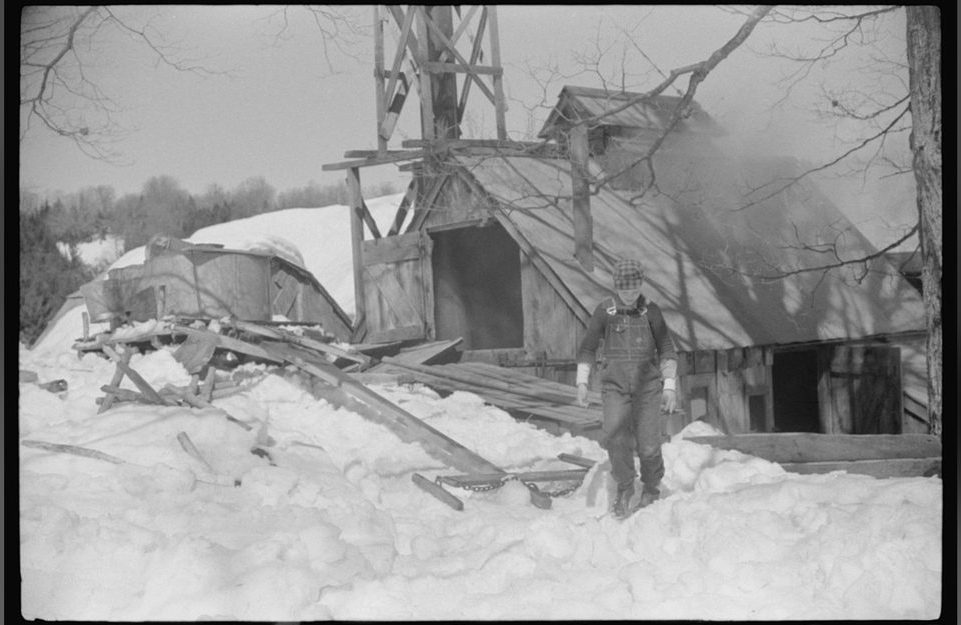
After the Civil War, the product itself changed. Solid maple sugar, the dense, shelf-stable block that had made sense before reliable jars and iceboxes, gave way to maple syrup as the industry’s main output, helped by the spread of tin cans, patented metal spouts, and dedicated evaporator pans through the 1850s to 1900s. The moral argument had lost to the market. The tree stayed in business anyway.
Industrialization solved the labor problem the politics never could
What Rush, Jefferson and Cooper wanted from a network of wooden pipes, the twentieth century eventually delivered through plastic. An early metal sap-gathering tube patented in 1916 proved impractical — it froze and leaked in the cold — but postwar experiments with flexible tubing picked up where wood and metal had failed. Researchers at the University of Vermont’s Proctor Maple Research Center, founded in 1946, tested short sections of plastic tube as early as 1952, and in 1959 Vermonter Nelson Griggs patented the first workable plastic sap-gathering pipeline. Vacuum pumps followed, pulling sap through the tubing network rather than relying on gravity alone, and reverse-osmosis filters arrived in the 1970s to strip water out of the sap before it ever reached the evaporator.
Historian Matthew M. Thomas, who has written the fullest account of this shift, notes that plenty of “old-timers” scoffed at the idea of stringing what looked like clotheslines through the sugarbush. The labor savings won the argument anyway: tubing eliminated the single largest annual cost of making syrup, which was simply paying people to carry sap through the snow.
The ceremony outlasted the economics
The abolitionist case for maple sugar disappeared along with slavery itself, and the industrial case gave way to syrup, tubing and reverse osmosis. What has not disappeared is the practice Native communities never fully stopped doing. Kanien’kehá:ka Faithkeeper Otsi’tsaken:ra Patton, who teaches the tradition at the Mohawk Trail Longhouse near Montreal, still burns tobacco each spring and asks the maple, Wahta, to fulfill its role in what he describes as a cycle of mutual obligation between people and trees — a relationship considerably older than any pamphlet written in Philadelphia.
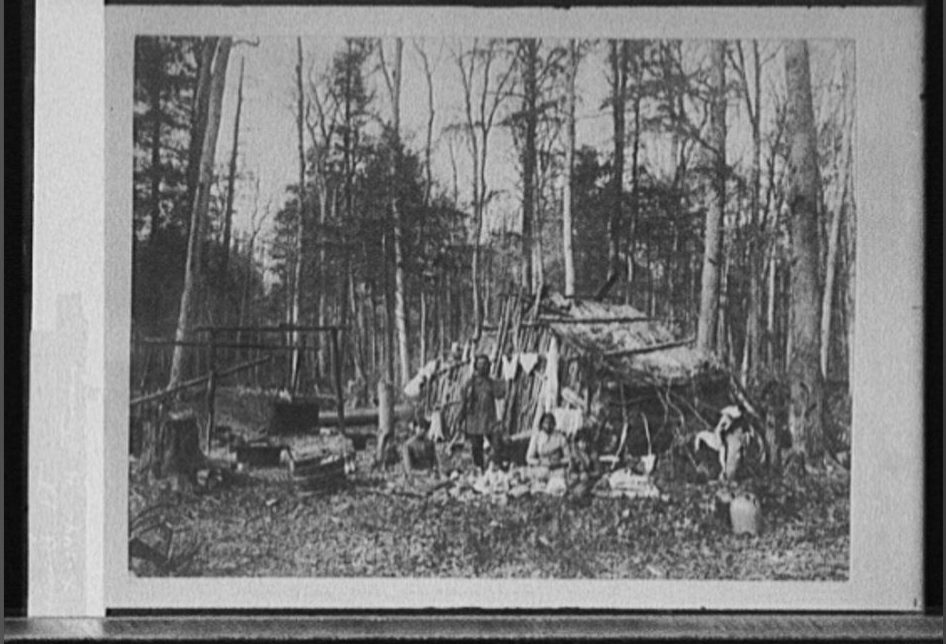
That relationship had frayed for long stretches. Otsi’tsaken:ra has described how his own Kahnawá:ke community, predominantly Catholic for generations, had to relearn maple songs and ceremonies from neighboring Haudenosaunee communities starting in the 1920s, after the longhouse tradition itself had been pushed aside. The revival has picked up speed in the last decade: several Kahnawá:ke families now run their own sugar shacks and teach visitors to boil sap the way their grandparents did, and schools in the community now include the maple harvest in their curriculum rather than leaving it to be relearned informally, generation by generation.
Today Vermont alone produces more than three million gallons of syrup a year and supplies over half the country’s output, while Canada, led by Quebec, supplies roughly three-quarters of the world’s maple products. None of that scale existed in 1790. What Rush, Jefferson and Cooper got right was that the tree could carry the weight of a whole industry. What they got wrong was assuming that a good enough substitute could out-argue a market — cane sugar’s advantage was cost, not virtue, and cost is what eventually won.
Watch the full history
The video companion to this article follows one Vermont family through a single sugaring season, from the first tap to the last boil.

Related reading
- How Cider, Not Beer, Became Colonial America’s Everyday Drink
- How Wooden Tally Sticks Ran England’s Treasury for 600 Years
- How a Water-Powered Grist Mill Turned Wheat Into Flour, No Cash Involved
- How Semaphore Flags Actually Worked at Sea
Shop this history
Maple Sugar: From Sap to Syrup by Tim Herd
Works cited
- Sturges, Mark. “‘Bleed on, blest tree!’: Maple Sugar and the Political Ecology of the Early Republic.” Early American Studies 16, no. 2 (Spring 2018): 353–380. University of Pennsylvania Press. Link.
- Gershon, Livia. “Praising Maple Sugar in the Early American Republic.” JSTOR Daily, April 7, 2022. Link.
- Theobald, Mary Miley. “Thomas Jefferson and the Maple Sugar Scheme.” Colonial Williamsburg Journal, Autumn 2012.
- Evans, Tony Tekaroniake. “The Indigenous Origins of Maple Syrup.” American Indian Magazine (Smithsonian National Museum of the American Indian) 23, no. 4 (Winter 2022). Link.
- Thomas, Matthew M. “From Pails to Pipelines: The Origins and Early Adoption of Plastic Tubing in the Maple Syrup Industry.” Vermont History 89, no. 1 (Winter/Spring 2021): 52–78. Vermont Historical Society. Link.
- University of Vermont Libraries. “History of Maple.” Maple Research Guide, in partnership with AgNIC. Link.
- United States Department of Agriculture, National Agricultural Statistics Service, New England Field Office. 2025 Maple Syrup Production. News release, June 2025. Link.