

Roughly twenty-five centuries before a London merchant got jeered by hackney coachmen for carrying one, a Greek poet was already using an umbrella as an insult. In a surviving fragment of his verse, Anacreon mocks another man for going about with “an ivory parasol, as women do.” Umbrellas were once considered unmanly across most of the ancient and early modern West, starting right there in sixth-century-BC Ionia: shading yourself rather than having a servant do it marked a man as vain at best and effeminate at worst, and that charge attached itself to the object for roughly the next two thousand years.
That is the strange part of this story. The umbrella’s oldest and most durable job was never staying dry. It was staying shaded, and more specifically, broadcasting that the person underneath it was too important to feel the sun. Waterproofing came later and in several unrelated places at once. Respectability, for men at least, came later still, and it took one particularly stubborn Englishman and two separate feats of engineering to finish the job.
The parasol began as a portable throne, not a rain shield
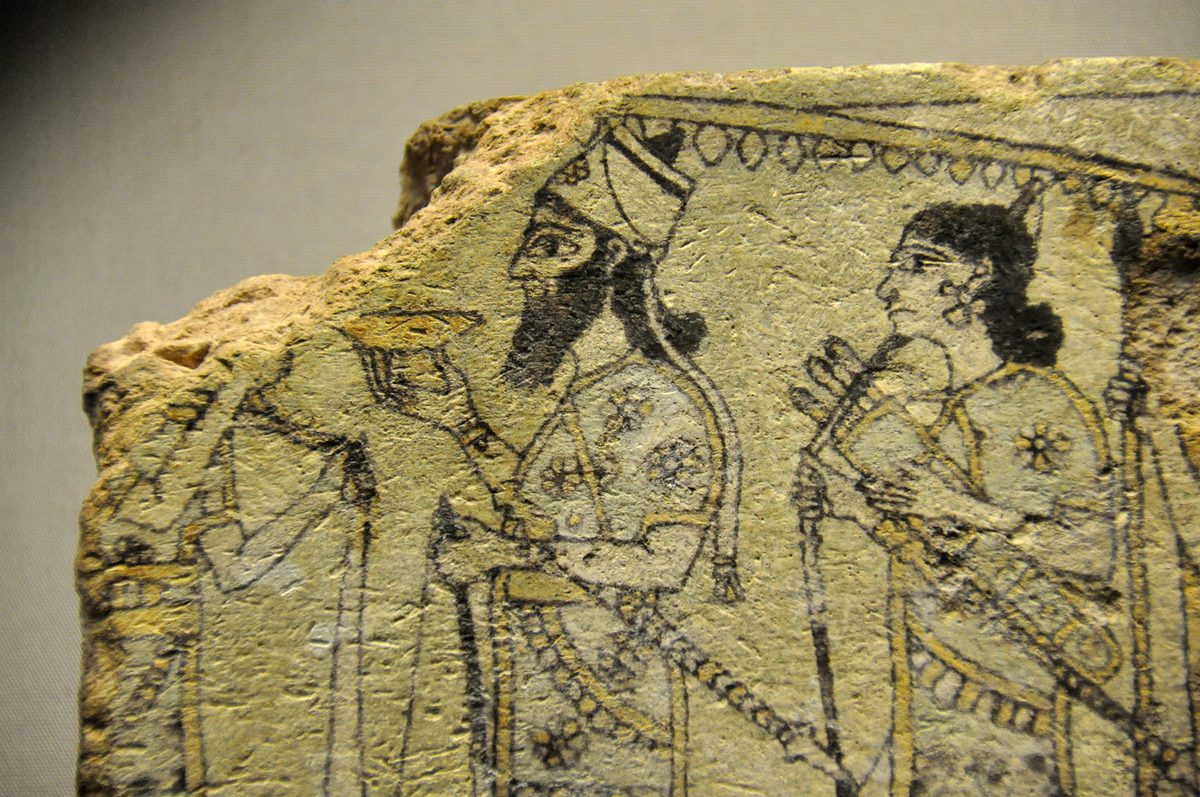
The earliest clear depictions of an umbrella-shaped object are Assyrian, and they are unambiguous about what it meant. Palace reliefs from Nimrud, carved in the ninth century BCE, show a fringed parasol held over the king by an attendant as he rides in procession or presides over a scene of conquest. Austen Henry Layard, the archaeologist whose excavations uncovered those reliefs, described the parasol as “the emblem of royalty so universally accepted by eastern nations,” carried over the king in peace and sometimes even in war. Egyptian art shows a similar idea in parallel: fan-and-canopy devices fixed to royal chariots, and processions in which a servant’s entire function was to keep one specific person out of the sun.
None of this had anything to do with weather. A parasol in this period is closer to a crown or a sceptre than to a modern umbrella: an object whose entire value is that hardly anyone is allowed to have one. That logic, status before function, shaped how the object was received almost everywhere it travelled next.
Why umbrellas were once considered unmanly in Greece and Rome
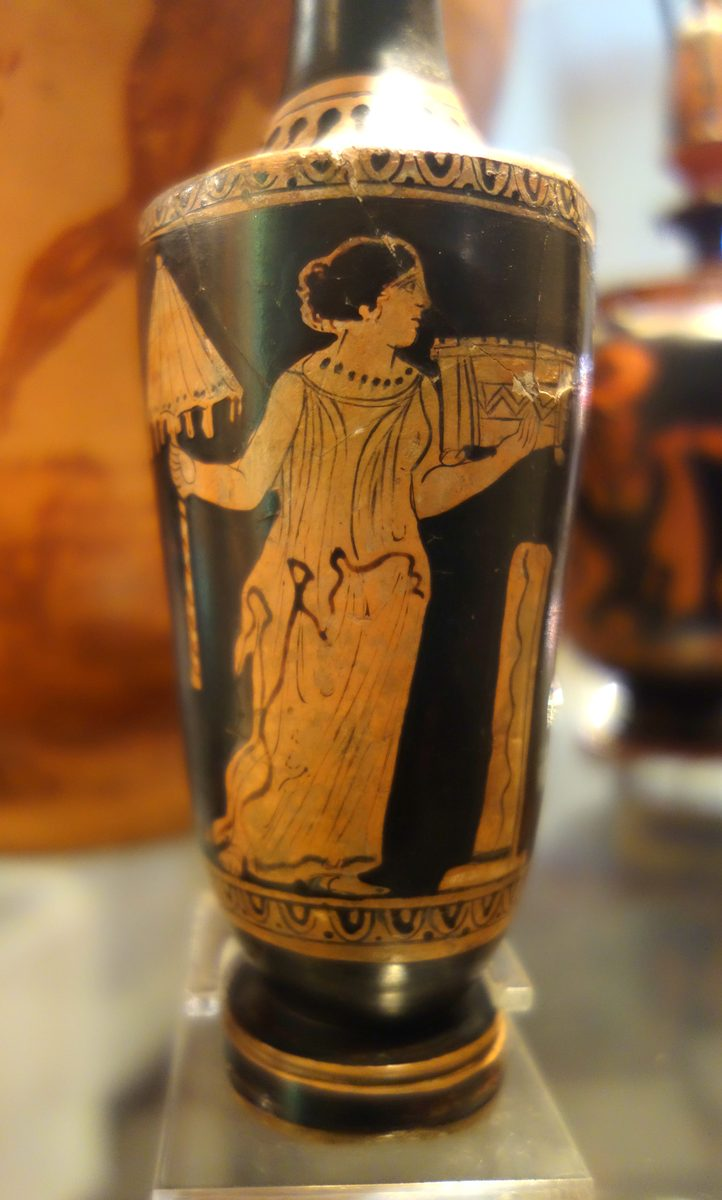
By classical Greece, the parasol (the skiadeion) had become everyday equipment for fashionable women, carried over their own heads rather than a king’s. Vase painting shows this plainly: a lekythos from Lucania, dated to roughly 400-370 BCE, depicts an ordinary woman holding an open parasol, no royal procession required. Religious life absorbed the same object. At the Scirophoria, a midsummer festival honouring Athena Sciras, priestesses carried white parasols in procession. Men were a different matter. Anacreon’s jab about the ivory-handled parasol survives precisely because it was understood as an insult, and the association hardened rather than softened with time.
Rome’s version, the umbraculum, was a folding sunshade typically made of skin or leather and carried mostly for and by women, again almost entirely a matter of fashion rather than rain protection. Ovid’s advice to a would-be lover, to hold a mistress’s parasol for her as a courteous gesture, only works as a joke because a Roman man holding one himself would have looked faintly absurd. The object’s gendering, in other words, was not a quirk of one culture. It was inherited and reinforced across at least two.
China solved the rain problem, and did it independently
While the Mediterranean world treated the parasol as a sunshade and a status symbol, China had already built a genuinely weatherproof version. Bamboo ribs covered in oiled paper produced a canopy that actually shed water, a design with, by China Today’s account, more than a thousand years of continuous history. One widely repeated origin legend credits the idea to the sister of the carpenter Lu Ban, who is said to have built a portable silk-and-bamboo cover that opened like a pavilion roof and folded away like a cane, after watching how poorly her brother’s fixed shelters handled a sudden rainstorm. Whatever the truth of that story, the finished object spread along real trade and cultural routes: by the Tang dynasty (618-907 CE), oil-paper umbrellas were established in Japan, Korea, Vietnam, Thailand and Laos, each region adapting the basic form to its own materials and customs. Traditional manufacture still runs to more than seventy separate hand steps, from selecting and curing the bamboo to oiling and sun-drying the paper canopy, and a single umbrella can take roughly two weeks to finish.

Crucially, nothing about this version carried the Mediterranean stigma. An oiled-paper umbrella was simply useful, for rain or sun, for men and women alike, which makes the later European struggle to reach the same unremarkable status look even stranger by comparison. Two civilisations solved overlapping problems, and only one of them attached two thousand years of social penalty to the solution.
Medieval Europe mostly let the umbrella disappear
When the Western Roman Empire came apart, the umbraculum largely went with it. William Sangster, whose 1855 survey Umbrellas and Their History remains one of the few books devoted entirely to the subject, traces the object’s near-total retreat from ordinary medieval life into one narrow lane: the church. An umbrella-shaped canopy, carried as a mark of rank over bishops and certain senior clergy, survived in Catholic ceremony precisely because, as Sangster records it, judgment halls converted into churches kept the judge’s insignia of office, the processional canopy among them. A version of that same object, the ombrellino or umbraculum, is still carried in some Catholic processions today and remains one of the heraldic symbols that marks a church as a basilica. An ordinary person caught in a medieval downpour, meanwhile, simply got wet.
One London merchant carried an umbrella until people stopped laughing
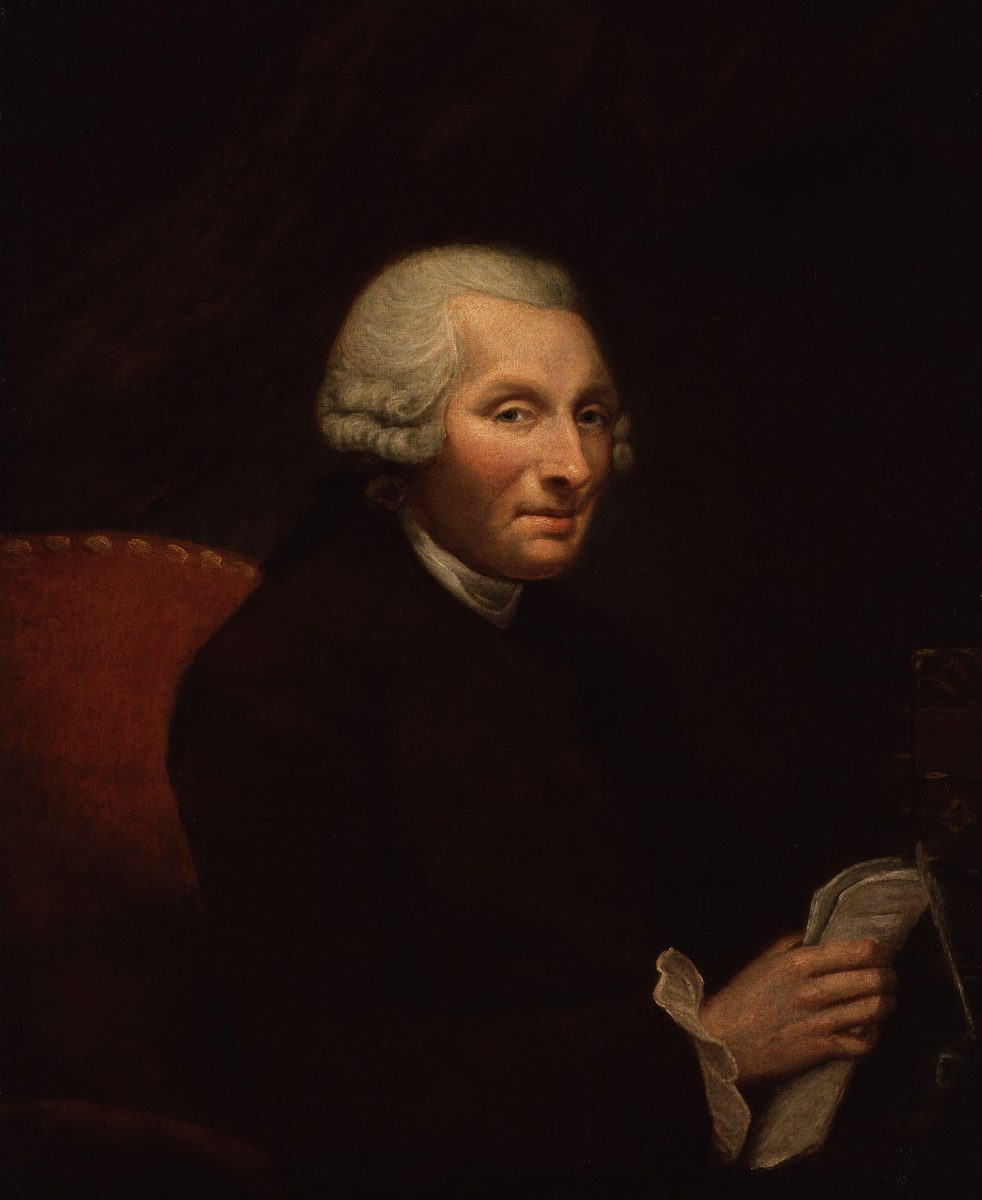
By the Georgian era, the fashionable parasol had returned to Western Europe by way of Italy and France, still overwhelmingly a woman’s accessory and still almost never carried against rain. Jonas Hanway, a London merchant, philanthropist and founder of the Marine Society, is remembered by Sangster as “the first man who had the courage to carry one habitually in London,” a habit Sangster credits to Hanway having “felt the benefit of one during his travels in Persia.” Both the National Maritime Museum and Westminster Abbey confirm the same distinction, and record that the writer Samuel Johnson mocked him for it. The reaction on the street was worse than mockery. Sangster describes umbrellas becoming “objects of derision, especially from the hackney coachmen, who saw in their use an invasion on the vested rights of the fraternity” — a cab driver’s fare depended on bad weather, and a pedestrian who could shrug off a downpour was a customer lost. A diarist named John Macdonald left a vivid record of exactly what that hostility sounded like: carrying his own silk umbrella through London in 1770, newly brought back from Spain, he was greeted with the shout, “Frenchman, Frenchman! why don’t you call a coach?” It is worth noticing how closely that insult tracks the one Anacreon aimed at a man carrying a parasol two thousand years earlier: foreign, over-delicate, not quite properly masculine. The specific charge barely changed; only the language did. (The fork drew almost exactly the same kind of ridicule in the same century, for much the same reason: a tool that implied its user thought themselves above doing things the plain old way.)
Hanway kept at it anyway, by Sangster’s account for roughly thirty years, from around 1750 until his death in September 1786, and by every surviving account without much fanfare, simply using the thing daily until the novelty wore off. Sangster’s own summary of what finally broke the resistance is almost anticlimactic: people “found their value, and got over the shyness natural to a first introduction.” By the early nineteenth century an umbrella in a man’s hand on a London street had stopped being a joke. The Science Museum Group holds a plain wood-and-bamboo umbrella frame, dated to around 1830, that belonged to the chemist John Dalton, a Manchester scientist with no reputation to spare for affectation. By Dalton’s generation, the object had become ordinary enough for an ordinary man of science to own one without comment.
Steel, not etiquette, is what finally made it everywhere
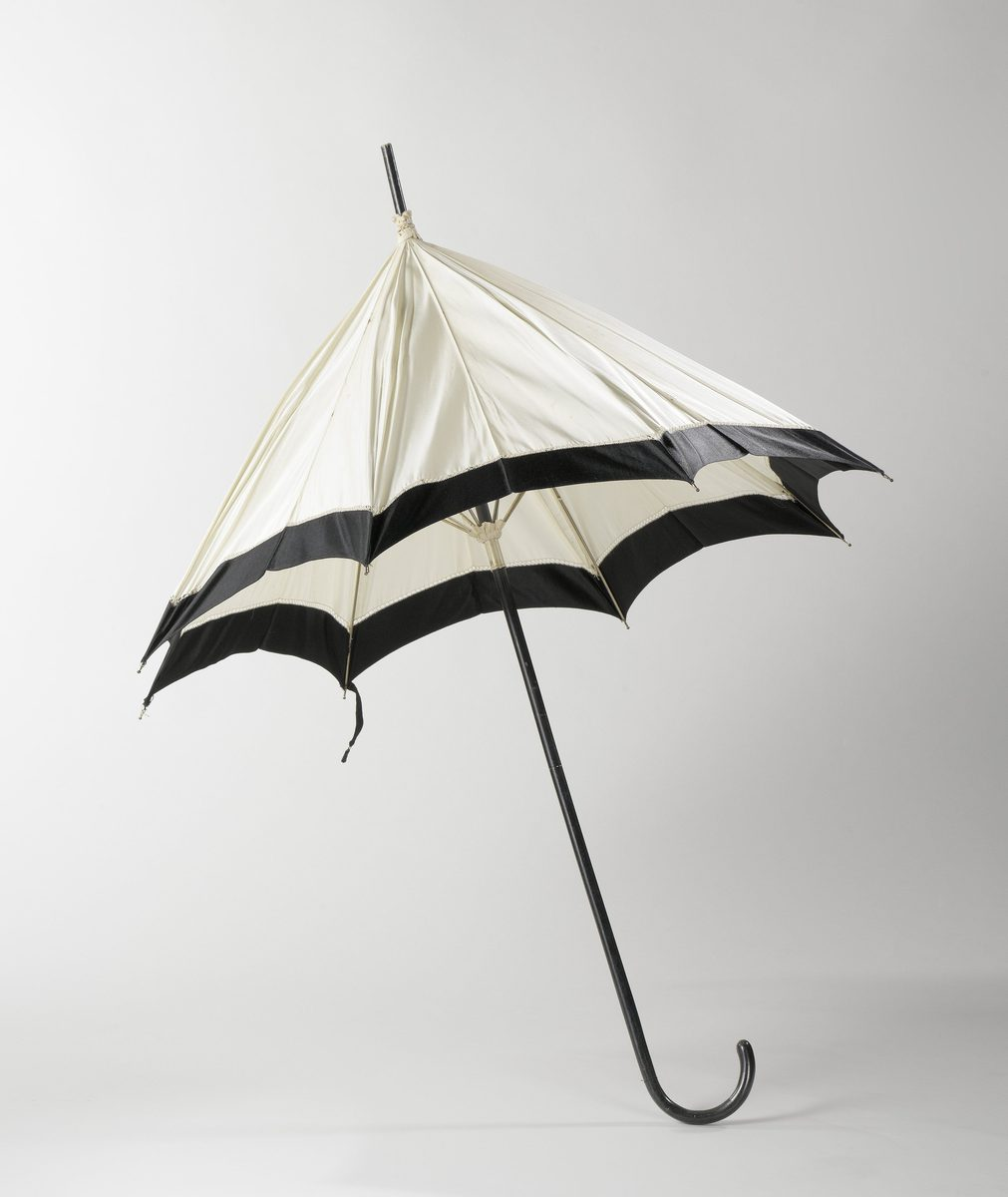
Acceptance alone did not make the umbrella cheap or reliable. Through the early nineteenth century, frames were still built on whalebone stays, which were heavy, expensive and prone to snapping in a real gust. The fix came from Sheffield. Samuel Fox, a wire manufacturer who had been selling umbrella frames from his Stocksbridge works since the 1840s, developed a lightweight U-section steel rib sold under the name Paragon, and Merchant & Makers‘ account of the firm credits it with creating a unique, stronger and lighter umbrella than whalebone had ever allowed. Sources disagree on exactly when the Paragon frame itself was perfected, with some industrial histories placing it as early as the 1850s and the Fox company’s own later retelling pointing to refinements still underway in the 1880s. What is not in dispute is the effect once steel ribs were in full production: a frame that sprang back into shape instead of splitting, built cheaply enough in quantity to reach a much wider market. By the 1930s, Fox-framed umbrellas were being exported to Japan, the United States and beyond, much as a cheap, well-engineered rib system did for the umbrella what the first reliable patent design had done a few decades earlier for a far less dignified household object, the spring-loaded mousetrap: turned an unreliable idea into something a factory could stamp out by the thousand.
Two more redesigns, a century apart, finished the shape we use now
The umbrella’s last two major redesigns both came from engineers solving a specific physical annoyance rather than a social one. The first was portability. According to the German Patent and Trademark Office’s own account of the invention, a former mining assessor named Hans Haupt filed a sequence of telescoping-umbrella patents between 1916 and 1930, the last of which, filed in April 1930 and granted in 1934, is treated by the office as the Knirps’s true birth: a design using auxiliary struts that let the canopy collapse down small enough for a coat pocket without damaging the fabric. Haupt’s own firm struggled to sell it. It was a Solingen manufacturer, Fritz Bremshey, who put the folding umbrella into mass production in 1932, and whose window displays turned initial skepticism into a genuine bestseller.
The second fix was aerodynamic. Conventional umbrellas fail in real wind for a simple reason: a gust gets underneath the canopy and turns it inside out. Around 2005, Gerwin Hoogendoorn, then a Dutch industrial design student, built a prototype that worked with that physics instead of against it, an asymmetric canopy that catches a gust on its underside and rotates to face it rather than inverting. “If the wind gets underneath,” Hoogendoorn told The Washington Post in 2018, it “catches the backside of the umbrella, causing it to turn into the same direction of the wind.” The design reached the market as the Senz storm umbrella in October 2006, roughly a hundred and fifty years after Samuel Fox’s steel ribs and almost four hundred years after Jonas Hanway’s first jeered walk through London rain.
Watch the full history
The short video that inspired this article covers the same two-thousand-year stigma, and the Englishman who broke it, in under a minute and a half; the research above is the long version.

What changed, across all of this, was never the object’s basic job. A canopy on a stick that keeps weather off one person is, mechanically, close to the simplest tool there is, and it has been close to this shape for roughly a millennium. What changed was permission: who was allowed to be seen holding one, and what holding one was understood to say about you. In Japan, the traditional wagasa never had to relitigate that question. It has shaded both rain and sun, for men and women alike, without a break in the argument that ran through Mediterranean and British history for two thousand years.
Every other version eventually caught up to that same quiet neutrality. The steel rib made the umbrella affordable. The telescoping shaft made it portable. The aerodynamic canopy made it reliable in weather that used to destroy it outright. None of those fixes addressed the thing that actually kept it out of men’s hands for two millennia, because that problem was never mechanical. It just took long enough to become invisible that nobody alive today remembers it was ever an argument at all.
Related reading
- Why the Fork Was Once Considered Sinful
- The Stereoscope Craze That Swept Victorian Parlours
- Why the Penny-Farthing’s Wheel Had to Be So Big
- The Clothespin Patent History Behind America’s Favorite Free Dryer
Shop the styles/items featured in this video
Works cited
- Sangster, William. Umbrellas and Their History. London: Effingham Wilson, 1855. Link.
- “Oil-Paper Umbrella: Artwork and Accessory.” China Today, May 15, 2018.
- “Jonas Hanway (1712-1786).” Royal Museums Greenwich, National Maritime Museum, collections record. Link.
- “Jonas Hanway.” Westminster Abbey, Abbey Commemorations. Link.
- “Umbrella Frame,” a wood-and-bamboo frame owned by the chemist John Dalton, c. 1830. Science Museum Group Collection. Link.
- “Parasol,” silk on a metal frame, England, c. 1870. Accession no. T.220E-1915. Victoria and Albert Museum. Link.
- “Fox Umbrellas: Makers of the Quintessentially British Brolly.” Merchant & Makers. Link.
- German Patent and Trademark Office (DPMA). “Knirps — The Foldable Umbrella.” Inventions That Made History. Link.
- Hoogendoorn, Gerwin, interviewed in “The Physics Behind This Odd-Looking, ‘Stormproof Umbrella’ From the Netherlands.” The Washington Post, March 30, 2018.