
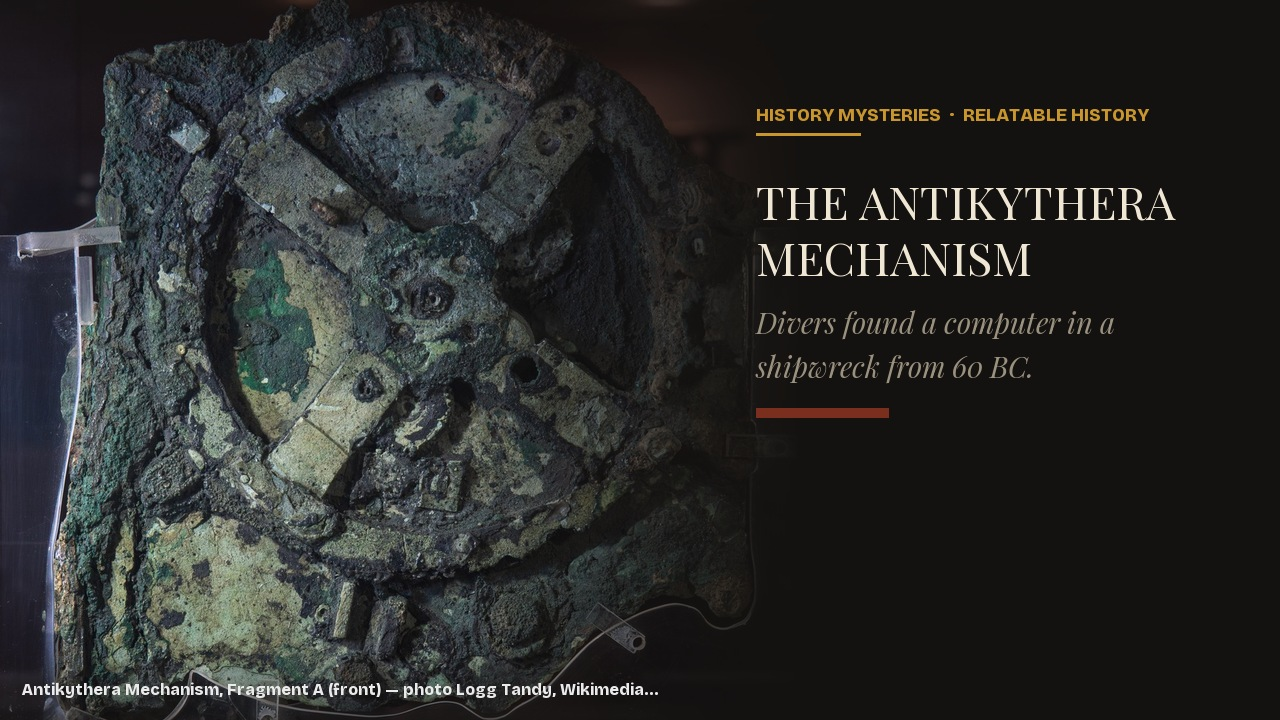
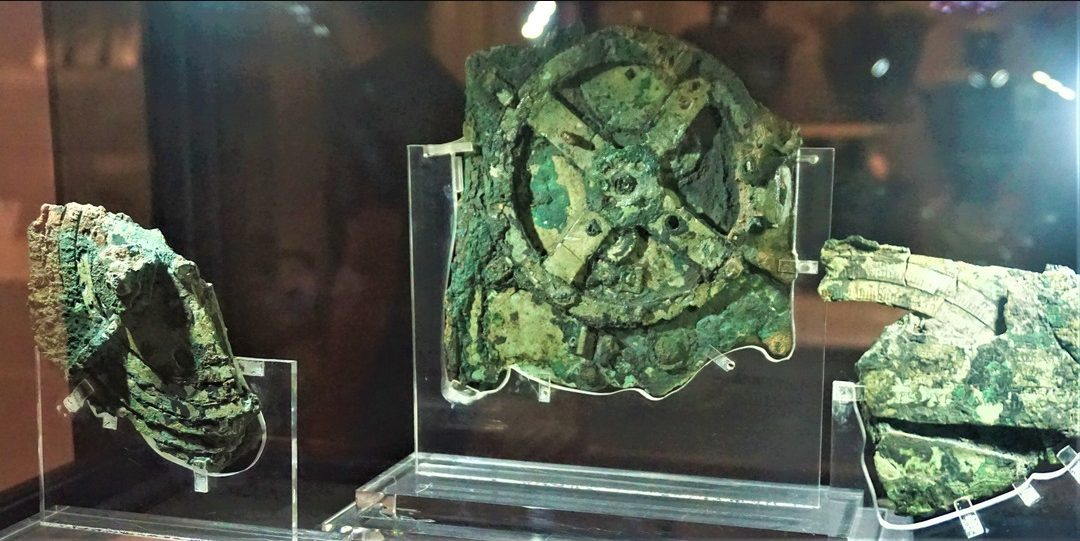
In the spring of 1900, a crew of Greek sponge divers waiting out a storm off the island of Antikythera found a Roman-era cargo wreck scattered across the seabed at a depth of roughly 45 metres. Among the bronze and marble statues they spent the next two years hauling to the surface was a corroded, fist-sized lump that nobody paid much attention to. It sat uncatalogued for the better part of a year before an archaeologist named Valerios Stais noticed, on 17 May 1902, that a gear wheel was embedded in the rock.
That lump is now called the Antikythera Mechanism, and it is the most complex surviving geared device from the ancient world by a wide margin. Study since has identified at least thirty hand-cut bronze gears, meshed to model the motion of the sun and moon against the zodiac, track a 19-year lunar calendar, flag the likely dates of solar and lunar eclipses years in advance, and display a four-year cycle of Greek athletic games including the Olympics. Nothing else approaching that level of mechanical sophistication appears in the archaeological record for roughly a thousand years afterward.
What survives is not the whole machine. Conservation work since has separated the find into 82 fragments, of which seven contain the majority of the mechanism and sixteen more carry partial inscriptions — by most estimates, around a third of the original device. Reading what remains of it took most of the twentieth century and all of the twenty-first so far.
The wreck held statues worth a fortune, and one object nobody understood
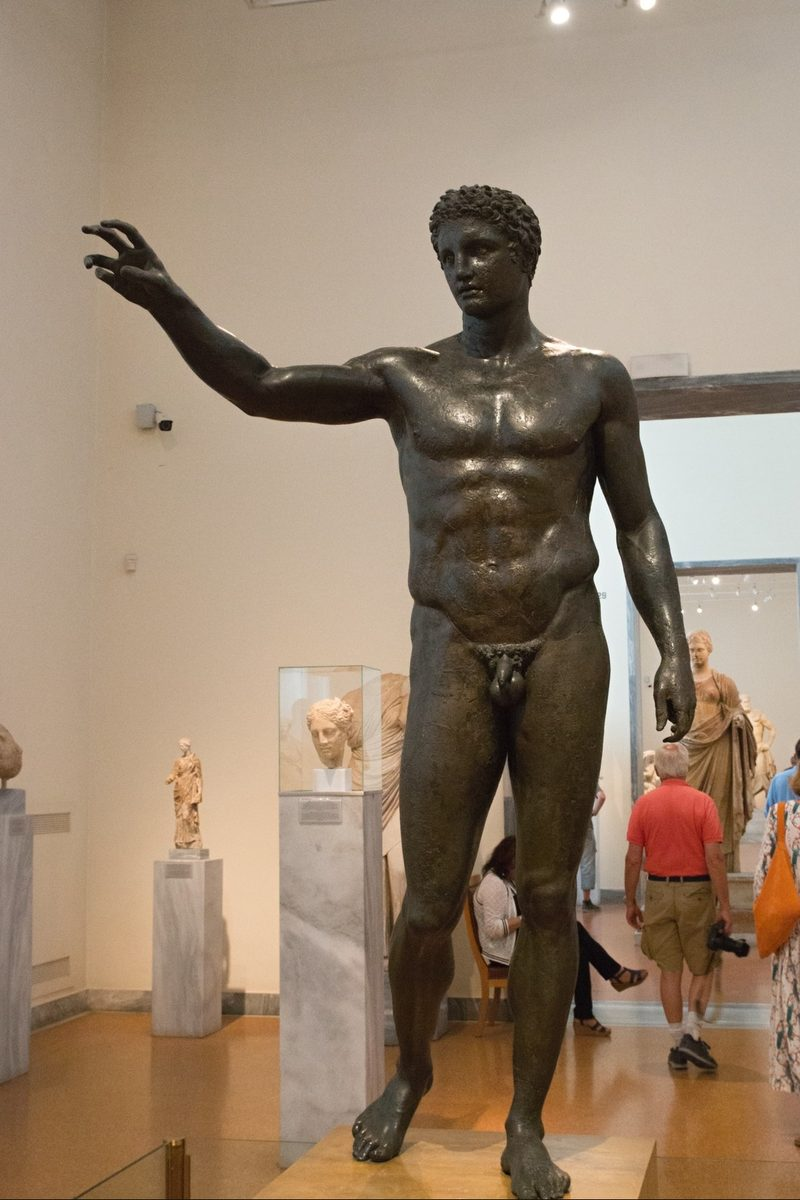
The Antikythera wreck was, by its own right, one of the richest hauls in the early history of underwater archaeology — arguably the first major one. Alongside life-size bronze statues including the striding youth now known as the Antikythera Ephebe, the divers and the Greek Royal Navy crew assisting them brought up marble horses, jewellery, coins, glassware, and a colossal bronze figure of Herakles that reportedly had to be left behind after breaking apart. The ship itself, dated by the National Archaeological Museum in Athens to around 60–50 BC, was carrying cargo that spanned the fourth to first centuries BC — a floating sample of several generations of Hellenistic Greek art and craft, likely bound for Roman buyers.
Against that backdrop, a green, rock-hard lump of corroded bronze did not stand out. It was catalogued with the rest of the wreck’s bronze fragments and left in storage at the museum. Stais’s observation in 1902 that it contained gearing, and might be some kind of astronomical clock, was met mostly with scepticism: nothing that intricate was known to exist before the medieval period, so the simplest explanation for a growing number of scholars was that it had to be something else, or that the dating of the wreck was wrong.
Reading the gearing took X-rays, then seventy more years
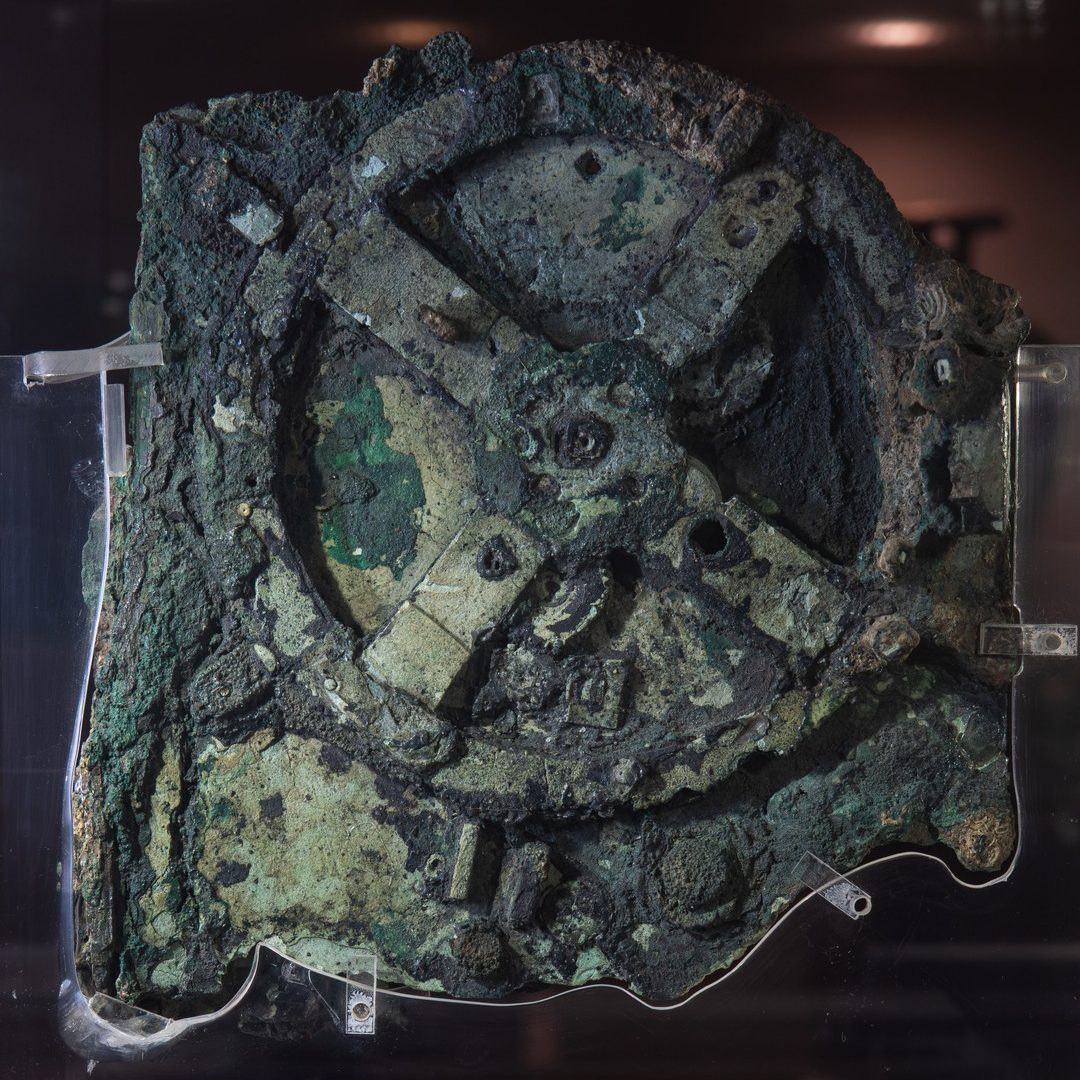
The fragments resisted inspection for decades simply because nobody could see past the corrosion without damaging what was left. The first real breakthrough came from the historian of science Derek de Solla Price, who worked with the Greek radiographer Charalampos Karakalos to X-ray and gamma-ray the fragments starting in 1971. Price published his findings in 1974 as a long monograph, Gears from the Greeks, proposing that the device modelled lunar and solar motion and arguing, controversially for the time, that it was a genuine instrument rather than a toy or a later forgery.
Price’s X-rays were two-dimensional and could not separate the gear layers cleanly. The device stayed only partly understood until 2005, when a team led by Mike Edmunds at Cardiff University brought a purpose-built 3D X-ray CT scanner and high-resolution surface imaging to the museum. The scans let researchers digitally peel the fragments apart layer by layer for the first time, and revealed thousands of characters of previously unread inscription hidden inside the corrosion — in effect, a technical manual engraved directly onto the machine’s own plates. A team led by Tony Freeth published the results in Nature in 2006, identifying 30 surviving gears and confirming eclipse-prediction gearing on the back of the device. A follow-up 2008 Nature paper, reading more of the inscription, identified a dial tracking the four-year cycle of Panhellenic games — Olympia, the Pythian, Nemean and Isthmian games among them — and traced the Corinthian-style month names used on the calendar ring.
Thirty gears modelled the sky, not just a calendar
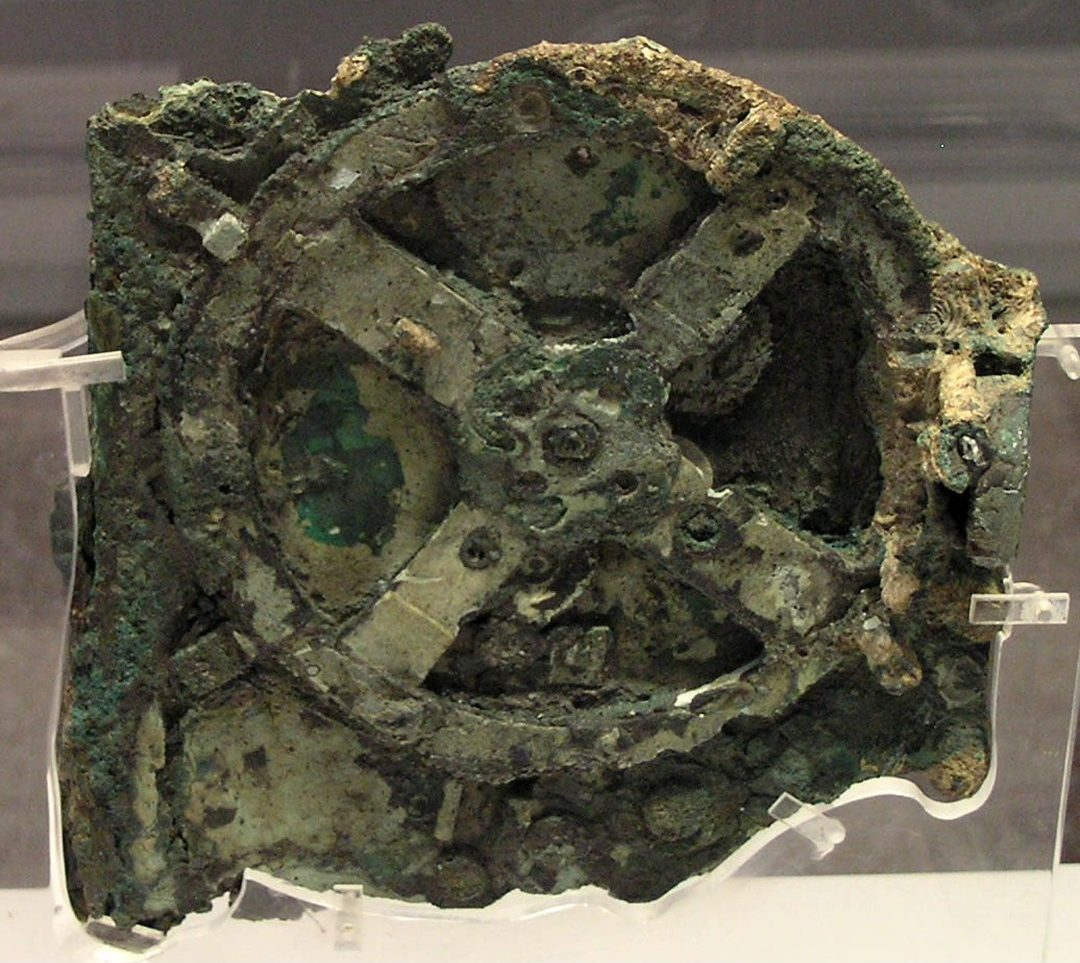
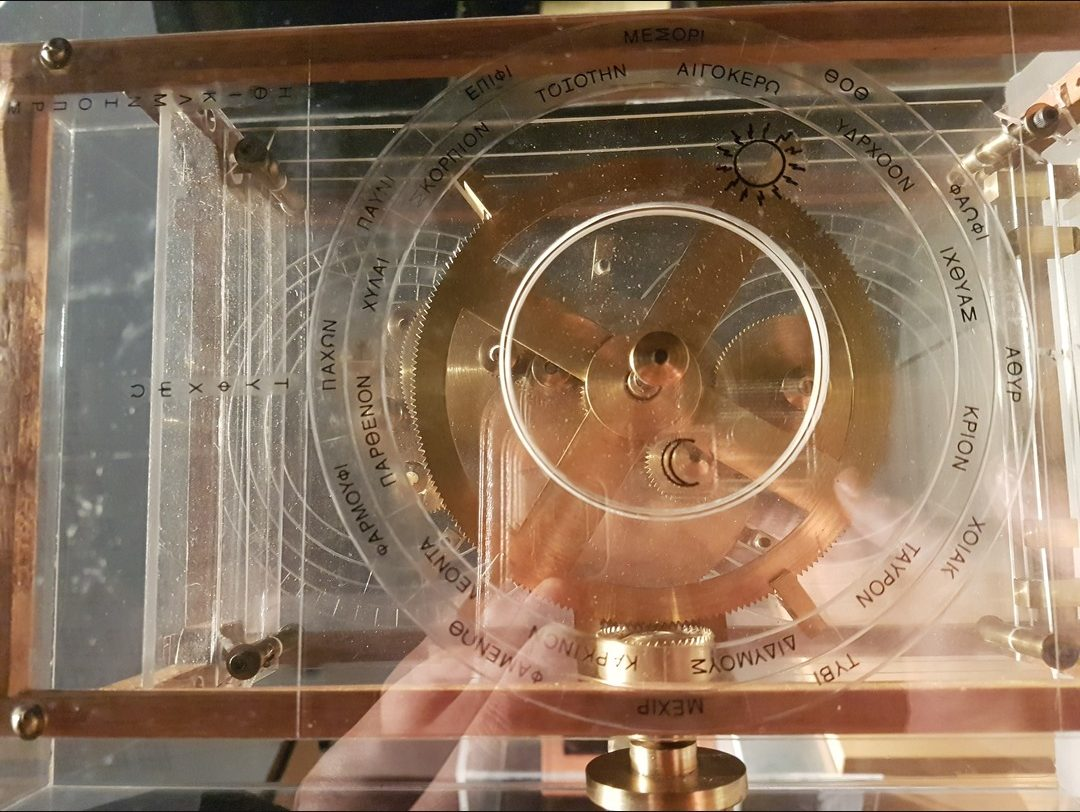
What the inscriptions and the CT scans describe is not a calendar in the simple sense but a mechanical model of several astronomical cycles running at once, driven by a single hand crank. The front face carried a zodiac ring and an Egyptian 365-day calendar ring, with pointers showing the position of the sun and moon against the stars — the moon’s pointer carried a small rotating sphere, half silvered and half dark, to show its current phase. The mechanism even modelled the moon’s uneven orbital speed, using a clever pin-and-slot gear pair rather than a simple fixed ratio, a solution that anticipates ideas in later European clockwork by more than a millennium.
The back of the device carried two large spiral dials. The upper one tracked the 19-year Metonic cycle, after which the phases of the moon repeat on the same calendar dates, subdivided into 235 lunar months and cross-referenced to a four-year Callippic correction. The lower spiral dial tracked the 223-month Saros cycle used to predict eclipses, with glyphs marking which months were eclipse risks and whether the eclipse would likely be visible, solar or lunar. The mechanism’s single largest surviving gear, roughly 13 centimetres across, was cut with exactly 223 teeth — one for every month in that cycle.
None of this required the user to understand the underlying astronomy. You turned a crank, and the gear train did the arithmetic that Babylonian and Greek astronomers had spent centuries working out by hand. That is the real claim to fame here: the Antikythera Mechanism is not evidence that the Greeks had modern astronomy. It is evidence that, having worked the astronomy out on paper, someone could also build a machine to do the sums for anyone who turned the handle, with no need for the lost decipherment skills that still keep scripts like Linear A unread today.
The whole assembly was housed in a wooden case roughly the size of a large book, about 34 by 18 by 9 centimetres, with bronze dial plates front and back and doors that opened to reveal the display. The 2006 and 2008 papers found that the inside of those doors and the margins of the dials carried something unexpected: a running explanatory text, in Koine Greek, describing what each dial showed and how to read it — in effect, an owner’s manual engraved directly into the object. That detail matters for how the mechanism is usually read. An instrument built with its own instructions stamped into the casing reads less like a single bespoke showpiece for one astronomer and more like an object its maker expected other people, who had not built it themselves, to actually use.
Nobody agrees exactly when it was built, or by whom
The wreck gives a firm latest possible date: the ship went down around 60–50 BC, so the mechanism was built before that. How much before is disputed. Freeth and most of the Cardiff/UCL team have argued for construction in the window of roughly 150–100 BC. A 2014 study by Christián Carman and James Evans, working from the eclipse pattern engraved on the back dial, argued instead for an initial calibration date around 205 BC — closer to the lifetime of Archimedes than to the astronomer Hipparchus, who is more commonly proposed as an intellectual influence on the device’s lunar theory. No study has settled the question, and the gap between the two proposals is more than a century.
Who actually built it is even less certain. The ship’s cargo included wine amphorae and glassware with strong Rhodian connections, and Rhodes was home to an active school of mechanics and to Hipparchus’s astronomical observations, which makes it the most commonly cited origin. The 2008 paper’s discovery of a Corinthian calendar on the Metonic dial complicated that picture, pointing instead toward a Corinthian colony such as Syracuse or Ambracia — Syracuse being, notably, Archimedes’s home city, and a place Cicero later wrote had produced geared bronze models of the heavens. No workshop, no signed parts, and no second example of this level of complexity have ever turned up to settle it either way, which puts the mechanism in odd company with other ancient objects whose makers are argued over on circumstantial grounds, like the Baghdad Battery.
A 2021 reconstruction explained what the front dial actually showed
The back dials were reasonably well understood by 2008. The front of the mechanism, which almost entirely failed to survive, was not. In 2021 a team at University College London, led by Tony Freeth and Adam Wojcik, published a full proposed reconstruction of the front gearing in Scientific Reports, arguing that it displayed a model of the Cosmos as the Greeks understood it: the sun, moon and five visible planets, each carried on its own ring and tracked with a small marker bead, cycling at different rates around a central zodiac dial.
Getting the planetary gearing to work required explaining numbers already visible in the inscriptions but previously unexplained — a 462-year cycle associated with Venus and a 442-year cycle associated with Saturn. The UCL team showed these numbers could be derived using a mathematical method attributed to the pre-Socratic philosopher Parmenides, applied to the planetary period relationships known to Babylonian astronomers. Built around those two cycles, a gear train for the remaining planets falls out with proportions that fit inside the mechanism’s known surviving casing — a strong circumstantial case, though because none of the front planetary gearing itself survives, it remains a proposed reconstruction rather than a confirmed one.
Nothing comparable turns up again for about a thousand years
Geared astronomical instruments of even roughly similar ambition do not reappear in the surviving record until mechanical astronomical clocks and geared astrolabes begin showing up in the Byzantine and Islamic worlds around the 9th to 11th centuries AD, and more elaborately in medieval Europe from the 14th century. Whether that gap reflects a real collapse in this specific craft tradition, or just the much higher survival odds of stone and marble over bronze — which was routinely melted down and recast — is itself argued over. Bronze that escaped the furnace usually did so by accident, at the bottom of the sea being the best accident of all. It is entirely possible other machines like this one were built and simply did not survive to be found.
Classical authors give some support to that reading. In De re publica, Cicero describes a bronze device built by Archimedes that represented, on a single turning globe, the differing speeds of the sun, the moon and the five planets then known, including how far behind the sun the moon fell on any given day — a device that ended up in Rome among the spoils Marcellus took from Syracuse after the city fell in 212 BC. Historians had generally read that passage as rhetorical colour rather than a literal engineering description, since nothing of the kind had ever been found. The Antikythera Mechanism does not prove Cicero was describing this particular device, or that Archimedes himself had any hand in it, but it does confirm that the underlying claim — that Hellenistic workshops could and did build planetary models in gear-driven bronze — was not an exaggeration. The written record, in other words, had been telling the truth about a technology archaeology had no physical evidence for, until a storm drove some sponge divers to shelter off a small Greek island.
Watch the full history
The short version covers the find, the gear count, and the eclipse-prediction claim in under a minute.

Related reading
- Was the Baghdad Battery Real? What the Evidence Actually Shows
- Why Linear A Still Can’t Be Read
- Why Were the Sanxingdui Bronzes Smashed Before Burial?
- Why Nobody Can Read the Voynich Manuscript
Works cited
- Freeth, Tony, Yanis Bitsakis, Xenophon Moussas, et al. “Decoding the ancient Greek astronomical calculator known as the Antikythera Mechanism.” Nature 444 (2006): 587–591. Link.
- Freeth, Tony, Alexander Jones, John M. Steele, and Yanis Bitsakis. “Calendars with Olympiad display and eclipse prediction on the Antikythera Mechanism.” Nature 454 (2008): 614–617. Link.
- Freeth, Tony, David Higgon, Aris Dacanalis, et al. “A Model of the Cosmos in the ancient Greek Antikythera Mechanism.” Scientific Reports 11 (2021): 5821. Link.
- Carman, Christián C., and James Evans. “On the epoch of the Antikythera mechanism and its eclipse predictor.” Archive for History of Exact Sciences 68 (2014): 693–774. Link.
- Price, Derek de Solla. Gears from the Greeks: The Antikythera Mechanism — A Calendar Computer from ca. 80 B.C. Transactions of the American Philosophical Society, vol. 64, part 7. American Philosophical Society, 1974.
- Marchant, Jo. Decoding the Heavens: Solving the Mystery of the World’s First Computer. Da Capo Press, 2009.
- National Archaeological Museum, Athens. “The Antikythera Shipwreck: The Ship, the Treasures, the Mechanism” (exhibition record). Link.
- University College London. “Experts recreate a mechanical Cosmos for the world’s first computer.” UCL News, 12 March 2021. (Live and verified by direct fetch; returned a bot-wall response to this run’s automated link check, so cited as print.)
- Woods Hole Oceanographic Institution. “Antikythera Shipwreck.” Ocean Learning Hub. Link.
- Museo Galileo, Florence. “Archimedes’ Planetarium,” on Cicero’s account in De re publica of the bronze device taken from Syracuse by Marcellus in 212 BC. Link.