
In 1994, the United States Air Force reopened a dead file and told the public, for the first time in forty-seven years, what had actually come down on a sheep ranch outside Roswell, New Mexico, in the summer of 1947. The debris was real. So was the cover story. What had crashed was neither a flying saucer nor, in the end, an ordinary weather balloon — it was a listening device, the answer to what was Project Mogul: a six-hundred-foot string of balloons built to eavesdrop on the sound of a Soviet atomic bomb, years before anyone had a better way to hear one.
Project Mogul is one of the stranger artifacts of the opening years of the Cold War: a surveillance system made of foil, rubber, sticks and tape, floated into the stratosphere on the theory that sound itself could be made to carry a warning across an ocean. Understanding why wreckage this flimsy triggered a press release, a retraction, and forty-seven years of official silence means following the balloon rather than the story that grew up around it.
None of what follows required imagination to piece together. It required a scientist’s widow handing over his field journal, a congressman filing a paper-trail request, and two federal reports that, between them, run to several hundred pages. The wreckage at Roswell was explained in detail in 1994 and 1995. The explanation simply arrived forty-seven years after the questions did.
A sheep rancher found the wreckage weeks before anyone called it a saucer
William Brazel — known locally as Mac — worked a sheep ranch somewhere between sixty and seventy-five miles northwest of Roswell, the distance depending on which account you read. On June 14, 1947, he and his young son Vernon came across debris scattered across a pasture: tinfoil, rubber strips, tough grayish paper, and balsa-wood sticks, some taped together at angles that struck Brazel, by his own later account, as deliberate rather than accidental. He gathered a little of it and left the rest where it lay.
Brazel went back for more material on July 4, and it was only on July 7 — three weeks after he first saw the debris — that he drove into town and mentioned it to the county sheriff, George Wilcox. Wilcox called the Roswell Army Air Field, home at the time to the 509th Bomb Group, the only nuclear-armed unit in the world. The base commander, Colonel William Blanchard, sent his intelligence officer, Major Jesse Marcel, out to look at what Brazel had found.
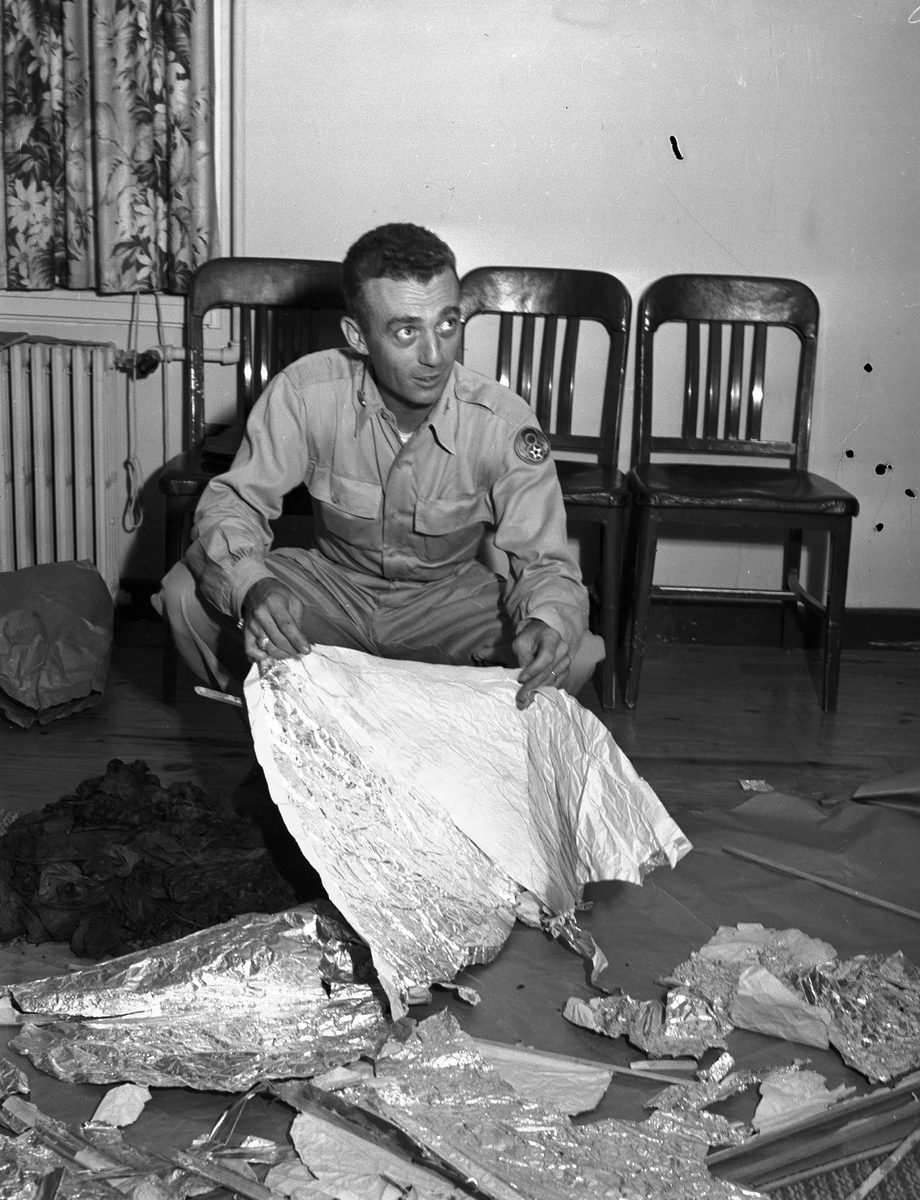
Marcel’s own later descriptions of the material are what kept the story alive for decades: foil that could be crumpled and would spring back into shape, wooden beams light enough to snap by hand, and sticking tape printed with a pattern of small flower-like symbols in pink and purple that struck him, and later writers, as faintly otherworldly. By Marcel’s own account, none of it weighed more than a few pounds in total, and none of it resembled any aircraft part he recognized.
The press release and its retraction happened the same afternoon
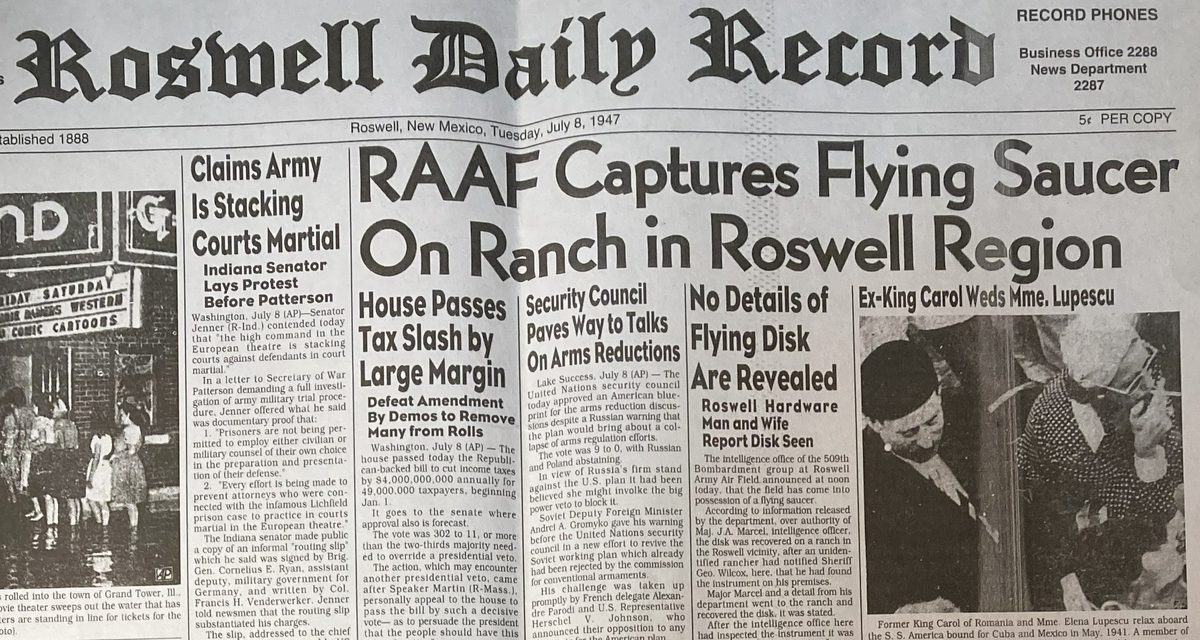
What turned a pasture of broken balsa wood into a national story was a single press release, issued on Colonel Blanchard’s authority by the base’s public information officer, Lieutenant Walter Haut, on the morning of July 8. It announced that the 509th had recovered a “flying disc.” The term was already current that summer — several hundred unrelated disc sightings had been reported nationwide since a widely covered sighting near Mount Rainier in June — and the Roswell Daily Record ran it as its front-page headline that afternoon: “RAAF Captures Flying Saucer on Ranch in Roswell.”
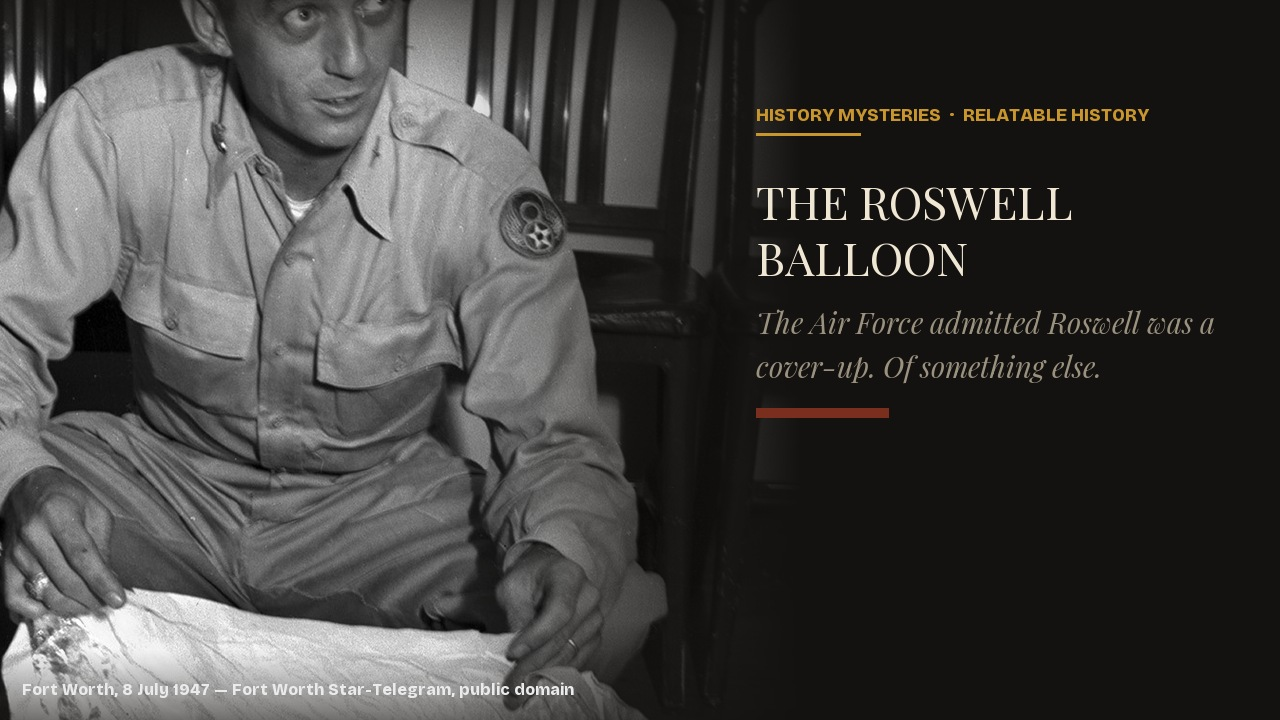
The retraction came before the ink was dry. Marcel had already flown the debris, on Blanchard’s order, to Eighth Air Force headquarters in Fort Worth, where Brigadier General Roger Ramey examined it with his staff. Ramey’s weather officer, Warrant Officer Irving Newton, was called in and immediately recognized the pieces as a radar target of a type used with weather balloons — one he said he had launched “a hundred times.” Ramey had Marcel photographed crouching over the material for the wire services, told reporters it was a weather balloon with a radar reflector, and the story that ran in the next morning’s papers nationwide was the retraction, not the disc.
For forty-seven years, that was where the official record stopped: a disc, walked back to a balloon, inside a single day. It was also, as it turned out, the truth without the whole truth. The balloon was real. What nobody said in 1947 was what kind of balloon, or what it had been built to do.
What Was Project Mogul, and Why a Balloon Had to Carry It
The radar target Irving Newton correctly identified was one small piece of a larger, deliberate piece of engineering. Project Mogul, run under US Army Air Forces contract with New York University’s constant-level balloon group, existed to solve a specific Cold War problem: the Soviet Union was working toward its own nuclear weapon, and in 1947 the United States had no reliable way to detect a test taking place on the other side of the planet. Seismic monitoring networks and reconnaissance satellites did not yet exist in a workable form. What did exist was a theory about how sound travels.
Geophysicist Maurice Ewing and meteorologist Athelstan Spilhaus had each worked on the idea that a layer of the atmosphere roughly forty-five thousand feet up — a “sound channel,” bounded by temperature layers that bend sound back on itself rather than letting it spread and fade — could carry a very low-frequency noise for enormous distances with little loss of strength. A nuclear detonation produces exactly that kind of low-frequency pulse. If a microphone could be held steady inside that channel, the theory went, it might pick up a bomb test thousands of miles away.
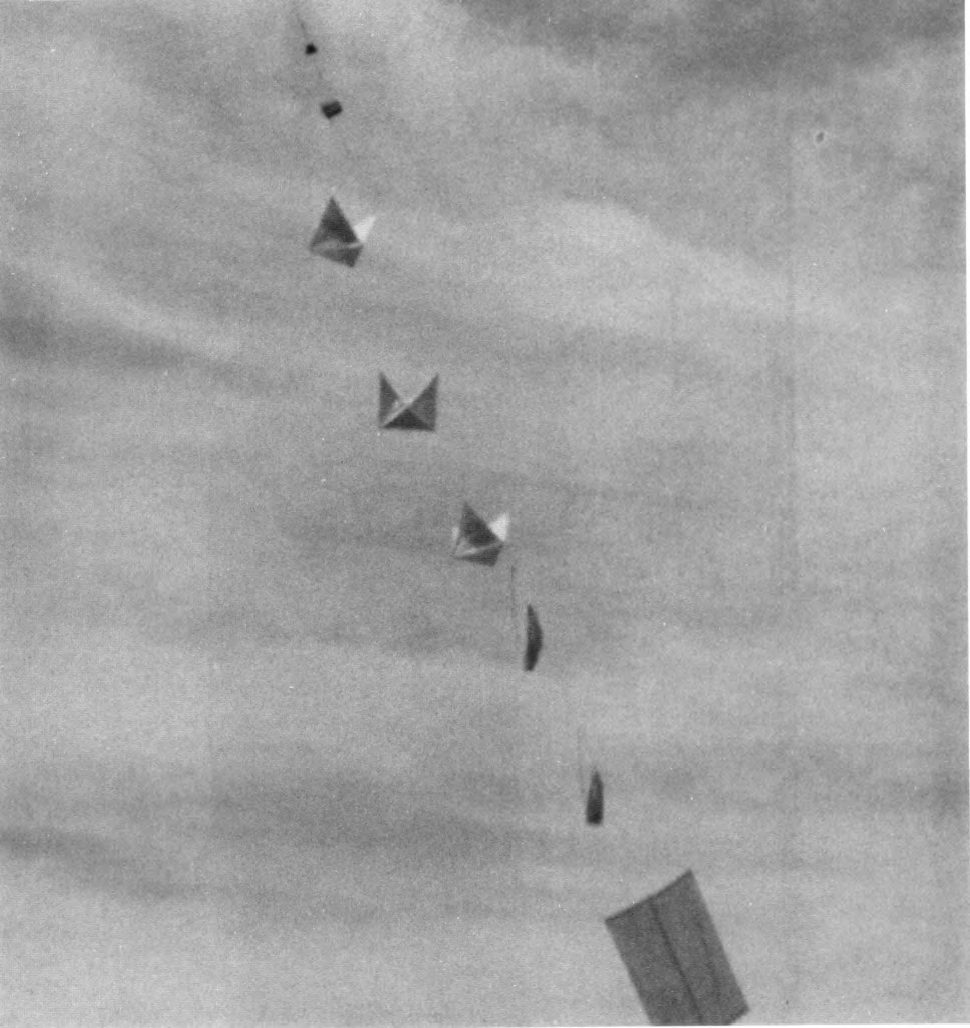
Holding a microphone steady at forty-five thousand feet, for days at a time, with 1947 technology, was the actual engineering problem, and it fell to a young NYU graduate student and project engineer named Charles B. Moore. His solution was a “balloon train”: a string of a dozen or more polyethylene and neoprene balloons, strung with instrument payloads and radar-reflecting targets, stretching over six hundred feet end to end, tuned to settle at a constant altitude rather than keep climbing until it burst. The radar targets — foil, balsa struts, and tape — existed purely so ground radar crews could track a payload nobody could otherwise see. Every material Jesse Marcel described finding in the pasture matches the recipe.
A scientist’s field journal is what finally tied the wreckage to a specific flight
Project Mogul’s ground team worked out of Alamogordo Army Air Field under geophysicist Albert P. Crary, who kept a professional journal through the project. When Air Force investigators reopened the Roswell question in 1994, Crary’s widow produced that journal, and it records that Flight 4 of the NYU balloon series launched on June 4, 1947, and was never recovered by the team that sent it up. Ten days later, on June 14, Mac Brazel found wreckage roughly where that flight would have come down had its instruments failed and let it drift before falling. The Air Force’s 1994 report concluded that “all available official materials indicated the most likely source of the wreckage recovered was one of the project MOGUL balloon trains.”
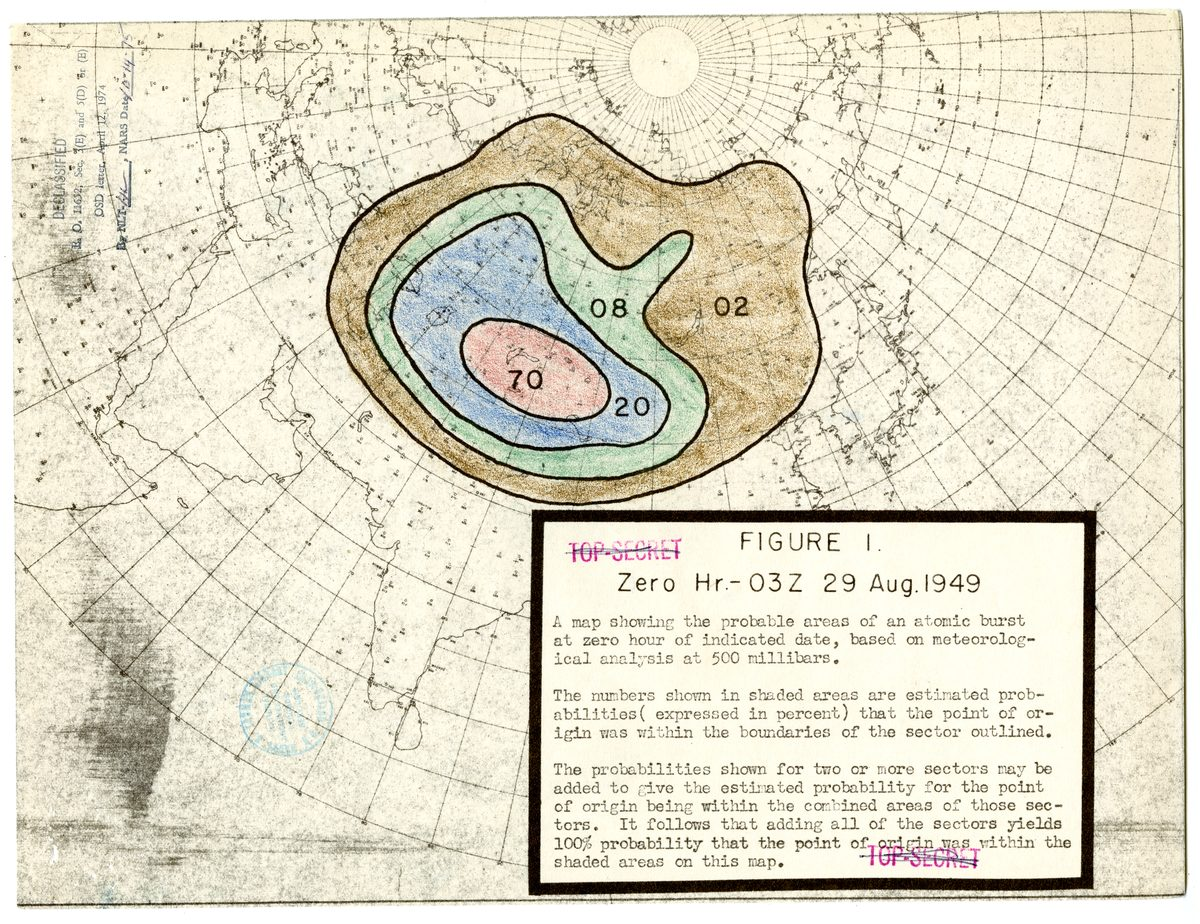
Getting to that sentence took forty-seven years, for a specific, documented reason: Project Mogul stayed classified long after any individual balloon stopped mattering, because confirming what the government had been trying to listen for would have told the Soviet Union exactly what detection capability the United States did, and did not, have. As the science writer Sam Kean has described the decision, the fear of tipping off Moscow ran deep enough that the Army let an alien-invasion rumor stand rather than confirm even a failed attempt at a listening program.
The declassification itself came from paperwork, not historians. In 1993, Representative Steven Schiff of New Mexico, after being rebuffed by the Pentagon, asked the General Accounting Office to search federal records for anything on the 1947 incident. That request produced two documents: the Air Force’s 1994 report identifying Project Mogul, and the GAO’s 1995 report on what records actually survived. The GAO found that administrative files from Roswell Army Air Field covering March 1945 through December 1949, and the base’s outgoing message logs for more than three of those years, had been destroyed, with no surviving paperwork showing who ordered it or under what authority. That gap reads as suspicious to anyone already inclined to suspect a cover-up, and as ordinary records-disposal practice to anyone who isn’t; the GAO’s report does not resolve which reading is correct, only that the documents able to settle it no longer exist.
The “alien bodies” claim arrived decades later, from a different source
Nothing in the 1947 record — not Marcel’s debris, not Haut’s press release, not the Fort Worth retraction — mentions bodies, alien or otherwise. That detail enters the story only in 1980, with The Roswell Incident, a book by Charles Berlitz and William L. Moore that wove decades-old recollections into a new narrative, one that also moved the date of the crash to July 2 — ten days off from the June 14 date fixed by Brazel’s own account and the surviving 1947 paperwork.
In 1997, the Air Force published a second report, The Roswell Report: Case Closed, aimed specifically at the bodies claim, which had grown considerably in UFO literature through the 1980s and 1990s. Investigator James McAndrew traced the recollections to a different, genuinely secret-free Air Force program: high-altitude parachute tests conducted at the same base through the 1950s, using anthropomorphic test dummies dropped from balloons to study what happened to a human body falling from extreme altitude. McAndrew’s report states plainly that there were no contemporary reports of alien bodies in 1947; accounts describing them appeared only in books and articles published after 1978, more than three decades after the events they describe.
That is a second mystery solved, but it is worth keeping separate from the first. The balloon wreckage and the “bodies” are different claims from different decades, explained by different declassified programs, and conflating them is most of what makes Roswell sound more mysterious than the paperwork supports.
The town chose to keep the legend anyway
None of the documentation changed Roswell’s relationship with its own story. The International UFO Museum and Research Center occupies a former movie theater on the town’s main street, and Roswell holds an annual UFO festival each July timed to the anniversary of the press release rather than the actual June discovery date. Walter Haut, the officer who wrote the original flying-disc release as a young lieutenant, helped found the museum decades later and spent much of the rest of his life giving interviews about the case he had set in motion.

Public opinion has not moved as far toward the official explanation as the paperwork might suggest it should. In a 2019 Gallup survey, 68 percent of American adults said they believed the government knows more about UFOs than it has revealed to the public — almost identical to the 71 percent who said the same in 1996, two years after the Mogul report was published. A third of respondents went further, saying they believed at least some UFO sightings really were alien spacecraft.
Judged purely as a listening device, the balloon train that came down near Corona was doing exactly what Flight 4 was built to do when it stopped answering; nobody involved ever confirmed whether it, or any Mogul flight, actually detected anything useful. Judged as the accidental origin of an American myth, the program is the rare secret that worked completely, in the wrong direction: it kept the Soviets in the dark about a listening program, and kept everyone else wondering about something else entirely for almost half a century.
Roswell is unusual among American conspiracy stories because it has an ending. Most don’t: the files stay sealed, or get released redacted, or turn out to document something so boring that nobody writes a book about the boring version. Roswell got two federal reports, a released field journal, and a GAO audit of its own paper trail, and all of it points to the same answer. The wreckage was a Cold War listening device. The bodies were a different program, confused with this one decades after the fact.
What the documentation didn’t do was make the mystery version go away. The majority of Americans still suspect their government knows more about UFOs than it says, and the most famous single case on record is also the one with the most paperwork behind its mundane explanation. A secret kept for a sound strategic reason, about a program that may never have worked particularly well, turned out to be far more durable as a story than it ever was as a balloon.
The debris is explained. Whether that settles it for you, or whether you’d rather keep wondering what a town does with seventy years of being famous for the wrong reason, is the more interesting question — and the one with no federal report coming to close it out.
Watch the full history
No long-form video exists yet for this one. The clip below is the original 47-second short that asked the question this article answers in full.

Related reading
- How Project Blue Book Investigated UFO Reports — the Air Force’s other, longer-running UFO debunking program.
- What the Records Actually Show About the Shag Harbour UFO — another documented case where the paper trail says less than the legend.
- The Nimitz Tic Tac Encounter: What the Official Record Actually Says — the modern version of the same official-record-versus-folklore gap.
- Why the Tunguska Explosion Left No Crater — another unexplained event that turned out to have a scientific, if unsatisfying, answer.
Works cited
- Weaver, Richard L. Report of Air Force Research Regarding the “Roswell Incident.” Headquarters United States Air Force, July 1994. Link.
- McAndrew, James. The Roswell Report: Case Closed. Headquarters United States Air Force, 1997. Link.
- United States General Accounting Office. Results of a Search for Records Concerning the 1947 Crash Near Roswell, New Mexico. GAO/NSIAD-95-187, 28 July 1995.
- Roswell Daily Record, 8 July 1947, front page.
- Berlitz, Charles, and William L. Moore. The Roswell Incident. Grosset & Dunlap, 1980.
- Frazier, Kendrick. “The Roswell Incident at 70: Facts, Not Myths.” Skeptical Inquirer, 2017. Link.
- Kean, Sam. “The Real Roswell Cover-Up? Spying on Air.” Science Friday, 21 July 2017. Link.
- Webster, Donovan. “In 1947, a High-Altitude Balloon Crash Landed in Roswell. The Aliens Never Left.” Smithsonian Magazine, 5 July 2017.
- “Americans Skeptical of UFOs, But Say Government Knows More.” Gallup, 6 September 2019. Link.