
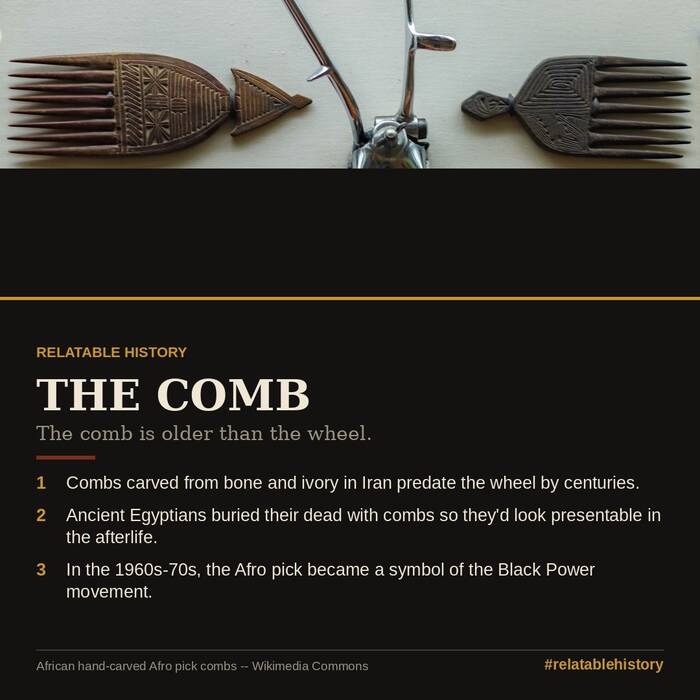
In 2022, a team of archaeologists announced they had identified the oldest known complete sentence written in the alphabet that would eventually give rise to Greek, Latin, and English. It was carved into an object that still turns up in bathroom drawers today, built to a design barely changed in thirty-seven centuries: a comb. The sentence is seventeen letters long, incised into a sliver of elephant ivory only 3.7 centimeters wide, excavated at Tel Lachish in Israel and dated on paleographic grounds to roughly 1700 to 1550 BCE. Translated, it reads: “May this tusk root out the lice of the hair and the beard.”
That comb is a useful correction to the picture most people carry of what the earliest alphabetic writing was for — temple dedications, royal names, religious formula. This one was put to work complaining about head lice, which is a reminder of why combs were used for lice long before they were used for style, and of how mundane the first uses of a new technology usually are. The Lachish comb is not an outlier, either. Across most of its documented history, the comb’s main job had very little to do with styling hair and a great deal to do with killing parasites, enforcing religious order, or, in one twentieth-century case, declaring exactly where you stood on American racial politics.
Here is the longer version of that story.
Why Combs Were Used for Lice as Far Back as the Bronze Age
The Lachish comb turned up in Pit AA485, in Area AA of the Tel Lachish excavation, inside a layer of debris dated centuries after the comb itself was carved. The research team — led by Daniel Vainstub, alongside Madeleine Mumcuoglu, Michael Hasel, Yosef Garfinkel, and four other collaborators — concluded in their 2022 publication that the comb had been made, used, broken, and discarded long before that later layer formed, which is a common fate for small, valuable objects that get kicked around a site for generations. They dated the inscription itself by comparing its letterforms to other securely dated Canaanite writing, arriving at a range of roughly 1700 to 1550 BCE.
The comb is tiny: 3.7 centimeters wide, carved from elephant ivory, with two rows of teeth that are now almost entirely broken off. Only the stubs survive. Their spacing, though, matches the pattern researchers use to identify delousing combs elsewhere in the ancient world: finer and more closely set than a purely detangling comb would need. Piecing together its seventeen letters took raking light and painstaking microscopy, not unlike the slow, letter-by-letter work that has gone into reading the Phaistos Disc, another ancient inscribed object whose script resisted easy reading. Unlike the Phaistos Disc, though, nobody seriously disputes what the Lachish comb says. Someone paid to have a short, specific wish against head lice engraved onto a comb, in an alphabet their society had only recently begun using for anything at all. It is, in other words, one of the first documented uses of writing for an ordinary household annoyance rather than a monument.
Egypt Buried Its Dead With Combs Carved Like Jewelry
Egypt treated the comb as something closer to art. The Metropolitan Museum of Art holds an ivory comb from the late Naqada III period, roughly 3200 to 3100 BCE, carved with rows of animals along its top edge — elephants and snakes, wading birds, a giraffe, hyenas, cattle, and what may be boars. The museum catalogs it as part of the funerary equipment of an elite person, and its detailed decoration suggests it was made for display in the grave as much as for use in life. At roughly 5.5 centimeters tall, it is smaller than a modern pocket comb.
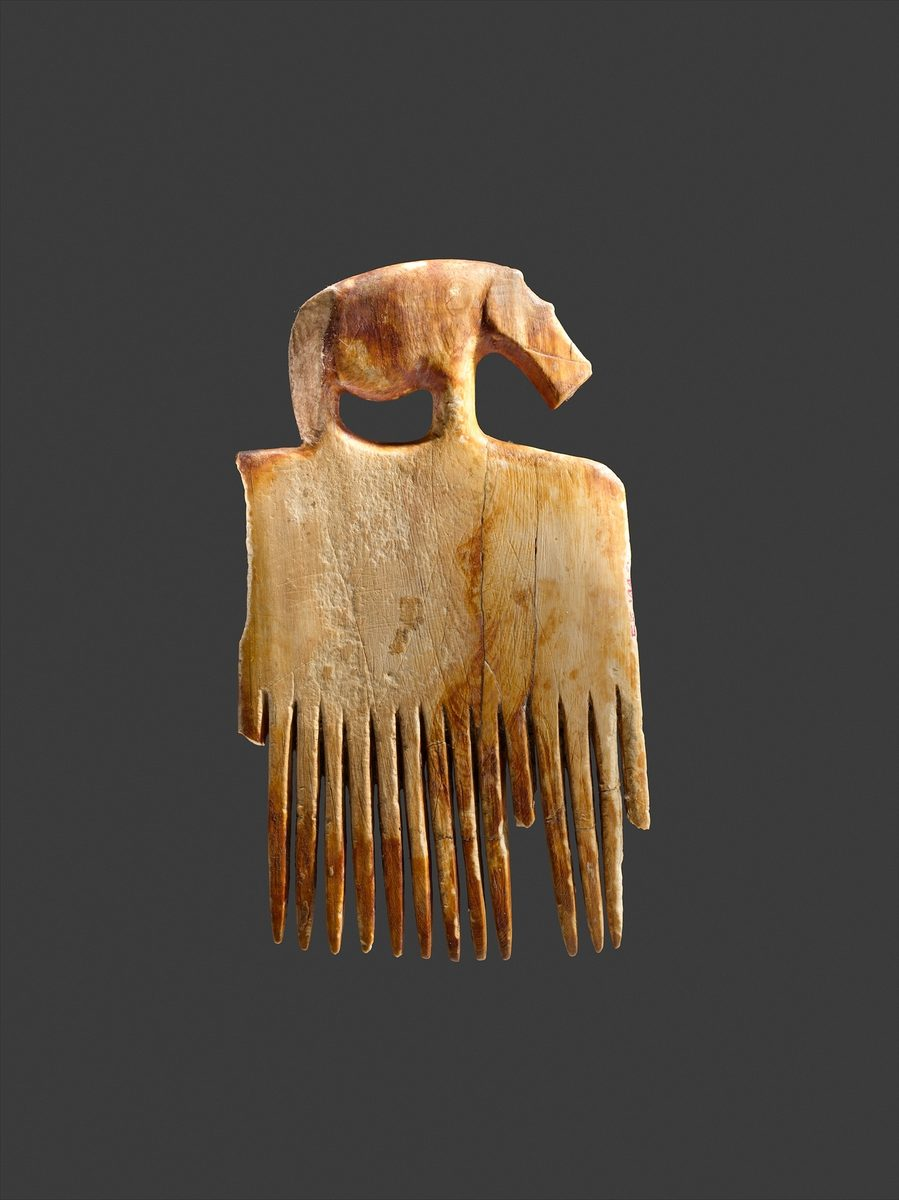
That comb was not unique. Wealthy Egyptians were routinely buried with grooming kits that included combs of ivory, wood, and bone, alongside cosmetics and mirrors — a pattern archaeologists read as evidence that looking presentable mattered as much for the afterlife as for ordinary life. Whatever the metaphysics, the practical effect is that some of the oldest surviving combs anywhere are Egyptian, and several of them are carved with more artistry than most jewelry from the same period.
Rome Turned Delousing Into a Design Problem, Not an Afterthought
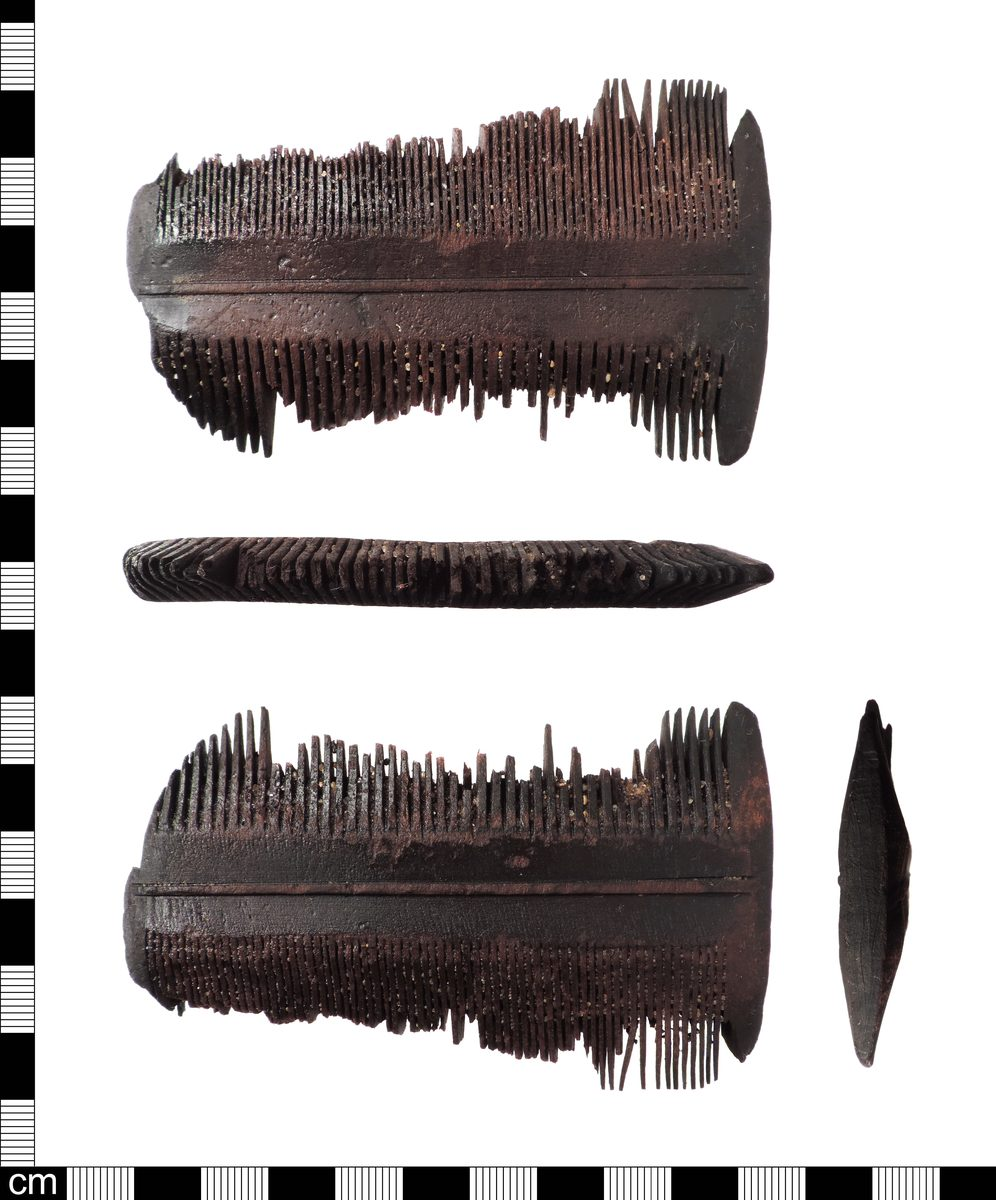
By the Roman period, the comb had a settled, unglamorous job description. Archaeologists have pulled hundreds of double-sided boxwood combs out of Roman sites from Egypt to Roman Britain, wide teeth on one edge for working out tangles, a row of much finer teeth on the other for combing out lice and the eggs they glue to individual hair shafts. Britain’s government-run Portable Antiquities Scheme has logged a steady stream of these finds over the years, pulled from Roman-period sites by archaeologists and metal detectorists alike, which gives a sense of how common the object really was rather than how rare the surviving examples are.
The physical evidence for what these combs actually did is unusually direct. In 1991, the entomologist Ricardo Palma examined a wooden comb recovered from a Roman-era burial at Antinoë in Egypt and found it still carried preserved head lice eggs, glued to fragments of hair caught in its teeth many centuries after the comb was last used. A similar study of first-century combs from the Judean Desert, carried out by the parasitologist Kostas Mumcuoglu and the anthropologist Joseph Zias, found lice or their eggs in eight of eleven combs examined — strong evidence that the fine-toothed side of these combs was not a stylistic flourish but a working tool, used often enough to leave its targets behind.
Clergy Turned the Comb Into a Sacred Object, and Historians Still Argue About Why
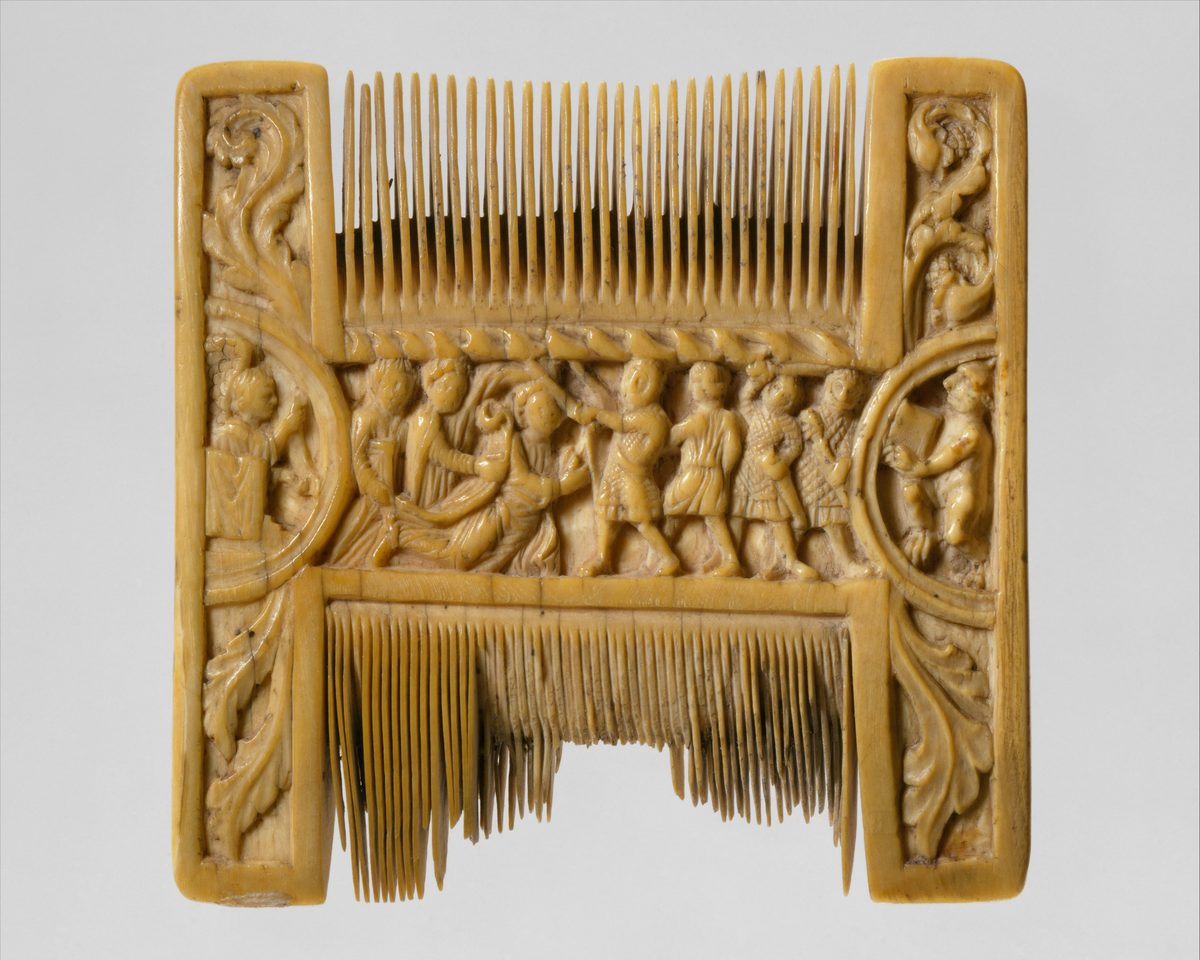
By the twelfth century, the comb had picked up a second, stranger job: liturgical prop. The Metropolitan Museum of Art holds a double-sided ivory comb, made in Britain around 1200 to 1210 and possibly in Canterbury, carved on one face with Henry II appointing Thomas Becket as archbishop and on the other with Becket’s martyrdom. The museum’s own description notes that priests used combs like this one before celebrating Mass. A related object at the Victoria and Albert Museum — an ivory comb made around 1130 at the school attached to St Albans, carved with scenes from Christ’s life — carries a more explicit explanation: the museum states that its use “symbolises the concentration of thoughts towards the liturgy,” a ritual tidying of the mind as much as the hair.
Not every scholar accepts that these objects were primarily religious. Cotswold Archaeology, writing up a fragmentary ivory comb recovered from the Clare Castle excavations in Suffolk, notes that a twelfth-century Danish prayer book, the Missale Lundense, preserves a specific prayer meant to be recited while a bishop’s hair was being combed — good evidence for a real liturgical practice. But the same write-up records that other specialists think combs this elaborate were more plausibly luxury items, possibly Byzantine in origin, that only later acquired a religious label. The honest answer is that both things may be true of different combs: a tool borrowed by the church from secular craftsmanship, and dressed up, after the fact, with a prayer.
A Billiard-Ball Shortage Accidentally Invented the Flammable Modern Comb
Comb-making stayed a hand craft for centuries longer, and one small town ended up running most of it. Leominster, Massachusetts, had been carving combs from cattle horn since the 1760s, when a maker named Enoch Noyes worked out a process of soaking horn in hot oil, splitting it, and cutting individual teeth by hand. Industrial machinery took over through the early 1800s, and the town’s population grew roughly fifty percent between 1845 and 1852 as its factories scaled up. The constraint on all of it was supply: horn and imported tortoiseshell were both finite, and by the middle of the century Leominster’s comb makers were running low on raw material.
The fix came from an unrelated shortage. In 1869, the American inventor John Wesley Hyatt, chasing a cash prize for a synthetic substitute for ivory billiard balls, developed celluloid, generally considered the first man-made plastic. As the historian Daniel Gross writes in a Science History Institute account of Leominster’s transformation, the new material was “off-white, stiff, and flammable,” which “left it vulnerable to further critique” even as it let comb makers abandon horn almost overnight and stamp combs out by the thousand. The flammability was not a minor footnote: celluloid is chemically close to guncotton, and factories that worked with it in volume ran a real, recurring fire risk, captured in surviving photographs like one taken by Lewis Hine of a celluloid factory reduced to brick ruins.
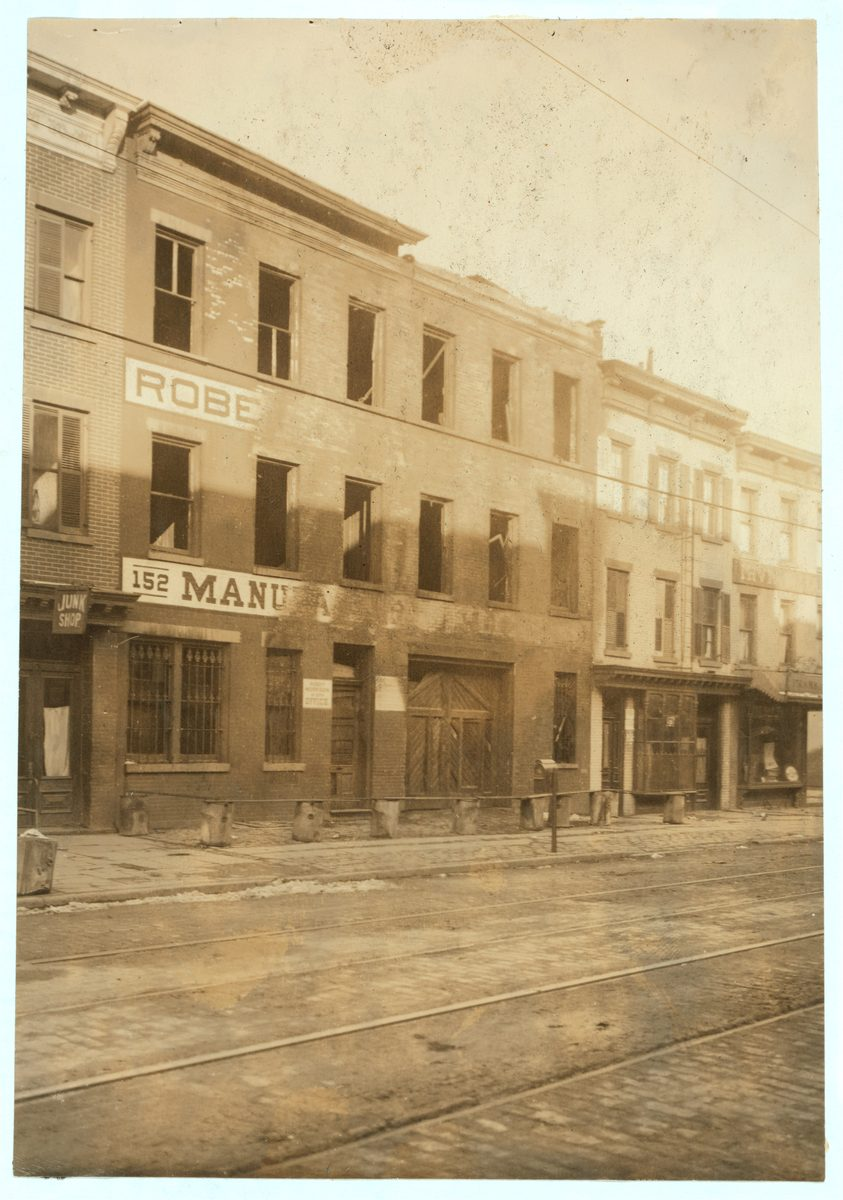
None of that killed the material’s usefulness. Cheap, moldable plastic did to the comb what it eventually did to dozens of other household objects, turning a hand-carved item that took a skilled worker hours to finish into something that could be stamped out for pennies and sold anywhere. The same shift in manufacturing logic, a few decades later, is what eventually made a mass-market zipper possible rather than a luxury novelty.
The Comb Became a Civil Rights Symbol in the 1970s
The wide-toothed hair pick, suited to styling natural hair without breaking the curl pattern, was not itself a 1970s invention. Samuel H. Bundles Jr. and Henry M. Childrey patented an early version in 1969, and a folding variant followed, filed in 1970 and granted in 1971. The detail that turned the object political was the handle. According to the Cambridge Egyptologist Sally-Ann Ashton, writing for History Workshop Online in 2014, the raised-fist handle was designed in 1972 by Anthony Romani, a detail she confirmed by speaking with Romani’s wife, who still worked at his company; Romani filed a patent for the design in 1974, and it was granted in 1976. The Museum of Modern Art, which holds an example in its design collection, instead credits the fist-handled pick jointly to Romani, Bundles, and Childrey, dating manufacture to 1972 through 1976 — a reminder that even a fairly recent, well-documented object can end up with more than one accepted origin story depending on which record you check.
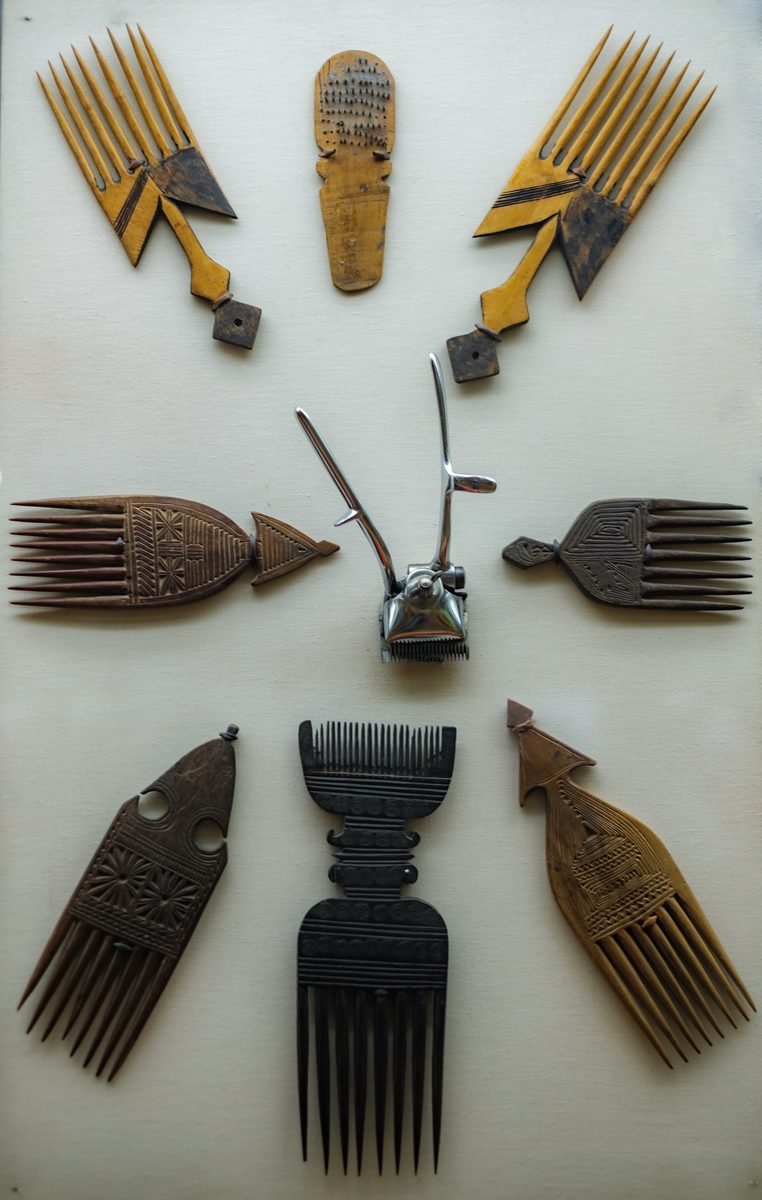
What is not in dispute is what the object meant once it was on shelves. The fist-handled Afro pick, sold in barbershops and record stores through the 1970s, became one of the most recognizable emblems of the Black pride and Black Power movements, celebrating natural hair at a moment when straightening was still treated as the cultural default. The Smithsonian’s National Museum of African American History and Culture now holds examples of the design in its permanent collection, cataloged under the “Black is Beautiful” movement, alongside the raised-fist salute the handle was always meant to echo.
Watch the full history
The video version runs through the comb’s Egyptian, Roman, and Black Power chapters in under two minutes — the short form of a story this article tells at full length.

Related reading
- The Evolution of Toothbrush Bristles, From Boar Hair to Nylon — another ancient grooming object whose material went through the same horn/bone-to-plastic shift
- Why No One Can Read the Phaistos Disc — or Agree That It’s Real — another ancient inscribed object pieced together letter by letter
- Who Invented the Zipper? It Took Three Men and Sixty-Six Years — a similar decades-long path from novelty material to mass manufacture
- Why Venice Made Mirror-Making a State Secret — another vanity-table object with a surprisingly political backstory
Shop the styles/items featured in this video
- Wide-Tooth Detangling Comb, Wood
- Fine-Tooth Nit/Lice Comb, Stainless Steel
- Vintage-Style Pocket Comb Set
- Afro Pick with Fist Handle
Works cited
- Vainstub, Daniel, Madeleine Mumcuoglu, Michael G. Hasel, Katherine M. Hesler, Miriam Lavi, Rivka Rabinovich, Yuval Goren, and Yosef Garfinkel. “A Canaanite’s Wish to Eradicate Lice on an Inscribed Ivory Comb.” Jerusalem Journal of Archaeology 2 (2022): 76–119. Link.
- The Metropolitan Museum of Art. “Hair Comb Decorated with Rows of Wild Animals.” Predynastic, Late Naqada III, ca. 3200–3100 BCE. Accession no. 30.8.224.
- The Metropolitan Museum of Art. “Double-Sided Ivory Liturgical Comb with Scenes of Henry II and Thomas Becket.” British, ca. 1200–1210. Accession no. 1988.279.
- Palma, Ricardo L. “Ancient Head Lice on a Wooden Comb from Antinoë, Egypt.” Journal of Egyptian Archaeology 77 (1991): 194.
- Morton, Ella. “Some of History’s Most Beautiful Combs Were Made for Lice Removal.” Atlas Obscura, June 21, 2016. Link.
- Victoria and Albert Museum. “Liturgical Comb.” Ivory, School of St Albans, England, ca. 1130. Link.
- Cotswold Archaeology. “Liturgical Comb,” Clare Castle excavation finds, Suffolk.
- Gross, Daniel A. “Plastic Town.” Distillations, Science History Institute. Link.
- Ashton, Sally-Ann. “Radical Objects: The Black Fist Afro Comb.” History Workshop Online, February 10, 2014. Link.
- The Museum of Modern Art. “Black Power Afro Pick Hair Comb,” by Anthony Romani, Samuel H. Bundles Jr., and Henry M. Childrey. 1972–1976. Object no. 215.2019.
- Smithsonian National Museum of African American History and Culture. “Afro Hair Comb with Black Fist Design.” Object no. 2014.125.1.