
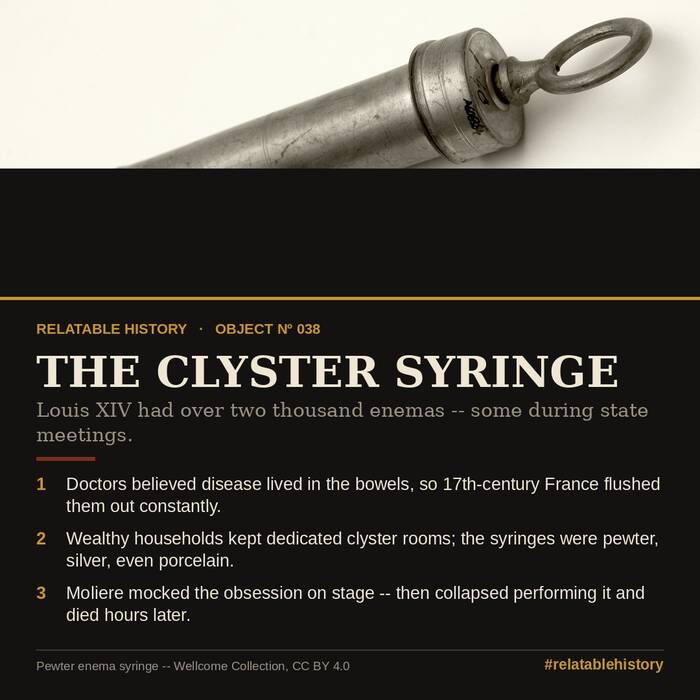
Louis XIV received roughly two thousand enemas over the course of his reign, and according to the health journal kept by his own physicians, several of them were administered while he was in the middle of meeting with his ministers. The king did not consider this unusual. He was near the center of a genuine enema craze that gripped French high society in the second half of the seventeenth century, when the clyster — a tube-and-bladder device for flushing the bowels with liquid — became one of the most fashionable objects a household could own, crafted from silver and pewter and displayed rather than hidden.
The object itself was nothing new. Egyptian physicians had been prescribing bowel irrigation more than three thousand years before Louis was born, and the practice had already passed through Greek, Islamic, and medieval European medicine on its way to Versailles. What changed at the French court was not the technology but the scale and the spectacle: an ordinary medical tool turned into a badge of rank, mocked on stage by the playwright who arguably died performing that mockery, and eventually undone by a discovery that made the entire medical theory behind it obsolete.
Ancient Egypt Treated the Bowels as the Root of Most Disease
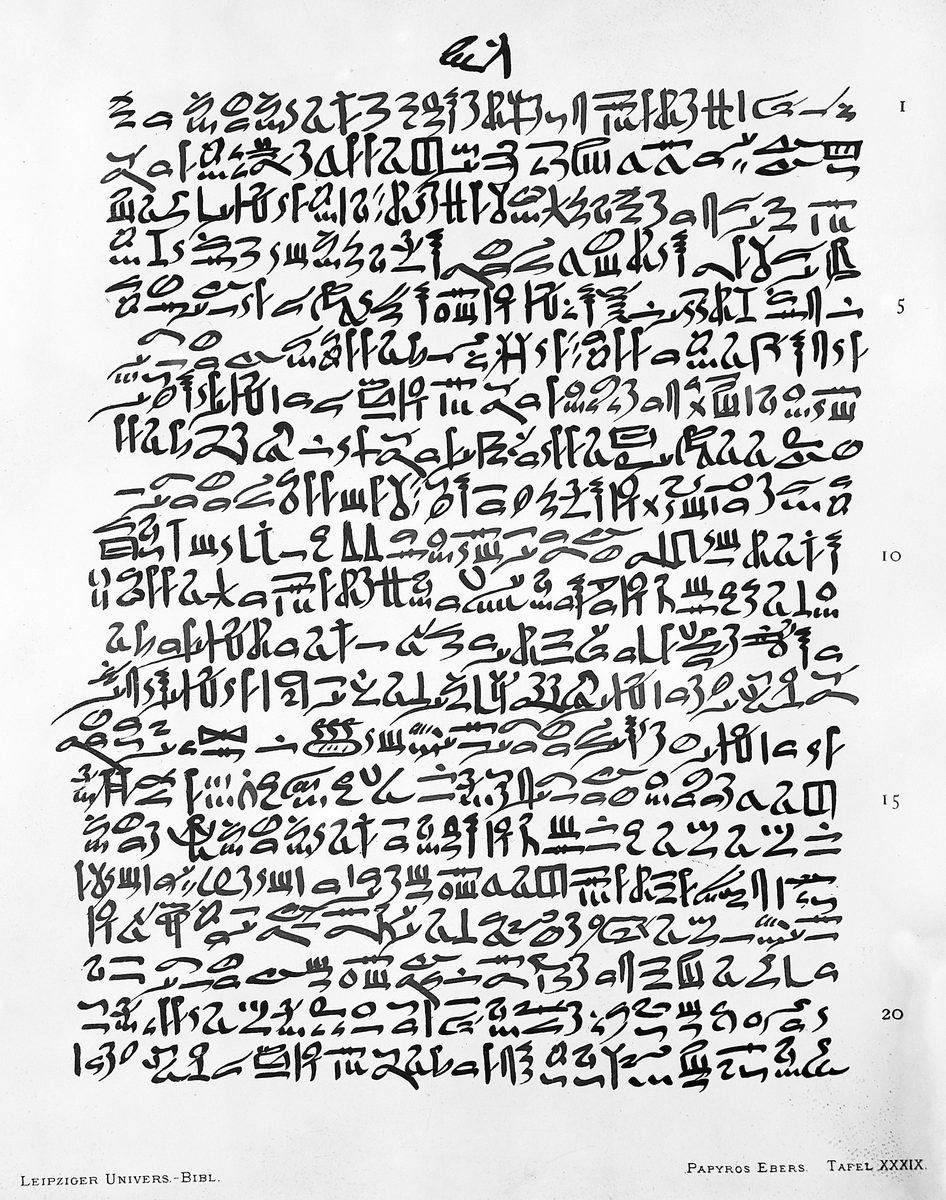
The oldest detailed instructions for a bowel-clearing treatment survive in the Ebers Papyrus, an 18.6-metre medical scroll bought by the Egyptologist Georg Ebers in Luxor in 1872 and now held at Leipzig University Library, where radiocarbon testing has dated it to the late sixteenth century BC. The scroll records roughly nine hundred prescriptions covering about eighty conditions, organized by body system, and one section deals specifically with pain in the anus, prescribing suppositories for relief. Flushing the bowels was not a fringe treatment in this tradition; it sat alongside eye disorders, skin complaints, and gynaecology as one of the papyrus’s recognized specialties.
The Greeks Named the Procedure, and Hippocrates Prescribed It for Fever
The word still used for the device, clyster, comes directly from the Greek klyzein, “to wash out” — the same root that gives English cloaca, a drain or sewer. By the fifth century BC the treatment had a name and a place in formal medical writing: the Hippocratic text On Regimen in Acute Diseases instructs that a feverish patient with undigested food still in the bowels should be given a clyster, or a suppository if he is too weak for the stronger treatment. That instruction treats the bowel flush as a calibrated clinical decision rather than a folk remedy, which is part of why the idea travelled so easily into the more systematic medical traditions that came after it.
Islamic Golden Age Physicians Systematized the Instrument
The clearest sign an idea has entered serious medicine is a textbook. In the Canon of Medicine, completed around 1025, the Persian physician Ibn Sina — known in the West as Avicenna — devoted part of his third book to the bowel, covering obstruction, hemorrhoids, anal fissures, and fistulas, and included a description and illustration of an enema apparatus. Physicians who have since examined his account note that his description of the digestive process compares surprisingly well with current anatomical understanding, a reminder that medieval clinical observation was often more careful than its reputation suggests. The Canon went on to serve as a core medical textbook in European universities into the sixteenth century, and in parts of the Middle East into the nineteenth — one of the main channels by which a detailed, instrument-based version of the treatment reached medieval and early modern Europe, rather than a vaguer folk version alone.
How the Versailles Enema Craze Became Court Theater
By the time the clyster reached the court of Louis XIV, European medicine ran on humoral theory: the belief that disease followed from an imbalance among the body’s four humors, and that clearing the bowel restored the balance faster than almost any other intervention. The king’s own physicians kept a running account of his treatments in a document historians call the Journal de la Santé du Roi, and modern accounts of that record put the number of enemas he received at roughly two thousand, sometimes as often as three in a single day, not counting the final years of his reign when his health had already collapsed. The memoirist Saint-Simon recorded that a lady of the court, the Duchess of Bourgogne, once received one mid-conversation with the king himself — a detail meant to show how unremarkable the procedure had become in that setting, not how shocking it was. Luxury versions of the instrument multiplied through the court on the king’s example: ivory and silver syringes are recorded among the possessions of figures including Madame de Pompadour and Cardinal Richelieu, each a notch further from the plain pewter tube Egyptian or Greek physicians would have recognized.
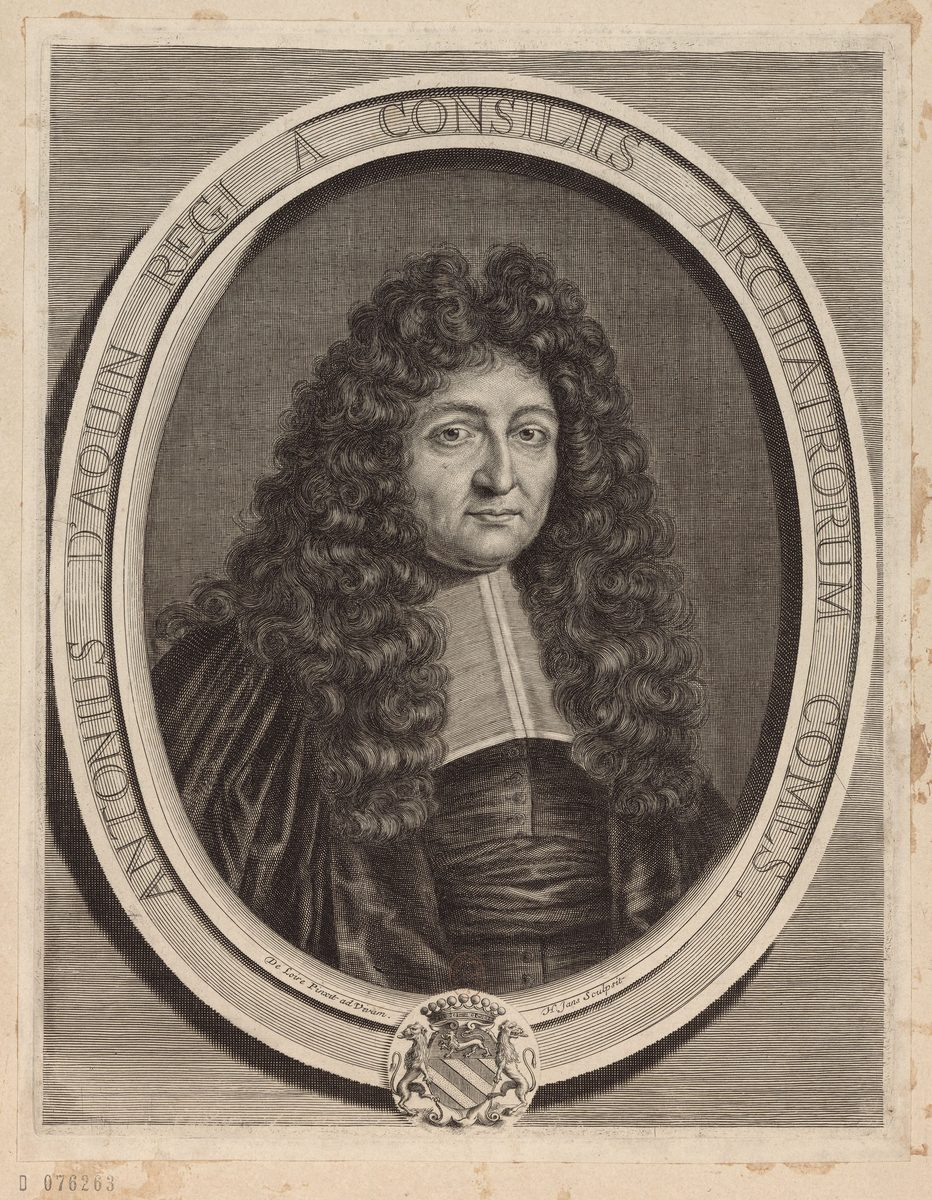
The fashion had a real medical text behind it, too: the physician Reinier de Graaf’s De Clysteribus, published in 1668, treated the administration of enemas as a subject serious enough for a dedicated Latin treatise, complete with instructions and instrument designs, only a few years before the treatment became a full court fad. Antoine d’Aquin, one of Louis’s personal physicians, was among those responsible for managing the king’s regimen day to day.
The Syringe Itself Was Built to Be Seen
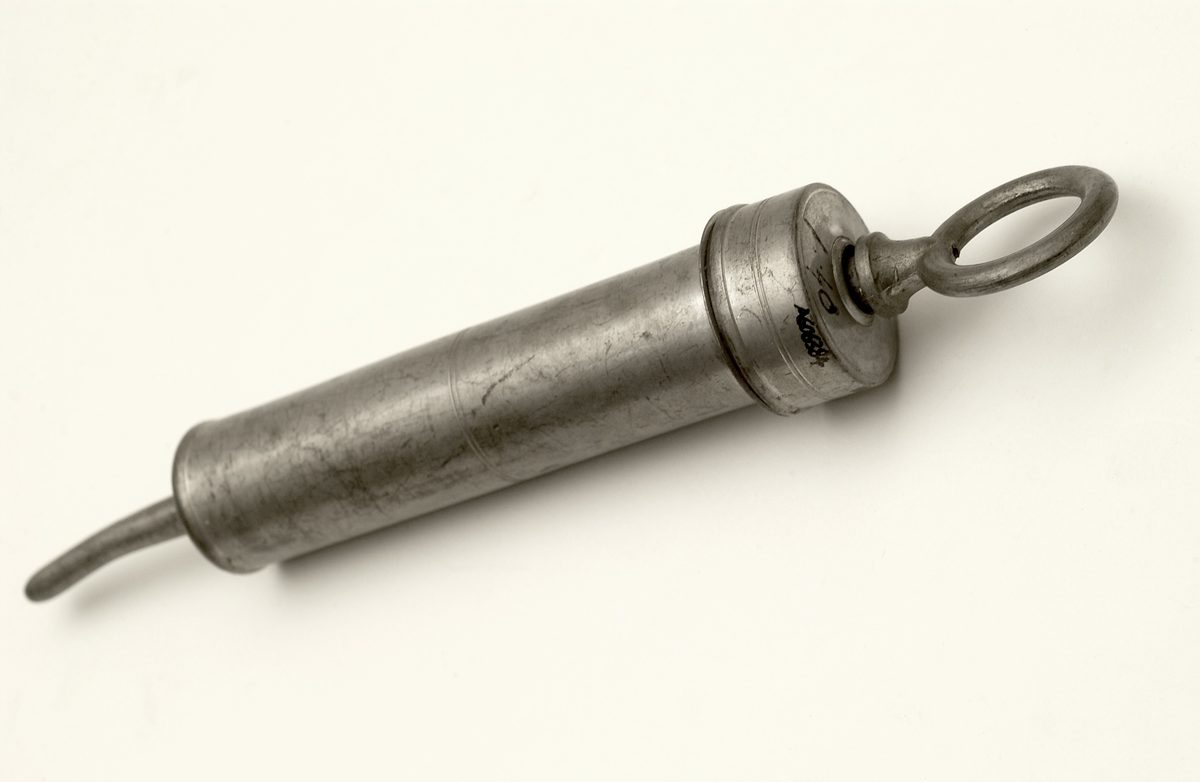
Surviving examples bear out how far the object travelled from ordinary medical equipment. The Science Museum Group’s collection, built largely from Henry Wellcome’s nineteenth- and early-twentieth-century acquisitions, holds a pewter enema syringe roughly 26 centimetres long, dated to the eighteenth or nineteenth century — plain compared with the silver and engraved examples described in French court accounts, but a clear example of the piston-and-nozzle design that stayed essentially unchanged for two centuries. Wealthy households are recorded as having kept a servant whose job was administering the treatment on schedule, which only reinforced the object’s status: a clyster you could not give yourself required someone else’s time, and someone else’s time was a luxury.
Molière Mocked the Craze in His Final Play, Then Died Performing It
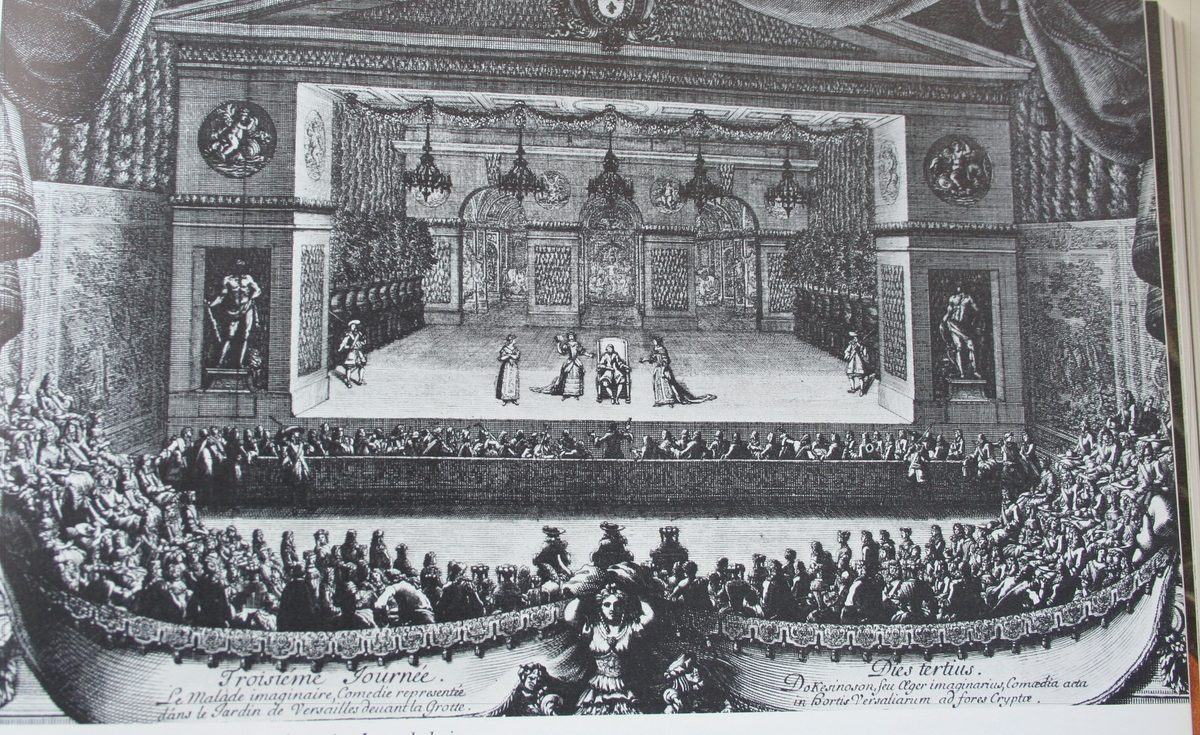
No one captured the absurdity of the fashion better than the playwright Molière, whose final work, Le Malade imaginaire (The Imaginary Invalid), is built entirely around a wealthy hypochondriac named Argan, who is prescribed an ever-escalating schedule of enemas by physicians inventing new ailments to justify new treatments. At one point Argan threatens that if he were a doctor himself, he would let his real-life critics die without treatment out of spite — a line that reads differently once you know Molière wrote it while already seriously ill. According to the scholar Julia Prest’s account of the play in The Cambridge Companion to Molière, Molière collapsed during the play’s fourth performance, on 17 February 1673, while playing Argan, and died that same evening — a detail every later account of the play treats as the darkest possible footnote to a comedy about a man pretending to be sick while the actor playing him actually was.
The Fashion Crossed the Atlantic, Then Germ Theory Ended It
The craze outlived Louis XIV by more than a century without losing much of its logic. When George Washington fell fatally ill in December 1799, the standard treatments his physicians reached for — according to the U.S. National Library of Medicine’s account of his final illness — included bloodletting, purgatives, emetics, enemas, and blistering, the same humoral toolkit that had been in use since before the Ebers Papyrus, applied to a man who had lost roughly half his blood volume to bleeding alone by the time he died. One of the attending physicians, Elisha Dick, proposed a tracheotomy to relieve Washington’s obstructed airway; he was overruled by his more senior colleagues, who continued bleeding the patient instead. Some historians argue the treatments actively hastened his death rather than preventing it.
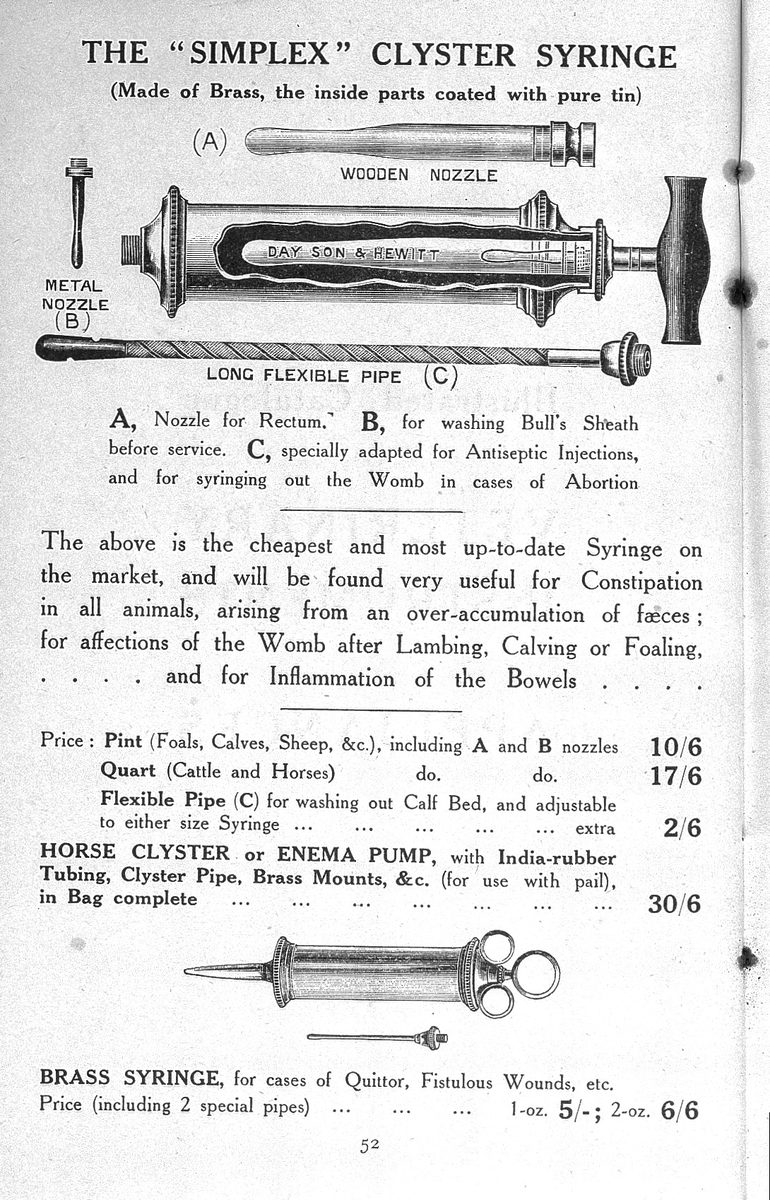
By the late Victorian period, manufacturers such as Arnold and Sons were selling boxed enema sets under brand names like “Simplex” — velvet-lined mahogany cases holding a brass-and-steel piston syringe, rubber tubing, and interchangeable nozzles, a far cry from a servant and a silver tube but still recognizably the same idea, and still sold as serious medical equipment. The theory underneath it collapsed only once germ theory, built on the work of researchers including Louis Pasteur and Robert Koch, demonstrated that specific microorganisms, not an imbalance of humors or bad air, caused most disease. Once doctors stopped believing a clogged bowel caused headaches and heartbreak, there was no reason left to keep a dedicated clyster room in the house, and the ornate syringe shrank down into the plain rubber bulb and drugstore enema bag that still sit, unglamorously, at the back of a medicine cabinet today.
What survives of the clyster today is almost entirely functional: bowel preparation before a colonoscopy, relief for severe constipation, and a persistent but medically unsupported wellness practice called colonic irrigation, which most gastroenterologists will say the colon does not need, since it already cleans itself quite well on its own. The gap between a two-thousand-strong royal prescription record and a quiet drugstore shelf is really a gap in medical theory, not taste: take away humoralism, and the object stops making sense as a cure for everything and becomes just what it always physically was, a tube for moving liquid into the body.
Louis XIV never got to make that distinction. So the next time a plain rubber bulb turns up at the back of a medicine cabinet, it is worth remembering it is the direct, humbled descendant of an instrument aristocrats once had engraved with a family crest and shown off to houseguests. Would you have agreed to one of these, three times a day, for a headache?
Watch the full history
The short version of this story — how a gut-flush became Versailles’s favorite status symbol — runs under two minutes.

Related reading
- The Radium Water That Dissolved Eben Byers’ Jaw
- How the Iron Lung Worked, and Who Was Still Breathing Inside One in 2026
- How Many Lobotomies Did Walter Freeman Actually Perform?
- Who Discovered Ether Anesthesia? The Feud That Ruined Three of the Four Men Who Claimed It
Shop the styles/items featured in this video
- “The Imaginary Invalid” (Molière’s play that satirized the clyster craze)
- Quackery: A Brief History of the Worst Ways to Cure Everything
- Modern enema kit (the plain descendant of the object in this article)
Works cited
- University Library of Leipzig. “Ebers Papyrus.” Permanent exhibition, Leipzig University Library. Link.
- Hippocrates. On Regimen in Acute Diseases. Translated by Francis Adams. The Internet Classics Archive. Link.
- Mahmoudi Nezhad, Golnoush Sadat, Behnam Dalfardi, Ahmad Ghanizadeh, and Samad E. J. Golzari. “Insights into Avicenna’s Knowledge of Gastrointestinal Medicine and His Account of an Enema Device.” Acta Medico-Historica Adriatica 13, no. 2, Supplement 2 (2015): 29–40. Link.
- Prest, Julia. “Medicine and Entertainment in Le Malade imaginaire.” In The Cambridge Companion to Molière, edited by David Bradby and Andrew Calder, 139–150. Cambridge University Press, 2006. Link.
- Gonzalez-Crussi, F. “An Enematic Saga.” Hektoen International, Fall 2017. Link.
- Science Museum Group Collection Online. “Pewter enema syringe.” Object A61271. Link.
- Science Museum Group Collection Online. “The Simplex Enema Set, Patented and Made by Arnold and Sons.” Object A640547. Link.
- U.S. National Library of Medicine. “Final Illness.” Rediscovering George Washington exhibition. Link.
- Lanziner, Jessica. “Discovering Diseases: The Beginnings of Germ Theory and Preventative Precautions.” Museum of Health Care at Kingston, 2020.
- “Clyster.” Online Etymology Dictionary.