
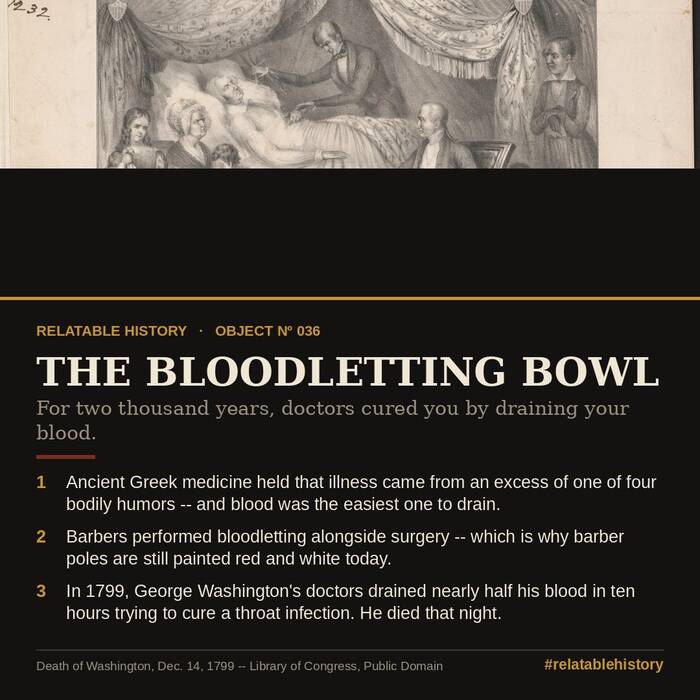
Why doctors drained blood from sick patients for roughly two thousand years starts with an object this ordinary: a pewter bowl with a row of fine rings scored into the inside, spaced out like the marks on a measuring cup. They were not decorative. A barber-surgeon reading those rings against the blood pooling in the bowl could tell a patient’s family, with real precision, exactly how many ounces had come out of someone’s arm that morning. Medicine’s single most common procedure for two millennia was dosed like a recipe, long before anyone had evidence that the dose did anything at all.
This is the story of why doctors drained blood from patients for roughly two thousand years: the theory that put a bowl on every physician’s shelf, the barbers’ guild that was legally required to wield it, the astrological charts that specified when not to use it, and two unusually well-documented deaths — a king’s and a president’s — whose doctors kept draining blood right up to the moment the patient died. It is also, in the end, the story of the one piece of arithmetic that finally made doctors stop.
Why doctors drained blood in the first place
The instruments for opening a vein are older than any surviving theory built to justify them. Archaeologists have recovered tools for venesection from Egyptian burials dated to roughly three thousand years ago — evidence that someone was deliberately letting blood as treatment well before classical Greece supplied the philosophy behind it. That philosophy held that the body ran on four humors — blood, phlegm, and two kinds of bile — and that illness was simply one of them running high.
It was Galen of Pergamon, a Greek physician working in Rome in the second century CE, who made blood the humor doctors reached for first. Galen did not just hold an opinion; he published one, in a body of surviving work modern estimates put past two million words, enough that for roughly fourteen centuries a physician could build an entire career citing him without personally testing a single claim. The same humoral logic, applied to the bowels rather than the blood, is also what later justified the purges and enemas administered at the French court. Bloodletting’s staying power was never really about which humor was in excess. It was about the fact that Galen’s authority outlasted Rome, outlasted the fall of the Western Empire, and outlasted most of the civilizations that studied him.
Why a barber held the blade
Diagnosing which humor was out of balance was considered scholarly work, suited to a university-trained physician. Actually making the cut was something else entirely — manual labor, and manual labor was beneath a physician’s dignity across most of medieval and early modern Europe. That left an opening for barbers, who already kept sharp blades for shaving and already ran shops where people sat still for long stretches. Barbers took on bloodletting, tooth-pulling and minor surgery as a natural sideline to haircuts, and did it often enough that the trade eventually needed its own regulation.
In England that regulation arrived in 1540, when an Act of Parliament merged the Worshipful Company of Barbers with the separate Guild of Surgeons into one body, the Company of Barber-Surgeons of London. The statute drew a firm line even as it joined the two trades: barbers were not to perform major surgery, and surgeons were not to cut hair, though both kept the right to pull teeth. As part of the settlement, the Crown granted the new Company the bodies of four executed criminals from the Tyburn gallows each year, for anatomical dissection. A large painting by Hans Holbein the Younger, commissioned to mark the union, still hangs in Barber-Surgeons’ Hall in London today. The arrangement held for two centuries before surgeons petitioned to separate in 1745, eventually forming what became the Royal College of Surgeons.
The barbers’ trade left one piece of branding that outlived the entire profession: the red-and-white striped pole still standing outside barbershops. Red stood for blood, white for the bandages wound around a patient’s arm afterward; American shops later sometimes added blue to round out a patriotic color scheme. It is, by a wide margin, the most successful piece of medical marketing still in daily use, advertising a procedure medicine abandoned more than a century ago.

The bowl, the fleam, and the scarificator
The bowl itself shows how routine the procedure had become. Surviving pewter and ceramic bleeding bowls are wide and shallow — built to catch blood running down a forearm rather than to be pressed against a wound — and many carry those measured rings on the inner surface, letting a practitioner read off a rough ounce count without a separate vessel. Dosing blood loss was treated with the same apparent rigor as dosing medicine, even though nobody had established what the right dose actually was.
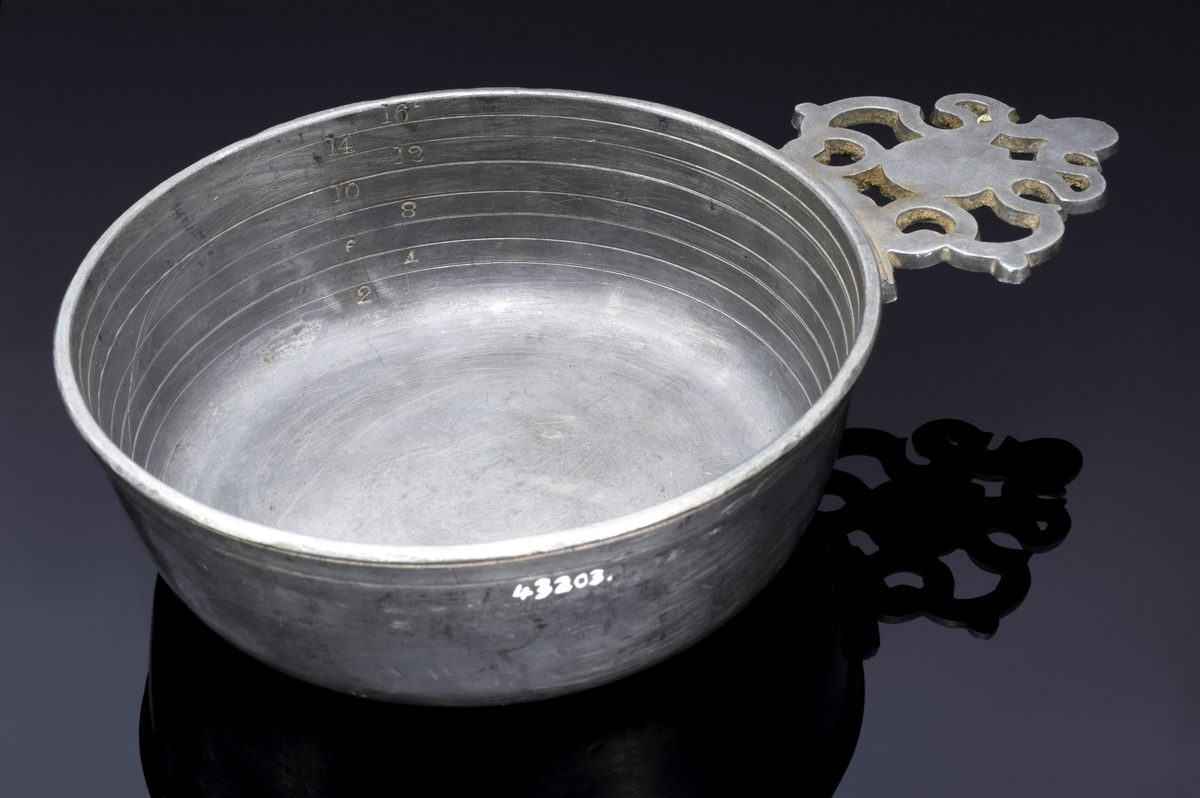
The cutting tool itself was a fleam: a small, usually folding blade, often sold cased with several widths so a barber-surgeon could match the blade to the vein. By the eighteenth century a stranger device had joined it. The scarificator was a small brass box holding anywhere from four to sixteen fixed blades on a spring-loaded mechanism; the operator cocked a lever, pressed the device flat against the skin, and triggered a button that snapped every blade forward at once, leaving a tidy grid of shallow cuts in a fraction of a second. Scarificators were usually paired with cupping — a heated glass vessel placed over the cuts to draw blood to the surface — a combination museums now catalogue as “wet cupping.”
None of this required much anatomical insight. A fleam or a scarificator did the same job whether the physician holding it believed in four humors or something else, which is part of why the tools themselves barely changed for two centuries even as the theory behind them was already under challenge. The instruments outlived their own justification by decades.
Scheduling a bleeding by the stars
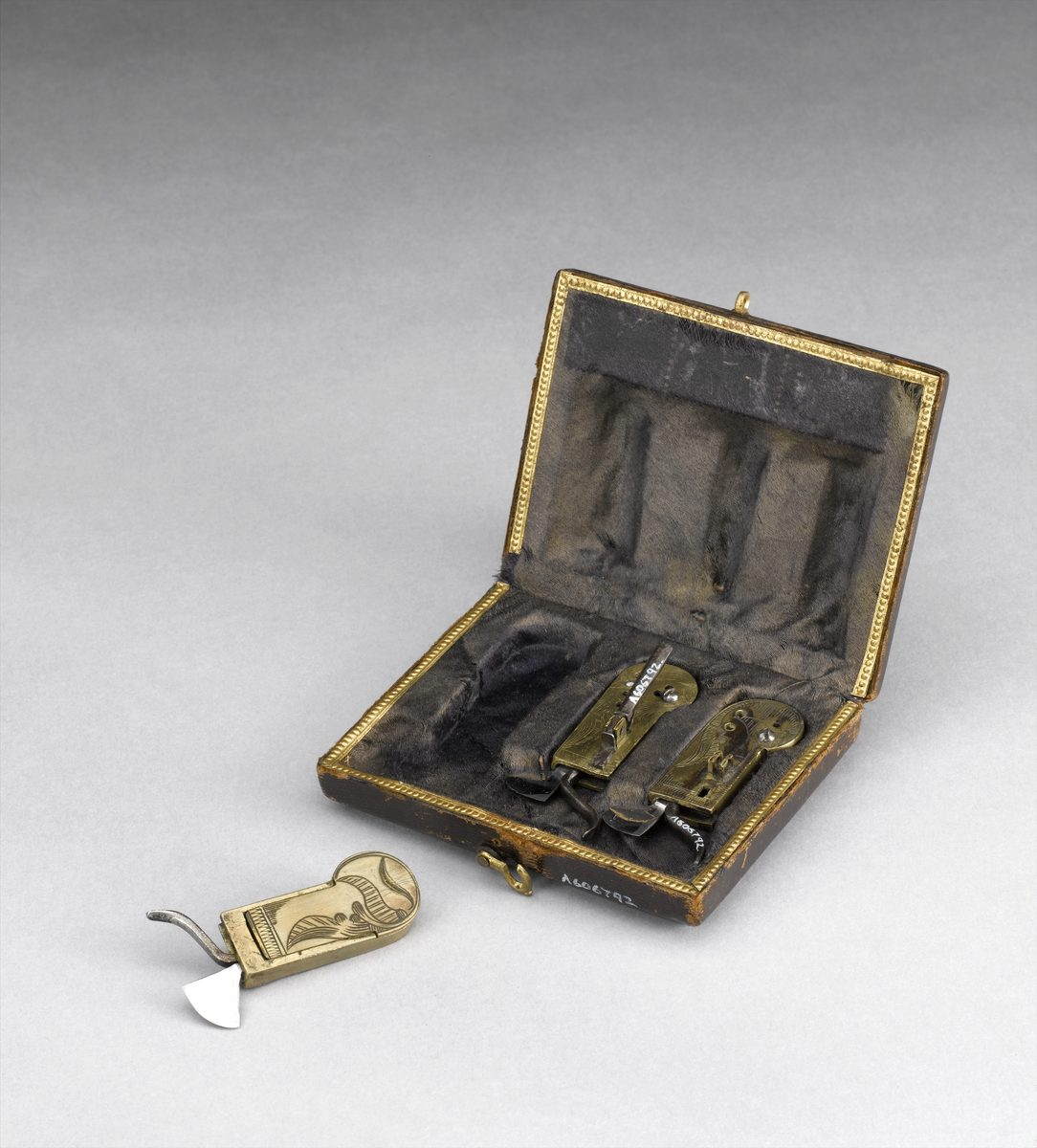
Deciding to bleed a patient was only half the decision. Early modern almanacs devoted real space to telling readers when not to, built around a recurring illustration called the zodiac man: a human figure with lines connecting each body part to the astrological sign believed to govern it. The underlying rule was simple and taken seriously for centuries — never let blood from a body part while the moon occupied the zodiac sign that ruled it, since the humors there were thought to already be unsettled. A German variant called the Aderlassmann folded a separate vein-location diagram into the same figure, giving a reader astrological timing and anatomical guidance in one picture.
This was not folk superstition sitting alongside real medicine; it was taught as part of the same system. A physician scheduling bloodletting consulted the same almanac a farmer consulted for planting, because both activities answered to the same cosmic bookkeeping. Ordinary households with no medical training at all kept these almanacs specifically so they would know, before sending for a barber-surgeon, whether a given week was even an astrologically acceptable one to be bled.
It is tempting to read that as quaint set against the bowl’s measured rings and the guild’s legal charter, but it did the same work as both of them: it made an unproven treatment feel procedurally rigorous. Precision in the wrong places is still precision, and for a very long time it was convincing.
Two deaths that became the case against it
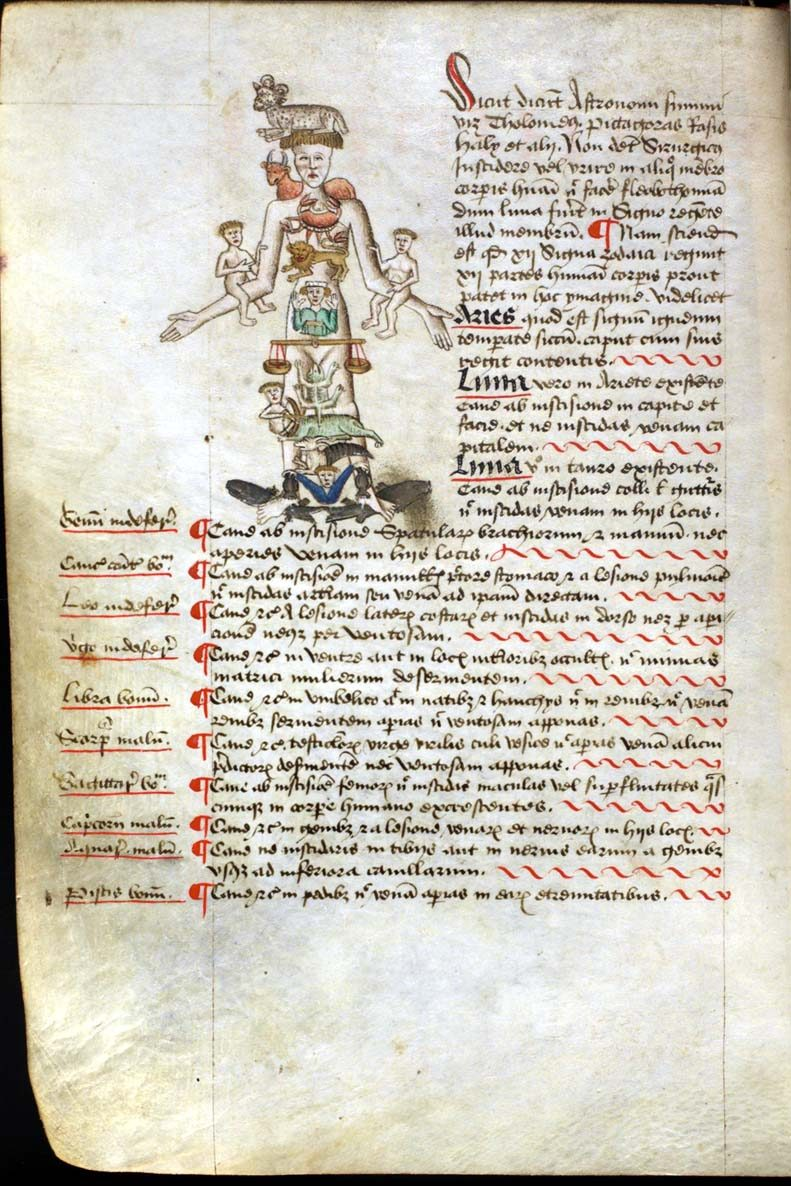
Two documented deaths, a king’s and a president’s, did more to dent bloodletting’s reputation than a century of theoretical argument ever had, if only because witnesses with no reason to think they were seeing anything but ordinary good medicine recorded both treatments in close, almost clinical detail.
King Charles II of England collapsed, almost certainly from a stroke, on the morning of 2 February 1685. His physicians’ first response was to open a vein in his left arm and draw roughly sixteen ounces of blood on the spot. Over the following four days they returned repeatedly: more bleeding, cupping, purges, blistering agents, and — among the stranger remedies recorded — a drink distilled from human skull. Charles died on 6 February. Whether the stroke itself was always going to be fatal is impossible to know at this distance, but the volume and pace of the interventions, piled onto a patient already in acute distress, is exactly the pattern historians point to when they say the treatment may have hastened rather than delayed the end.
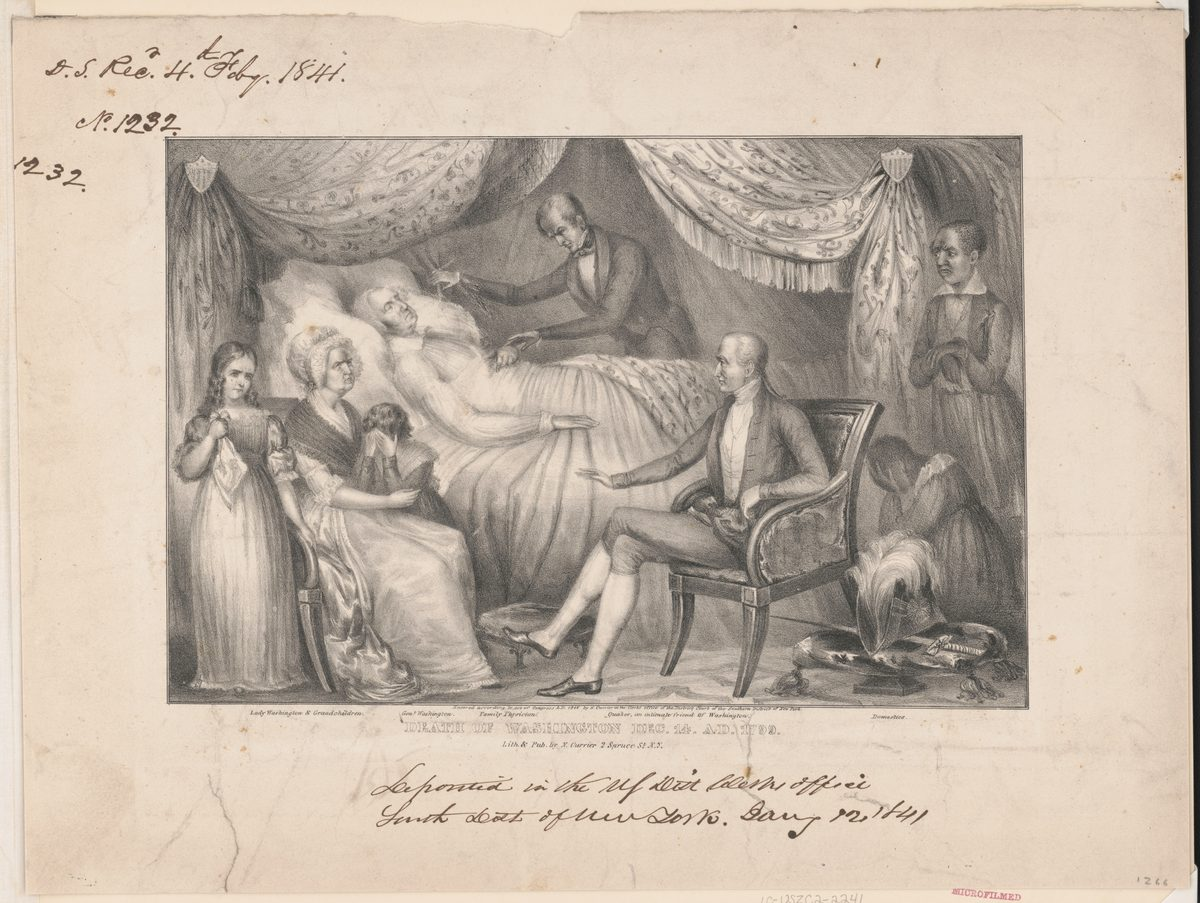
George Washington’s final illness, 114 years later, is documented in even finer detail, because his secretary Tobias Lear and his own physicians left timestamped accounts. Washington woke in the early hours of 14 December 1799 struggling to breathe, after a day spent outdoors in freezing rain; the retrospective diagnosis most historians favor today is acute bacterial epiglottitis, a swelling of the throat that can close off the airway within hours. His doctors responded the only way the medicine of 1799 knew how: they bled him at six in the morning, again at half past nine, again at eleven, and a final time that afternoon over the objections of one of the four physicians present, Dr. Elisha Cullen Dick. Altogether they removed more than eighty ounces of blood — something like forty percent of his entire blood volume — over roughly twelve hours, alongside blistering agents and a sage-tea gargle meant to ease his throat. Washington died that night.
Neither case proved bloodletting useless on its own; contemporaries could and did explain away a single bad outcome. What they could not as easily explain away, as cases like these accumulated among elite patients whose every treatment was recorded by name, was a pattern — repeated, aggressive bleeding, administered right up to the moment of death, in illnesses where it manifestly was not working.
The arithmetic that ended it, and the narrow use that outlived it
The case that actually broke bloodletting’s authority in European medicine did not come from a king’s or a president’s bedside. It came from a French physician named Pierre Charles Alexandre Louis, who spent the 1820s doing something almost nobody in his profession had done systematically before: counting outcomes instead of trusting impressions. Louis compared pneumonia patients at Paris’s Hôpital de la Charité who had been bled early in their illness against those bled several days in, and simply tallied who lived. The comparison, first published in 1828, found the early-bled group recovered slightly faster on average but died more often — a result Louis himself called startling and almost absurd. The fuller story of that study, and the enormous European leech industry it helped dismantle a few years later, is its own article on this site. What matters here is that it was the first time anyone had tried to settle the bloodletting question with numbers instead of authority, and the numbers did not cooperate with fourteen centuries of Galen.
Bloodletting did not vanish overnight. It faded through the second half of the nineteenth century as germ theory gave physicians an actual mechanism for disease, which made emptying out a vague “excess humor” look increasingly beside the point. By the early twentieth century, routine bloodletting for ordinary illness had essentially disappeared from mainstream medicine, taking the barber-surgeon’s old franchise with it.
What survived is the one use nobody has to argue about on faith, because it is measurable in a way the old practice never was. Hereditary hemochromatosis is a genetic disorder, common among people of northern European descent, in which the body absorbs and stores too much dietary iron, eventually damaging the liver, heart and joints if left untreated. The standard treatment today is therapeutic phlebotomy — deliberately removing blood on a regular schedule, specifically because the iron bound up in red blood cells leaves with it. Patients typically have a unit of blood drawn weekly or every other week until their iron levels normalize, then on a maintenance schedule afterward. It is, mechanically, the same act a barber-surgeon performed in 1700: open a vein, fill a container, measure what came out. The difference is that a hematologist today can explain, from a blood test, exactly why it works.
Watch the short
No long-form video exists yet for this topic; the original short, about a minute and a half long, covers the bowl, the barber poles, and Washington’s final hours.

The bowl itself ended up in museum storage, one object among thousands that represents a theory rather than a cure. But it is worth resisting the urge to file two thousand years of bloodletting away as simple quackery, because almost nobody involved was acting in bad faith. The physicians who bled George Washington believed, sincerely and on the best authority available to them, that they were his best chance. The barber-surgeons who built an entire guild around the lancet were not con artists; they were a licensed, regulated profession performing the accepted standard of care. The same institutional confidence, a century later, is what let a radium tonic dissolve a wealthy collector’s jaw while his doctors insisted it was invigorating him, and what let one American neurologist perform a single unproven procedure on thousands of patients without ever running the comparison Louis had already shown the profession how to make.
What the whole two-thousand-year run actually demonstrates is how long a plausible-sounding theory can survive without anyone checking whether it does what it claims, once it has institutions, tools and a trusted authority behind it. Pierre Louis’s arithmetic is remembered now mostly by historians of medicine, but the habit it represents — compare the outcomes, trust the numbers over the impression — is the direct ancestor of every clinical trial that decides, today, whether a new treatment has earned the confidence doctors are about to place in it. The bowl is in a case behind glass. The question it eventually forced doctors to ask never went out of use.
Related reading
- The Bloodletting Craze That Nearly Wiped Out Europe’s Leeches
- The Strange History of the Enema Craze That Swept Versailles
- The Radium Water That Dissolved Eben Byers’ Jaw
- How Many Lobotomies Did Walter Freeman Actually Perform?
Shop the styles/items featured in this video
- Medical history book on the history of bloodletting and humoral medicine
- Reproduction antique-style pewter bowl (decorative)
- Vintage barber pole wall decor
- Biography of George Washington covering his final illness
Works cited
- Greenstone, Gerry. “The History of Bloodletting.” British Columbia Medical Journal 52, no. 1 (2010): 12–14. Link.
- Forde, Pamela. “Science or Superstition: The Rise and Fall of Galenic Medicine.” Royal College of Physicians Museum, March 7, 2025.
- Worshipful Company of Barbers. “History.” barberscompany.org. Link.
- Science Museum Group. Scarificator. Object no. 1996-278/276, Science Museum Group Collection Online. Link.
- “Balancing Information and Expertise: Vernacular Guidance on Bloodletting in Early Modern Calendars and Almanacs.” The Collation, Folger Shakespeare Library. Link.
- Fitzharris, Lindsey. “The Cutter’s Art: A Brief History of Bloodletting.” July 28, 2016.
- Markel, Howard. “Dec. 14, 1799: The Excruciating Final Hours of President George Washington.” PBS NewsHour, December 14, 2014.
- Morabia, Alfredo. “Pierre-Charles-Alexandre Louis and the Evaluation of Bloodletting.” JLL Bulletin: Commentaries on the History of Treatment Evaluation (2004). James Lind Library. Link.
- Zubair, Abbas. “Therapeutic Phlebotomy.” Clinical Liver Disease 4, no. 5 (2014): 102–106. Link.