
George Washington’s dentures were made of hippopotamus tusk, lead, brass, gold wire, and teeth pulled from cows, horses, and other people. Not one scrap of wood went into any of it. Four sets survive today in museum collections, a fifth is believed to have gone into the ground with him, and no two of the four were built quite the same way, as if the dentists who made them never stopped experimenting on the most famous mouth in the country.
The wood story is easy to debunk and has been debunked for decades. What tends to get left out once the debunking is done is everything else: who actually built these devices, where the materials came from, and a 1784 payment in Washington’s own ledger that historians still argue about. That record, not the wood, is the part of this object’s history that is genuinely hard to sit with.
Here is what is actually documented, from Washington’s own account books, his dentist’s letters, and the surviving dentures themselves.
Washington Spent Three Decades Losing His Teeth
Washington’s dental trouble started young and never let up. Records show him buying toothbrushes and tinctures of myrrh by his early twenties, and his first documented tooth extraction came in April 1756, when he was twenty-four. From there the losses came almost annually. A 1776 portrait by Charles Willson Peale shows a scar on his left cheek, attributed to an abscessed tooth. By 1781 he had enough teeth missing that he was wearing a partial plate wired to what remained, made by a dentist named William Baker, and in 1783 he sat for a wax-and-plaster impression of his mouth so a dentist could build him something more permanent.
None of it held. By the time Washington stood on a balcony in New York City in April 1789 and took the oath of office as the first president, exactly one natural tooth remained in his head. Everything else that let him speak, chew, and be photographed smiling with his mouth closed was, from that point on, artificial.
Here’s What George Washington’s Dentures Were Made Of, Set by Set
Washington went through a sequence of dentists, and each left a physically different object behind. Baker built the early wired partial before the Revolution. Jean-Pierre Le Mayeur, a French-trained dentist working in New York, treated him through the 1780s and was known locally for advertising tooth transplants. From his 1789 inauguration until his death a decade later, Washington’s dentist of record was John Greenwood, a New Yorker who built him at least four separate full sets.
Greenwood himself is worth a short detour, because so little about him looks like dental training. Boston-born, he apprenticed as a cabinetmaker before the Revolution, then spent the war first as a teenage fifer with a Massachusetts regiment and later aboard privateers, where he was captured by the Royal Navy more than once and held on Barbados. He learned dentistry from his own father, another Boston-trained practitioner, and opened his New York practice in 1786, three years before Washington became his most famous patient. He was also an obsessive tinkerer: he adapted his mother’s foot-treadle spinning wheel into what is credited as the first dental foot engine built in America, used for shaping denture bases rather than drilling live teeth, and he was among the first American dentists to tell patients to brush regularly, advice that was still far from standard practice.
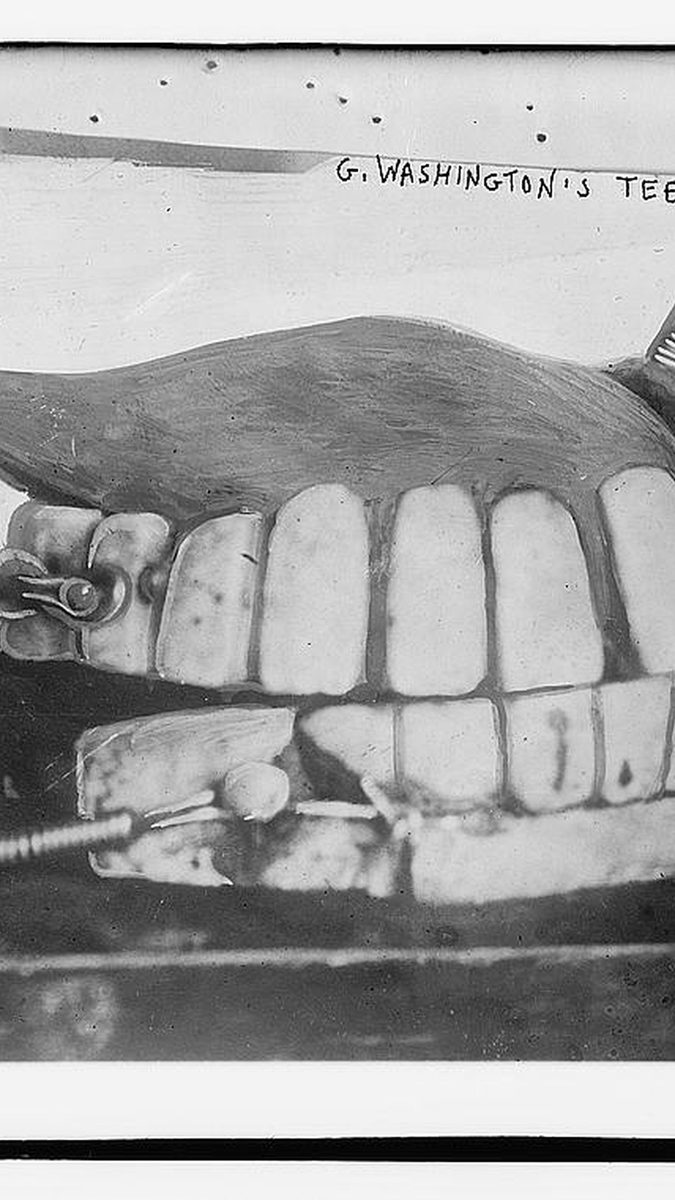
The four dentures that survive in museum collections today are made from different combinations of materials: hippopotamus ivory, walrus ivory, probably some elephant ivory, cow and horse teeth, and lead, tin, copper, silver, and brass. Only two of the four contain human teeth, fitted specifically into the lower incisors, the teeth most visible when a mouth is open to speak. A handful of tiny wood pegs show up among the fasteners holding some of the plates together — not teeth, just pegs, but close enough to the legend that it is worth saying plainly: that is the only wood anywhere in the record. Making a base that could pass as gum tissue and hold a full arch of teeth was skilled, improvisational work, closer to the custom fitting a dentist like the one behind the dental key would have recognized than to anything resembling a modern denture mold.
Nine Teeth, Six Pounds, Two Shillings
Washington’s financial ledger for May 1784 contains a line that has become the most debated detail in this whole object’s history: a payment of six pounds and two shillings — about a hundred and twenty-two shillings, or roughly fourteen shillings apiece — to enslaved people on his own property, for nine teeth. The entry notes the payment was made “on account of” Le Mayeur, the French dentist.
Historians read that notation differently, and it is worth saying so plainly rather than picking a side. Mount Vernon’s own research staff reads “on account of” as meaning the teeth were destined for Le Mayeur’s own stock or his other patients, not proven to be the specific teeth later wired into Washington’s own mouth. The art historian Jennifer Van Horn, writing in Early American Studies, places the purchase inside a broader pattern: dentists of the period preferred human donor teeth when they could get them, animal teeth were a common substitute, and buying teeth from enslaved people was, in her phrase, not unusual among the small number of Americans wealthy enough to wear dentures at all. What neither reading can settle is whether the sellers had any real choice, given that they were Washington’s legal property at the time of the sale. Mount Vernon pulled a souvenir magnet replica of the dentures from its gift shop after renewed public attention to this record.
The surrounding market makes the ambiguity sharper rather than softer. Three years after that 1784 payment, a Virginia newspaper ran an advertisement seeking front teeth from “any person, white, or black (excepting slaves),” willing to sell them — a phrasing that shows just how irregular, and how legally uncertain, a transaction with enslaved sellers like Washington’s actually was by the standards of the trade itself.
The Mouth Fought Back With Springs
However the plates were built, wearing them was a daily mechanical struggle. Gold and silver-alloy springs and wire connected the upper and lower plates, and those springs did not sit passively — they actively pushed the jaw open, which meant Washington had to consciously clench his jaw shut just to keep his lips closed in public. In one exasperated letter to Greenwood, Washington complained that a set was “uneasy in the mouth and bulge my lips out.”
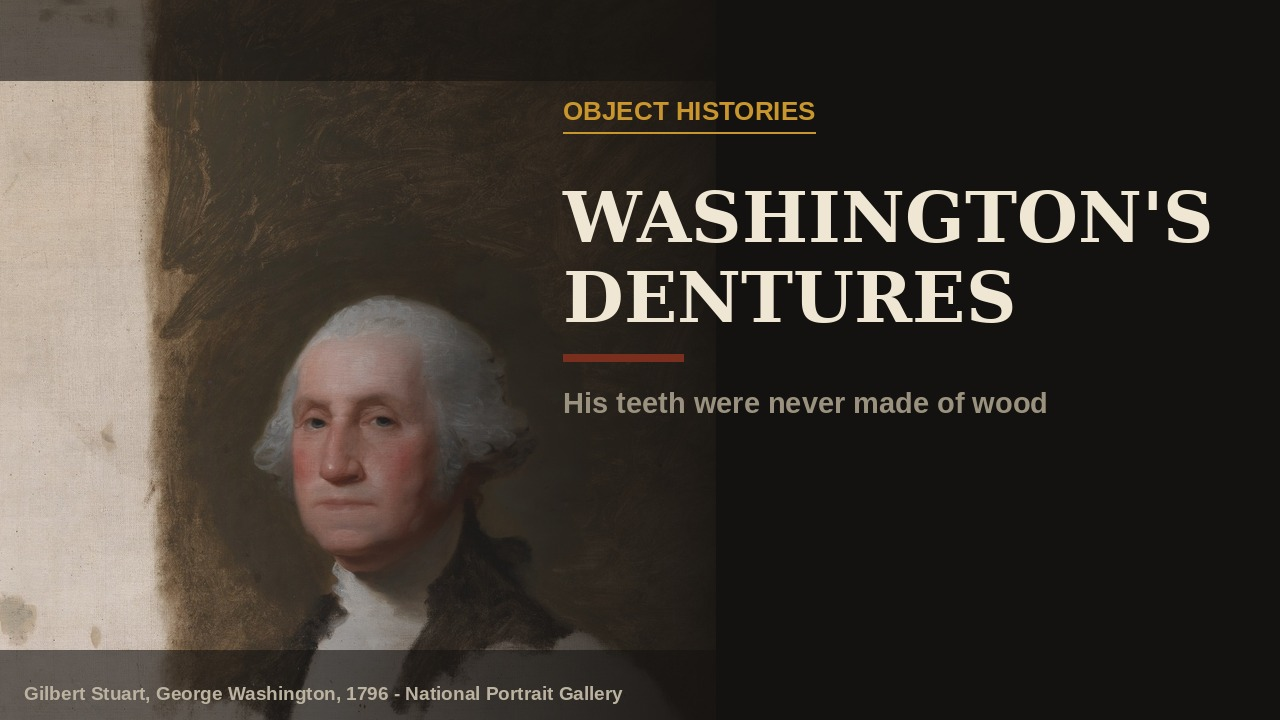
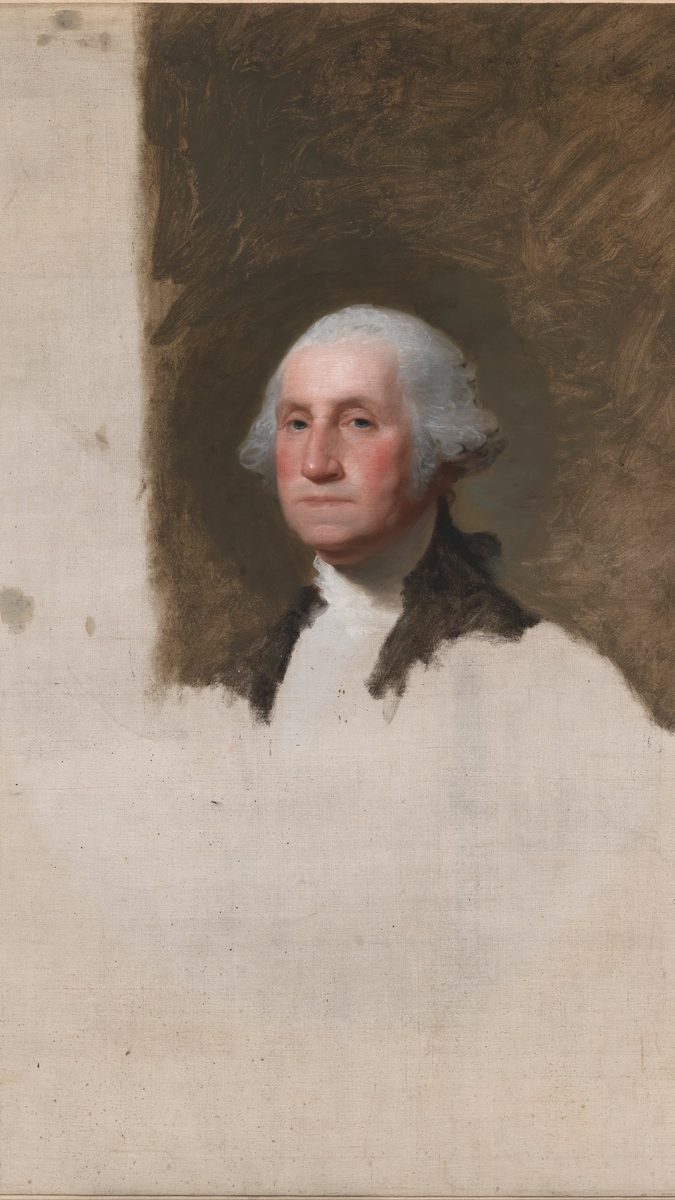
The strain shows up in the art. Gilbert Stuart’s unfinished 1796 portrait of Washington, the one later engraved onto the dollar bill, shows a jaw pushed subtly forward and lips pressed into a tight, closed line. People who knew him in person remarked that he rarely smiled broadly, and it is not hard to see why: between the chronic discomfort and the risk of his mouth springing open mid-sentence, restraint was the safer performance.
So Where Did the Wood Story Actually Come From?
If nothing in the dentures was wood, the myth still had to start somewhere, and the likeliest answer is the ivory itself. Ivory is porous. Years of contact with wine, tea, coffee, and saliva soak into it, staining it and opening fine cracks across the surface. Greenwood’s own correspondence backs this up directly: he once wrote that a set Washington had sent back to him “was very black,” and that it was port wine, which Washington drank against his dentist’s advice, that was dulling and darkening the polish. Stained and cracked that way, especially viewed from a few feet off or through the yellowed varnish of an old portrait, ivory can read as something close to wood grain. Nineteenth-century writers working from descriptions rather than the objects themselves seem to have made exactly that leap, and the story calcified from there, repeated in American textbooks and trivia books into the middle of the twentieth century.
It has since been checked directly against the objects. Materials testing on the surviving dentures, and the museum catalog records built from it, confirm ivory, metal alloys, and teeth — never wood forming any part of a tooth or a biting surface, in any of the four sets that survive.
What Happened to the Real Teeth Afterward
In 1796, with his last natural tooth causing new problems, Washington reluctantly let Greenwood pull it. He gave the tooth to his dentist as a keepsake, and Greenwood had it mounted and wore it for the rest of his own life. Greenwood’s descendants eventually gave the family’s Washington-related dental collection, including that tooth and one of the dentures, to the New York Academy of Medicine, where both are held today. Mount Vernon acquired its own complete, four-piece set separately, by purchase in 1949, and it remains on view there now.
None of this came cheap. Washington reportedly paid Greenwood around sixty dollars for a set, roughly four months’ wages for an ordinary worker in the mid-Atlantic states at the time. Custom dentures built from imported ivory and other people’s teeth were, like the prosthetic eyes examined in that object’s own strange manufacturing history, a luxury almost nobody outside the first president’s circle could have afforded.
None of this needed myth-busting to come to light. The real materials list was sitting in Washington’s own ledgers and his dentist’s letters the entire time; nobody had to dig for it. What the record actually adds up to is a single mouth held together by ivory shipped in from African hippos, metalwork from New York artisans, and teeth that came, at least in part, from people Washington legally owned and never compensated beyond that one ledger entry.
The wooden-teeth version let generations of schoolchildren laugh at an old man’s vanity and move on. The real version does not let anyone off quite so easily, which is probably why the simpler story kept getting taught for two centuries after conservators had already proven it false. The uncomfortable facts were never hidden. They just made for a worse anecdote.
Watch the full history
The short video that started this one covers the wood myth and the basic materials in under two minutes; everything above fills in the rest, including the parts the sixty-second version had no room for.

Related reading
- How Artificial Eyes Were Made, From Ancient Iran to Modern Acrylic
- Why Amputation Before Anesthesia Meant Racing the Clock
- How the Dental Key Worked, and Why It Took a Century to Retire
- Why Doctors Drained Blood to Treat Almost Any Illness
Works cited
- Van Horn, Jennifer. “George Washington’s Dentures: Disability, Deception, and the Republican Body.” Early American Studies 14, no. 1 (2016): 2–47.
- Wills, Matthew. “Were George Washington’s Teeth Taken from Enslaved People?” JSTOR Daily, February 25, 2020. Link.
- Tedeschi, Bob. “How George Washington’s Teeth — From Animals and Maybe Slaves — Became an American Legend.” STAT, July 3, 2017. Link.
- George Washington’s Mount Vernon. “False Teeth.” Digital Encyclopedia.
- George Washington’s Mount Vernon. “A History of Washington’s Dental Troubles.”
- George Washington’s Mount Vernon. “John Greenwood (1760–1819).” Digital Encyclopedia.
- George Washington’s Mount Vernon. “Wooden Teeth Myth.” Digital Encyclopedia.
- George Washington’s Mount Vernon. Dentures, object no. W-1520/A. eMuseum collection record. Link.
- New York Academy of Medicine Library. “Washington’s Lower Denture, ca. 1789.” Link.
- Johnson, Kayla. “The Strange Truth About George Washington’s Famous Teeth.” The Collector, April 22, 2026. Link.