
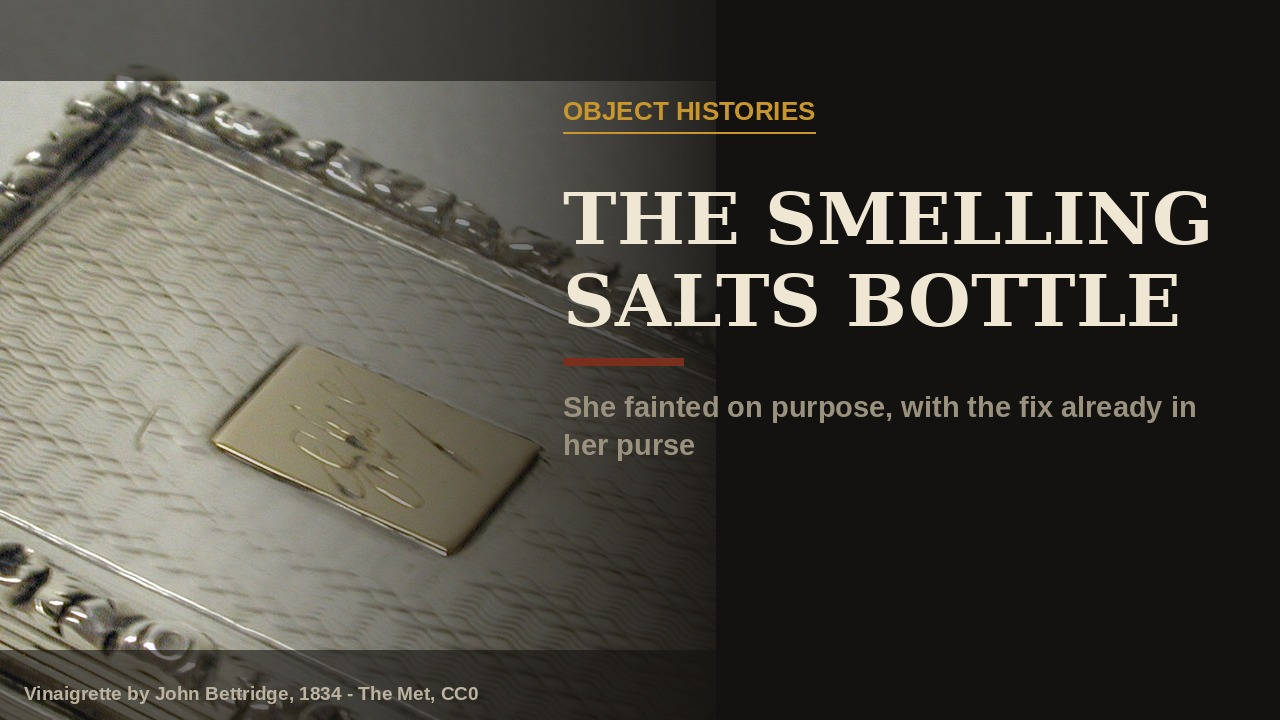
What was in Victorian smelling salts was, almost always, burnt deer antler. The dainty silver bottle a Georgian or Victorian woman carried on her hip held a chemical compound apothecaries made by packing shavings of antler and hoof into sealed iron retorts and heating them until they broke down and released ammonia gas. The jewelry was elegant. The contents were not.
The habit of carrying a jolt to the nose did not end with the corset. It migrated into boxing corners, then football sidelines, and survived there in something close to its original form for another century, until regulators and a professional sports league both decided, within a year of each other, that the same jolt that revived a fainted Victorian was also capable of hiding a concussion.
The Active Ingredient Was Burnt Deer Antler
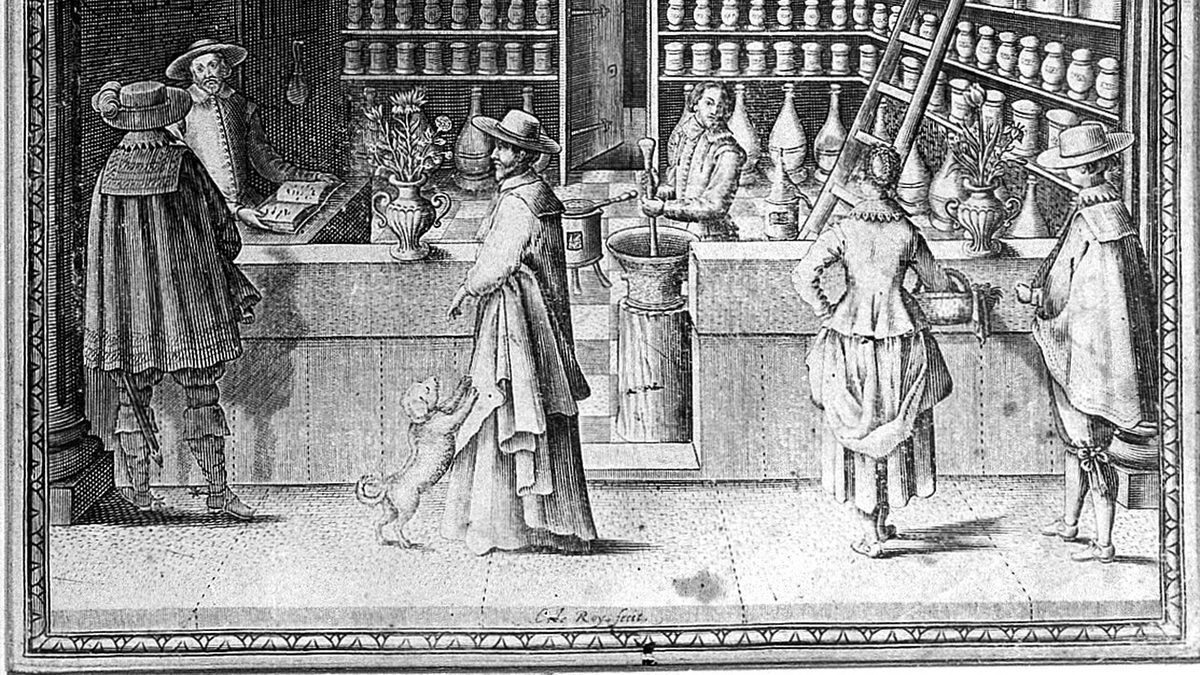
Chemically, smelling salts are ammonium carbonate, a compound that irritates the lining of the nose and lungs sharply enough to trigger an inhalation reflex: the muscles controlling breathing kick in, oxygen reaches the brain, and a fainted person gasps back to consciousness almost at once. For centuries, apothecaries produced it by a process called destructive distillation — heating shavings of deer antler, horn, and hoof in a sealed vessel until they decomposed and gave off ammonia vapor, which was then captured and concentrated. The product was called “hartshorn,” literally the horn of a hart, a deer, and the name stuck to the chemical long after anyone was actually burning antlers to make it.
Apothecaries sold the result two ways under two names: “spirit of hartshorn” or “sal volatile” as a strong solution to be sniffed, and a milder, diluted tincture doctors prescribed by the spoonful as a nerve tonic. Same compound, different dose, different end of the bottle.
Georgian Women Wore the Remedy as Jewelry
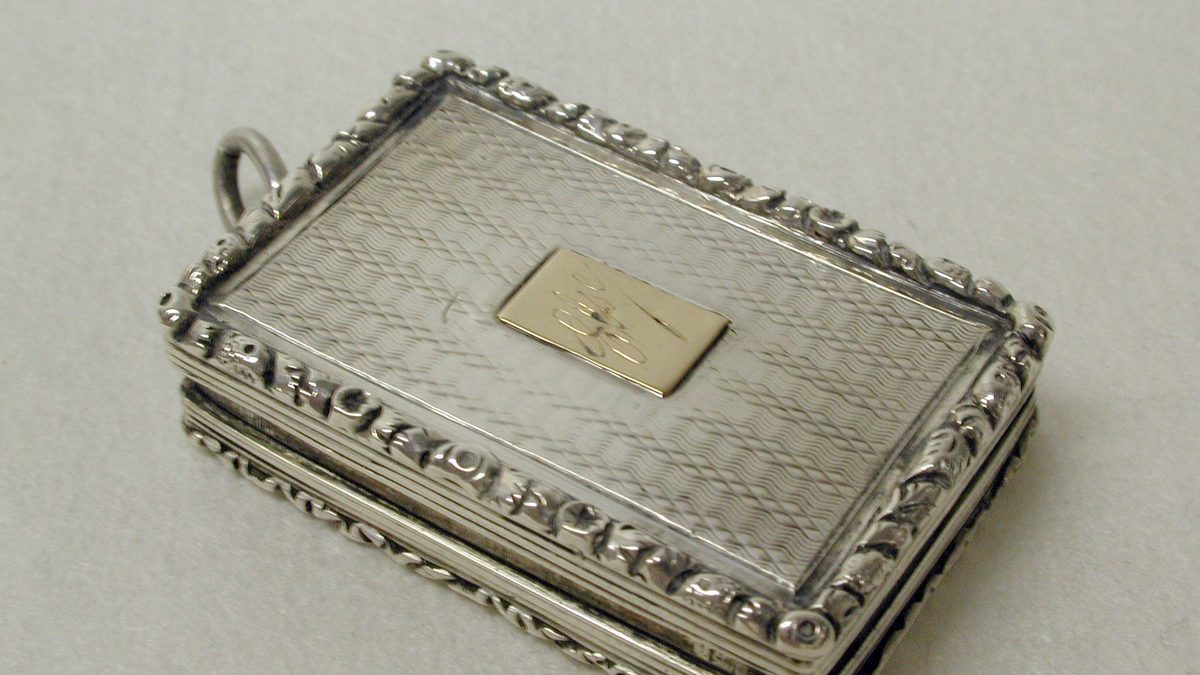
By the 1770s, carrying hartshorn had become a fashion statement rather than just a medical precaution. The object that made that possible was the vinaigrette: a small, hinged box, often no bigger than a matchbook, with a perforated inner grille that held a vinegar-soaked sponge dosed with the ammonium salt. Nearly all of them were silver, and the overwhelming majority were made in one city, Birmingham, then Britain’s capital of small, precise metalwork. Silversmiths including John Bettridge, Nathaniel Mills, and George Unite turned out vinaigrettes shaped like shells, baskets, fruit, and tiny books, their designs growing more elaborate as the century went on. Because the ammonia fumes would corrode plain silver, the inner grille was almost always gilded in gold to survive contact with the acid. A woman’s vinaigrette advertised her taste and status as plainly as any other piece of jewelry she wore.
Surviving examples, now scattered through museum and auction catalogs, trace the fashion decade by decade: a Bettridge box hallmarked in 1818, another by the maker Lea in 1822, pieces by Nathaniel Mills carrying a Victorian assay mark as late as 1846. Shapes grew more playful as the trend matured — rectangles gave way to shells, baskets, acorns, even miniature books small enough to pass, at a glance, for an actual piece of reading material rather than an emergency medical device.
Corsets Turned Fainting Into Something Worth Planning For
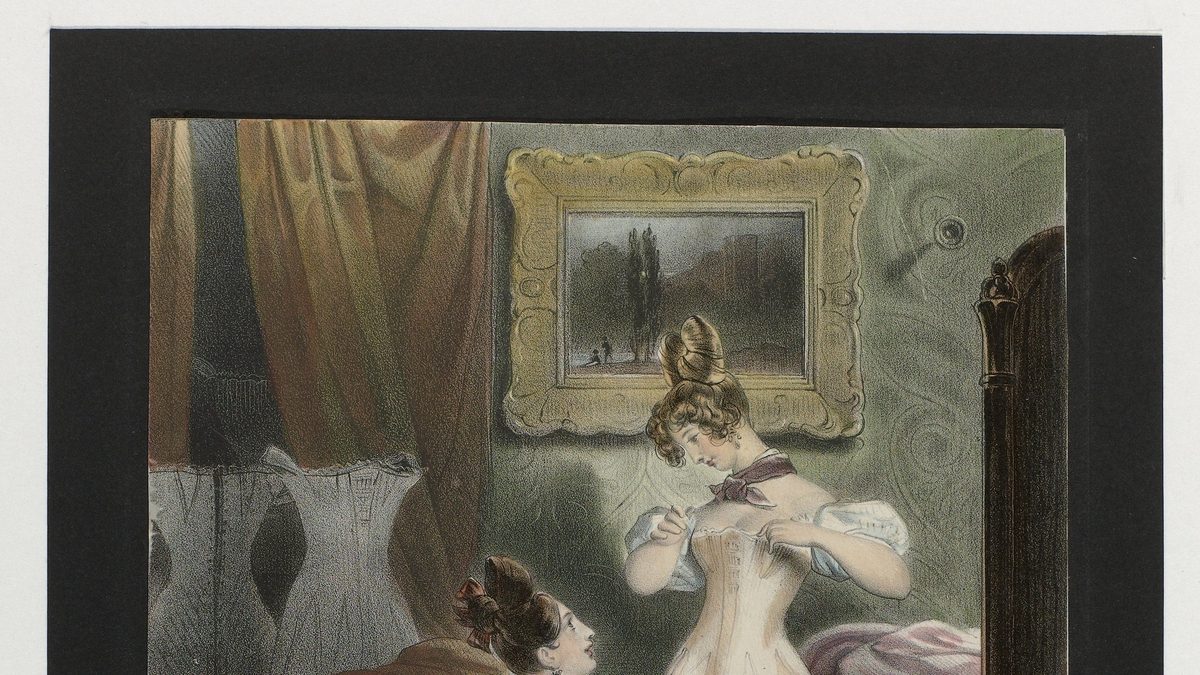
There was no shortage of reasons to reach for one. A corset laced tightly enough to visibly narrow the waist also measurably reduced lung capacity, and Georgian and Victorian women wore them in rooms lit by oxygen-consuming gas lamps and crowded with people in heavy fabric. Fainting, politely termed “the vapours,” became common enough that a bottle at the hip was not paranoia so much as preparation. For some women it carried a faint social benefit too: a delicate, frequent swoon read as proof of a fine, sensitive constitution, the fashionable opposite of coarse good health.
The remedy and the cause were, in a real sense, matched to each other. A faint of this kind is usually what doctors now call vasovagal syncope: blood pressure and heart rate drop suddenly, blood flow to the brain dips, and consciousness goes with it. Whatever actually tips a tightly laced, overheated, under-oxygenated woman into that state, the fix works the same way every time: the ammonia sting forces a sharp reflex inhalation, blood pressure and breathing both spike back up, and the brain gets its oxygen again almost as fast as it lost it. It is a crude mechanism, but not an illogical one — closer to a chemical defibrillator for the nervous system than to a soothing tonic.
Does the Story Really Go Back to Ancient Rome?
The vinaigrette’s own marketing liked to claim classical roots, and the claim is at least partly real, though murkier than the short version suggests. Pliny the Elder, writing in the first century AD, describes a salt called hammoniacum, gathered near a temple to the god Jupiter Ammon in what is now Libya. That salt is where the modern words “ammonia” and “ammonium” ultimately come from. What is far less certain is whether Pliny’s hammoniacum was chemically anything like the ammonium carbonate Georgian apothecaries later burned out of deer antler — later scholarship on his description leans toward it being an ordinary rock salt that simply shared a place-name with the temple, not a smelling-salt ancestor at all. The Romans gave the compound its name. Whether they ever actually used anything resembling it to revive a fainted guest is a separate, much shakier claim.
The Same Salt Leavened Gingerbread
Here is the detail that rarely survives the retelling: the substance reviving fainting Victorians also leavened their gingerbread. Ammonium carbonate was one of the earliest chemical leaveners, used in baking long before baking powder existed, because it releases gas when heated, the same reaction that makes it so effective in the nose. German bakers still use it today, under the name Hirschhornsalz — hart’s-horn salt, no euphemism at all — in traditional Christmas biscuits like lebkuchen, where it gives a snap that baking soda cannot quite reproduce. The sickroom bottle and the pantry jar held, in a real sense, the same thing, which is a reminder of how recent the line between medicine cabinet and kitchen cupboard actually is. Modern baking powder, built around sodium bicarbonate and an acid salt, only displaced hartshorn gradually through the nineteenth century; it took over almost entirely because it leaves no ammonia smell behind in a large, moist cake, even though the older compound still works better in the thin, dry biscuits German bakers kept using it for.
The Habit Outlived the Corset by a Century
The corset loosened its grip through the early 1900s, but the bottle did not disappear, it just changed venues. Boxing corners kept small glass ammonia capsules to snap under the nose of a fighter who had gone down, meant to get him back on his feet before the referee’s count ran out. From boxing the habit spread into locker rooms generally, and it became a quiet, semi-official fixture on American football sidelines for decades, supplied by team staff as an unofficial pick-me-up between plays.
That ordinary routine ran into trouble in 2024, when the Food and Drug Administration warned consumers against a cluster of ammonia-based inhalant products, several marketed specifically for alertness and energy under names like Ammonia Sport and Nose Slap. The agency said the manufacturers had shown no evidence the products were safe or effective, and that it had received reports of shortness of breath, seizures, migraines, vomiting, and fainting after use — warning letters went out to seven companies, including brands sold under names like Ward Smelling Salts, Ammonia Sport, and Nose Slap, the last of these already flagged once before, in 2023, for the same reason. The NFL’s own Head, Neck, and Spine Committee picked the warning up from there, and on August 5, 2025, the league sent teams a memo barring club personnel from supplying or using smelling salts or any other ammonia inhalant before, during, or after games. The stated concern was specific: the sharp jolt these products produce can mask exactly the grogginess and disorientation that signal a concussion, making it harder for medical staff to tell whether a player’s brain had actually been hurt. The ban covers team staff. It does not address what a player carries in for himself, a detail that says a fair amount about how hard a two-hundred-year-old habit is to fully legislate away.

Trace the object all the way through and the throughline is almost unchanged: a compound made by burning animal horn, inhaled for the same sharp jolt, carried by people who needed to look composed under pressure, in a container that got progressively less decorative, from gilded Birmingham silver to a foil packet on a sideline bench. The chemistry never updated. Only the excuse for needing it did.
Watch the full history
The short video that started this one covers the vinaigrette and the fainting fashion in under two minutes; the chemistry, the Roman half-truth, and the 2025 NFL ban are new here.

Related reading
- What George Washington’s Dentures Were Made Of
- Why Amputation Before Anesthesia Meant Racing the Clock
- How the Dental Key Worked, and Why It Took a Century to Retire
- Why Doctors Drained Blood to Treat Almost Any Illness
Works cited
- Pliny the Elder. Natural History, Book 31, Chapter 39, on the salt called “hammoniacum.” Perseus Digital Library. Link.
- Conservation & Art Materials Encyclopedia Online (CAMEO), Museum of Fine Arts, Boston. “Ammonium Carbonate.”
- Science Museum Group Collection. Silver vinaigrette, object co133215 (George Unite, Birmingham, 1875). Link.
- “The 19th-Century Vinaigrette.” Lincolnshire Life. Link.
- U.S. Food and Drug Administration. “FDA Warns Consumers Not to Purchase or Use Unapproved Inhalant Products Marketed for Alertness and Energy.” August 6, 2024. Link.
- Associated Press. “NFL Bans Smelling Salts Over Concern They Mask Concussion Symptoms.” Fox Sports, August 5, 2025. Link.
- “NFL Will Ban Smelling Salts and Other Ammonia Products for the 2025 Season, New Memo Says.” TMJ4/Scripps News. Link.