
How tarot became fortune telling is a story with a surprisingly exact starting point: fifteen minutes, in Paris, in 1781, inside the head of a man who had never actually seen anyone use the cards to predict anything. For three hundred years before that moment, tarot was just a card game, expensive and aristocratic at first, then ordinary and everywhere. Nothing about its imagery was designed to tell anyone’s future. The fortune-telling tradition built on top of it afterward is, in a real sense, a layer of invented history draped over a deck of playing cards.
A Deck Built for a Card Game, Not a Reading
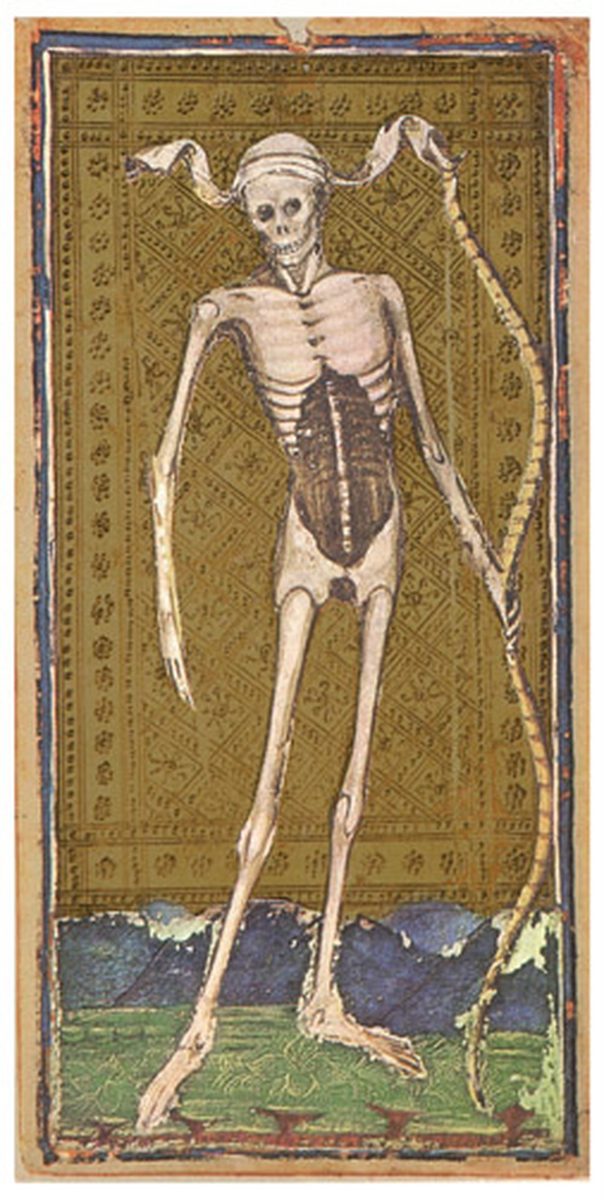
Tarot began in northern Italy around the 1440s, where wealthy families commissioned hand-painted, gilded decks for a trick-taking game called tarocchi, essentially an ancestor of bridge. The most famous surviving example, the Visconti-Sforza deck, was likely made for the family whose marriage united Milan’s two ruling houses. No complete deck survives: the Morgan Library in New York holds 35 of the original cards, another 26 sit in Bergamo’s Accademia Carrara, and 13 more belonged to a separate collecting family, out of what would have been a 78-card pack. The rules of the original game are lost entirely. What survives is the art, and it was treated as art: a luxury object for dukes, not a tool for anyone’s fortune.
Three Centuries as an Ordinary Card Game
In the sixteenth century, the game spread out of Italy along with returning French troops, and mass production in Marseille standardized it into the familiar 78-card, four-suit format, with 22 trump cards and the Fool. For the better part of three centuries after its invention, that is essentially all tarot was: a popular trick-taking game played across Western Europe, no more mystical than a deck of ordinary playing cards, which, in a direct lineage, is more or less what it was.
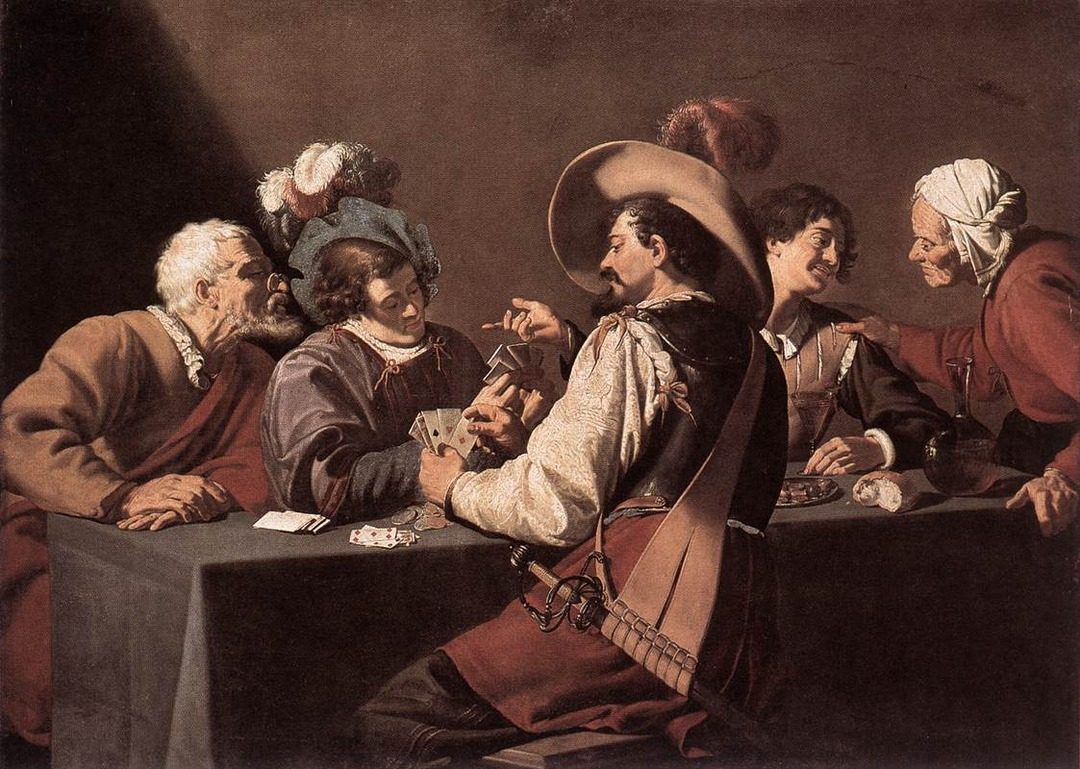
That ordinary card game never actually went away, which is easy to forget once a deck becomes famous for something else entirely. According to Pagat.com, a reference site run by card-game historian John McLeod, regional tarot card games are still played today in eleven European countries, including France, Germany, Austria, Italy, and Switzerland, each with its own rules and scoring. French Tarot in particular remains an ordinary household game there, sold in stationery shops, played by people who have never once used the deck to read anyone’s future. The fortune-telling tarot and the trick-taking tarot are, structurally, the same 78 cards. They simply became two largely separate traditions, running in parallel for more than two hundred years with surprisingly little overlap between the players of one and the readers of the other.
A Scholar Decided It Was Egyptian, in About Fifteen Minutes
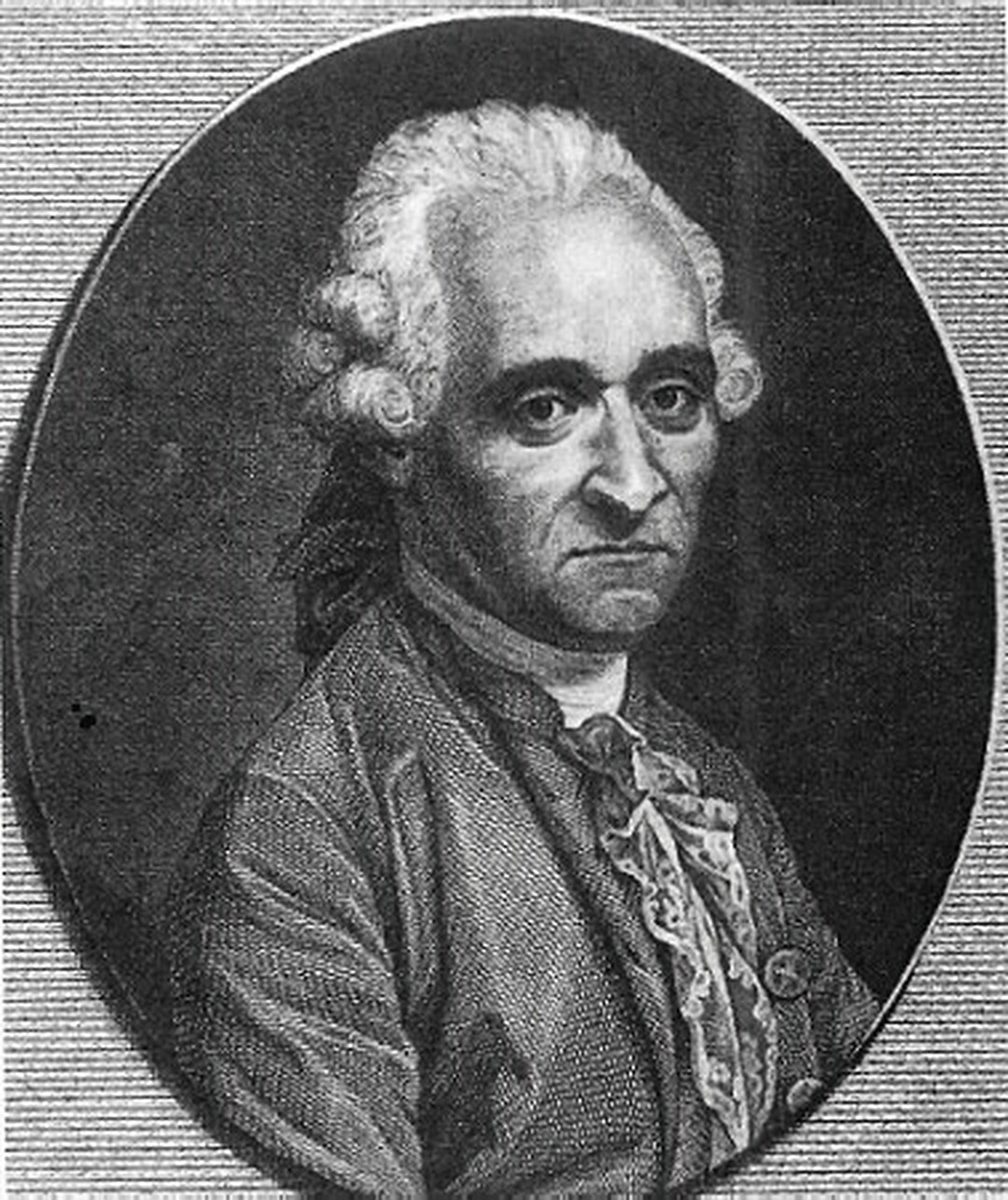
That changed because of Antoine Court de Gébelin, a French pastor, scholar, and Freemason, in an essay published in 1781 in the eighth volume of his sprawling work Le Monde Primitif. Watching a woman play a round of tarot, he wrote that he recognized the cards almost at once: in his own account, it took about fifteen minutes for him to conclude that the deck was nothing less than the one surviving book of ancient Egyptian wisdom, a copy of the lost Book of Thoth, distilled into a form that had been hiding in plain sight as a parlor game. “I cast my eyes,” he wrote, “and immediately recognize the Allegory.”
He offered almost nothing resembling evidence. He pointed to no Egyptian monument, no papyrus, no actual artifact. His strongest comparison was to a Chinese monument someone else had described to him secondhand, which he thought resembled the cards. He matched the deck’s four suits to what he believed were ancient Egypt’s four social castes, read the 22 trump cards as a chain of allegorical figures, and credited Romani people with carrying the practice across Europe, wrongly assuming they had come from Egypt themselves rather than, as later research showed, from the Indian subcontinent. Historians since have been blunt about the result: most of his claims were simply wrong, built more on confident rhetoric than on research. None of that stopped the idea from taking hold. A separate essay on tarot published in the same volume, by the Comte de Mellet, reached similar Egyptian conclusions without citing Court de Gébelin at all, which suggests both men were drawing on notions already circulating in the overlapping worlds of Masonic lodges and occult salons, rather than either one inventing the connection entirely from scratch.
Etteilla and How Tarot Became Fortune Telling for Pay
The man who actually monetized the Egyptian theory was a Parisian seed merchant and part-time mathematician named Jean-Baptiste Alliette, who wrote and practiced under his own surname spelled backward: Etteilla. Between 1783 and 1785 he published a method for reading tarot that accepted Court de Gébelin’s Egyptian claim at face value, and in 1789 he went further, publishing the Grand Etteilla, also called the Egyptian Tarot: the first deck ever designed explicitly for divination rather than gameplay. He reordered the trump cards, moved the Fool to the very end of the sequence, printed divinatory keywords directly on the card borders so a reading could be done without memorization, and introduced the practice of reading a card’s meaning differently depending on whether it turned up upside down. He also charged people money for readings, which, more than any specific card design, is probably his most lasting contribution: Etteilla is a reasonable candidate for the first person anywhere to make a living as a professional tarot reader.
An Overlooked Illustrator Drew the Deck Everyone Now Pictures
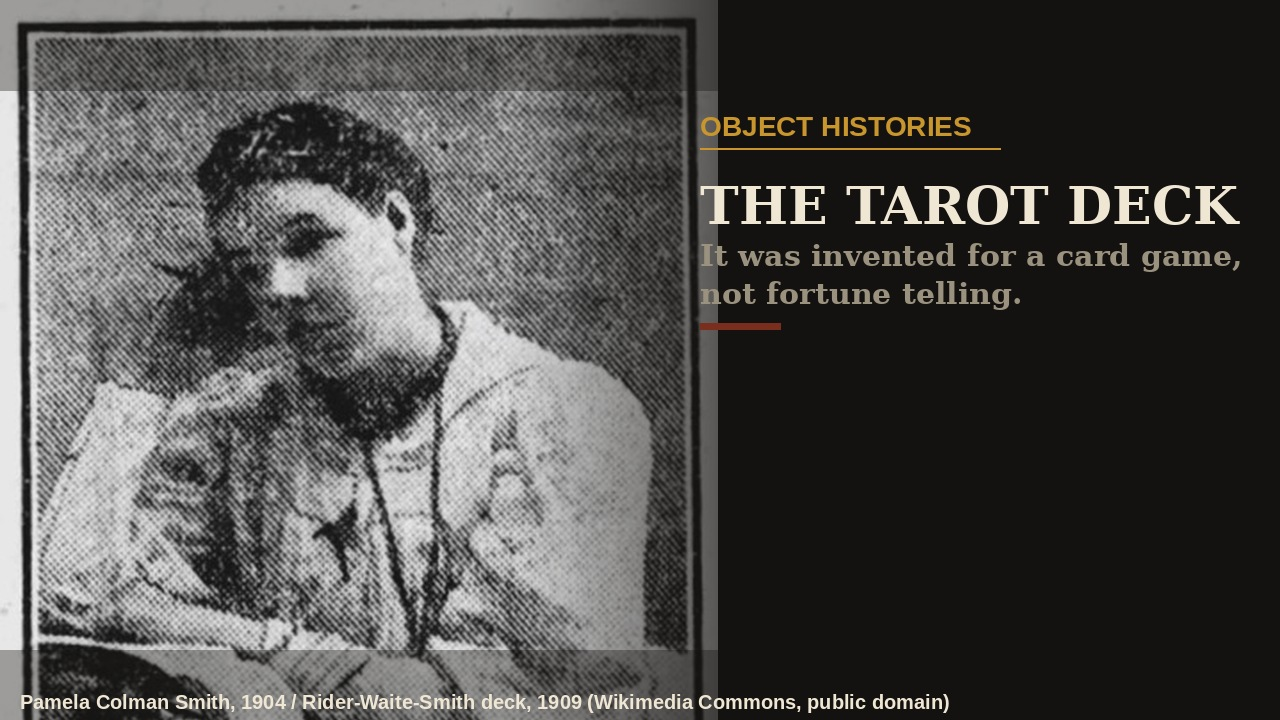
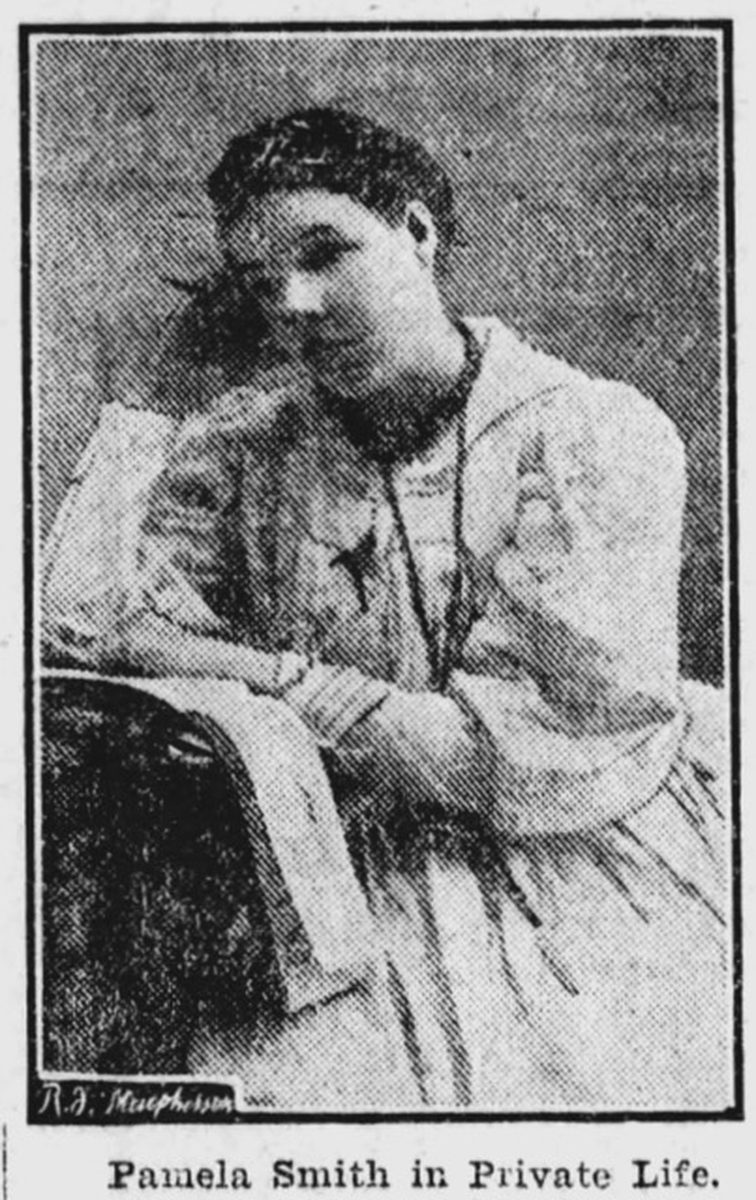
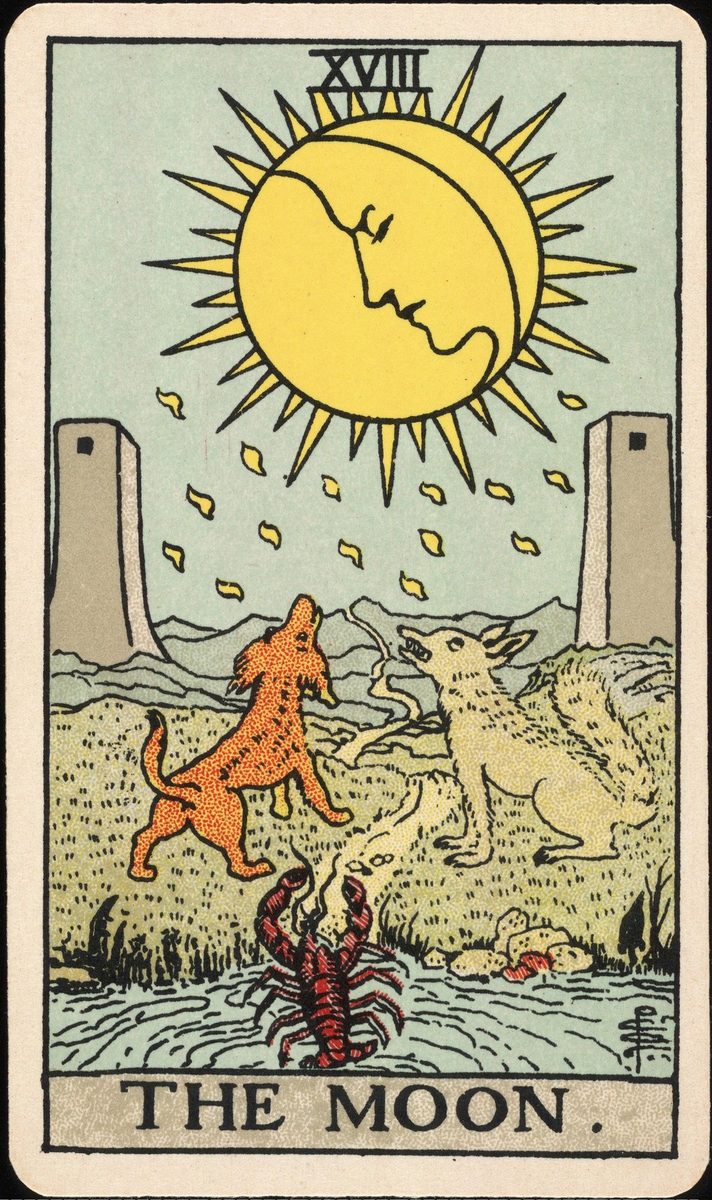
The imagery most people now associate with tarot, the Tower struck by lightning, the Moon with its two baying animals, the Wheel of Fortune, comes from neither the Visconti-Sforza cards nor any eighteenth-century Egyptian deck. It comes from 1909, when the occultist A.E. Waite, a member of the Hermetic Order of the Golden Dawn, hired the artist Pamela Colman Smith to illustrate a new deck for the publisher Rider & Co. Smith finished all 78 illustrations in a few months. Waite designed the broad program for the 22 trump cards, the Major Arcana, but gave Smith a comparatively free hand on the 56 suit cards, the Minor Arcana, and that decision turned out to be the deck’s real innovation: earlier tarot decks had left the numbered suit cards as plain repeated symbols, like a modern deck’s five of clubs, while Smith gave every single one of them a fully illustrated scene a reader could interpret on sight.
That one choice is most of the reason the deck still dominates the market more than a century later. A reader using an older, unillustrated deck effectively had to memorize or invent a meaning for all 56 plain suit cards before a reading meant anything; a reader holding Smith’s version could interpret an unfamiliar card the way anyone reads a picture, by looking at it. The deck still runs on the four standard tarot suits, Wands, Cups, Swords, and Pentacles, each loosely mapped by Golden Dawn tradition onto fire, water, air, and earth, but it was Smith’s specific scenes for each numbered card, not the underlying suit structure, that made the system usable by someone without years of occult study behind them.
She was, by her own account, not particularly well compensated for it, later describing the commission as “a big job for very little cash.” The deck was published and marketed as the Rider-Waite deck, crediting the publisher and Waite by name while leaving her off the cover entirely. It took most of a century for that to be corrected in any formal way; the deck is now far more often called the Rider-Waite-Smith, or simply the Smith-Waite, and Smith’s own biography and other artwork, largely forgotten for decades, has drawn renewed museum attention in recent years. In 2022, a Rider-Waite-Smith Moon card was included in the Whitney Museum’s survey of American modernism, hung not as a curiosity but as a serious work of early twentieth-century illustration, a kind of recognition that eluded Smith for her entire lifetime.
Trace the object from its first appearance to the version sold in bookstores today, and the throughline is almost the opposite of what the cards themselves seem to promise: nothing about tarot was ever foretold or revealed. A Milanese card game got a Parisian scholar’s fifteen-minute guess bolted onto it, a seed merchant turned that guess into a business, and an artist paid too little and credited too late gave the whole system the face it still wears. Every step of that chain was improvised by someone solving an immediate problem in front of them, a bored lady’s card game, a lecture that needed a dramatic conclusion, a job that needed finishing fast, rather than handed down from any single source, Egyptian or otherwise.
Watch the short
The sixty-second video that started this one covers the Visconti family’s original card game and Court de Gébelin’s 1781 claim; Etteilla’s cartomancy business and Pamela Colman Smith’s own account of the 1909 commission are new here.

Related reading
- Who Really Invented the Ouija Board?
- Inside the Discovery of the Great Pyramid’s Big Void
- How Iceboxes Worked Before the Electric Refrigerator
- What Was in Victorian Smelling Salts
Works cited
- The Morgan Library & Museum. “Visconti-Sforza Tarot Cards,” MS M.630.
- Victoria and Albert Museum. “Tarot Cards.” Link.
- Solly, Meilan. “Discover the Renaissance Origins and Mystical Evolution of Tarot Cards.” Smithsonian Magazine. Link.
- “Court de Gébelin and Le Monde Primitif, 1781.” The World of Playing Cards. Link.
- “The Most Recognizable Work at the Whitney Museum’s New Modernism Exhibit May Be a Tarot Deck.” Religion News Service, September 8, 2022.
- “The Occult Revival: Etteilla.” Kerykeion, Learn Tarot: History. Link.
- McLeod, John. “Tarot Card Games.” Pagat.com. Link.