
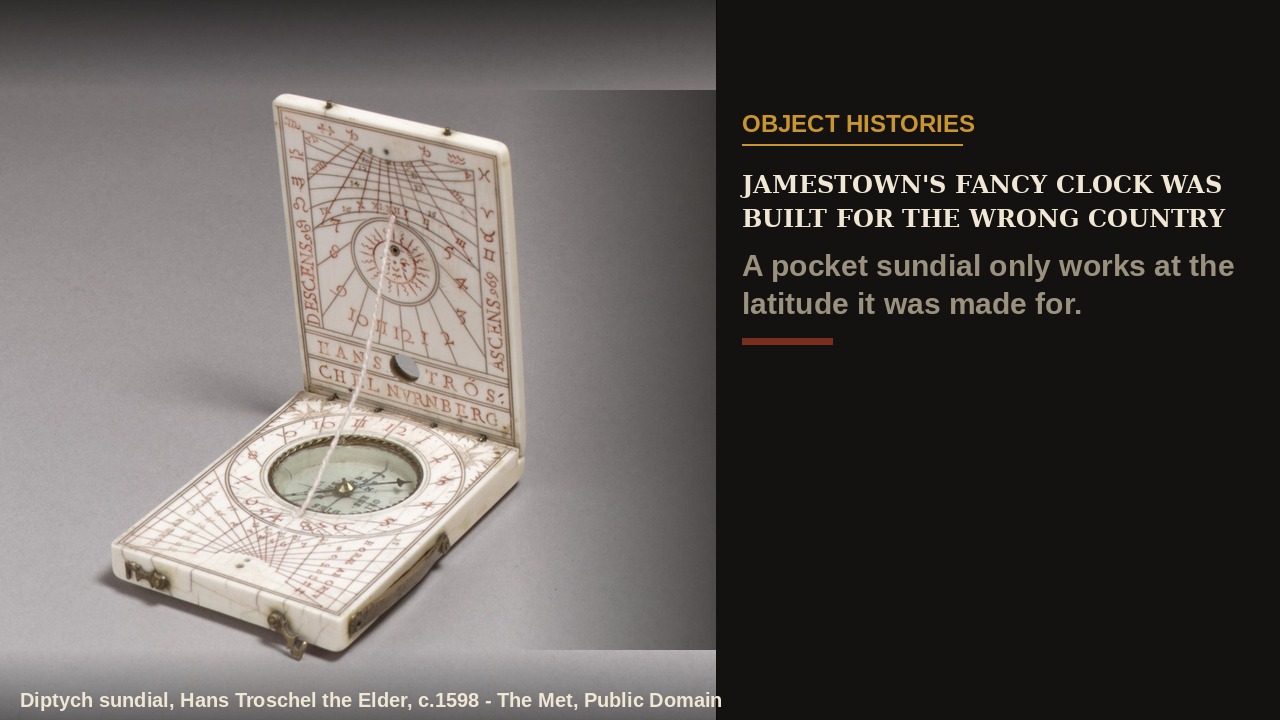
The Jamestown pocket sundial is one of the stranger objects to come out of the ruins of James Fort: a small, expensive, beautifully engraved ivory instrument, carried across the Atlantic by people who wanted to know what time it was, that was never actually capable of telling them. Archaeologists have now recovered fragments of at least four of these dials from the fort site, and Captain John Smith himself, by his own account, carried a related but physically different version of one during his famous 1607 capture. Both kinds of instrument shared the same basic flaw, and it had nothing to do with being broken.
What a Diptych Dial Actually Was
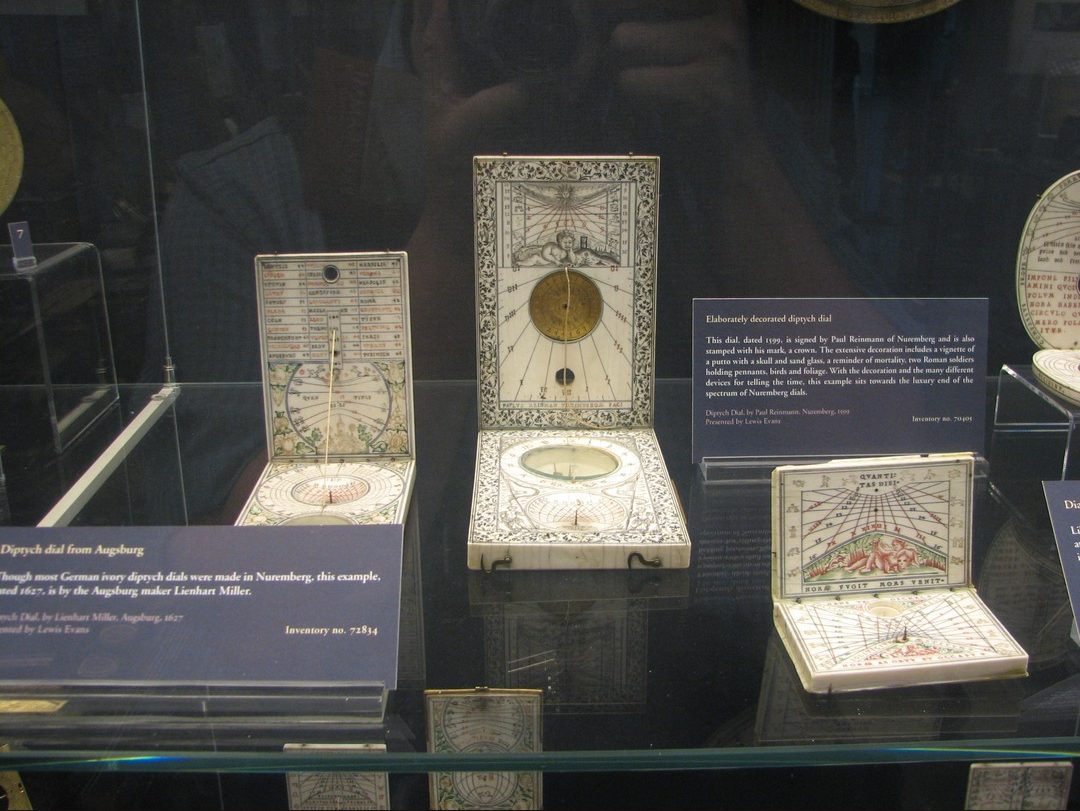
The most common type recovered at Jamestown is called a diptych dial: two flat ivory leaves joined by a hinge, opening to a right angle like a tiny book. A horizontal dial was usually engraved into the inside of the lower leaf and a vertical dial into the upper one, and a thin string, knotted through a hole and pulled taut between the two leaves, served as the gnomon — the part that actually casts a shadow. A small magnetic compass set into a recess in the lower leaf let the owner orient the whole device to true north before reading it, since a sundial that isn’t facing the right direction tells you nothing at all. These were manufactured almost as a trade specialty in Nuremberg, Germany, by family workshops of compass- and dial-makers, and a well-preserved example by one such maker, Hans Tröschel the Elder, survives today at the Metropolitan Museum of Art, engraved specifically for Nuremberg’s own latitude of roughly 49.5 degrees.
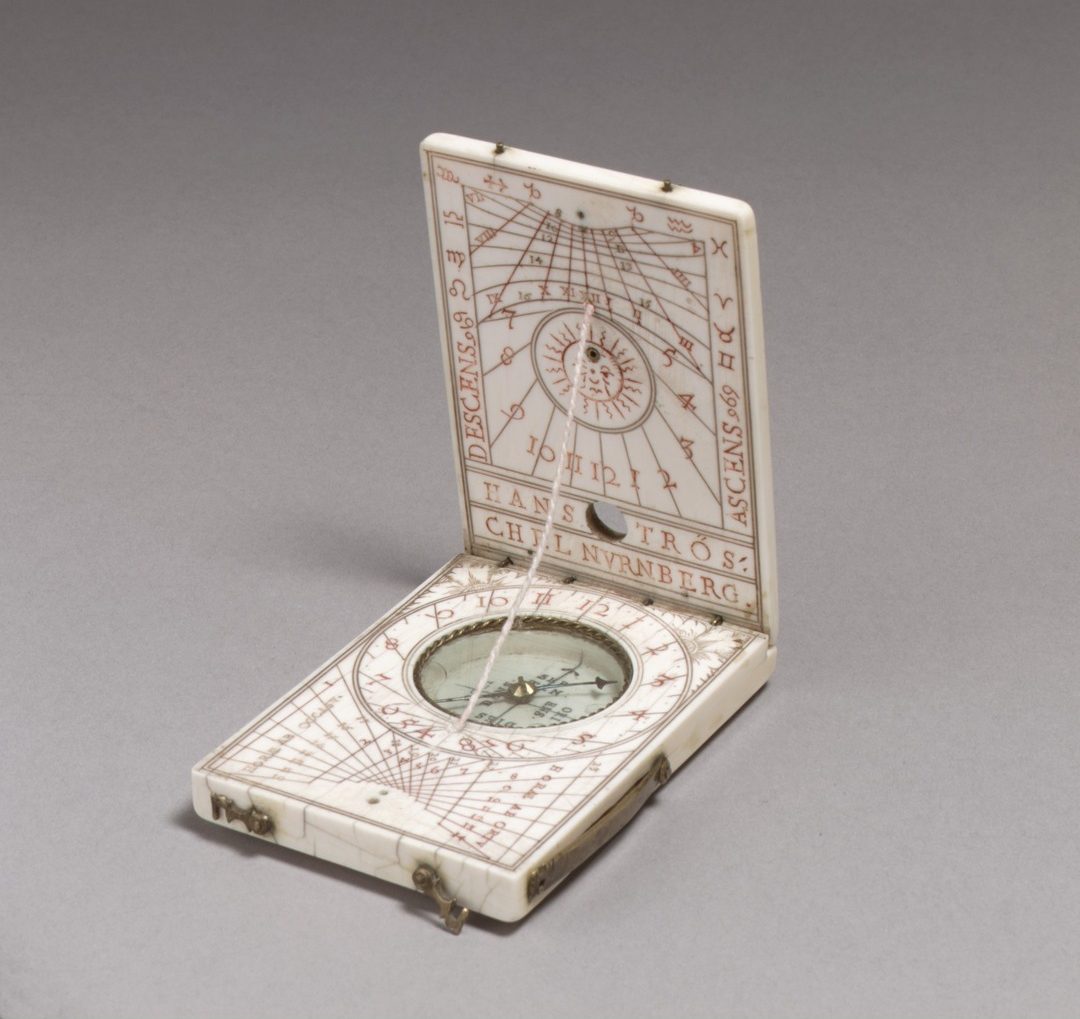
That detail — “engraved specifically for” one latitude — is the whole story. A horizontal sundial only reads correctly at the latitude its hour lines were drawn for, because the sun’s angle above the horizon at any given hour changes with how far north or south you are standing. Move the same dial to a different latitude and the shadow still falls, and the hour lines are still beautifully engraved, but they no longer correspond to the actual time. A dial made to be accurate in Germany would drift further and further from correct the farther its owner carried it from Germany — which is precisely what happened to the examples that ended up in Virginia.
Captured, and Holding Up a Dial to Live
Smith’s own instrument wasn’t a flat diptych dial at all. According to his 1608 account, the “True Relation,” analyzed in detail by historian of science Sara Schechner, Smith carried what he called a “round Ivory double compass Dyall” — a pocket sundial built into a hollow ivory sphere rather than a folding book. One hemisphere held a magnetic compass, its needle glued beneath a card painted with a wind rose and covered in glass, with a brass sundial stretched across the opening to hold the glass in place; devices of this general type typically held a second mechanism, a brass volvelle for tracking the phases of the moon, in the other hemisphere, though Schechner is careful to note that’s the usual design for this class of instrument rather than something confirmed about Smith’s particular dial. The exterior was engraved with the ecliptic, the equator, and other celestial circles — a small working model of the heavens you could carry in a pocket.
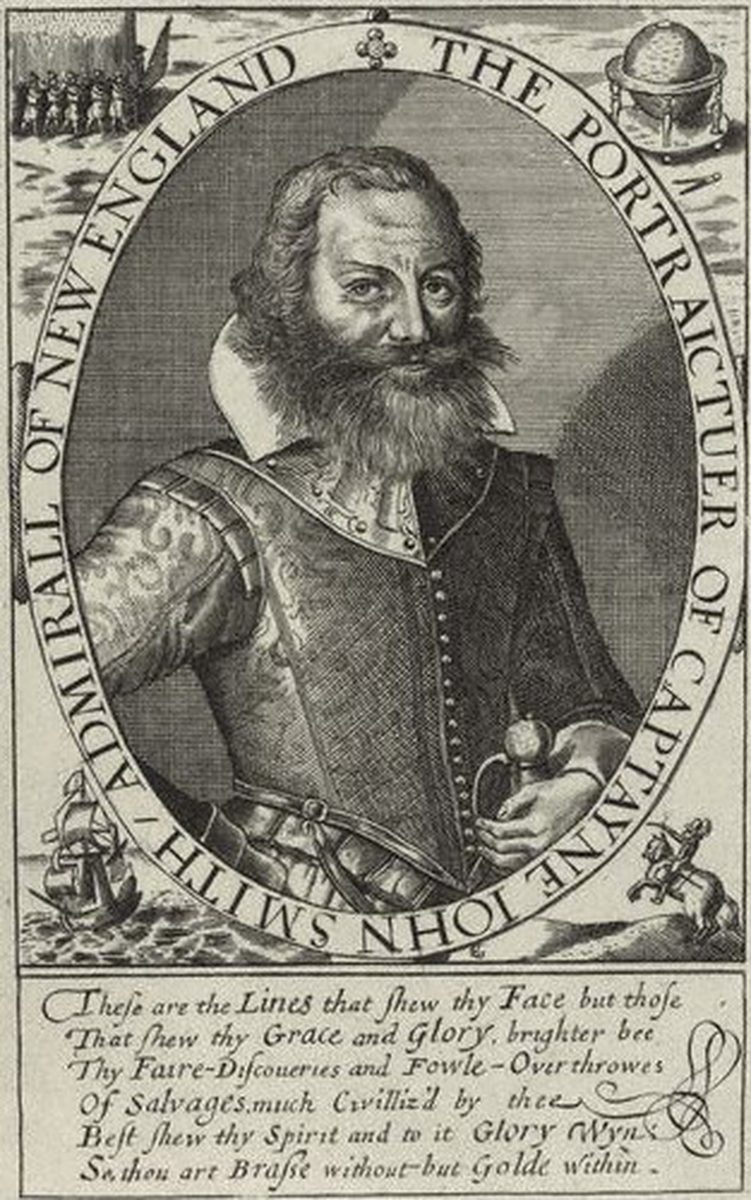
In December 1607, while exploring the upper Chickahominy River by canoe, Smith was ambushed by roughly two hundred Powhatan warriors under Opechancanough, wounded by arrows, and chased into a swamp until the cold mud stopped him. He surrendered and was brought before Opechancanough, and by his own telling, Smith handed over the compass dial and talked his captor through how it worked — the floating wind-rose needle, visible through its glass cover but impossible to touch, apparently held the group’s attention long enough that Opechancanough let him keep talking about the earth, sun, moon, and stars. It bought him time, not mercy: about an hour later he was tied to a tree, arrows drawn, before Opechancanough held the dial up and called it off. Smith was then marched through a string of villages for roughly a month before finally being brought in front of Powhatan himself, where, in the episode Smith is most remembered for, Powhatan’s young daughter Pocahontas — about nine or ten years old at the time — intervened to save him. Schechner’s own reading of that second episode is more skeptical than the popular legend: she argues it “appears” to have been a staged, choreographed ritual rather than a spontaneous rescue, specifically because having a foreign soldier publicly spared by a child was a pointed way to humble him — a scholarly reading, not a settled fact, but one worth holding alongside the more familiar version of the story.
Four Dials, Four Distant Latitudes
Smith’s sphere-shaped dial and the flat diptych dials recovered archaeologically at James Fort are not the same object — they’re two different, physically distinct types of instrument, and nothing in the record claims otherwise. What they share is a maker’s region and a buyer’s motive: both were fine, expensive European scientific instruments, and both ended up thousands of miles from the latitude they were built for. Jamestown Rediscovery, the ongoing archaeological project at the fort site, has recovered fragments of at least four separate ivory diptych dials from the ground there, most of them discarded by around 1610, just a few years after the fort was founded. One fragment carries a maker’s inscription, “Hans Miler” (also spelled Miller), tying it to a documented family of compass- and dial-makers working in early 17th-century Nuremberg. A separate pair of lower-leaf fragments recovered at the fort were calculated, according to Jamestown Rediscovery’s own research, to have been engraved for use in Venice, Italy — a latitude of roughly 45 degrees, nowhere near either Nuremberg or Virginia.
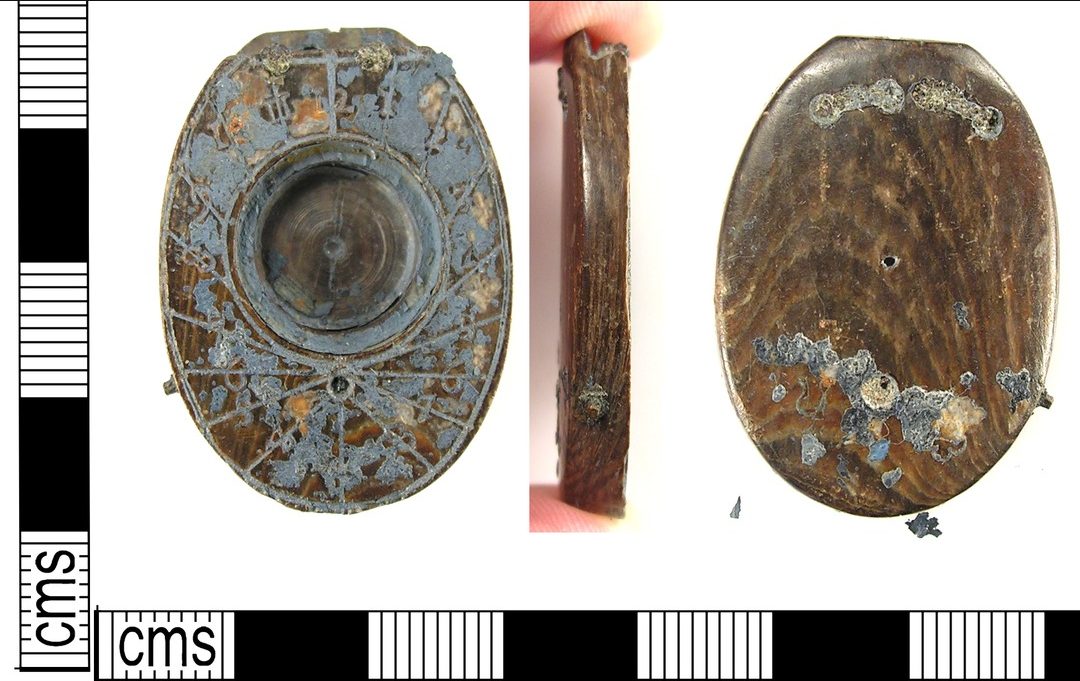
A third data point comes from the specific Hans Miler fragment recovered during the fort’s 19th archaeological season, in April 2012, found in fill above a cellar from the earliest years of the fort, roughly ten feet from James Fort’s first well. Jamestown Rediscovery’s senior conservator, Michael Lavin, used a Serle Dialing Ruler — a specialized measuring tool made by the North American Sundial Society specifically for analyzing historic sundials — to work out the hour-line geometry on that fragment, and calculated it had been engraved for a latitude of approximately 53 degrees. Put the figures side by side: Nuremberg itself sits at roughly 48 to 49.5 degrees depending on the source consulted, one excavated fragment was cut for Venice’s roughly 45 degrees, another was cut for something closer to 53 degrees, and Jamestown sits at about 37 degrees. These aren’t competing claims about the same object that need to be reconciled into one number — they’re several different dials, made in several different European cities, every one of them wrong for Virginia by a wide and different margin.
Why the Latitude Mattered So Much
The gap between roughly 37 degrees and anywhere from 45 to 53 degrees isn’t a rounding error. It is the difference between the sun’s path over Virginia and its path over most of western and central Europe, and on an engraved horizontal dial that difference shows up as hour lines that are simply spaced wrong for the place the owner was actually standing. A colonist who carried one of these dials to Jamestown and set it in the sun at what felt like local noon would have watched its shadow fall across a line engraved for an hour that wasn’t noon at all back home, let alone in Virginia. Some diptych dials of this era were built with movable or interchangeable latitude plates specifically so a traveler could adjust for wherever they ended up, but the fragments recovered at James Fort show no sign of that more flexible design — they were made for one fixed place, and that place wasn’t North America.
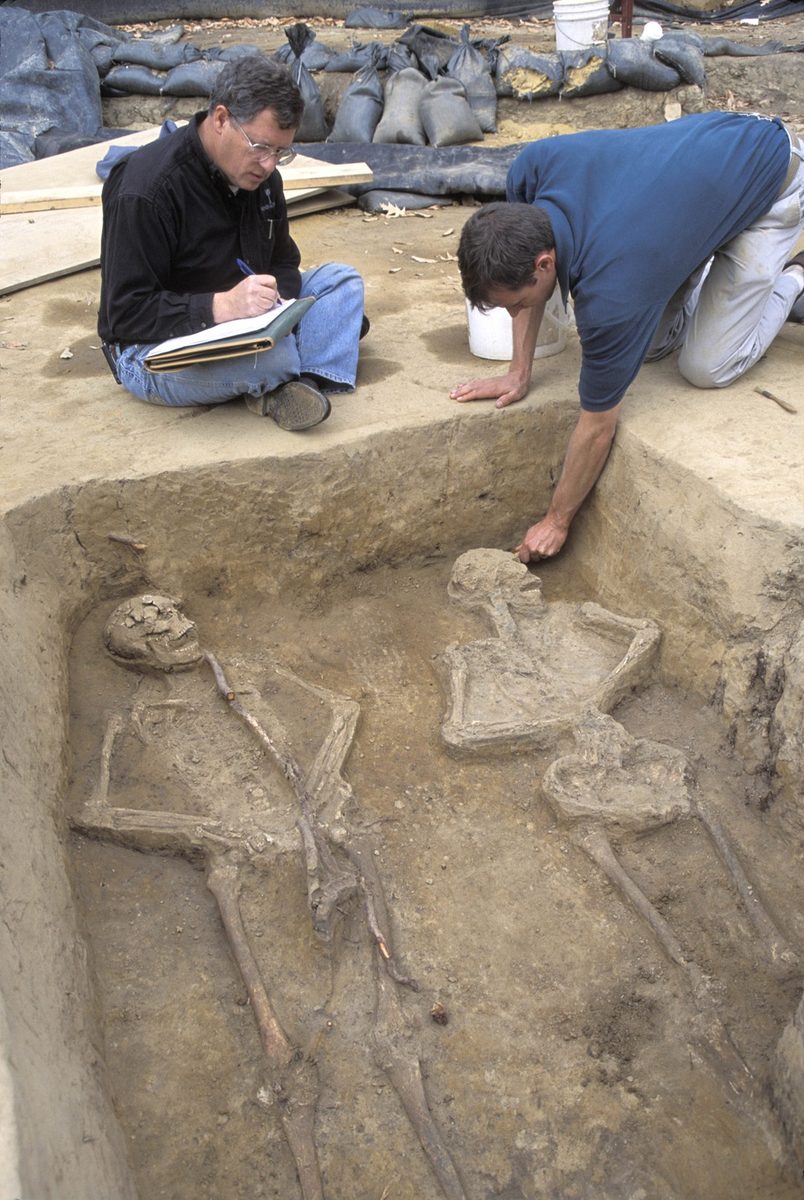
The Jamestown Pocket Sundial Nobody Could Use for Time
None of this necessarily means the dials were a waste of money or a careless mistake, and Jamestown’s own senior curator, Bly Straube, has made a case against reading it that simply. Her argument, laid out in Jamestown Rediscovery’s own account of the 2012 find, is that a diptych dial’s real value to a 17th-century owner may have been aesthetic and cosmological rather than narrowly practical — a small, finely made object that “simulated the heavens” and announced its owner’s wealth, education, and engagement with the new science of the age, independent of whether it told accurate local time. On that reading, a Jamestown colonist who owned one wasn’t necessarily disappointed that it ran wrong by an hour or more; he may have been carrying it for largely the same reasons people carry a fine pocket watch today, whether or not it keeps perfect time. That reading sits alongside, rather than erasing, the plain physical fact that these specific instruments were engraved for specific European cities and simply could not do the one job a sundial is supposed to do once they crossed an ocean.
What’s Left
Most of what survives of the James Fort dials today is fragments — a compass housing here, a hinge pin there, corroded ivory that has to be read with calipers and a dialing ruler rather than simply picked up and used. Complete, intact examples of the type do survive elsewhere, in museum collections built from the same Nuremberg trade that supplied Jamestown’s colonists in the first place, which is as close as it’s possible to get today to seeing what one of these objects actually looked like new, fully engraved and working, before any of them ever crossed the Atlantic to a latitude they were never built for.
Watch the short

Related reading
- The Kaleidoscope Patent That Failed Its Own Inventor
- Why Player Pianos Outsold Real Pianos in 1924
- Charles Babbage and the Organ Grinders He Hated
- Why Music Boxes Disappeared: Rise and Fall of an Industry
Works cited
- “Diptych Dial.” Historic Jamestowne, Jamestown Rediscovery. Link.
- “May 2012.” Historic Jamestowne, Jamestown Rediscovery dig updates. Link.
- “Ivory Diptych Sundial Unearthed at Jamestown.” North American Sundial Society. Link.
- Schechner, Sara J. “The Adventures of Captain John Smith, Pocahontas, and a Sundial.” 2007. Link.
- “Portable Diptych Sundial.” The Metropolitan Museum of Art, object 188849.