
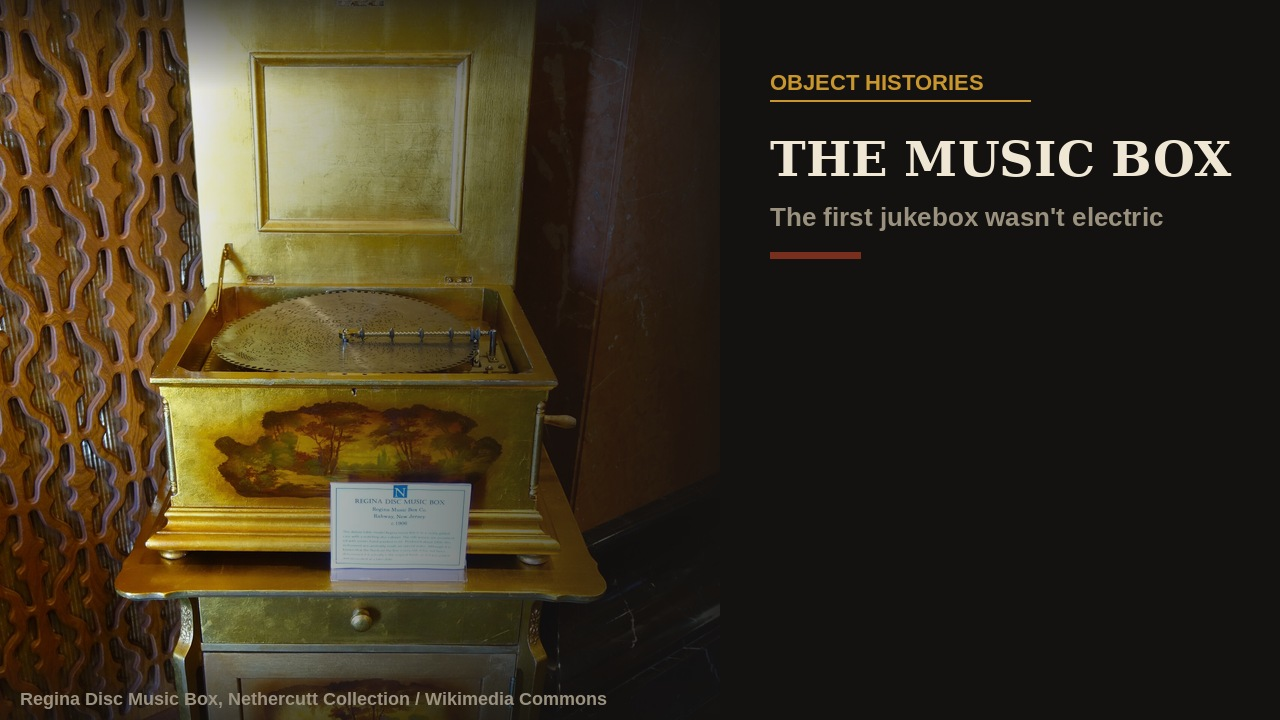
Why music boxes disappeared is really the story of a single American factory that went, in thirty years, from recognized market leader to total bankruptcy — and the honest answer is that a Geneva watchmaker’s small 1796 trick built an entire industry that one single invention, Thomas Edison’s phonograph, was always going to be able to out-compete. It just took a few decades for everyone involved to find that out the hard way.
A Geneva Watchmaker’s Pocket-Size Trick
In 1796, a Geneva watchmaker named Antoine Favre-Salomon had an idea: fit a tiny musical mechanism, a toothed steel comb plucked by pins on a rotating cylinder, inside a pocket watch. It worked, and it was small enough to carry. Geneva’s watchmaking trade had the exact tools and skills the idea needed, and within a few years the mechanism had outgrown the watch case entirely, becoming its own standalone object. By 1810, the Swiss town of Sainte-Croix, where farmers had long done precision piecework for watchmaking firms during the harsh mountain winters, had become the music box capital of the world, a concentration of manufacturers and parts suppliers that a 19th-century entrepreneur named Charles Reuge would formalize into his own company there in 1865.
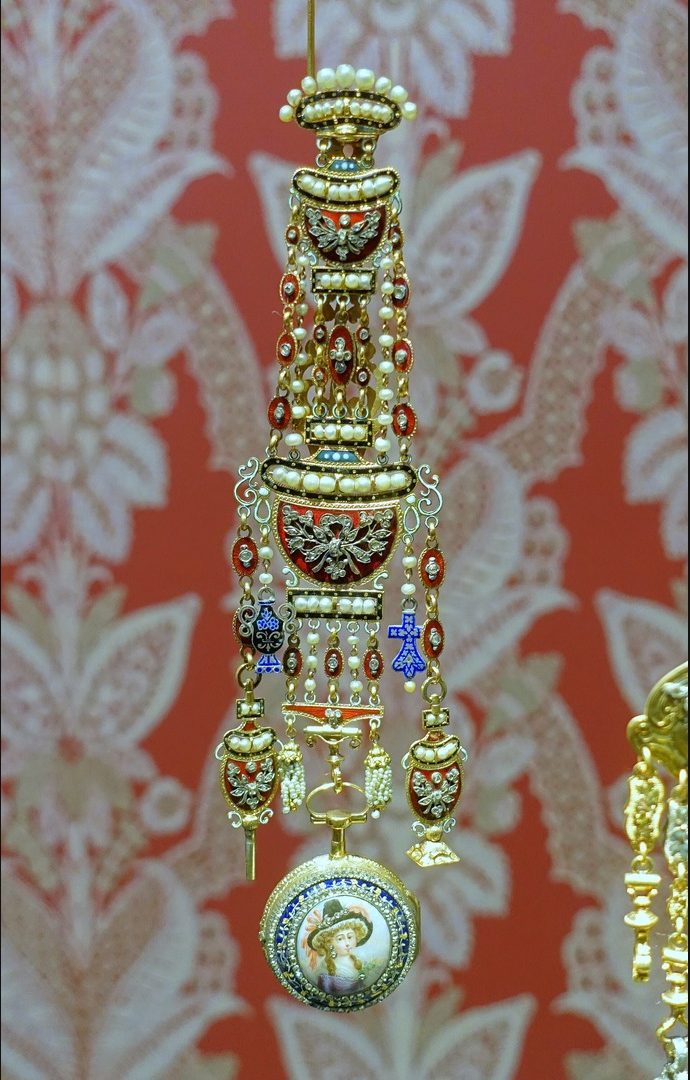
What made Sainte-Croix the right place for this to happen wasn’t luck. The town sat high in the Jura mountains, where farming alone couldn’t support a family through the long winter months, so local farmers had spent generations supplementing their income with contract piecework for the watchmaking houses down in the valleys, filing and assembling tiny components to exacting tolerances between harvests. That meant Sainte-Croix already had, by the time Favre-Salomon’s comb-and-cylinder idea needed somewhere to be built at scale, a whole regional workforce trained in exactly the kind of miniature precision mechanical work a music box demands. Manufacturers and specialist parts suppliers clustered there through the early 1800s for the same reason software companies cluster near engineering talent today, and by 1865, when Charles Reuge opened his own workshop in the town repairing and selling musical pocket watches, Sainte-Croix wasn’t becoming the world’s music box capital anymore. It already was one.
Germany’s Disc Revolution, and a Falling-Out
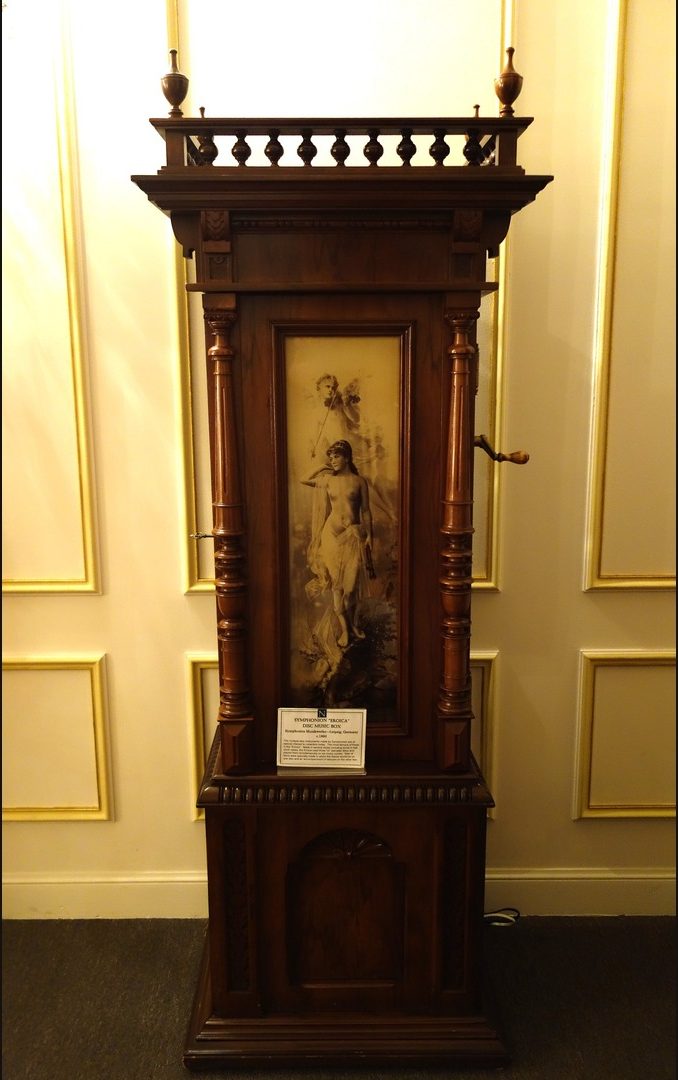
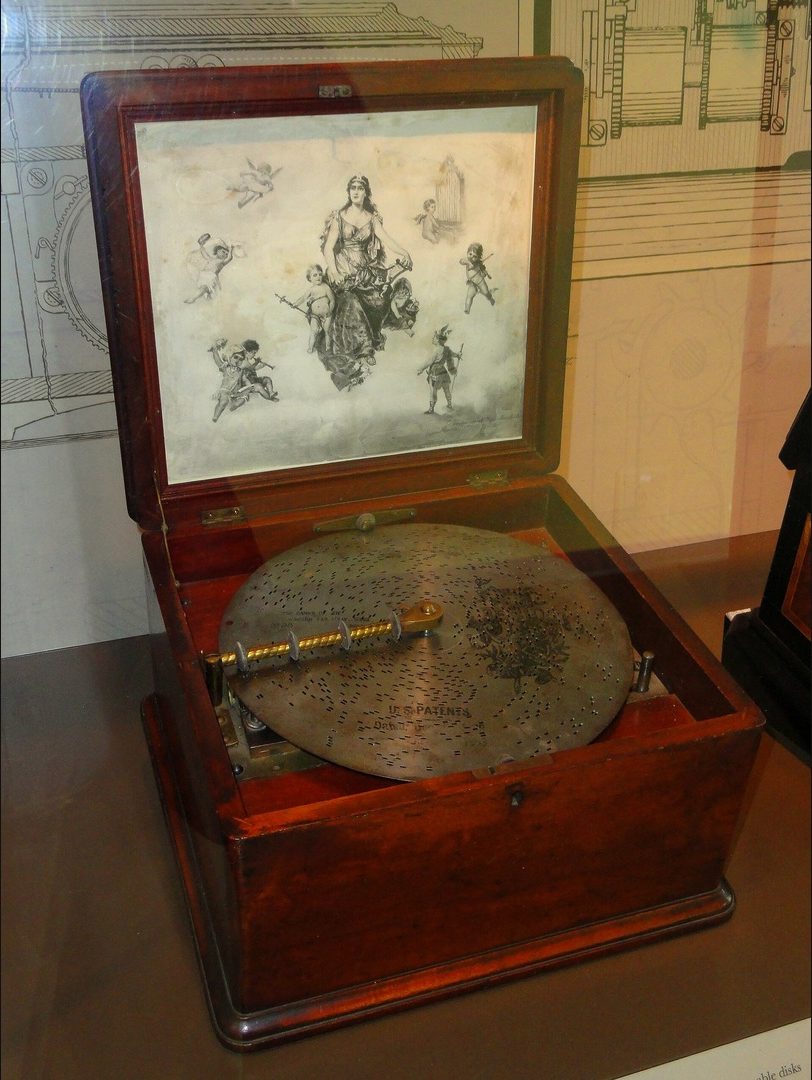
For most of the 19th century, music boxes played fixed tunes off a cylinder, which meant every new song required an entirely new, expensive cylinder. The decisive change came out of Leipzig, Germany, in 1885, when Paul Lochmann founded the Symphonion company with two partners, Gustave Brachhausen and Paul Riessner, and built what historians credit as the first disc-playing music box. A steel disc, stamped with projecting pins instead of engraved like a cylinder, was cheap to manufacture and easy to swap, and customers could now simply buy a new disc for a new song instead of a whole new machine. It should have been a straightforward success story. Instead, within about two years, Brachhausen and Riessner left Symphonion entirely and founded their own competing company, Polyphon, making nearly identical machines a short distance away in the same city. Exactly why they split isn’t fully documented, but the two firms spent the following years as direct Leipzig rivals, each selling steel-disc music boxes under their own name.
Brachhausen Crosses the Atlantic
In 1892, Gustave Brachhausen left Germany for the United States, bringing a Polyphon-style disc music box with him and setting up an operation in Jersey City, New Jersey, initially importing finished boxes and parts from the German factories. Steep American import tariffs made that approach expensive fast, so production shifted toward assembling imported movements into American-made cabinets, and the company, incorporated in 1894 as the Regina Music Box Company, grew quickly enough that by 1896 it had purchased its own manufacturing property in Rahway, New Jersey: a 25,000-square-foot building on Cherry Street that would remain Regina’s home for the rest of its run. By 1900 the company’s music boxes were being made entirely in America, no longer dependent on imported German parts at all.
Regina Becomes the Market Leader
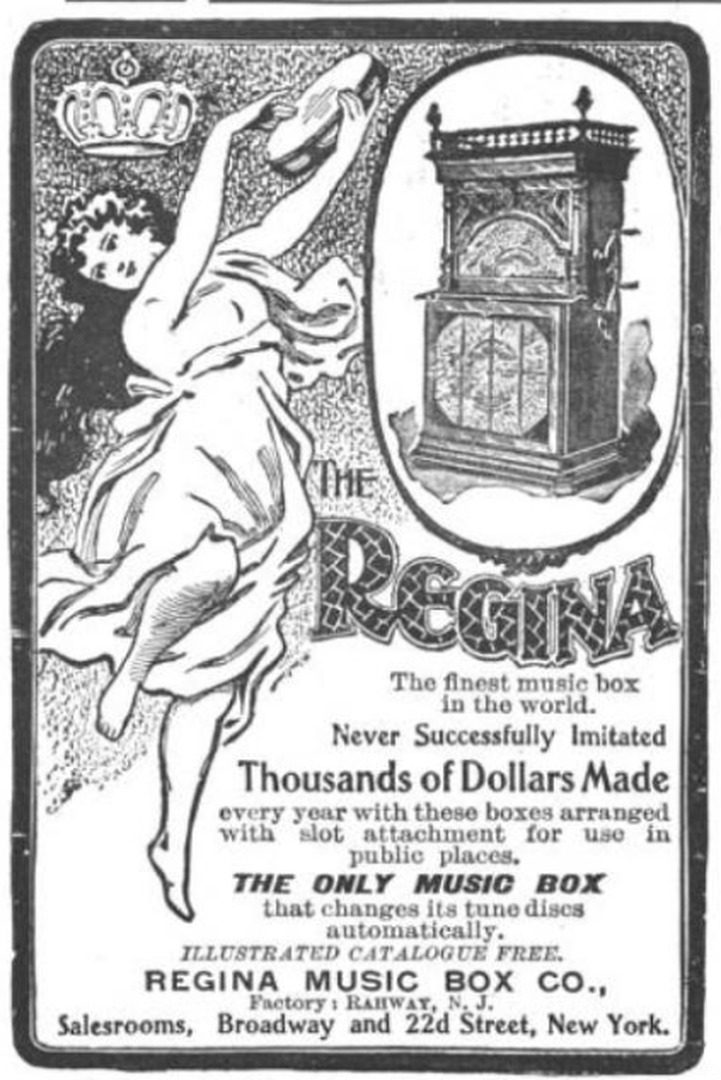
1896 was also the year Symphonion itself tried to enter the American market directly, and by that point Regina was already recognized as the industry’s leader here, a position its German rivals never managed to take away. Brachhausen kept innovating: in 1897 he patented an automatic disc-changing mechanism, branded as the Regina Corona, that let a single cabinet cycle through multiple discs without anyone touching it, a real convenience advance over hand-swapping a disc for every song. Regina also built a nationwide sales network by offering retailers and department stores a 50 percent wholesale discount, and ran its own service division to install and maintain the coin-operated models that showed up in saloons, drugstores, and ice-cream parlors across the country — the “slot attachment for use in public places” that period advertisements promoted directly. By the early 1900s the company employed more than 300 workers and reported annual sales above $2 million, and over its full run from 1892 to 1921 it shipped roughly 100,000 music boxes in total. In 1904, music boxes as a category were, by one period account, second only to pianos in total American sales — and the competition for that market, even at its peak, was already described as fierce.
The Business That Outlived Its Founder’s Fortune
The company’s name changed to “The Regina Company” around this time — sources give either 1902 or 1903 for the exact year — dropping “Music Box” from its name as it began hedging into other product lines. The shift didn’t go smoothly: in 1903, after a new product line failed, investors removed Brachhausen himself from day-to-day business administration, even though the company he’d built was still selling. He stayed connected to Regina’s fortunes in a different way afterward, eventually selling his remaining stock in the company in 1915 for roughly $1 million, worth something on the order of $31 million today. It didn’t last: by 1919, by one account, Brachhausen was broke and divorced, and returned to the company he’d founded as an ordinary worker. That personal collapse is a separate timeline from Regina’s own corporate one — the business itself, weakened but still operating, continued limping along for several more years afterward.
Edison’s Phonograph, and Why Music Boxes Disappeared
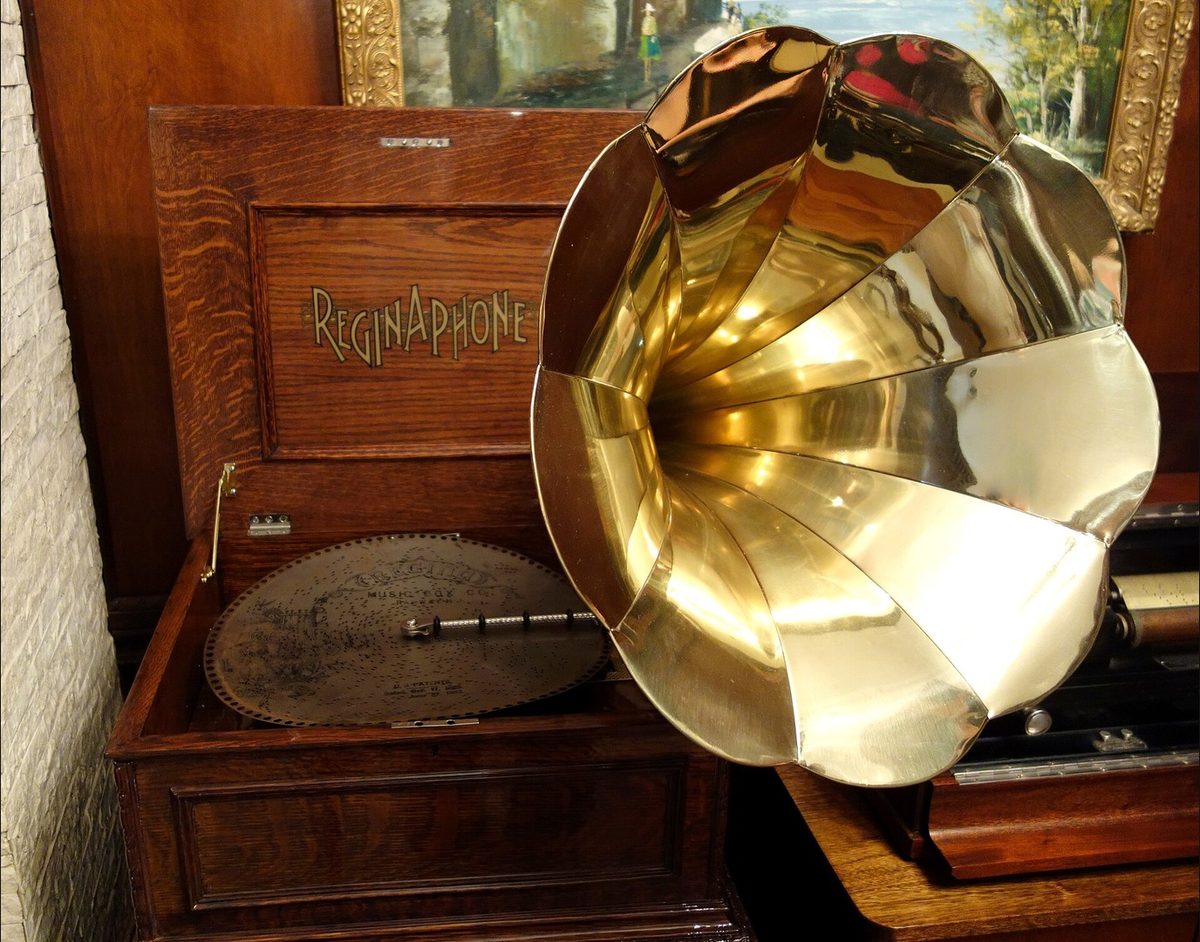
The machine that actually killed the disc music box industry wasn’t a rival music box maker at all. It was the phonograph, improving and cheapening year over year through the early 1900s, offering something no music box ever could: the actual recorded voices and instruments of real performers, instead of a steel comb’s approximation of a melody. Regina tried to hedge rather than concede the fight outright, building the Reginaphone, a single cabinet that could play both its own steel discs and standard phonograph records, alongside ventures into player pianos, coin-operated gambling machines, and hall clocks. None of it was enough. In 1921 the company made its most drastic pivot yet, diversifying into an entirely different product: the vacuum cleaner. The timing could hardly have been worse, and the diversification is remembered as a financial disaster rather than a rescue. The Regina Company filed for bankruptcy in 1922, selling off its product lines and emerging from the process worth only a fraction of what it had been.
None of this was really a failure of the product itself. A steel disc spinning a toothed comb was never going to out-argue a wax cylinder or a shellac record that could reproduce an actual human voice, and once that technology existed and got cheap enough for a middle-class parlor, the outcome for every company still built around pins and combs was never seriously in doubt. Regina didn’t lose to a smarter competitor working the same problem; it lost to a completely different problem being solved better, which is a harder kind of competition for a 300-person factory to out-engineer its way around, no matter how good its disc-changing mechanism was.
What Became of Regina
The Regina name didn’t disappear with the bankruptcy, though the music boxes did. The vacuum cleaner line that had been launched as a last-ditch pivot in 1921 survived the reorganization and kept the Regina name on American store shelves for decades afterward, manufacturing vacuum cleaners under its own name until the Oreck Corporation’s takeover in 1997. The music box side of the business, the thing Brachhausen had actually built his reputation on, was gone decades before that: by 1920, according to one contemporary account, music box manufacturers as a category had “essentially become ghosts,” replaced on parlor tables and in drugstore corners alike by a machine that could finally play back a real human voice. Back where the whole story started, though, the craft never fully died. Reuge, the Sainte-Croix firm Charles Reuge opened in 1865, grew into a full factory under his son Albert in 1886 and is still operating in that same Swiss town today, under new ownership since the independent watchmaker De Bethune acquired it in 2023 — more than two centuries after a Geneva watchmaker first decided a pocket watch could sing.
Watch the full history
The video below covers the full arc in more visual detail: the Geneva pocket-watch trick, the Leipzig split, and the Regina empire’s rise and collapse.

Related reading
- How the Mechanical Turk Worked, and Who Was Hiding Inside
- The Real History of the Fortune Teller Machine
- How Tarot Became Fortune Telling, 300 Years Later
- How Iceboxes Worked Before the Electric Refrigerator
Works cited
- “Our History.” Reuge S.A. Link.
- Hose, Ken. “A Brief History of the Symphonion Company.” Museums Victoria Collections, 2009.
- “The Curious Melodic Case of the Regina Music Box.” Collectors Weekly. Link.
- “Regina Music Box Company.” Musical Box Society International Collections (mus-col.com). Link.
- “Where Was It Made? Part XI: Music Boxes.” Postcard History. Link.
- “Regina Music Box Co.” Mechanical Music Digest Archives, 21 May 1998. Link.