
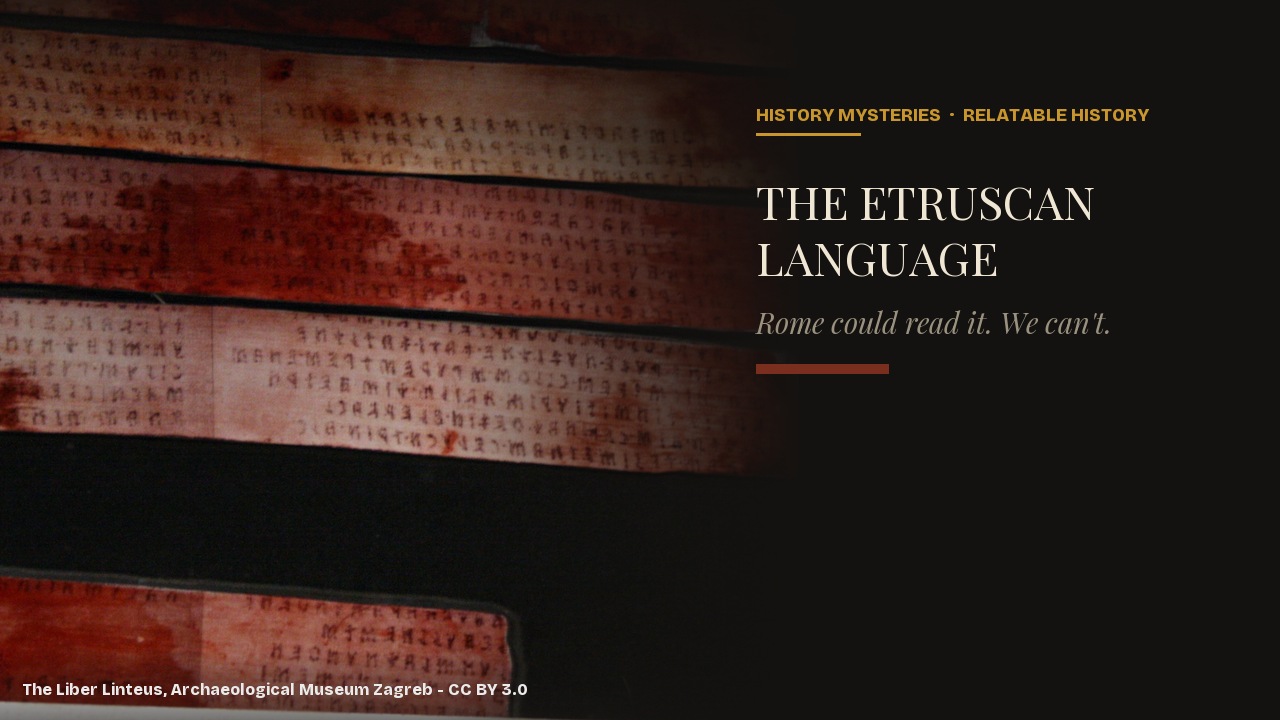
In May 2026 the Italian government agreed to pay fifteen million euros for a tomb. Not for the gold inside it — Etruscan tombs were stripped of anything valuable centuries ago — but for thirty-seven painted panels on its rock-cut walls, the closest thing the Etruscans left behind to an account of their own history in their own words. The tomb was found by accident in 1857 and had stayed in the same family’s hands ever since. This year, for the first time, the public gets to walk in and read it. What its painted captions say, and the far stranger place those same names turn up again three centuries later, is exactly where the overlooked evidence for the Etruscan language actually lives.
The standard introduction to Etruscan runs like this: a fully legible alphabet, handed down to Rome itself, wrapped around a body of inscriptions that mostly refuse to say anything beyond a name, a father’s name, and an age. That’s accurate, and it leaves out almost everywhere the language actually survives. It survives on a bronze monster’s hind leg. It survives on the backs of roughly three thousand hand mirrors, the majority of them owned and commissioned by women. It survives, very possibly, in two Latin words still sitting in an English dictionary. And in one remarkable case, it survives because a Roman emperor stood up in front of the Senate and repeated, point for point, a story the Etruscans had been telling about themselves for three hundred years.
None of this is in the handful of famous long texts usually rolled out to make the case that Etruscan is a mystery — and it’s a different kind of mystery than, say, the Phaistos Disc or the Voynich manuscript, where even the basic symbols remain contested. Etruscan’s alphabet was solved centuries ago. It’s the content that stayed locked. The evidence for how much of that content scholars have actually recovered starts with a roaring, three-headed bronze that has been on display in Florence since 1553.
The first piece of evidence for the Etruscan language: a bronze monster’s leg
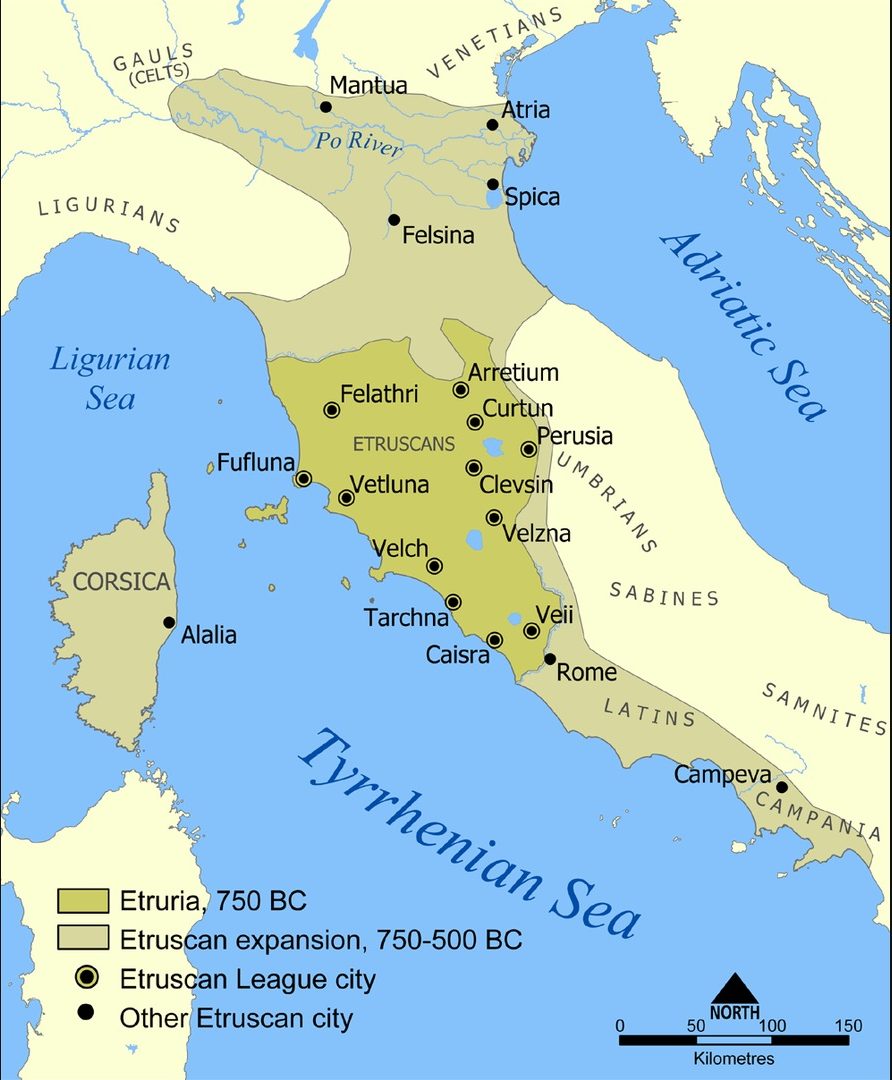
In 1553, workers digging fortifications for Cosimo de’ Medici outside Arezzo hit a buried trove of votive bronzes. One of them turned out to be the Chimera of Arezzo: a lion’s body, a goat’s head rearing from its spine, a snake for a tail, cast in the fifth or fourth century BC and still one of the most complete large Etruscan bronzes ever recovered. It is now the centerpiece of the National Archaeological Museum in Florence.
Scratched into its front right leg is a single word: tinscvil. Scholars read it as a dedication formula, roughly “gift to Tin” — Tinia being the chief god of the Etruscan pantheon, the rough equivalent of Jupiter. Whoever commissioned this enormous, expensive object wanted it on permanent record that it belonged to the god, not to them.
That one word is a better teacher than it looks. Etruscan inscriptions overwhelmingly follow a handful of fixed formulas: an object or a tomb announces who it belongs to, who made it, or who it’s dedicated to, very often using the first-person pronoun mi, “I.” A small terracotta oil flask shaped like a duck carries the inscription aska mi eleivana, mini mulvanike mamarce velchana — “I am an oil bottle, and Mamarce Velchana donated me.” A bronze mirror reads mi malena larthia puruhenas — “I am the mirror of Larthia Puruhena.” Neither sentence is complicated. Both are typical. Lined up by the thousand, repeating formulas like these are what let scholars work out Etruscan grammar without a single bilingual dictionary to check it against — building the language from the inside, from the position a word keeps occupying, rather than translating in from a relative. The first scholar to assemble the inscriptions into a systematic reference corpus built for exactly this kind of comparison was the Italian archaeologist Massimo Pallottino, whose 1954 Testimonia Linguae Etruscae set the model every later corpus, digital or printed, still follows.
The painting Italy just paid fifteen million euros to keep whole
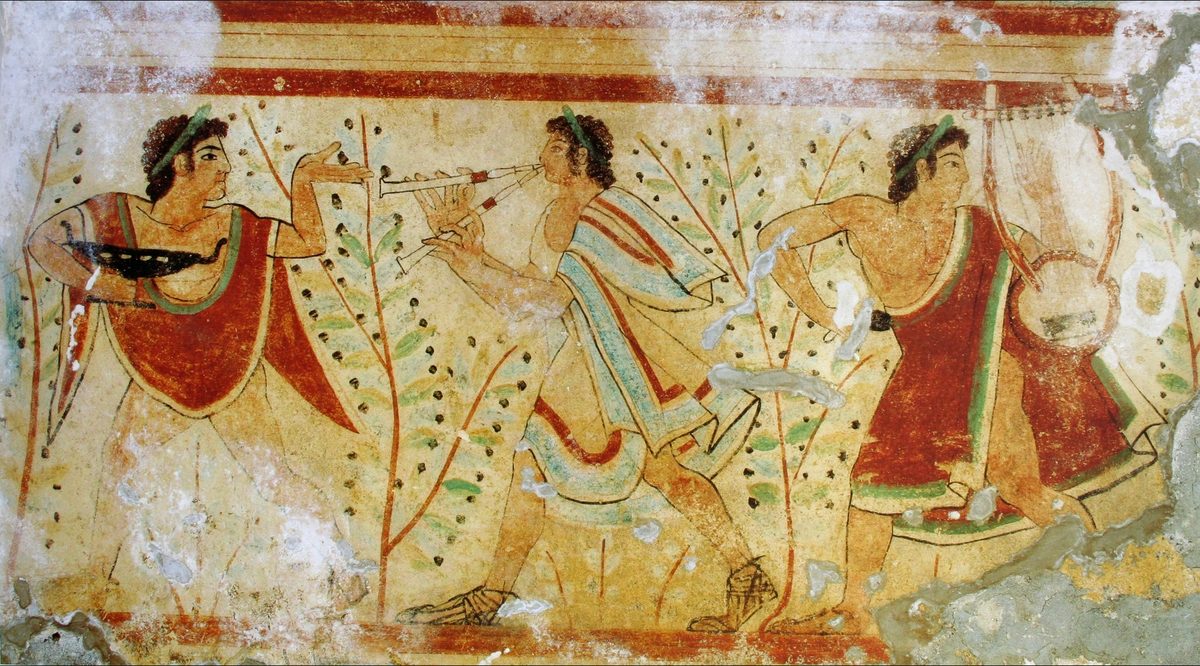
Alessandro François was excavating the Ponte Rotto necropolis at Vulci, on land belonging to Prince Alessandro Torlonia, when, on the first of May 1857, he broke into a tomb nobody had touched since antiquity. Cut into the tufa bedrock and dated to roughly 340 to 320 BC, it held thirty-seven painted panels — by far the most ambitious cycle of narrative painting to survive from Etruscan hands.
One wall shows the sacrifice of Trojan prisoners at the tomb of Patroclus, Achilles presiding, with the Etruscan death-demons Charun and Vanth looking on. The opposite wall shows something closer to home: the liberation of a man named Caile Vipinas by his brother Aule and by a third figure, labeled in paint as Macstarna. Each figure is captioned with its own name, in Etruscan, beside its head — a narrative tomb painting footnoting itself as it goes.
For a language whose other long texts are ritual calendars and property deeds, a captioned historical narrative — even a legendary one — is a genuinely different kind of evidence. It isn’t more grammatically useful than the ritual calendars; the captions are short. What it offers instead is context: proof that a wealthy Etruscan family in the fourth century BC was commissioning art about its own political history, with named Etruscan actors, for other Etruscans to recognize.
The tomb stayed in private hands — the Torlonia, Sforza Cesarini, and Gaetani families — for the next century and a half, on limited display in Rome. Italy’s culture ministry first tried to acquire it in 1921 and failed. The deal finally closed in May 2026, for fifteen million euros. Beginning 25 June 2026, the François Tomb goes on permanent public display at the National Etruscan Museum of Villa Giulia, with loans arriving from the Louvre, the British Museum, and the Vatican Museums for the opening exhibition. For the first time in a hundred and seventy years, reading Macstarna’s name off that wall won’t require a private invitation.
An emperor repeated the Etruscan version, word for word, in the Senate
The name Macstarna doesn’t stop at the tomb wall. It resurfaces almost three hundred years later, in bronze, in a speech delivered by the emperor Claudius to the Roman Senate in 48 AD — and this time, the text survives because Rome itself preserved it.
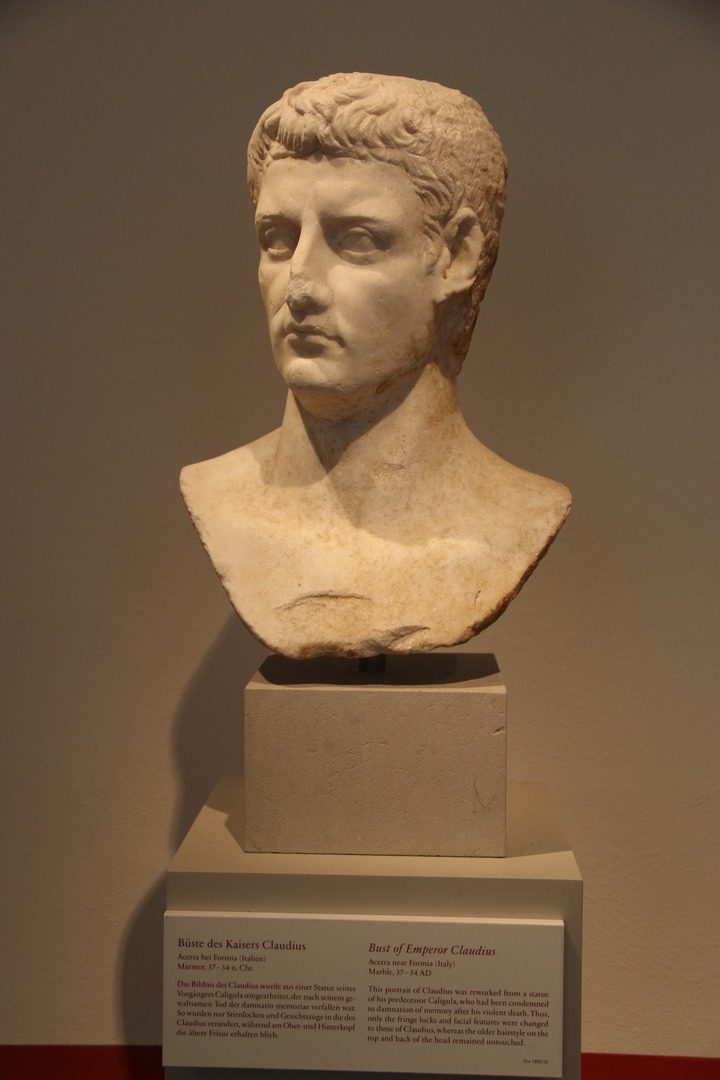
The speech is known as the Lyon Tablet, or Tabula Lugdunensis: two fragmentary bronze panels recording Claudius’s own address on who should be allowed to sit in the Senate. Partway through, arguing that Rome had always absorbed outsiders, Claudius brings up Servius Tullius, traditionally counted as Rome’s sixth king. The standard Roman account, he says, makes Servius the son of a captive woman named Ocresia. But, he goes on, if you follow the Etruscan sources instead, Servius was originally a companion of a chieftain named Caelius Vivenna — and after a reversal of fortune, he left Etruria with Vivenna’s surviving men, seized the hill later named for his friend, the Caelian, and changed his name. His Etruscan name, Claudius tells the Senate, had been Mastarna.
That is the same figure, the same rescue-after-defeat story, and very nearly the same spelling painted on the tomb wall at Vulci almost three centuries earlier. Claudius wasn’t inventing this — he had married into a family of Etruscan descent, and he treated the Etruscan tradition as credible enough to set against Rome’s own official story of one of its kings, in a speech to the body that governed Rome. A fresco in a private tomb and an emperor’s bronze-inscribed address turn out to be arguing the same case.
Three thousand mirrors, mostly owned by women
Tombs and temples produced the famous texts. Dressing tables produced the biggest body of evidence nobody talks about. More than three thousand Etruscan bronze mirrors survive, made across workshops at Vulci, Tarquinia, Cerveteri, and Chiusi between the late sixth and second centuries BC, and roughly three hundred of them carry engraved inscriptions.
A bronze mirror in the Metropolitan Museum of Art, made around 350 to 300 BC, shows a minor Etruscan goddess named Zipunu flanked by two attendant figures, each one labeled directly on the bronze: Zipunu herself, and the heroes Prucnas and Thalna. That labeling habit is routine on Etruscan mirrors, and it has done scholars an enormous favor. Mirror engravers overwhelmingly illustrated Greek mythology, but captioned it in Etruscan spelling: Aphrodite becomes Turan, Adonis becomes Atune. Every one of those captions is a small, checkable bridge between a myth everyone already knew from Greek sources and the Etruscan vocabulary for it.
The inscriptions do something else, too. Most name a woman — as owner, as the person the mirror was made for, or as the person who gave it as a gift, in the same mi formula as the Chimera’s dedication and the duck-shaped oil flask. Three hundred inscribed objects, overwhelmingly associated with women’s names, is treated by historians as meaningful evidence for female literacy in Etruscan society — a detail the funerary long texts, written for and about men’s political and religious lives, don’t preserve at all.
Two words you already know, maybe
Etruscan has no living descendants. It isn’t related, as far as anyone has shown, to any language spoken today. But a handful of Latin words have no good explanation inside the Indo-European family tree, and some of the leading candidates to fill that gap are Etruscan.
The strongest case is persona — “mask” in classical Latin, the term for the full-head masks worn by actors in Roman theater, long before it drifted into “person” and “personality.” One old theory derives it from Latin personare, “to sound through,” on the idea that a mask amplified an actor’s voice; the vowels don’t actually support that derivation. The competing proposal, over a century old now, is that it was borrowed from an Etruscan word, phersu, also meaning mask. Neither camp has fully won; one standard etymological reference simply has no entry for the word at all, which is its own kind of honest answer.
Atrium is the other candidate, and a shakier one. The Roman writer Varro floated an Etruscan origin two thousand years ago, and some modern linguists still prefer it to the Indo-European alternatives on offer, mostly because none of those alternatives is especially convincing either — one leading etymological dictionary concludes there is “no good alternative,” which is a different thing from calling the Etruscan theory strong. A full academic monograph on the subject, Margaret Watmough’s 1997 Studies in the Etruscan Loanwords in Latin, works through dozens of these candidates word by word, and the honest state of that scholarship is that most of them stay open questions rather than settled facts.
None of this — the bronze leg, the tomb wall, the emperor’s speech, the mirrors, the two disputed words — would make anyone’s shortlist if you asked for “the Etruscan texts.” That list belongs to the handful of long inscriptions that get photographed for every textbook. But almost none of the confirmed grammar, vocabulary, or mythology actually came from those. It came from thousands of short, formulaic, unglamorous objects saying, in effect, “I belong to so-and-so,” and from the rare moments an Etruscan text crosses paths with a Roman one and the two can be checked against each other — much the way research into the Indus Valley script or the Rohonc Codex keeps turning up more in the margins of those mysteries than in their single famous object.
New material of exactly that unglamorous kind is still surfacing. A thermal sanctuary excavated at San Casciano dei Bagni in Tuscany since 2018 has produced two dozen bronze votive statues and thousands of coins from altars inscribed in both Etruscan and Latin side by side — bilingual dedications from people who apparently used both languages without thinking it was remarkable.
The gap in the record hasn’t closed. Entire genres — the Etruscan plays, poems, and histories that Roman writers mention secondhand and then lose — are still gone, and nothing currently coming out of the ground is likely to bring any of them back. Which lost Etruscan book would you want returned?
Watch the full history
The video covers the long texts — the Liber Linteus, the Pyrgi tablets, and the rest of the famous corpus — that this article deliberately left in the background.

Related reading
- Why No One Can Read the Phaistos Disc — or Agree That It’s Real
- Why No One Has Ever Deciphered the Indus Valley Script
- Why Nobody Can Read the Voynich Manuscript
- Rohonc Codex Deciphered? Inside a 450-Page Mystery
Works cited
- Cartwright, Mark. “Chimera of Arezzo.” World History Encyclopedia, 13 January 2017. Link.
- Cartwright, Mark. “Etruscan Language.” World History Encyclopedia, 21 February 2017. Link.
- “Mirror with Zipunu, Prucnas, and Thalna.” The Metropolitan Museum of Art, accession no. 22.139.61.
- Cartwright, Mark. “Etruscan Bronze Mirrors.” World History Encyclopedia, 24 January 2017. Link.
- Claudius. Tabula Lugdunensis (Lyon Tablet), 48 AD, on Servius Tullius and Mastarna. Imperium Romanum, trans. Jakub Jasiński. Link.
- “Italy Buys Etruscan Treasure François Tomb for €15 Million.” Wanted in Rome, 29 May 2026. Link.
- Watmough, Margaret M. T. Studies in the Etruscan Loanwords in Latin. Biblioteca di “Studi Etruschi” 33. Leo S. Olschki, 1997. Link.
- Harper, Douglas. “person.” Online Etymology Dictionary.
- Harper, Douglas. “atrium.” Online Etymology Dictionary.
- Saraceni, Jessica Esther. “Bathhouse Yields Trove of Bronzes.” Archaeology, Archaeological Institute of America, 8 November 2022. Link.
- Balzan Foundation. “Massimo Pallottino — Bio-bibliography,” 1982 International Balzan Prize for Studies of Antiquity. Link.