
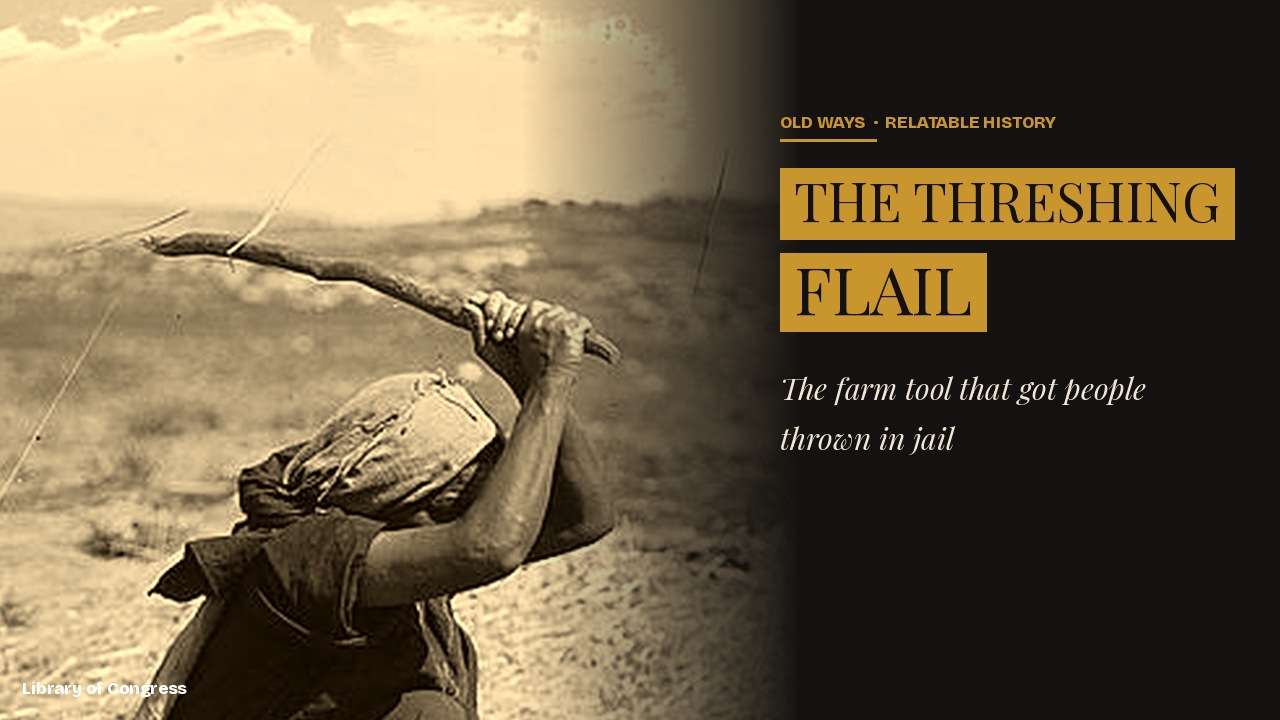
In the autumn of 1830, farm laborers across southern and eastern England spent their nights breaking into barns to destroy a machine. Courts in more than a dozen counties went on to try upwards of 1,900 people for offences connected to the unrest. Nineteen were executed. Five hundred and five were transported to Australia, some for life. Six hundred and forty-four were imprisoned. The machine they were destroying did one specific job: it beat grain loose from its husk, the same job a hand tool called a flail had already been doing, unmechanized, for well over a thousand years.
That hand tool is the subject of this article. It is two pieces of wood joined by a hinge of leather, swung overhead to crack a sheaf of wheat open without crushing the kernel inside. It has no moving parts beyond that hinge, almost no metal beyond an occasional iron cap to stop the wood from splitting, and for most of agricultural history it was the only method anyone had for threshing grain by hand. Its name was the flail, and by the time England’s threshing machines started multiplying in the 1820s, the tool had already outlasted the Roman Empire by close to a thousand years.
What follows is the mechanics of that tool — how it was built, how a threshing floor actually worked, what the job paid and who did it — and then the specific history of the machine that ended its working life, and the riot that tried to stop the machine instead.
A Hinge of Leather Made the Whole Tool Work
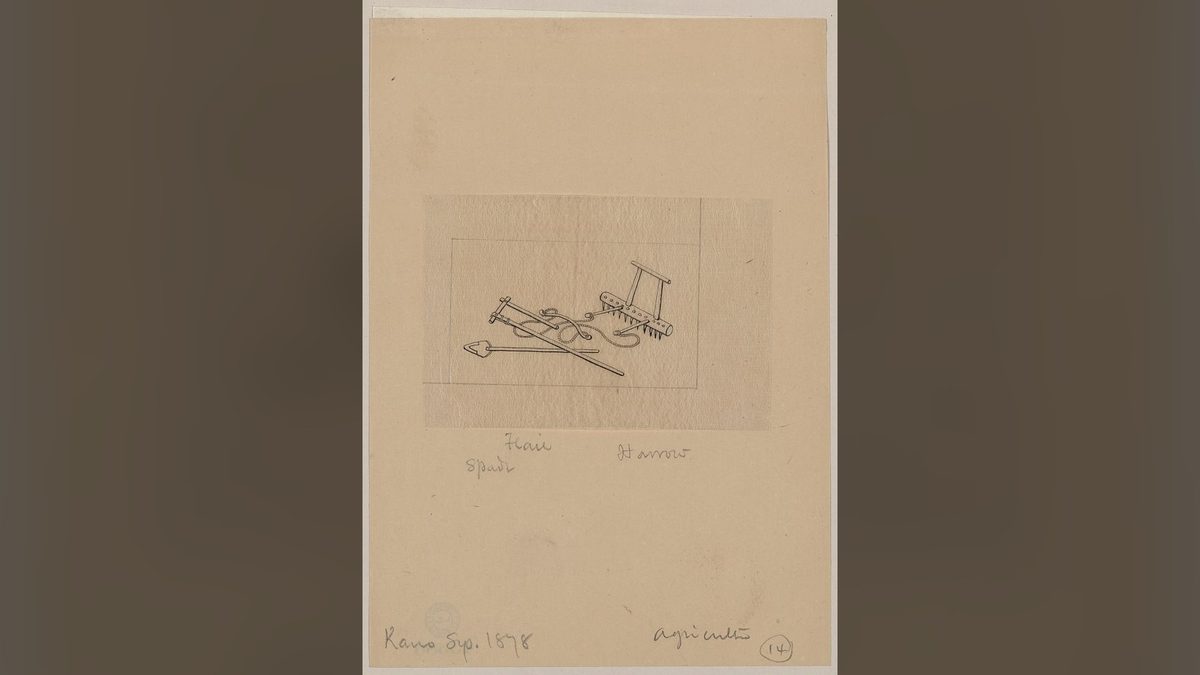
A flail is really two tools pretending to be one. The first piece is the handstaff: a straight wooden pole, commonly around four feet long and roughly an inch in diameter, which the thresher actually grips and swings. A surviving example in the National Museum Wales collection measures 1,298mm — a little over four feet — widening near its working end, where a cap of sheet iron is nailed on to keep the wood from splitting under the strain. The second piece is the swingle, also called the swipple in parts of England: a shorter, heavier length of wood, often cut from a denser timber such as holly or blackthorn so it could take the repeated impact.
The two pieces never touch rigidly. They are joined by a flexible coupling — traditionally a strip of leather or eel skin threaded through holes drilled in the end of each piece. That hinge is the entire trick of the design. A rigid pole just pushes grain around. A free-swinging head can flip over in mid-swing and land flat, which is exactly what is needed to crack a husk open without destroying the kernel inside.
Every farming region built its own version from whatever straight-grained wood was on hand, and every region had its own name for the result. The Pitt Rivers Museum’s English collections include a “swivel-flail” from Minster Lovell in Oxfordshire and “long-handled corn-flails” from farms in Cumbria, alongside the more familiar two-piece Sussex pattern. In parts of Ireland the same tool is still called a scutch; in German-speaking farm country, a dreschflegel. Museums that collect old farm tools tend to keep a whole shelf of them, and no two look quite alike, because the proportions were sized to the strength and reach of whoever was going to swing the thing.
Threshing Floors Were Built to Survive Years of Pounding
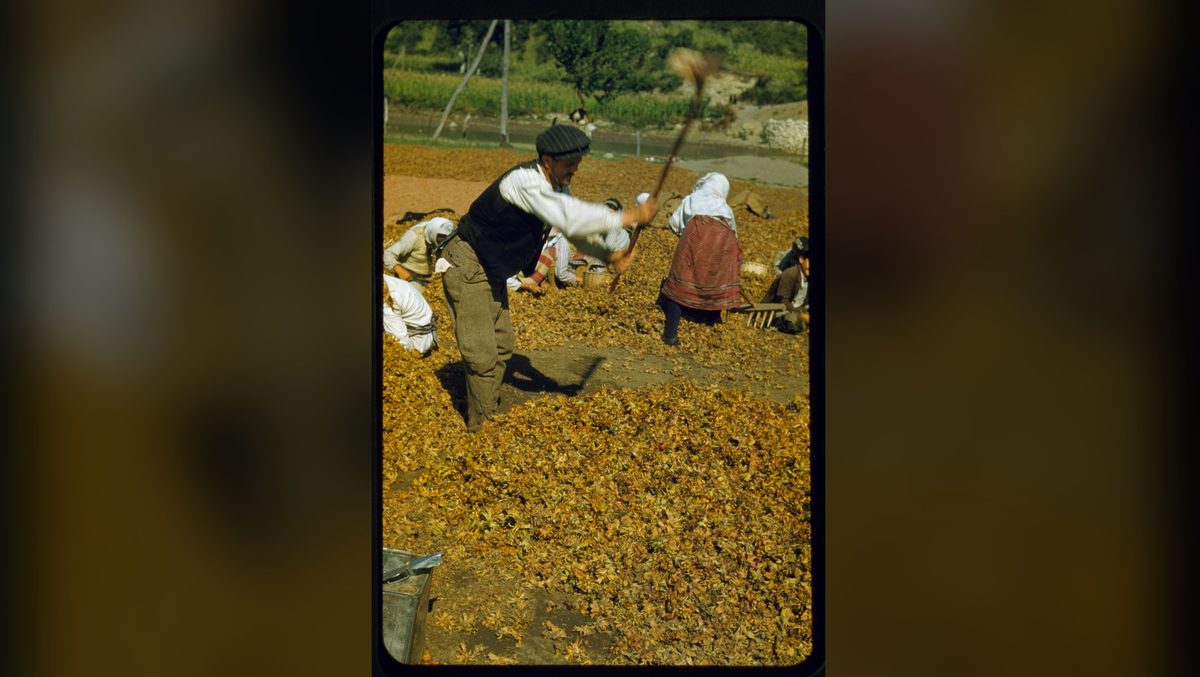
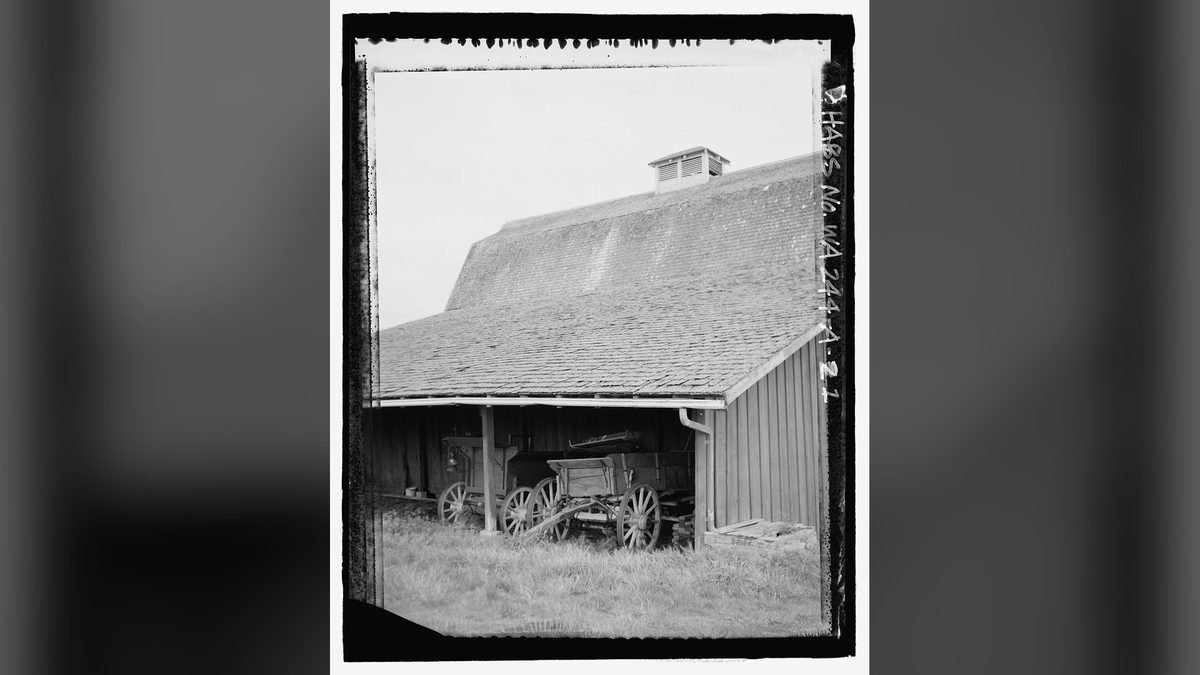
Grain came in from the field as sheaves — whole bundles of stalks with the kernels still locked inside the husk. Those sheaves were spread across a threshing floor, a hard, swept surface usually inside a barn built specifically to keep rain and wind off the grain while it was being worked. The floor itself was often the most carefully built surface on the farm: packed earth, sometimes finished with a mix of clay and ox blood to harden it against the pounding, or later laid in wood or stone, because any give in the floor wasted the force of every swing.
The thresher swung the handstaff overhead, and the loose leather joint let the swingle snap over and land flat across the stalks, cracking the husks open and knocking the kernels free. It took real skill. Hit it wrong and the swingle could bounce back and catch the thresher in the face, a hazard experienced farmhands warned beginners about constantly. On a large farm, four or five threshers often worked the same floor at once, falling into a rotating rhythm so each swing landed in the gap left by the one before it — a steady, overlapping beat that travelers sometimes wrote about hearing from a quarter mile off.
Threshing alone did not finish the job. What was left afterward was a mix of grain, broken straw, and chaff — the papery husks — all piled together and useless until separated. That came next, with a winnowing basket, or simply by tossing the mixture into a breeze and letting the wind carry the lighter chaff away while the heavier grain dropped straight back down.
Winter Threshing Was the Only Wage Many Laborers Could Count On
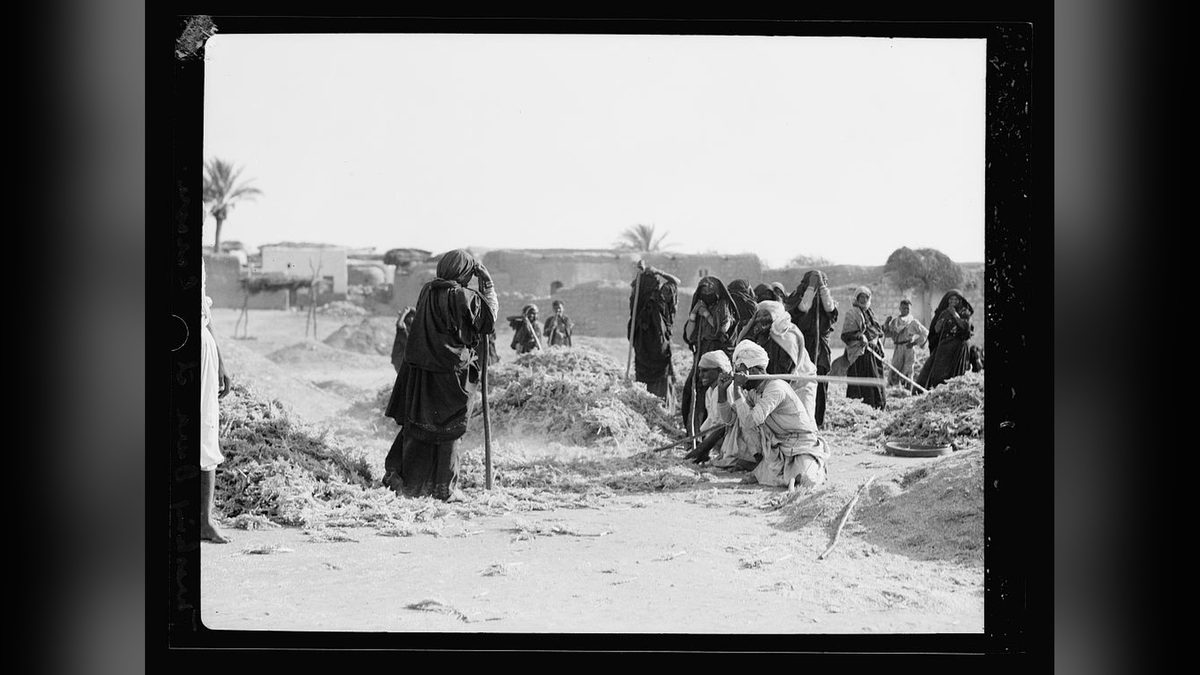
Threshing was not a one-afternoon chore. Grain came off the field in late summer and fall, but there was always more of it than a crew could thresh right away, so it sat stacked in the barn and got worked through gradually, over the winter, by whoever the farm could put on a flail. For hired farm laborers, that was the point: threshing was winter employment on farms that otherwise had no work to offer between the harvest and spring planting. The economic historian E. J. T. Collins, who studied harvest technology and labor supply in Britain between 1790 and 1870, documented just how much rural households depended on exactly this kind of off-season employment to get through the winter months.
The pace was demanding and the output modest by modern standards. By one commonly cited estimate from farm-history interpreters, a single worker swinging a flail more or less continuously could thresh around seven bushels — about 420 pounds — of wheat in a full day. A farm with hundreds of bushels to get through needed a crew working for weeks. Wages were sometimes paid by the bushel threshed rather than by the day, which meant a faster worker simply earned more, and farm families kept close count of exactly how much grain each person had beaten loose by the week’s end. Children were often set to the lighter job of winnowing while the adults flailed, and many barns built specifically for this work had large doors on opposite walls, lined up with each other, so that opening both created a through-draft useful for winnowing without waiting on an outdoor breeze.
It was loud, dusty, repetitive work, and on a working farm it was also inescapable: no flail meant no flour, no feed, and no grain to sell. The same slow season kept other hand labor going on the same farms — shelling corn kernel by kernel, or gathering for a corn husking bee once the ears themselves were in — and all of it ran on the same logic: the harvest produced more raw material than any one tool could process at once, so the processing became the winter’s actual job.
A Drum Machine Did in Minutes What Took a Crew Days
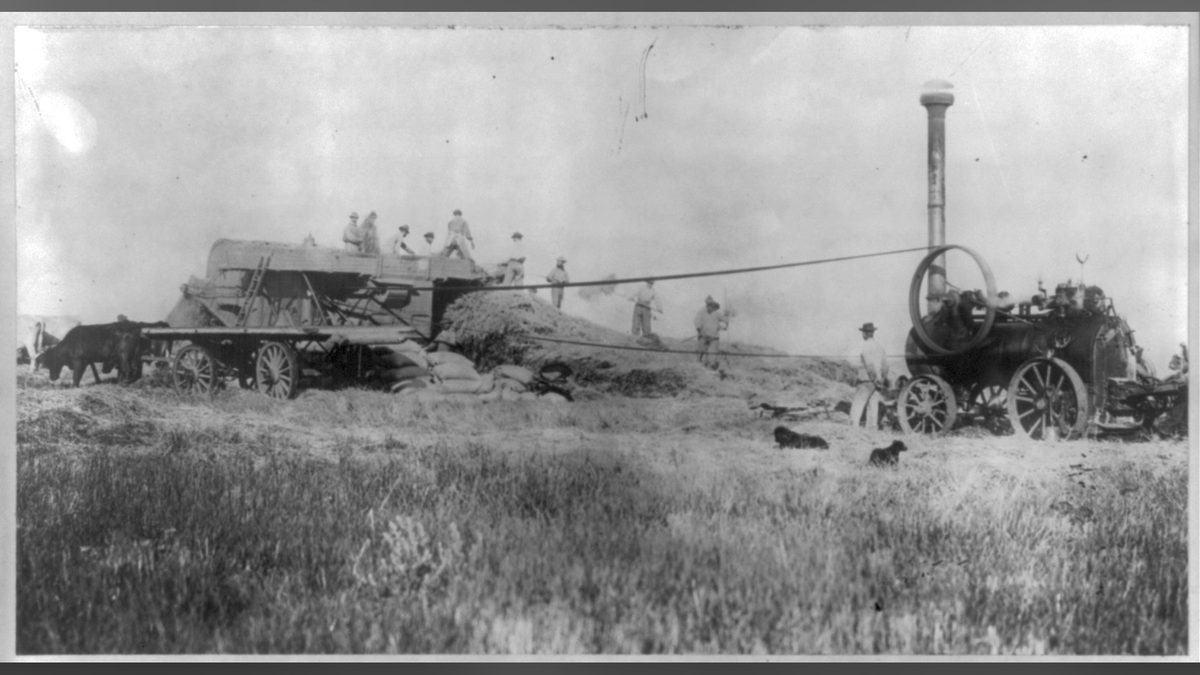
Hand-threshing with a flail is old enough that Roman writers were describing it as an established method two thousand years ago, and for nearly all of the time since, nothing replaced it. That changed in 1788, when Andrew Meikle, a millwright working at Preston Mill in East Lothian, Scotland, patented a mechanical threshing machine: a rotating drum that beat grain loose continuously as sheaves were fed into it, a job a flail crew took days to do by hand. According to National Records of Scotland, which lists Meikle among the country’s notable historical figures, the drum thresher was his single most consequential invention, built on earlier threshing experiments by other engineers but the first design that genuinely worked at scale — and yet it brought him little financial reward; by his final years he was reportedly dependent on friends for support.
The machine could be turned by water, by a horse walking in a circle, or, later, by steam, and it spread across the English countryside through the early 1800s wherever a farm could afford one. It should have been welcomed as a straightforward improvement. It was not.
Farm Workers Fought the Machines With Fire and Hammers
By the late 1820s, English agricultural laborers were already under serious pressure. The National Archives, in an education resource on the period, cites falling agricultural wages, poor harvests in 1829 and 1830, and an influx of Irish labor as background conditions, concentrated mainly in the east and south of England. Into that pressure came the threshing machine, which took away exactly the one source of income — winter threshing wages — that laboring families had been able to count on.
Starting in the late summer of 1830, farm workers across southern and eastern England began breaking into barns at night and smashing threshing machines, often leaving anonymous letters warning any farmer who installed one, signed with the invented name Captain Swing. The campaign, which historians Eric Hobsbawm and George Rudé documented in detail in their 1969 study of the unrest, spread through more counties than any previous English rural disturbance and became known as the Swing Riots. It is one of the earliest well-recorded cases of organized machine-breaking aimed specifically at protecting jobs from automation, rather than at any single landlord or local grievance.
The government’s response was severe. Special commissions tried more than 1,900 people, and the sentences handed down — 19 executions, 505 transportations to Australia, 644 imprisonments, by the National Archives’ own figures — remain among the harshest ever applied to an English labor protest. The riots did not stop the machines. Mechanical threshing was standard on any farm that could afford it within a few decades, and the flail quietly went from essential tool to relic.
The Flail Outlived Its Own Replacement, Just Barely
By the early twentieth century, combine harvesters could cut, thresh, and clean grain in a single pass across a field, finishing in an afternoon what a flail crew once spent an entire winter on. Even after the tool itself disappeared from working farms, the word it left behind did not: the verb flail, used to describe wild, uncoordinated swinging, is recorded in this looser sense from 1873, according to the Online Etymology Dictionary — drawn directly from watching, or trying, this exact motion.
It did not vanish everywhere at once, either. Small farms, poorer regions, and places mechanization reached late kept threshing grain by hand well into the early twentieth century. Other hand crafts the farm once depended on disappeared the same gradual way — the woven bee skep gave up its hive to a movable-frame box, the hand corn sheller gave way to powered shelling rigs — each one retired quietly once a machine could do the same job faster. According to Living History Farms, an outdoor agricultural museum in Iowa that still demonstrates the practice, a single worker with a flail could thresh roughly seven bushels of wheat in a day, a figure now quoted mainly to show visitors exactly how much the drum thresher changed. A few traditional farms and living-history sites still flail grain by hand today, on purpose, specifically to keep the skill from disappearing for good.
So here is the question worth sitting with: if the harvest came in this fall and there were no machine within a hundred miles, how many winter days would it take to get the grain out of the husk by hand — and how much would you expect to be paid for it?
Watch the full history
The video covers the tool’s construction and the basic mechanics of a threshing floor in about eight minutes; the riot gets only two sentences there, which is most of why this article exists.

Related reading
- How Corn Shellers Worked, and Why American Farms Needed One — another hand tool that did a season’s grain-processing work before machines took over
- The Real History of the Worm Fence — built by the same off-season farm labor the flail kept busy all winter
- What Finding a Red Ear of Corn Actually Meant at a Husking Bee — the social side of the farm’s other great grain-processing chore
- How Skep Beekeeping Worked Before the Movable-Frame Hive — another pre-industrial farm craft that machines eventually replaced
Shop the styles/items featured in this video:
Works cited
- Collins, E. J. T. Harvest Technology and Labour Supply in Britain, 1790–1870. PhD thesis, University of Nottingham, 1970. Link.
- Hobsbawm, E. J., and George Rudé. Captain Swing. Lawrence & Wishart, 1969.
- The National Archives (UK). “What caused the Swing Riots in the 1830s?” Education resources.
- National Records of Scotland. “Andrew Meikle (1719–1811).” Hall of Fame.
- Amgueddfa Cymru – National Museum Wales. Collections Online: flail, object 98.328, Social & Cultural History collection. Link.
- Pitt Rivers Museum, University of Oxford. “Analysing the English Collections: Harvesting Tools.” Link.
- Living History Farms. “Grain Harvest and Threshing Time.” Link.
- Harper, Douglas. “flail (n.).” Online Etymology Dictionary.